



FIX Tag 50 and Futures Trader Identification: The Exchange Audit Trail Explained
Overview #
Every electronic order placed on a futures exchange carries a hidden fingerprint. Buried inside the FIX message that transmits your trade from platform to exchange is a small but consequential field — SenderSubID, also known as FIX Tag 50. This is the field regulators use to answer the question: Who actually placed this trade?
Tag 50 is not a position tracking system. It does not measure how many contracts you hold. It is something more fundamental: an order-level identifier that links every individual electronic order to the specific human being or algorithmic strategy that originated it. When the CFTC investigates suspicious pre-announcement trading or potential market manipulation, Tag 50 is the trail they follow.
Understanding Tag 50 matters for anyone trading futures electronically — whether you are an institutional trader routing thousands of orders per second or a retail trader placing ten contracts through a broker platform. If your orders touch CME Globex, ICE Futures, or any major electronic futures exchange, Tag 50 is being recorded with every single one.
This article explains what Tag 50 is, how it works within the FIX protocol architecture, why exchanges require it, how regulators use it, and what compliance obligations it creates for trading firms and individual traders.
The FIX Protocol: Electronic Trading's Universal Language #
To understand Tag 50, you need to understand FIX — the Financial Information eXchange protocol. FIX is the standard messaging format that electronic trading platforms, brokers, and exchanges use to communicate buy and sell orders.
FIX was developed in 1992 by Fidelity Investments and Salomon Brothers to standardize how institutional traders communicated electronically. Before FIX, every broker and exchange had their own proprietary format — a fragmented, error-prone system. FIX unified the language of electronic trading and became the backbone of global financial markets.
FIX messages are structured as sequences of tag-value pairs separated by delimiters. Every piece of information in a FIX message has a numeric tag number:
- Tag 8 (BeginString): FIX version identifier, e.g.,
FIX.4.4 - Tag 35 (MsgType): Type of message —
Dfor New Order Single,Ffor Order Cancel Request - Tag 49 (SenderCompID): The ID of the firm sending the message
- Tag 50 (SenderSubID): The ID of the individual within that firm — this is the trader identifier
- Tag 56 (TargetCompID): The ID of the entity receiving the message (typically the exchange)
- Tag 55 (Symbol): The instrument being traded (e.g.,
ESM6for June E-mini S&P 500) - Tag 54 (Side): Buy or sell direction
- Tag 44 (Price): Limit price
Understanding Tag 50 matters for anyone trading futures electronically — whether you are an institutional trader routing thousands of orders per second or a retail trader placing ten contracts through a broker platform.
The combination of Tag 49 + Tag 50 is what creates a complete trader identity within a FIX message: Tag 49 identifies the firm, Tag 50 identifies the individual or strategy within that firm.
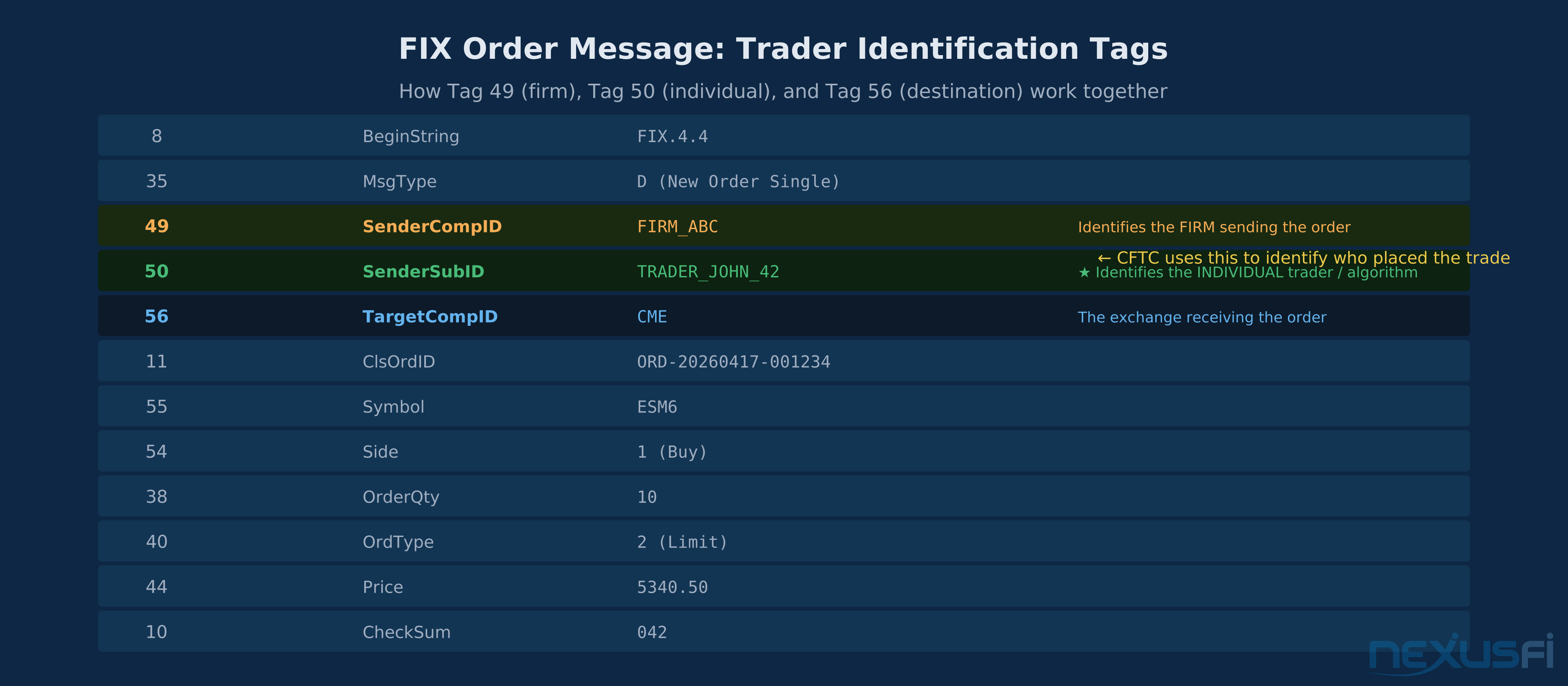
A retail trader placing a limit order for 5 ES contracts generates a FIX message flowing from their trading platform to their broker's order routing system and then to CME Globex. Somewhere in that message flow, Tag 49 identifies the broker-dealer (the FCM), and Tag 50 identifies either the retail trader's account or the individual placing the order.
Tag 49 vs Tag 50: Firm vs Individual Identification #
The distinction between Tag 49 (SenderCompID) and Tag 50 (SenderSubID) is fundamental to understanding how the audit trail works.
Tag 49 — SenderCompID (Firm Identity)
SenderCompID identifies the organization originating the order — the FCM, broker-dealer, or trading firm. Every firm has exactly one registered SenderCompID per connection to the exchange. CME Group assigns these identifiers when a firm establishes its electronic trading connection. ICE similarly maintains firm-level connection registrations.
When the CFTC wants to know which firm submitted an order, Tag 49 answers that. It narrows the field from millions of market participants to a specific licensed entity.
Tag 50 — SenderSubID (Individual/Strategy Identity)
SenderSubID identifies the specific person or algorithm within that firm. A large proprietary trading firm might have dozens of human traders, hundreds of algorithmic strategies, and thousands of automated systems all submitting orders under a single SenderCompID. Tag 50 disaggregates them.
The value of Tag 50 is entirely up to the firm to define — it is a free-form string that the order-submitting organization sets. Common conventions include:
- Human trader initials + desk code:
JSMITH_EQDESK1 - Algorithm name + version:
MOMENTUM_STRAT_V3 - System identifier:
MM_ES_PROD_SERVER2 - Account-based codes:
ACCT_12345_AUTO
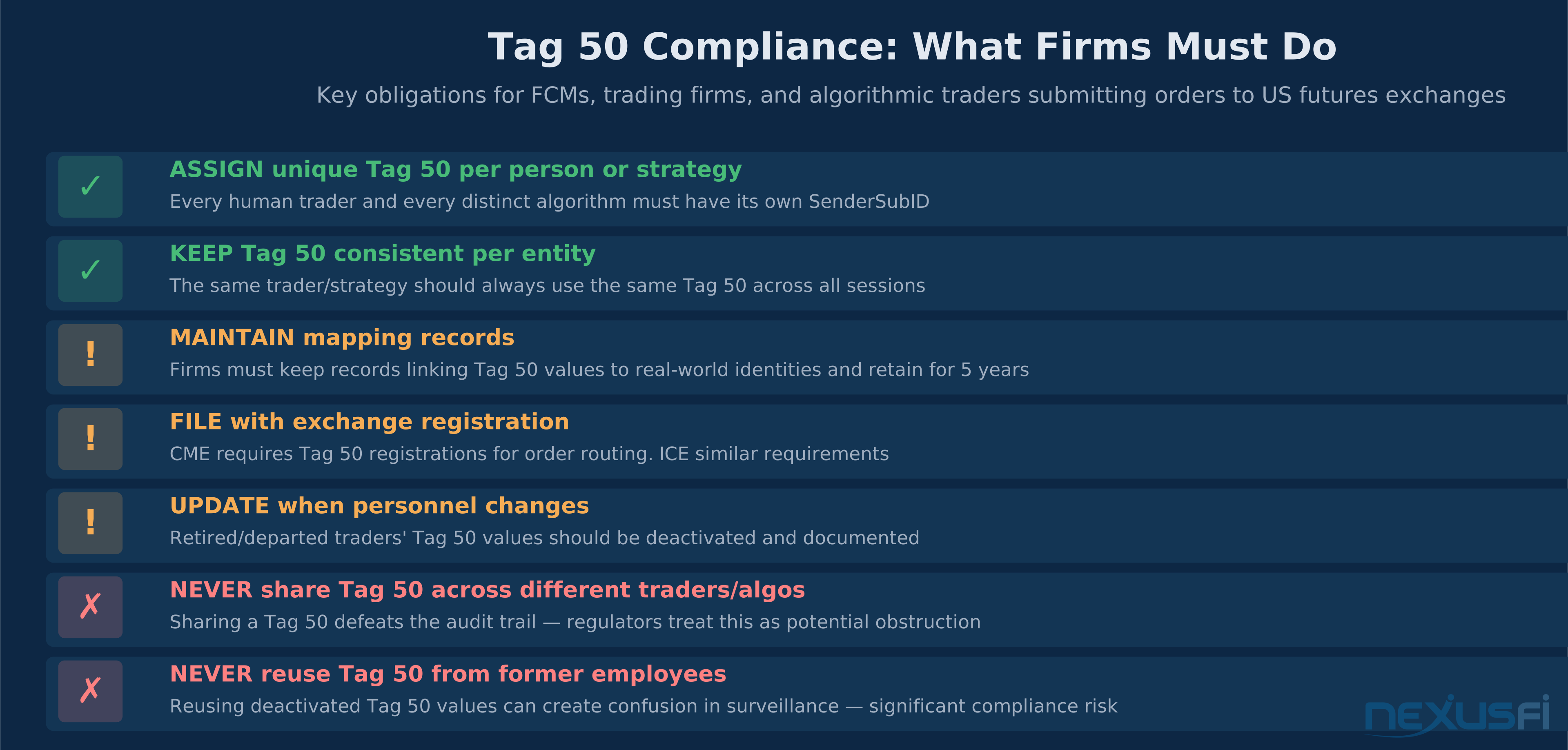
Crucially, the firm is responsible for ensuring every distinct trader and every distinct algorithmic strategy uses a unique, consistent Tag 50 value. This is not optional — it is a compliance obligation enforced by the exchanges and implicitly by the CFTC.
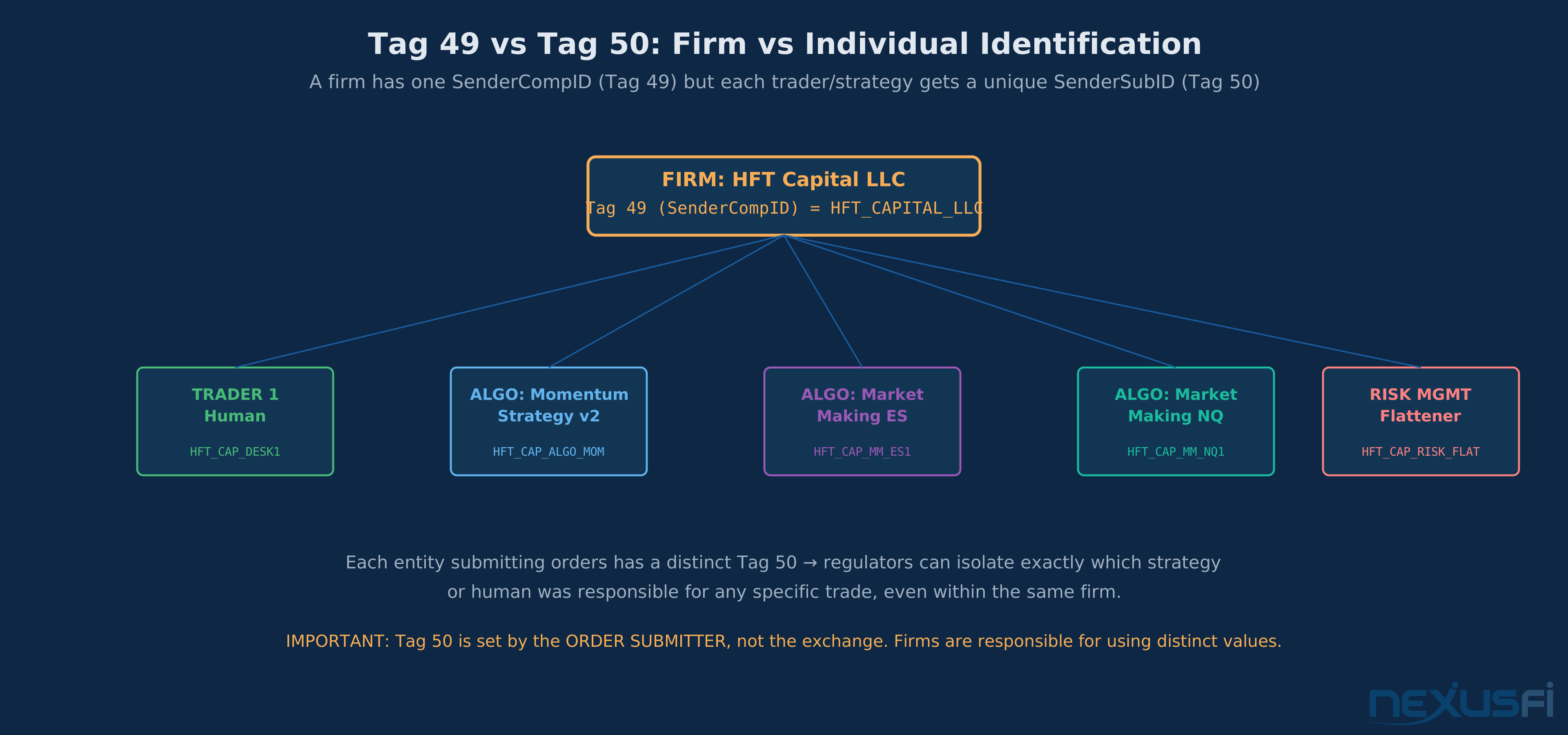
For retail traders accessing markets through a retail broker, the FCM typically assigns the Tag 50 value on your behalf. You may never see it, but it is there. Your retail account generates a unique sub-identifier within the FCM's system — that identifier is what gets embedded in Tag 50 when your orders hit the exchange.
How Exchanges Capture and Store Tag 50 Data #
CME Group and ICE — the two dominant US futures exchanges — both require Tag 50 on electronic orders submitted through their trading systems. This is not optional or a best practice recommendation. It is an exchange requirement, enforced at the technical protocol level.
CME Globex Architecture
CME Globex, the CME's electronic trading platform, processes over 3 billion messages per day. Every order entering Globex via the iLink 2 or MDP 3.0 protocol is logged with the full FIX header, including Tag 49 and Tag 50. These logs are immutable — they cannot be modified, deleted, or retroactively altered.
CME maintains these audit trail records for regulatory purposes. The CME Regulatory Services Division (CME RSD) has access to Tag 50 data and uses it for its own market surveillance. When the CFTC or another regulator requests audit trail data, CME produces it from these logs.
ICE Platform
Intercontinental Exchange operates ICE Futures U.S. and ICE Futures Europe. Like CME, ICE requires Tag 50 on electronic orders placed through its FIX gateways. ICE maintains complete audit trail data and cooperates with regulatory data requests.
ICE also runs its own market surveillance program using Tag 50 data. The combination of position data (from large trader reports) and order-level data (from Tag 50 audit trails) gives ICE significant surveillance capability.
What Gets Logged
For every order submitted to these exchanges, the following data is permanently recorded:
- The timestamp (to microsecond or nanosecond precision on modern systems)
- Tag 49: The submitting firm
- Tag 50: The submitting individual or strategy
- The full order parameters: instrument, quantity, price, order type, direction
- Order status changes: acknowledgments, partial fills, cancellations, rejects
- Execution data: fill price, fill quantity, counterparty data
This record is the backbone of market surveillance. It transforms the futures market from an anonymous venue into a fully auditable one.
The Audit Trail: From Order to Investigation #
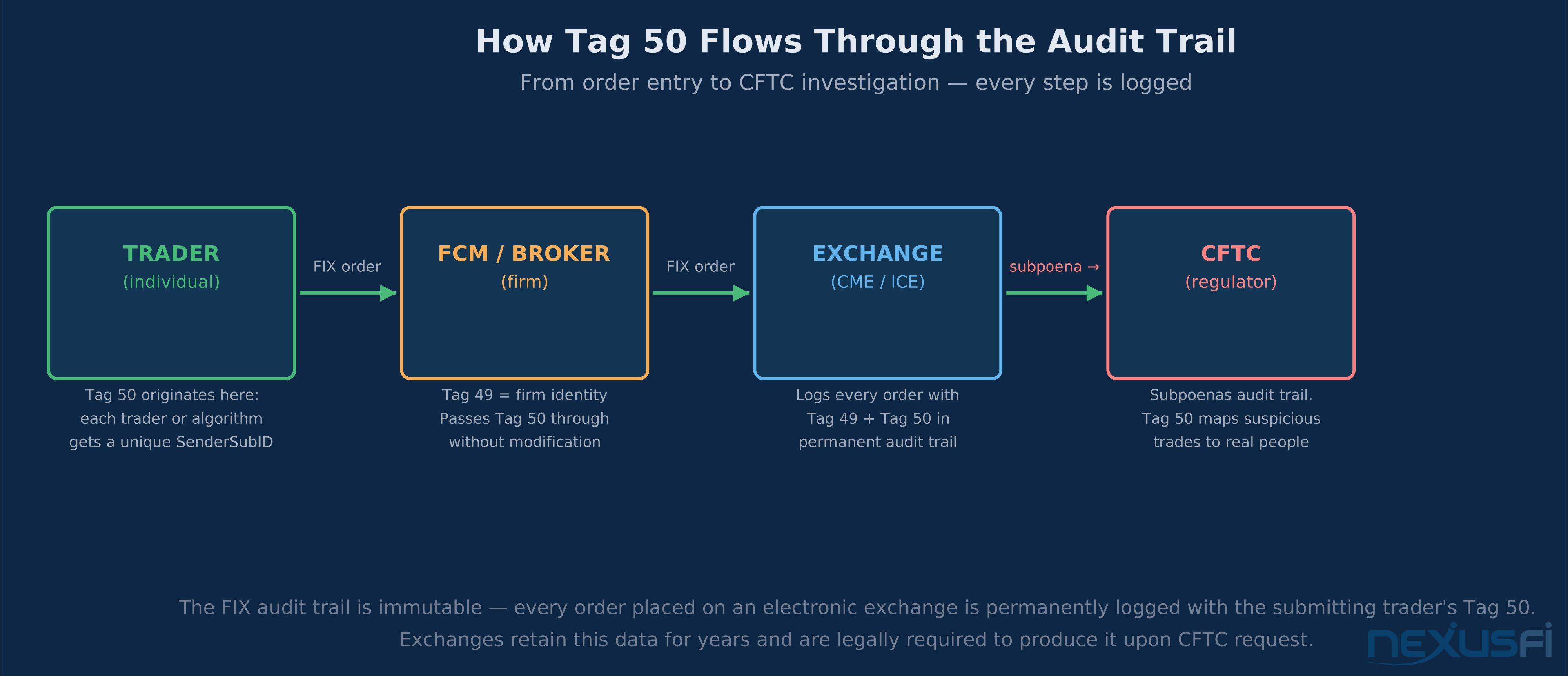
The regulatory power of Tag 50 lies in the complete audit trail it enables. When the CFTC opens an investigation into potential manipulation, insider trading, or pre-announcement trading, the following sequence unfolds:
Step 1: Pattern Detection
Regulatory surveillance systems — operated by both the exchanges and the CFTC directly — continuously analyze order flow patterns. Algorithms look for statistical anomalies: orders placed with unusual precision and timing relative to price-moving events, coordinated activity across multiple accounts, or position-building patterns that suggest foreknowledge.
Step 2: Initial Data Pull
When a suspicious pattern triggers, investigators pull the relevant FIX audit trail data from the exchange. They can query by time window, instrument, order size, or any other parameter. The data arrives as a structured dataset of orders, each tagged with Tag 49 (firm) and Tag 50 (individual/strategy).
At this point, investigators know exactly which firms and which sub-identifiers were involved in the suspicious activity. They know the order-level detail: when each order was placed, at what price, in what quantity, how it was modified, and how it was executed.
Step 3: KYC Mapping
Tag 50 values are strings assigned by firms — they are not naturally meaningful to an outside observer. The CFTC's next step is to serve data requests on the FCMs whose Tag 49 identifiers appeared in the suspicious activity. These requests demand the FCMs provide their Know Your Customer (KYC) records that map Tag 50 values to real-world identities.
Every FCM and registered trading firm is required by law to maintain records identifying the natural persons and entities behind every Tag 50 value they issue. These records must be retained for a minimum of five years. When the CFTC requests them, the FCM must produce them.
Step 4: Identity Resolution
The mapping from Tag 50 to real-world identity is typically straightforward: the FCM's internal records link the sub-identifier to a person's name, employer, and trading account. For algorithmic strategies, the mapping leads to the strategy owner and the technical team responsible.
Now investigators have transformed a pattern of suspicious orders into a list of named individuals and entities. From here, the investigation proceeds through subpoenas, depositions, and evidence gathering in the conventional manner.
Step 5: Enforcement
The CFTC's enforcement division can bring charges for manipulation, spoofing, wash trading, insider trading, or pre-announcement trading. Tag 50 data is a central piece of evidence — it directly links named defendants to specific orders at specific times.
Large Trader Reporting and Tag 50: Two Different Systems #
It is worth clarifying how Tag 50 relates to the CFTC's Large Trader Reporting System (LTRS), which requires traders exceeding certain position thresholds to file Form 40 reports. These are two distinct systems that work at different levels:
Large Trader Reporting System (LTRS)
- Level: Position-level (end-of-day aggregate positions)
- Trigger: Exceeding reportable levels (varies by commodity — e.g., 25 contracts in some markets, hundreds in others)
- Mechanism: Daily position reporting via FCMs to CFTC
- Purpose: Monitor concentration risk, potential market manipulation through size
- Data: Who holds what, in aggregate, at end of day
Tag 50 / FIX Audit Trail
- Level: Order-level (every individual electronic order)
- Trigger: Every electronic order, regardless of size
- Mechanism: FIX protocol, captured by exchange on every order
- Purpose: Track who placed each individual order, when, and at what price
- Data: Granular order-by-order attribution to specific traders/strategies
A trader below the large trader reporting thresholds still has their orders tagged with Tag 50. A large trader required to file Form 40 reports also has every order tagged. The systems are complementary: LTRS tells regulators who holds big positions; Tag 50 tells regulators exactly who placed which orders building (or liquidating) those positions.
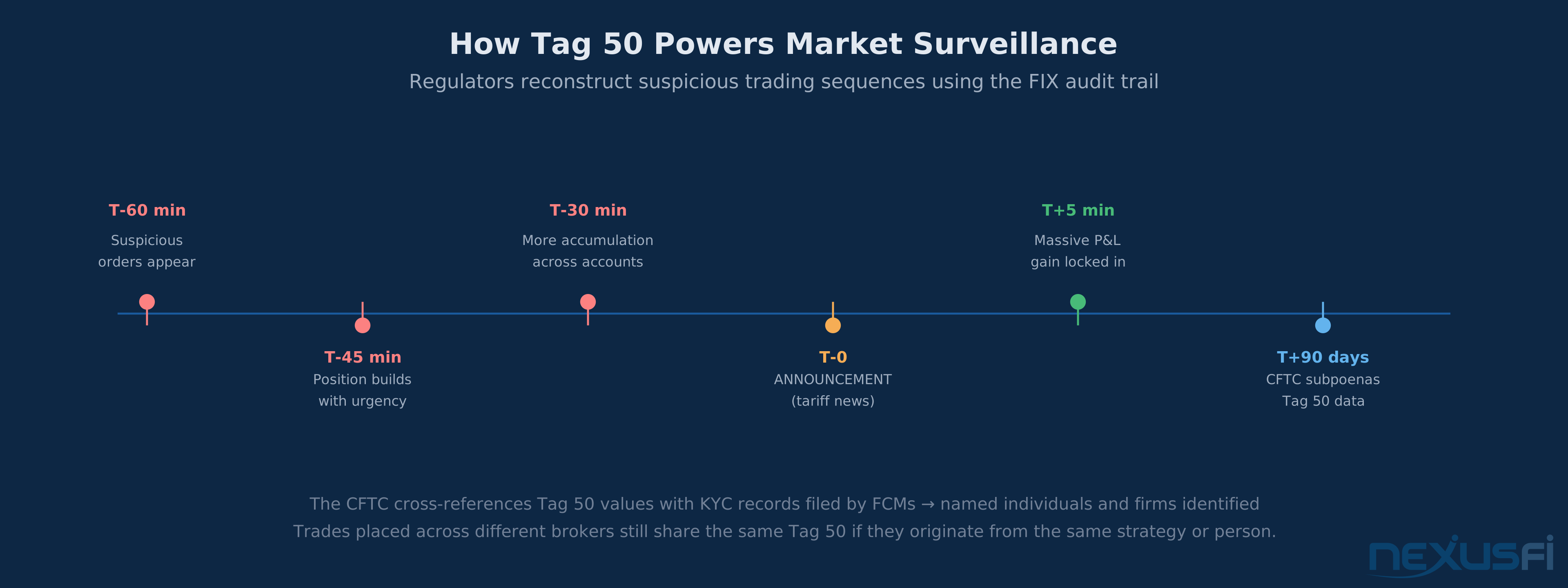
The combination of the two systems is powerful: if a large trader's Form 40 filing shows a sudden large long position in oil futures, investigators can pull the FIX audit trail and reconstruct, order by order, exactly how and when that position was built. They can then compare the timing against public information events to assess whether the activity was legitimate or suspicious.
Tag 50 in Practice: What Retail Traders Need to Know #
Most retail traders trading futures through a retail broker or FCM never directly interact with Tag 50. The FCM handles it on your behalf. But there are practical implications to understand.
Your Tag 50 is assigned by your FCM
When you open a futures trading account with a broker like Interactive Brokers, Tradovate, TD Ameritrade, or any other FCM, the broker registers your account and assigns internal identifiers. When your orders flow through their routing system to CME or ICE, the FCM embeds a Tag 50 value in the FIX message that links your order to your account.
You cannot choose your own Tag 50 when trading through a retail broker. It is a back-office function managed entirely by the FCM.
Your orders are permanently attributed to you
Every futures order you place electronically is permanently logged with your identity (via your FCM's internal KYC records mapped to Tag 50). There is no anonymity in electronic futures trading. If you ever engage in conduct that triggers regulatory scrutiny — even inadvertently, by trading in a pattern that resembles manipulation — investigators can trace the orders to your account.
Multiple accounts, multiple Tag 50 values
If you have accounts at multiple FCMs, each FCM assigns its own internal Tag 50 to your orders. However, investigators can connect these by cross-referencing your KYC records across firms. "Spreading" activity across multiple brokers does not provide anonymity.
Third-party systems and automated trading
If you use a third-party automated trading system — an EA on MetaTrader, a strategy on NinjaTrader's automated trading, or a custom API system — those orders still carry a Tag 50 assigned by your FCM. The fact that a machine placed the order does not break the regulatory attribution. Your FCM knows which automated system was running under your account credentials.
Tag 50 for Institutional Traders and Algorithmic Trading Firms #
For institutional traders, prop shops, and algorithmic trading firms, Tag 50 compliance is an active operational responsibility.
Assigning Tag 50 Values
Large trading operations typically maintain a registry of Tag 50 assignments. Every human trader who submits electronic orders gets a distinct Tag 50. Every algorithmic strategy gets its own Tag 50 — often including version information so that a new version of a strategy gets a new identifier.
This granularity is important for internal risk management as well as regulatory compliance. If a rogue algorithm causes a fat-finger error or unusual market impact, the firm needs to be able to identify which strategy was responsible by examining the audit trail internally. A well-managed Tag 50 registry makes this instant; a poorly managed one makes it a forensic challenge.
Compliance Obligations
Firms submitting orders to CME and ICE have several Tag 50-related obligations:
Registration: FCMs and firms may be required to register their Tag 50 values with exchanges. CME maintains registration processes for order routing and Tag 50 assignments.
Record retention: The mapping between Tag 50 values and real-world identities (persons and strategies) must be retained. CFTC Rule 1.31 requires records to be kept for five years, with the first two years in an accessible, readily retrievable format.
Consistency: The same trader or strategy should always use the same Tag 50. Changing Tag 50 values without reason creates confusion in audit trails and may raise regulatory questions.
Non-sharing: Two different traders or strategies must not share a Tag 50. This defeats the audit trail and is a compliance violation.
Risk of Non-Compliance
Using inconsistent, incorrect, or shared Tag 50 values does not make orders untraceable — it creates inconsistencies that attract scrutiny. Regulators have sophisticated tools to identify cases where Tag 50 usage appears irregular. Non-compliance with Tag 50 requirements can result in exchange sanctions or regulatory penalties.
Global Context: Trader Identification Beyond the US #
The FIX Tag 50 requirement at US futures exchanges is part of a broader global movement toward order-level trader attribution. Different jurisdictions have implemented this concept in different ways:
MiFID II (Europe)
The EU's Markets in Financial Instruments Directive II, effective January 2018, includes detailed requirements for transaction reporting that identify the trader (for human decisions) or the algorithm (for algorithmic decisions) responsible for each transaction. MiFID II Article 26 requires investment firms to include decision-maker codes in trade reports submitted to national regulators. While MiFID II uses a different technical framework than FIX Tag 50, the regulatory intent is identical: every trade must be attributable to a specific responsible party.
Consolidated Audit Trail (CAT) — US Equities
The Consolidated Audit Trail, mandated by the SEC for US equity markets, creates an order-level audit trail similar to what FIX Tag 50 provides for futures. CAT captures every order and execution in US equities and options, linked to the customer accounts and market participants responsible. The CAT and FIX Tag 50 together mean that the vast majority of US financial market activity is now subject to order-level attribution.
ASIC Market Integrity Rules (Australia)
The Australian Securities and Investments Commission's Market Integrity Rules require electronic order attribution. Australian exchanges including ASX accept FIX orders and require participant identification consistent with the global FIX standard.
SEBI (India)
The Securities and Exchange Board of India requires unique client codes on futures orders placed on NSE and BSE. While using different technical mechanisms than FIX Tag 50, the principle is the same: every order must be attributable to a specific client.
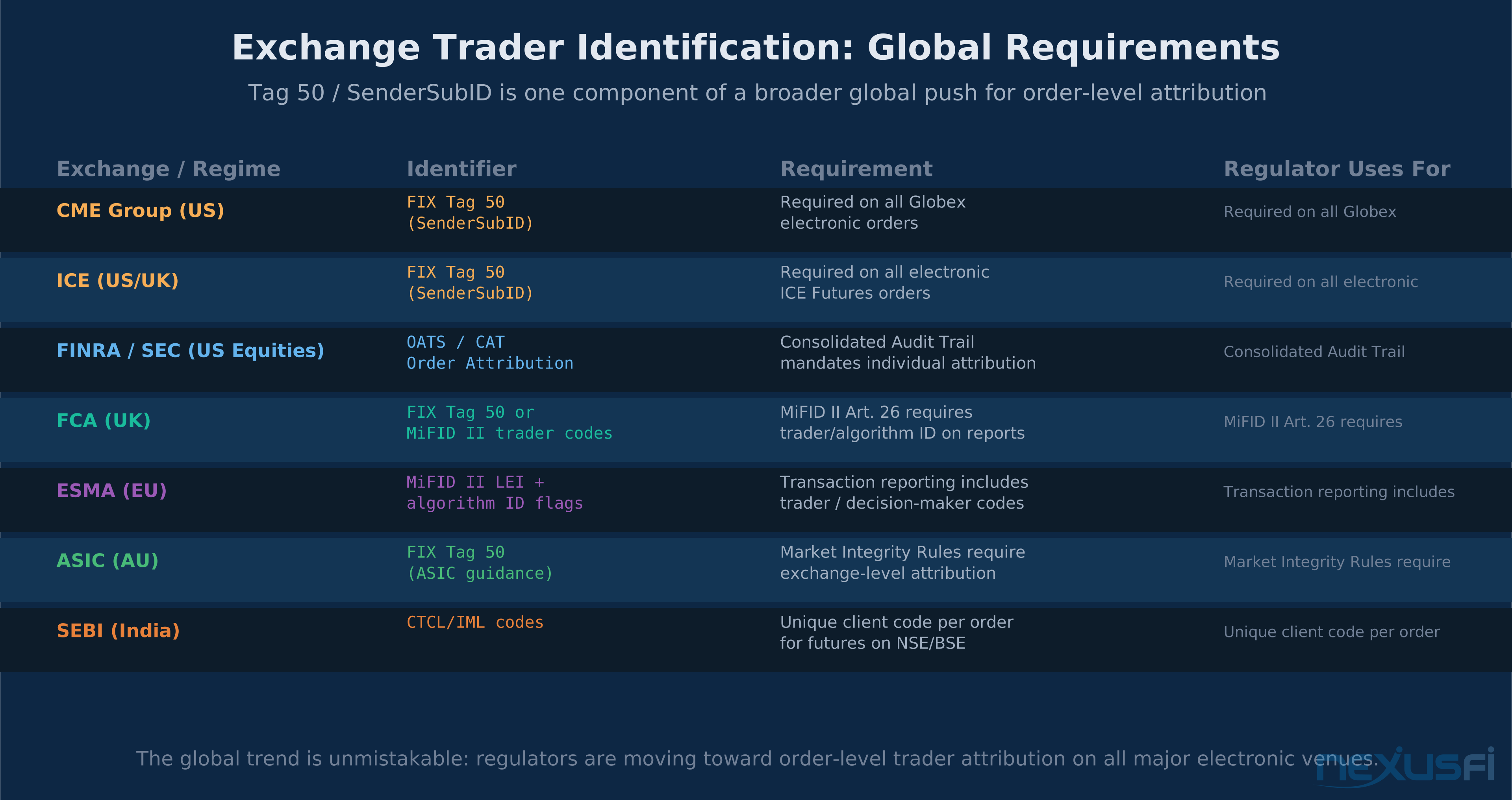
The convergence of these systems reflects a global regulatory consensus: fully electronic, highly liquid markets require complete audit trails to detect manipulation and protect market integrity. FIX Tag 50 at US futures exchanges is the US implementation of this principle.
High-Frequency Trading and Tag 50 #
The high-frequency trading (HFT) ecosystem is where Tag 50 compliance becomes most complex. A large HFT firm might operate dozens of independent trading strategies, each with its own server cluster, each generating millions of orders per day.
Strategy-Level Attribution
Modern HFT firms do not just assign one Tag 50 per human trader — they assign one Tag 50 per strategy, often per strategy instance per server. This granularity allows the firm to:
- Monitor each strategy's market impact independently
- Identify which strategy is responsible for any execution anomaly
- Demonstrate to regulators that different strategies are operationally independent
Version Management
When an HFT firm deploys a new version of a strategy with different logic, some compliance departments assign a new Tag 50 to clearly distinguish the old and new behavior in the audit trail. Others maintain the same Tag 50 for the same strategic intent, updating only when the fundamental approach changes. There is no universal standard — firms develop internal policies based on their risk management and compliance philosophy.
Latency Arbitrage and Tag 50
In latency arbitrage strategies — where firms compete to be first to respond to price movements at one exchange by trading at another — Tag 50 creates an interesting dynamic. The strategy at each venue has its own Tag 50, but sophisticated regulators can correlate the timing of activity across venues and across Tag 50 values to construct a unified picture of a firm's coordinated behavior.
Practical Examples: Tag 50 in Market Surveillance #
The regulatory utility of Tag 50 is best illustrated through the types of investigations it enables:
Pre-Announcement Trading Investigation
When a major policy announcement — interest rate decisions, tariff announcements, government reports — is followed by a sharp market move, regulators examine whether any traders positioned unusually in the minutes before the announcement. Using Tag 50 audit trail data, investigators can reconstruct the exact sequence of orders: which traders built positions, when, at what prices, and how those positions performed after the announcement.
By mapping the Tag 50 values to KYC records, investigators identify whether any of the pre-positioned traders had relationships with people who had advance knowledge of the announcement. The audit trail does not prove guilt — but it identifies whose trades warrant further scrutiny.
Spoofing Detection
Spoofing — placing large orders with the intent to cancel before execution, to manipulate price perception — leaves a distinctive pattern in the FIX audit trail. A spoofer places a large order, other traders adjust their bids/offers in response to the apparent large buyer or seller, and the spoofer cancels the original order and executes in the opposite direction.
Tag 50 allows regulators to attribute the spoof orders and the cancellations to a specific trader. Because the audit trail captures every modification and cancellation, the full pattern is visible. CFTC enforcement actions for spoofing have routinely relied on FIX audit trail evidence, with Tag 50 linking the pattern to named defendants.
Wash Trading Detection
Wash trading — creating artificial volume by trading with oneself or a coordinated counterparty — is difficult to detect at the account level but can be identified through Tag 50 analysis. If two different Tag 50 values at the same firm are consistently matching against each other, trading at off-market prices, or generating offsetting positions, surveillance systems flag the pattern for investigation.
Coordinated Trading Across Accounts
Regulators can use Tag 50 data to identify coordinated trading across accounts that are nominally independent. If multiple Tag 50 values from different firms are trading in perfect synchrony — placing orders at the same second, in the same instruments, in consistent proportions — investigators examine whether the accounts are actually controlled by a single entity attempting to conceal coordinated activity.
What This Means for Market Integrity #
Tag 50 and the audit trail system it enables represent a significant evolution in futures market surveillance. Before electronic trading and FIX protocol standardization, market surveillance relied heavily on end-of-day position reports and post-hoc analysis of cleared trades. The granularity of order-level data was unavailable.
The fully electronic, FIX-based futures market of today is the most transparent version of these markets in history. Every order is timestamped, attributed, and permanently logged. Exchanges and regulators have surveillance capabilities that would have been unimaginable in the open-outcry pit trading era.
For legitimate market participants, this transparency is protective: market manipulation that might have operated with impunity in less surveilled markets is now far more likely to be detected and prosecuted. For anyone considering illegal market activity, Tag 50 is a reminder that electronic futures markets are comprehensively monitored. The audit trail exists, and regulators know how to read it.
For FCMs and trading firms, the operational lesson is clear: Tag 50 compliance is not bureaucratic formality. It is the technical infrastructure of regulatory accountability. Maintaining accurate, consistent, well-documented Tag 50 assignments protects both the firm and the individual traders working within it.
Summary #
FIX Tag 50 (SenderSubID) is the fundamental trader identification mechanism in electronic futures trading. Embedded in every FIX order message, it identifies the individual person or algorithmic strategy responsible for each order. Exchanges including CME and ICE capture and permanently log this data as part of their immutable audit trails.
Regulators, led by the CFTC, use Tag 50 data to investigate suspicious trading activity. By subpoenaing audit trail records from exchanges and KYC records from FCMs, investigators can map any suspicious order in any futures market to a named real-world entity.
Key takeaways:
- Tag 49 identifies the firm; Tag 50 identifies the individual or strategy
- Every electronic futures order has a Tag 50, regardless of order size
- Tag 50 data is permanently logged by exchanges and retained for regulatory use
- The CFTC can and does request Tag 50 data during investigations
- Firms are responsible for assigning unique, consistent Tag 50 values to each trader and strategy
- Retail traders' Tag 50 values are assigned and managed by their FCM on their behalf
- Global regulatory frameworks (MiFID II, CAT) use equivalent systems for equity markets
Related reading: Position Limits, Accountability Levels, and Large Trader Reporting in Futures Markets
Citations
- — CFTC / Large Trader“A reportable trader must file a Form 40 on call by the Commission or its designee. Every person who holds or controls a reportable position must file a CFTC Form 40.”
- — CFTC / Large Trader“Generally, you are required to do so if you are holding or controlling a reportable position. The goal of this is for the federal regulator to understand what you are doing.”
- — CFTC Large Trader Reporting
- — FIX Protocol SenderSubID (Tag 50) Specification
- — CME Globex iLink 3 Specification