



Pattern Day Trader Rule: The $25,000 Gate That Shaped Retail Trading for 25 Years -- and Why It's Gone
Overview #
For a quarter century, one rule defined the boundary between who could day trade equities and who couldn't: maintain $25,000 in your margin account, or stop after three round trips per week. The Pattern Day Trader (PDT) rule wasn't subtle. It was a hard line drawn in 2001, and it pushed an entire generation of retail traders toward futures, options, and offshore brokerages to avoid it.
On April 14, 2026, the SEC granted accelerated approval to FINRA's proposal to amend Rule 4210, eliminating both the "pattern day trader" designation and its $25,000 minimum equity requirement. SEC Release No. 34-105226 replaced the binary threshold with a risk-based intraday margin system that evaluates actual position exposure rather than enforcing a flat dollar floor.
This is the most significant structural change to U.S. retail trading access since the rule was enacted. Here's what it was, why it lasted so long, and what replaces it.
Key Concepts #
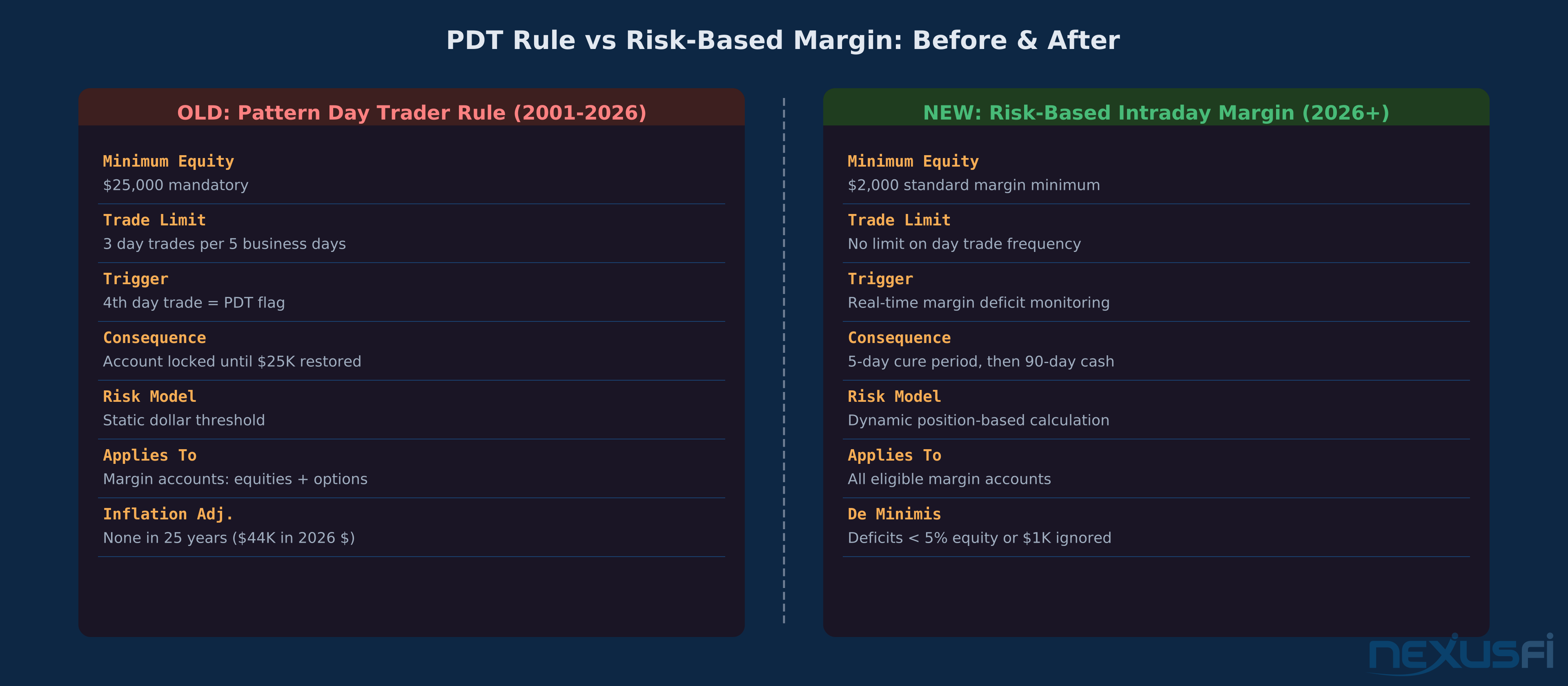
Pattern Day Trader (PDT) -- Under the now-eliminated FINRA Rule 4210(f)(8)(B), any customer who executed four or more day trades within five business days, where those trades represented more than 6% of total trading activity, was classified as a "pattern day trader." That classification triggered a mandatory $25,000 minimum equity requirement in the margin account.
Day Trade -- The purchase and sale (or short sale and cover) of the same security on the same trading day in a margin account. Cash account trades were not counted toward the PDT threshold, but cash accounts have their own settlement restrictions.
Risk-Based Intraday Margin -- The replacement framework. Instead of a static dollar threshold, brokerages now calculate margin requirements based on real-time position exposure and the specific volatility of assets being traded. The standard $2,000 minimum for margin accounts applies.
Intraday Margin Deficit -- Under the new rules, a customer's intraday margin obligation is the greater of their maintenance margin requirement or the Regulation T initial margin requirement for positions held during the day. A de minimis exception exists: deficits under the lesser of 5% of account equity or $1,000 are not treated as violations.
SEC Release No. 34-105226 -- The formal approval order filed April 14, 2026 (File No. SR-FINRA-2025-017) that granted accelerated approval to FINRA's rule change.
The Rule That Defined Retail Day Trading (2001-2026) #
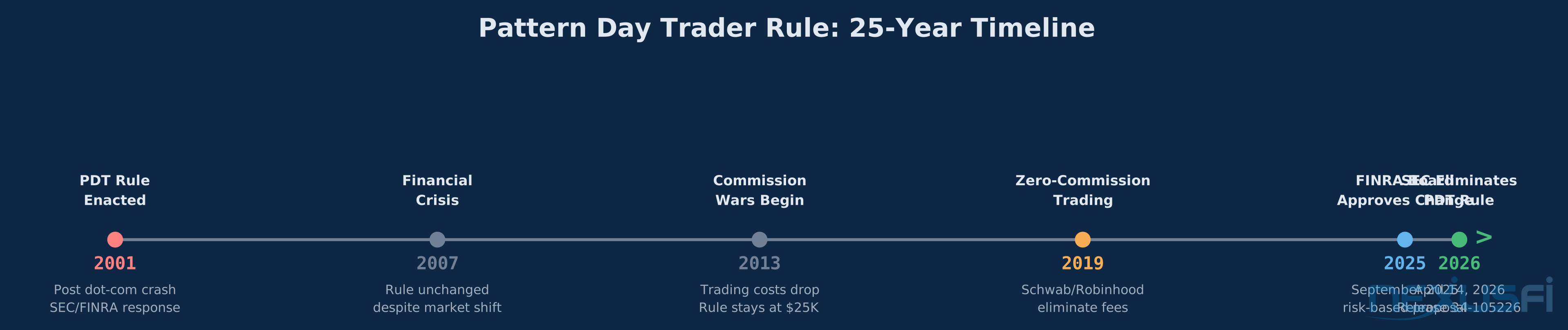
The PDT rule emerged from a specific moment in market history. The dot-com crash of 2000-2001 exposed how many undercapitalized retail traders had been day trading on margin with borrowed money they couldn't afford to lose. The SEC and FINRA responded with a blunt instrument: if you want to day trade equities on margin, prove you have at least $25,000 in capital.
The rule took effect in September 2001. At the time, online brokerage commissions ran $10-$30 per trade, market data was expensive, and the retail trading population was a fraction of what it would become. The $25,000 threshold represented a meaningful financial commitment -- roughly $44,000 in 2026 dollars adjusted for inflation.
The logic was straightforward. As EDGE explains on NexusFi [1]: "Pattern Day Trading Accounts: Based on FINRA and NYSE day trading rules, any account that places 4 day-trades in a 5 trading day period is permanently deemed to be a Pattern Day Trading account." Once flagged, the restrictions stuck.
For 25 years, the rule operated exactly the same way. Markets transformed around it -- commissions dropped to zero, fractional shares appeared, 0DTE options exploded in popularity, spot crypto ETFs launched -- but the $25,000 line never moved.
How the PDT Rule Worked #
The mechanics were binary and unforgiving:
The Count: Execute four or more day trades in any rolling five-business-day period in a margin account. A "day trade" means opening and closing the same position on the same day.
The Flag: Your account gets classified as a "pattern day trader." Once flagged, the designation was basically permanent at most brokerages.
The Requirement: Maintain at least $25,000 in equity (cash plus securities minus margin debt) in the margin account at all times. Not $25,000 at the start of the day. At all times.
The Consequence: If your equity drops below $25,000, you're locked out of day trading until you deposit funds to restore the minimum. Some brokers imposed a 90-day freeze. Others required a written request to remove the restriction.
The Buying Power Calculation: Pattern day traders with $25,000+ equity received "day-trading buying power" equal to four times their maintenance margin excess. A $30,000 account might get $120,000 in day-trading buying power. But this leverage came with strings -- fail to meet a day-trading margin call within five business days, and your buying power got restricted to one times maintenance margin for 90 days.
The rule applied only to margin accounts trading equities and equity options. Cash accounts were exempt but had their own constraints: you couldn't trade with unsettled funds, meaning you had to wait T+1 (previously T+2) for trades to settle before reusing that capital.
As bobwest notes on NexusFi [2]: "For many traders, the Pattern Day Trader rule and the different margin requirements will make a big difference" when choosing between equities and futures.
The PDT Workaround That Built the Futures Industry #
Here's the market consequence regulators probably didn't anticipate: the PDT rule became one of the best marketing tools futures brokerages ever had.
Futures markets have never had a PDT rule. A trader with a $5,000 account could day trade ES, NQ, or CL as many times as they wanted in a single day. No trade counting. No $25,000 minimum. No buying power restrictions tied to trade frequency.
As wldman points out on NexusFi [3]: "The 25,000 requirement and the pattern day trading rule (Reg T) as they apply to equities do not apply in the futures markets."
This asymmetry drove capital into futures -- especially after 2010, when micro futures contracts made the barrier to entry even lower. Many traders who entered the futures space specifically because PDT restrictions made equity day trading impractical discovered genuine advantages: favorable 60/40 tax treatment under Section 1256, nearly 24-hour trading sessions, and some of the deepest liquidity pools in global markets.
The prop firm evaluation industry, which grew explosively from 2020 onward, was built almost entirely on futures precisely because there was no PDT gatekeeping. A trader could take a $50,000 evaluation with a few hundred dollars in fees and day trade to their heart's content.
As bobwest observes on NexusFi [4] when ranking futures versus stocks: the $25,000 barrier and its associated restrictions were a major factor pushing traders toward derivatives.
Why the Rule Finally Died #
FINRA's board of governors voted in September 2025 to propose replacing the PDT provisions with intraday margin standards. The commission received public comments that "overwhelmingly supported" the change. On April 14, 2026, the SEC granted accelerated approval.
Three factors converged to kill the rule:
Technology Outpaced Regulation. In 2001, real-time risk monitoring across millions of accounts was impractical. In 2026, every major brokerage runs algorithmic risk engines that can calculate margin exposure, flag deficits, and liquidate positions in milliseconds. The $25,000 threshold was always a crude proxy for "can this trader absorb intraday losses?" Modern risk systems can answer that question directly without needing a dollar floor.
The Market Changed. Zero-commission trading, fractional shares, 0DTE options, spot crypto ETFs, 24-hour equity trading proposals -- the 2026 trading environment bears almost no resemblance to 2001. FINRA explicitly acknowledged this in its filing, noting that "the current day trading margin provisions may be viewed as outdated in light of the evolution in members' risk management abilities and practices."
Political and Competitive Pressure. Robinhood, Webull, and other retail-focused brokerages lobbied actively for the change. The PDT rule was widely perceived as protecting large accounts at the expense of smaller traders -- the opposite of the SEC's stated mission to protect retail investors. Multiple members of Congress publicly criticized the rule.
What Replaced It: Risk-Based Intraday Margin #
The new framework under amended Rule 4210 replaces the binary PDT system with a dynamic, position-level margin calculation:
No More Trade Counting. The concept of "four day trades in five business days" is gone. Brokerages don't count day trades or flag accounts based on frequency.
No More $25,000 Floor. The standard $2,000 minimum for margin accounts applies. Any eligible margin account above $2,000 can day trade equities without frequency restrictions.
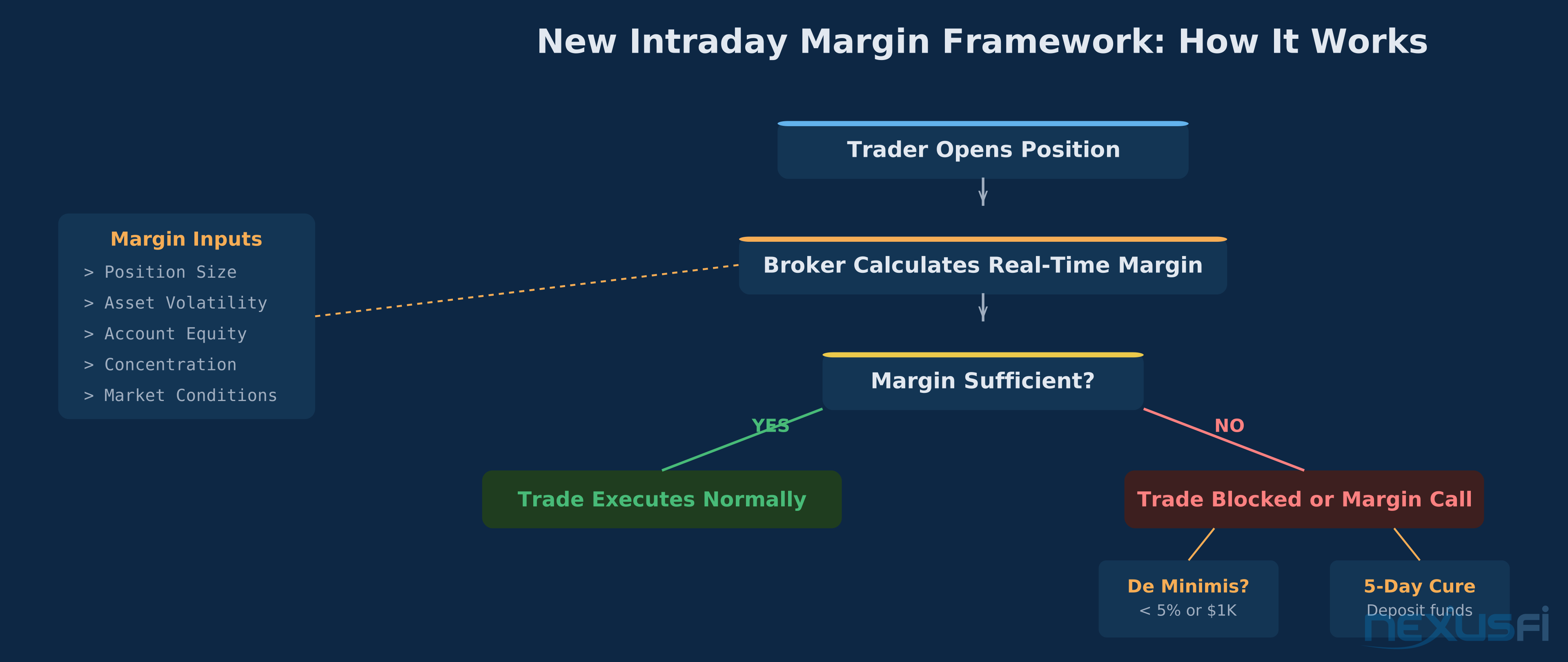
Real-Time Risk Assessment. Brokerages must monitor intraday margin in one of two ways:
- Real-time monitoring: Block or liquidate trades that would create margin deficits exceeding available collateral. Charles Schwab, Interactive Brokers, and Robinhood have announced they'll use this approach.
- End-of-day check: Perform a single margin calculation at market close and issue calls for any shortfalls.
Position-Based Margin. Instead of a flat dollar threshold, margin requirements are calculated based on the actual positions held, their volatility, and current market conditions. A trader buying 10 shares of a $50 stock faces different margin requirements than one buying 1,000 shares of a volatile biotech.
De Minimis Exception. Intraday margin deficits below the lesser of 5% of account equity or $1,000 are not treated as violations. This prevents minor, momentary fluctuations from triggering margin calls.
Five-Day Cure Period. Traders who receive an intraday margin call have five business days to deposit funds. Failure to meet the call results in a 90-day restriction to cash-only trading -- similar in consequence to the old PDT violation, but triggered by actual risk exposure rather than trade count.
Implementation Timeline #
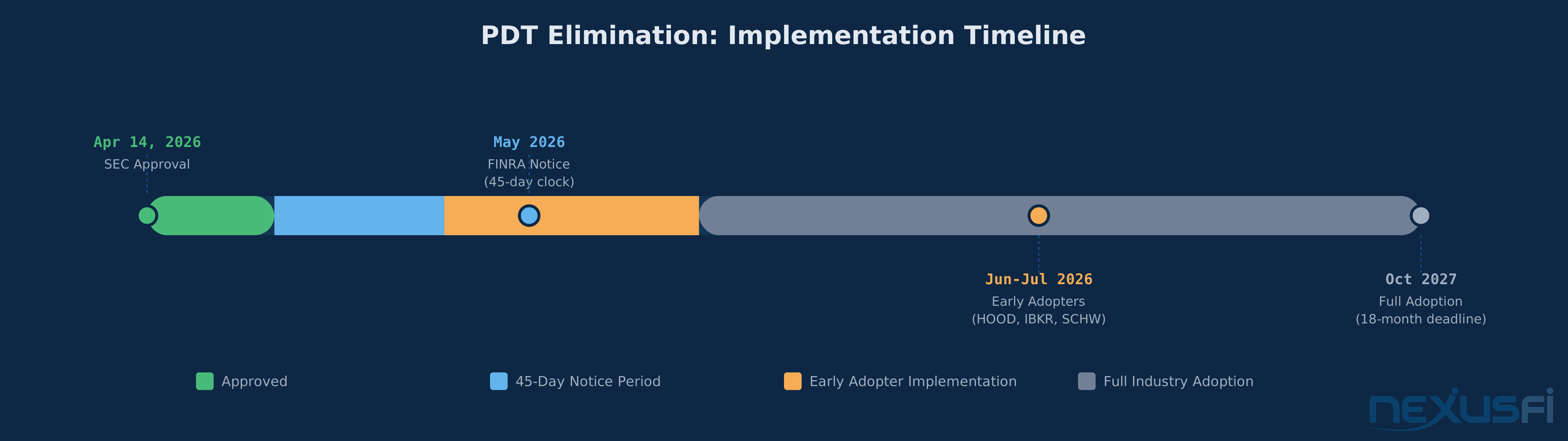
The transition from PDT to risk-based margin follows a staged rollout:
45 Days After FINRA Notice: Brokerages can begin implementing the new rules. FINRA will announce the effective date through a Regulatory Notice.
18-Month Interim Period: Full adoption across all platforms, with an outer boundary of approximately October 2027. Firms with existing real-time margin infrastructure -- Schwab, Interactive Brokers, Robinhood -- are expected to move much faster.
Early Movers: Robinhood shares surged 7.6% to $85.11 on the announcement. Webull jumped over 9%. Both companies lobbied for the rule change and have the infrastructure to implement quickly. These firms have clear competitive incentives to be first-to-market with the new framework.
During the interim period, individual brokerages may implement the new rules at their own pace. Some traders may see PDT restrictions removed within weeks at forward-leaning firms, while others at more conservative brokerages may wait months.
What This Means for Futures Traders #
This is where it gets especially interesting for the NexusFi community. The PDT rule's elimination removes one of futures trading's most cited advantages over equities. But the structural case for futures extends well beyond regulatory access:
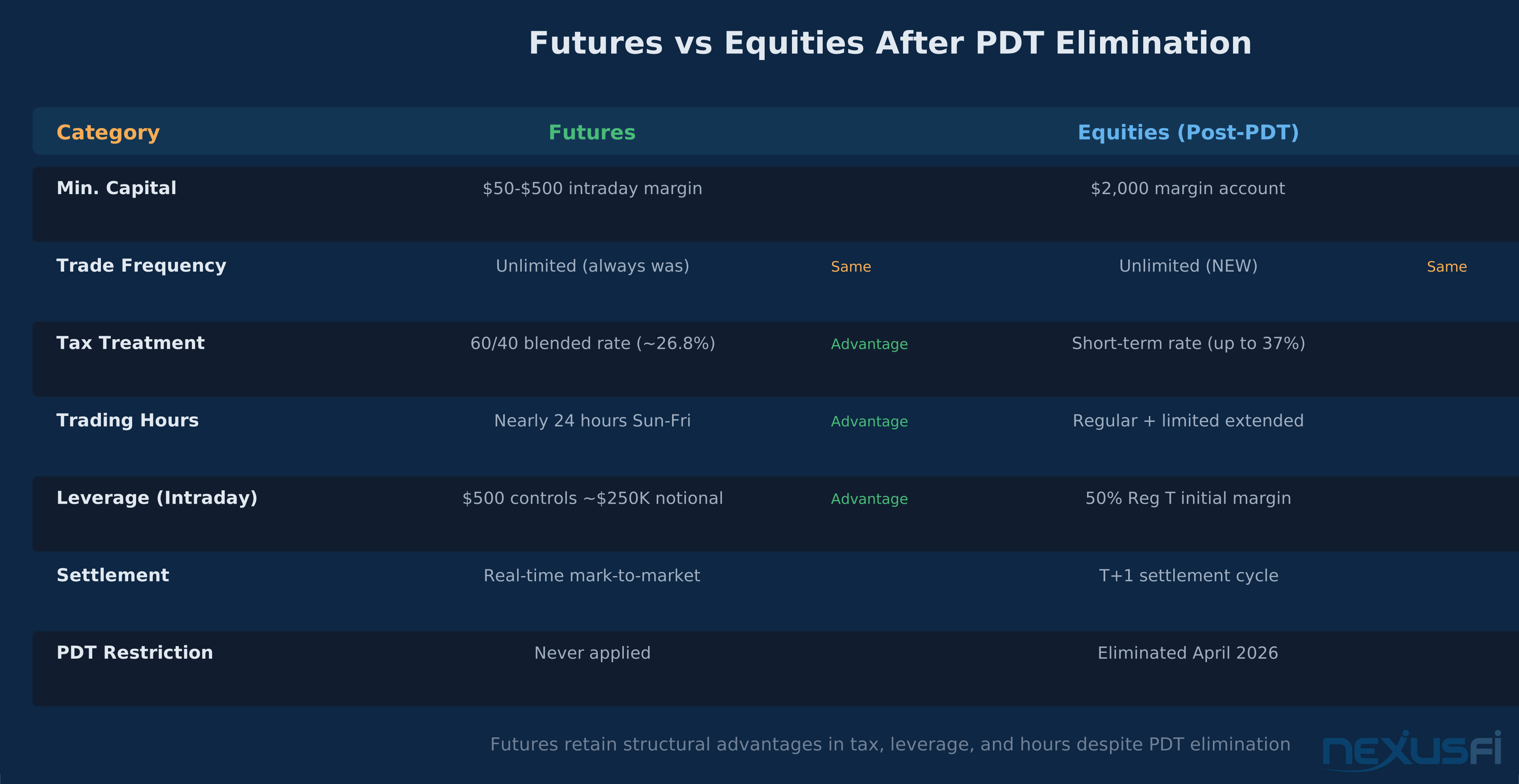
Tax Treatment Remains Superior. Futures still benefit from the 60/40 long-term/short-term capital gains split under IRC Section 1256, regardless of holding period. A day trader in ES pays a blended rate of roughly 26.8% on gains (at current tax brackets), while an equity day trader pays their full short-term rate -- potentially 37% for high earners. On $100,000 in annual trading profits, that's a $10,000+ difference.
Leverage Remains More Efficient. Intraday futures margins run $50-$500 per contract at most brokers, representing a fraction of notional value. Even under the new equity regime, Regulation T still requires 50% initial margin for equities. A trader wanting $100,000 in notional equity exposure needs $50,000 in margin. That same notional exposure in MES contracts might require $500-$1,000 in intraday margin.
Trading Hours Remain Broader. CME equity index futures trade nearly 24 hours, Sunday through Friday. Equity markets, despite proposals for extended hours, still operate primarily during regular sessions. Globex overnight sessions on ES and NQ are among the most liquid trading environments in the world.
Market Depth Remains Unmatched. ES, NQ, and CL remain among the most liquid instruments globally. The ES order book regularly shows tens of thousands of contracts at the inside market. No equity, with the possible exception of SPY, matches this depth.
The Real Question: Will capital shift back? Many traders -- especially those using prop firm evaluations -- entered futures specifically because PDT made equity day trading impractical with small accounts. With that barrier removed, some capital may rotate back to equities.
But traders who discovered futures through the PDT workaround may have found genuine advantages -- leverage efficiency, tax treatment, 24-hour access, the CME's central counterparty clearing -- that keep them in derivatives regardless.
The Broader Market Shift #
Analysts expect several downstream effects from the PDT elimination:
Increased Retail Equity Volume. More participants with more frequent trading access means more volume. Estimates range from 15-40% increases in retail equity order flow, especially during the first few months after implementation.
Tighter Equity Spreads During Regular Hours. More participants submitting limit orders generally compresses bid-ask spreads. This is a net positive for all equity traders.
More Volatile Opens and Closes. As retail participation broadens, the auction dynamics at market open and close may see increased activity, potentially amplifying the already-volatile first and last 30 minutes of the equity session.
Broker Competition Intensifies. With PDT no longer a differentiator, brokerages will compete on other dimensions: execution quality, margin rates, platform features, educational resources. This competition benefits traders.
Options Market Impact. The PDT rule applied to equity options as well as stocks. Its removal may accelerate the already-explosive growth in retail options trading, especially 0DTE strategies that by definition involve same-day entry and exit.
The Bottom Line #
The Pattern Day Trader rule was a product of its time -- a blunt regulatory instrument designed for a market where online trading was novel, commissions were expensive, and real-time risk monitoring was impractical. For 25 years, it accomplished its stated goal of preventing undercapitalized traders from overleveraging in equities. It also accomplished an unstated consequence: driving a generation of retail traders into futures markets where the restriction never existed.
The replacement framework is demonstrably more sophisticated. Risk-based margin that evaluates actual position exposure is objectively better risk management than a flat dollar threshold. The question isn't whether the new system is an improvement -- it clearly is. The question is whether it changes trader behavior and capital allocation in ways that reshape the competitive environment between equities and derivatives.
For futures traders, the structural advantages -- tax treatment, leverage efficiency, trading hours, market depth -- remain intact. The PDT elimination removes one talking point from the futures marketing playbook, but it doesn't change the underlying economics that make futures efficient instruments for active trading.
For equity traders, especially those who have been trading with less than $25,000 in capital and working around the three-trade-per-week limitation, this is a genuine unlock. The gate is open.
For more on how futures margin works, including the exchange-vs-broker dynamics that determine your intraday buying power, see Day Trading Margins and Intraday Margin Policies.
Knowledge Map
Go Deeper
Build on this knowledgeReferences This Article
Articles that build on this topicCitations
- — Questions from McMathews (2011)“Pattern Day Trading Accounts: Based on FINRA and NYSE day trading rules, any account that places 4 day-trades in a 5 trading day period is permanently deemed to be a Pattern Day Trading account”
- — SPY vs ES - commission and tax implications (2019) 👍 1“For many traders, the Pattern Day Trader rule and the different margin requirements will make a big difference”
- — Newbie Question about Day Trading (2014) 👍 3“The 25,000 requirement and the pattern day trading rule (Reg T) as they apply to equities do not apply in the futures markets”
- — Rank your Futures vs Stocks trading priority (2021) 👍 3“the $25,000 barrier and its associated restrictions were a major factor pushing traders toward derivatives”
- — Sec.gov
- — Schwab.com
- — Financefeeds.com