



International Futures Markets Access: Cross-Border Brokerage, Regulatory Frameworks, and Trading Beyond Your Home Exchange
Overview #
Most retail futures traders start with their home exchange — CME for U.S. traders, Eurex for Europeans, SGX for Singapore-based traders. But global futures markets run around the clock across dozens of exchanges, and the products on foreign venues don't always have domestic equivalents. Bund futures trade on Eurex. Nikkei futures trade on OSE and SGX. Brent crude trades on ICE Europe. If you want access to these markets, you need to understand how cross-border futures access actually works.
Here's the short version: accessing foreign exchanges is technically feasible but operationally complex. The barriers aren't about exchange connectivity — that's a solved problem. The real friction comes from regulatory eligibility, margin treatment, currency risk, and whether your broker will carry the foreign product at all. Get these right and you can trade globally from a single account. Get them wrong and you're looking at higher margin, unexpected FX losses, and tax reporting headaches.
Multi-Currency Margin — Account capability to hold margin deposits in multiple currencies (USD, EUR, GBP, JPY, etc.) rather than forcing conversion to a single base currency.
This guide covers the regulatory frameworks that govern cross-border futures trading, the three models for accessing foreign exchanges, how margin and currency mechanics work across jurisdictions, and the tax implications that most traders overlook.
Key Concepts #
FCM (Futures Commission Merchant) — The entity that holds your customer funds and clears your trades. For cross-border access, your FCM's clearing relationships with foreign exchanges determine what products you can trade.
Part 30 Exemption — A CFTC framework that governs foreign intermediaries soliciting or accepting orders from U.S. persons for foreign futures. Provides a legal pathway but doesn't remove practical compliance friction.
Multi-Currency Margin — Account capability to hold margin deposits in multiple currencies (USD, EUR, GBP, JPY, etc.) rather than forcing conversion to a single base currency. Reduces FX conversion costs but may still involve haircuts.
Foreign Board of Trade (FBOT) — A non-U.S. exchange recognized by the CFTC to provide direct access to U.S. participants under certain conditions.
Segregated Funds — Customer money held separately from the broker's operating capital. Segregation standards vary by jurisdiction — CFTC rules are among the strongest globally.
Cross-Margining — Recognition of offsetting positions across related products, potentially reducing total margin requirements. Cross-margining across jurisdictions is limited and clearing-house dependent.
How Cross-Border Access Actually Works #
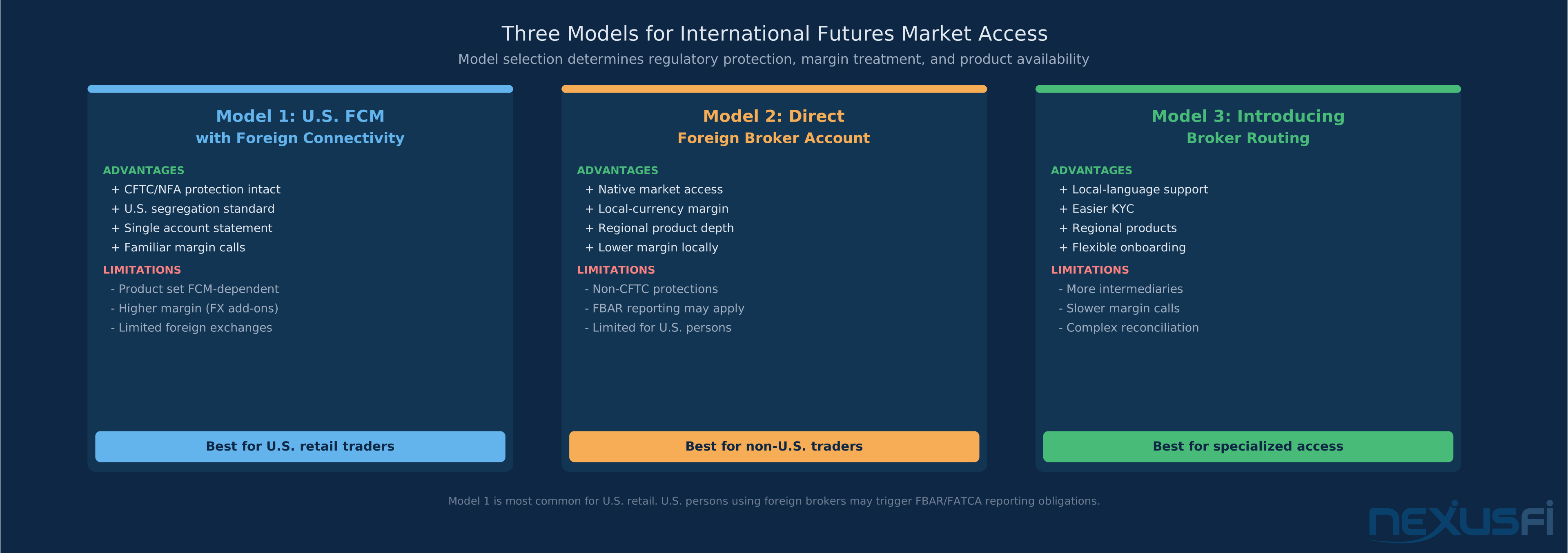
There are three models. The one you end up with depends on your residency, your broker's infrastructure, and how much operational complexity you're willing to accept.
Model 1: U.S. FCM with Foreign Exchange Connectivity #
This is the most common path for U.S. retail traders accessing Eurex, SGX, OSE, or ICE Europe. Your account sits with a U.S.-registered FCM under CFTC/NFA oversight. The FCM routes your orders to foreign exchanges through its own clearing memberships or relationships with foreign clearing members.
What you get: CFTC customer protections, U.S.-standard segregation, familiar margin call procedures, and a single account statement. The regulatory framework you know stays intact — you're still a customer of a U.S. FCM even when trading German bund futures.
What you give up: not every foreign product is available (it depends on the FCM's connectivity), margin may be higher than what a local broker would charge (the FCM adds buffers for FX and concentration risk), and multi-currency support varies. Some FCMs convert everything to USD internally. Others maintain native-currency sub-ledgers.
As the NexusFi community has discussed extensively in broker evaluation threads, understanding whether your broker is an IB or FCM and who ultimately clears your trades is fundamental — doubly so when foreign exchanges are involved.
Model 2: Direct Account with a Foreign Broker #
A Singapore resident opening with a MAS-regulated broker for SGX access. A UK trader opening with an FCA-regulated broker for Eurex. In this model, you're directly under the foreign regulator's framework.
For non-U.S. traders, this often provides the cleanest access to regional exchanges — local-currency funding, native margin treatment, and regulatory protections tailored to the local market. But for U.S. persons, this path is narrow. Most foreign brokers avoid accepting U.S. retail clients because the CFTC compliance burden is steep. Those that do accept U.S. persons may offer limited products or require additional disclosures.
The bigger issue: you're outside CFTC/NFA customer protections. Fund segregation standards, dispute resolution mechanisms, and margin call procedures differ by jurisdiction. The post-PFG due diligence thread on NexusFi, led by @djkiwi, laid out exactly why understanding where your money sits matters — and that risk multiplies when your funds are held under a foreign regulatory framework.
Model 3: Introducing Broker Routing to Foreign Clearing #
A local IB handles onboarding and customer service while routing orders to an FCM or foreign clearing member. You get local-language support and potentially easier KYC, but more intermediaries in the chain. This adds operational complexity — margin calls may take longer to communicate, statement reconciliation gets messier, and if something goes wrong, you're navigating multiple entities across multiple jurisdictions.
Regulatory Frameworks: What Actually Differs #
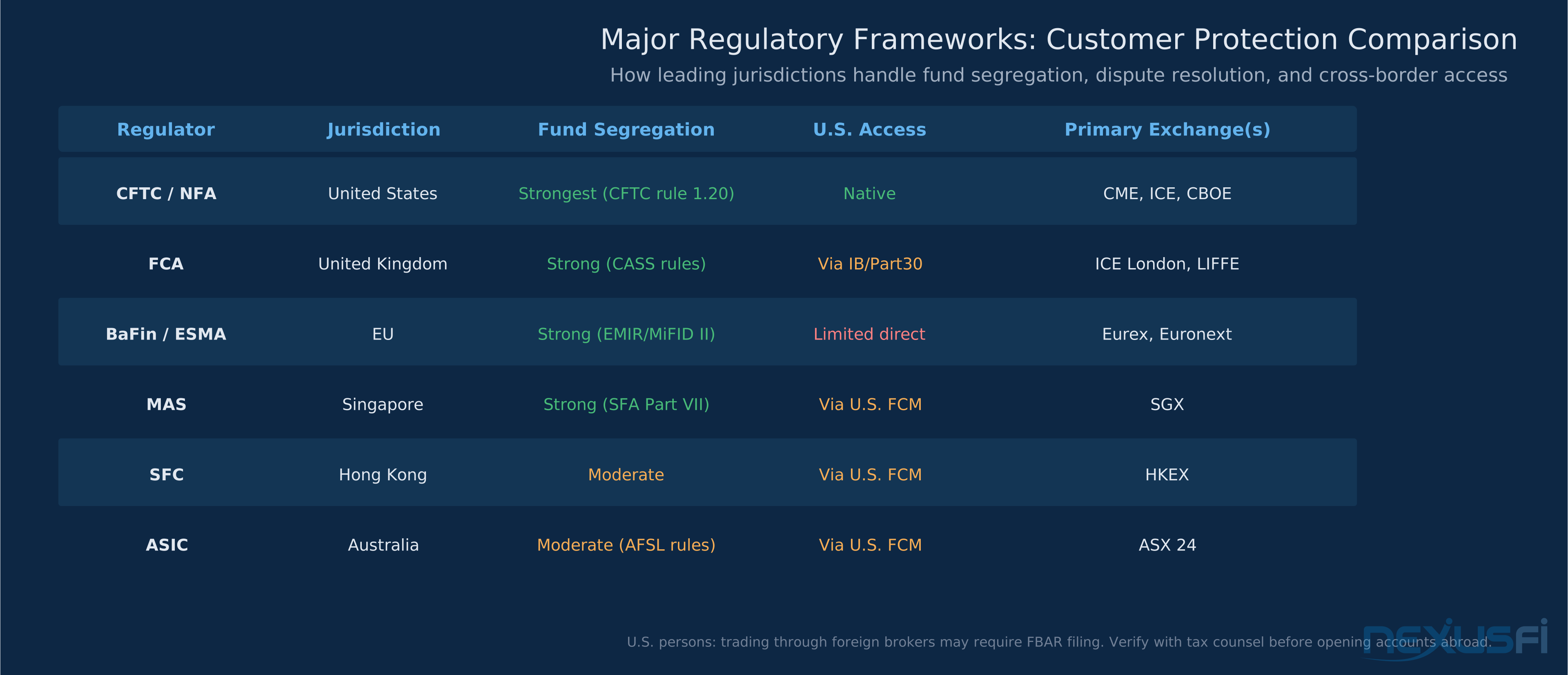
The six major regulatory frameworks governing futures trading each have distinct approaches to customer protection, margin, and cross-border access.
CFTC/NFA (United States) #
The strictest customer protection regime for futures. CFTC rules govern segregation of customer funds, disclosure requirements, margin practices, and intermediary registration. NFA handles day-to-day supervision and enforcement.
For cross-border access, the key constraint is that retail futures trading through U.S. persons must flow through CFTC-registered intermediaries (or structures that satisfy CFTC requirements). This limits your broker options but provides the strongest fund protection in the industry.
U.S. traders benefit from strong segregation, standardized clearing, and relatively clean tax reporting for common futures. The tradeoff: fewer product choices than a global institutional desk and sometimes limited direct access to non-U.S. exchanges.
FCA (United Kingdom) #
Post-Brexit, the FCA operates independently from the EU's MiFID II framework. FCA-regulated brokers can offer exchange-traded derivatives including international futures, subject to conduct rules and client money obligations.
UK-based traders often see broader access to international products through global brokers, and multi-currency account support tends to be stronger than U.S.-centric platforms. The regulatory emphasis is on conduct and consumer protection rather than the prescriptive intermediary registration requirements common in the U.S.
BaFin / EU Framework #
German and EU regulation operates within the MiFID II / EMIR overlay. Futures access through Eurex is well-standardized for EU-resident traders. Local-currency margin and collateral options are more readily available than through U.S. brokers.
The complication: the EU framework is fragmented across member states. A broker licensed in one EU country doesn't automatically have the same client treatment rules as one licensed in another, though passporting provides some harmonization.
MAS (Singapore) and SFC (Hong Kong) #
Both serve as major derivatives hubs for Asia-Pacific. Singapore offers strong multi-currency infrastructure and good banking integration — MAS-regulated brokers often provide efficient SGX access. Hong Kong's SFC emphasizes licensing and risk disclosures, with strict onboarding requirements.
For both, the practical question for foreign traders is the same: is the broker willing and able to service your residency under their regulatory framework?
ASIC (Australia) #
ASIC has become more restrictive on leveraged products but exchange-traded futures remain available. Australian traders can access international futures through global brokers, though account and collateral handling varies widely.
Margin Across Borders: Where Theory Meets Reality #
Margin is where cross-border trading gets expensive if you don't understand the mechanics.
Exchange Margin Is the Floor, Not the Ceiling #
Every exchange sets initial and maintenance margin for its contracts. But when you trade a foreign exchange product through your broker, the broker almost always adds margin on top. These "house add-ons" cover:
- FX risk (the contract is denominated in one currency, your account in another)
- Concentration risk (you're trading a product the broker monitors less frequently)
- Liquidity risk (the foreign contract may be less liquid during your trading hours)
- Holiday/settlement mismatch (foreign exchange holidays don't align with yours)
The result: your effective margin on a Eurex contract traded through a U.S. FCM is often 20-50% higher than what a European broker would charge a local client. That's not the broker gouging you — it's pricing the real operational risk of cross-border clearing.
Cross-Margining Limitations #
Portfolio margining and cross-margining work well within a single clearing system. They work poorly across jurisdictions. If you hold offsetting positions on CME and Eurex, your broker's margin system may not recognize the hedge. Each position gets margined independently, and your total margin requirement is the sum rather than the net.
Some prime brokerage arrangements offer cross-venue margin netting, but these are typically institutional products. Retail accounts usually face the full margin on each venue.
Intraday vs. Overnight Differences #
Foreign contracts often carry different intraday and overnight margin tiers. Your broker may offer reduced intraday margin on domestic products but require full exchange margin (or more) on foreign contracts around the clock. Weekend and holiday margins can spike — especially around local market events that don't register on your home calendar.
Currency Risk: The P&L Driver Nobody Talks About #
When you trade a EUR-denominated futures contract from a USD account, your P&L has two components:
Total P&L = Futures price change + FX translation effect
If you buy a Eurex bund future and the price rises 50 ticks in your favor, but EUR/USD drops 1% during the same period, your USD-denominated gain is smaller than the tick value suggests. In extreme cases, you can be right on the trade and still lose money in home-currency terms.
This isn't theoretical. Currency moves during macro events (central bank decisions, geopolitical shocks, elections) can be violent, and they hit at exactly the moments when your futures positions are most active.
How Brokers Handle Currency #
Three approaches exist, and you need to know which one your broker uses:
Auto-conversion: The broker converts daily P&L from contract currency to your base currency automatically. Simple but exposes you to daily FX rates and conversion spreads.
Multi-currency sub-ledgers: Your account maintains separate balances in each currency. P&L stays in the contract currency until you choose to convert. Reduces forced FX exposure but requires you to manage currency balances actively.
Base-currency-only: Everything is computed in your base currency. The broker handles all conversions internally, usually at an unfavorable spread. The simplest operationally but the most expensive for active international traders.
Tax Implications for U.S. Traders #
Section 1256 Treatment #
Many exchange-traded futures contracts qualify for Section 1256 treatment under U.S. tax law — 60% long-term, 40% short-term capital gains regardless of holding period, with mark-to-market at year-end.
But not every foreign contract automatically qualifies. The instrument must meet the definition of a "regulated futures contract" under U.S. tax rules. Major contracts on recognized foreign exchanges generally qualify, but exotic or thinly-traded foreign products may not. Verify contract classification before assuming 60/40 treatment applies.
FX Translation Creates Separate Tax Events #
If your account holds foreign-currency balances, realized currency conversions may generate taxable gains or losses independent of your futures trading. Converting EUR to USD to meet a margin call can create a taxable FX gain even if your futures position is underwater.
Foreign Account Reporting #
U.S. traders using foreign broker accounts may trigger FBAR (Foreign Bank Account Report) filing requirements if aggregate foreign financial account balances exceed $10,000 at any point during the year. FATCA reporting may also apply depending on asset thresholds. Trading through a U.S. FCM that routes to foreign exchanges avoids these requirements because your account is with a domestic entity.
Part 30 and Foreign Intermediaries #
CFTC Part 30 governs how foreign intermediaries interact with U.S. persons in connection with foreign futures. It creates a legal pathway for certain foreign firms to solicit or accept orders from U.S. customers under defined conditions — equivalent disclosure, recordkeeping, and compliance measures.
In practice, Part 30 is important but limited. Many foreign firms avoid U.S. retail entirely because the compliance burden outweighs the revenue opportunity. Those that do operate under Part 30 may offer narrower product sets and less familiar customer experiences.
If you're considering a Part 30 arrangement, verify:
- Who holds your funds and under what segregation standard?
- Who clears your trades?
- What are the margin call mechanics and in what currency?
- What dispute resolution framework applies?
- How has the intermediary performed during market stress?
The existence of a legal pathway doesn't guarantee a good customer experience. As @Big Mike emphasized during the Phillip Capital discussion, understanding the clearing chain and who actually holds your money is the most important due diligence step.
Recognition Agreements: What They Do and Don't Do #
The CFTC maintains recognition arrangements with foreign regulators and can recognize Foreign Boards of Trade (FBOTs), allowing certain foreign exchanges to provide direct or indirect access to U.S. market participants.
What recognition does: reduces duplicative regulatory requirements for firms, facilitates cross-border clearing relationships, and supports exchange connectivity.
What recognition doesn't do: guarantee retail account eligibility, remove broker onboarding restrictions, eliminate local tax consequences, or override exchange membership rules.
The practical implication: recognition agreements matter for the infrastructure that makes cross-border trading possible, but they don't solve the individual trader's access problem. The question is still "Does my broker offer this product, and am I eligible to trade it?"
Before You Trade Internationally: The Checklist #
Regulatory #
- Which legal entity holds your account?
- Which regulator governs your customer relationship?
- Are you eligible based on residency, citizenship, and tax status?
- Are the products exchange-traded futures (not CFDs, swaps, or other derivatives)?
Margin and Currency #
- What is your account base currency?
- Can you hold foreign-currency balances?
- How does the broker handle P&L currency conversion?
- What FX haircuts apply to non-base-currency collateral?
- What is the conversion spread/markup?
Exchange Access #
- Which venues and specific contracts are enabled for your account?
- What market data subscriptions are required (and what do they cost)?
- What order types are supported on each foreign venue?
Tax #
- Does each foreign contract qualify for Section 1256 treatment?
- Will the broker provide U.S.-compatible tax reporting?
- Do foreign account reporting thresholds apply?
Operations #
- What are the exchange holiday calendars for each venue you trade?
- How are margin calls communicated across time zones?
- Is liquidation automated across all venues?
- What support is available during foreign trading hours?
Practical Takeaways #
Access is broker-dependent, not exchange-dependent. The question isn't whether Eurex or SGX is reachable — it's whether your specific broker will carry the product for your specific account type.
Currency risk can dominate your P&L. A 1% move in EUR/USD on a EUR-denominated position can wipe out or amplify your futures gain. Understand your FX exposure before sizing positions.
Margin will be higher than you expect. House add-ons for FX risk, concentration, and liquidity routinely push effective margin 20-50% above what local traders pay.
Tax classification isn't automatic. Verify each foreign contract's Section 1256 status before assuming favorable tax treatment.
The strongest protection is a transparent clearing chain. Know your FCM, your clearing member, your segregation standard, and your dispute resolution framework. As @djkiwi documented in the complete broker due diligence guide, the time to understand these structures is before you fund the account — not after something goes wrong.
Start with your home exchange. If you're new to futures, master domestic markets first. International access adds complexity in margin, currency, tax, and operations. Add foreign products only when you have a specific trading thesis that requires them.