



Futures Broker Regulation and Account Safety: What Actually Protects Your Money and What Doesn't
Overview #
Your futures account has zero SIPC protection. That's not a technicality
A regulatory framework does exist
This article covers the actual mechanics of how your futures broker is structured, what protections are real, what the documented failure modes look like, and how to verify your broker's financial health before those questions become urgent. The process is less than an hour and worth doing before you wire significant capital anywhere.
The Regulatory Framework #
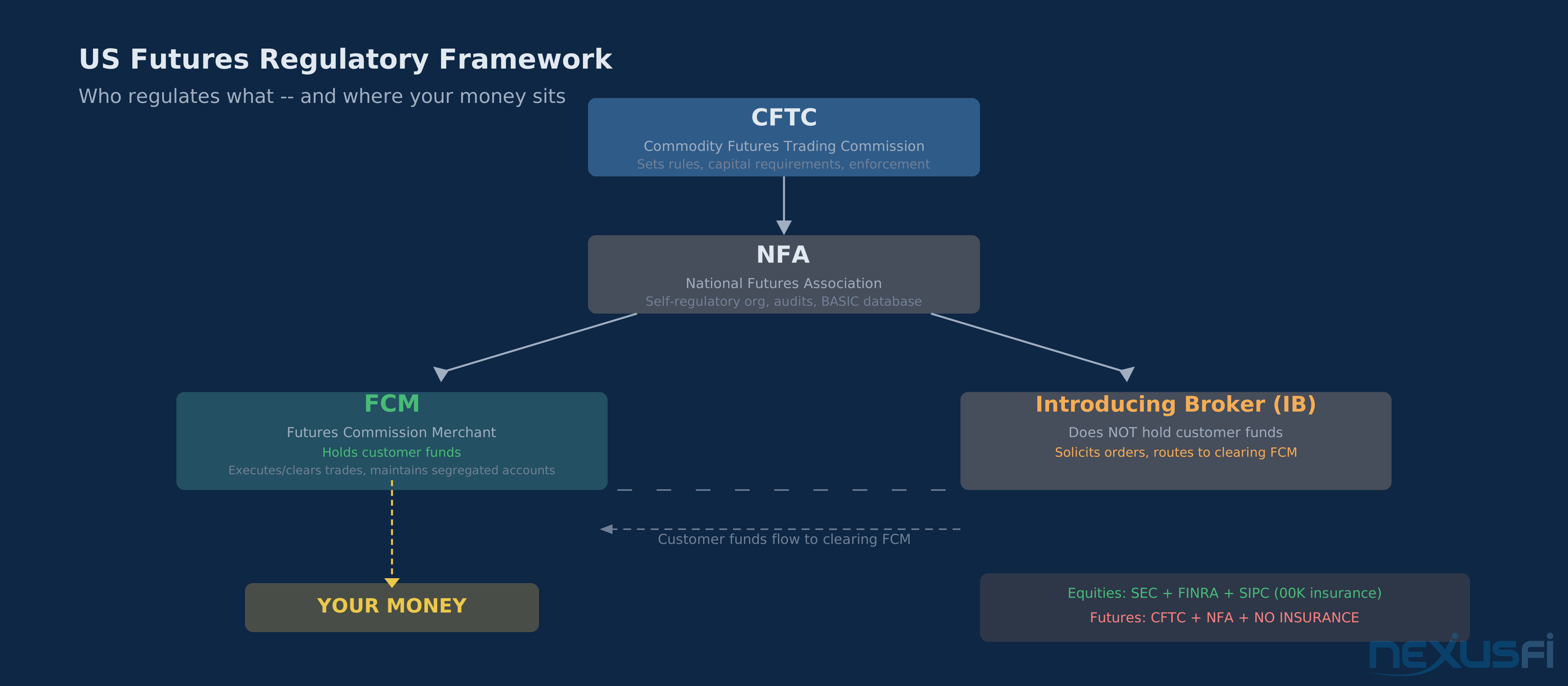
Three entities govern US futures trading: the CFTC, the NFA, and the FCMs themselves. Understanding the layered structure matters because it determines where liability sits and what recourse you have.
CFTC #
The Commodity Futures Trading Commission is an independent federal agency created by the Commodity Exchange Act. It sets the rules: capital requirements, segregation mandates, reporting obligations, approved investment instruments for customer funds. CFTC enforcement actions are public record, and the agency publishes monthly financial data on every registered FCM
The CFTC can bring enforcement actions, impose fines, and refer cases for criminal prosecution. What it can't do is compensate customers when money is already gone.
NFA #
The National Futures Association is the self-regulatory body for the futures industry
NFA performs audits, investigates complaints, and can bar members from the industry. PFGBest's collapse exposed the limits of this oversight: the NFA was reviewing bank statements that the CEO had fabricated for nearly two decades.
FCMs and Introducing Brokers #
An FCM (Futures Commission Merchant) is the entity that actually holds customer funds. FCMs are authorized to accept customer margin, execute or clear trades, and maintain the customer segregated accounts that hold your capital. Registration as an FCM requires meeting minimum capital thresholds and ongoing reporting obligations.
An Introducing Broker (IB) solicits orders and maintains customer relationships but doesn't hold funds. The IB passes customer accounts and funds to a clearing FCM. As EdgeClear explained in a 2020 thread on broker structure: "As an IB, we do not hold the customer segregated funds account. FCMs are required to hold these funds in a segregated bank account."[6]
This distinction matters for due diligence. If your broker is an IB, you need to identify the clearing FCM
Customer Fund Segregation #
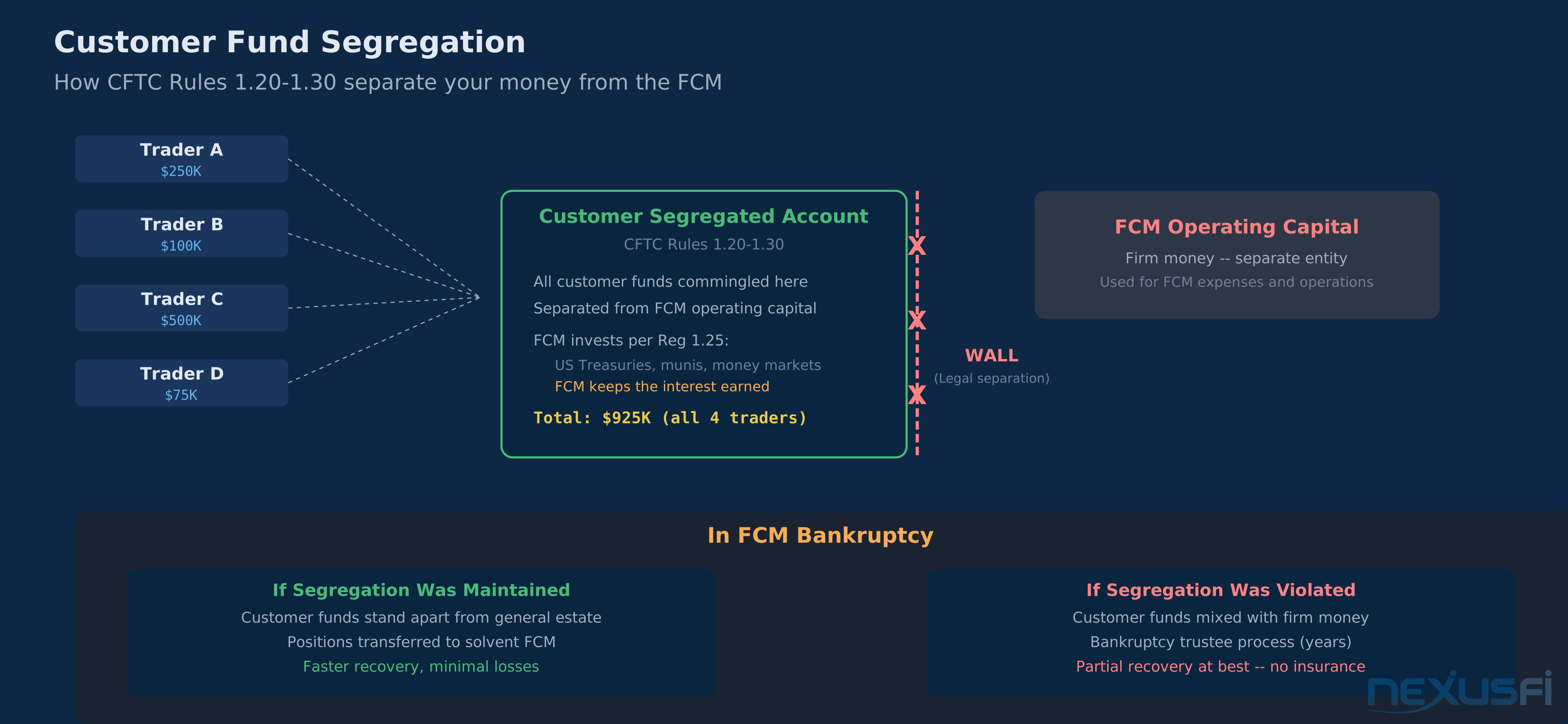
CFTC Rules 1.20 through 1.30 mandate that FCMs maintain customer funds separately from firm operating capital. This is customer segregation
What Segregation Means #
Customer funds are commingled with other customers' funds in a dedicated customer segregated account. They're separated from the FCM's own capital. The firm can't use customer funds to pay operating expenses or firm creditors. In a bankruptcy proceeding, customer funds theoretically stand apart from the firm's general estate.
The key word is theoretically. Segregation is an accounting and legal requirement. It works when FCMs comply with it honestly. It fails when they don't
What FCMs Do With Your Money #
FCMs don't just park customer funds in a checking account. CFTC Regulation 1.25 specifies the instruments in which FCMs can invest customer segregated funds: US government securities, agency securities, municipal securities, certain corporate notes and bonds, and money market mutual funds. The FCM keeps the interest earned on these investments. You earn nothing. That yield is part of the FCM's business model.
This creates a structural dynamic: FCMs have an incentive to take on duration risk and credit risk within Regulation 1.25 limits to maximize yield. Most do this conservatively. MF Global did not.
Daily Reconciliation Requirements #
FCMs must reconcile customer segregated accounts daily and file monthly reports with the CFTC. The reports are public. They show excess net capital (capital above regulatory minimums), customer funds on deposit, and segregated fund balances. This data is the basis for a meaningful due diligence check, which is covered in the Practical Considerations section.
Re-Hypothecation Risk #
Some FCMs
@djkiwi documented this risk in detail following PFGBest: Interactive Brokers' structure meant "IB re-pledged or re-sold $7.9 billion of $16.7 billion of available client funds."[1] The funds weren't missing
What Goes Wrong: MF Global and PFGBest #
These aren't edge cases. They're the dominant data points for thinking about FCM risk. Every due diligence framework for futures brokers runs through them.
MF Global (2011) #
MF Global was one of the largest futures brokers in the world
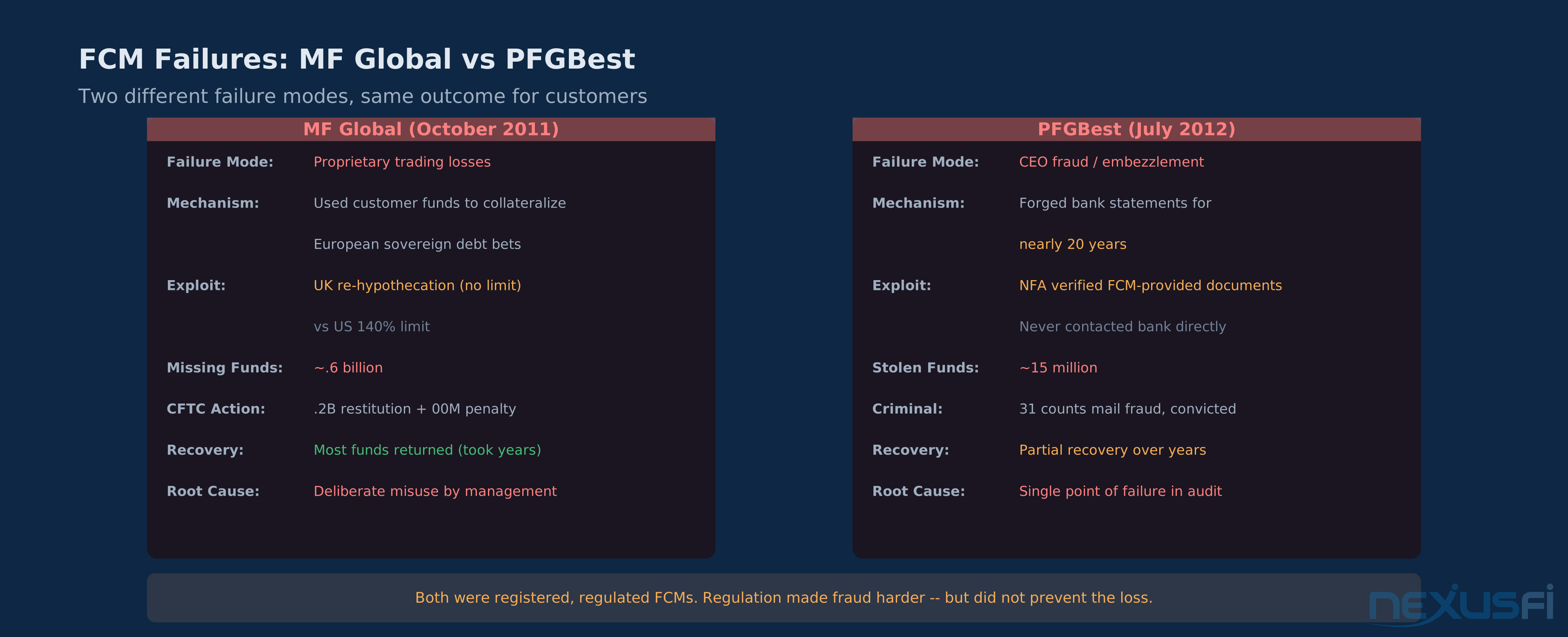
In October 2011, MF Global filed for bankruptcy. In the aftermath, approximately $1.6 billion in customer funds were missing. The shortfall traced primarily to a deliberate decision to use customer funds to collateralize the firm's proprietary bets on European sovereign debt. The mechanism relied partly on UK re-hypothecation rules
Customer recovery took years. The CFTC eventually ordered $1.2 billion in restitution plus a $100 million civil monetary penalty, which was largely uncollectable given the firm's insolvency. Customers ultimately recovered most of their funds through a prolonged bankruptcy process
The lesson: a well-known, regulated, publicly-traded FCM with prominent leadership deliberately used customer funds for firm purposes. The regulatory framework did not prevent it.
PFGBest (2012) #
Russell Wasendorf Sr. founded Peregrine Financial Group (PFGBest) in 1980 and grew it into a mid-size FCM. For approximately 20 years, Wasendorf forged bank statements to conceal the fact that he was stealing customer funds. He created fake bank correspondence, fabricated account balances, and submitted the forgeries to regulators and auditors. The total theft reached approximately $215 million.
The NFA's monitoring process relied on reviewing bank statements provided by the FCM. It did not independently verify balances directly with the banks. Wasendorf's confession noted that the fraud persisted because no one at the NFA contacted US Bank directly. The control had a single point of failure.
After the fraud was discovered in 2012, Wasendorf attempted suicide and was subsequently convicted of 31 counts of mail fraud. Customers recovered partial funds through bankruptcy proceedings over the following years.
Post-failure reforms included requirements for electronic confirmation of segregated account balances directly with depository institutions, eliminating the ability to submit fabricated statements.
The Pattern #
Both failures share a structure: regulated entities, subject to oversight, that deliberately circumvented the rules. The regulation made fraud harder and detection more likely over time. It didn't prevent the loss when principals decided to steal. No insurance fund existed to cover the shortfall. Customer recovery depended on bankruptcy proceedings.
@Big Mike was direct about what this means: "There is NO INSURANCE for funds deposited at an FCM. You have only the trust in the FCM's accounting practices to save you."[3]
SIPC: The Protection Futures Don't Have #
Securities accounts at FINRA-member broker-dealers carry SIPC protection up to $500,000 (including $250,000 in cash claims). SIPC is funded by assessments on its member firms and provides a meaningful backstop if a broker-dealer fails
There's no futures equivalent. The NFA doesn't maintain an insurance fund. The CFTC doesn't guarantee customer accounts. When an FCM fails and customer funds are missing, there's no check coming.
The IB-Sweep Strategy #
Some dual-registered broker-dealers that offer both securities and futures accounts allow customers to use sweep programs that move excess futures account cash into SIPC-insured securities accounts. Interactive Brokers is the primary example in active retail use.
[1] IB's structure provides what amounts to "$2.75M in per-account protection" through combination of SIPC and excess coverage.[2]
This isn't a complete solution. Funds swept into securities accounts aren't immediately available for futures margin. There's operational friction in moving capital back and forth. But for traders holding significant cash at a broker, it's a meaningful structural protection that pure FCMs can't offer.
The tradeoff: dual-registered broker-dealers like IB tend to carry more complexity, including the re-hypothecation exposure noted above. Pure FCMs with no proprietary trading desk carry different risk profiles. Neither is automatically safer
FCM Financial Health: Reading the CFTC Reports #
The CFTC publishes monthly financial data for every registered FCM at cftc.gov. The report is public, updated monthly, and covers every firm authorized to hold customer funds. Most traders never look at it.
Adjusted Net Capital (ANC) #
FCMs must maintain minimum capital above a regulatory floor
@Big Mike reviewed this data in the context of AMP Global: "There are only 8 FCMs that have lower excess capital than AMP, out of 64 FCMs in the report."[2] That's not a condemnation of any specific firm
Customer Segregated Funds #
The same CFTC reports show customer segregated funds on deposit. Comparing excess net capital against segregated customer funds gives a rough ratio of the firm's capital buffer relative to its customer exposure. A firm with $50M in excess capital covering $500M in customer funds carries different risk than one with $200M covering $800M.
Frequency #
Check these reports at least quarterly. During periods of market stress, check monthly. FCM financial conditions can deteriorate quickly during volatile markets, and the CFTC data provides at least a monthly snapshot of where firms stand.
How to Verify Your Broker #
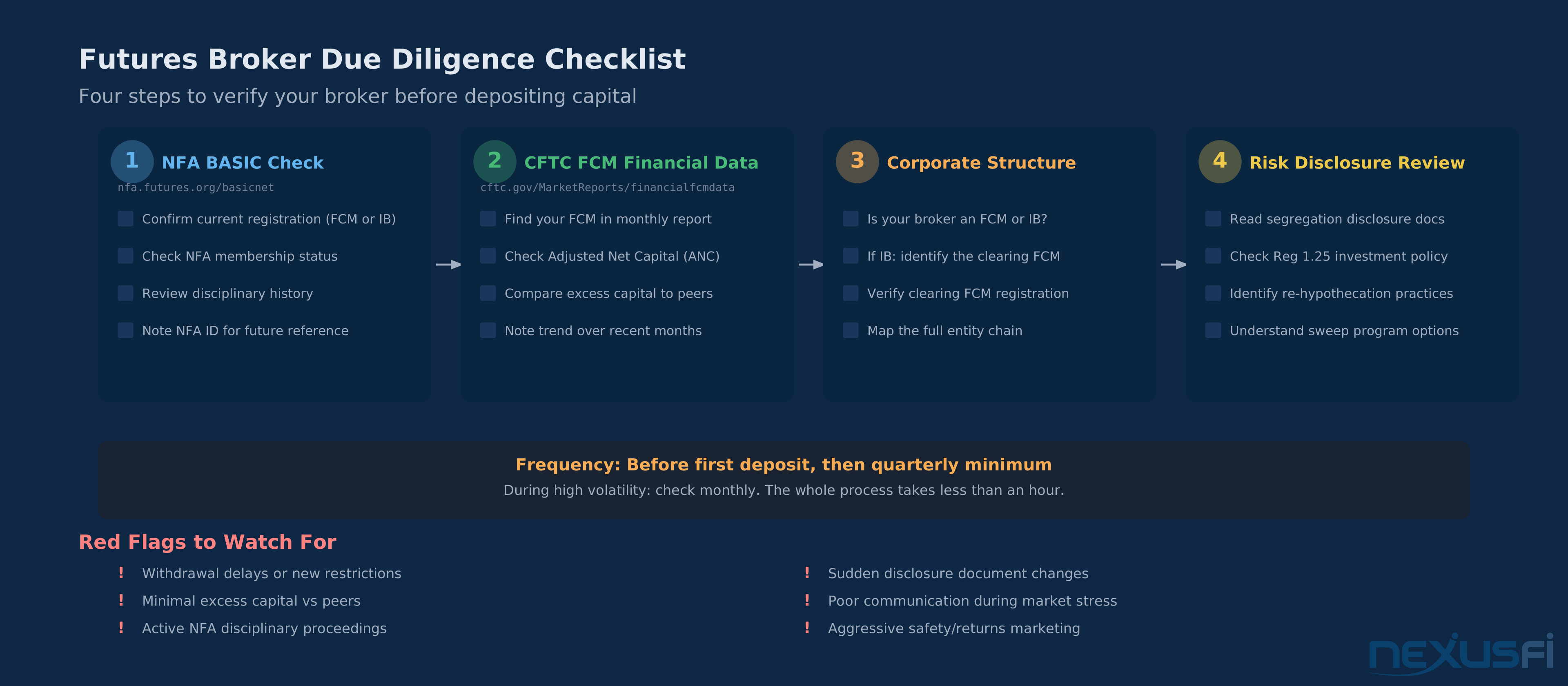
The verification process takes less than an hour and should be done before depositing significant capital at any new broker, and periodically thereafter.
Step 1: NFA BASIC Check
Go to nfa.futures.org/basicnet. Search for your broker by firm name or NFA ID. Confirm current registration status, membership type (FCM or IB), and check for any disciplinary history. Suspensions, fines, and NFA arbitration awards are all listed. An IB registration means you need to identify the clearing FCM separately.
Step 2: CFTC FCM Financial Data
Go to cftc.gov and work through to the monthly FCM financial data reports. Find your broker (or the clearing FCM if your broker is an IB). Check excess net capital, the ratio of excess capital to customer funds on deposit, and compare against peers. Note the trend
Step 3: Corporate Structure
Understand exactly who holds your money. Is your retail-facing broker an FCM or an IB? If it's an IB, which FCM clears the trades? Can you independently verify the clearing FCM's registration? For multi-entity structures, identify every entity in the chain.
Step 4: Segregation Disclosure Documents
FCMs are required to provide customers with risk disclosure documents that explain how customer funds are held, which instruments they're invested in under Regulation 1.25, and what re-hypothecation practices apply. @Arch cited NinjaTrader Clearing's customer disclosure directly: the FCM's segregated funds are "commingled and are not held in individual accounts in each customer's name."[5] That's standard and expected
Red Flags #
These don't guarantee a problem, but each warrants immediate investigation.
Withdrawal delays or new restrictions. If your broker adds friction to withdrawals
Inability to independently verify balances. If you can't independently confirm your account balance and transaction history without relying solely on the broker's own reporting, you have a verification gap.
Sudden changes in disclosure documents. FCMs update their risk disclosures occasionally for routine compliance reasons. Sudden, unexplained changes to how they describe their use of customer funds or their investment practices are worth a direct call.
Minimal excess capital. An FCM consistently near its regulatory minimum isn't necessarily insolvent, but it has a thin buffer. Cross-check against peers in the CFTC data.
Active NFA disciplinary proceedings. Check BASIC for open matters, not just historical ones. An open investigation is material information.
Aggressive marketing around safety or returns. Firms that emphasize their own safety record as a primary marketing message are sometimes doing so because it's their most vulnerable point. The strongest FCMs don't need to advertise that they haven't stolen customer funds.
International Brokers #
Non-US futures brokers operate under different regulatory frameworks
The FTX collapse illustrated what happens when customers rely on unregulated international entities.
[4] FTX isn't a futures broker in the traditional sense, but the structural lesson applies: jurisdiction determines what rules apply and what recourse exists when things fail.
The UK historically allowed unlimited re-hypothecation of customer assets
The key question for any non-US broker: under which regulatory regime is your protection actually enforceable? If the FCM is incorporated in a jurisdiction with minimal financial regulation, your rights in a bankruptcy proceeding are governed by those laws, not CFTC rules.
For US traders using non-US brokers for CME or other US exchange access, verify whether the entity holding your funds is CFTC-registered. Some foreign brokers are registered with the CFTC as FCMs for business with US customers. Those that aren't are operating outside the US regulatory framework entirely.
Practical Protection Steps #
Given the actual risk structure, these are the steps that matter.
Diversify across FCMs for significant capital.
[2] There's no specific threshold where this becomes mandatory, but traders with more than $100,000 at a single FCM should at minimum understand the logic of concentration risk and make a deliberate decision about it.
Use sweep programs when available. If you're trading with a dual-registered broker-dealer that offers SIPC sweep, understand how it works and whether the operational tradeoff makes sense for your capital size. For traders holding significant idle cash, it's the only mechanism that approaches insurance-level protection.
Keep only necessary trading capital at the FCM. Don't leave months of excess margin sitting at a broker because it's convenient. Move capital back to FDIC-insured bank accounts when you don't need it for active positions.
Monitor CFTC FCM reports quarterly. Set a calendar reminder. The check takes 15 minutes once you know where to look.
Understand the IB vs FCM distinction. If you're trading through an IB, identify the clearing FCM and do your due diligence on that entity. Your retail-facing broker's marketing and customer service quality tells you nothing about the financial health of the FCM holding your money.
Read the risk disclosure documents. Every FCM provides them. Most traders never read them. They specify exactly what the FCM does with customer funds under Regulation 1.25 and disclose any re-hypothecation practices. Five minutes of reading eliminates surprises.
Citations #
Knowledge Map
Prerequisites
Understand these firstGo Deeper
Build on this knowledgeReferences This Article
Articles that build on this topicCitations
- — Futures Broker Due Diligence Notes post PFG (2012) 👍 82“IB re-pledged or re-sold $7.9 billion of $16.7 billion of available client funds.”
- — Class Action Lawsuit: AMP Global Clearing LLC (2020) 👍 21“There are only 8 FCMs that have lower excess capital than AMP, out of 64 FCMs in the report.”
- — Is Amp at risk of going under? (2020) 👍 7“There is NO INSURANCE for funds deposited at an FCM.”
- — What if a broker declare bankruptcy!!! Ftx first whose next? (2022) 👍 6“In the US Customer Funds are required to be held in a separate segregated account.”
- — NinjaTrader Clearing Risks (2024) 👍 5“Futures commission merchants commingle the funds received from customers.”
- — Edge Clear futures broker www.edgeclear.com (FT71) (2020) 👍 5“As an IB, we do not hold the customer segregated funds account.”