



Spread Trading Tools and Platform Features for Futures: Evaluating Platform Capabilities for Calendar, Intermarket, and Crack Spreads
Overview #
Spread trading in futures — simultaneously holding long and short positions in related contracts to profit from changes in their price relationship — is one of the oldest and most widely practiced strategies in commodity and financial futures markets. Calendar spreads, intermarket spreads, crack spreads, crush spreads, and dozens of other spread strategies trade billions of dollars daily on CME, ICE, and other major exchanges.
But here's the problem that most retail traders encounter: the trading platform designed for outright futures speculation often handles spread trading poorly. The features that make a platform excellent for directional ES or CL trading — fast order entry, clean charting, sharp DOM — are necessary but insufficient for spread traders. Spread traders need synthetic spread symbols, ratio-aware P&L calculations, spread-specific order types, and charting tools that display the price difference between legs rather than the legs themselves.
Spread trading in futures — simultaneously holding long and short positions in related contracts to profit from changes in their price relationship — is one of the oldest and most widely practiced strategies in commodity and financial futures markets.
This article explains what spread trading requires, how to evaluate whether a platform supports it properly, and what the key features are that separate spread-capable platforms from ones that force you to manage everything manually.
Types of Spreads and Their Platform Requirements #
Understanding what your platform needs starts with understanding which spread types you'll be trading. Each has distinct display, order management, and charting requirements.
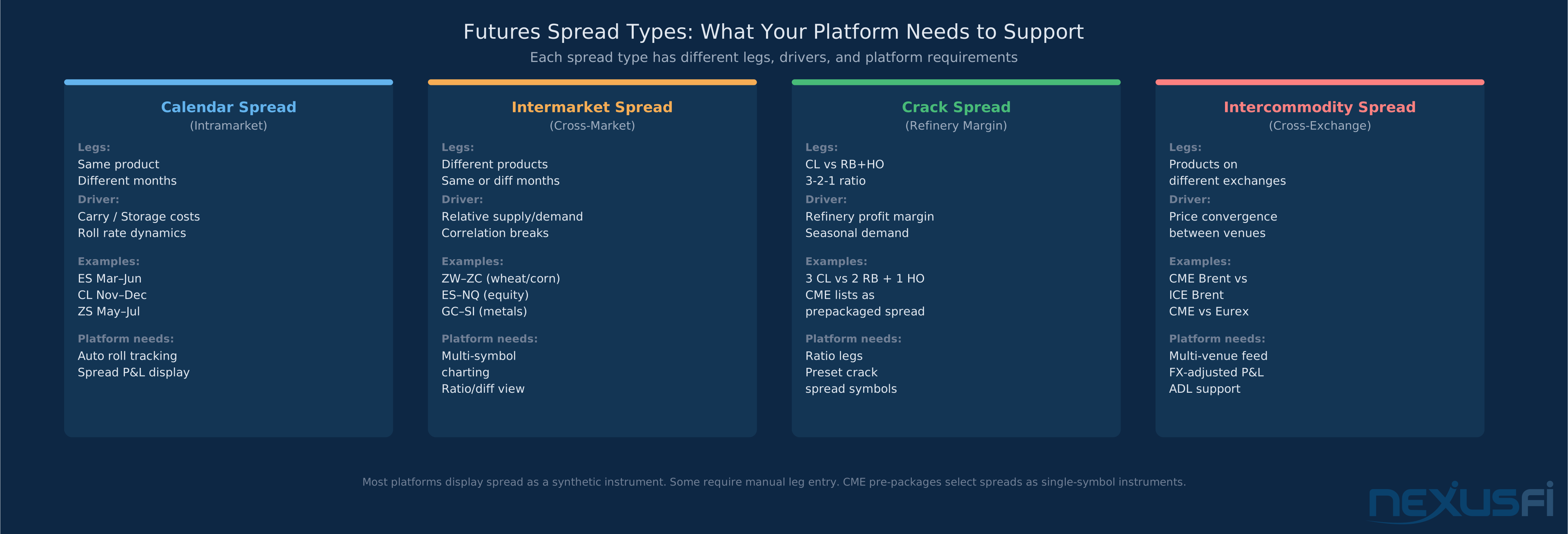
Calendar Spreads (Intramarket Spreads) #
A calendar spread involves simultaneous long and short positions in the same underlying product but different delivery months. The simplest version: long December corn, short March corn. The spread price is the difference between the two contract prices.
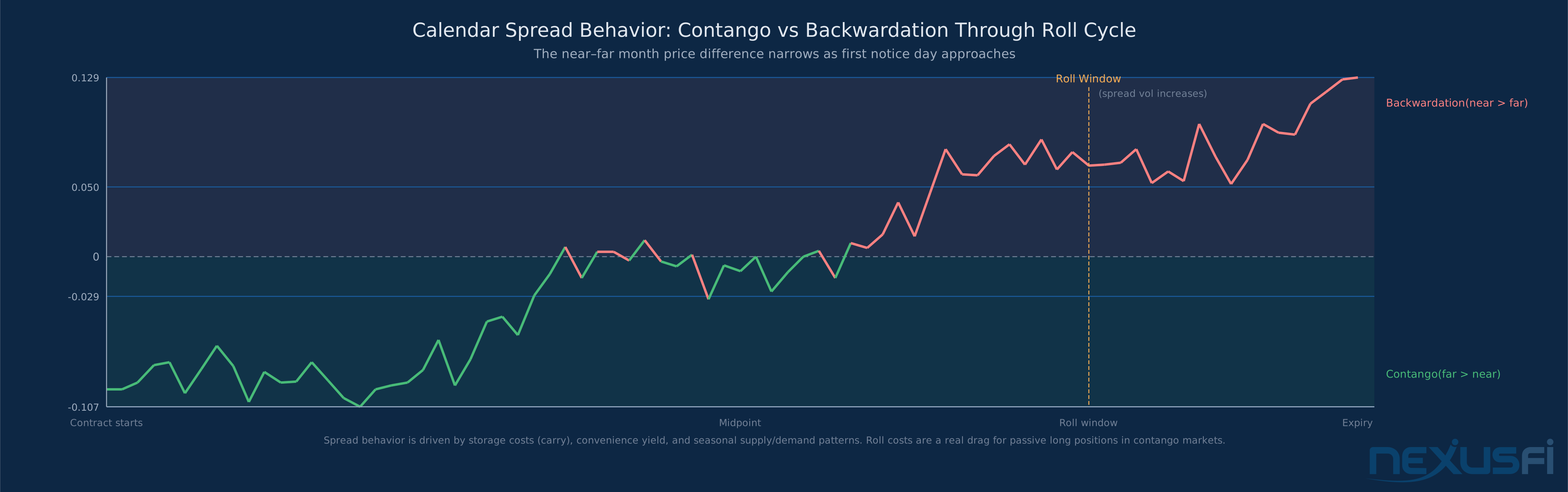
Economic rationale: Calendar spreads reflect the cost of carrying inventory forward in time — storage costs, interest, and convenience yield. In commodities, these costs create predictable seasonal structures that generate tradeable opportunities. In financial futures, calendar spreads track the roll cost between contract months.
Platform needs:
- Native spread symbols that show the price difference directly (most CME calendar spreads have dedicated spread symbols)
- Automatic P&L calculation as the spread moves
- Spread-specific DOM or order entry showing the net price
- Roll alerts when the front month approaches first notice day
CME offers spread instruments for most major products — the "Calendar Spread" symbol for ES, CL, GC, and others lets you trade both legs as a single order, eliminating the execution risk of entering legs sequentially.
Intermarket Spreads (Cross-Market Spreads) #
Intermarket spreads trade two different but related products simultaneously. Wheat/Corn (ZW/ZC), ES/NQ, Gold/Silver (GC/SI), and crude oil versus natural gas are common examples.
Economic rationale: Related products move together over time but diverge temporarily due to supply/demand imbalances, seasonal factors, or event-driven shocks. The spread captures the relative value between them.
Platform needs:
- Multi-symbol charting that displays the spread (A minus B, or A/B ratio) rather than individual prices
- Ability to define custom spread formulas (some pairs require non-1:1 ratios)
- Simultaneous leg entry with minimal fill lag between legs
- Correlation analysis tools
Unlike calendar spreads, intermarket spreads often don't have exchange-native symbols. You're typically building the spread synthetically across two separate order entries.
Crack Spreads #
Crack spreads trade crude oil against its refined products — gasoline (RB) and heating oil (HO). The standard crack spread is the 3-2-1: buy 3 crude oil contracts, sell 2 RBOB gasoline contracts, sell 1 heating oil contract. The spread represents the refinery profit margin.
Economic rationale: When refineries are running at capacity, crack spreads are tight (crude and product prices converge). Supply disruptions, seasonal demand peaks, or extreme crude price moves push the spread to extremes that eventually revert.
Platform needs:
- Support for ratio spreads (3-2-1 requires 3 CL, 2 RB, 1 HO — not equal legs)
- CME pre-packages crack spread instruments (CL/RB, CL/HO, and 3-2-1 versions) — platform should display these
- Seasonal spread calendars or overlays showing typical crack spread behavior
Intercommodity Spreads (Cross-Exchange) #
Trading related products on different exchanges adds complexity. CME crude oil versus ICE Brent crude, or CME natural gas versus European TTF gas, are examples.
Platform needs:
- Multi-venue data feeds (often requires separate subscriptions for each exchange)
- FX-adjusted P&L when contracts are denominated in different currencies
- Simultaneous routing to different clearinghouses
Most retail platforms support single-exchange spread trading well but handle cross-exchange spreads poorly. Professional ADL (algorithmic design language) platforms like CQG or FlexTrade are better suited for this level of complexity.
Core Platform Features for Spread Traders #
Native Spread Symbols vs Synthetic Construction #
The most important decision when evaluating a platform for spread trading: does it support exchange-native spread symbols, and does it allow you to build synthetic spread instruments from individual legs?
Exchange-native spread symbols (CME calendar spreads, crack spreads):
- Single order entry for both legs simultaneously — eliminates leg risk
- Displayed with a single spread price, not two individual prices
- Lower margin than outright equivalent (spreads get reduced margin recognition)
- The most reliable way to ensure simultaneous fill
Synthetic spread construction (required for intermarket spreads):
- Platform combines two separate contracts into a single display instrument
- You define the formula: e.g., ZW00 - ZC00 (wheat spot minus corn spot)
- Platform computes a synthetic "spread price" from the two individual prices
- Order entry still requires placing two separate limit orders — sequential execution risk remains
Good spread platforms support both. Bad ones only show you individual contracts and require you to manually track the relationship in a spreadsheet.
Spread-Specific Order Types #
Limit Spread Orders #
A limit spread order specifies the maximum you'll pay for (or minimum you'll receive for) the spread, not the individual legs. For example: "Buy the Dec/Mar ES calendar spread at -0.25 points or better" means you want the December contract at a price that's no more than 0.25 points below March. The exchange (for native spreads) or the platform (for synthetic spreads) matches legs simultaneously at the required differential.
Without limit spread orders, you're entering two separate limit orders, which creates leg risk: the first leg fills while the second misses, leaving you with a naked outright position you didn't want.
Leg Legging Strategies #
Some platforms let you specify which leg to "leg first" — which individual contract to try to fill before triggering the second leg. This is an advanced strategy for improving execution quality on synthetic spreads where native spread symbols don't exist.
Spread vs Outright Display #
When you hold a calendar spread, what you want to see in your P&L panel is the spread profit — not two separate P&L lines that partially offset each other. A proper spread-enabled platform shows:
- The net spread position (e.g., "Long 2 Dec/Mar ES calendar spread at -1.50")
- The current spread price (updated in real time)
- The spread P&L in dollars
A platform that shows you "Long 2 ES Dec @ 4850, Short 2 ES Mar @ 4851.50" without a combined view makes spread management substantially harder.
Spread Charting #
Charting is where most platforms designed for outright trading fall short for spread traders. You need:
Spread price chart: A single chart showing the price difference or ratio between two contracts over time. Not two overlaid charts — a single series that plots (leg A price) - (leg B price) or (leg A price) / (leg B price).
Seasonal overlay: For commodity spreads, the ability to overlay current year spread behavior against historical seasonal patterns. The typical December/March corn spread follows a well-documented seasonal pattern — platforms that include historical seasonal charts help you identify whether the current spread is at historically extreme levels.
Roll tracking: Automatic adjustment as the front month approaches expiry. A well-designed calendar spread chart should continue without a break when the spread rolls from (e.g.) Dec/Mar to Mar/May.
Ratio charts: For intermarket spreads that require ratio normalization (e.g., gold vs silver is more meaningfully expressed as GC/SI ratio than GC-SI difference, because the prices are different orders of magnitude).
Most generic futures platforms (including well-regarded ones designed for outright trading) handle spread charting poorly. You often need to:
- Use a dedicated spread analysis platform or add-on
- Build custom indicators that calculate the spread within your primary platform
- Use a separate tool (spreadsheet, Python analysis) for strategy development, then execute in your primary platform
Reduced Margin for Spreads #
Exchanges recognize that calendar spreads carry less directional risk than outright futures positions. CME publishes "inter-month spread credits" that reduce the SPAN margin requirement when both legs of a spread are held simultaneously.
Example: Holding one long ES December and one short ES March requires substantially less margin than holding two outright ES contracts, because the positions partially offset each other's directional risk.
Platform requirement: Your platform and FCM must properly apply spread margin credits. Some FCMs or platforms charge full outright margin for each leg, failing to recognize the offset. This can unnecessarily tie up capital or trigger margin calls that wouldn't exist under proper spread margining.
Auto-Roll Features #
For traders holding positions across contract expirations, automatic roll handling is critical.
Continuous contracts: Some platforms create "continuous" price series for charting purposes by stitching together successive contracts. But there are multiple stitching methods (back-adjusted, ratio-adjusted, unadjusted) that produce very different-looking historical charts. Understand which method your platform uses.
Roll alerts: The platform should flag when your open position is approaching first notice day or last trading day and provide easy roll order entry to move the position to the next contract month.
Spread position roll: For calendar spread positions, rolling forward means simultaneously entering the next spread while closing the current one — a "butterfly" roll. Platforms that support this as a single multi-leg order reduce execution risk substantially.
Platform Comparisons for Spread Traders #
Not all futures platforms treat spread trading equally. Here's a framework for evaluating them:
What to Look For #
Data feed: Does the platform subscribe to exchange spread data (not just outright contract data)? Exchange spread data shows actual spread trades, not just synthetic calculations. This matters for liquidity assessment and price validation.
Leg ratio support: Can you define non-1:1 spreads? Crack spreads (3:2:1), crush spreads (10:11:9 in grain markets), and some commodity spreads require ratio-aware position management.
Historical spread analysis tools: Can you access years of historical spread data at daily or intraday resolution? Some platforms restrict spread history or only show the "most recent" contract spread rather than continuous data.
Order entry for spreads: Is there a dedicated spread order entry panel, or do you have to enter legs separately in the standard order entry window?
Integration with technical analysis: Can you apply standard technical indicators (moving averages, RSI, MACD) to the spread chart, not just the outright leg charts?
Spread scanner/screener: Can the platform scan across multiple spread combinations to identify those trading at historically extreme levels? This is especially valuable for calendar spread traders monitoring the term structure across many commodities.
Common Limitations in Otherwise Solid Platforms #
Many platforms that excel for outright futures trading have known spread limitations:
DOM-focused platforms: Price ladder tools designed for lightning-fast outright execution often handle spread display and order management awkwardly. You can typically execute spread orders, but the visualization is suboptimal.
Single-exchange platforms: Platforms optimized for CME Group products may handle CME-native spread symbols beautifully but have no support for ICE spreads or cross-exchange strategies.
Script-based platforms: Platforms where all features are programmed through proprietary scripting languages can handle spread logic — but only if someone has written the spread indicator or strategy. Check whether your platform has community-contributed spread tools.
Mobile trading apps: Most mobile trading interfaces for futures provide poor spread support. Order entry for two-leg strategies on a small screen is awkward, and spread visualization is often absent.
Reading Spread Charts: What Makes Them Useful #
Term Structure Curves #
Rather than a single price chart of one contract, spread traders often analyze the entire term structure — the prices of all listed contract months simultaneously. This shows:
- Contango: Far months priced higher than near months (normal in financial and most commodity markets). The curve slopes upward.
- Backwardation: Near months priced higher than far months (occurs when physical supply is tight). The curve slopes downward.
- Seasonal kinks: Unusual pricing patterns at specific contract months that reflect known seasonal supply/demand changes (e.g., heating oil premium in fall/winter months).
A term structure chart lets you identify where the curve is at historically extreme levels and which calendar spread (which pair of months) offers the best risk/reward.
Spread vs Seasonal #
The most powerful analysis tool for commodity calendar traders: a chart showing the current year's spread behavior plotted against the historical average (seasonal norm) and historical range for the same calendar dates.
When the current spread is at the low end of the historical range for this time of year, it's statistically cheap. When it's at the high end, it's statistically expensive. This doesn't guarantee reversion, but it quantifies the deviation from historical norms.
Some platforms include seasonal analysis built in; others require external tools (Moore Research Center, SeasonAlgo, or custom programming).
Support and Resistance in Spread Charts #
Spread charts often exhibit cleaner technical levels than outright futures because:
- Macro noise (general market direction) is partially netted out
- The spread reflects a specific economic relationship rather than general sentiment
- Seasonal patterns create recurring support/resistance at predictable times of year
Standard technical analysis — trend lines, moving averages, key level identification — applies to spread charts just as it does to outright charts.
Common Spread Trading Mistakes #
Ignoring leg risk during entry: Entering legs sequentially (first fill, then try to fill the second) exposes you to the market moving between fills. Using exchange-native spread order types eliminates this risk for eligible spreads.
Misunderstanding contract multipliers: CL (crude oil) is 1,000 barrels per contract; RB (RBOB gasoline) is 42,000 gallons per contract. These are not 1:1 in notional value. Proper spread construction requires calculating dollar-equivalent exposure per leg.
Forgetting about delivery mechanics: Calendar spreads held into the delivery window behave differently — the front month may lose liquidity rapidly. Most spread traders close positions well before first notice day.
Confusing price spread with dollar P&L: A one-cent move in ZW-ZC is worth $50 (ZW tick value is $50/cent) from the wheat leg but $50 from the corn leg as well. Understanding the actual dollar P&L per spread price move requires knowing each contract's tick value.
Poor platform selection: Trying to trade spread strategies on a platform that only shows outright prices is like trying to work through with a compass that only points in cardinal directions. Use the right tool for the job.
Decision Framework for Platform Evaluation #
When evaluating whether a platform is adequate for spread trading, work through these questions:
Can I enter both legs simultaneously? For exchange-native spreads: yes, if the platform supports native spread symbols. For synthetic spreads: only with leg-legging strategies or automated multi-leg order entry.
Does the platform show me the spread price, not just individual prices? Essential for position management. If you see two P&L lines instead of one spread P&L, the platform is not spread-optimized.
Can I chart the spread price history? A spread chart showing (Leg A price - β × Leg B price) over 2-5 years is essential for strategy development.
Does the FCM apply spread margin credits? Confirm this with your broker. Improper margin treatment on spreads can much impact capital efficiency.
Does the platform support the specific spread type I need? Calendar spreads: nearly universal. Crack spreads: requires ratio leg support. Cross-exchange spreads: limited platform support, usually requires specialized tools.
Spread trading offers genuine statistical edges in futures markets — the economic relationships that create spreads are fundamental and persistent. But capturing those edges requires matching your trading tools to the strategy's requirements. A platform that excels for outright trading may provide only frustration for spread-focused strategies.
Knowledge Map
Go Deeper
Build on this knowledgeReferences This Article
Articles that build on this topicCitations
- — Spreads brokers? (2019) 👍 7
- — Seasonal Trades (2021) 👍 2
- — commodity spreads (2018) 👍 5
- — SpreadPlanner review - seasonal trading (2023) 👍 2
- — Treasury Spreads - Beginner Questions (2021) 👍 2
- — Spread / Pairs Trading - the allure and the reality (2013) 👍 13