



Statistical Arbitrage Systems for Futures: Pairs Trading, Mean-Reversion Strategies, and the Math Behind Spread Trading
Overview #
Statistical arbitrage is the systematic exploitation of temporary pricing inefficiencies between related instruments. In futures markets, where multiple contracts on related assets trade simultaneously across global exchanges, these relationships are abundant — and the traders who can identify, model, and execute on them with discipline occupy a genuine edge.
The core premise is simple: related assets tend to move together over time. When they temporarily diverge, that divergence creates a trading opportunity. When the relationship reasserts itself, the trade closes at a profit. Done well, statistical arbitrage produces returns that are largely uncorrelated with market direction — you don't need the market to go up or down, just for the spread between two related instruments to revert to its historical mean.
In futures markets, where multiple contracts on related assets trade simultaneously across global exchanges, these relationships are abundant — and the traders who can identify, model, and execute on them with discipline occupy a genuine edge.
The execution, however, is anything but simple. Statistical arbitrage requires building quantitative models, testing cointegration relationships, managing multiple simultaneous positions, and executing both legs of a spread with minimal slippage. This article covers how it works in futures markets, the mechanics of the most common approaches, and the practical realities that separate successful programs from expensive experiments.
Key Concepts #
Cointegration — A statistical property where two price series share a long-run equilibrium. Cointegrated pairs don't move in lockstep (that's correlation) but are bound by a relationship that causes their spread to be mean-reverting over time. Formally, two I(1) price series are cointegrated if a linear combination of them is I(0) — stationary. This is the mathematical foundation for pairs trading.
Spread — The price difference (or ratio) between two related instruments. In futures stat arb, the spread is typically: Spread = Price_A - β × Price_B, where β is the hedge ratio that balances the dollar exposure between legs.
Hedge Ratio (β) — The multiplier applied to the second leg of a spread to equalize dollar exposure across both legs. If ES is at 5,000 and NQ is at 18,000, and you want $1 of NQ exposure per $1 of ES, the hedge ratio accounts for tick size, contract multiplier, and current price differences.
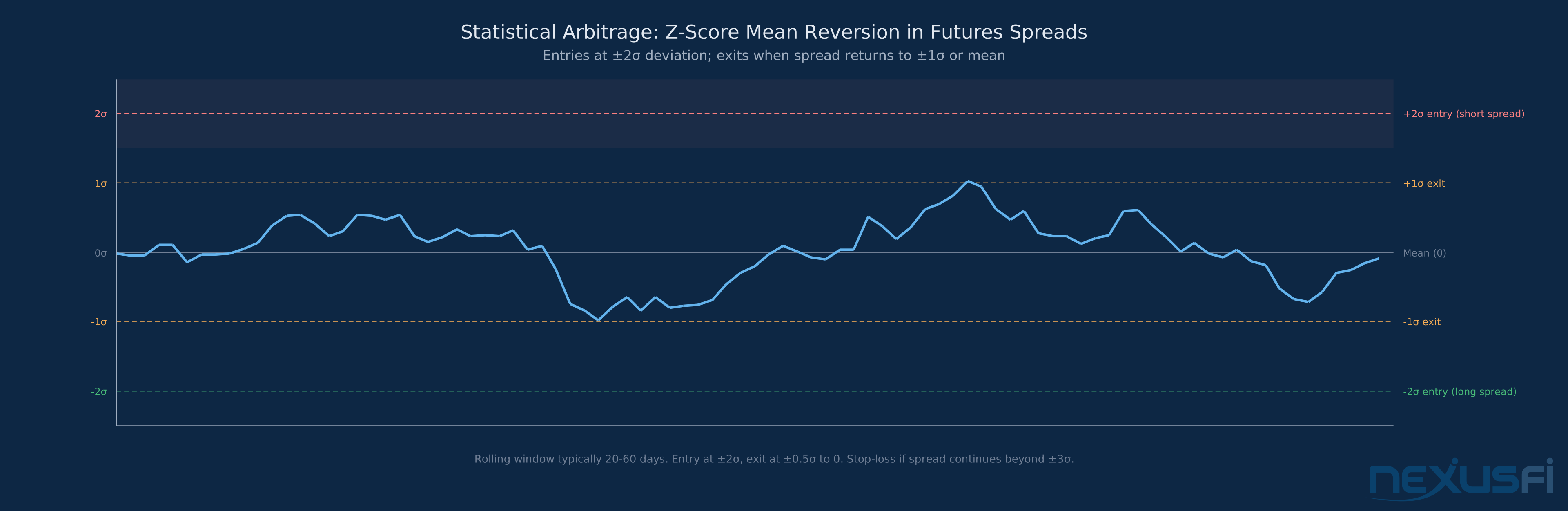
Z-Score — The current spread value expressed in standard deviations above or below its rolling mean. Z = (Spread - Rolling_Mean) / Rolling_Std. A z-score of +2 means the spread is 2 standard deviations above its recent average — statistically unusual and potentially a shorting opportunity.
Mean Reversion — The tendency of a spread to return to its historical average after deviating. Mean reversion is what makes statistical arbitrage work. Without it, you're just entering random positions and hoping the market moves in your favor.
Half-Life — The expected time for a spread to revert halfway to its mean. Shorter half-lives mean faster trades and less exposure to regime changes. A spread with a 5-day half-life is typically tradeable; a 60-day half-life means capital is tied up for two months per trade, which substantially affects returns.
Ornstein-Uhlenbeck Process — The mathematical model most commonly used to describe mean-reverting spreads. The OU process defines how a spread reverts to its mean at a rate θ, with volatility σ, and a long-run mean μ. Half-life = ln(2) / θ.
Regime Change — When the fundamental relationship between two instruments breaks down, destroying the cointegration that made the spread tradeable. This is the primary risk in statistical arbitrage. Historical cointegration doesn't guarantee future cointegration.
Why Futures Markets Are Good for Statistical Arbitrage #
Several structural features make futures markets especially attractive for pairs trading and spread strategies:
Low transaction costs. Futures commissions are among the lowest of any liquid asset class. Round-trip costs of $1-3 per contract make it economically viable to trade the tight spreads that statistical arb generates.
Standardized instruments. Every ES contract is identical. This eliminates the credit and idiosyncratic risk that complicates statistical arbitrage in equities or fixed income cash markets.
24-hour trading. CME Globex operates nearly continuously during the week. This matters because spread relationships can develop at any hour, and being able to enter and exit around the clock reduces timing risk.
Leverage. Futures margin is a small fraction of notional value. A $2,200 initial margin on an ES contract worth ~$280,000 means spreads that capture a $500 move per leg can produce significant percentage returns on capital deployed.
Physical linkages. Many futures contracts represent actual deliverable commodities or financial instruments, creating fundamental economic ties that stabilize cointegration relationships. Wheat and corn are agricultural substitutes — animals can eat either. This substitution relationship creates persistent spread dynamics that aren't purely statistical artifacts.
Testing for Cointegration #
Before trading any spread, you must test whether the relationship is actually cointegrated. Statistical confidence is non-negotiable — trading a relationship that looks cointegrated but isn't is just speculation dressed up in math.
Step 1: Identify Candidate Pairs #
Start with pairs that have economic justification for co-movement. The math should confirm what economic logic suggests.
Common economically-motivated futures pairs:
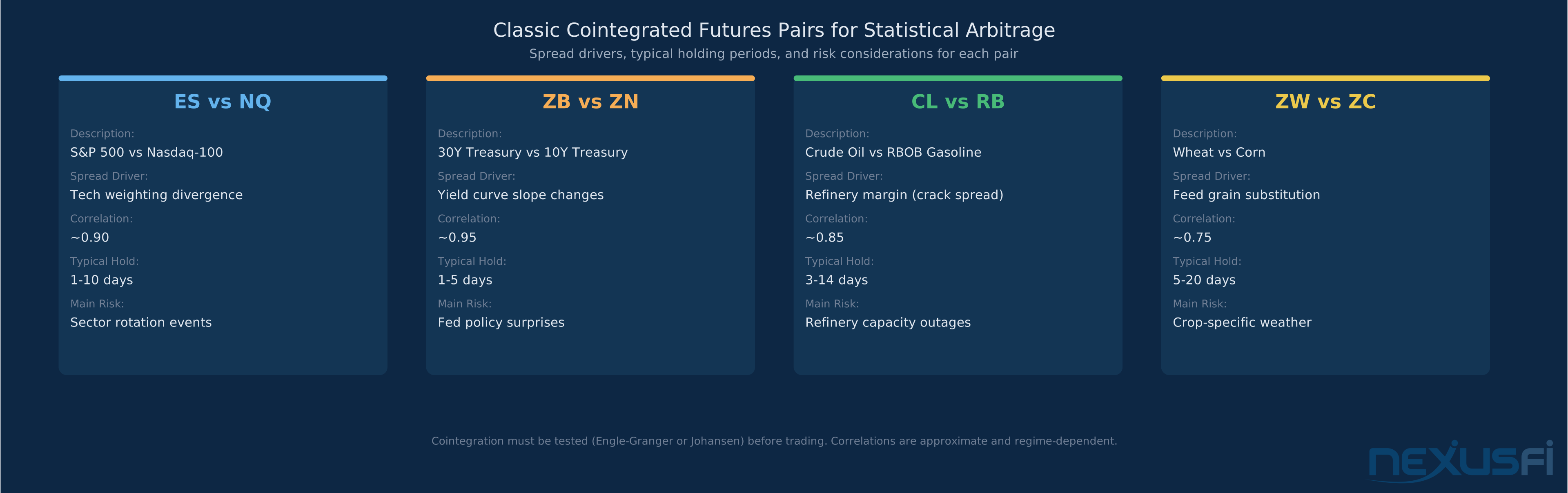
- ES / NQ: Both track large-cap U.S. equities; divergence driven by tech sector weighting
- ZB / ZN: 30-year and 10-year Treasury futures; spread reflects yield curve slope
- CL / RB: Crude oil and RBOB gasoline; crack spread reflects refinery economics
- ZW / ZC: Wheat and corn; both grains, substitutable as feed
- GC / SI: Gold and silver; both precious metals, divergence driven by industrial demand
- 6E / 6B: Euro and British pound FX futures; correlated major currencies
- NG / TTF: U.S. and European natural gas; linked by LNG arbitrage
Step 2: Engle-Granger Cointegration Test #
The most common test for two-variable cointegration:
- Regress price_A on price_B to estimate the hedge ratio β and the spread series: spread_t = price_A_t - β × price_B_t
- Apply the Augmented Dickey-Fuller (ADF) test to the spread series
- If the ADF test statistic is below the critical value (typically -2.9 at 5% significance), the spread is stationary and the pair is cointegrated
Interpretation: A stationary spread means it has a constant mean and variance over time — it reverts to the mean rather than drifting away permanently.
Step 3: Johansen Test for Multiple Variables #
When you have three or more related instruments, the Johansen test identifies all cointegrating relationships simultaneously. This is useful for portfolio-level approaches like trading a basket of correlated commodity futures.
Step 4: Estimate Half-Life #
Fit an OU process to the spread series. The half-life tells you how quickly the spread reverts and determines appropriate holding periods:
Formula: Regress Δspread_t on spread_{t-1}. The coefficient on spread_{t-1} gives you the mean-reversion speed θ. Half-life = -ln(2) / ln(1 + θ)
Practical interpretation:
- Half-life < 5 days: Short-term intraday or overnight strategy
- Half-life 5-20 days: Swing trading timeframe
- Half-life > 30 days: Position trading, high capital commitment per trade
- Half-life > 60 days: Borderline tradeable for most funds given capital efficiency concerns
The Z-Score Entry and Exit System #
Once cointegration is confirmed and the half-life is acceptable, the trading system is straightforward:
Computing the Rolling Z-Score #
- Calculate the current spread: spread_t = price_A_t - β × price_B_t
- Compute the rolling mean and standard deviation over a lookback window (typically 1-3× the half-life)
- Calculate z-score: z_t = (spread_t - rolling_mean_t) / rolling_std_t
Standard Entry/Exit Rules #
| Signal | Action |
|---|---|
| z > +2.0 | Short the spread (sell A, buy B) |
| z < -2.0 | Long the spread (buy A, sell B) |
| z crosses ±1.0 | Exit half position (partial profit) |
| z returns to 0 | Exit remaining position (full profit) |
| z exceeds ±3.5 | Stop-loss exit (relationship may be breaking) |
Why ±2σ? Statistical theory says a z-score exceeding ±2 occurs only ~4.5% of the time in a normal distribution. If the spread is truly mean-reverting, these extreme deviations represent high-probability entry points. The further the deviation, the higher the expected return on mean reversion.
Why not ±3σ? Waiting for ±3σ means fewer but higher-confidence trades, but also means you'll miss many trades and often enter right when the relationship is breaking down (distribution tails are fat in real markets, and extreme moves sometimes indicate regime change rather than opportunity).
Dynamic Position Sizing #
Most professional programs don't use fixed position sizes. Instead, they scale position size to z-score magnitude: larger deviation → larger position, up to a cap.
A common approach: units = min(floor(|z| / 2 × base_units), max_units)
At z = 2.0: base_units. At z = 3.0: 1.5× base_units. At z = 4.0: 2× base_units. Never more than 2× base regardless of z.
Classic Pairs and Their Drivers #
ES vs NQ: The Equity Index Spread #
The E-mini S&P 500 and E-mini Nasdaq-100 track different segments of U.S. equities. The S&P is cap-weighted across 500 large-caps; the Nasdaq is concentrated in mega-cap tech. In normal markets, they move near-identically. During tech sector rotations, the spread diverges.
Long ES / Short NQ (NQ outperforming by too much): Bet that tech premium reverses, broader market catches up. Long NQ / Short ES (NQ underperforming): Bet that tech catches up to broader market.
The hedge ratio shifts over time as the tech weighting in each index changes. Recalculate quarterly. During high-beta tech rallies (growth outperformance), the cointegration temporarily weakens — spreads can stay wide longer than expected.
ZB vs ZN: Treasury Curve Spread #
30-year T-Bond (ZB) and 10-year T-Note (ZN) futures track different points on the Treasury yield curve. Their spread reflects the slope of the yield curve — the difference between long and short rates.
Long ZB / Short ZN (2s30s flattener): Bet long rates fall relative to intermediate rates — typically in a recession or flight-to-safety environment. Long ZN / Short ZB (steepener): Bet long rates rise relative to intermediate — typically when inflation expectations increase or Fed signals future rate cuts without immediate action.
Dollar value of a basis point (DV01) must be equalized between legs. ZB has a higher DV01 than ZN, so the hedge ratio is approximately 0.6-0.7 ZB per 1 ZN.
CL vs RB: The Crack Spread #
Crude Oil (CL) and RBOB Gasoline (RB) are linked by refinery economics. The crack spread — the difference between gasoline prices and crude oil prices — represents refinery profit margin. When refineries are running at capacity, the margin is thin. Supply disruptions, seasonal demand peaks (summer driving), or extreme crude price moves can push the spread to extremes.
The standard crack spread is the 3-2-1: buy 3 crude contracts, sell 2 gasoline contracts, sell 1 heating oil contract. CME lists pre-packaged crack spread instruments that eliminate leg execution risk.
ZW vs ZC: The Wheat-Corn Spread #
Wheat and corn are substitute feeds for livestock. When the wheat/corn price ratio diverges much from historical norms, livestock producers substitute the cheaper grain. This substitution demand creates mean reversion in the spread.
Historical ratio: Wheat typically trades at 1.2-1.5× the price of corn. When the ratio exceeds 2.0 or drops below 1.0, substitution economics eventually reassert themselves.
Risk Management for Futures Statistical Arbitrage #
Stop-Loss Design #
The hardest decision: when to exit a position that's moving against you. If the spread is widening, it could be:
- Temporary noise — it will revert (don't exit)
- Slow reversion — it will revert, but later (stay patient)
- Regime change — it's not reverting (exit immediately)
Most programs use a stop-loss at z = ±3.5 or ±4.0. Beyond that level, the statistical case for reversion weakens and the risk of regime change increases.
Time-based stops: If a position hasn't reverted within 3× the half-life, the spread is behaving unusually. Consider reducing or exiting regardless of z-score.
Correlation-Aware Portfolio Management #
When running multiple pairs simultaneously, correlations between them matter. If you're long 5 equity index spreads during a market dislocation, they may all gap against you simultaneously. True statistical arbitrage diversification means selecting pairs with uncorrelated spread dynamics.
A useful rule: Don't hold more than 30% of portfolio risk in pairs from the same sector or driven by the same macro factor.
Liquidity Risk #
Both legs must be executable. If one leg is illiquid, you can't enter or exit at modeled prices. Execution slippage on the spread can eliminate the statistical edge in tight spreads.
Minimum liquidity requirement: Both instruments must have sufficient open interest and average daily volume to absorb your position size with less than one tick of average slippage per leg.
Transaction Costs vs Edge #
Statistical arb edges in futures are typically small — 1-3 ticks per leg per trade. After round-trip commissions and slippage, you need spreads where the z-score entry is wide enough to leave profit after costs.
A rough calculation: If your spread has a $100 expected reversion profit and two legs cost $10 each in commissions + slippage, you need a minimum $20 net profit — only achievable if the expected reversion is much larger than your cost.
Technology Requirements #
Data Requirements #
- Tick-level price data for both instruments (for intraday strategies)
- Historical time series for cointegration testing (typically 2-5 years)
- Synchronized timestamps — mismatched data creates spurious spread values
- Corporate action adjustments for equity index futures (roll data for continuous contracts)
Execution System Architecture #
Statistical arbitrage requires near-simultaneous execution of both legs. In highly liquid markets like ES/NQ:
- Sequential execution works fine if the spread is wide relative to bid-ask
- Simultaneous execution via DMA with a low-latency connection is better
- Exchange-native spread instruments (where available) eliminate leg-entry risk entirely
Signal Latency #
For short half-life spreads (< 5 days), signal latency matters. If your z-score calculation runs on minute bars with a 30-second delay, you're entering at a much worse price than a system computing in real time.
Backtesting Statistical Arbitrage #
Overfitting is the primary hazard. Statistical arb backtests are especially susceptible because:
- In-sample data mining: Testing many pairs and selecting the best-looking ones biases results
- Lookback contamination: Using future data to estimate the cointegration relationship or z-score parameters
- Survivorship bias: Testing only pairs that still exist and are still correlated today
- Transaction cost underestimation: Paper models often assume perfect fills at mid-price
Proper backtesting protocol:
- Identify candidate pairs using economic logic first (not in-sample optimization)
- Split data: cointegration test in-sample, execute strategy out-of-sample
- Use realistic slippage assumptions (at least 0.5-1 tick per leg for liquid futures)
- Apply out-of-sample forward testing for at least 6 months before live trading
- Check for stability: does the cointegration relationship remain significant across multiple sub-periods?
Common Mistakes #
Not re-estimating hedge ratios. The optimal hedge ratio between two instruments changes as prices, volatilities, and correlations evolve. A hedge ratio estimated two years ago may not minimize spread variance today. Recalibrate quarterly at minimum.
Ignoring regime changes. When cointegration breaks, spreads can trend for months. A stop-loss at 3-4σ is essential — don't wait for "eventual reversion" that may not come in your trading timeframe.
Trading low-liquidity pairs. The math might be perfect, but if you can't execute both legs efficiently, the theoretical edge disappears in execution costs.
Single-pair concentration. Running one or two pairs means one regime change can destroy the portfolio. True statistical arbitrage runs 10-30 pairs simultaneously with genuine diversification across sectors.
Confusing correlation with cointegration. Two instruments can have high correlation (they move in the same direction most of the time) without being cointegrated (the spread between them can drift permanently). Correlation is not a sufficient condition for pairs trading.
Decision Framework #
| If You're Building... | Key Requirement | Primary Risk |
|---|---|---|
| Equity index spreads (ES/NQ) | Real-time data, DMA execution | Tech sector regime change |
| Treasury curve spreads | DV01-balanced hedging | Fed policy surprises |
| Crack spreads | Seasonal adjustment | Refinery capacity events |
| Grain spreads | Weather data integration | Crop-specific supply shocks |
| FX currency spreads | FX volatility awareness | Central bank interventions |
Statistical arbitrage in futures is one of the few strategies where the edge is genuinely systematic rather than sentiment-based. The work is in model development, testing, and strong risk management — not in predicting where the market is going. When implemented carefully with proper cointegration testing, realistic cost modeling, and disciplined stop-loss execution, futures pairs trading remains one of the most durable systematic strategies available to individual and institutional traders alike.
Knowledge Map
Go Deeper
Build on this knowledgeReferences This Article
Articles that build on this topicCitations
- — Half-life over Cointegration? (2025) 👍 3
- — Spread / Pairs Trading - the allure and the reality (2013) 👍 7
- — Is anyone actually making money? (2023) 👍 6
- — Spread / Pairs Trading - the allure and the reality (2013) 👍 3
- — NT7 and R (2010) 👍 3