|
Turin + Italy
Posts: 201 since Feb 2020
Thanks Given: 26
Thanks Received: 138
|
The History of the American Stock Exchange is described here:
https://www.history.com/topics/us-states/wall-street-timeline
https://www.nyse.com/history-of-nyse
https://en.wikipedia.org/wiki/New_York_Stock_Exchange
https://www.nyse.com/publicdocs/American_Stock_Exchange_Historical_Timeline.pdf
In summary:
In 1792 the Buttonwood Agreement was drawn up, formalizing the association between merchants, traders, and speculators in the late 18th century who gathered in the shade of a large American sycamore tree (see image). This was the beginning of the Exchange, which for the first few years was held in the Tontine Coffee House, located near the famous plane tree at the intersection of Wall Street and Water Street.
Founding Wall Street
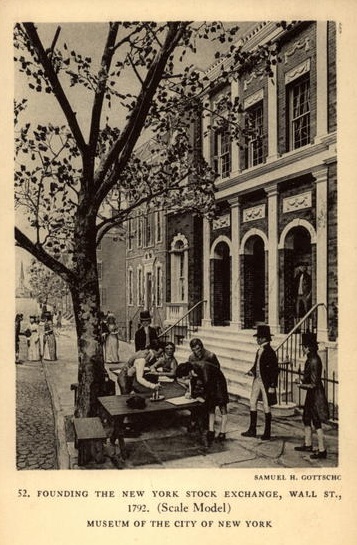
March 8, 1817: The members of the Buttonwood Accord adopted a charter creating the New York Stock & Exchange Board, the precursor to today's NYSE.
1867: The stock ticker is first launched on Wall Street. The number and variety of securities traded at the NYSE steadily increased as America grew.
When telephones were installed at the NYSE in 1878, the market became even more efficient.
New York Stock Exchange in 1882:
New_York_Stock_Exchange_1882

On December 15, 1886, trading volume exceeded 1 million shares for the first time.
The Dow Jones Industrial Average (DJIA) was introduced on May 26, 1896, and although the DJIA is the best known, it was not the first of the Dow indices.
1903: The modern New York Stock Exchange building is opened on Broad Street and Wall Street (the later periods you can read about in the links I have indicated to you above).
I think the Site: https://stooq.com/ just wanted to merge the historical data from 1792 with the current S & P 500 (which was introduced in 1957, but the origin of the S&P 500 goes back to 1923, when Standard & Poor's introduced a series of indices that included 233 companies) and since it had to name the data file with only one name, he chose precisely: S & P 500.
I think it is to be appreciated a Site that offers free long-term historical data of: World Indices, Stocks, Commodities,...etc....
|






 Have a good weekend!