



Binary Outcome Trading: How Yes/No Event Contracts Work on Kalshi, Polymarket, and the New Prediction Market Exchanges
Overview #
Binary outcome trading is the simplest form of derivatives trading in existence. You pick an event. You decide if it'll happen or not. You buy a contract. If you're right, you get a dollar. If you're wrong, you get nothing.
That's it. No Greeks, no delta hedging, no complex payoff curves. Just yes or no — and the market tells you what it thinks the odds are through the price.
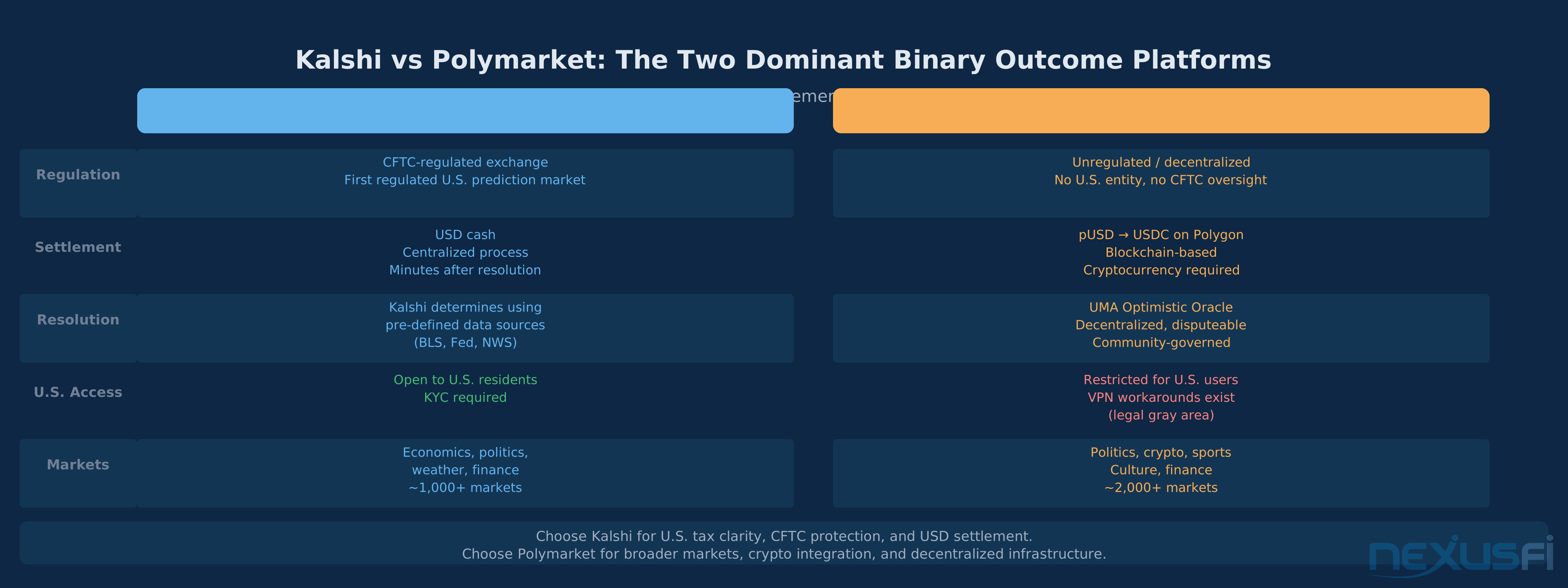
Platforms like Kalshi, Polymarket, and Robinhood have turned this basic idea into a legitimate asset class. Kalshi operates as the first CFTC-regulated prediction market exchange in the United States, meaning it follows the same regulatory framework as established exchanges like the CME and ICE. Polymarket takes a different approach — decentralized, blockchain-based, settling in cryptocurrency. Robinhood offers prediction markets through its Prediction Markets Hub, routing orders to Kalshi's regulated exchange — so if you trade event contracts on Robinhood, you're trading on Kalshi's order book with Robinhood as the broker layer. All three let you trade on real-world outcomes, but the mechanics under the hood differ in ways that matter for your money.
This article breaks down exactly how binary outcome contracts work, how to read their pricing, how settlement happens, and what makes these instruments at the core different from the binary options you've probably been warned about.
The NexusFi community has been tracking the prediction market space since CME first launched event contracts in 2022. @bobwest was among the first to flag these instruments in the forum, digging into the parallels and key differences between exchange-listed event contracts and the offshore binary options most experienced traders had learned to avoid. Meanwhile, @trendisyourfriend raised the fundamental question that every newcomer asks: how exactly do they determine the probability of each side?
Key Concepts #
What a Binary Outcome Contract Actually Is #
A binary outcome contract is a financial instrument tied to a specific, pre-defined event with only two possible outcomes: Yes or No. The key word is "specific." The event isn't vague — it's precisely defined with clear resolution criteria.
"Will the Federal Reserve cut rates at the June 2026 meeting?" That's a binary event. There's no ambiguity about what counts as a rate cut. There's no partial outcome. Either rates drop or they don't.
Every binary outcome contract has three non-negotiable elements:
- The question — a precisely worded yes/no proposition
- The resolution source — who or what determines the outcome (BLS data, Fed announcement, official temperature reading)
- The expiration — when the event resolves
Before you trade anything, read the resolution criteria. This sounds obvious, but resolution ambiguity is a unique risk in event markets that doesn't exist in traditional stock or futures trading. If the wording says "Will GDP growth exceed 2.0%?" and actual GDP comes in at exactly 2.0%, does that resolve Yes or No? The contract terms define this — and you need to know before you put money down.
How Pricing Works — Cents Equal Probability #
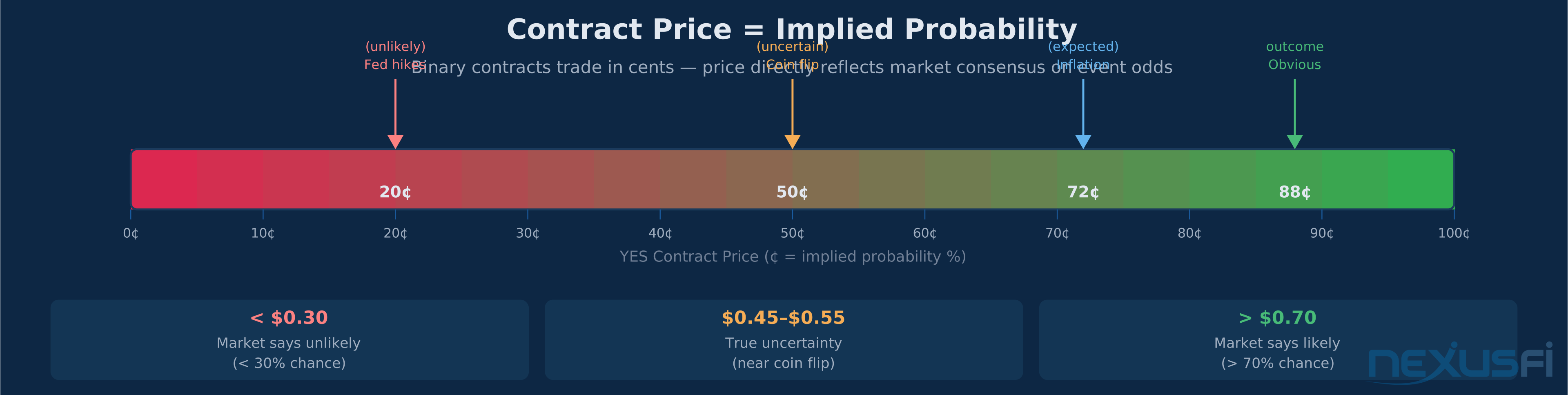
Binary outcome contracts trade between $0.01 and $0.99. The price represents the market's collective belief about the probability of the event happening.
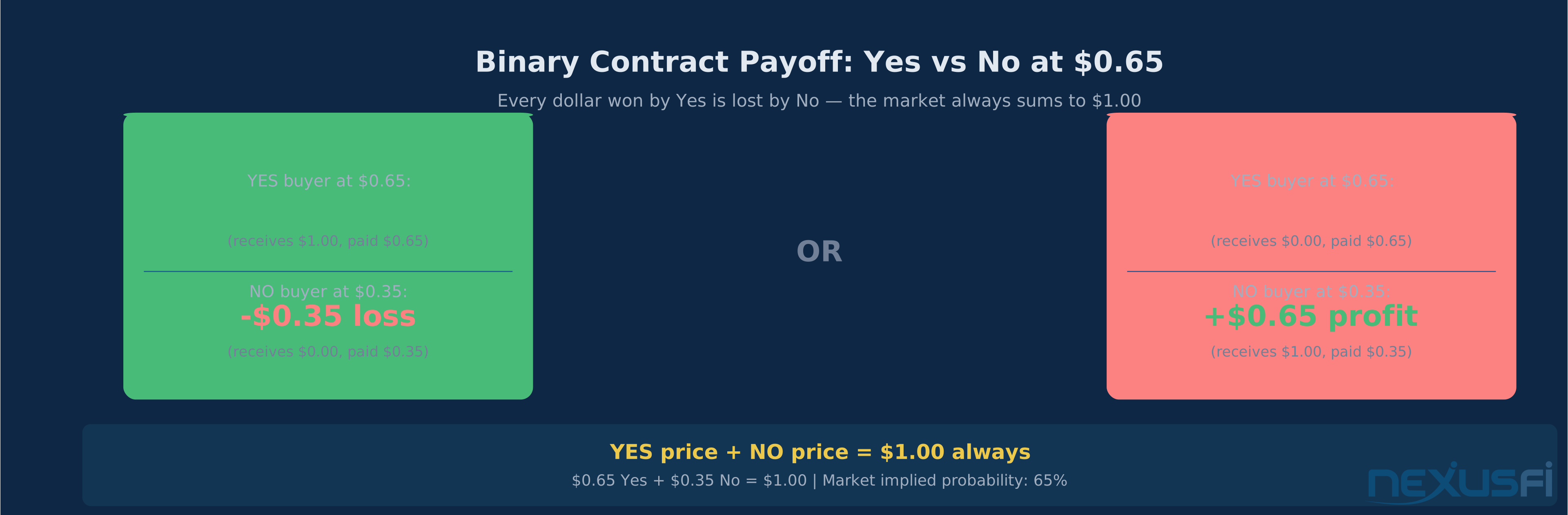
A contract trading at $0.65 means the market estimates roughly a 65% chance the event occurs. Buy it at $0.65, and if the event happens, you receive $1.00 — a $0.35 profit per contract. If the event doesn't happen, you lose your $0.65.
Here's the math, laid out clean:
| Scenario | You Buy Yes at $0.65 | You Buy No at $0.35 |
|---|---|---|
| Event happens | +$0.35 profit | -$0.35 loss |
| Event doesn't happen | -$0.65 loss | +$0.65 profit |
| Max risk | $0.65 per contract | $0.35 per contract |
| Max reward | $0.35 per contract | $0.65 per contract |
Notice something? When you buy Yes at $0.65, someone is effectively selling you that contract — they're taking the No side at $0.35. The two sides always add up to $1.00. This is the fundamental complementarity of binary markets. Every dollar won by one side is a dollar lost by the other.
NexusFi member @Laconic examined this complementarity closely and identified the critical economic question: fair value means the Yes price plus the No price should equal the payout, and any deviation defines the vig you need to overcome before profitability. Over 100 or 1,000 trades, the market maker's spread eats into your edge relentlessly — it's the single most important cost to understand before placing a trade.
There's an important caveat here though. The market price approximates probability, but it isn't a precise probability reading. Bid/ask spreads, platform fees, and liquidity dynamics all distort the raw number. A contract priced at $0.65 might represent anywhere from a 60-70% true probability once you account for the spread and the cost of trading. The thinner the market, the more that gap between displayed price and implied probability widens.
The price you pay is also your maximum loss. That hard cap on downside is what makes binary contracts at the core different from leveraged products where losses can exceed your initial stake. A $0.65 Yes contract risks exactly $0.65 — no margin calls, no gap risk, no scenario where you owe more than you put in.
Settlement — $1 or $0, Nothing in Between #
Settlement is binary. That's the whole point.
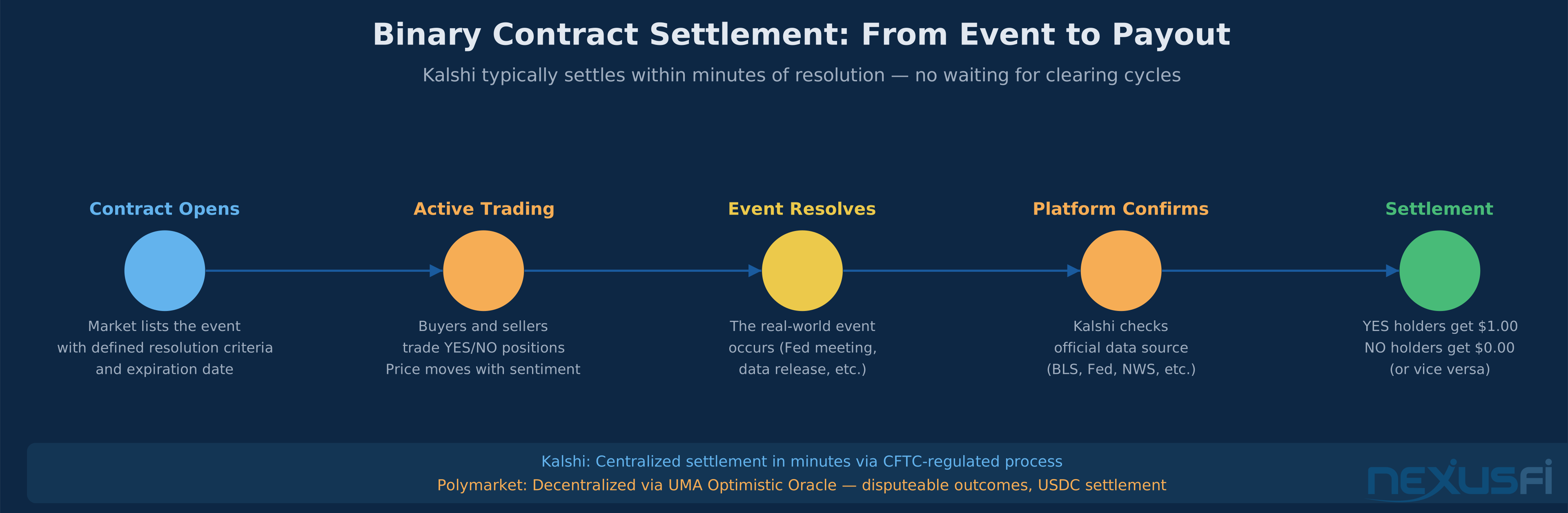
When the event's outcome is determined — the Fed announces its decision, the temperature hits a threshold, the GDP number gets published — the contract resolves:
- Yes is correct: Every Yes contract pays out $1.00. Every No contract pays $0.00.
- No is correct: Every No contract pays out $1.00. Every Yes contract pays $0.00.
On Kalshi, settlement happens in USD, typically within minutes of the event resolution. The platform references specific data sources for each contract — the Bureau of Labor Statistics for jobs data, the National Weather Service for temperature, official election results for political contracts.
Polymarket works differently. Settlement uses pUSD (Polymarket USD) as collateral, backed by USDC on the Polygon blockchain. Winning shares redeem for $1.00 in pUSD. The resolution process relies on the UMA Optimistic Oracle — a decentralized dispute resolution system where anyone can challenge a proposed outcome.
This difference matters. On Kalshi, the CFTC-regulated exchange determines the outcome using pre-specified data sources. On Polymarket, the resolution is decentralized and theoretically disputable. Different trust models for different risk appetites.
How It Works -- The Trading Mechanics #
Order Books and Price Discovery #
Binary outcome markets use order books just like stock or futures exchanges. There are buyers (bids) and sellers (asks), and the price where they meet is the current market price.
On Kalshi, you'll see a familiar order book with bids on one side and asks on the other. The platform offers three order types:
Quick Orders (Market Orders): You buy at the best available price immediately. Simple, fast, but you might get filled at a worse price than expected in thin markets. The platform walks through the order book, filling at each available price level.
Limit Orders: You specify the exact price you want. Your order sits in the book until someone matches it. More control, potentially better pricing, but no guarantee of execution.
Sell Orders: When you hold a position and want to exit before settlement. Under the hood, this is actually a buy order for the opposite direction — if you hold Yes contracts and sell them, you're effectively creating Yes/No pairs that net to $1.00.
Here's where execution risk comes in. In liquid markets — major Fed decisions, high-profile elections — spreads are tight and orders fill fast. In thinner markets — a niche weather contract, an obscure economic indicator — the spread can be 10-20 cents wide. That's 10-20% of your potential payout eaten by the spread before the event even happens.
The Yes/No Duality #
This trips up beginners more than anything else. On some platforms, you "Buy Yes" or "Buy No." On others, you "Buy" or "Sell." Same economics, different UI language.
Think of it this way:
- Buying Yes at $0.70 = You believe the event will happen. You risk $0.70 to make $0.30.
- Buying No at $0.30 = You believe the event won't happen. You risk $0.30 to make $0.70.
These are economically identical to the two sides of the same trade. If Yes trades at $0.70, No trades at $0.30 (they sum to $1.00). The platform just frames the interface differently.
You can also exit before settlement. If you bought Yes at $0.40 and the price moves to $0.70, you can sell your Yes position and pocket the $0.30 difference without waiting for the event to resolve. This is trading the probability shift, not the outcome itself.
What Drives Price Movement #
The price of a binary contract moves based on new information and changing market sentiment. The key drivers:
Scheduled data releases: Economic indicators (CPI, jobs report, GDP) have fixed release dates. Prices shift as expectations change leading up to the release, then move sharply when the actual data drops.
Breaking news: Political developments, regulatory announcements, corporate decisions — anything that changes the probability of the event.
Time decay and uncertainty compression: As an event approaches, uncertainty decreases. A contract for "Will it rain in New York on April 20?" might trade at $0.50 three weeks out but converge toward $0.90 or $0.10 as weather models firm up the day before. This isn't theta decay in the options sense — it's information resolution narrowing the probability distribution.
Order flow dynamics: Large orders can move thin markets much. A whale buying 10,000 contracts in a market with $0.05 depth will move the price dramatically. This creates both risk and opportunity.
@SMCJB raised a provocative question in the NexusFi Prediction Markets forum that gets at where these markets are heading: would traders rather trade traditional instruments like 30-Day Fed Funds futures (ZQ), or an actual event-based contract asking "Does the Fed Raise — Yes/No?" The answer likely depends on whether you're hedging (traditional futures still win) or expressing a pure directional view on a specific outcome (event contracts win). As SMCJB noted, the deeper question is who actually needs these contracts versus who merely wants to trade them — and if the answer is mostly the latter, the line between trading and gambling gets uncomfortably thin.
How This Differs from Offshore Binary Options #
This distinction matters enough to warrant its own section. Exchange-style event contracts and offshore binary options share the word "binary," but they're at the core different products.
| Feature | Exchange Event Contracts (Kalshi) | Offshore Binary Options |
|---|---|---|
| Counterparty | Other market participants via order book | The broker/house |
| Regulation | CFTC-regulated DCM (same as CME, ICE) | Often unregulated or offshore-regulated |
| Price discovery | Supply and demand among traders | Set by the platform's pricing model |
| Continuous trading | Yes — buy and sell anytime before settlement | Often fixed: buy at open, wait for expiry |
| Transparency | Full order book visible | Opaque pricing, platform controls |
| Exit flexibility | Sell position anytime at market price | Usually locked until expiration |
| Settlement | $1.00 or $0.00 per contract | Varies — fixed payouts often 70-85% |
NexusFi founder
That advice targeted offshore binary options platforms specifically — and it still holds. The regulated exchange-traded event contracts discussed here are a at the core different product, though the distinction matters enough that the NexusFi community debated it extensively when CME first launched them. @forgiven noted the payout mechanics — on CME event contracts, if the product is trending one direction and the payout exceeds the contract cost plus fees, there's an identifiable edge.
When you trade on Kalshi, you're trading against other people in a transparent marketplace. The exchange facilitates and regulates, but doesn't take the other side of your bet. When you trade offshore binary options, you're often trading against the house — and the house sets the odds.
The CFTC regulates Kalshi as a Designated Contract Market. This means segregated customer funds, regulatory reporting requirements, and legal recourse if something goes wrong. Offshore binary options platforms operate outside this framework.
Practical Application -- From Theory to First Trade #
What a Real Trade Looks Like #
Let's walk through a concrete example on Kalshi:
The Market: "Will the S&P 500 close above 5,500 on March 31, 2026?"
Current Pricing: Yes = $0.72, No = $0.28
Your Analysis: You've looked at the current S&P 500 level (trading at 5,480), recent momentum, and upcoming catalysts. You believe there's a better than 72% chance it closes above 5,500.
Your Trade: Buy 100 Yes contracts at $0.72 each
- Total cost: $72.00
- If S&P closes above 5,500: You receive $100.00, netting $28.00 profit (38.9% return)
- If S&P closes at or below 5,500: You lose your $72.00
Position Management: Two days later, positive economic data pushes the S&P to 5,550. Your Yes contracts are now trading at $0.89. You have two choices:
- Hold to settlement: If the S&P stays above 5,500 at close, you get $100. Risk is it drops back below.
- Sell now: Lock in $17.00 profit ($89.00 - $72.00) without waiting for settlement.
Risk Management Principles #
Binary outcomes create a unique risk profile. Your maximum loss is always known upfront — it's the price you paid for the contract. But there are subtleties:
Position sizing matters more than you think. With 50/50 odds and binary outcomes, you'll hit losing streaks. A simple simulation: with a 55% edge on every trade, there's roughly a 20% chance of hitting 5 consecutive losses. If each loss wipes out 10% of your bankroll, five in a row drops you by 41%.
The Kelly Criterion applies directly. For a binary outcome with probability p of winning and payout b (where b = (1-price)/price for a Yes contract), the Kelly fraction is: f = (p b - (1-p)) / b. If you estimate a 60% true probability for an event priced at $0.50 (implying 50%), Kelly says bet 20% of your bankroll. Now consider an asymmetric case: you estimate 70% true probability for a contract priced at $0.60 (market implies 60%). Here b = 0.40/0.60 = 0.667, and Kelly gives f = (0.70 x 0.667 - 0.30) / 0.667 = 25%. Even though your perceived edge is the same 10 percentage points, the asymmetric payout structure — risking $0.60 to win $0.40 — changes the optimal bet size in ways that aren't intuitive without running the math. Most experienced traders use fractional Kelly — half or quarter Kelly — because overestimating your edge destroys accounts faster than being wrong. @Fat Tails developed one of the most rigorous treatments of Kelly Criterion and risk of ruin in the NexusFi community, walking through exact calculations for adjusting bet size to risk appetite. His key insight applies directly to binary outcome trading: the calculated risk of ruin is a minimum* — there's always additional unaccounted risk from system failures, edge degradation, or changing market conditions. For event contract traders, this means defaulting to quarter-Kelly or less until you have a statistically significant sample confirming your edge.
Most experienced binary traders run quarter-Kelly or less. Your edge estimate is always less precise than you think, and overestimating that edge with full Kelly sizing is the fastest way to blow up a binary trading account. When in doubt, cut the position size in half again.
Diversification across uncorrelated events is your main edge management tool. A portfolio of 20 binary positions across different event categories (economic, weather, political, financial) will have lower variance than the same capital concentrated in 2-3 positions, assuming the events are genuinely uncorrelated.
Platform Selection Checklist #
Before placing your first trade, consider:
- Regulation: Is the platform CFTC-regulated (Kalshi directly, or Robinhood routing through KalshiEX) or decentralized (Polymarket)?
- Funding method: USD bank transfer (Kalshi) or cryptocurrency/USDC (Polymarket)?
- Market availability: What event categories does the platform cover?
- Fee structure: Kalshi uses a probability-weighted taker fee formula — fees = ceil($0.07 x contracts x price x (1 - price)). At a 50-cent contract (maximum uncertainty), the taker fee is about 1.75 cents per contract. At 10 or 90 cents, it drops to roughly 0.63 cents. Maker fees (limit orders resting on the book) are 25% of the taker rate. Kalshi charges no settlement or membership fees. Robinhood's Prediction Markets Hub adds a flat $0.01 per contract on top of the Kalshi exchange fee ($0.01), totaling $0.02 per contract regardless of price. For comparison: at a 50¢ contract, Kalshi's direct taker fee is $0.0175 — just slightly below Robinhood's flat $0.02. At high-conviction contracts near 10¢ or 90¢, Kalshi direct costs $0.0063 vs Robinhood's $0.02 — over 3x more expensive through the Robinhood layer. If you're already a Robinhood user and primarily want access to mainstream contracts (Fed decisions, elections, major sports), the convenience may outweigh the fee difference. For active event contract traders or access to niche markets, direct Kalshi is more cost-effective. Polymarket has begun rolling out taker fees on select categories at varying rates. Always factor total trading costs — fees plus spread — into your edge calculations
- Liquidity: Are the markets you want to trade actually liquid enough to enter and exit?
- Tax reporting: Does the platform issue 1099 forms? (Kalshi does, Polymarket doesn't)
Where It Goes Wrong #
Binary outcome trading looks simple. That simplicity is deceptive.
Overconfidence in probability assessment. The most common failure mode. You "know" an event will happen, so you size up. The market prices it at $0.75 (implying 75%), and you think it's 95%. But market prices aggregate the views of thousands of participants, many of them experts. When your estimate diverges sharply from the market, you're more likely wrong than right. The wisdom of crowds isn't perfect, but it's a high bar to beat consistently.
Illiquidity traps. You buy into a thinly traded contract and the price moves against you. Now you want to exit, but the bid is 15 cents below where you entered. Your theoretical max loss was the purchase price, but your practical loss includes the spread cost of exiting an illiquid position.
Resolution risk. The event outcome is ambiguous. "Will inflation exceed 3%?" — but which inflation measure? CPI? Core CPI? PCE? If you didn't read the resolution criteria and the contract uses a different measure than you expected, you can be "right" about inflation and still lose the trade.
Always read the resolution criteria before entering a position. Being right about the outcome and still losing because of definitional ambiguity is a uniquely binary-market failure mode. Check the exact data source, the exact threshold, and whether boundary values resolve Yes or No.
Late-event volatility. As events approach resolution, prices can swing wildly on last-minute information. A weather contract for tomorrow's temperature might go from $0.60 to $0.20 in an hour as weather models update. If you're in the position, that's a 67% drawdown with no time to react.
Citations
- PredScope — How to Use Kalshi: Complete Beginners Guide (2026) (2026)
- Kalshi News — What Is Kalshi? A Beginners Guide (2026)
- Polymarket Documentation — Polymarket 101 (2026)
- Polymarket Help Center — What is a Prediction Market? (2026)
- Kalshi News — Order Types on Kalshi (2022)