



Event Contracts: Binary-Outcome Derivatives, CFTC Regulation, and Where to Trade Them
What Event Contracts Are and Why They Matter #
Event contracts are derivatives that settle based on whether a specific future event happens or not. Yes or no. Binary outcome. The contract pays out a fixed amount if the event occurs, and zero if it doesn't. That's the entire product in one sentence.
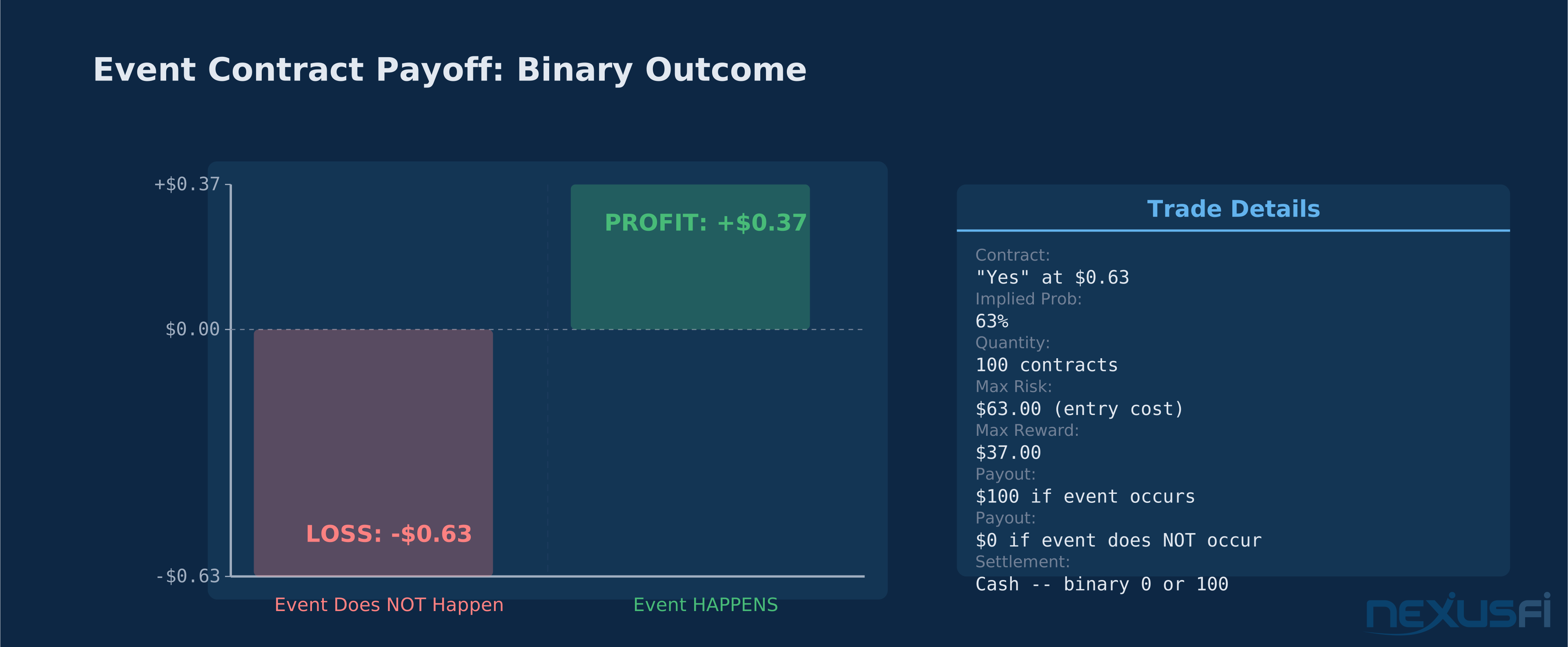
The price of an event contract at any given moment reflects the market-implied probability of that event occurring. A contract trading at $0.63 implies roughly a 63% chance the event happens. Buy "Yes" at $0.63, the event happens, you collect $1.00. Profit: $0.37 per contract. The event doesn't happen? You lose your $0.63. No margin calls, no gap risk beyond your entry cost, no partial fills at random prices. You know your maximum loss the moment you enter.
CME Group, the largest derivatives exchange on the planet, launched its first event contracts in 2022 and blew past 100 million contracts traded in just 8 weeks by early 2026.[3] That kind of volume doesn't happen because traders are confused.
This simplicity is both the appeal and the trap. The bounded payoff makes position sizing trivially easy — but it also creates a structure that can feel more like placing a bet than trading a market. CME Group, the largest derivatives exchange on the planet, launched its first event contracts in 2022 and blew past 100 million contracts traded in just 8 weeks by early 2026.[3] That kind of volume doesn't happen because traders are confused. It happens because the product fills a genuine gap in how markets express views on discrete outcomes.
How Event Contracts Work: The Mechanics #
Every event contract has five defining elements:
- Event Definition — The exact measurable condition. "Will CPI exceed 3.5% for March 2026?" or "Will the S&P 500 close above 5,800 today?" No ambiguity in the trigger.
- Settlement Source — The official authority that determines the outcome. Bureau of Labor Statistics for CPI. The exchange's official closing price for index levels. NOAA for weather data. The oracle matters — disputes usually come down to whose number counts.
- Contract Size — Typically small. $1 per point on many platforms, meaning a full contract ranges from $0 to $100 in value. This is deliberately retail-accessible.
- Settlement Time — The contract resolves immediately after the event's official determination. An election contract settles when results are certified. A CPI contract settles when BLS publishes the number. No extended trading after the fact.
- Cash Settlement — No physical delivery. The contract settles at 100 (event occurred) or 0 (event didn't occur). Gains and losses are credited or debited to your account.
Order Book and Pricing
Event contracts trade on standard limit order books — bids and offers posted at each price increment, just like any futures contract. Liquidity tends to concentrate near the consensus probability level. If the market thinks an event has a 50/50 chance, you'll see the deepest book around the $0.48-$0.52 range. Spreads are typically tight (1-2 ticks) for liquid events like U.S. elections or major economic releases, and wider for niche events like regional weather outcomes.
Market makers quote both sides and hedge through correlated instruments — holding baskets of related event contracts, overlaying with standard futures positions, or maintaining cash reserves equal to maximum potential loss. The bounded payoff actually simplifies their risk management compared to path-dependent derivatives.
What It Looks Like in Practice
Say you think the Fed will cut rates at its next meeting. The "Yes" contract is trading at $0.72 (72% implied probability). You buy 100 contracts at $0.72 each. Your maximum loss: $72. If the Fed cuts, you collect $100 — profit of $28. If they hold, you lose your $72. No margin maintenance, no overnight funding, no delta hedging. The position is fully defined at entry.
That simplicity attracts a different type of participation than traditional futures. As NexusFi member
CFTC Regulation: Why It Matters #
Event contracts traded on U.S. exchanges are regulated by the Commodity Futures Trading Commission (CFTC) as commodity futures. This is the single most important fact about this product class. It's what separates them from offshore binary options, unregulated prediction markets, and the sketchy platforms that have historically populated this space.
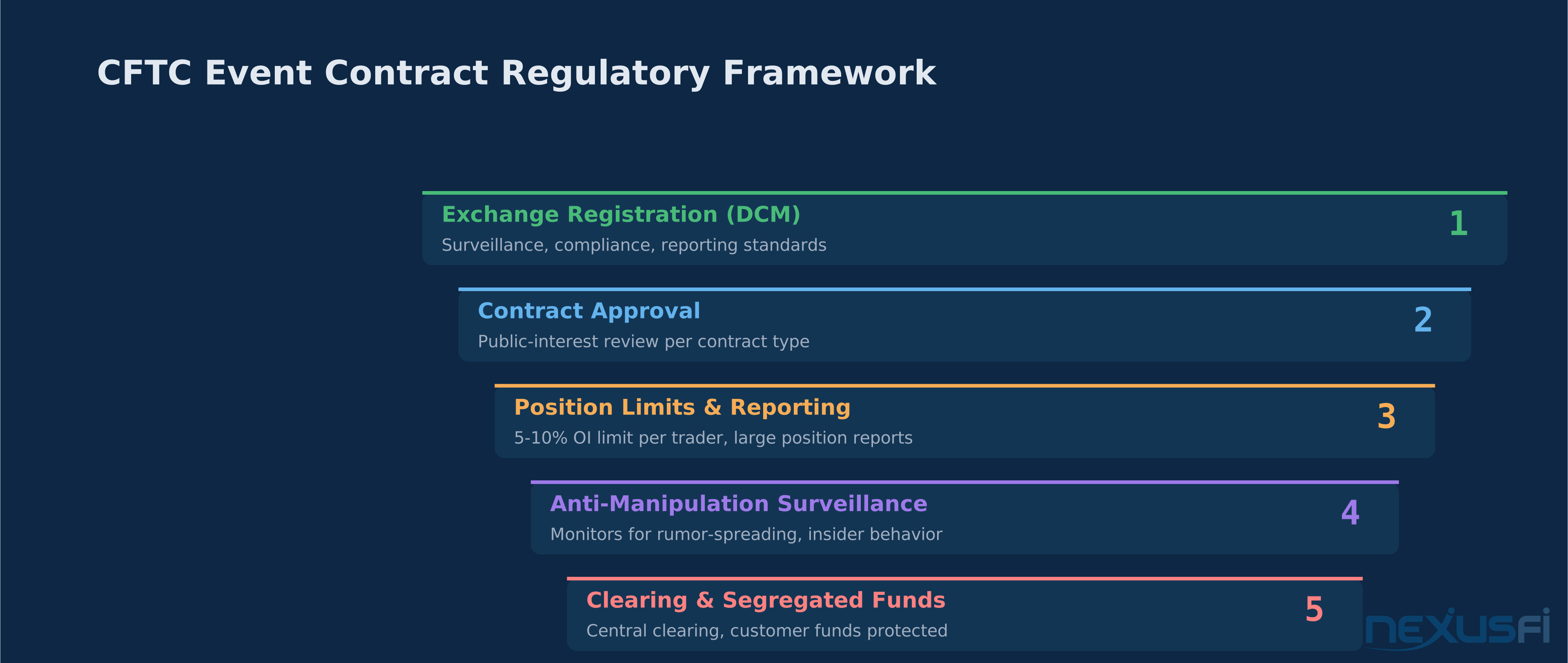
The regulatory framework requires:
- Designated Contract Market (DCM) registration — The exchange itself must register with the CFTC, demonstrating compliance with surveillance, compliance, and reporting standards. Kalshi became the first DCM built exclusively for event contracts in 2020.
- Contract-by-contract approval — Not every event is tradeable just because the exchange wants to list it. Each contract type must pass a public-interest review. This is where political contracts get controversial.
- Position limits and reporting — Participants face limits on open interest (typically 5-10% of total OI per trader) to prevent manipulation. Large positions trigger mandatory CFTC reporting.
- Anti-manipulation surveillance — Because outcomes are tied to public events, the CFTC monitors for rumor-spreading, misleading statements, and insider-type behavior designed to move the market.
- Clearing and margin — A central clearing house guarantees every trade. If a participant defaults, the clearing fund absorbs the loss — not the counterparties.
In February 2026, the CFTC withdrew a Biden-era proposal that would have effectively banned prediction markets, signaling a new regulatory direction. Chairman Michael Selig announced a four-part regulatory agenda for event contracts, with plans to draft "clear standards" rather than relying on the existing patchwork approach.[4]
The practical implication: when you trade event contracts on a CFTC-regulated exchange, your funds are held in segregated accounts, the exchange is subject to ongoing regulatory oversight, and there's a legal framework for dispute resolution. This is at the core different from trading on an unregulated platform where your counterparty might be someone's laptop in a jurisdiction with no investor protection.
The Hedging vs. Gambling Question
The central policy debate that has surrounded event contracts for two decades: are they legitimate derivatives for risk transfer and price discovery, or are they gambling products that happen to be listed on an exchange?
The answer depends entirely on what you're trading and why. A utility company buying weather event contracts to hedge revenue variability from temperature fluctuations? That's classic commercial hedging — no different in principle from a farmer hedging corn prices. A retail trader buying "Will Candidate X win the election?" contracts because they saw a TikTok? That's speculation with extra steps.
The CFTC evaluates each contract against criteria including: whether it serves a legitimate economic purpose, whether it's susceptible to manipulation, and whether the underlying event involves unlawful activity or socially harmful outcomes. This is why economic data contracts (CPI, Fed decisions) get approved more easily than political contracts.
Where to Trade Event Contracts #
Kalshi
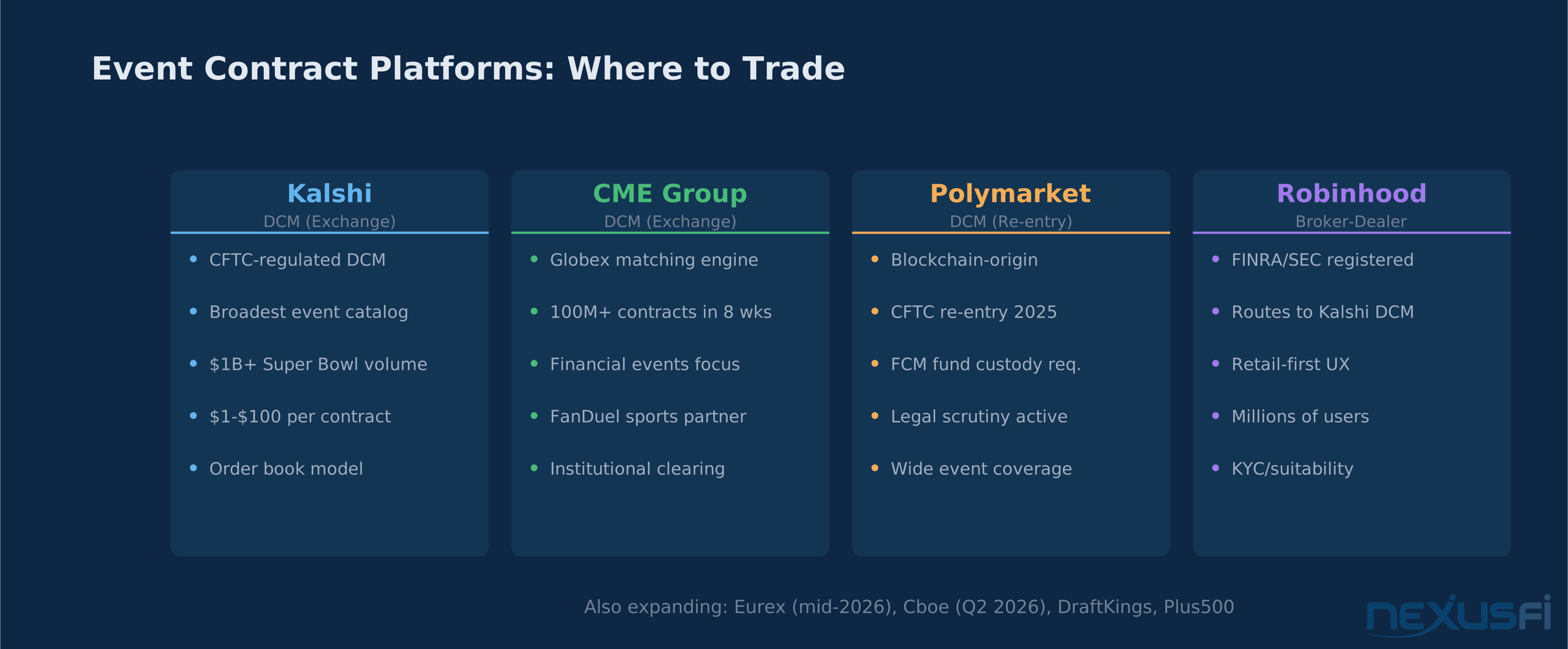
Kalshi is the defining name in event contract trading. Approved by the CFTC in 2020 as the first Designated Contract Market built specifically for event contracts, Kalshi offers markets on political outcomes, economic data releases, weather events, and more. Contract size is typically $1 per point ($0-$100 range per contract), making it accessible to retail traders.
Kalshi hit $1 billion in Super Bowl trading volume in February 2026 alone — a number that would have been unthinkable for a prediction market exchange even two years earlier.[2] The platform uses a standard order-book model with professional market makers providing liquidity.
What makes Kalshi significant isn't just the product — it's the regulatory model. By securing CFTC approval for specific contract types and building exchange-grade surveillance and clearing infrastructure, Kalshi created the template that other platforms are now following.
CME Group
CME Group entered event contracts as an extension of its existing derivatives infrastructure. The world's largest futures exchange launched event contracts in 2022, initially covering equity index, energy, metals, and currency outcomes. By 2025, CME had expanded into sports event contracts through a partnership with FanDuel[5] and was exploring broader event categories.
CME's event contracts trade on the Globex platform — the same matching engine that handles ES, NQ, crude oil, and treasuries. The advantage: deep institutional infrastructure, strong clearing through CME Clearing House, and the regulatory credibility of a 100+ year-old exchange. The disadvantage: CME's event contract catalog is narrower than Kalshi's, focused primarily on financial market outcomes rather than political or weather events.
CME blasted past 100 million event contracts traded in just 8 weeks after expanding its offerings.[3] That pace of adoption reflects institutional comfort with the product when it's listed on infrastructure they already trust.
Polymarket
Polymarket operates as a prediction market platform that returned to the U.S. market in late 2025 with CFTC approval, requiring participants to use a Futures Commission Merchant (FCM) for fund custody.[6] Unlike Kalshi's exchange model, Polymarket historically used blockchain-based settlement, though its U.S. re-entry involved adapting to traditional regulatory requirements.
Polymarket has faced legal scrutiny — including a class action lawsuit questioning whether its operations constitute CFTC-regulated event trading or state-regulated gambling.[7] The resolution of this distinction will likely shape the regulatory environment for all prediction market platforms.
Robinhood
Robinhood entered the event contracts space as a retail distribution platform, routing orders to underlying DCMs like Kalshi. Robinhood's role is primarily user access and product packaging — it's a FINRA/SEC-registered broker-dealer that must satisfy Know Your Customer (KYC), suitability, and disclosure requirements. The trading infrastructure and clearing happen at the exchange level.
Robinhood's significance is in reach, not in market structure. When a platform with tens of millions of active users offers event contracts alongside stocks and crypto, it normalizes the product class for retail participants. Whether that's good or bad depends on your view of retail participation in binary-outcome derivatives.
The Expanding Environment
The event contracts space is expanding rapidly. Eurex (Europe's largest derivatives exchange) announced plans for prediction markets targeting mid-2026.[8] Cboe is developing all-or-nothing binary options for Q2 2026.[9] Plus500 launched event contract access through a Kalshi partnership.[10] DraftKings expanded into CFTC-regulated prediction markets via Crypto.com's derivatives exchange.[11] Google opened advertising to CFTC-regulated prediction markets.[12]
The convergence is real. Traditional exchanges, fintech platforms, sports betting companies, and crypto venues are all moving into event contracts. The line between "futures exchange" and "prediction market" is blurring faster than regulators can draw it.
Types of Event Contracts #
Economic Data Contracts
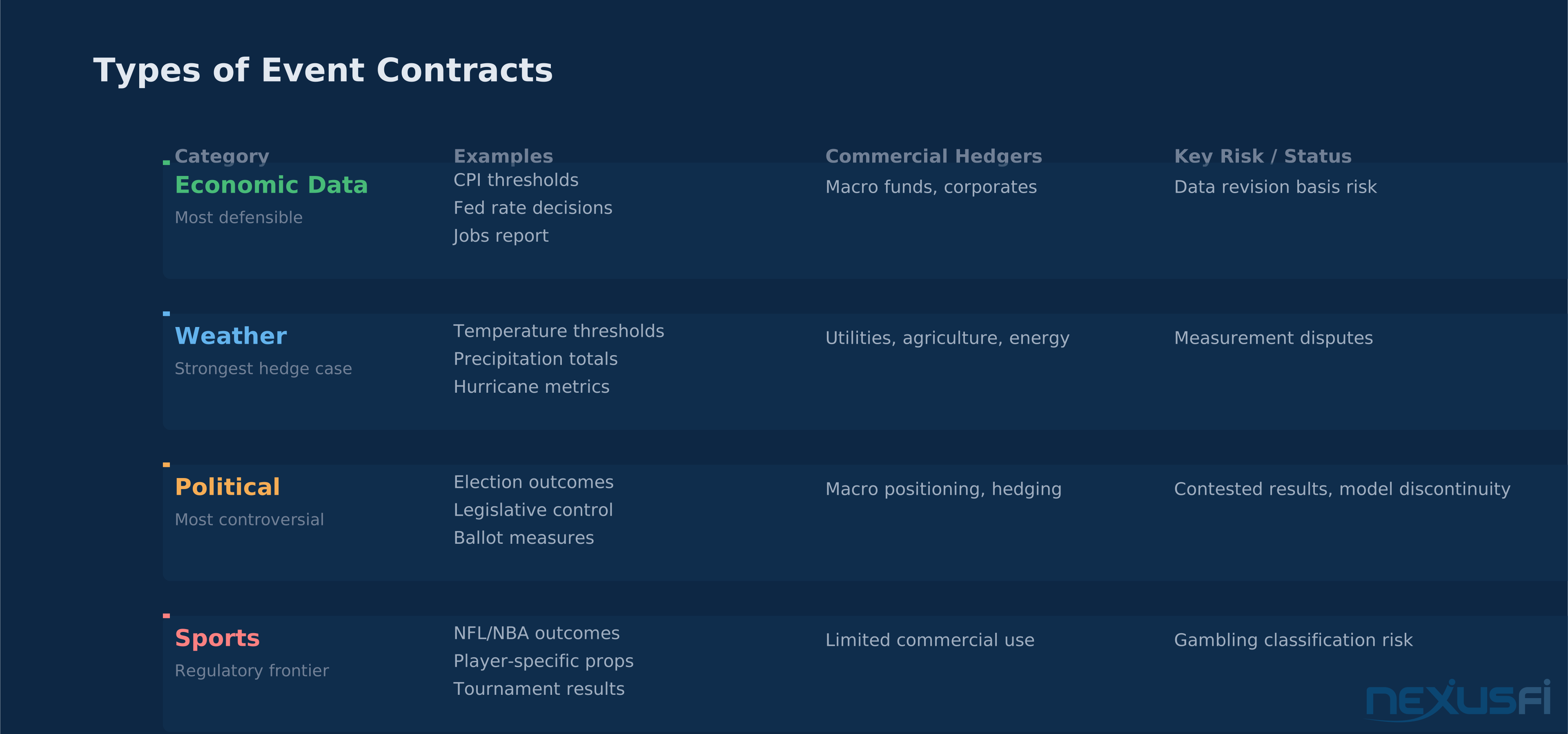
These are the most economically defensible event contracts. Will CPI exceed a certain threshold? Will the Fed cut rates? Will unemployment be above or below consensus? The outcomes are objectively measurable, published by official government agencies, and directly relevant to hedging real business exposure.
Macro traders use these to express views on data surprises. Corporates use them to hedge event-driven revenue risk. Funds structure short-duration exposure around specific data releases. One important nuance: many economic series are subject to revision. The contract must specify whether "first release" or "final revised" data governs settlement — a detail that creates real basis risk if you're not paying attention.
Political Event Contracts
Election outcomes, legislative control, ballot propositions. These generate the most volume and the most controversy. The appeal is obvious — elections are massive macro events that affect rates, equities, energy, taxes, and regulation. The controversy is equally obvious — "betting on democracy" raises legitimate public policy concerns about incentivizing manipulation.
Political event contracts face unique resolution risks: contested elections, recounts, boundary changes. The contract language must anticipate edge cases that don't exist with a simple CPI print. Model discontinuity is also extreme — a single poll surprise or debate moment can move prices violently, with liquidity evaporating at the worst possible time.
Weather Contracts
Weather derivatives are the most institutionalized type of event contract, with established measurement systems (NOAA), decades of historical data, and clear commercial hedging use cases. Temperature thresholds, heating/cooling degree days, precipitation totals, hurricane metrics — utilities, agriculture, energy companies, logistics firms, and insurers all have legitimate exposure to weather outcomes.
These contracts fit the CFTC's "legitimate hedging purpose" test more cleanly than any other event type. The measurement infrastructure is strong, the commercial users are identifiable, and the risk transfer is genuine.
Sports Event Contracts
CME partnered with FanDuel to offer sports event contracts on Globex — putting CFTC-regulated prediction markets in direct competition with state-regulated sportsbooks.[5] This raises the starkest version of the hedging vs. gambling question. A futures exchange offering contracts on NFL outcomes through the same matching engine that trades Treasury bonds and crude oil is either a natural market evolution or a category error, depending on your perspective.
Risk Considerations for Traders #
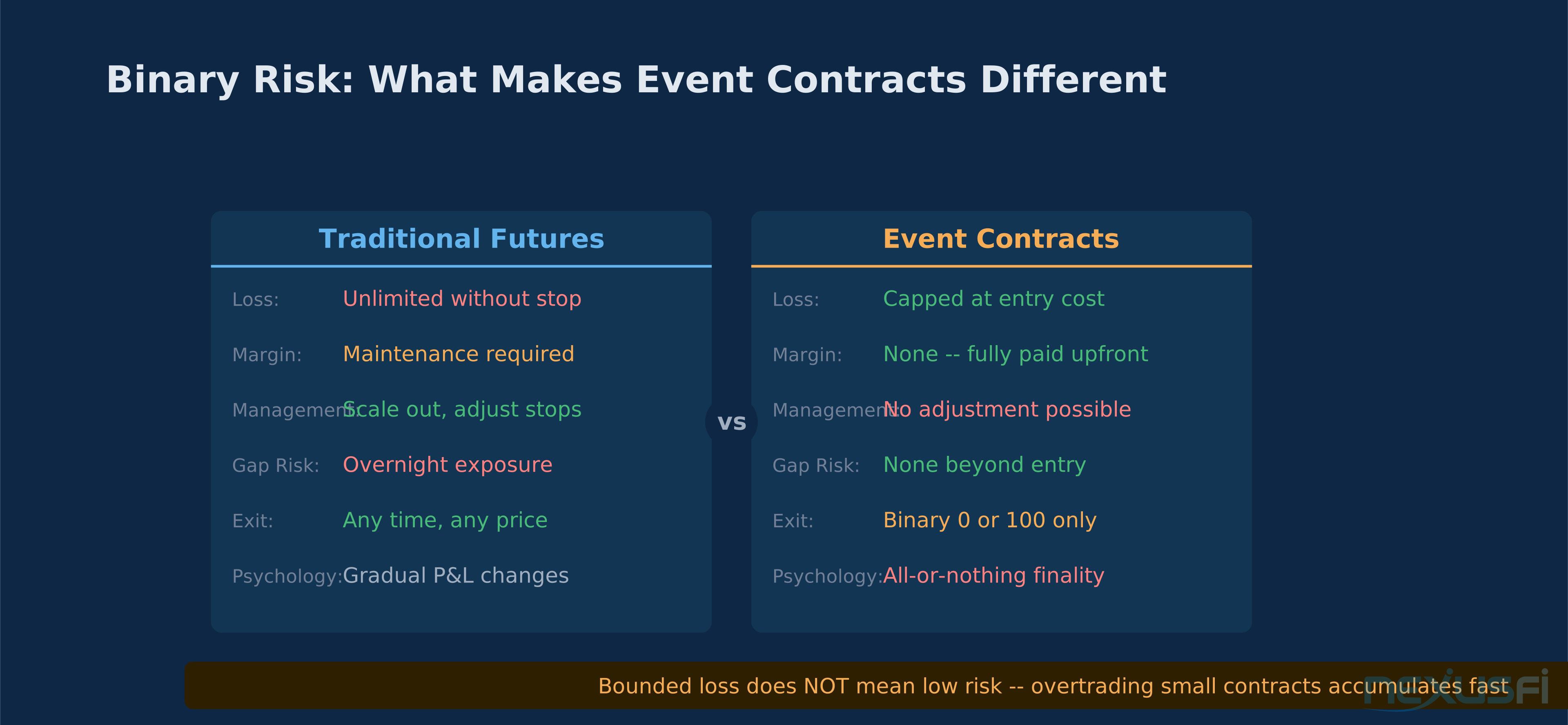
What's Different About Binary Risk
The bounded payoff profile is the defining risk characteristic. Maximum loss per contract equals your purchase price. No margin calls. No gap risk beyond what you paid. This sounds appealing until you realize the flip side: there's no ability to manage a losing position by adjusting your stop or scaling out. The event either happens or it doesn't. Your position is binary.
This creates behavioral risks that don't exist with standard futures:
- Overtrading — Small contract sizes make it easy to accumulate large notional exposure without realizing it. Fifty $10 contracts is $500 at risk.
- Probability confusion — A contract trading at $0.80 does not mean the event has an 80% chance of happening. It means that's what the market is pricing, which incorporates risk premiums, liquidity effects, and behavioral biases.
- All-or-nothing psychology — Unlike a futures position where you might recover half your loss on a partial reversal, an event contract that settles at zero returns nothing. This finality can create either excessive caution or reckless doubling-down.
Resolution Risk
The biggest operational risk in event contracts is resolution integrity — not volatility. If the contract definition is ambiguous, if the settlement source is disputed, or if edge cases arise that weren't anticipated in the contract language, the settlement process can become contentious. This is especially true for political contracts where "winner" might be disputed through legal proceedings.
Liquidity Risk
Thin markets in niche event contracts can create significant price slippage. Limit orders are essential. Monitor order book depth before entering positions. Liquidity tends to be highest for popular events (major elections, Fed decisions) and thinnest for obscure outcomes (regional weather, niche political races). Near expiration, liquidity can evaporate entirely as participants withdraw before settlement.
Practical Trading Considerations #
Event contracts work best when:
- You have a view on a specific outcome that standard derivatives don't express well
- You want precisely defined risk with no margin maintenance
- You're hedging genuine business exposure to an event outcome
- The contract definition is unambiguous and the settlement source is credible
They work worst when:
- You're treating them as a substitute for actual analysis
- You're accumulating many small positions without tracking aggregate exposure
- The contract definition has edge cases you haven't considered
- Liquidity is thin and you're taking sizes that move the market
The product has found its market. CME's 100 million contracts in 8 weeks proves demand exists. Kalshi's $1 billion Super Bowl volume proves retail engagement is real. The regulatory framework is developing in real time, with the CFTC actively shaping standards rather than banning the category. Whether event contracts become a permanent fixture of the derivatives environment or a bubble that regulators eventually constrain depends on how well the industry manages the tension between legitimate risk transfer and casual speculation.
Sources & Citations #
- bobwest on NexusFi — "Event Contracts - New Way to trade the CME Futures markets" (Nov 2022)
- Fi on NexusFi — "Kalshi Hits $1 Billion in Super Bowl Trading Volume" (Feb 2026)
- Fi on NexusFi — "CME Group Event Contracts Blast Past 100 Million Traded" (Feb 2026)
- Fi on NexusFi — "CFTC Withdraws Prediction Market Ban, Signals New Rulemaking" (Feb 2026)
- Fi on NexusFi — "CME to list Sports Event Contracts Dec'25" (Nov 2025)
- Fi on NexusFi — "Kalshi, Polymarket, Prediction Markets etc" (Dec 2025)
- Fi on NexusFi — "Kalshi, Polymarket, Prediction Markets etc" (Dec 2025)
- Fi on NexusFi — "Eurex Eyes Prediction Markets" (Mar 2026)
- Fi on NexusFi — "Cboe Eyes Prediction Markets With Regulated Binary Options" (Feb 2026)
- Fi on NexusFi — "Plus500 Futures Launches US Prediction Markets Through Kalshi" (Feb 2026)
- Fi on NexusFi — "Kalshi, Polymarket, Prediction Markets etc" (Dec 2025)
- Fi on NexusFi — "Google Opens Advertising to CFTC-Regulated Prediction Markets" (Jan 2026)
Knowledge Map
Prerequisites
Understand these firstGo Deeper
Build on this knowledgeCitations
- — Event Contracts - New Way to trade the CME Futures markets (2022) 👍 6“This seems to be similar to binary options: you bet that an instrument will be higher or lower than some level.”
- — Kalshi Hits $1 Billion in Super Bowl Trading Volume (2026)“CME Group already lists event contracts. Cboe is launching binary options in Q2.”
- — CME Group Event Contracts Blast Past 100 Million Traded (2026)“Watch for performance bond adjustments and cross-margining benefits.”
- — CFTC Withdraws Prediction Market Ban (2026)“Chairman Selig announced four-part regulatory agenda for event contracts.”
- — CME to list Sports Event Contracts (2025)“100+ year old derivatives exchange partnering with FanDuel for sports event contracts.”
- — Polymarket Returns to US with CFTC Approval (2025)“FCM requirement ensures customer funds are protected under existing CFTC framework.”
- — Kalshi, Polymarket, Prediction Markets (2025)“Is this CFTC-regulated event trading or state-regulated gambling?”
- — Eurex Eyes Prediction Markets (2026)“Nasdaq exploring binary contracts for asset prices and economic data.”
- — Cboe Eyes Prediction Markets With Binary Options (2026)“All-or-nothing options contracts designed to compete with prediction market exchanges.”
- — Plus500 Launches Prediction Markets via Kalshi (2026)“Plus500 expanded US presence by partnering with CFTC-regulated Kalshi.”
- — DraftKings Expands CFTC-Regulated Prediction Markets (2026)“First player-specific sports event contracts for NFL and NBA.”
- — Google Opens Advertising to Prediction Markets (2026)“The line between traditional futures and event contracts continues to blur.”