



Binary vs Scalar Prediction Markets: Different Contract Structures Explained
Understanding the structural difference between YES/NO binary contracts and scalar contracts that pay out based on magnitude — and why it matters for strategy.
Overview #
The vast majority of prediction market contracts are binary: a single YES/NO question with a $1.00 payout for the correct side. But a growing category of contracts — scalar contracts — have payouts that vary based on the magnitude of an outcome, not just whether it happened.
Understanding the distinction matters because the two structures have different probability estimation requirements, different risk profiles, and different optimal trading strategies.
Understanding the distinction matters because the two structures have different probability estimation requirements, different risk profiles, and different optimal trading strategies.
Binary Contracts: The Standard #
Binary contracts resolve to exactly one of two outcomes:
- YES ($1.00 per contract)
- NO ($0.00 per contract)
Every binary contract presents a yes/no question: "Will the Federal Reserve raise interest rates at the November meeting?" "Will Candidate A win the election?" "Will CPI exceed 3.5% for October?"
The YES price at any given time is the market's implied probability of the YES outcome. A price of 68¢ means the market estimates 68% probability of YES, and so 32% probability of NO.
Binary Contract Mechanics #
Your profit or loss from a binary contract depends entirely on:
- The price you paid to enter
- Whether the contract resolves YES or NO
If you bought YES at 65¢ and it resolves YES: You receive $1.00. Profit = $0.35 per contract. If you bought YES at 65¢ and it resolves NO: You receive $0.00. Loss = $0.65 per contract.
There is no partial outcome in a binary contract. Nothing in between.
Scalar Contracts: Magnitude Matters #
Scalar contracts pay out on a sliding scale based on where the outcome falls within a defined range. Instead of asking "did X happen?", scalar contracts ask "what was the value of X?"
How Scalar Payouts Work #
A scalar contract defines:
- A floor value (where payout = $0.00)
- A ceiling value (where payout = $1.00)
- Resolution: Payout = (Actual value - Floor) / (Ceiling - Floor)
Example: A CPI scalar contract with floor = 2.5% and ceiling = 4.5%:
- If CPI comes in at 2.5% → payout = $0.00
- If CPI comes in at 3.5% (midpoint) → payout = $0.50
- If CPI comes in at 4.5% → payout = $1.00
- If CPI comes in at 3.0% → payout = (3.0 - 2.5) / (4.5 - 2.5) = $0.25
Scalar vs Binary for the Same Event #
Compare how the same economic question can be structured both ways:
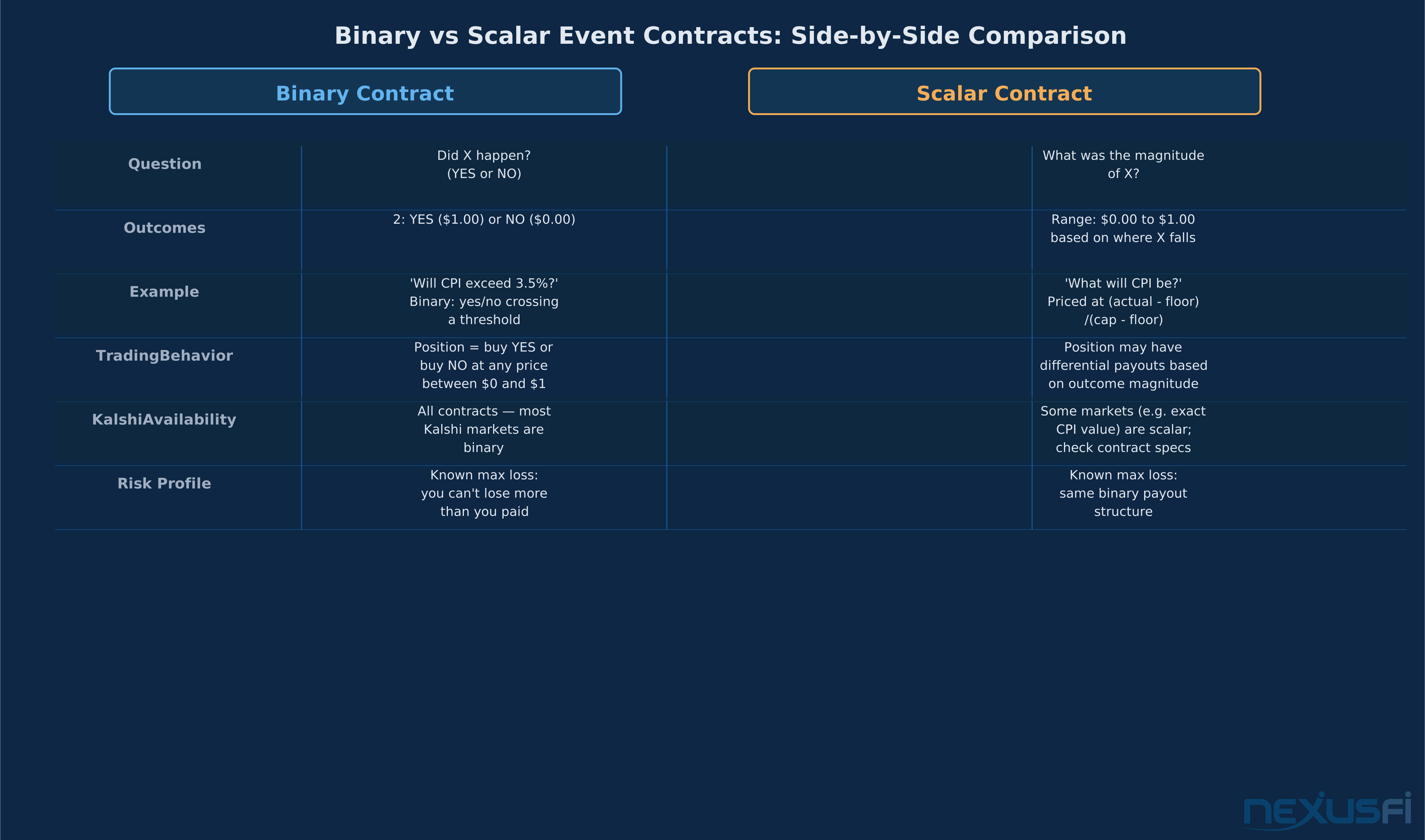
Binary version: "Will October CPI exceed 3.2%?"
- Resolves YES ($1.00) or NO ($0.00) based on a single threshold
Scalar version: "What will October CPI be?" (Floor: 2.0%, Ceiling: 5.0%)
- Resolves at a sliding payout based on exact CPI reading
- More information-rich: captures your view on magnitude, not just direction
Trading Strategy Differences #
Binary and scalar contracts require different analytical approaches.
Binary Contract Analysis #
Binary analysis answers one question: is YES more or less likely than the current price implies? Your probability estimate either beats the market (trade exists) or doesn't (skip).
The analysis is directional: you need to determine which side of the threshold the outcome will land on. Historical base rates, current trends, and specific information all feed into a single probability estimate.
Edge example: CPI consensus is 3.1%. Binary contract asks "above 3.2%?" at 35¢. You've modeled a 50% probability the actual reading exceeds 3.2%. Your edge = 50% - 35% = 15 percentage points. Clear trade.
Scalar Contract Analysis #
Scalar analysis answers a more complex question: what will the distribution of outcomes look like, and where does that put expected value relative to current price?
You need to estimate not just direction, but the full probability distribution of the outcome. The scalar contract price reflects the market's expected value, which incorporates the entire distribution.
Edge example: Scalar CPI contract (floor 2.0%, ceiling 5.0%) priced at $0.52 (implying market expects CPI around 3.6%). Your model suggests mean CPI of 3.2% with moderate upside tail. Your expected payout = (3.2 - 2.0) / (5.0 - 2.0) = 0.40. Contract priced at 0.52. You should sell (short) the contract — market is pricing CPI higher than your model suggests.
Hedging With Binary and Scalar Together #
If Kalshi offers both a binary and scalar contract on the same event, they can be used together for hedging or expressing subtle views:
- Long binary "above 3.2%" + Short high-range scalar: Profits if CPI is modestly above 3.2% but not extremely high
- Long YES "will Fed cut?" + Long low-range scalar: Profits if the Fed cuts as expected AND the subsequent data shows low inflation
Combination strategies require careful position sizing to ensure the combined payoff matches your thesis.
Resolution Precision: Binary vs Scalar #
One underappreciated difference: resolution edge cases.
Binary contracts have a single trigger. "Above 3.2%" either is or isn't above 3.2%. There's no ambiguity unless the number exactly equals 3.2% — and good contract specifications address this precisely ("strictly greater than" vs "greater than or equal to").
Scalar contracts can have more complex resolution mechanics:
- How are revisions handled? (Initial release vs. revised figure)
- What happens if the outcome falls outside the floor/ceiling range?
- Which specific data series is used (headline vs. core, seasonally adjusted vs. not)?
Read scalar contract specifications more carefully than binary contracts. The resolution formula and data source specification are load-bearing — small details determine significant payoffs.
When Binary Contracts Are Preferred #
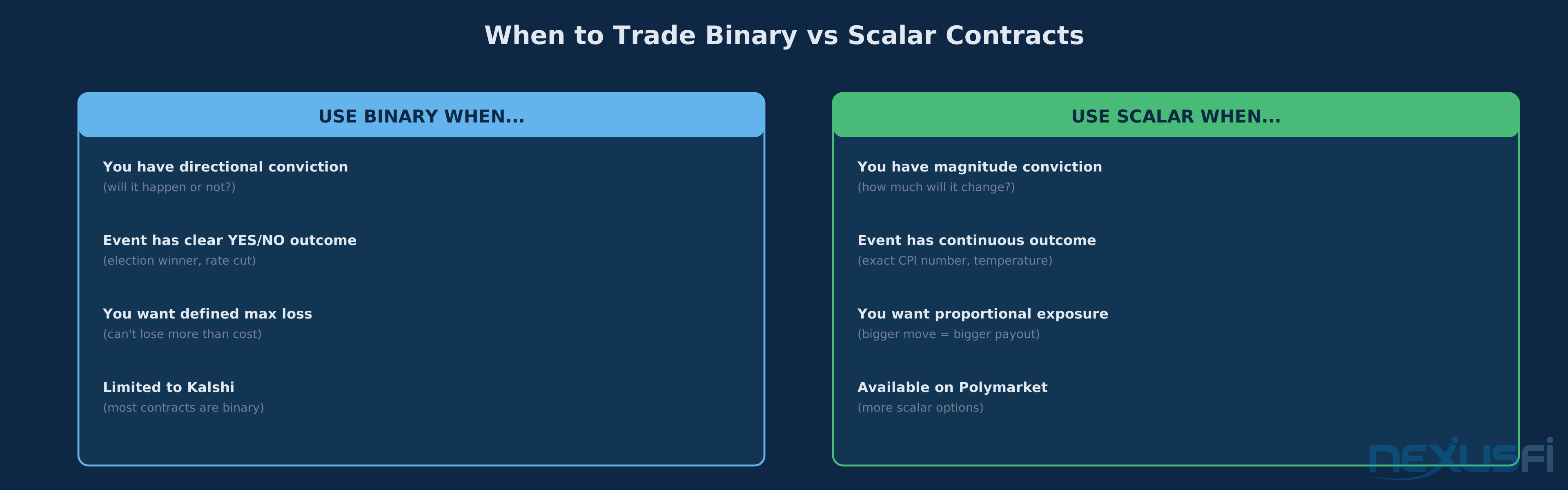
Binary contracts are generally preferable when:
- Your analysis is naturally directional (yes/no judgment)
- The threshold that matters to you aligns with the contract threshold
- You want a simple, unambiguous risk profile
- You're new to prediction markets and want to minimize complexity
The vast majority of prediction market trading, including at institutional scale, uses binary contracts. The intuitive yes/no structure maps well to most event forecasting.
When Scalar Contracts Add Value #
Scalar contracts are valuable when:
- You have a view on the magnitude of an outcome, not just the direction
- The binary contract threshold doesn't align with your actual uncertainty
- You want to express relative value between high and low outcomes
- You're combining positions to create more complex payoff profiles
For analytically sophisticated traders with full probability distribution models (e.g., economics professionals with CPI models), scalar contracts are often more information-efficient — they let you express more of your analytical view in a single contract.
Citations #
- @Fi: Kalshi, Polymarket, Prediction Markets etc — Community discussion of contract types and mechanics
- @Fi: Getting Started on Kalshi: Account Setup, Funding, and First Trade — Platform-specific contract type reference
- How Kalshi Works: Contracts, Odds & Settlement Explained — pm.wiki
- Event Contracts: What They Are & How to Trade Them — PredScope
This article is part of the NexusFi Academy Prediction Markets series. Full series at /a/prediction-markets/.
Knowledge Map
References This Article
Articles that build on this topicCitations
- — Cboe Eyes Prediction Markets With Regulated Binary Options (2026)
- — CME Launching Binary Option Trading (2022) 👍 1
- — Event Contracts - New Way to trade the CME Futures markets (2022) 👍 6
- — NADEX Binary Options Cost Breakdown Comparison (2017) 👍 3
- — Kalshi Hits $1 Billion in Super Bowl Trading Volume (2026)