



Geopolitical Event Contracts: Trading War, Sanctions, and Diplomacy on Prediction Markets
Overview #
Geopolitical events are the one category where the market can be completely wrong for days before reality forces a correction. Elections have polling. Economic releases have forecasts. Geopolitical crises have nothing except the collective judgment of participants trying to price a distribution they've never traded before.
Prediction markets — especially Kalshi and Polymarket — have emerged as the primary venue for pricing these binary outcomes explicitly. When US-Israeli forces struck Iran in February 2026, Polymarket was pricing WTI above $90 by June at 60% within hours of the initial reports, while formal exchange-traded futures markets were still working out what the opening moves should be. The "shadow markets" @SMCJB referenced on NexusFi during that crisis were functioning as leading indicators, not laggards.
But geopolitical prediction markets are not simply political markets with higher stakes. They have distinct mechanics, different edge sources, and failure modes that can destroy a position in minutes if you misread the contract definition. Trading a "US-Iran deal by December 2026" contract is not the same as having a view on Iran's nuclear program — it's having a view on whether specific, verifiable conditions will be met in a specific time window as determined by specific authoritative sources. Those are three separate problems, and most traders only think about the first one.
This article covers the mechanics of geopolitical event contracts: how to read settlement language, how to model war premiums and bimodal distributions, which information sources actually matter, how to size positions in binary illiquid markets, and how to avoid the structural mistakes that consistently bleed money in these instruments. For the platform comparison between Kalshi and Polymarket, see Kalshi vs. Polymarket. For political election-driven contracts specifically, see Trading Political Event Contracts.
Geopolitical prediction markets reward contract interpretation precision over geopolitical forecasting ability. Most participants trade headlines. Profitable traders trade precisely-defined contractual outcomes. The gap between those two activities is where the edge lives.
The Contract Definition Problem #
Before forming any view on geopolitics, read the settlement criteria. This sounds obvious. Almost nobody does it with the rigor required.
The NexusFi community ran directly into this problem when the NFA raised concerns about prediction market settlement in early 2026. @jlabtrades articulated the contract-house argument:
The key phrase is "clear rules." On Kalshi and Polymarket, those rules are written out in settlement FAQs that most traders never read. The gap between what you think the contract measures and what it actually settles on is the primary source of unexpected losses in geopolitical prediction markets.
The critical questions before any geopolitical trade:
What exactly constitutes "Yes"? "War declared" might require a formal congressional declaration (rare and slow), or it might resolve on the first exchange of fire between national military forces, or it might require UN recognition. Each definition points to a completely different probability. Kalshi has resolved some contracts differently than traders expected based on these edge cases.
Which authority determines resolution? A contract settling on "official US government statement" is very different from one settling on "UN Security Council resolution." Government statements can be issued in hours. UN resolutions require council agreement, often vetoed. Map the resolution authority to the procedural reality of how fast that authority can act.
Does partial completion count? A "sanctions removed" contract might mean 100% removal of all sanctions, partial removal of specified categories, or removal of specific entities from a list. "Nuclear deal reached" might require signatures, ratification, or merely a public announcement. These edge cases show up in contract FAQs. Read them.
What's the time window? A contract expiring December 31, 2026 might be measuring something procedurally impossible within that window. Iranian nuclear negotiations have historically taken 2-3 years from framework agreement to implementation. A contract expiring in eight months is implicitly asking whether an extreme acceleration of the usual timeline can occur. Price that separately from the underlying question of whether a deal is possible at all.
Bimodal Distributions and War Premiums #
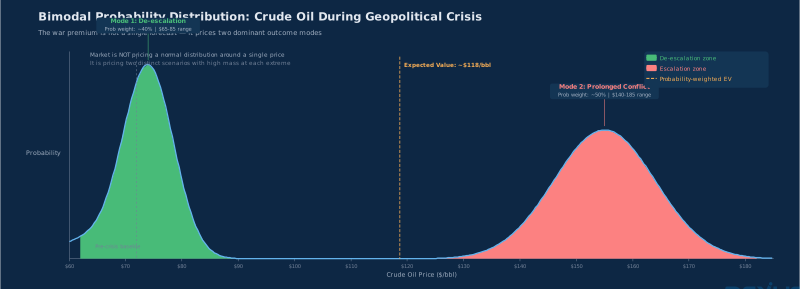
When US-Israeli forces struck Iran in February 2026, crude oil opened up 13% on Sunday evening. @SMCJB cut through the noise on NexusFi to describe exactly what the market was pricing:
That's bimodal distribution thinking applied correctly. The 13% oil move wasn't saying the market expected 13% higher prices permanently — it was saying the market was pricing a distribution with two dominant modes: high-probability de-escalation returning to baseline, and low-probability catastrophic escalation at a much higher level. The probability-weighted average landed at +13%.
@jlabtrades quantified the mode structure explicitly in the same thread:
@SMCJB added the trading-specific insight that's easy to miss if you learned probability in a classroom rather than a trading room:
Geopolitical event contracts on prediction markets are explicitly pricing this bimodal structure. When a "Hormuz closure exceeds 60 days" contract is at 35%, that's not saying there's a 35% chance of some vague bad outcome — it's saying the market assigns 35% to the prolonged closure mode and 65% to the contained/resolved mode. Your edge comes from whether your assessment of those mode probabilities is better than the crowd's.
@SMCJB pushed the challenge further, cutting to the analytical core:
The war premium framework matters for sizing. A contract that drops from 40% to 20% on a single diplomatic headline isn't wrong — it's repricing from "both modes in play" to "de-escalation mode now dominant." That's not a market mistake. That's the market working correctly. Don't fade it without a specific reason to believe the headline is less definitive than it appears.
The Probability Assessment Framework #
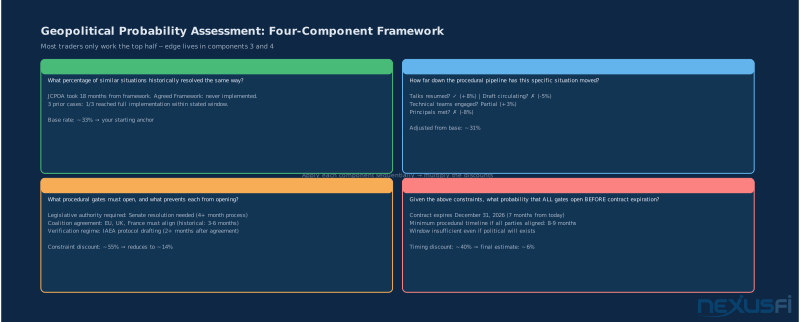
Modeling geopolitical probability well requires separating four distinct problems that most traders blur together.
Base rate. Start with the historical frequency of similar outcomes under comparable conditions. "Formal nuclear deal signed within 12 months of framework agreement" has a calculable base rate from the JCPOA, the Agreed Framework with North Korea, and other historical precedents. Most geopolitical market participants skip this step entirely and go straight to narrative. The base rate is your anchor against overconfidence in any specific scenario.
Current state assessment. Map the actual current conditions against the base rate. Are negotiators meeting? Is a draft text circulating? Have verification mechanisms been discussed? The further down the procedural pipeline an agreement has moved, the higher you should be pricing near-term resolution. This is the difference between "talks held" and "deal signed" — very different contract propositions even when the headline says "progress."
Constraint analysis. This is where most traders underweight the difficulty. What prevents the event from occurring within the contract window? For sanctions removal: legislative authority required, coalition agreement needed, verification regime agreed, congressional notification period. For military conflict: logistics, political authorization, coalition building, domestic legal authority. Each constraint is a gate that has to open. Model the probability of each gate opening in sequence within your time window.
Timing probability. Separate the question of "will this happen" from "will this happen before contract expiration." An Iran nuclear deal might be 70% likely over 5 years and 15% likely before December 2026. You're trading the second question. Implementation constraints and procedural timelines are often the determining factor in a contract that would otherwise be straightforward.
Combine these into a rough framework: start with the base rate, adjust up or down based on current state, apply a constraint discount for implementation difficulty, then apply a separate timing discount for the contract window. The result is a number you can actually compare against the market price.
The most common error in geopolitical probability assessment is confusing rhetoric with action. Officials have every incentive to signal progress publicly that may not exist in practice. A "breakthrough" headline that produces no change in underlying procedural reality is noise. Track what actually changes in the negotiation's structural position, not what officials say about it.
Information Source Hierarchy #
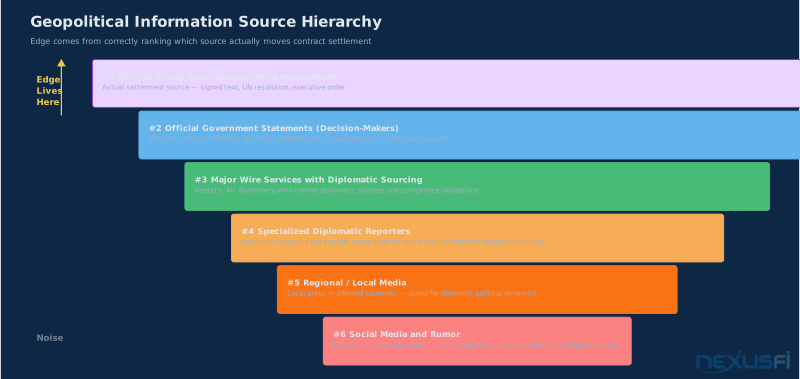
Not all geopolitical information moves event contracts equally. Having a ranked model of what sources actually predict resolution determines whether you're leading or chasing the market.
For geopolitical event contracts, the hierarchy runs roughly as follows:
Official treaty text and authoritative instruments — the actual draft document, UN resolution text, executive order text. These are the source the contract settles on. If the resolution criteria is "signed by both parties," a signed draft text is a near-certainty that the contract resolves Yes. Most other information is derivative of this.
Official government statements from decision-makers with authority — the President, Secretary of State, Foreign Minister, Prime Minister. Note the difference between a decision-maker and a spokesperson. A Foreign Minister saying "we have reached an agreement in principle" is different from a spokesman saying "talks continue productively." The former is a material development; the latter is noise management.
Major wire services with diplomatic sourcing — Reuters, AP, Bloomberg reporting with named diplomatic sources, not anonymous officials. These wires have compliance obligations that constrain what they can publish without verification. A Reuters report saying "sources say a framework is largely negotiated" is worth more than a cable news headline saying "progress on Iran talks."
Specialized diplomatic reporters — journalists who have covered the specific negotiation for years, have established sources within delegations, and have a track record of accurate advance reporting. These reporters often know what's in a draft before it's released publicly.
Regional and local sources — local media in Iran, Israeli press, Gulf regional outlets. Useful for context and early signals on domestic political dynamics that affect whether decision-makers have the freedom to agree. Requires cross-checking against more verified sources before trading on.
Social media and rumor — generally noise in geopolitical markets, but occasionally the leading indicator when a breaking development hasn't yet reached official channels. Useful for directional awareness, not for sizing decisions. Never trade on social media alone without a cross-reference.
Your edge in geopolitical event contracts often comes not from being the first to hear something, but from being the first to correctly evaluate whether a source actually means what the headline says. The "shadow markets" @SMCJB referenced were pricing the Iran situation in real-time precisely because prediction market participants were parsing source quality faster than formal futures markets could update.
Event Types: War, Sanctions, and Diplomacy #
The three main categories of geopolitical event contracts have distinct mechanics and common failure modes.
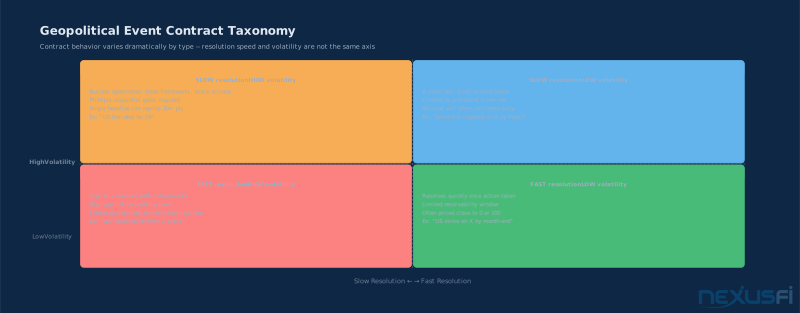
War and conflict escalation contracts are the most volatile and the most likely to gap on a single headline. The key distinction to trade correctly is between:
- Rhetoric -- official statements about potential action
- Posture -- military movements, asset deployments, readiness changes
- Limited strikes -- discrete military actions without sustained campaign
- Sustained conflict -- repeated or ongoing military engagement
- Formal declaration -- the legal/diplomatic step that many contracts require
These steps move at very different speeds. Rhetoric to posture can take weeks. Limited strikes can happen in hours once a decision is made. Formal declarations are often retrospective or never happen at all in modern conflicts. If a contract requires "formal declaration of war," know that the United States hasn't formally declared war since 1942.
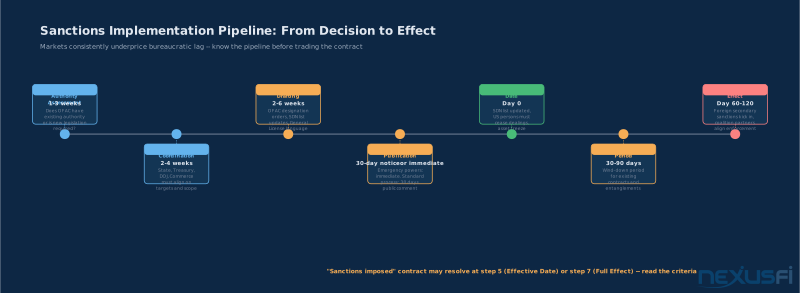
Sanctions contracts require understanding the implementation pipeline more than the political will. Sanctions pass through multiple steps: executive authority assessment, legal drafting, inter-agency review, Federal Register publication, implementation date, grace periods, exemption adjudication. A "sanctions imposed" contract that resolves on the announcement vs. the effective date can have a weeks-long spread in resolution timing. Which date the contract uses changes your probability assessment much.
Markets consistently underprice the bureaucratic lag on sanctions. Even when political will exists, implementation takes longer than expected. Bet on this tendency.
Diplomacy and deal contracts — nuclear agreements, trade frameworks, peace accords — have the most complex probability structures because they require sequential completion of multiple gates. @Symple highlighted the asset class dynamics that emerge when these situations evolve:
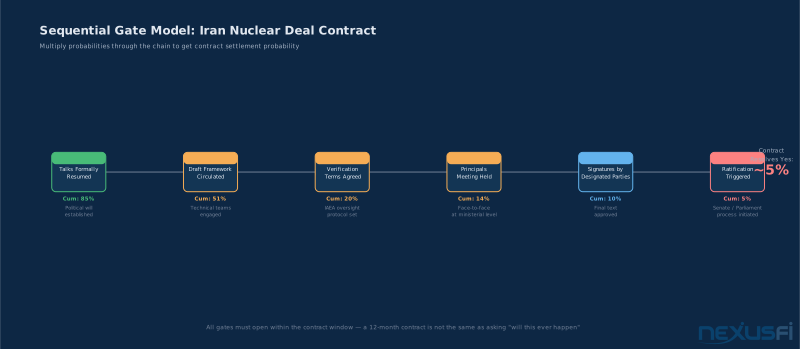
A useful framework for diplomatic contracts: map the minimum required conditions for a "Yes" resolution. A nuclear deal typically requires: talks formally resumed + draft framework circulated + technical working groups agree on verification + principals meet + signatures by designated parties + ratification mechanism triggered. Assign a probability to each gate. Multiply. Adjust for the contract window. Compare to market price.
Iran as a Case Study: Reading the 2026 Market #
The Iran situation in 2026 offers a live example of how prediction markets, futures markets, and geopolitical analysis interact — and where each gets it right or wrong.
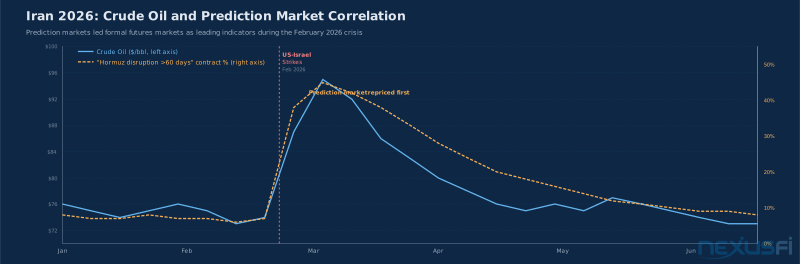
When strikes began in late February 2026, prediction markets on Polymarket were already pricing oil at $90+ by June at 60% within hours of reports — before formal futures exchanges had reopened for Sunday evening trading. @SMCJB noted this explicitly, pointing out that these shadow markets were functioning as real price discovery mechanisms even without the exchange infrastructure.
The bimodal structure was clear from the first night: de-escalation back to pre-crisis prices vs. prolonged Hormuz disruption with $140+ oil. The prediction market priced the aggregate distribution; the futures market priced the expected value. Both are right in their own terms — futures markets are designed for hedging, not for expressing binary views. Prediction markets are designed exactly for this.
The contract interpretation lesson: a "Hormuz closed > 60 days" contract that resolves at 35% is pricing something specific — the probability that tanker traffic doesn't normalize within 60 days. That's very different from the probability that the conflict continues. Hormuz can reopen for traffic while the broader conflict continues. If the contract uses "tanker traffic < 10% of normal" as the settlement criterion, that's what you're pricing — not the war outcome.
The current market as of mid-2026 has de-escalated much from the March peak, with diplomatic contacts resuming through intermediaries and Hormuz traffic partially restored. Prediction markets tracking "US-Iran deal by December 2026" have moved from near-zero during peak crisis to roughly 8-12% — reflecting that diplomatic channels are open but a formal deal within the contract window remains unlikely given procedural constraints.
Watch how the prediction market price moves relative to futures markets during geopolitical shocks. When prediction markets lead and futures markets follow, you're seeing the prediction market functioning as price discovery. When futures lead and prediction markets follow with a lag, there's potential arbitrage in the lag.
Position Sizing for Binary Geopolitical Risk #
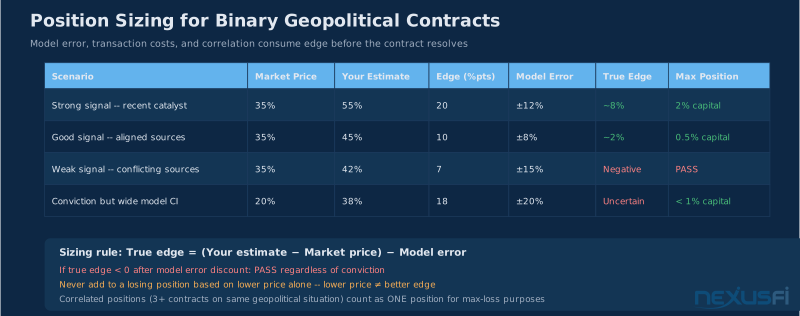
Binary geopolitical contracts require smaller positions than traders' conviction levels typically suggest. The reasons are structural, not psychological.
First, model error in geopolitical probability assessment is large. You might estimate a contract at 35% with a ±15% confidence interval. When your uncertainty range is that wide, large positions capture almost none of the edge — the downside risk from model error is comparable to the upside from being right.
Second, execution in thin markets is costly. Wide spreads on geopolitical contracts can represent 3-7% of the contract value. Position sizing that ignores transaction costs will find the edge has been consumed before the contract even resolves.
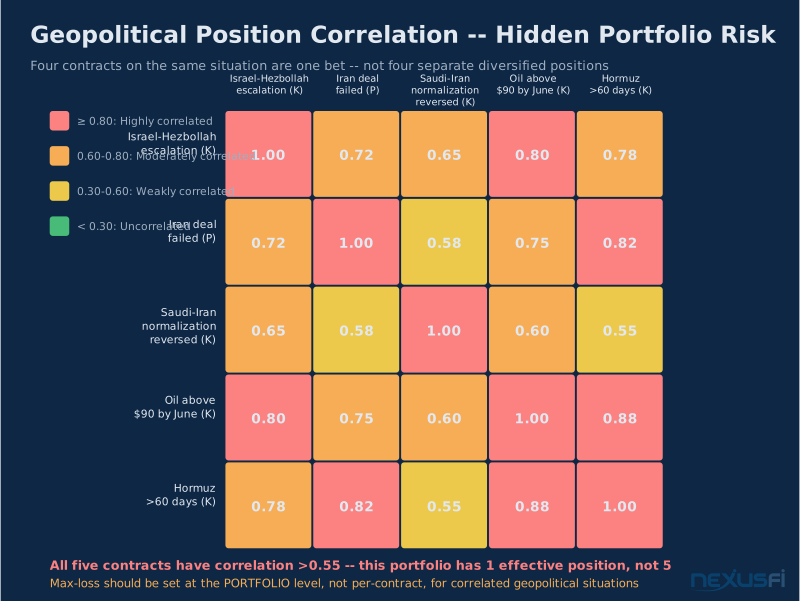
Third, correlation. A portfolio holding "Israel-Hezbollah escalation," "Iran deal failed," "Saudi-Iran normalization reversed," and "oil above $90 by June" is effectively the same bet expressed four ways. The apparent diversification is an illusion. When the underlying geopolitical situation moves, all four positions move together.
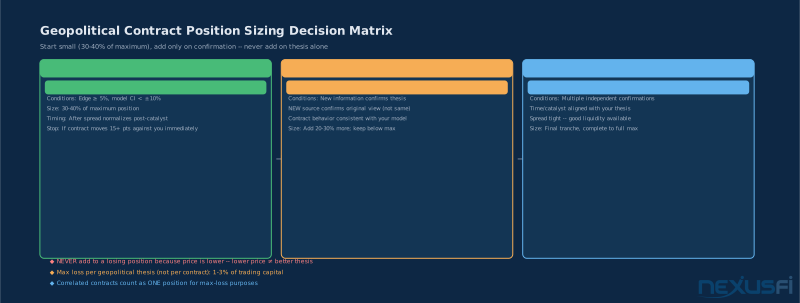
A practical sizing framework:
Define maximum loss per event. Set a hard cap at 1-3% of trading capital per geopolitical thesis, not per contract. If you hold three correlated contracts on the same situation, that 3% covers all three combined.
Scale to edge magnitude, not conviction magnitude. If the market is at 35% and you estimate 45%, your edge is 10 percentage points. If the market is at 35% and you estimate 70%, your edge is 35 percentage points. Same situation, wildly different edge. Size so — but cap both at the maximum loss threshold.
Start small, add on confirmation. Don't take a full position at your initial estimate. Take 30-40% of maximum, then add when subsequent information confirms your view. This automatically reduces average cost when your first entry is early and reduces risk when you're wrong from the start.
Never add to a losing position on thesis. If the contract is moving against you because of new information, that new information should update your probability estimate. If your updated estimate still favors the position, fine — but size shouldn't increase just because price decreased. That's the behavior that turns small positions into blown accounts.
Trigger Calendar and Timing #
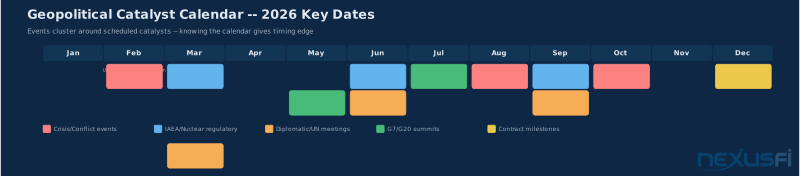
Geopolitical events rarely happen on random days. They cluster around scheduled catalysts: UN sessions, sanctions review dates, IAEA quarterly reports, G7/G20 summits, election dates, treaty expiration deadlines, congressional recess windows. Knowing the calendar of what can and cannot happen before the next trigger gives you timing edge even when you have no geopolitical informational edge.
A "deal reached by August 2026" contract that requires Senate ratification faces a specific calendar constraint: the Senate is in recess for most of August. If a deal can't technically be ratified before expiration, the question isn't whether the deal happens — it's whether the settlement criteria require formal ratification or just announcement. Read the contract.
For Iran specifically: IAEA Board of Governors meetings happen quarterly, with key sessions in June and September. Major diplomatic windows tend to cluster around these meetings because technical verification discussions happen in parallel. If a "deal" contract requires IAEA verification language, know when the IAEA can formally act on it.
Calendar awareness also helps with the "nothing happens" trade. Between catalysts, geopolitical situations often drift without major developments. A contract at 25% in week 3 of a four-week calm period might be better than a contract at 20% in week 1 — the same underlying probability, but the window for the event to occur within the contract has compressed. Time decay works differently in geopolitical event contracts than in options, but the directional principle is similar.
Settlement Risk and Fund Custody #
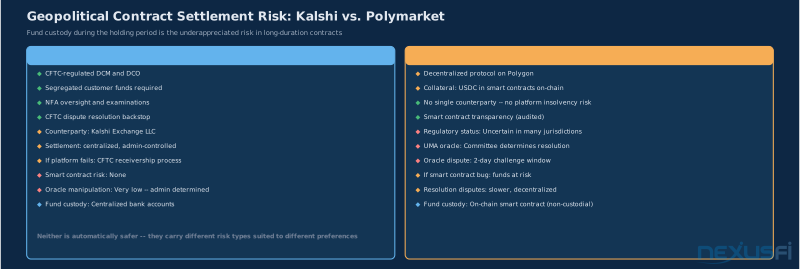
Geopolitical event contracts hold your capital for potentially long periods. A "Will X happen in 2026?" contract placed in January might hold your funds for 12 months. This is materially different from a futures contract where daily mark-to-market and margin calls keep funds moving constantly.
@Fi articulated the structural concern directly in the NFA clearing debate:
@SMCJB noted the historical precedent that fund protections don't guarantee protection against custodial failure:
This matters practically. Before entering a long-duration geopolitical contract:
- Verify the platform's regulatory status and customer fund segregation practices
- Understand the dispute resolution mechanism if settlement is contested
- Know what happens to your collateral if the platform experiences financial stress during the holding period
- Check whether the platform's settlement process has a history of ambiguity disputes on similar contract types
Kalshi is a CFTC-regulated DCM and DCO. Polymarket operates as a decentralized protocol with smart contract settlement — your collateral is in USDC on-chain, not held by a counterparty. These are very different risk profiles for fund custody. The decentralized structure eliminates some custodial risk while introducing smart contract and oracle risk. Neither is automatically superior — they're different risk types that suit different preferences.
Execution in Thin Markets #
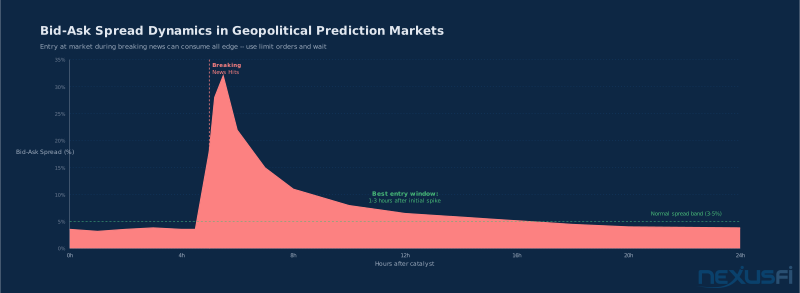
Geopolitical prediction market contracts are illiquid by nature. Most contracts have spreads of 3-8% under normal conditions that widen dramatically during breaking news. Execution strategy matters as much as probability assessment in these markets.
@SMCJB raised whether prediction markets would eventually develop consolidated price feeds analogous to NBBO:
Use limit orders. This cannot be overstated. In a thin order book, a market order on a 35¢/65¢ bid/ask contract can fill at 30¢ or 70¢ depending on book depth. That's a 5-10% swing from a single sloppy execution on a binary that might have 10% total edge. The limit order foregoes speed in exchange for price certainty. In geopolitical markets, speed matters less than you think unless you have access to news flow that the market hasn't priced yet.
Time your entries around book stability, not around your view formation. When breaking news hits, spreads widen dramatically as market makers pull their offers and retail flow comes in one-directional. The best time to enter after a headline is often 15-30 minutes later, once the initial panic flow has cleared and the book has stabilized. You give up some of the initial price move, but you gain execution quality.
For larger positions, work the order in tranches over hours or days. A limit order representing 10% of the available book depth at the current best offer will move the market against you. Split it into 3-4 tranches placed over time. This is less efficient in theory, but in practice geopolitical situations don't resolve on 30-minute timeframes, and the execution improvement is worth the cost.
The primary edge in geopolitical prediction markets comes from reading contract settlement language more carefully than competitors, modeling bimodal probability distributions instead of single-point forecasts, ranking information sources by actual predictive value, and sizing with discipline that accounts for model error and correlation. The geopolitical opinion itself — who wins, what gets negotiated, how the crisis resolves — is the least differentiating input. Most participants have approximately the same information about geopolitics. The ones who profit consistently are the ones who correctly map that information to specific contract settlement criteria, trade the right size, and execute with patience in thin markets.
Knowledge Map
Prerequisites
Understand these firstGo Deeper
Build on this knowledgeReferences This Article
Articles that build on this topicCitations
- — US-Israeli Strikes Kill Iran's Supreme Leader -- Oil Surges (2026) 👍 2“This war premium implies a high probability that nothing happens, but a low probability that things go ballistic. And if things really do go Ballistic, are you worrying about the price of crude, or at best massive economic damage to the developed world?”
- — US-Israeli Strikes Kill Iran's Supreme Leader -- Oil Surges (2026) 👍 2“I have the advantage of trading US Power back in 1998 when prices for the first time ever went to over $5k. Classic example of a bi-modal distribution which is definitely something that people who don't have a high level statistics education just may not understand.”
- — US-Israeli Strikes Kill Iran's Supreme Leader -- Oil Surges (2026) 👍 3“Mode 1: Escalation Contained / Hormuz Reopens -- Price range $95-115/bbl, Probability weight ~35-40%. Mode 2: Prolonged Closure / Regional War -- Price range $140-185/bbl, Probability weight ~45-55%.”
- — NFA Raises Concerns About Direct Clearing for Retail Derivatives Traders (2026) 👍 1“The whole argument from the contract event houses is that this is peer to peer with clear rules and no margin allowed, so why is a FCM needed if its all immediately cash settled between buy/seller”
- — US-Israeli Strikes Kill Iran's Supreme Leader -- Oil Surges (2026) 👍 2“With the Strait of Hormuz under threat -- carrying roughly 20% of global oil supply -- active positioning across crude oil, gold, silver, bonds, and equity futures, while emphasizing thin liquidity and the importance of patience.”
- — NFA Raises Concerns About Direct Clearing for Retail Derivatives Traders (2026) 👍 1“Binary event contracts are fully collateralized upfront -- that's a genuinely different risk profile from traditional futures. Your money sits with the DCO for the entire duration. A 'Will X happen by December 2026' contract placed in March means 9 months of fund custody with no independent entity verifying segregation.”
- — US-Israeli Strikes Kill Iran's Supreme Leader -- Oil Surges (2026) 👍 2“there is a X% chance of a A% drop and a Y% of a B% increase and this is not mean = x and stdev = s math!”
- — US-Israeli Strikes Kill Iran's Supreme Leader -- Oil Surges (2026) 👍 2“I assume you have access to market prices. So what are the bimodal distributions that option prices are implying?”
- — NFA Raises Concerns About Direct Clearing for Retail Derivatives Traders (2026) 👍 1“that protection didn't stop REFCO, Peregrine (PFG) or MF Global.”
- — NFA Raises Concerns About Direct Clearing for Retail Derivatives Traders (2026) 👍 1“Could we see something similar to NBBO implemented in prediction and crypto markets?”