



Market Making in Prediction Markets: How Professional Traders Set Prices
Understanding how market makers provide liquidity, earn the bid-ask spread, and shape prices in event contract markets on Kalshi and Polymarket
Overview #
Every time you buy or sell a prediction market contract, someone is on the other side of that trade. In liquid markets, market makers
This article explains market making mechanics in prediction markets, the strategies market makers use to manage risk, and what this means for regular traders looking to buy and sell event contracts profitably.
Understanding how market makers provide liquidity, earn the bid-ask spread, and shape prices in event contract markets on Kalshi and Polymarket Every time you buy or sell a prediction market contract, someone is on the other side of that trade.
What Is a Market Maker? #
A market maker is a trader who simultaneously quotes a price to buy (bid) and a price to sell (ask) for a security. The difference between these prices
In prediction markets:
- Bid: The price the market maker will pay to buy YES contracts from you
- Ask: The price the market maker will sell YES contracts to you
- Spread: Ask - Bid = the market maker's gross profit per round-trip
Example: A market maker might quote a contract at:
- Bid: 0.62 (market maker buys YES from you at 62¢)
- Ask: 0.65 (market maker sells YES to you at 65¢)
- Spread: 3¢ (market maker earns 3¢ if both sides fill)
This 3¢ spread represents 3% of the full contract value
Why Market Makers Are Essential #
Without market makers, prediction market trading would be much harder:
- You'd need to find someone with exactly the opposite opinion, willing to trade at exactly your price, at exactly the right time
- Thin markets would have huge price gaps between buyers and sellers
- Large orders would move prices dramatically
Market makers solve the "double coincidence of wants" problem by being always willing to trade
The market maker's value proposition: Immediacy. You can buy or sell instantly rather than waiting for a matching counterparty. The bid-ask spread is the price of that immediacy.
How Prediction Market Makers Set Prices #
Market makers don't randomly pick bid/ask prices. They maintain a probability model and quote around that model's estimate.
The Theoretical Fair Value #
A market maker starts with their internal estimate of the contract's fair value. For a political contract, this might be derived from polling aggregates, prediction model outputs (FiveThirtyEight-style), and historical base rates. For a weather contract, it's derived from NWS model output and climatology.
Fair value = Market maker's best estimate of the true probability
Bid = Fair value - Half spread Ask = Fair value + Half spread
If a market maker estimates 65% probability for an event:
- Fair value: 0.65
- Bid: 0.635 (= 0.65 - 0.015)
- Ask: 0.665 (= 0.65 + 0.015)
- Spread: 3¢
Spread Determinants #
Market makers set wider spreads in markets with:
Higher uncertainty: If the market maker's model is less certain, the spread must be wider to protect against adverse selection (the risk that the trader knows more than the market maker and is exploiting that information advantage).
Lower liquidity: Less active markets with fewer participants require wider spreads because market makers can't offset their positions as easily.
Upcoming information events: If an important news release is imminent (e.g., a Fed rate decision in 3 hours), spreads widen because the probability is about to become much clearer. The market maker faces the risk of being stuck on the wrong side just before the information arrives.
Binary outcome proximity: Contracts near 50% probability (true coin-flip events) have maximum uncertainty and typically command wider spreads.
Inventory Management #
When a market maker buys many YES contracts (because many traders want to sell), they accumulate inventory. This inventory is risky
- Adjusting quotes: After buying lots of YES, shift the bid lower (make it less attractive to sell more YES to them) and the ask lower (make it more attractive for traders to buy YES, offsetting the inventory)
- Hedging: Offset prediction market positions with correlated instruments. A market maker heavily long YES on "Will the Fed raise rates?" might hedge with Treasury futures
- Reducing position size: Stop quoting the market temporarily to avoid further inventory accumulation
What this means for traders: When you see a market suddenly widen its bid-ask spread or shift prices much without obvious news, a market maker may be managing inventory imbalance. This is not necessarily a signal to trade against
Becoming a Market Maker on Polymarket #
Polymarket has a formal market maker program for algorithmic traders. Key requirements:
Technical requirements:
- Use the Polymarket API (REST and WebSocket endpoints)
- Deploy a proxy wallet for programmatic trading
- Manage gas costs for on-chain trade settlement (minimal on Polygon)
Capital requirements:
- Sufficient USDC to post meaningful two-sided quotes
- Polymarket's market maker documentation suggests minimum capital of $10,000+ for meaningful contribution
Incentives:
- Market makers on Polymarket may receive rebates (the opposite of taker fees) as compensation for providing liquidity
- Details vary by market and tier
Practical starting point: Polymarket's official documentation at docs.polymarket.com/market-makers/getting-started provides step-by-step instructions for setting up market making operations, including wallet setup, API authentication, and order management.
Kalshi Market Making #
Kalshi has a designated market maker (DMM) program for approved participants. Unlike Polymarket's open API, Kalshi's market maker program requires prior agreement and may offer rebates or preferential fee structures. Contact Kalshi directly for details.
Adverse Selection: The Market Maker's Core Risk #
The biggest risk in market making is adverse selection
Example: You're quoting a weather contract at 0.62/0.65. An algorithmic trader who just downloaded the latest NWS model run (published 5 minutes ago) knows the probability is actually 0.78. They buy YES from you at 0.65
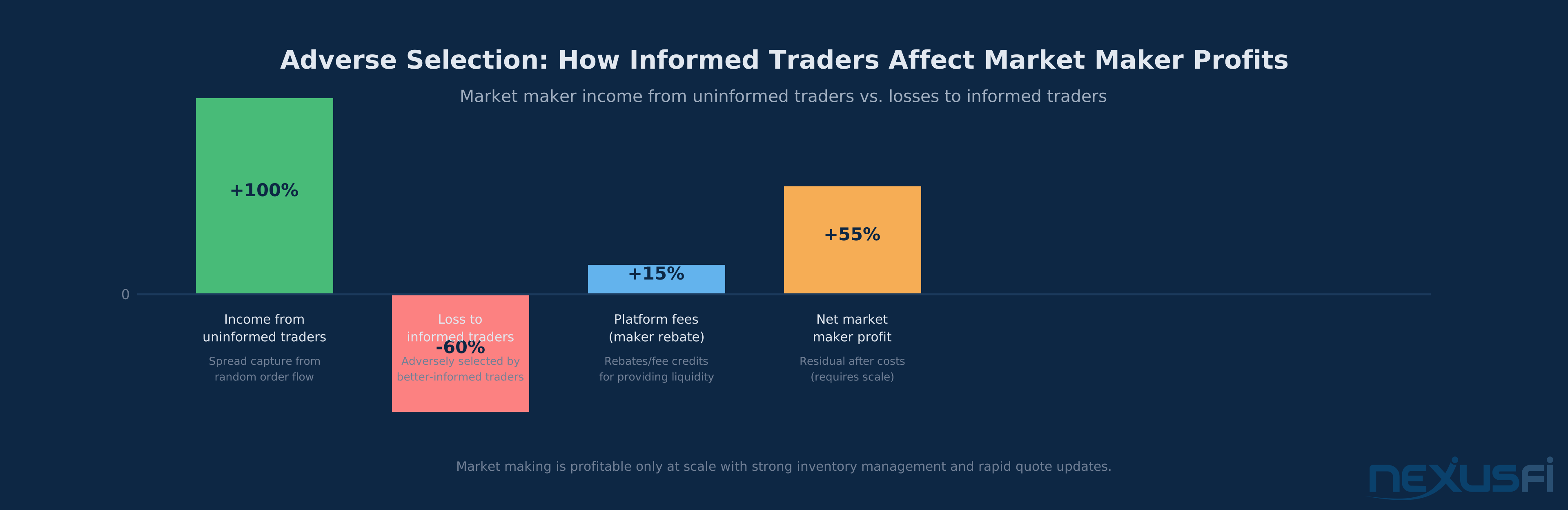
Adverse selection cost: Across all trades, market makers earn the spread from uninformed (liquidity-demanding) traders and lose to informed traders. The spread must be wide enough that earnings from uninformed flow cover losses to informed flow.
How market makers defend:
- Monitor for unusual order flow patterns (one-sided large orders suggest informed trading)
- Update models in real-time from the same data sources informed traders use
- Widen spreads proactively before known information events
- Limit order sizes to reduce exposure to any single informed trade
How Market Making Shapes Prices #
The bid-ask spread isn't just a cost
- Market maker initial pricing: Based on their probability model
- Informed trader pressure: When traders with better information consistently buy or sell one side, the market maker shifts their fair value estimate toward the direction of informed flow
- Uninformed trader noise: Random buying and selling that provides income to market makers but doesn't systematically shift prices
- Competition between market makers: Multiple market makers competing tighten the spread, improving efficiency
Price discovery timeline: A contract's true probability is gradually discovered through the trading process. Early in a contract's life, spreads are wide (high uncertainty). As information accumulates and resolution approaches, spreads narrow and prices converge on the true probability.
Practical Implications for Regular Traders #
Understanding market making helps you trade more efficiently:
Use limit orders to avoid paying the spread: Posting a limit order at the midpoint between bid and ask means you're providing liquidity (acting like a market maker), potentially receiving a tighter fill or even a rebate on some platforms.
Avoid thin markets with wide spreads: A 10% bid-ask spread means you need a 10% edge just to break even. Never trade with market orders in thin markets.
Time your trades around market maker repositioning: Immediately after major news (model updates, breaking events), spreads temporarily widen as market makers recalibrate. Waiting 15-30 minutes for spreads to normalize reduces your trading costs.
Recognize market maker-driven price moves: A sudden price move without obvious news may be a market maker managing inventory, not a genuine information signal. Don't chase these moves.
Size matters for market impact: Larger orders push prices against you because market makers adjust their quotes after seeing large interest. Break large positions into smaller orders over time.
The Automated Prediction Market #
As of 2026, most liquid prediction market contracts have significant algorithmic market making. These automated systems:
- Update quotes within milliseconds of new information
- Process NWS model updates, news headlines, and on-chain data
- Maintain risk limits and inventory targets automatically
- Compete with each other to provide the tightest spreads
Implication for manual traders: In highly liquid markets (major political events, Bitcoin price targets), you're competing against well-capitalized algorithmic market makers who update instantly. Your edge must be in information they don't process (niche data sources, specialized domain knowledge) or time horizons where algorithms are less focused (long-dated contracts, niche markets).