



Prediction Market Microstructure: Order Books, Matching, and Price Formation
How orders execute on Kalshi and Polymarket, where bid-ask spreads come from, and what retail traders can read from the order book
Overview #
Prediction market microstructure is the study of how trades are executed, how prices are formed, and how information flows through event contract markets. For traders on Kalshi, Polymarket, and Robinhood event contracts, understanding microstructure separates profitable execution from unknowingly bleeding edge to transaction costs, spreads, and market makers who understand the order book better than you do.
This article covers the mechanics that sit beneath every trade: how binary order books work, what drives bid-ask spreads in probability-priced instruments, how Kalshi's central limit order book differs from Polymarket's automated market maker, and what the order book tells you about where smart money thinks a contract is heading. Part of the NexusFi Academy Prediction Markets series — see Introduction to Prediction Markets for the complete beginner's guide.
The Binary Order Book: How $0--$1 Pricing Changes Everything #
Prediction market order books look like conventional limit order books — ranked bids and offers, depth at each price level, execution at the best available price — but the bounded $0--$1 price range introduces dynamics that don't exist in continuous instruments like futures or equities.
In a conventional futures order book, prices extend infinitely in both directions. The ES futures contract can be $3,000 or $6,000 or theoretically any number. Liquidity concentrates around the current price and thins out in both directions, with the market always finding a new equilibrium.
Binary order books are different: prices are strictly bounded between $0.01 and $0.99. Every contract must settle at exactly $1.00 (YES wins) or $0.00 (NO wins). This boundedness creates two specific microstructure effects:
1. Asymmetric Liquidity Distribution
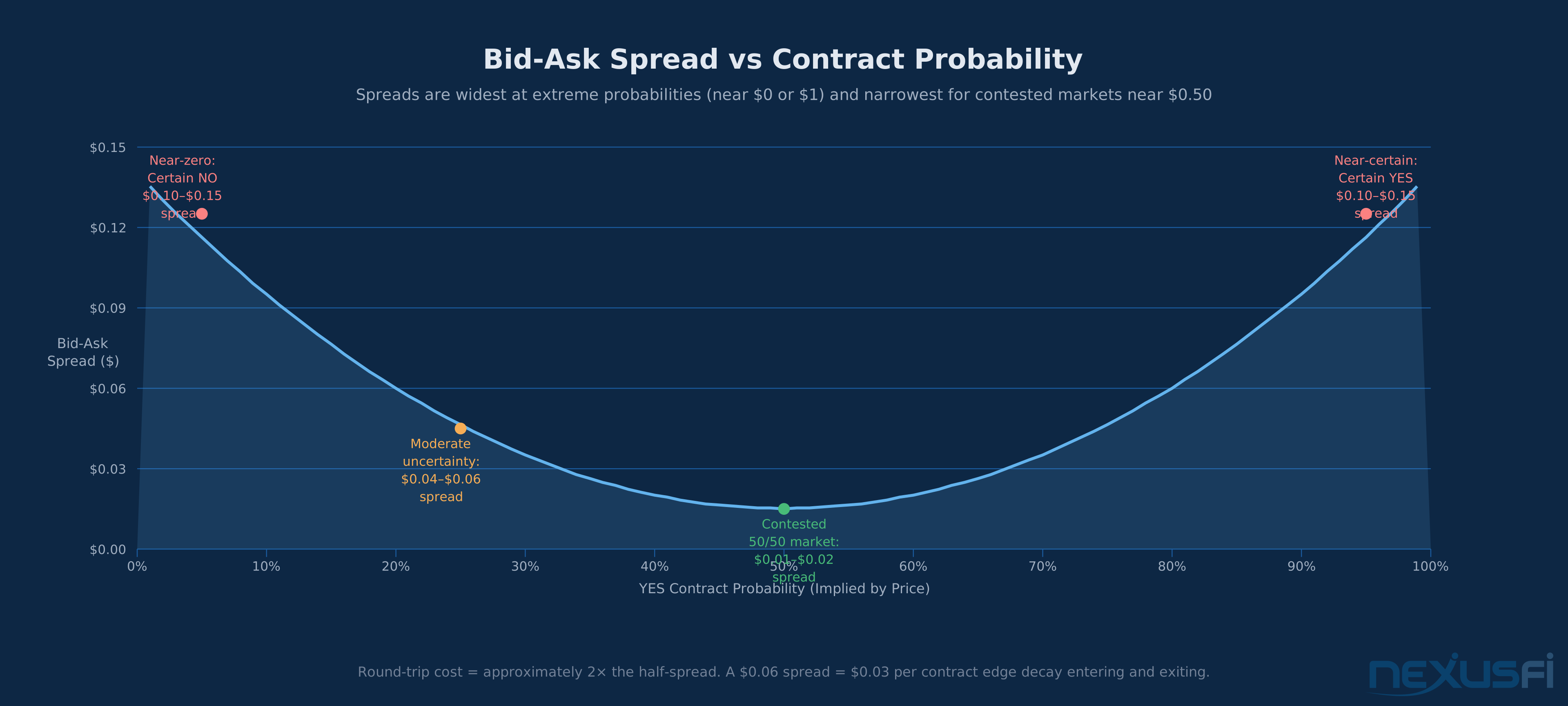
In liquid prediction markets on contested binary questions, liquidity concentrates in the $0.30--$0.70 range when probability is genuinely uncertain, then shifts dramatically as events approach resolution. A market at $0.85 looks different from a market at $0.50 — the near-certain side has almost no buyers left (who's buying YES at $0.85 for a $1.00 payout?), while the NO side at $0.15 is the mirror.
Understanding where a market sits in this bounded space tells you which side of the order book will have natural liquidity and which will have spread.
2. Forced Convergence at Expiration
Unlike futures contracts that roll continuously, binary contracts have a fixed expiration where price must converge to $0 or $1. This forced resolution creates microstructure effects that don't exist in perpetual instruments: as expiration approaches, the effective bid-ask spread widens dramatically on the uncertain side, and spreads on the certain side collapse to near-zero.
A contract at $0.92 one day before resolution has basically no microstructure risk on the YES side — every rational market participant knows it will settle at $1.00 or $0.00, so the YES buyer at $0.92 is taking a 8-cent risk for an 8-cent gain (if YES). The spread on such contracts is typically $0.01--$0.02. But the same contract two weeks from resolution with genuine uncertainty trades with $0.04--$0.08 spreads because market makers bear real risk over the holding period.
The YES/NO Duality: The Unique Feature of Binary Markets #
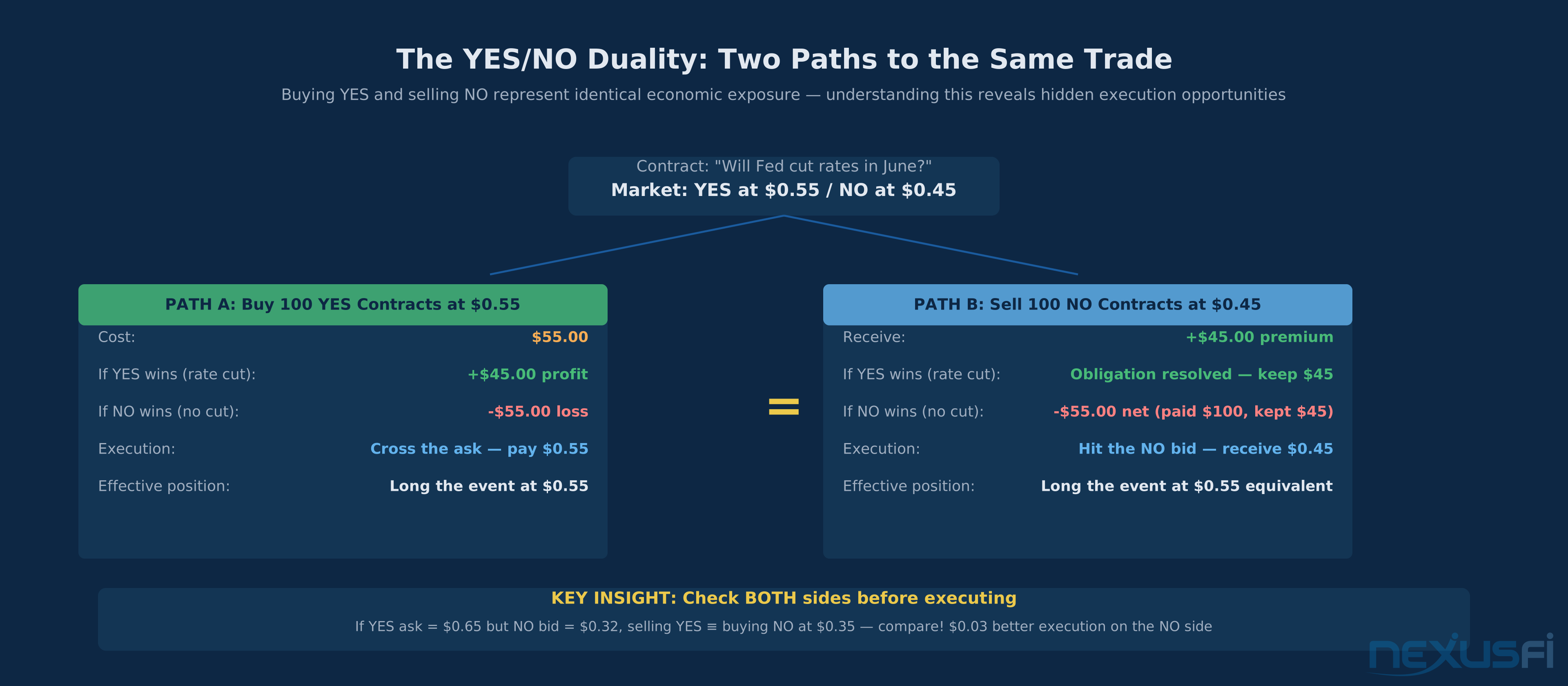
Every prediction market contract has a dual nature that doesn't exist in linear instruments: buying YES is economically equivalent to selling NO, and vice versa.
If a contract trades at $0.55 YES / $0.45 NO:
- Buying 100 YES contracts at $0.55 costs $55 and pays $100 if YES resolves
- Selling 100 NO contracts at $0.45 receives $45 immediately and pays $100 if NO resolves
Both positions have identical net exposure: you're long the event paying $55 or receiving $45. The difference is only in the cash flow timing.
A note on fees and fair parity:
The theoretical equivalence P(YES) + P(NO) = 1 holds for fair probabilities before fees. In execution, fees create a small wedge: Kalshi charges a trading fee of 7% × C × (1 − C) where C is the contract price, so execution prices deviate slightly from perfect parity. For most practical purposes this is a minor adjustment ($0.01--$0.03 on a typical contract), but traders executing large positions should account for it when comparing YES and NO sides.
Why this matters for microstructure:
This duality means that effective spreads are not just measured by the bid-ask on the YES side — they're measured across both sides simultaneously. On Kalshi, the order book shows both YES bids/asks and NO bids/asks, and sophisticated traders can exploit temporary misalignment between the two sides.
When the YES bid is $0.54 and the NO ask is $0.47, a contract appears to offer a $0.01 "riskless" arbitrage (buy NO at $0.47 + buy YES at $0.54 = $1.01, but you receive $1.00 on resolution). In practice, execution costs eat this — but monitoring the YES/NO relationship reveals when the order book is temporarily out of balance and which side has the better execution.
The practical execution implication:
Before hitting a market order on the YES side, always check whether the equivalent NO order offers better economics. On liquid markets, the difference is usually negligible. On illiquid markets — especially narrow questions with few participants — the NO side can occasionally offer noticeably better pricing for the same economic exposure.
Kalshi: Central Limit Order Book (CLOB) Mechanics #
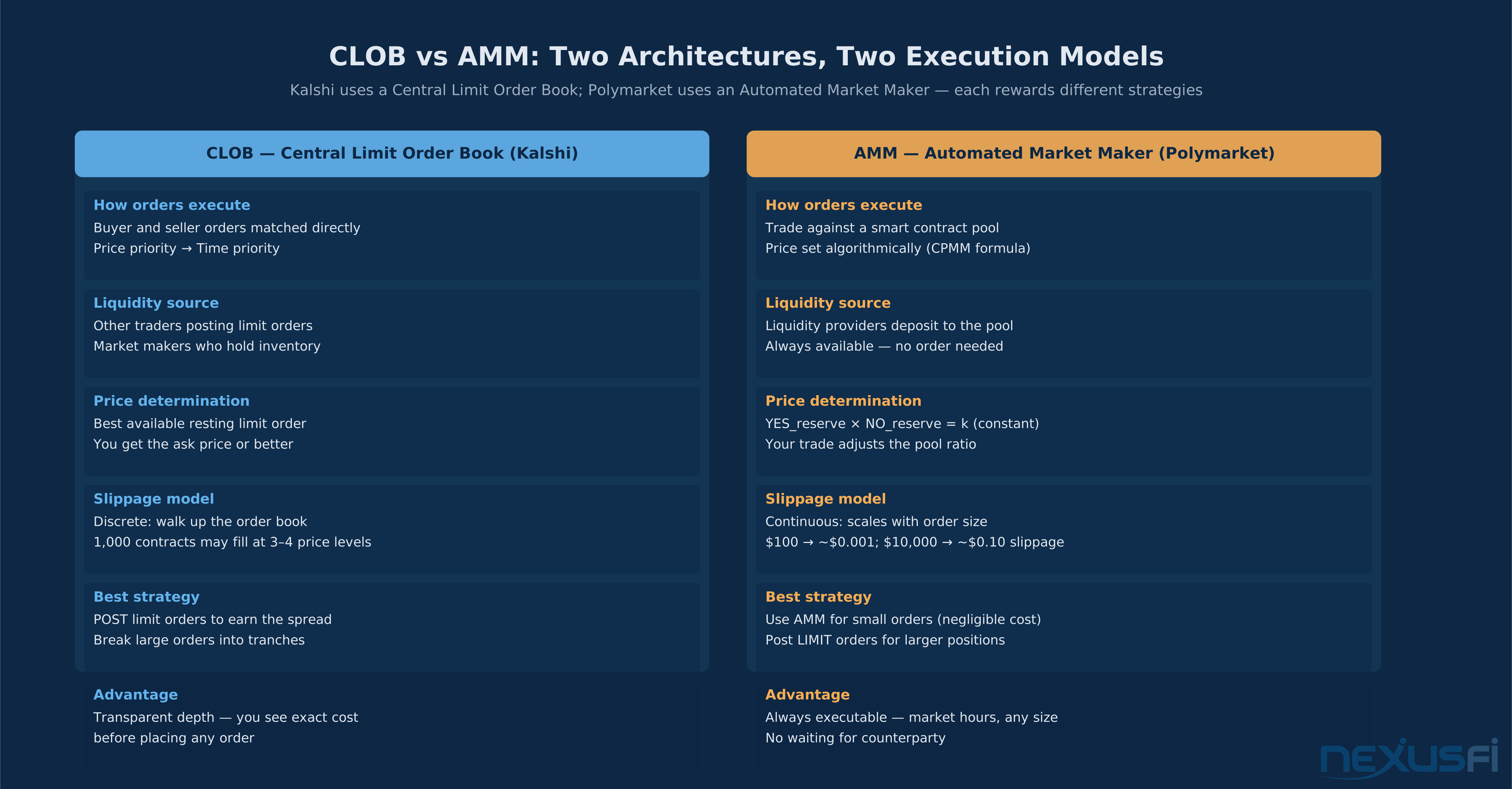
Kalshi operates a Central Limit Order Book (CLOB) — the same architecture used by futures exchanges and equities markets. Every order is entered into a shared electronic order book and matched according to strict rules: price priority first, then time priority at the same price.
How Kalshi's CLOB Works #
Order entry: Traders submit limit orders at a specified YES or NO price. Kalshi accepts prices in whole cents from $0.01 to $0.99.
Order matching: When an incoming order's price crosses the best available opposing order, a trade executes at the resting order's price. If I submit a market buy of YES and the best ask is $0.58, I fill at $0.58 regardless of what I was willing to pay.
Queue priority: At any price level, orders are ranked by time of arrival. Earlier orders have priority over later orders at the same price. This matters enormously in fast-moving markets — a market maker who posted their $0.55 bid at 9:00 AM gets filled before a trader who posted at 9:01 AM.
Partial fills: Large orders often fill against multiple resting orders across multiple price levels. A 500-contract market buy might fill 200 contracts at $0.58, 150 at $0.59, and 150 at $0.60 — your average price is above the best ask at time of entry because you consumed all liquidity at the $0.58 level.
Kalshi's Liquidity Profile #
Most Kalshi markets have sparse order books compared to futures exchanges. A major Federal Reserve decision market might have 10,000--50,000 contracts on each side with $0.01--$0.02 spreads. A niche science event market might have 200 total contracts with $0.05--$0.15 spreads.
This sparseness means that limit orders are the default execution mechanism for any serious Kalshi trader. Market orders consume liquidity and face spread costs. Limit orders earn the spread by providing liquidity — the same dynamic that applies in futures markets but more pronounced because of thinner books.
Reading Kalshi's Order Book #
Kalshi shows order book depth as total contract volume at each price level. A depth display showing:
YES Side:
Ask $0.62 -- 840 contracts
Ask $0.61 -- 320 contracts
Ask $0.60 -- 1,100 contracts

Bid $0.58 -- 2,200 contracts
Bid $0.57 -- 900 contracts
Bid $0.56 -- 450 contracts
This book shows a $0.02 spread ($0.58 bid / $0.60 ask), with significant buying interest at $0.58 and selling at $0.60. The large $0.58 bid suggests either a single large participant or aggregated retail interest who believes YES is worth at least $0.58 — implying 58% probability.
The $0.62 ask with 840 contracts suggests a seller willing to part with YES if probability moves to 62%. The gap between $0.60 and $0.62 is thin, indicating the market doesn't see much supply in that range.
For a trader analyzing this book: the $0.60 ask is a natural resistance level (420 contracts must clear before $0.61). The $0.58 bid is natural support. If the question's probability shifts above 60%, the $0.61--$0.62 range will clear quickly.
Polymarket: Automated Market Makers (AMMs) and Hybrid Mechanics #
Polymarket operates on a fundamentally different architecture. Rather than a CLOB where every order waits in a queue, Polymarket uses an Automated Market Maker (AMM) for baseline liquidity, supplemented by a CLOB layer for limit orders.
How Polymarket's AMM Works #
An AMM is a smart contract that holds a pool of YES and NO tokens and prices trades algorithmically based on the pool's composition. The most common formula for binary markets is a constant product market maker (CPMM) — in practice, Polymarket uses a modified variant with virtual reserves that smooths slippage at extreme probability levels, but the core invariant applies:
YES_reserve × NO_reserve = k (constant)When a trader buys YES tokens, they send USDC into the pool, the pool mints YES tokens and sends them to the trader. The price of YES adjusts continuously: more YES demand increases YES price, automatically reducing NO price (since YES + NO = $1.00).
This mechanism means there is always liquidity on Polymarket, but the cost of that liquidity varies with trade size. Large orders move the AMM price significantly. Small orders pay close to the current spot price.
AMM Slippage vs CLOB Spread #
The key difference between AMM execution and CLOB execution:
On a CLOB (Kalshi), you pay the bid-ask spread — the difference between where buyers and sellers have posted orders. On a thin market with a $0.05 spread, you pay approximately $0.025 per contract on average (half-spread) as execution cost.
On an AMM (Polymarket), you pay slippage — the price impact of your order size against the pool's depth. Small orders (say, $50 notional) pay minimal slippage, often less than $0.01. Large orders ($10,000+) can pay significant slippage — sometimes $0.05--$0.15 per contract on low-liquidity pools.
The practical implication: Polymarket rewards small position sizes in its AMM pools and punishes large orders. Kalshi rewards early order placement and punishes market orders.
Polymarket's Limit Order Book Overlay #
Polymarket added a limit order book layer on top of its AMM that allows traders to post limit orders at specific prices. When a limit order's price crosses the AMM spot price, the order fills. This hybrid architecture means sophisticated Polymarket traders can either:
- Trade against the AMM at the current spot price (guaranteed execution, variable slippage)
- Post limit orders at desired prices (no execution guarantee, earn spread if filled)
Market makers on Polymarket typically operate at both levels: posting limit orders just inside the AMM spread to capture the premium for providing liquidity, while hedging their exposure via the AMM or other platforms.
Gas Costs and Polygon's Microstructure Impact #
Unlike Kalshi (where trading is free except for platform fees), Polymarket trades are on-chain Polygon transactions. As of early 2026, Polygon gas costs are negligible — typically less than $0.01 per transaction. But the fact that every order is an on-chain transaction introduces latency effects that don't exist on centralized exchanges. High-frequency strategies that depend on millisecond reaction times are effectively impossible on Polymarket.
Bid-Ask Spread Mechanics: Why Prediction Market Spreads Are Wide #
Bid-ask spreads in prediction markets are typically wider than comparable financial derivatives for three interconnected reasons.
1. Adverse Selection Risk — The Primary Spread Driver in a Multi-Cause System #
Bid-ask spreads in prediction markets are wider than comparable financial derivatives due to several compounding factors: adverse selection from knowledge-asymmetric counterparties, limited hedging options for market makers, smaller market size attracting fewer liquidity providers, event volatility (prices can move 30+ cents on a single news release), and resolution risk (ambiguity in how borderline cases settle). Fee structures also matter: Kalshi charges 7% × contract price × (1 − contract price), which peaks at contracts near $0.50 and compounds the effective cost beyond the quoted spread.
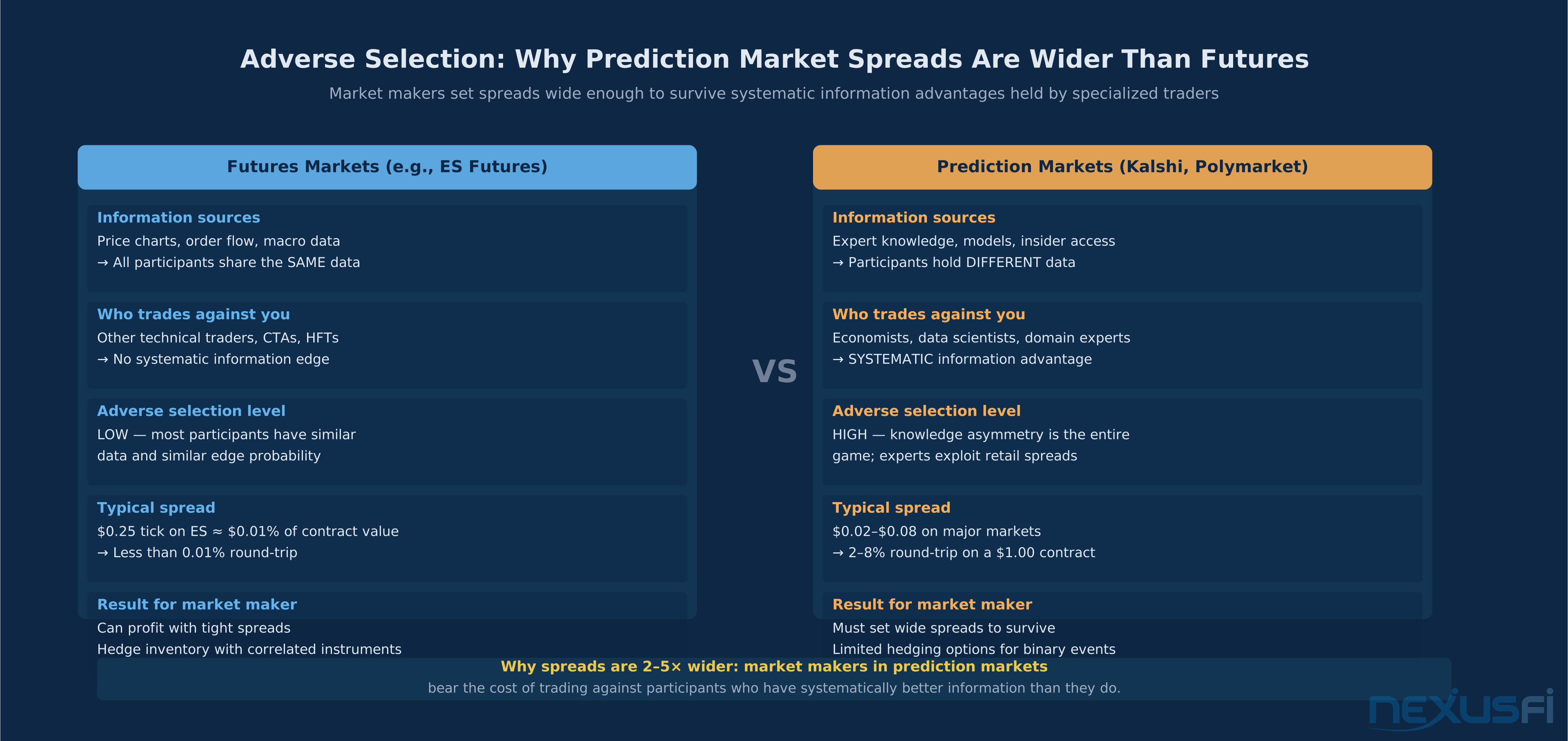
Of these drivers, adverse selection is the most structurally distinctive to prediction markets. Market makers face extreme adverse selection: When you post a limit order, you're providing liquidity to everyone — retail traders, casual bettors, and expert researchers who have done deep analysis on the question.
In futures markets, adverse selection is limited because all participants largely share the same information (price charts, order flow, macro data). In prediction markets, knowledge asymmetry is the entire game. A market on "Will GDP growth exceed 2.5% in Q2?" attracts economists, quants with proprietary models, and traders with Bloomberg terminals. A market maker who doesn't have an opinion on GDP growth must price their spread wide enough to survive being consistently traded against by people who do.
The result: market makers in prediction markets require wider spreads to cover adverse selection costs. Empirically, prediction market spreads are 2--5x wider than equivalent financial derivatives for the same underlying event.
2. Inventory Management in Bounded Markets #
In futures markets, a market maker can hedge their inventory by taking opposite positions in correlated instruments. A market maker long ES inventory can hedge with SPY, SPX options, or correlated equity futures.
In prediction markets, hedging is harder. If you're long YES on a Federal Reserve rate decision contract, you can't easily hedge with a Fed futures instrument because none exists with the same expiry and resolution criteria. Market makers hold inventory risk that they can't fully hedge, requiring wider spreads to compensate.
3. Market Size and Competition #
Larger markets attract more market makers, which compresses spreads through competition. Kalshi's biggest markets (Presidential election, major sporting events) have $0.01--$0.02 spreads because dozens of market makers compete for fill. Smaller markets with $100,000 total volume may have $0.05--$0.10 spreads because only one or two participants provide liquidity.
This creates a liquidity hierarchy in prediction markets: bet on popular events and pay 1--2% round-trip; bet on niche events and pay 5--15% round-trip before even considering adverse selection from your own information advantage (or lack thereof).
Price Formation: How Collective Intelligence Sets Prices #
Price discovery in prediction markets works differently from futures. In futures, price discovery occurs primarily through order flow — aggressive buying and selling by informed participants moving prices toward equilibrium. Fundamental value (the "correct" price) is continuously contested by traders who disagree about it.
In prediction markets, the mechanism is similar but the nature of "information" is different. Participants trade based on probabilistic assessments of discrete events: who will win an election, whether GDP will exceed a threshold, whether a company will announce a deal. Information is heterogeneous — different traders have different data, models, and reasoning — and prices aggregate these assessments.
The Efficient Information Aggregation Question #
A widely studied property of well-designed prediction markets is their accuracy as probability estimators. When Kalshi shows a Federal Reserve rate cut at 73%, does that mean there's a 73% chance of a rate cut?
The evidence from research on political prediction markets (Iowa Electronic Markets, PredictIt) suggests yes, with important caveats:
- Well-funded, liquid markets with many sophisticated participants tend to be well-calibrated
- Thin markets with retail-dominated participation may be less calibrated
- There's evidence that certainty is underpriced (markets shy away from 95%+) and uncertainty near 50/50 is sometimes overpriced
For trading purposes: treat Kalshi prices as reasonable probability estimates for popular markets, but not as definitive anchors for niche markets where participation is thin.
Information Cascades and Microstructure #
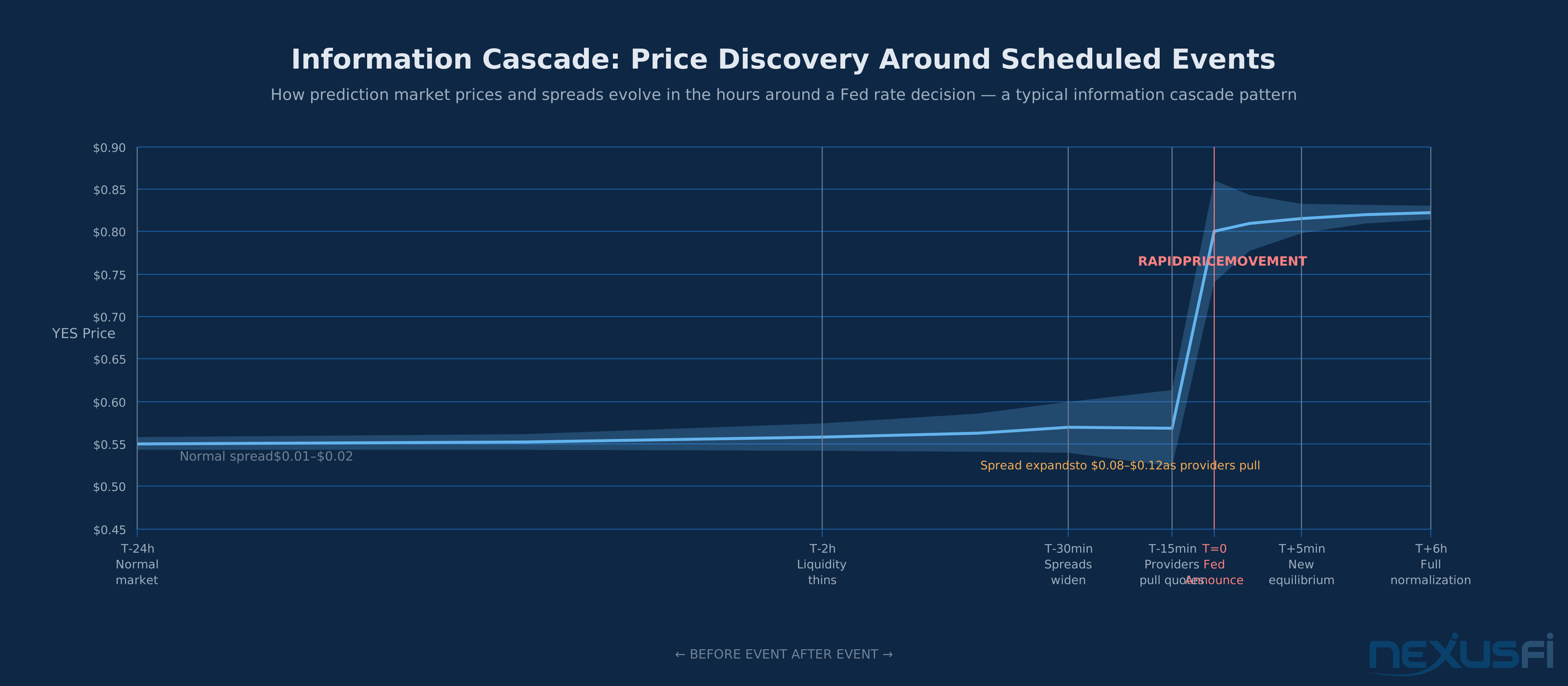
A key microstructure phenomenon in prediction markets is the information cascade: when a major data release (e.g., an early state election result) arrives, informed traders rush to update their positions simultaneously. Prices move in a cascade as market makers update quotes and informed traders consume liquidity.
During information cascades:
- Spreads temporarily widen (market makers don't know who has the information)
- Limit orders at stale prices get filled by informed traders (adverse selection spikes)
- Price discovery can be rapid — ES futures might take minutes to incorporate a news shock; a prediction market on the same event can re-price in seconds
For retail traders, information cascades are both opportunity and risk: if you have the information early, you can profit from it. If you don't, you're the market maker who sold at a bad price to someone who did.
Market Depth and Liquidity Concentration: Reading the Order Book #
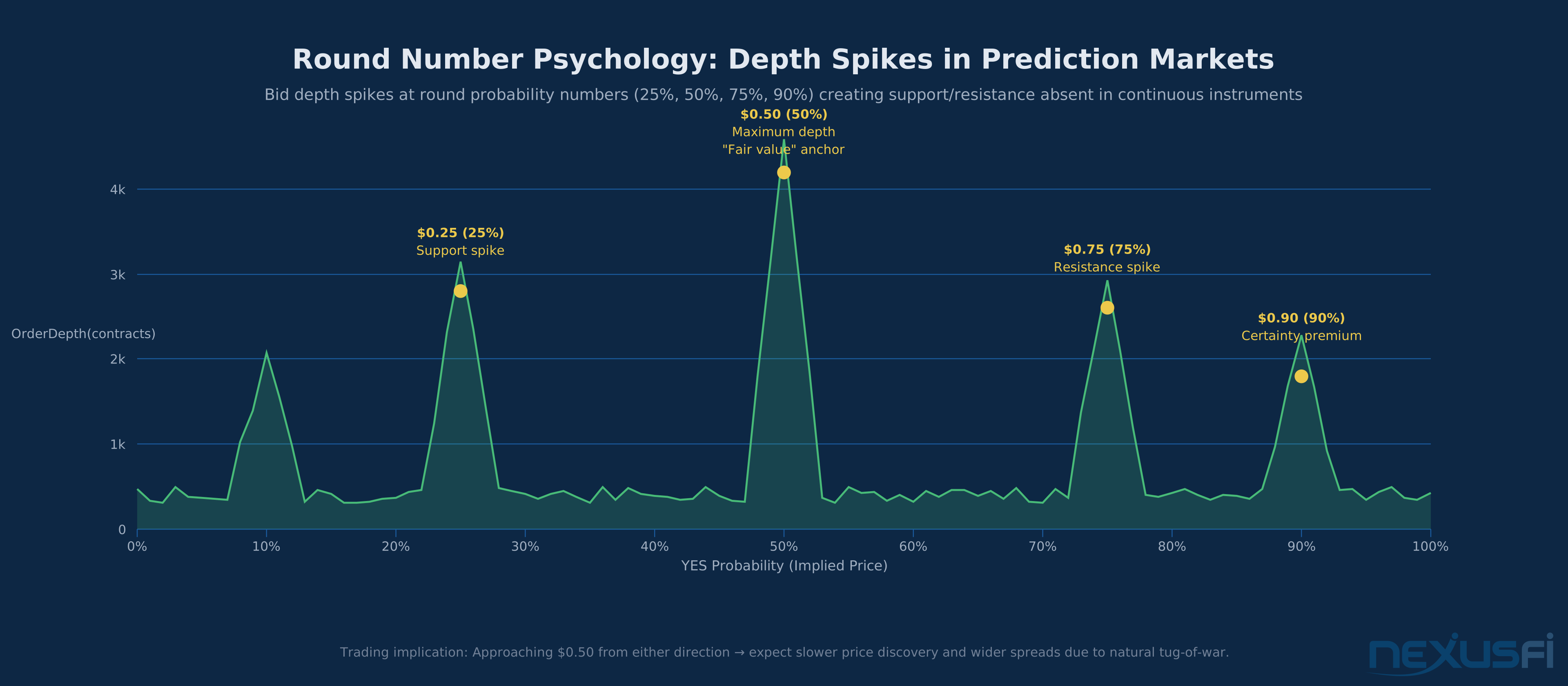
Order book depth in prediction markets is highly concentrated, not uniform. Understanding where depth concentrates and why helps you predict price resistance and support.
Round Number Effects #
Prediction market participants strongly anchor to round probability numbers: 25%, 50%, 75%, 90%, and especially 50/50. Order book depth typically spikes at these levels.
A contract trading at $0.52 will often have a thick bid at $0.50 (participants who think the event is 50/50 and see value at $0.50) and a thin bid between $0.51 and $0.49. This creates a microstructure support/resistance at round numbers that doesn't exist in continuous price instruments.
Trading implication: When a prediction market approaches $0.50 from either direction, expect reduced volatility and increased spread. The $0.50 level attracts both buyers (who see value) and sellers (who see resistance), creating a natural tug-of-war that slows price discovery.
Event-Driven Depth Shifts #
Order book depth shifts dramatically around events that provide information about resolution. Before a scheduled data release, market depth tends to thin (liquidity providers don't want adverse selection) and spreads widen. After the data release, depth rebuilds as the new equilibrium is established.
Pattern for Fed decision markets:
- T-24 hours: Normal depth, normal spreads
- T-2 hours: Depth begins thinning, spreads widen to $0.03--$0.05
- T-15 minutes: Depth is sparse, spreads can be $0.05--$0.10 as market makers pull quotes
- Decision announcement: Rapid price movement, thin market, high slippage
- T+5 minutes: New equilibrium, spreads normalize, depth rebuilds
For retail traders: don't place large orders in the 15 minutes around scheduled resolution-relevant events. Slippage and adverse selection are highest at these moments.
Market Impact in Binary Markets #
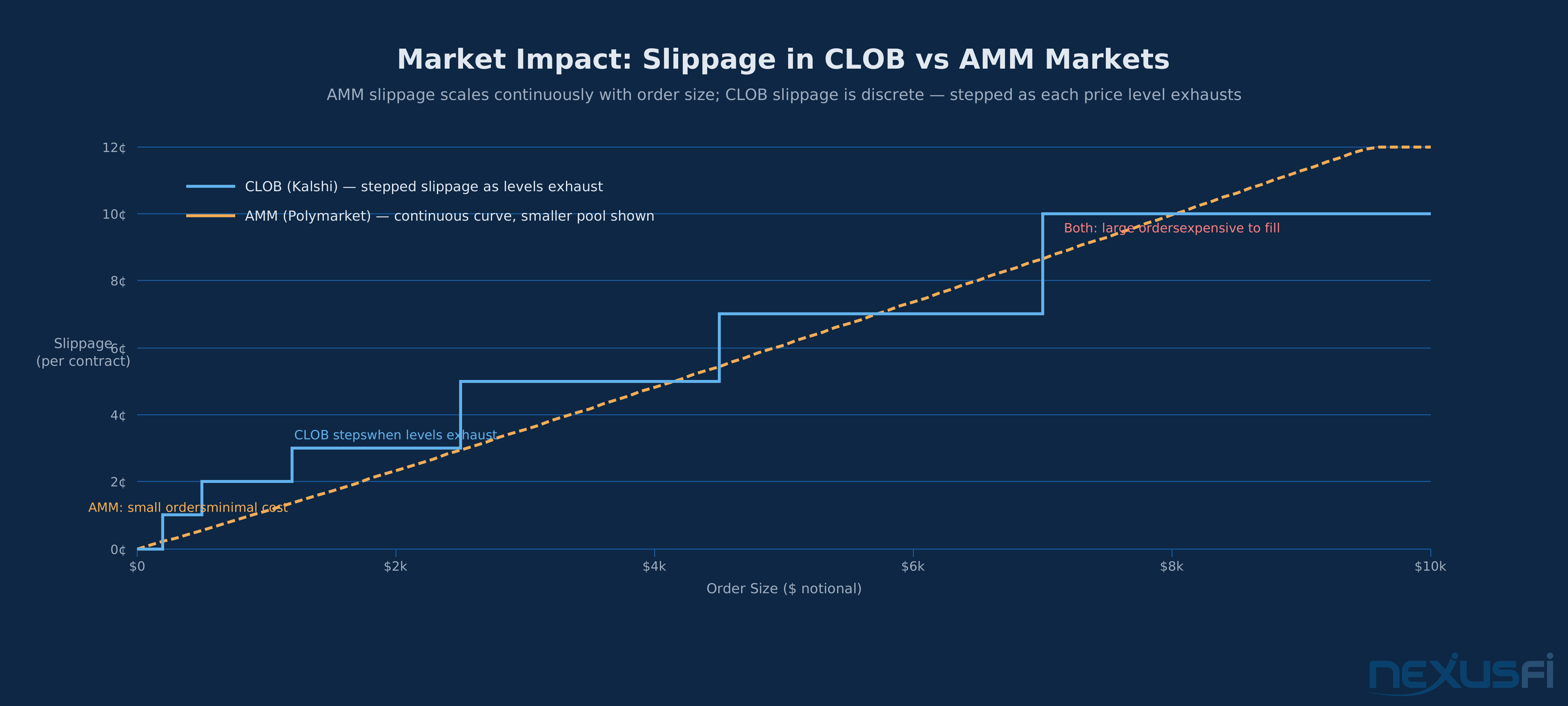
Market impact — the price movement caused by your own order — is more severe in prediction markets than in liquid futures, but with a distinctive pattern.
Slippage in CLOB Markets (Kalshi) #
On Kalshi, market impact is determined by order book depth at each price level. If you buy 1,000 YES contracts on a market where depth is:
Ask $0.58: 200 contracts
Ask $0.59: 150 contracts
Ask $0.60: 300 contracts
Ask $0.61: 400 contracts
Your 1,000-contract buy fills:
- 200 at $0.58 (exhausts that level)
- 150 at $0.59 (exhausts that level)
- 300 at $0.60 (exhausts that level)
- 350 at $0.61 (partial fill)
Average fill: approximately $0.601 vs. the $0.58 best ask. That's $0.021 of market impact — 21 basis points of slippage beyond the best ask. For a contract priced at $0.58, this represents ~3.6% execution slippage.
Minimizing market impact on Kalshi: break large orders into smaller tranches and use limit orders to indicate price levels where you're willing to buy without exhausting liquidity.
Slippage in AMM Markets (Polymarket) #
On Polymarket's AMM, market impact scales continuously with order size using the CPMM formula. For a pool with $100,000 in liquidity:
- $100 order: approximately $0.001 slippage
- $1,000 order: approximately $0.01 slippage
- $10,000 order: approximately $0.10 slippage
Larger Polymarket pools (elections, major sporting events) can have $5M--$20M in liquidity, drastically reducing slippage for typical retail order sizes. Small pools with $50,000 in liquidity will have significant slippage for orders above $5,000.
Execution Strategies: Minimizing Transaction Costs #
Limit Orders on Kalshi #
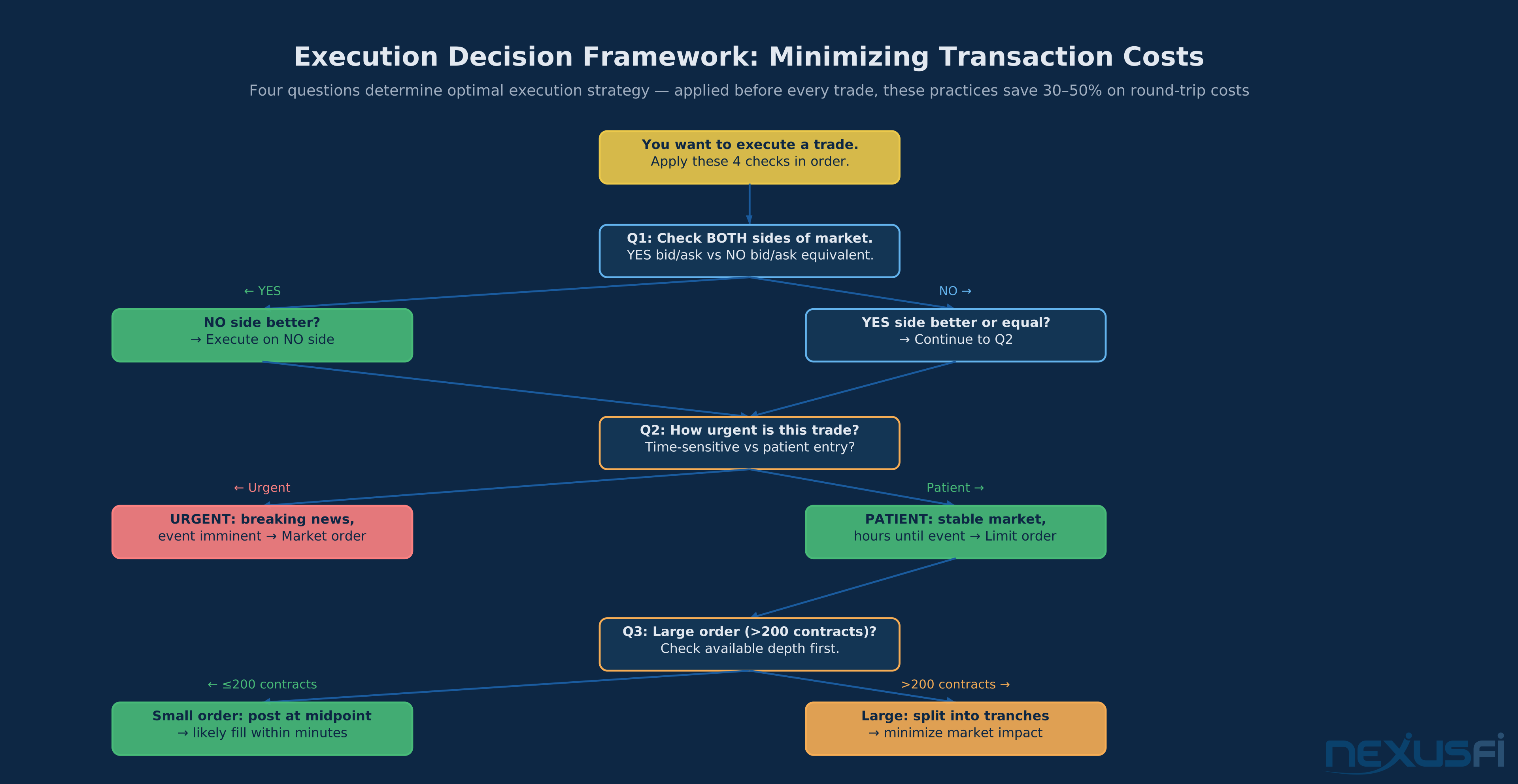
The primary tool for minimizing execution costs on Kalshi's CLOB is limit order placement. By posting a limit order at the current bid (rather than crossing the spread to buy at the ask), you earn the spread instead of paying it.
Practical workflow:
- Identify target position size
- Check current spread and depth
- Post limit order at midpoint (between bid and ask) if the market has been stable
- Adjust limit price based on your urgency — higher urgency = closer to the ask
The tradeoff: limit orders risk non-execution if the market moves away from your price. On illiquid questions, your limit order may sit unfilled for hours or days while the question's probability moves without you.
Monitoring the YES/NO Relationship #
Always check both sides of the market before executing. On Kalshi, the YES and NO books sometimes offer different effective prices for the same economic exposure.
If YES ask is $0.65 but NO bid is $0.32, selling YES is equivalent to buying NO at $0.35 (1 - $0.65). Buying NO at the $0.32 bid gives you $0.03 better execution for the same economic position.
This asymmetry is most common in thin markets and typically corrects quickly through arbitrage. Checking both sides of the market costs nothing and occasionally reveals better execution.
Polymarket AMM vs. Limit Orders #
On Polymarket, the choice between AMM execution and limit orders depends on your urgency:
- AMM execution: guaranteed fill, slippage cost scales with size
- Limit orders: better price if filled, no fill guarantee
For routine position entries in liquid markets, limit orders posted at the AMM midpoint typically fill within minutes. For time-sensitive trades (reacting to breaking news), AMM market execution at current price is often worth the slippage cost.
Microstructure Signals: What the Order Book Tells You #
Beyond just executing trades, reading the order book provides information about where sophisticated participants think probability lies.
Order Book Imbalance as a Leading Indicator #
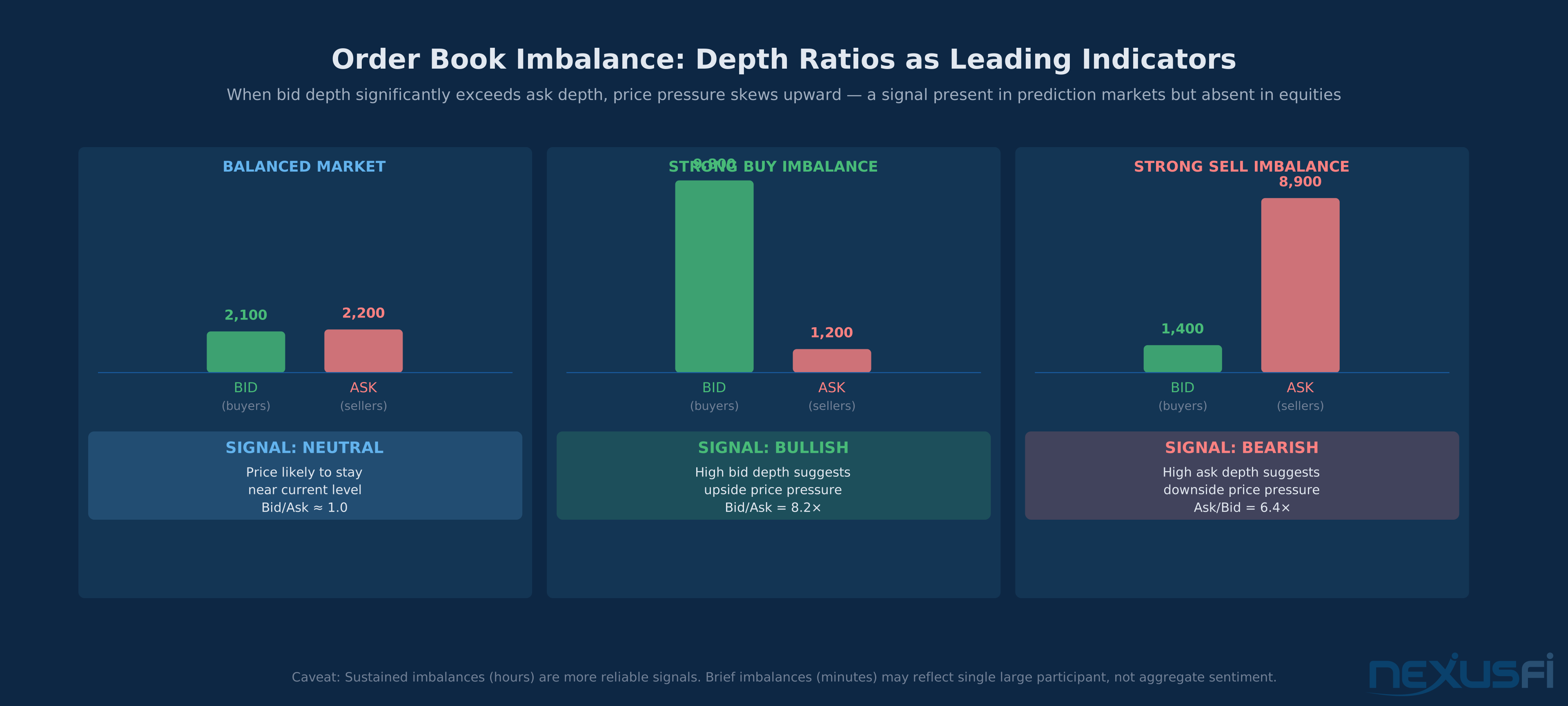
A significant imbalance between bid and ask depth often presages price movement. If the YES side has 10,000 contracts at the bid and only 500 contracts at the ask, there are far more buyers willing to hold YES at current prices than sellers. This imbalance suggests price pressure to the upside.
This signal is more reliable in prediction markets than in equities because:
- Algorithmic traders who spoof order books for profit are largely absent (market is too small)
- Participants tend to post genuine views rather than tactical quotes designed to mislead
Caveats: order book imbalances can be misleading if one large institutional participant is accumulating or distributing. Monitor persistence — an imbalance that sustains over hours is more informative than one that appears and disappears in minutes.
Stale Orders as Value Indicators #
In prediction markets, orders sometimes sit on the book for hours or days after the underlying probability has shifted. These "stale" orders represent execution opportunities for alert traders.
Example: a "Will the Fed cut rates in March?" contract was priced at $0.55 (55% probability). A seller posted 500 NO contracts at $0.44 (equivalent to YES at $0.56) when the probability was genuinely ambiguous. After a stronger-than-expected CPI report, the market priced YES at $0.35 — but the stale NO seller at $0.44 hasn't cancelled. Buying that NO position at $0.44 is now buying at $0.56 YES equivalent when the market is at $0.35 — an obvious mistake.
Alert traders monitor for stale orders after major news events to identify momentary pricing anomalies.
Platform Comparison: Microstructure Differences That Matter #
| Feature | Kalshi | Polymarket | Robinhood Events |
|---|---|---|---|
| Architecture | CLOB | AMM + CLOB hybrid | CLOB (Kalshi partnership) |
| Settlement | USD | USDC (crypto stablecoin) | USD |
| Gas/Transaction costs | None | ~$0.01 (Polygon) | None |
| Spread on major markets | $0.01--$0.02 | $0.01--$0.03 (AMM midpoint) | $0.01--$0.02 |
| Spread on minor markets | $0.05--$0.15 | Variable (pool depth dependent) | Not available |
| Market impact for large orders | Explicit (uses CLOB depth) | Continuous (AMM formula) | Explicit |
| KYC requirement | Full U.S. KYC | Wallet only (no personal info) | Full brokerage KYC |
| Order book transparency | Full depth visible | AMM + limit book depth | Limited |
| Trading hours | Near-continuous | Continuous (blockchain) | Market hours only |
For retail traders: Kalshi is better for large orders — you can see exactly where depth sits before committing. Polymarket is better for small orders where AMM slippage is negligible and market selection is broader. Robinhood offers easy onboarding but limits market selection.
Three practices that immediately improve execution: (1) Check both YES and NO sides before every trade — the NO side occasionally offers $0.02--$0.03 better effective pricing for the same exposure; (2) Use limit orders for any order over 50 contracts on Kalshi — market orders at a $0.06 spread cost $3 per 100 contracts versus $0 for a filled limit at mid; (3) Avoid market orders in the 15 minutes around scheduled resolution-relevant events — spreads can widen to $0.08--$0.12 and slippage multiplies. These three alone reduce round-trip costs by 30--50% for typical retail trade sizes.
How Microstructure Connects to Your Edge #
Understanding microstructure doesn't create an edge by itself — your edge comes from having better probability estimates than the market. But microstructure determines how much of that edge you capture versus give up to transaction costs.
A trader with a genuine 5% edge (they think YES is 60%, market says 55%) who executes with 3% round-trip transaction costs captures only 2% expected value from the trade. Improving execution from 3% to 1% round-trip triples their effective capture rate.
This is why professional prediction market traders obsess over execution:
- Limit orders instead of market orders
- Monitoring both YES and NO sides
- Breaking large orders into tranches
- Timing entries around low-slippage periods
- Choosing platforms based on market-specific liquidity
The traders who consistently make money in prediction markets combine accurate probability estimation with disciplined execution. Ignoring one renders the other insufficient.
Frequently Asked Questions #
Why are prediction market spreads wider than futures spreads?
Three factors: higher adverse selection risk (knowledge asymmetry is the whole game), limited hedging opportunities for market makers, and smaller market size attracting fewer competing liquidity providers. As prediction markets grow, spreads have been gradually compressing. Major Kalshi markets now trade with spreads comparable to options on equivalent events.
Can I make money just from providing liquidity in prediction markets?
In theory, yes — and some algorithmic traders do. But prediction markets have much higher adverse selection costs than futures because participants intentionally hold information advantages. Pure market-making (with no directional view) in prediction markets is harder than in futures. Most successful liquidity providers have some underlying view on probability that reduces their adverse selection risk.
How does knowing microstructure help in practice?
Concretely: check both YES and NO sides before executing, use limit orders for any order over 50 contracts on Kalshi, and avoid market orders in the 15 minutes around scheduled information events. These three practices reduce execution costs by 30--50% for typical retail trade sizes.
What's the most common microstructure mistake retail traders make?
Using market orders on illiquid questions. A $200 market buy on a question with $0.08 spread effectively donates $16 to the liquidity provider versus a limit order at the midpoint. At scale, this difference is significant.
Citations #
- @bobwest, Event Contracts - New Way to trade the CME Futures markets, NexusFi Emini and Emicro Index forum, 2022 — discussion of binary event contract mechanics in context of futures trading
- @Fi, Cboe Eyes Prediction Markets With Regulated All-or-Nothing Binary Options, NexusFi Traders Hideout, 2026 — analysis of regulated binary options expanding the prediction market ecosystem
- @Fi, Kalshi Hits $1 Billion in Super Bowl Trading Volume, NexusFi Traders Hideout, 2026 — liquidity context for major prediction market events
This article is part of the NexusFi Academy Prediction Markets series. Full series at /a/prediction-markets/.
Knowledge Map
Prerequisites
Understand these firstGo Deeper
Build on this knowledgeReferences This Article
Articles that build on this topicCitations
- — Event Contracts - New Way to trade the CME Futures markets (2022) 👍 3“Binary event contract mechanics -- order book and execution differences from standard futures”
- — Event Contracts - New Way to trade the CME Futures markets (2022) 👍 2“Spread dynamics and execution mechanics in CME binary event contracts”
- — Kalshi, Polymarket, Prediction Markets etc (2025) 👍 4“CLOB vs AMM platform mechanics -- how order execution differs between Kalshi and Polymarket”
- — Cboe Eyes Prediction Markets With Regulated All-or-Nothing Binary Options (2026)“Regulated binary options and market structure implications”
- — Kalshi Hits $1 Billion in Super Bowl Trading Volume (2026)“Liquidity context for major prediction market events -- spread compression at scale”
- — Tradeweb Takes Minority Stake in Kalshi (2026)“Institutional participation in prediction market order books”
- — CME Group Event Contracts Blast Past 100 Million Traded (2026)“Order flow volume and market impact in high-volume event contract markets”
- — Event Contracts - New Way to trade the CME Futures markets (2022) 👍 1“Early community analysis of binary event contract order book behavior”
- — Kalshi, Polymarket, Prediction Markets etc (2025)“Platform comparison -- CLOB vs AMM order execution and spread mechanics”
- — Polymarket CLOB Documentation
- — Kalshi Trading Documentation