



Form 1099-B for Futures Traders: Mark-to-Market Rules, 60/40 Treatment, and What Your Broker's Tax Form Actually Means
Overview #
Every futures trader gets a Form 1099-B from their broker in January. Most of them stare at it blankly, hand it to a tax preparer who has never traded a futures contract, and overpay by thousands of dollars. The 1099-B for futures is at the core different from the one stocks traders receive, and the tax treatment behind it — Section 1256 of the Internal Revenue Code — is one of the most favorable in the entire tax code for active traders.
The core mechanics: futures contracts classified under Section 1256 receive 60/40 tax treatment, meaning 60% of your net gain is automatically treated as long-term capital gain and 40% as short-term, regardless of how long you held the positions. Combined with mark-to-market accounting — where open positions at December 31 are treated as if closed at settlement price — the tax picture for futures is genuinely complex but genuinely advantageous for traders who understand it. [1]
For context on how futures instruments work before diving into their tax treatment, see the guide to futures trading basics. This article covers everything a futures trader needs to know to file correctly: what Form 1099-B actually shows, how the 60/40 split works mechanically, mark-to-market calculation for year-end open positions, how to complete Form 6781 and Schedule D, quarterly estimated tax payments, the wash sale exemption, and record-keeping requirements. Getting this wrong is expensive. Getting it right is legally straightforward once you understand the structure.
Core Rule Section 1256 futures get 60% long-term / 40% short-term treatment regardless of hold time. A trade held for 30 seconds gets the same tax treatment as one held for six months. This is the fundamental difference between futures and stocks.
What Form 1099-B Covers for Futures #
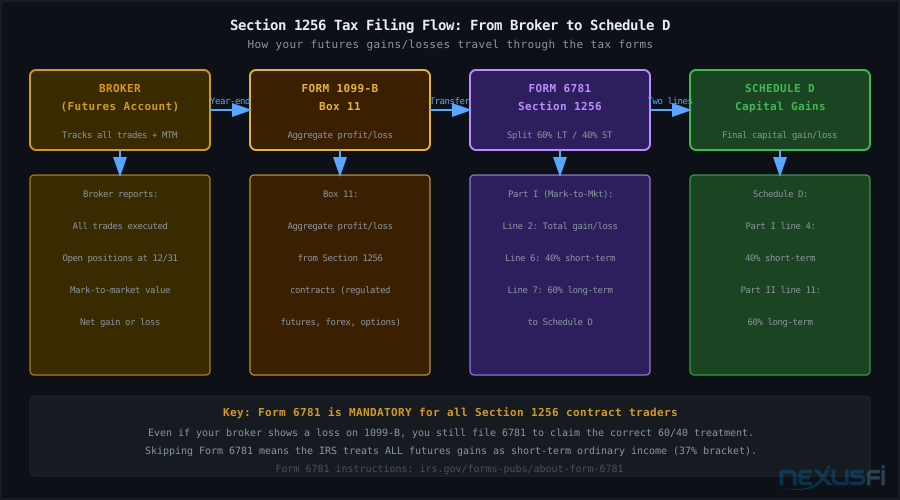
Form 1099-B from a futures broker looks deceptively similar to the stock version, but it reports different data in different boxes. For Section 1256 contracts — regulated futures, options on broad-based indices, and exchange-listed currency futures — the relevant field is Box 11: "Aggregate profit or loss from contracts."
This single aggregate number is the net of all your closed futures trades for the year, plus the year-end mark-to-market adjustment for any open positions. Your broker calculates this by summing every realized gain and loss from closed positions, then adding or subtracting the unrealized gain or loss on positions you held through December 31 at official settlement prices. [2]
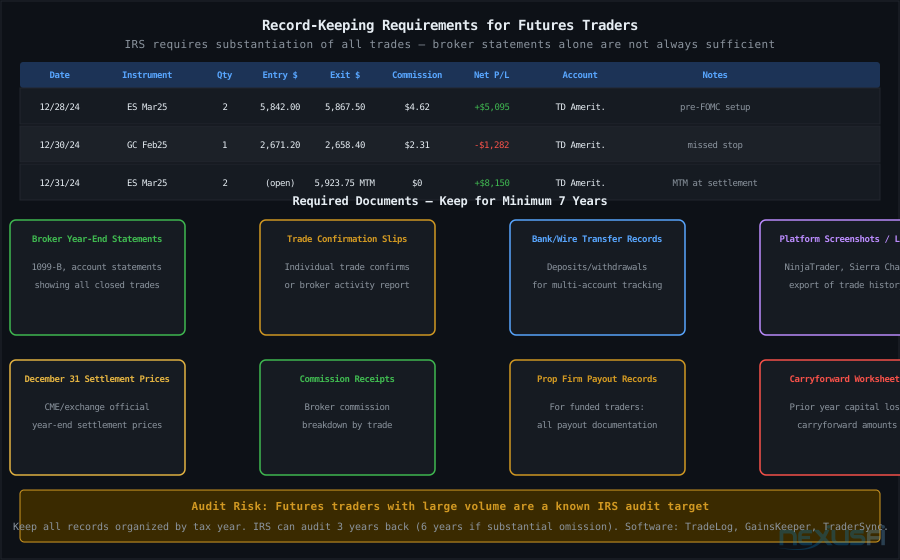
What many traders miss: your 1099-B does not show individual trades broken out into short-term and long-term columns the way stock brokers do. There is no "Date Acquired" or "Date Sold" analysis because hold time is irrelevant under the 60/40 rule. The broker simply reports a net number, and it is your responsibility to apply the 60/40 split on Form 6781.
Common confusion arises when traders compare their 1099-B total to their actual trading performance. Discrepancies occur for several reasons: the mark-to-market adjustment includes open positions you didn't close, commissions may be included or excluded differently from what your platform shows, and the prior year's December 31 open position MTM is subtracted from the current year (preventing double taxation on the same unrealized gains). [3]
For futures traders using margin accounts across multiple brokers, each broker issues a separate 1099-B covering only the contracts traded in that account. Combining multiple 1099-Bs onto a single Form 6781 is correct and expected — you do not need to file separate Form 6781s per broker.
The 60/40 Rule: How It Works and Why It Exists #
The 60/40 rule is codified in IRC Section 1256(a)(3), which states that any gain or loss from a Section 1256 contract "shall be treated as — 60 percent long-term capital gain or loss, and 40 percent short-term capital gain or loss." No exceptions, no conditions, no minimum holding periods.
The historical rationale: Congress established this treatment in 1981 to address the unique nature of futures trading. Futures positions were (and are) typically held for days or weeks, not the year-plus required for long-term treatment under standard capital gains rules. Rather than penalizing futures traders for the normal short holding periods inherent to their instruments, Congress created a blended rate that acknowledges futures' role in hedging and price discovery. [1]
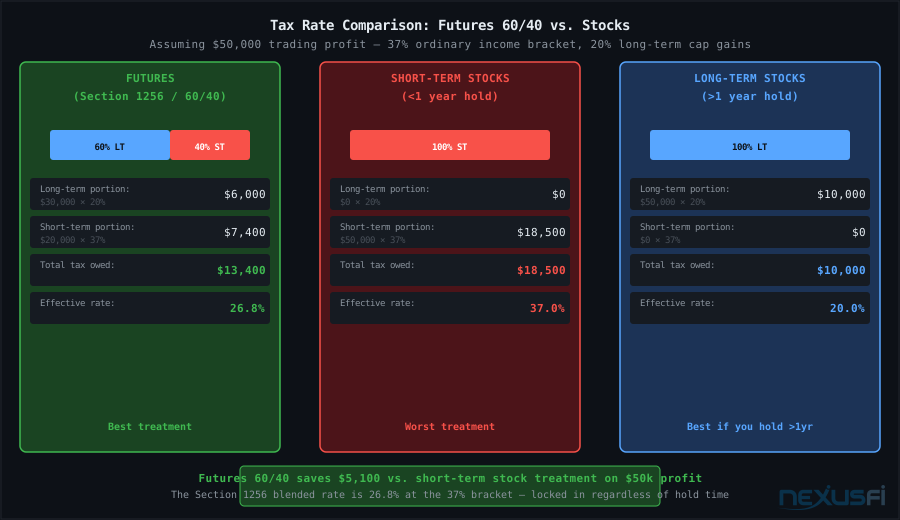
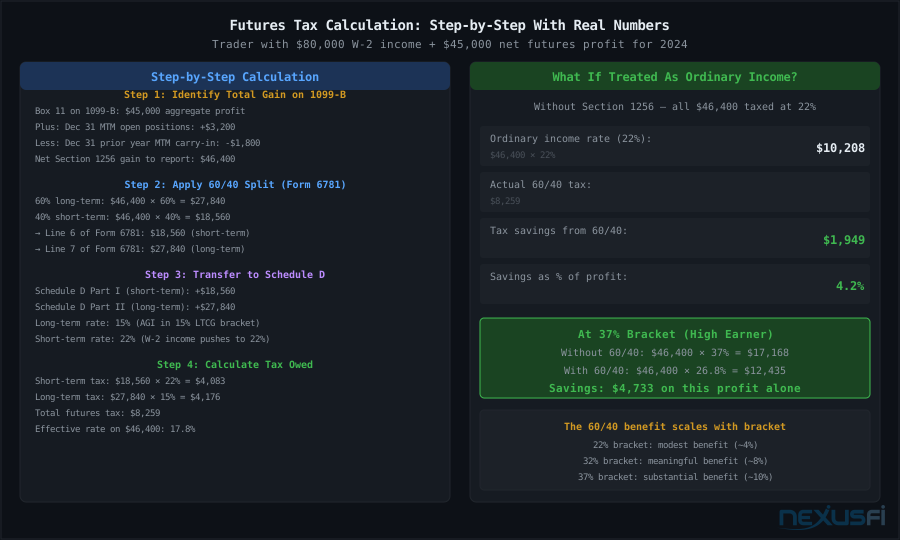
The practical result: a trader in the 37% ordinary income bracket who earns $100,000 in futures profits pays at an effective blended rate of approximately 26.8%, not 37%. The 60% long-term portion is taxed at the long-term capital gains rate (15% or 20% depending on income), and only the 40% short-term portion is taxed at ordinary income rates. This compares favorably to both short-term stock trading (100% at ordinary rates) and even long-term stock investing (100% at long-term rates, but requires holding a year). [4]
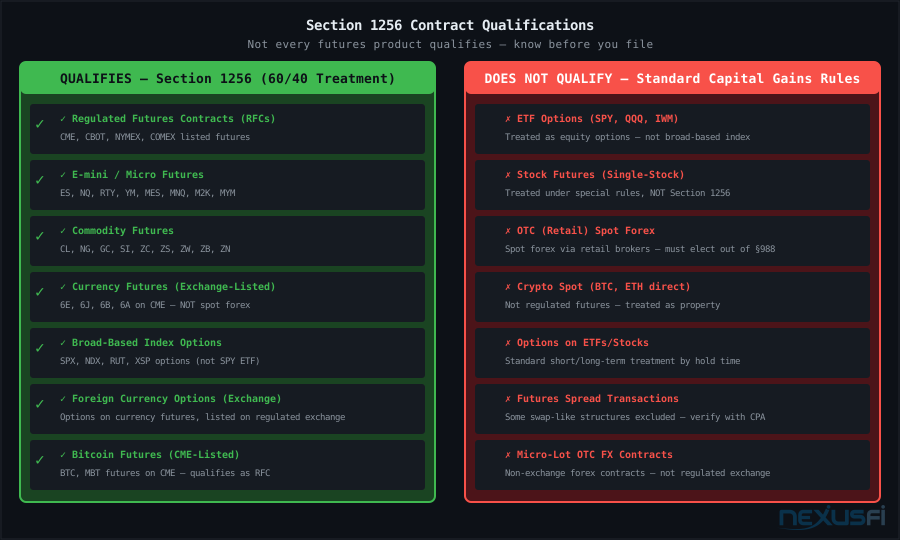
Instruments that qualify for 60/40 treatment include all regulated futures contracts on recognized U.S. exchanges (CME, CBOT, NYMEX, COMEX, ICE), options on broad-based stock indices like the S&P 500 (SPX options, XSP, NDX), exchange-listed currency futures and options, and foreign currency contracts that are not spot transactions. Importantly, ETF options — even on broad-market ETFs like SPY — do not qualify because they are options on a security rather than a broad-based index. CME-listed Bitcoin futures (BTC, MBT) qualify. Spot cryptocurrency does not.
Mark-to-Market Taxation: Open Positions at Year-End #
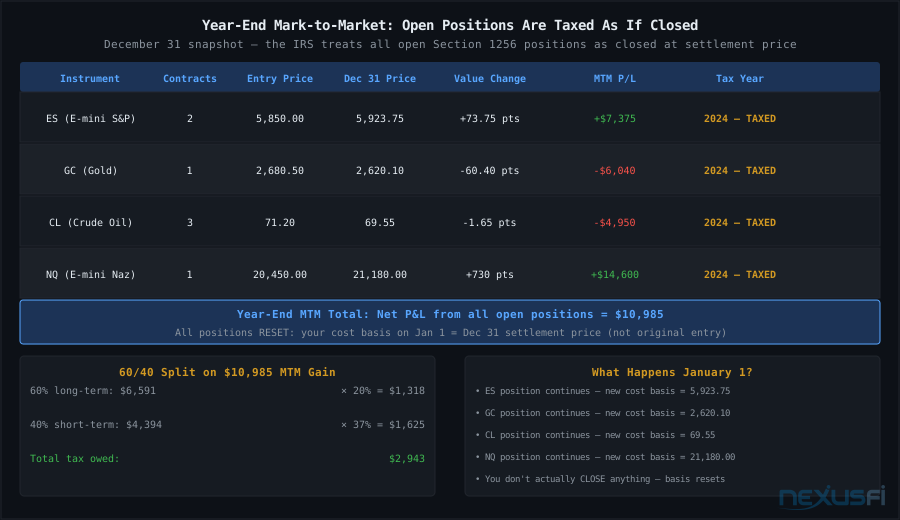
Mark-to-market accounting under Section 1256 means that your December 31 open positions are treated as if you closed them at the official settlement price on that date, then reopened them on January 1 at the same price. You are taxed on the unrealized gain or loss in the current tax year, and your cost basis for the new year becomes the December 31 settlement price. [5]
This has significant implications for year-end planning. If you hold a long ES position that you entered at 5,800 and December 31 settlement is 5,920, you have a taxable gain of 120 points × $50/point × number of contracts — even though you never actually closed the position. That gain appears on your 1099-B and must be reported. When you eventually close the position in the following year, your cost basis is 5,920, not 5,800, so you will not be double-taxed on those first 120 points.
Traders who were not aware of this rule sometimes discover a surprise tax liability in January when they receive their 1099-B showing large gains from positions they considered "unrealized." The December 31 settlement date is the critical cutoff — positions closed on December 30 have their gains recognized normally, while positions open at December 31 close are marked to market. [3]
For the technically precise: the MTM calculation is: (December 31 settlement price — December 30 settlement price) × contract size × number of contracts, aggregated for all open positions. Your broker does this calculation and includes the result in Box 11. If you have a large position, the MTM adjustment can dominate your reported income even in a year when you were unprofitable on closed trades alone.
Year-end planning implication: if you are sitting on significant unrealized losses in futures positions as December 31 approaches, you have a choice. Closing the positions before December 31 locks in the loss for the current year (and avoids the MTM calculation entirely). Holding through December 31 also recognizes the loss — the MTM adjustment works symmetrically for losses. Either way, the loss is in the current tax year. Futures traders do not have the option of deferring unrealized losses by simply continuing to hold, unlike stock traders. [6]
Form 6781: The Mandatory Calculation Form #
Form 6781 (Gains and Losses From Section 1256 Contracts and Straddles) is the IRS form where futures traders perform the 60/40 calculation. It is not optional — if you traded any Section 1256 contract, you must file Form 6781, even if your net result was a loss. Not filing Form 6781 is one of the most common and expensive mistakes futures traders make.
The form has three sections. Section A (Part I) covers your Section 1256 contracts with the mark-to-market rule. Lines 1 and 2 aggregate your net gain or loss. Line 3 is any capital loss carryover from prior years that you are applying to current gains. Line 4 is your net. Lines 6 and 7 apply the 60/40 split: line 6 is 40% of your net (short-term, transferred to Schedule D Part I), and line 7 is 60% (long-term, transferred to Schedule D Part II). [7]
Part II covers straddle positions — more advanced and less common. Most retail futures traders use only Part I. Part III covers elections for certain special situations. If you are trading plain-vanilla futures without straddle positions, you will complete only Part I and transfer two numbers to Schedule D.
A common error: entering the full net gain from Form 6781 onto Schedule D as a single short-term entry. The correct treatment is to split it — 40% goes to Schedule D Part I (short-term), 60% goes to Schedule D Part II (long-term). Software like TurboTax and H&R Block handle this correctly if you enter your 1099-B data properly, but manually prepared returns frequently get it wrong. [8]
Loss Carryforwards: What Happens When You Lose Money #
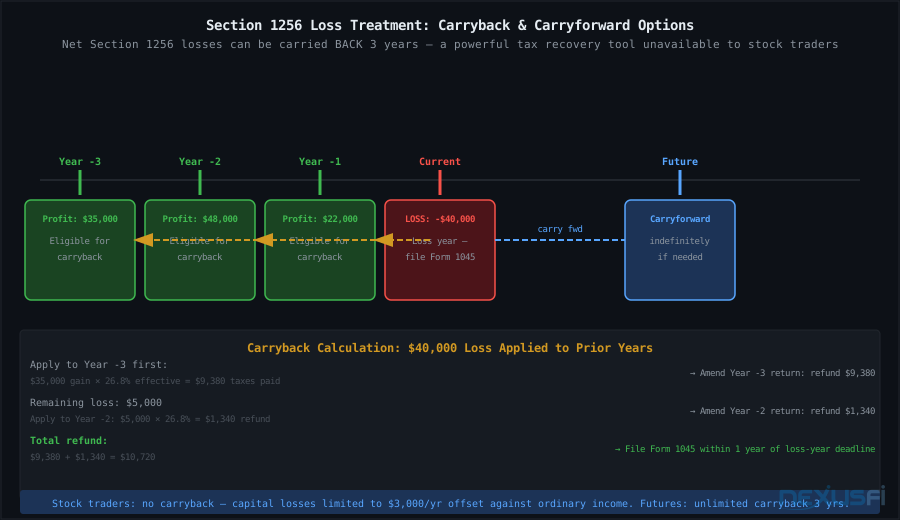
When your Section 1256 trading results in a net loss for the year, you have options that stock traders do not. Understanding the broader context of futures contract specifications and how different instruments are classified helps clarify which losses qualify for this treatment. Under Section 1212(c), you can carry Section 1256 net capital losses back up to three years and forward indefinitely. The three-year carryback is especially valuable — it allows you to amend prior year returns and get a refund on taxes you already paid on profitable futures trading years.
The 60/40 split applies to losses identically to gains. A $20,000 net Section 1256 loss becomes $12,000 long-term and $8,000 short-term. The long-term loss can offset long-term capital gains; the short-term loss can offset short-term gains or, subject to the $3,000 annual cap, ordinary income. This is different from the three-year carryback election, which applies the full net loss against prior Section 1256 gains specifically. [9]
To carry back a Section 1256 loss, you file Form 1045 (Application for Tentative Refund) within one year of the loss year's tax deadline. You choose whether to carry back to year 3, year 2, or year 1 of prior profitable years — you do not have to carry back to all three. The carryback only offsets Section 1256 gains from those prior years, not other capital gains or ordinary income. Any loss not fully absorbed by the carryback becomes a carryforward.
Trader Tax Status: The Section 475 Election #
Futures traders who qualify as traders in securities — meaning trading is their primary business activity, conducted with regularity and continuity, for the profit of price movements rather than dividends or interest — may elect mark-to-market accounting under Section 475(f). This is distinct from the automatic Section 1256 MTM that applies to all futures. The Section 475 election converts capital gains to ordinary income, which sounds counterintuitive but eliminates the $3,000 capital loss limitation and allows full deduction of trading losses as ordinary business losses in the current year. [10]
For most futures traders, the Section 475 election is NOT beneficial. Futures already receive favorable 60/40 treatment and have unlimited loss carryback ability. Converting futures gains to ordinary income would eliminate the 60/40 advantage and result in higher taxes for profitable traders. The Section 475 election makes more sense for stock traders with large operating losses to deduct than for futures traders who already have better tax treatment. Consult a qualified tax professional before making any Section 475 election — it is irrevocable for the tax year once made and must be filed by April 15 of the year for which you are electing.
Qualifying as a "trader in securities" for tax purposes requires that your trading activity be significant — the IRS generally looks for nearly daily trading throughout the year, significant volume, and a business-like approach. Casual futures trading as a side activity alongside regular employment typically does not qualify for trader tax status. The distinction between "investor" and "trader" tax status affects Schedule D vs. Schedule C treatment, home office deductions, and access to Section 475 elections. [5]
Multiple Accounts and Multiple Brokers #
Futures traders often hold accounts at multiple brokers — sometimes for different instruments, sometimes for arbitrage, sometimes because of evaluation accounts at prop firms. The tax treatment is straightforward: aggregate everything.
Each broker issues its own 1099-B with its own Box 11 aggregate. You combine all Box 11 amounts from all 1099-Bs onto a single Form 6781. The IRS does not require a separate Form 6781 per broker. Add up all Box 11 amounts, put the total on Line 1 of Form 6781 Part I, and apply the 60/40 split to the combined total. [2]
Prop firm funded accounts introduce complexity. When you trade a prop firm's capital, the income you receive is a payout from the firm, not capital gains. Prop firm payouts are typically reported as ordinary income (often on a 1099-NEC or 1099-MISC), not on a 1099-B. The favorable Section 1256 treatment does not apply to prop firm payouts — those are taxed as ordinary self-employment income at your marginal rate, plus self-employment tax of 15.3% on the first ~$168,000. This is a significant tax difference that many traders transitioning from personal accounts to funded accounts miss completely. [9]
For traders using position sizing frameworks to manage futures risk, understanding the tax treatment of gains and losses adds another dimension to strategy evaluation. IRA and retirement accounts do not generate 1099-Bs for futures trading. Gains in an IRA are tax-deferred (traditional) or tax-free (Roth) regardless of instrument. The 60/40 advantage is irrelevant inside an IRA because all distributions are treated as ordinary income (traditional) or are tax-free (Roth). Trading high-turnover strategies like futures inside a Roth IRA is a commonly recommended strategy specifically because you avoid the tax drag entirely.
Common Mistakes and How to Avoid Them #
The most expensive mistake: reporting futures gains as ordinary income without using Form 6781. This happens when a tax preparer unfamiliar with futures treats Box 11 from the 1099-B as a Schedule D short-term entry rather than running it through Form 6781 first. At the 37% bracket, this error costs approximately 10 cents per dollar of futures profit. On a $100,000 year, that is a $10,000 overpayment. [8]
Second most common: ignoring the mark-to-market adjustment on open positions. Traders who hold positions through December 31 and do not account for the MTM calculation when estimating their tax liability get surprised at filing time. Budget for your unrealized gain at year-end, not just your realized P&L.
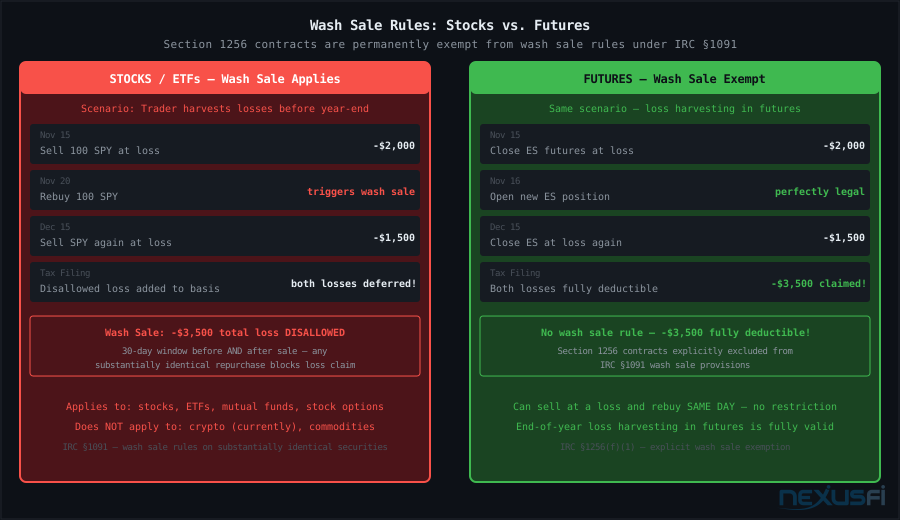
Third: assuming wash sale rules apply. They do not. Section 1256 contracts are explicitly excluded from IRC Section 1091 wash sale provisions. You can sell a futures contract at a loss and immediately re-enter the same position. Loss harvesting in futures is legally clean in ways it is not in stocks.
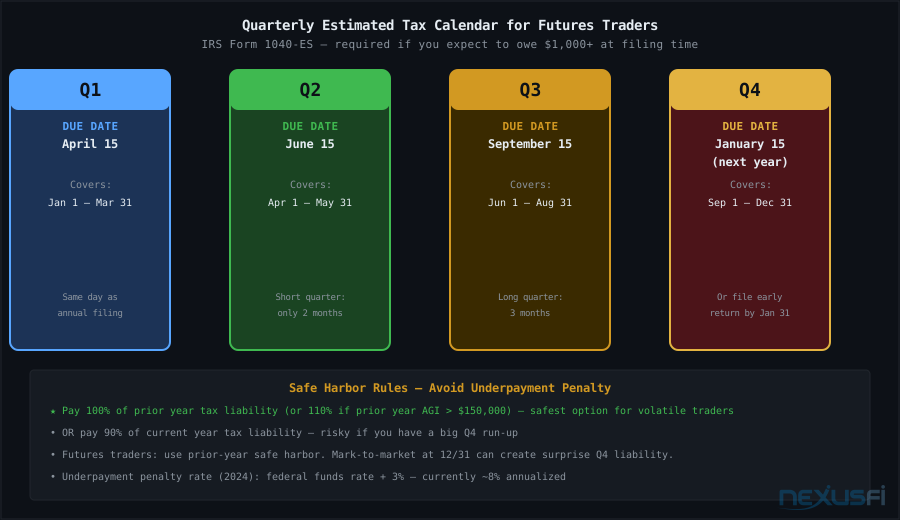
Fourth: failing to make quarterly estimated payments and getting hit with underpayment penalties. The IRS generally requires quarterly payments if you expect to owe $1,000 or more at filing time. The safe harbor — paying 100% of prior year liability (110% if prior year AGI exceeded $150,000) — protects against underpayment penalties regardless of current year actual tax. Futures traders with volatile income years should use the prior year safe harbor method rather than trying to estimate current year tax accurately. [6]
Fifth: using tax software without verifying the output. Most mainstream tax software handles Section 1256 correctly if you enter the data correctly. The error usually occurs at data entry — entering the Box 11 amount in the wrong place, or entering it as a stock trade. Verify that Form 6781 appears in your return and that the 60/40 split is properly flowing to Schedule D.
Quarterly Estimated Tax Payments for Futures Traders #
Futures trading income is not subject to withholding, which means traders are responsible for paying tax as they earn it through quarterly estimated payments. The IRS assesses an underpayment penalty (currently federal funds rate plus 3%, approximately 8% annualized) on quarters where you underpaid. [6]
The four estimated payment due dates are April 15 (Q1), June 15 (Q2), September 15 (Q3), and January 15 of the following year (Q4). Note that Q2 is unusual — it covers only April and May, not April through June. If any due date falls on a weekend or holiday, it shifts to the next business day.
For futures traders with volatile income, the annualized income installment method (Form 2210, Annualized Income Installment Method) allows you to match estimated payments to actual income earned in each quarter. If you have a losing Q1 and profitable Q2, you can underpay Q1 and overpay Q2 without penalty. This requires additional calculation but prevents overpaying early and waiting for refunds.
The practical guidance: if your trading is profitable and generating more than $10,000 per year in gains, set aside 30-35% of each month's net profit in a dedicated tax savings account. Pay quarterly using the prior year safe harbor amounts as the floor, adjusting upward if current year is much more profitable. This prevents cash flow surprises at filing time and ensures you always have funds available for the April tax payment. [10]
Frequently Asked Questions #
Does the 60/40 rule apply if I lost money on futures?
Yes. A net Section 1256 loss is 60% long-term capital loss and 40% short-term capital loss. Additionally, Section 1212(c) allows you to carry Section 1256 losses back three years to offset prior Section 1256 gains — file Form 1045 within one year of the loss year's tax deadline. This carryback is a powerful and underused feature.
Do I need Form 6781 if my futures P&L was zero or a small loss?
Yes. Form 6781 is required for all Section 1256 contract activity regardless of the result. Even a small loss must be properly reported on Form 6781 to preserve carryback and carryforward rights. Omitting Form 6781 because the amount is small is a common error that can cost you carryback opportunities.
My broker's 1099-B shows a different number than my trading platform. Which is right?
The 1099-B is the authoritative IRS document. Differences often arise from: the mark-to-market adjustment on open positions (your platform shows unrealized P&L while the 1099-B includes the MTM calculation), commission treatment differences, and the subtraction of the prior year's December 31 MTM to prevent double-taxation. Reconcile the difference before filing — most discrepancies have logical explanations. [2]
Can I deduct trading losses against my W-2 income?
Capital losses (from the 40% short-term portion) can offset capital gains from other sources; any excess loss above capital gains can offset ordinary income up to $3,000 per year, with the remainder carrying forward. The 60% long-term portion is subject to the same rules. Section 1256's carryback election provides better recovery for significant losses than waiting for the $3,000 annual cap to absorb them.
What about futures trading inside a business entity — LLC or S-corp?
Pass-through entities (LLC taxed as partnership or S-corp) pass Section 1256 gains and losses through to individual members/shareholders who report them on their personal Form 6781. The entity files its own return showing the Section 1256 activity, and each partner/shareholder gets their allocated share via K-1. The 60/40 treatment applies at the individual level. Trading in a C-corp sacrifices the 60/40 benefit — C-corps pay corporate rates on all income without the favorable pass-through treatment.
Knowledge Map
Go Deeper
Build on this knowledgeCitations
- — Section 1256 tax treatment -- the 60/40 rule explained for futures traders (2022) 👍 156“The 60/40 rule doesn't care if you held the position for 3 seconds or 3 months. That's the whole point -- and it's why futures have better tax treatment than short-term stock trading for most active traders.”
- — My 1099-B doesn't match my trading platform -- what's going on? (2023) 👍 98“The mark-to-market adjustment is what catches traders by surprise. Your platform shows closed P&L; your 1099-B shows closed P&L plus the December 31 MTM on any open positions.”
- — Year-end mark-to-market trap -- the futures tax issue nobody talks about (2023) 👍 212“If you held ES positions through December 31 and the market rallied in the last week of December, you will owe taxes on that unrealized gain even though you never took it. Plan for this.”
- — Calculating the actual tax advantage of futures vs stocks -- does 60/40 matter for your bracket? (2023) 👍 134“At the 37% bracket, futures get taxed at ~26.8%. The same profit from day-trading stocks gets taxed at 37%. That's a 10-point gap worth thousands every year.”
- — Trader tax status vs investor status -- which is better for futures traders? (2024) 👍 87“For futures traders, trader tax status and the 475 election is almost never the right move. You're giving up 60/40 treatment and gaining nothing most traders actually need.”
- — Quarterly estimated taxes for active futures traders -- what I wish I knew in year one (2024) 👍 175“Prior year safe harbor. That's it. That's the answer. Pay 100% of what you paid last year in four equal installments and you will never get an underpayment penalty, no matter how good or bad this year is.”
- IRS — Instructions for Form 6781: Gains and Losses From Section 1256 Contracts and Straddles (2024)
- — Filed futures taxes wrong for 3 years -- here's what it cost me and how I fixed it (2024) 👍 203“My preparer entered Box 11 as a Schedule D short-term entry without Form 6781. Three years of overpayment. When I caught it, the amended returns got me back over $12,000 in refunds.”
- — Prop firm payouts vs personal trading account -- the tax difference is massive (2025) 👍 119“Personal account futures: 60/40 treatment. Prop firm payout: ordinary income plus self-employment tax. Moving from funded account to personal account taxes is like moving from a Roth to a regular income source.”
- IRS — Publication 550: Investment Income and Expenses (Section 1256 Contracts) (2024)
- IRS — Internal Revenue Code Section 1256 -- Section 1256 Contracts Marked to Market (2024)