



Risk Management for Futures Trading
Overview #
Risk management isn't a chapter you read after you learn to trade. It IS trading. Every profitable trader who survives long enough to compound returns got there by managing risk first and finding entries second. The traders who blow up are almost always the ones who had a genuine edge but sized too big for the variance — they were right about the direction often enough, but one bad streak at oversized positions wiped out years of gains in a matter of days.
This article covers the complete risk management framework for futures trading: position sizing, stop placement, risk-reward analysis, drawdown management, and the structural differences between how professionals and amateurs approach risk. Everything ties back to one principle: define your risk before you enter the trade, size your position to survive the worst case, and let the math do the heavy lifting.
Key Concepts #
Risk Per Trade: The maximum dollar amount you're willing to lose on any single trade, expressed as a percentage of your account. The standard range for futures is 0.5% to 2% of account equity. Go above 2% and the math of drawdown recovery starts working against you fast.
R-Multiples: Your trade's outcome expressed as a multiple of your initial risk. If you risk $200 and make $600, that's a 3R winner. If you lose the full $200, that's a -1R loser. R-multiples normalize performance across different position sizes and instruments, making it the single best metric for comparing trading strategies and tracking performance over time.
Risk of Ruin: The probability of drawing your account down to a point where you can't trade anymore. This isn't theoretical — it's a calculable number based on your win rate, reward/risk ratio, and percentage risked per trade. Every system has a risk of ruin; the question is whether yours is 0.001% or 15%.
Maximum Drawdown: The largest peak-to-trough decline in your account. Every system has one. The question isn't whether you'll experience a drawdown — it's whether your position sizing can survive it when it comes. A 30% drawdown requires a 43% gain just to get back to even. Know your system's expected maximum drawdown and size to match it.
Position Sizing: The calculation that determines how many contracts to trade on each setup. This is the single most powerful lever in your entire trading operation. Get entries right but sizing wrong, and you'll still blow up. Get sizing right but entries mediocre, and you can still grind out a living. The math is unambiguous on this point.
Volatility-Adjusted Risk: Adjusting your stop distance and position size based on current market volatility, typically measured by Average True Range (ATR). A 4-point stop on ES when ATR is 15 points means something entirely different than a 4-point stop when ATR is 50 points.
The Risk-First Framework #
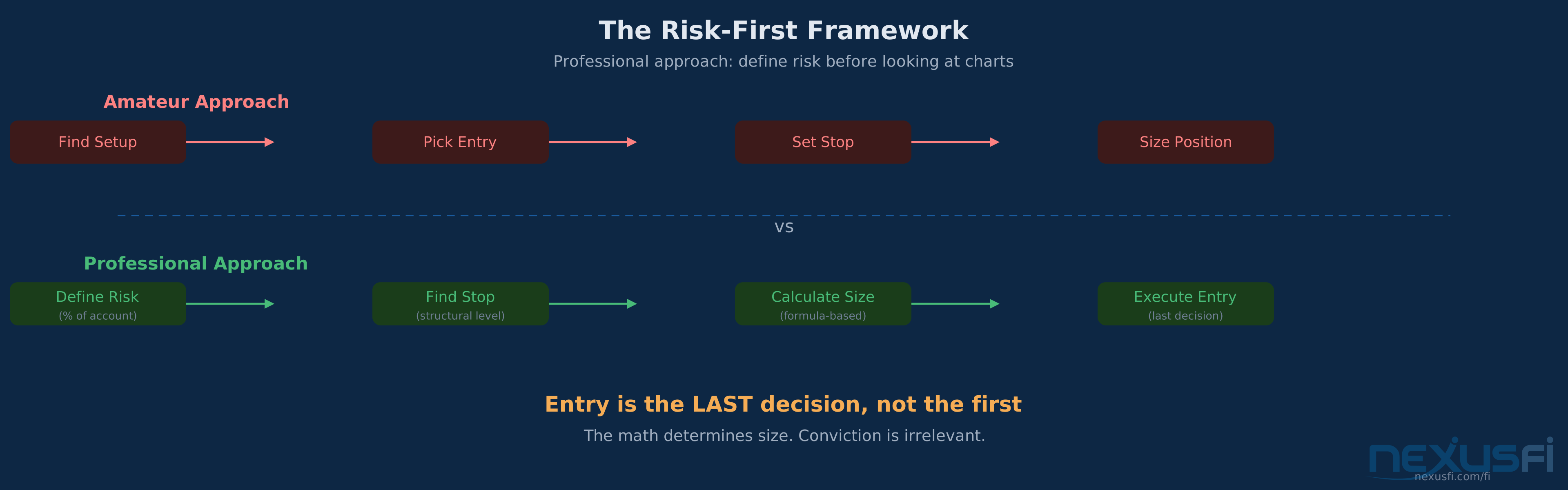
Most traders think about trading as: find a setup, determine the entry, then figure out risk. Professionals reverse this completely. The framework is:
- Define risk first
- Identify the invalidation level
- Calculate position size
- Then execute
This reversal matters because it prevents the most common account-killing behavior: sizing positions based on conviction rather than math. "I'm really confident in this setup" is how accounts die. The math doesn't care about your confidence.
As @Big Mike [noted on NexusFi] [6], "a stop is where you are wrong about a trade. It has nothing to do with your profit or your position size." The stop is structural — it marks the price level where your trade thesis is no longer valid. Once you accept that, everything else in risk management flows from it.
Position Sizing Methods #
Fixed Fractional Position Sizing #
The most widely used method. You risk a fixed percentage of your current account balance on every trade.
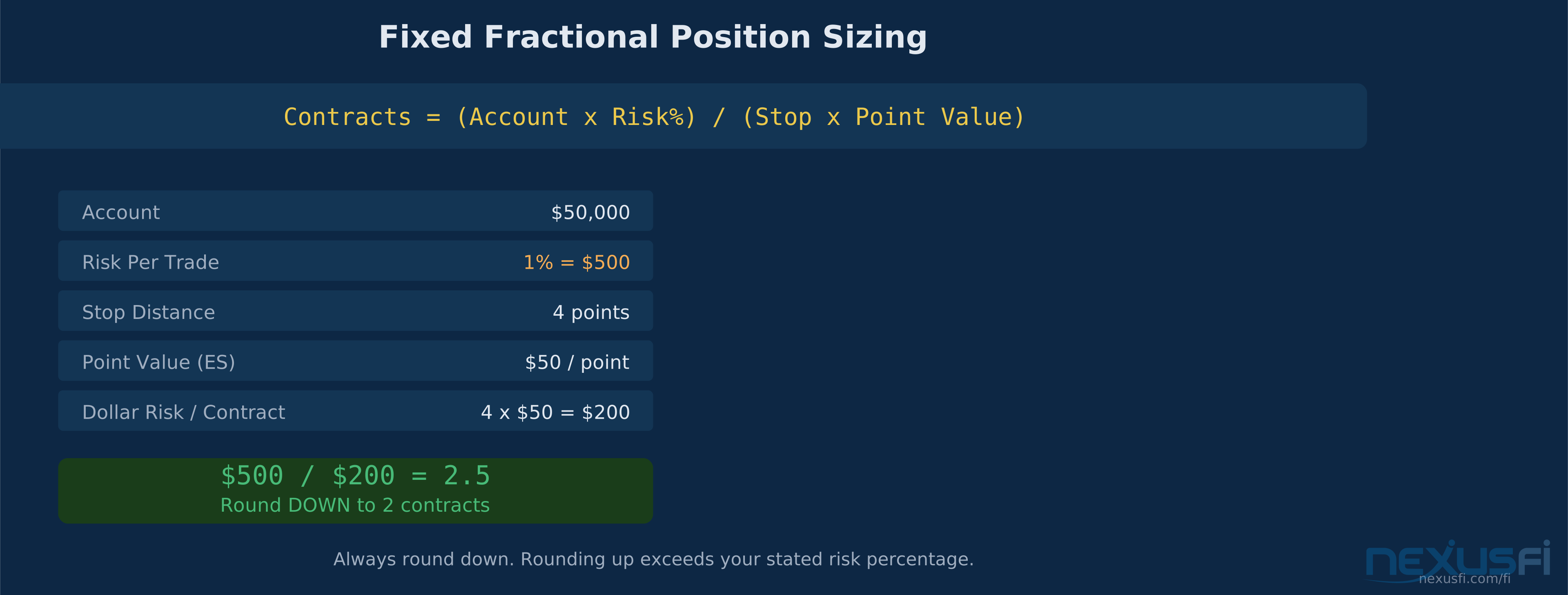
The formula:
Contracts = (Account × Risk%) / (Stop Distance × Point Value)Worked example:
- Account: $50,000
- Risk per trade: 1% = $500
- Stop distance: 4 points
- Point value: $50/point (ES)
- Dollar risk per contract: 4 × $50 = $200
- Contracts: $500 / $200 = 2.5 → round down to 2 contracts
Always round down. Rounding up means you're risking more than your stated percentage.
As @tigertrader [explained] [4]: "If you are willing to risk 2% of your $100,000 trading account on a trade where your stop is set at 4 points ($200 per contract), you could trade 10 contracts and still remain risk-prudent."
The beauty of fixed fractional sizing is that it self-corrects. After losses, your account shrinks and so does your position size — automatically reducing exposure when your edge is underperforming. After wins, your account grows and positions scale up organically. This geometric compounding is the key advantage of fixed fractional over the naive "always trade 2 contracts" approach.
ATR-Based Position Sizing #
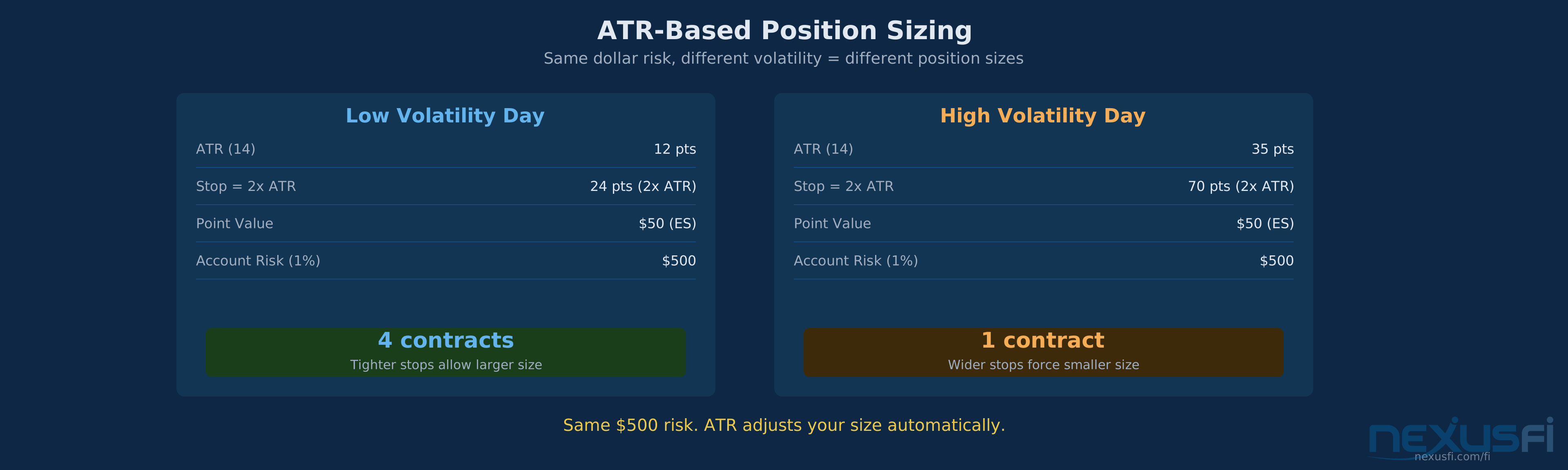
Instead of using a fixed-tick stop, you let the market's current volatility determine your stop distance.
The formula:
Stop Distance = ATR(N) × Multiplier
Contracts = (Account × Risk%) / (Stop Distance × Point Value)
@Fat Tails [developed a full-featured position sizing tool] [2] that uses "ATR(36) plus Spread" on the 5-minute chart as the money management stop-loss. The key insight: the ATR adapts to current conditions automatically. During low-volatility sessions, your stops tighten and size increases. During high-volatility sessions, stops widen and size decreases.
Worked example:
- Account: $30,000
- Risk: 1% = $300
- 14-period ATR on 15-min chart: 0.35 points
- Stop = 0.35 × 2 = 0.70 points
- Dollar risk/contract: 0.70 × $1,000 = $700
- Contracts: $300 / $700 = 0.43 → 0 contracts (risk exceeds allocation)
This is ATR sizing working correctly. It just told you this trade doesn't fit your risk parameters at current volatility. Don't force it by widening your risk percentage — that defeats the entire purpose of volatility-adjusted sizing. Wait for volatility to contract or find a setup with a tighter structural stop.
Kelly Criterion (Modified) #
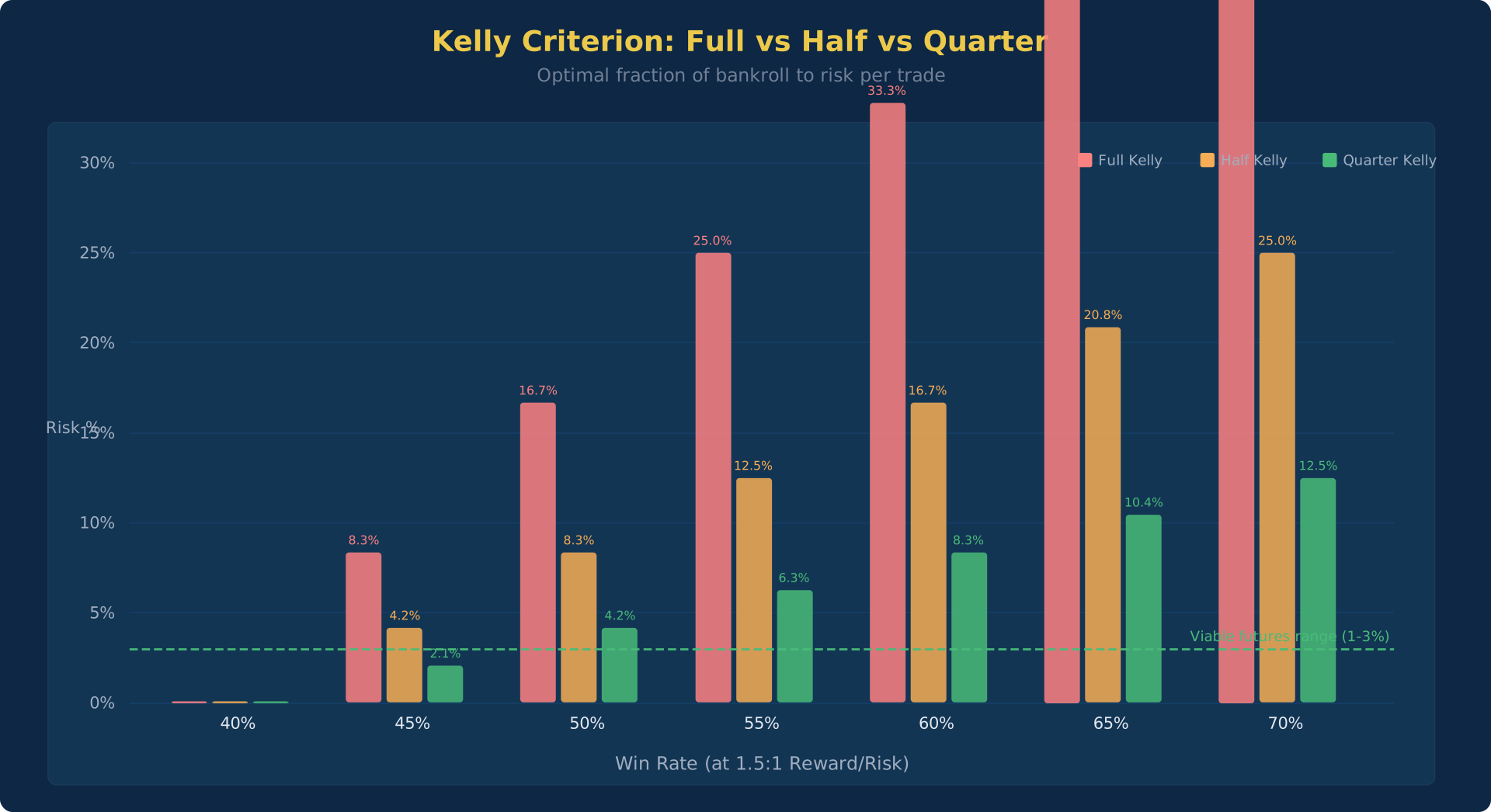
The Kelly Criterion calculates the theoretically optimal fraction of your bankroll to bet. Full Kelly is too aggressive for futures trading because it assumes you know your exact edge, which in practice you never do with complete precision.
Kelly% = W - [(1-W) / R]
Where: W = win rate, R = average win/average loss ratioExample: 55% win rate, 1.5:1 reward/risk
- Kelly% = 0.55 - (0.45 / 1.5) = 0.55 - 0.30 = 25%
- Half-Kelly = 12.5%
- Quarter-Kelly = 6.25%
Full Kelly at 25% is reckless for futures. Quarter-Kelly at 6.25% is still aggressive. Most viable futures strategies land in the 1-3% risk range, which corresponds to fractional Kelly for systems with typical win rates and payoff ratios.
As @Fat Tails [analyzed extensively] [3], "How many contracts should I trade to comply with the specified risk? The risk of ruin is equivalent with a maximum drawdown and the probability that the maximum drawdown is reached or exceeded."
Stop Loss Placement #
Structure-Based Stops #
Your stop loss goes where your trade thesis is invalidated — not where you feel comfortable, and not at a round number because it's tidy. The stop is a structural statement about your analysis: "If price reaches this level, I was wrong about the market's current auction."
Using Volume Profile levels:
- Long from VAL → Stop below the LVN beneath the value area
- Long from POC → Stop below VAL (the thesis is "price accepts value here")
- Short from VAH → Stop above the HVN above the value area
- Breakout above VAH → Stop just below VAH (the thesis is "price accepts higher value")
These stops are structural because they represent levels where the market's auction has established clear reference points. A stop below the LVN means "if price gets here, my thesis that value holds is wrong."
Concrete ES Trade Example #
Here's a real-world setup to illustrate structure-based stop placement on the E-mini S&P 500:
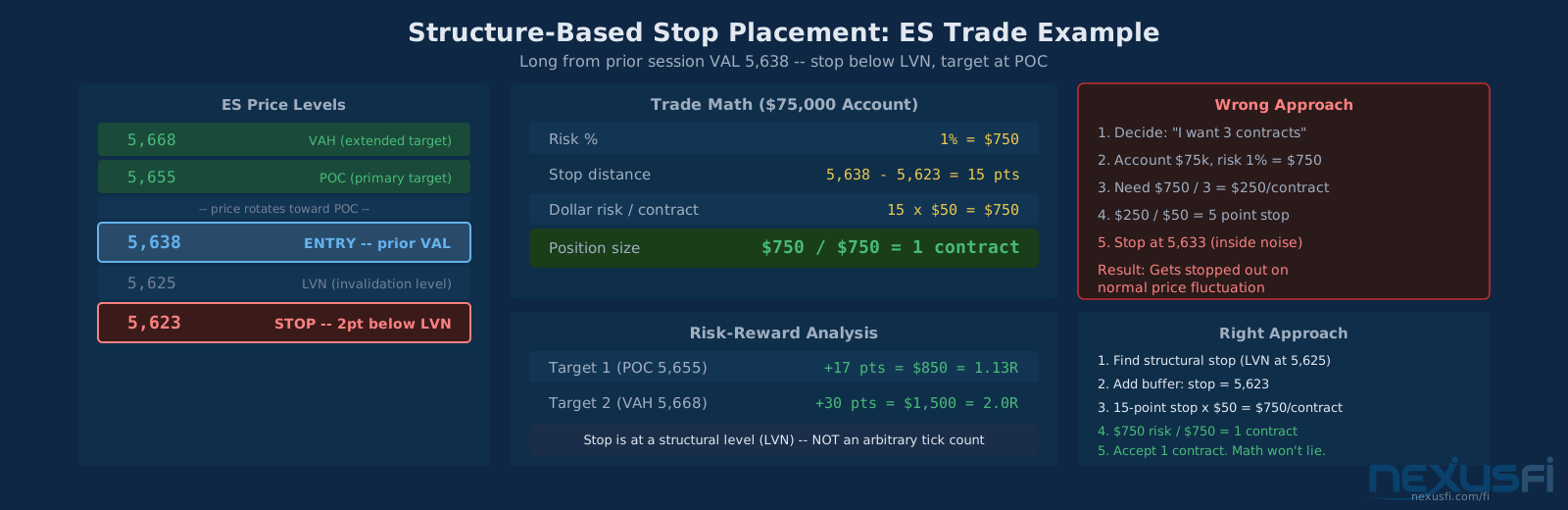
Scenario: ES is trading at 5,642 and you identify a long setup from the prior session's Value Area Low at 5,638. The prior session's Low Volume Node sits at 5,625, and the Point of Control is at 5,655.
Step 1 — Set the structural stop: Your thesis is "price will accept value at yesterday's VAL and rotate back toward POC." The invalidation point is the LVN at 5,625 — if price trades through there, the value area thesis is broken. Place your stop at 5,623 (2 points below the LVN for buffer against stop runs).
Step 2 — Calculate stop distance: Entry at 5,638, stop at 5,623 = 15 points of risk.
Step 3 — Size the position:
- Account: $75,000
- Risk: 1% = $750
- Stop distance: 15 points × $50/point = $750/contract
- Contracts: $750 / $750 = 1 contract
Step 4 — Set the target: POC at 5,655 gives a 17-point target = $850 potential profit. That's a 1.13R trade — marginally acceptable. If you want better R:R, you could target the prior session's VAH at 5,668 for a 30-point target (2R), but that requires stronger conviction in the rotation.
Step 5 — Validate: 1 contract at 15 points of risk = $750 = exactly 1% of the account. The stop is at a structural level (LVN), not an arbitrary tick count. The trade fits the framework.
Notice what didn't happen: you didn't start with "I want to trade 3 contracts" and then squeeze the stop to 5 points to make it fit. You started with structure, sized to fit the stop, and accepted 1 contract because that's what the math dictated.
Using ATR for stop distance: The ATR doesn't tell you where to put your stop — it tells you whether your stop is wide enough to survive normal market noise. A stop inside 1× ATR on your trading timeframe will get hit by routine price movement more often than your system expects.
Rule of thumb: stop distance should be at least 1× ATR on your trading timeframe to avoid noise stops. Ideally 1.5-2× ATR for swing setups.
The Stop-Size Relationship #
Here's the critical connection most traders miss: your stop distance directly determines your position size, which directly determines your risk profile.
As @monpere [explained] [7]: "You should be placing your stop according to market analysis, then size your position to hit the desired dollar risk. The formula is simple: Dollar Risk / Per-Contract Risk = Number of Contracts."
The trap: Traders who pick position size first and stop second are doing it backwards. This leads to either stops that are too tight (noise stops) because they want to trade more contracts, or risk that's too large because they refuse to trade fewer contracts with a wider stop.
Risk-Reward Framework #
Minimum R-Multiple Threshold #
Don't take trades where the target doesn't justify the risk. The math:
- At 50% win rate, you need better than 1:1 R:R to profit (after commissions)
- At 40% win rate, you need at least 2:1 R:R to break even
- At 60% win rate, you can profit at 1:1 but you're leaving money on the table
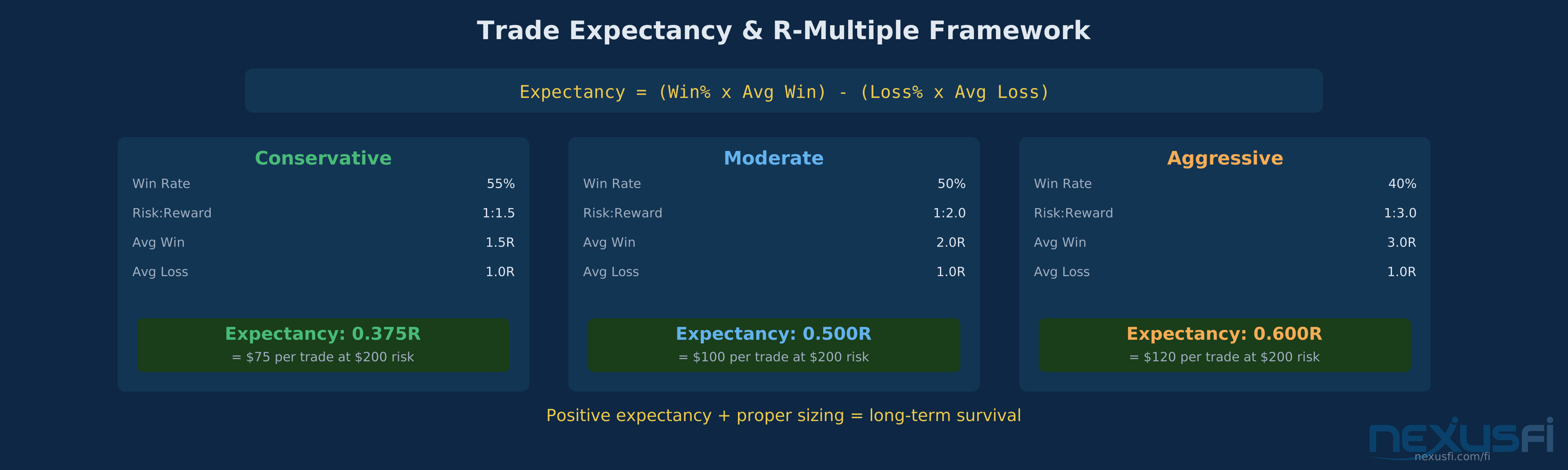
The expectancy formula:
Expectancy = (Win% × Avg Win) - (Loss% × Avg Loss)Example: 55% win rate, 1.5R average win, 1R average loss
- Expectancy = (0.55 × 1.5) - (0.45 × 1.0) = 0.825 - 0.45 = 0.375R per trade
That's $75 expected profit per trade if R = $200. Over 200 trades per year, that's $15,000. The math works — but only if you actually take every valid setup and size consistently. Cherry-picking or emotion-driven sizing destroys the expectancy edge.
R-Multiple Sizing in Practice #
As @monpere [noted] [8]: "Sizing based on the location of your stop is basically R-Multiple sizing. Your stop is your 'R' (Risk), the smaller the stop the larger the position, the bigger the stop the smaller the position."
This creates an elegant feedback loop: tighter structural stops (higher-conviction setups at clear levels) allow larger position sizes within the same dollar risk. The framework naturally allocates more capital to better setups.
Expectancy Tracking: The 100-Trade Sample #
Your expectancy formula means nothing in isolation. It only becomes actionable when you track it across a statistically meaningful sample — minimum 100 trades. Before reaching that threshold, you're trading on hope and small-sample noise, not verified evidence of edge.
How to track it in your trade journal:
Record every trade with five columns: date, instrument, entry price, exit price, and R-multiple result. After 100+ trades, calculate your core metrics:
- Win rate: Winning trades divided by total trades
- Average R on winners: Sum of positive R-multiples divided by number of winners
- Average R on losers: Sum of negative R-multiples divided by number of losers. This number should cluster around -1R if you're disciplined about honoring stops. If your average loser is -1.5R or worse, you have a stop discipline problem that no entry methodology can fix.
- Expectancy per trade: (Win% × Avg Winner R) - (Loss% × Avg Loser R)
What the numbers tell you: If your expectancy lands below 0.20R per trade after 100 trades, your system needs work — either the win rate, the average win size, or both. The fix isn't to abandon the system but to diagnose whether the problem is entries (win rate), exits (average win too small), or risk management (average loss too big). Each diagnosis leads to a different intervention.
An expectancy of 0.30R to 0.50R per trade with consistent execution is the range where most professional futures traders operate. Above 0.50R sustained across 200+ trades suggests either a genuinely rare system or a sample that hasn't yet encountered its worst drawdown regime.
The critical discipline: don't adjust your system parameters during the 100-trade sample. You're measuring, not optimizing. Tweaking mid-sample — tightening stops after a loss, widening targets after a win, skipping setups that "feel" wrong — poisons the data and prevents you from ever knowing whether your original system has genuine edge. Run the 100 trades mechanically. Analyze after. Then decide whether to modify.
Practical tip: Use a simple spreadsheet with running totals. After every trade, update your cumulative win rate and expectancy. Watch how these numbers stabilize as the sample grows. The first 30 trades will swing wildly — that's noise, not signal. By trade 80-100, you'll see meaningful convergence. That's the point where you can start trusting the data to guide decisions about position size scaling, system modifications, or whether to keep trading the system at all.
Maximum Drawdown Management #
The Math of Recovery #
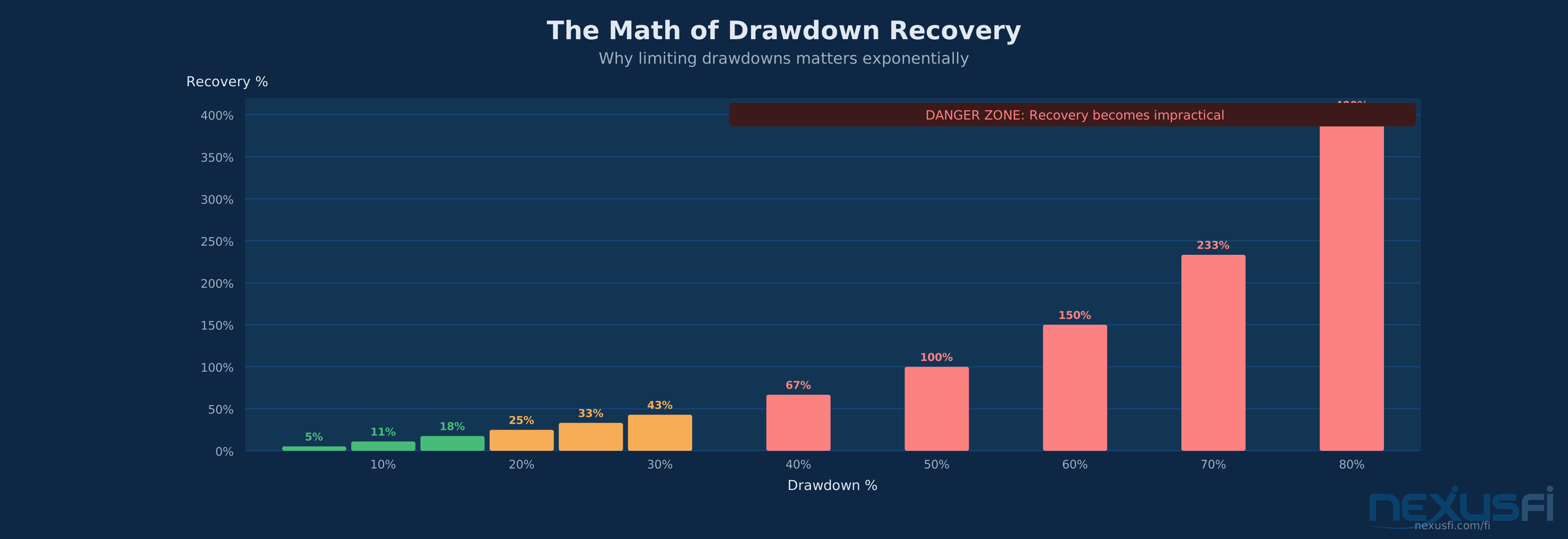
This is the number that should be taped to every trader's monitor:
| Drawdown | Recovery Needed |
|---|---|
| 10% | 11.1% |
| 20% | 25.0% |
| 30% | 42.9% |
| 40% | 66.7% |
| 50% | 100.0% |
| 60% | 150.0% |
At 20% drawdown, you need a 25% gain to get back to even — and you're generating that gain from a smaller capital base, so it takes proportionally longer. A 50% drawdown needs a 100% return, which most traders never achieve even in their best year. This asymmetry is the single most important number in risk management.
This table is why risk per trade matters so much. At 2% risk per trade with a 55% win rate, the probability of a 10-trade losing streak is about 0.03%. But at 5% risk per trade, that same 10-trade streak takes you from 100% to 60% — and now you need a 150% return on your remaining capital to recover. That's not a drawdown; that's a death sentence for the account.
Drawdown Rules #
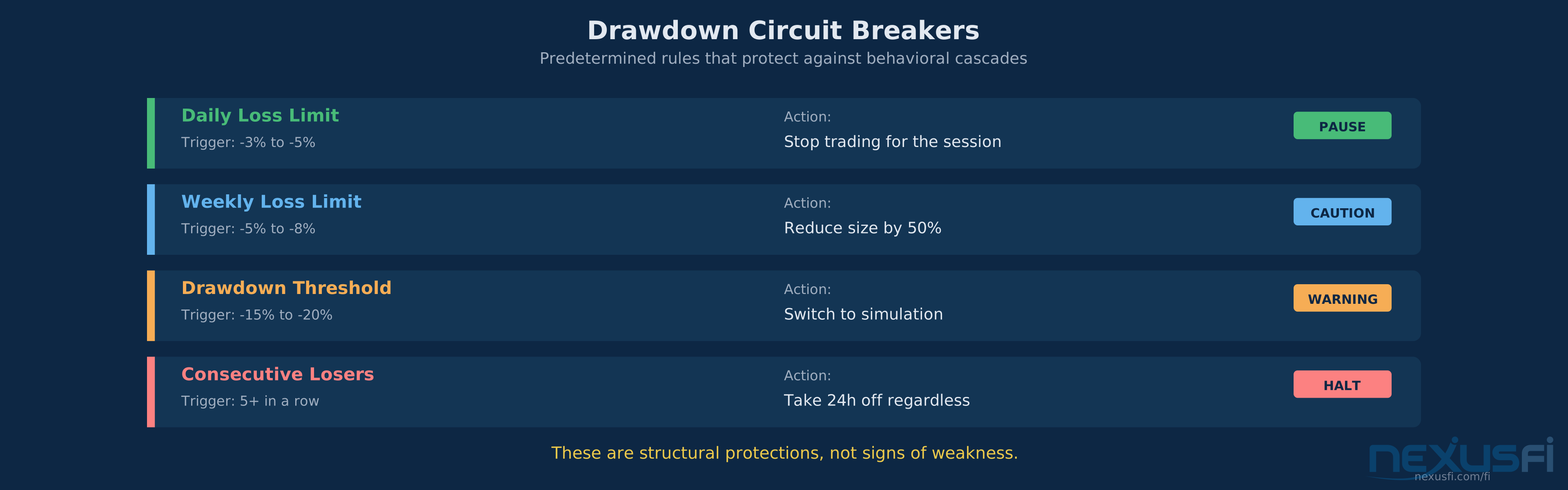
Circuit breakers are non-negotiable structural protections. Set them before the session starts, when you're thinking clearly — not in the heat of a losing streak when judgment is compromised.
- Daily loss limit: Stop trading after losing 3-5% in a single session
- Weekly loss limit: Reduce size by 50% after losing 5-8% in a week
- Drawdown threshold: Stop trading live after 15-20% drawdown, switch to simulation until you've "earned back" the theoretical equivalent
- Consecutive loss limit: After 5 consecutive losers, take 24 hours off regardless of daily P&L
These aren't signs of weakness. They're structural protections against the behavioral cascade that turns normal drawdowns into account-ending spirals.
Systematic Size Reduction During Drawdowns #
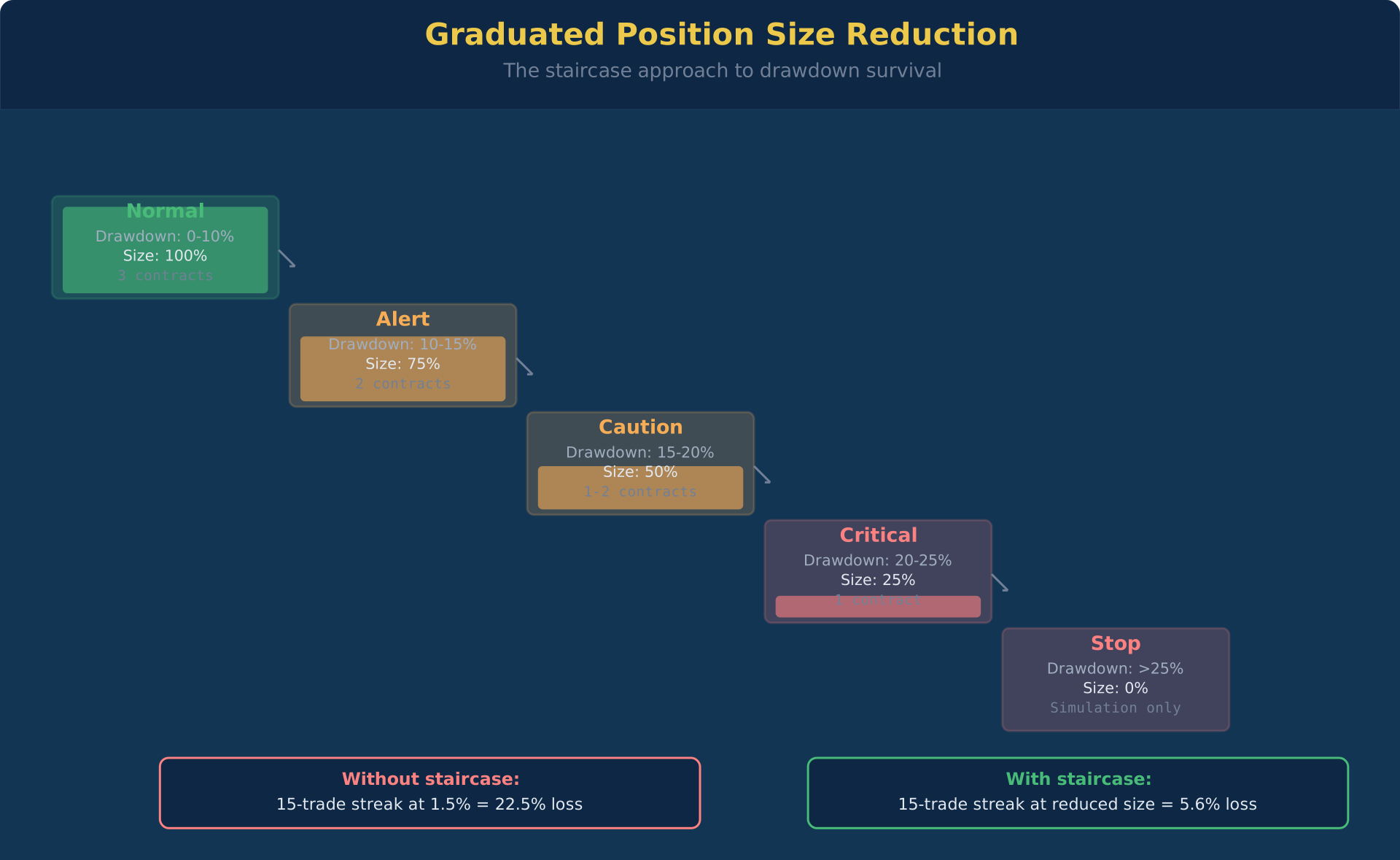
Beyond circuit breakers, professionals use a graduated position size reduction schedule that kicks in automatically as drawdowns deepen. The logic is straightforward: fixed fractional sizing already reduces your absolute dollar risk as your account shrinks, but that automatic adjustment isn't aggressive enough during severe drawdowns. You need an additional layer of protection to survive the tail events.
The staircase approach:
- At 10% drawdown from equity peak: Reduce standard position size by 25%. If your normal calculation says 3 contracts, trade 2.
- At 15% drawdown: Reduce by 50%. Normal 3 contracts becomes 1-2.
- At 20% drawdown: Reduce by 75%. You're trading minimum viable size — 1 contract on your primary instrument.
- At 25% drawdown: Stop live trading entirely. Switch to simulation. Your system needs re-evaluation, not more capital exposure.
Why this matters more than it looks: A trader risking 1.5% per trade at full size is risking 0.375% per trade at the 75% reduction level. That dramatically extends survival time. Even a brutal 15-trade losing streak at reduced size costs roughly 5.6% of remaining capital instead of 22.5% at full size. The math of survival changes completely.
Climbing back up: The recovery protocol mirrors the reduction. Once your equity recovers past a threshold (say, back above the 15% drawdown level), you restore one level of sizing — not all at once. This prevents the common trap of snapping back to full size after one good week, only to get caught by the next drawdown leg. The staircase works both directions: controlled descent, controlled ascent.
Risk of Ruin #
@Fat Tails [built one of the most complete risk of ruin calculators on NexusFi] [10], examining "the maximum acceptable drawdown as a percentage of the account balance" and "the probability of ruin, which is the likelihood that such drawdown is reached or exceeded."
The key variables:
- Win rate
- Average win/loss ratio
- Risk per trade (as % of account)
- Maximum acceptable drawdown
At 1% risk per trade with a 55% win rate and 1.5:1 R:R, risk of ruin is negligible. At 3% risk per trade with the same edge, risk of ruin climbs meaningfully. At 5%, it becomes a real threat over hundreds of trades.
The lesson: even with a genuine edge, oversizing kills. The graveyard of blown accounts is full of traders who had winning systems but couldn't survive the variance.
Correlation Risk #
Multi-Instrument Portfolios #
Traders running multiple futures instruments simultaneously face correlation risk — the danger that what looks like diversification is actually concentrated exposure to the same underlying move. This is one of the most underappreciated risks in futures trading, and it can turn a "diversified" portfolio into a leveraged directional bet overnight.
Common correlation traps:
- Long ES + Long NQ = ~90% correlated on most days. This isn't diversification — it's a leveraged equity index position with extra margin requirements.
- Long CL + Short ES during a geopolitical crisis = potentially the same trade (oil spikes, equities sell)
- Long ZB + Short ES = genuinely negative correlation most of the time, but the correlation can flip during credit events or major market structure shifts
Worked Example: Combined Portfolio Risk #
Consider a trader who thinks they're diversified across three instruments:
Positions held simultaneously:
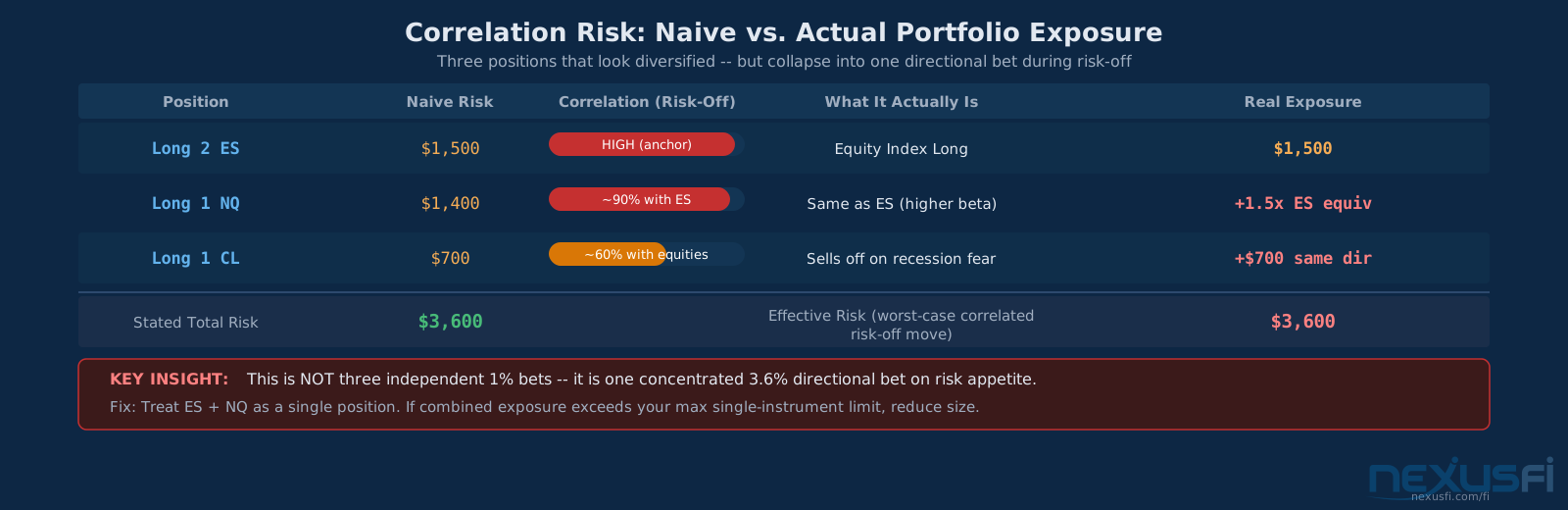
- Long 2 ES contracts (entry: 5,640, stop: 5,625 = 15 points × $50 = $750/contract)
- Long 1 NQ contract (entry: 20,350, stop: 20,280 = 70 points × $20 = $1,400/contract)
- Long 1 CL contract (entry: $68.50, stop: $67.80 = 70 ticks × $10 = $700/contract)
Naive risk calculation (assuming independence):
- ES risk: 2 × $750 = $1,500
- NQ risk: 1 × $1,400 = $1,400
- CL risk: 1 × $700 = $700
- Total "diversified" risk: $3,600
Correlation-adjusted risk calculation: During a broad risk-off event (surprise Fed hawkishness, geopolitical shock, credit scare), ES and NQ move together with 0.90+ correlation, and CL often sells off simultaneously as recession fears spike.
- ES + NQ combined: These are basically the same trade. Combined risk = $1,500 + $1,400 = $2,900 in correlated equity exposure.
- CL: During risk-off, crude often drops too. Assume 0.60 correlation with equities in a selloff.
- Worst-case simultaneous risk: All three stops hit = $3,600, which on a $100,000 account is 3.6%.
That 3.6% might look acceptable — until you realize it's not three independent 1% bets. It's effectively one 3.6% directional bet on risk appetite. If your individual instrument risk limit is 1.5%, you've accidentally created a position that's 2.4× your intended maximum exposure.
The fix: Calculate portfolio risk as if all positions are correlated. Add up the dollar risk on all positions that would lose in the same macro scenario. If that number exceeds your single-instrument maximum (typically 1.5-2% of account), reduce position sizes until it doesn't.
Practical correlation rule: For equity index futures (ES, NQ, YM, RTY), treat your combined risk as a single position. If you're long 2 ES and 1 NQ, your total equity index risk is 2 ES + ~1.5 ES-equivalent (NQ has higher beta) = 3.5 ES-equivalents. Size to match your actual exposure.
As @redratsal [discussed on NexusFi] [9], managing account size across multiple instruments requires factoring in the combined drawdown potential, not just individual instrument risk.
The Professional Approach #
The difference between professionals and amateurs isn't entries — it's how they handle risk after the entry. Professionals accept mediocre entries as inevitable and build systems that profit anyway through disciplined risk management.
Professionals:
- Define maximum risk before looking at charts
- Size every position mathematically, not intuitively
- Use circuit breakers religiously — they're triggered automatically, not by judgment calls
- Track R-multiples, not dollar P&L
- Accept that 40-50% of trades will lose — and plan for losing streaks of 6-10 trades as normal variance
- Increase size only after the system earns it through sustained performance
- Review risk parameters quarterly, adjust for changed volatility regimes
Amateurs:
- Size based on conviction ("I'm really confident in this one")
- Move stops to avoid taking losses
- Double down on losers (averaging down without a structural thesis)
- Skip circuit breakers after losses ("I need to make it back")
- Judge performance by individual trades rather than expectancy over samples
As @tigertrader [put it] [5]: "Proper money management begins with proper position sizing which will inevitably aid you in your stop placement."
Practical Application: The Pre-Trade Checklist #
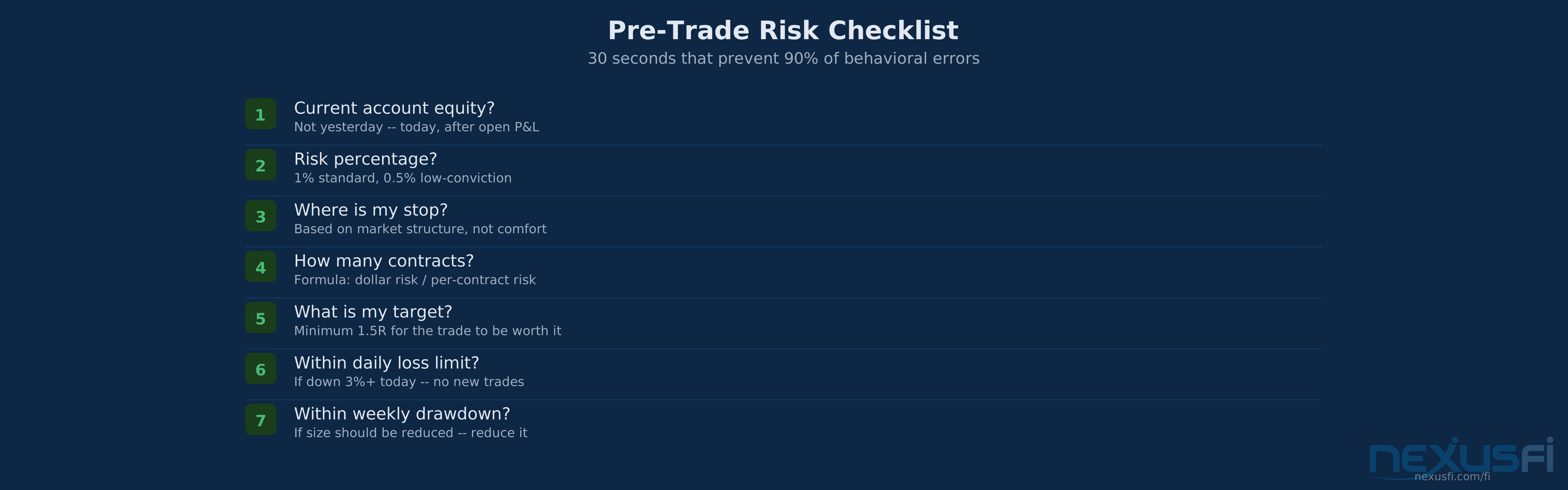
Before every trade, run this checklist:
- What is my current account equity? (Not yesterday's — check right now, after today's P&L)
- What is my risk percentage? (1% for standard setups, 0.5% for lower-conviction)
- Where is my stop? (Based on market structure, not comfort level)
- How many contracts at this stop? (Formula: dollar risk / per-contract risk)
- What is my target? (Minimum 1.5R for the trade to be worth taking)
- Am I within my daily loss limit? (If already down 3%+ today, step away — no exceptions)
- Am I within my weekly drawdown limit? (If size should be reduced, reduce it now before entering)
The entire checklist takes 30 seconds. It prevents 90% of the behavioral errors that blow accounts.
Component Articles #
This hub covers the risk management framework. For deeper education on individual concepts:
Sources & Citations #
This article draws on extensive research and community discussion from NexusFi's trading forums, including contributions from @Fat Tails (risk of ruin analysis, position sizing tools), @tigertrader (money management frameworks, stop placement), @monpere (R-multiple sizing), @Big Mike (structural stop placement), @VinceVirgil (practical risk calculations), and @kevinkdog (scalping-specific sizing).
Knowledge Map
Prerequisites
Understand these firstGo Deeper
Build on this knowledgeReferences This Article
Articles that build on this topicCitations
- — PositionSizer for ninjatrader (2010) 👍 12“This is too easy. I use NinjaTrader to run ATM strategies, and the question arises indeed, how to adapt the stop loss size to volatility, exchange rate and risk allowance.”
- — Why 7% is the Difference between Failure and Success in Trading (2012) 👍 6“Luger: I think that we are talking about two different things here .... (a) the risk that the trading system is correctly represented by the sample (b) the risk derived from the variance of the sample How good is the sample? The sample trades are tho...”
- — Killer Instinct and the Home Run Mentality (2011) 👍 8“You can always adopt a fixed fractional trading strategy where you determine the number of contracts you trade for a defined level of risk.”
- — STOPS are Frustrating (SL) ...to take or not to take (2011) 👍 6“Stops suffer from the same problem of duality as does leverage. Used properly it is an indispensable tool, but used improperly it will inhibit or destroy your P&L.”
- — Spoo-nalysis ES e-mini futures S&P 500 (2014) 👍 18“I think tigertrader did already, but short version is a stop is where you are wrong about a trade. It has nothing to do with your profit or your comfort level, etc.”
- — EURUSD Scapling (2012) 👍 5“You are trading your equity curve not the market. You should not be placing stops based on the amount of money you are comfortable to lose, you should place stops where it technically makes sense in the market, whether that is 10 ticks away or 100 ti...”
- — Surly's TST Combine (2012) 👍 4“Sizing based on the location of your stop is basically R-Multiple sizing. Your stop is your 'R' (Risk), the smaller the stop the larger the contract size, and vice-versa the larger the stop the smaller the contract size.”
- — Account size when trading multiple instruments (2011) 👍 3“Hi Jstnbrg, If you are looking for formulas on money management: Trading System Solutions - Publications - Money Management - The Basics of Money Management III Personally I like Larry William's : Num_Lots = % risk * Capital / (- Max_Drawdown) / 100...”
- — Risk of Ruin (2012) 👍 13“Model Limitations I am not yet satisfied with the result of this thread. We have shown, that it is possible to build a model for the most basic case of a Bernoulli distribution , that is when you enter a bet -> you either win the amount A or lose the...”
- — CFTC Customer Protection: Understanding the Risks of Futures Trading (2024)
- — Trading Forex: What Investors Need to Know (2024)