



Maximum Favorable Excursion (MFE): The Data Behind Your Profit Target Placement
Overview #
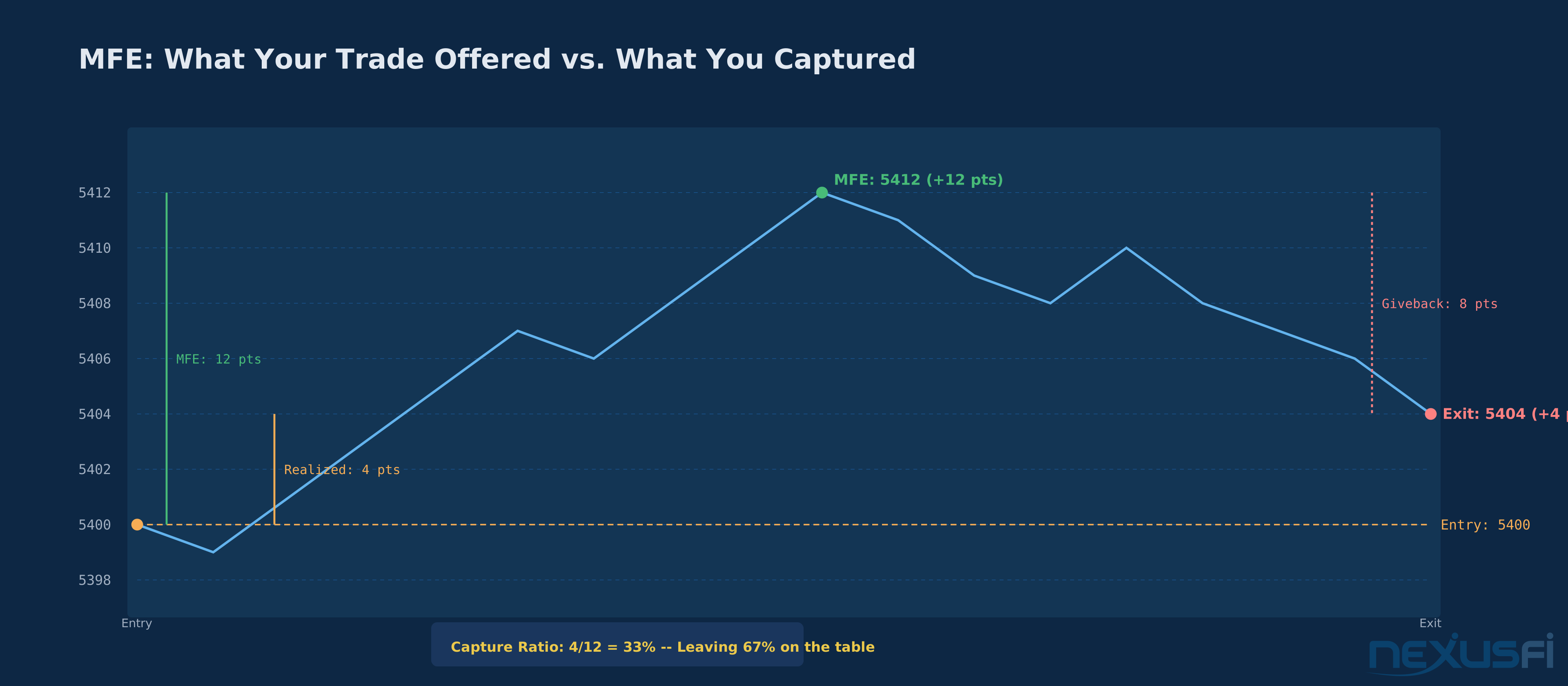
You entered a trade. It moved 12 ticks in your favor. You exited with 4. That gap — 12 ticks of available profit versus 4 ticks captured — is the information that Maximum Favorable Excursion reveals.
MFE measures the farthest a trade moves in your direction while it's open. Not what you walked away with. The best the market offered before you hit the exit button. When you track MFE across hundreds of trades, you stop guessing about profit targets and start setting them from data.
If MAE tells you where to place your stop, MFE tells you where to place your target. Together they answer the two fundamental questions of trade management — how much room to give a trade, and how much to expect from it.
Most traders obsess over entries. MFE forces you to confront your exits.
Key Concepts #
Maximum Favorable Excursion (MFE) — The largest unrealized profit a trade achieves from entry to exit. If you buy ES at 5400 and price runs to 5412 before pulling back to your exit at 5406, your MFE is 12 points ($600 per contract) — even though you only captured 6 points.
Capture Ratio — The percentage of MFE you actually realized as profit. Calculated as (Realized P&L / MFE) x 100.
A capture ratio below 50% means you're giving back more than half of what's available.
MFE Distribution — The histogram of MFE values across all your trades. Shows you the probability of price reaching any given profit level. If 70% of your trades reach 6+ ticks MFE, that's your baseline for a first target.
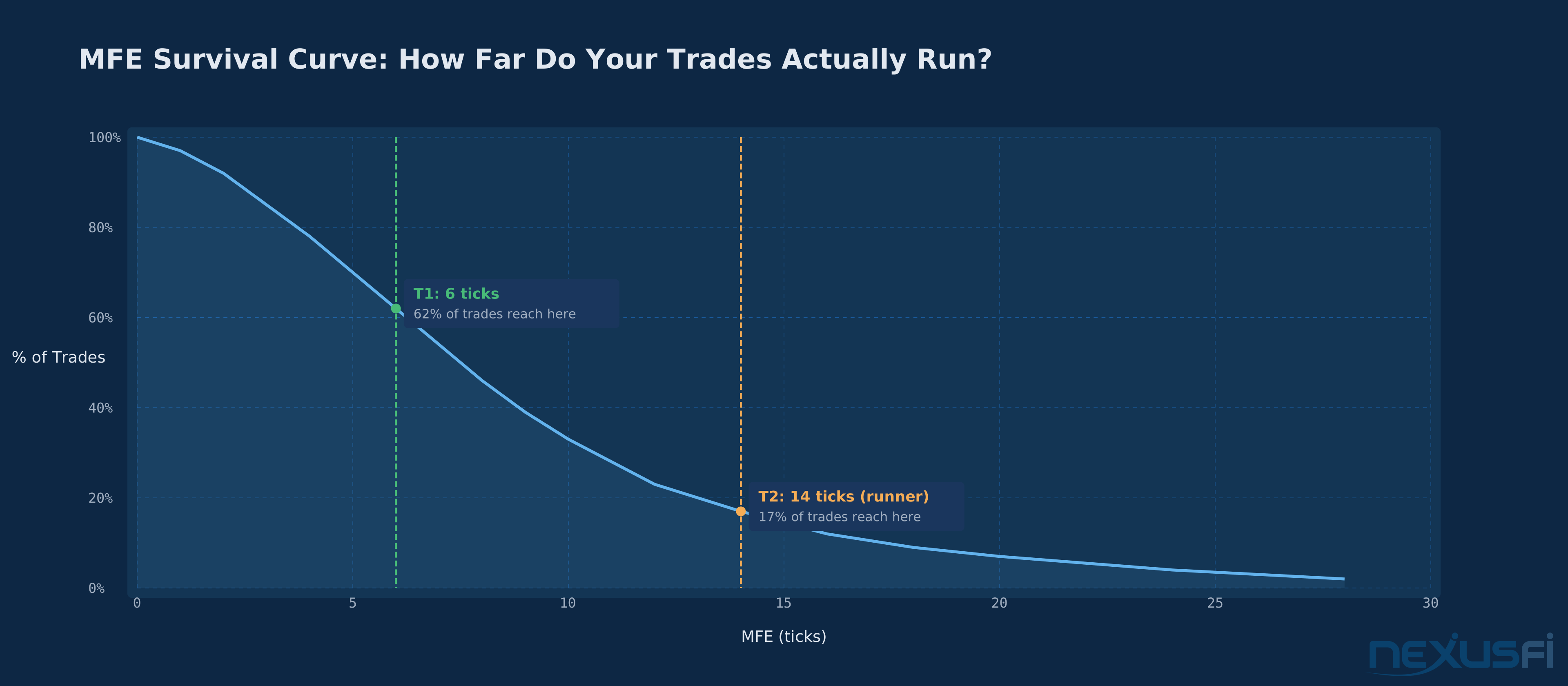
MFE Survival Curve — A probability chart showing the percentage of trades that reach or exceed each MFE level. At MFE = 0, 100% of trades qualify. At higher MFE levels, the percentage drops. The shape of this curve tells you exactly where diminishing returns kick in for your targets.
Giveback — The difference between MFE and your actual exit. MFE of 12 ticks, exit at 6 ticks = giveback of 6 ticks. Tracking average giveback reveals whether your exits are too early, too late, or well-calibrated.
How MFE Works #
The calculation is simple. For every completed trade, record the best price reached after entry and before exit.
Long trade: MFE = Highest price during trade - Entry price
Short trade: MFE = Entry price - Lowest price during trade
Convert to whatever unit makes sense for your analysis: ticks, points, dollars, or R-multiples.
Example on ES (E-mini S&P 500):
- Entry: 5400.00 (long)
- Highest price during trade: 5408.50
- Exit: 5404.25
- MFE = 8.50 points = 34 ticks = $425 per contract
- Realized profit = 4.25 points = $212.50 per contract
- Capture ratio = 50%
Normalizing to R-multiples makes cross-instrument comparison cleaner.
Data granularity matters. Computing MFE from daily bars understates the actual excursion because intraday wicks get lost. For futures day trading, use 1-minute bars at minimum. Tick data is ideal. The difference can be significant — an MFE of 6 points on 5-minute bars might be 8 points on tick data because you're catching the actual intrabar high.
Using MFE to Set Profit Targets #
This is where MFE earns its keep. Instead of picking a target because it "feels right" or matches some arbitrary risk/reward ratio, you build targets from observed trade behavior.
Step 1: Collect MFE data. Run your strategy for 200+ trades. Record MFE for each trade. You need volume to see the distribution clearly.
Step 2: Build the survival curve. Plot the percentage of trades that reach each MFE level. Example from an ES scalping strategy:
- 100% of trades reach 1 tick MFE (obviously)
- 85% reach 4 ticks
- 60% reach 8 ticks
- 35% reach 12 ticks
- 15% reach 20+ ticks
Step 3: Pick your target zone. The survival curve shows the tradeoff between target size and fill probability. A 4-tick target fills on 85% of trades. An 8-tick target fills on 60%. A 12-tick target fills on only 35%.
The right target depends on your strategy's expectancy math. Sometimes a smaller target with a higher hit rate produces better expectancy than a larger target with a lower hit rate. Run the numbers.
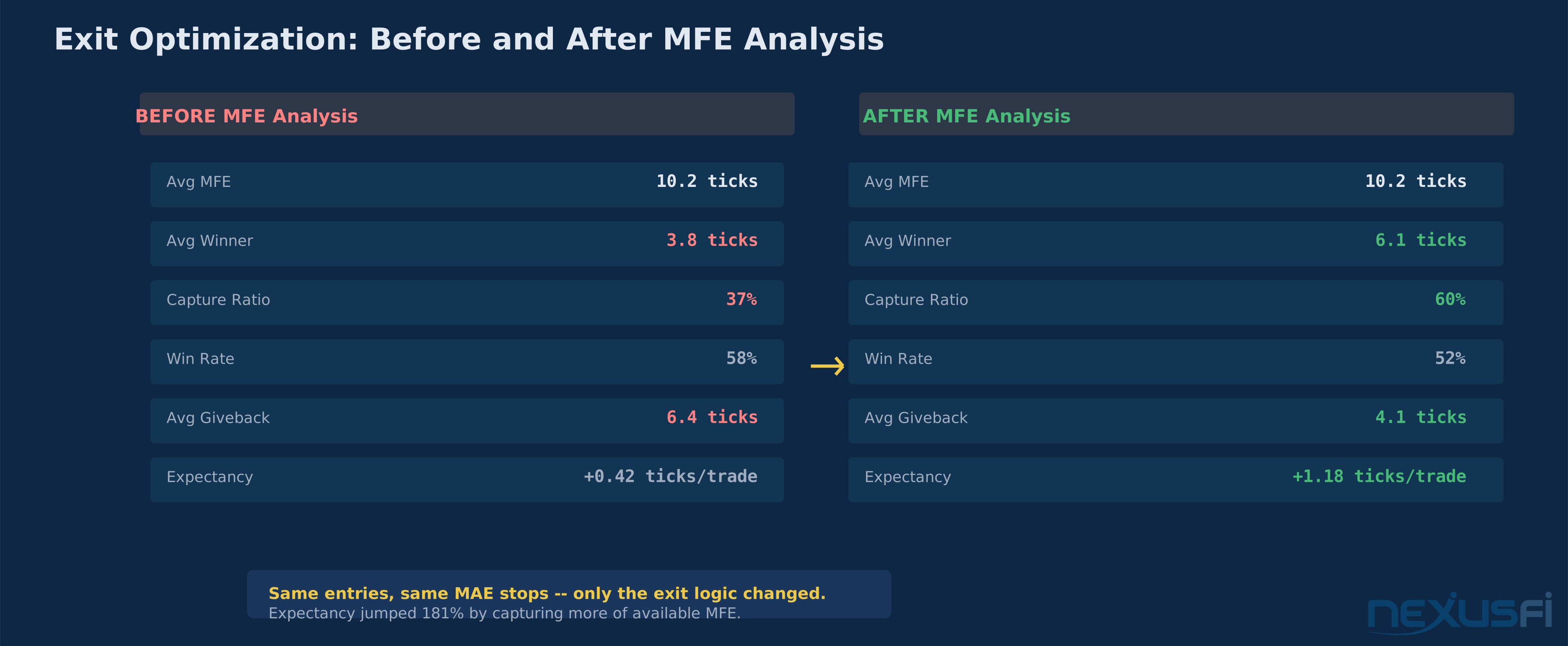
Step 4: Diagnose your current exits. Compare your actual capture ratio to what the MFE data says is available. If your average MFE is 10 ticks but your average winner pays only 4 ticks, you're capturing 40% of available profit. That's a red flag.
Scaling Out with MFE Data #
MFE distributions often reveal a natural scaling structure. Price reaches a first threshold with high probability, then pushes further with decreasing probability. This maps directly to a partial exit strategy.
The MFE-based scaling approach:
Take your MFE survival curve and identify two levels:
- First target (T1): Where 70-80% of trades reach. High probability, modest profit. Take 50-75% of position here.
- Runner target (T2): Where 25-35% of trades reach. Lower probability, but the trades that get there are your big winners. Let the remaining 25-50% of position ride with a trailing stop.
Example workflow: If MFE data shows 75% of trades reach 6 ticks and 30% reach 14+ ticks:
- T1 = 6 ticks: Scale out 60% of position
- Move stop to breakeven
- T2 = trail the remaining 40% with a 4-tick trail
This is the core insight: MFE data lets you match your exit structure to what the market actually offers for your entries.
MFE by Regime and Setup #
MFE distributions are not static. They shift with market conditions.
Trend days vs. chop days: On trend days in ES, MFE for with-trend entries can run 20-40+ ticks. On range days, the same entries might max out at 6-8 ticks. If you use a single fixed target, you'll either leave money on the table during trends or get stopped out during chop.
Session effects: Trades taken at the open typically have higher MFE than midday trades because the first 30 minutes produce the widest price range. Segment your MFE analysis by time of entry.
Instrument differences:
- Index futures (ES, NQ): Clean directional runs, MFE distributions have long right tails on trend days
- Treasuries (ZB, ZN): Slower, grindier moves, MFE arrives gradually
- Energy (CL, NG): Sharp spikes produce high MFE quickly, but reversals are equally violent
- Currencies (6E): More mean-reverting, MFE tends to cluster in a tighter range
Professional traders compute separate MFE distributions for each regime rather than using a single aggregate.
The Capture Ratio Audit #
Run this quarterly. Pull your last 200+ trades and compute:
- Average MFE — What the market typically offered
- Average realized profit on winners — What you actually took
- Capture ratio — #2 / #1
- Giveback — Average MFE minus average realized profit
Healthy benchmarks:
- Capture ratio above 50% for scalping strategies
- Capture ratio above 35-40% for swing/trend strategies (these have higher MFE but wider trails)
- Consistent capture ratio across time periods (improving is good, deteriorating needs investigation)
If your capture ratio is below 30%, something is wrong with your exit logic. Either you're exiting on fear, trailing too tight and getting shaken out, or holding too long and watching winners round-trip into losers.
Practical Application #
NinjaTrader: The Strategy Analyzer shows MFE for every simulated trade. In live trading, the Account Performance window displays MFE per trade. Export to CSV for distribution analysis.
Sierra Chart: Trade Activity Log includes MFE columns. The Spreadsheet Study can automate MFE tracking across all trades.
Track entry price, best price during trade, and exit price. The math does itself.
Professional workflow:
- Export trade list with timestamps and prices
- Compute MFE for each trade using intraday bar data
- Segment by setup type, instrument, and market regime
- Build MFE distributions and survival curves per segment
- Compare current targets against what MFE data shows is available
- Test alternatives — fixed targets, partials at MFE thresholds, trailing after trigger
- Evaluate impact on win rate, expectancy, profit factor, and drawdown
- Validate out-of-sample to prevent overfitting
Fill realism caveat: MFE assumes you could have exited at the peak. In practice, limit orders at the exact MFE level might not fill because price touches your level and reverses instantly. Adjust MFE-based targets 1-2 ticks conservatively.
Common Mistakes #
Chasing 100% capture. No one captures the full MFE consistently. Aiming for 100% turns you into a bottom-ticker/top-ticker, which kills your fill rate. A 50-60% capture ratio on a strategy with positive expectancy is excellent.
Ignoring the distribution shape. Average MFE is misleading if the distribution is bimodal. A strategy might have 50% of trades with MFE under 4 ticks and 10% with MFE over 20 ticks. The average says 8 ticks, but no single target captures both clusters. That's a scaling problem, not a target problem.
Using MFE without MAE. MFE in isolation tells you half the story. A trade with 20-tick MFE sounds great until you learn it had 15-tick MAE. That's a sloppy entry that happened to work. Use them together — the MAE/MFE matrix from the MAE article separates clean entries from lucky ones.
Overfitting to historical peaks. Optimizing exits to perfectly match historical MFE distributions produces fragile systems. Walk-forward or out-of-sample validation is mandatory. Markets change, and MFE distributions shift with them.
Small sample sizes. Just like MAE analysis, 200+ trades minimum. Drawing conclusions from 30 trades is curve-fitting noise. As @DarkPoolTrading showed on [NexusFi] [9], strong MFE analysis needs enough trades to reveal the real distribution, not random clusters.
Knowledge Map
References This Article
Articles that build on this topicCitations
- — Outside the Box and then some.... (2018) 👍 6“One of the more powerful but less understood optimization tools out there is the MAE/MFE stat.”
- — Snax's /ES & /CL Trading Journal (2019) 👍 3“I achieved (4/17) x 100 = 23.53% of the MFE.”
- — Maximum Favorable Excursion (MFE) % and optimization strategies (2016) 👍 4“If your initial risk is 15 ticks, price moving 15 ticks in your favor would be 1R, 30 ticks would be 2R, and so on.”
- — Maximum Favorable Excursion (MFE) % and optimization strategies (2011) 👍 10“If you have a positive expectation via a profitable trading strategy... the best strategy to optimize profits is to calculate the maximum favorable excursion and use it to set precise exit points.”
- — HumbleTrader's next chapter (2024) 👍 8“MFE -- Max favorable excursion data is useful in knowing scale out targets. How much price moves in your favor before turning.”
- — MAE and MFE metrics -- The How to and where to find (2017) 👍 3“If your stop loss keeps getting hit, but you reach 75% of your profit target by way of the MFE, then you can consider cutting your point value of your profit target down to increase the volume of captures.”
- — Maximum Favorable Excursion (MFE) % and optimization strategies (2016) 👍 7“I do this for every trade taken and record it in a spreadsheet. I call it Total Reasonable Movement from entry and will track price for as long as it does not hit my initial stop area.”
- — Vovan348 Day Trading TF with NFT setup (2011) 👍 2“MFE is maximum favorable excursion. It represents the furthest positive gain while the trade is open.”
- — Profit target strategy (2013) 👍 1“Robust MFE analysis needs enough trades to reveal the real distribution, not random clusters.”