



Strategy Optimization and Parameter Tuning: Finding Robust Settings Without Curve-Fitting
Overview #
Every automated trading strategy has parameters. A moving average period, a stop-loss distance, a profit target, a lookback window. The question isn't whether to improve them
Most traders get this catastrophically wrong. They find the "best" settings on historical data, go live, and watch their equity curve do the exact opposite of the backtest. The strategy didn't fail. The optimization process failed.
Here's the core problem: when you test thousands of parameter combinations and pick the winner, you're not discovering a trading edge. You're discovering which random noise pattern happened to look profitable in that specific data window. The distinction between genuine edge detection and sophisticated curve-fitting is the single most important skill in systematic trading.
Key Concepts #
Optimization
Curve fitting
Parameter stability region
Walk-forward optimization (WFO)
Degrees of freedom
Optimization bias
The Optimization Trap #
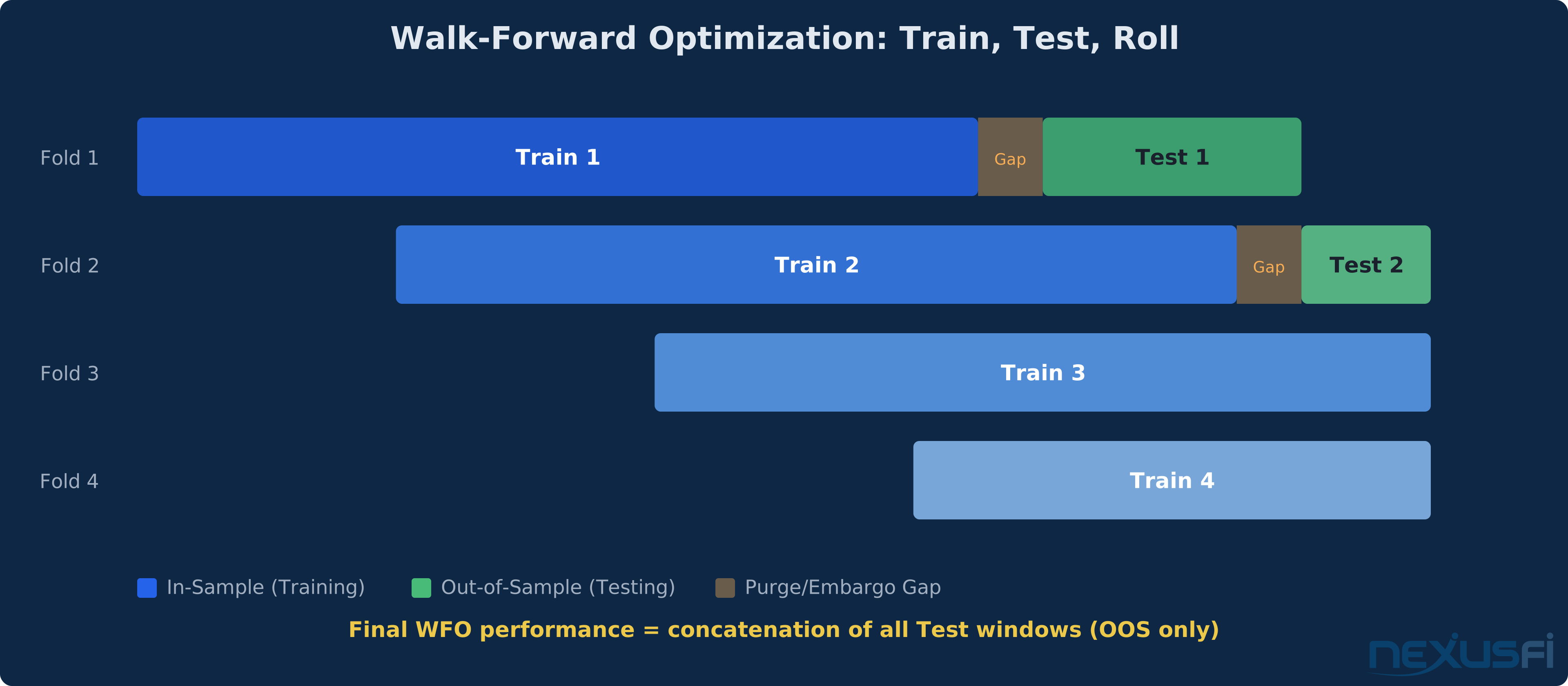
Here's a number that should scare you: if you test 1,000 parameter combinations on random, non-trending data, the "best" combination will show a positive Sharpe ratio roughly 97% of the time. Not because there's an edge. Because randomness, sampled enough times, produces patterns.
[kevinkdog nailed this on NexusFi] [2]: "You have 36K iterations now, you are just curvefitting and overoptimizing. You'll get a nice looking backtest that just falls apart in real time. The result with 100 iterations is more likely to be tradeable."
The math behind optimization bias is straightforward. If you evaluate N independent trials and each has variance σ², the expected maximum grows roughly as σ × √(2 × ln(N)). With 10,000 trials, the expected inflation is about 4.3 standard deviations. That's your entire "edge"
This doesn't mean optimization is useless. It means you need a process that separates signal from noise during optimization, not after.
Walk-Forward Optimization: The Foundation #
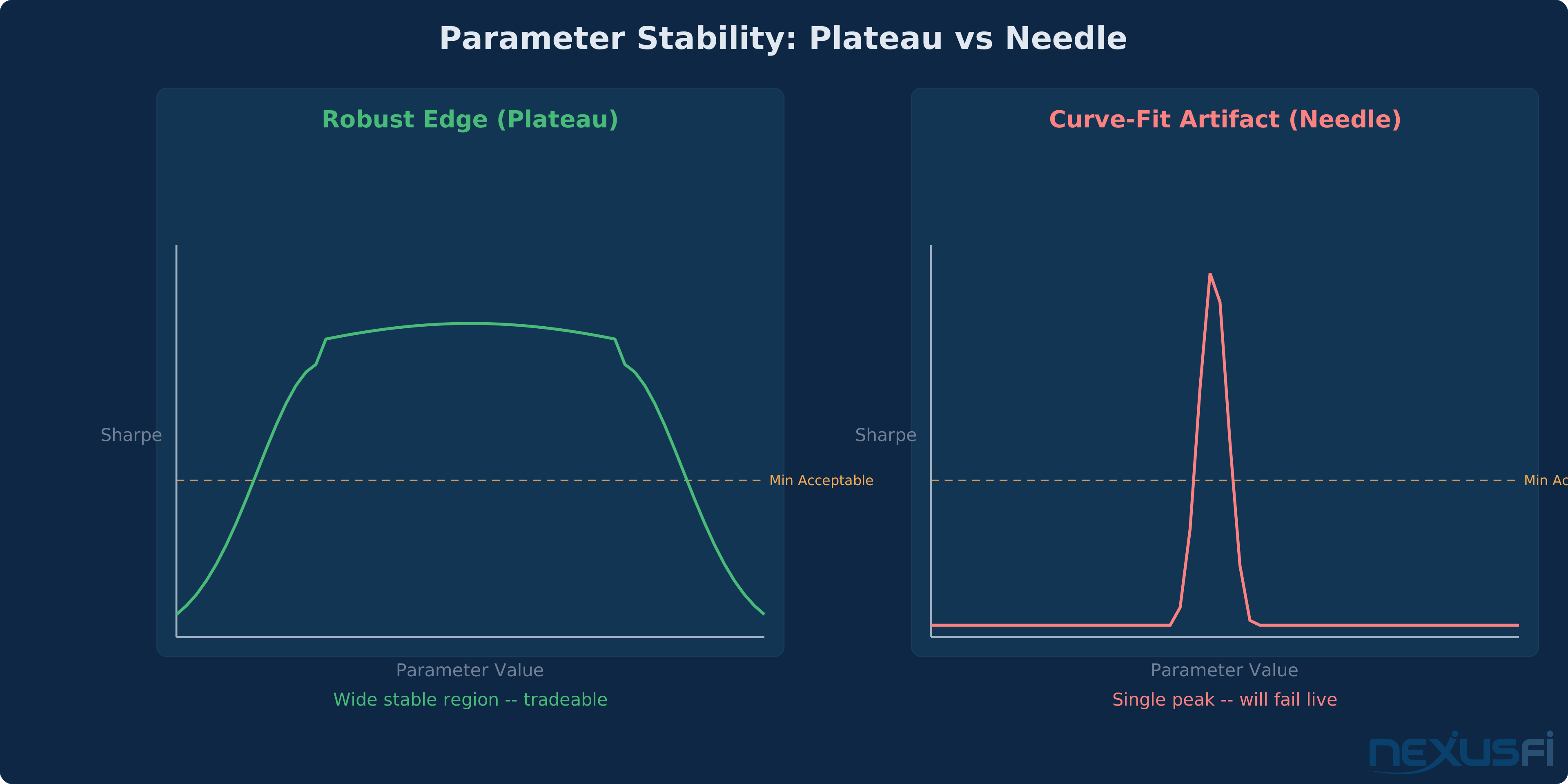
Walk-forward optimization is the closest thing you have to a time machine. Instead of optimizing on all your data and then pretending the results predict the future, you simulate the actual process of recalibrating a strategy over time.
The procedure:
- Define your windows. Pick a training period (12-24 months of futures data works well) and a testing period (3-6 months). The ratio matters
- Improve on training window. Run your parameter search on the first training period only. Find the "best" parameters according to your fitness function.
- Freeze and test. Lock those parameters. Apply them to the next testing window without any modification. Record the results.
- Roll forward. Slide both windows forward by the length of the test period. Repeat steps 2-3.
- Stitch the OOS results together. Your walk-forward performance is the concatenation of all out-of-sample test periods. This is your realistic expectation.
The critical implementation detail most traders miss: purge/embargo gaps. If your strategy uses a 50-bar lookback, the first 50 bars of your test period are contaminated by training data. You need a gap between training and test windows at least as long as your longest indicator lookback. Skip this and your walk-forward results carry leakage from the training set.
As [Darwin discussed on NexusFi] [3], standard backtesting "first optimises the parameters, and then tests them, all on the same data. That means we have no clue if we have valid parameters or overfitted ones."
Walk-Forward Performance Metrics #
Don't just look at aggregate walk-forward Sharpe. Break it down by fold:
| Fold | Training Period | Test Period | In-Sample Sharpe | Out-of-Sample Sharpe | Optimal MA Period |
|---|
|
| 1 | Jan 2020 - Dec 2020 | Jan - Jun 2021 | 2.1 | 0.8 | 21 |
|---|---|---|---|---|---|
| 3 | Jan 2021 - Dec 2021 | Jan - Jun 2022 | 2.3 | -0.2 | 24 |
| 4 | Jul 2021 - Jun 2022 | Jul - Dec 2022 | 1.7 | 0.9 | 20 |
What you want to see: consistent OOS performance across folds and stable optimal parameters. If the optimal MA period jumps from 12 to 45 between folds, the strategy is fitting to regime-specific noise. If OOS Sharpe is positive in 3 out of 4 folds with similar magnitude, you have something worth investigating further.
Parameter Stability Regions: The Real Test #
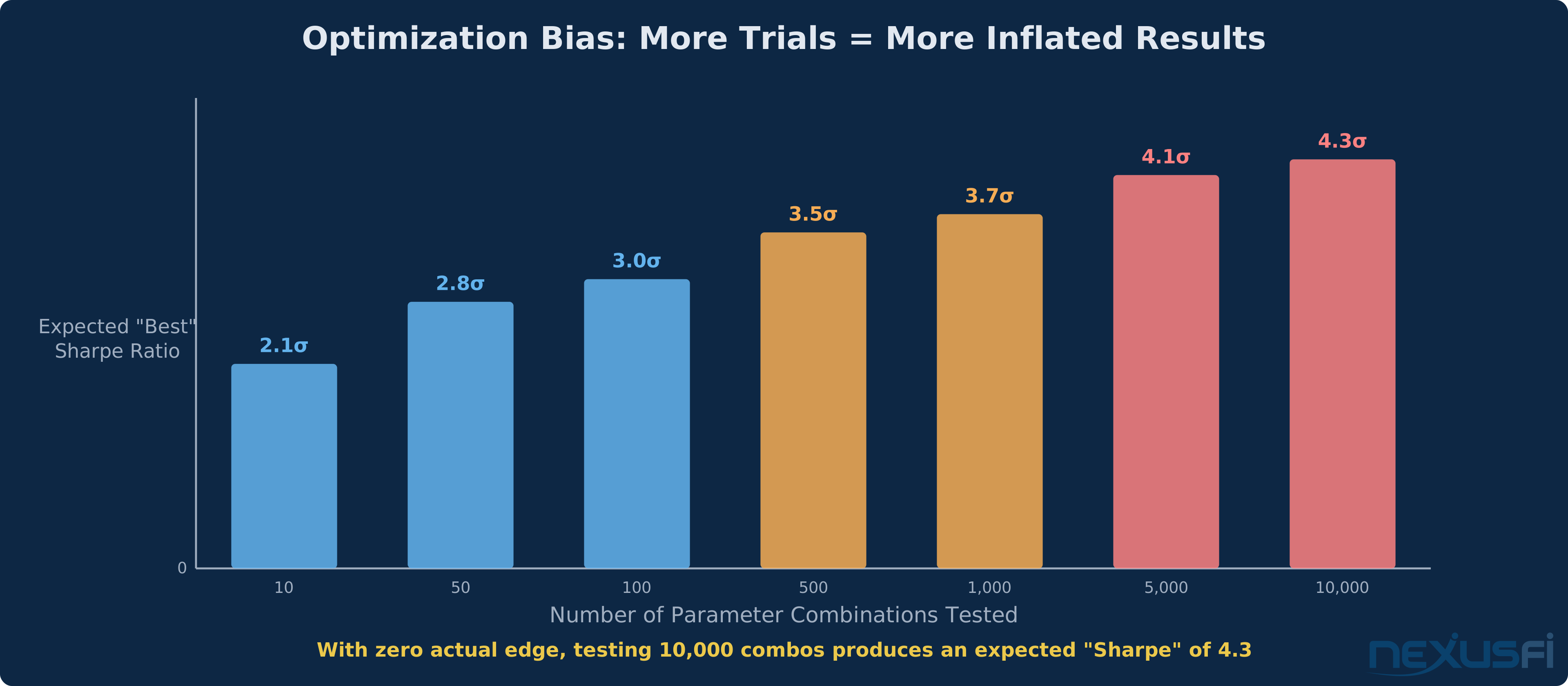
Finding the "best" parameter is the wrong goal. Finding the region where parameters produce acceptable results
Here's the concept: instead of asking "what MA period gives the highest Sharpe?", ask "over what range of MA periods does the strategy maintain Sharpe > 1.0?"
If the answer is "MA periods 15-30 all produce Sharpe between 1.0 and 1.4," you have a flat plateau. The strategy works because of something structural in the market, not because you found one magic number. Pick a value near the center of the plateau.
If the answer is "MA period 23 gives Sharpe 2.1, but 22 gives 0.3 and 24 gives -0.1," you have a needle. That Sharpe of 2.1 is curve-fitting, period. The performance depends on hitting exactly the right number, and the right number will shift tomorrow.
[sefstrat explained this perfectly] [1]: "Good curve fitting" is finding "a range of numbers near each other which all give similar performance."
Sensitivity Analysis in Practice #
The practical test for parameter stability:
- Take your optimal parameter set.
- Perturb each parameter by ±10%, ±20%, ±30% while holding the others fixed.
- Record the performance at each perturbation.
- Plot the results.
If performance degrades smoothly and gradually, the parameter is stable. If it falls off a cliff with a 10% change, you're standing on a needle.
For multi-parameter strategies, create heatmaps showing performance across two parameters simultaneously. You're looking for broad, warm-colored regions
The Stability Selection Rule #
After running walk-forward optimization across all folds, compute the stability region for each fold separately. The parameters you should trade live are those that fall within the intersection of stability regions across all folds. If no intersection exists
Multi-Objective Optimization: Stop Maximizing Sharpe #
Optimizing for a single metric is a recipe for disaster. Maximize Sharpe and you'll get a strategy that trades once per year during the one lucky week. Maximize profit factor and you'll get a strategy that wins big on rare occasions and bleeds out slowly. Maximize net profit and you'll ignore risk entirely.
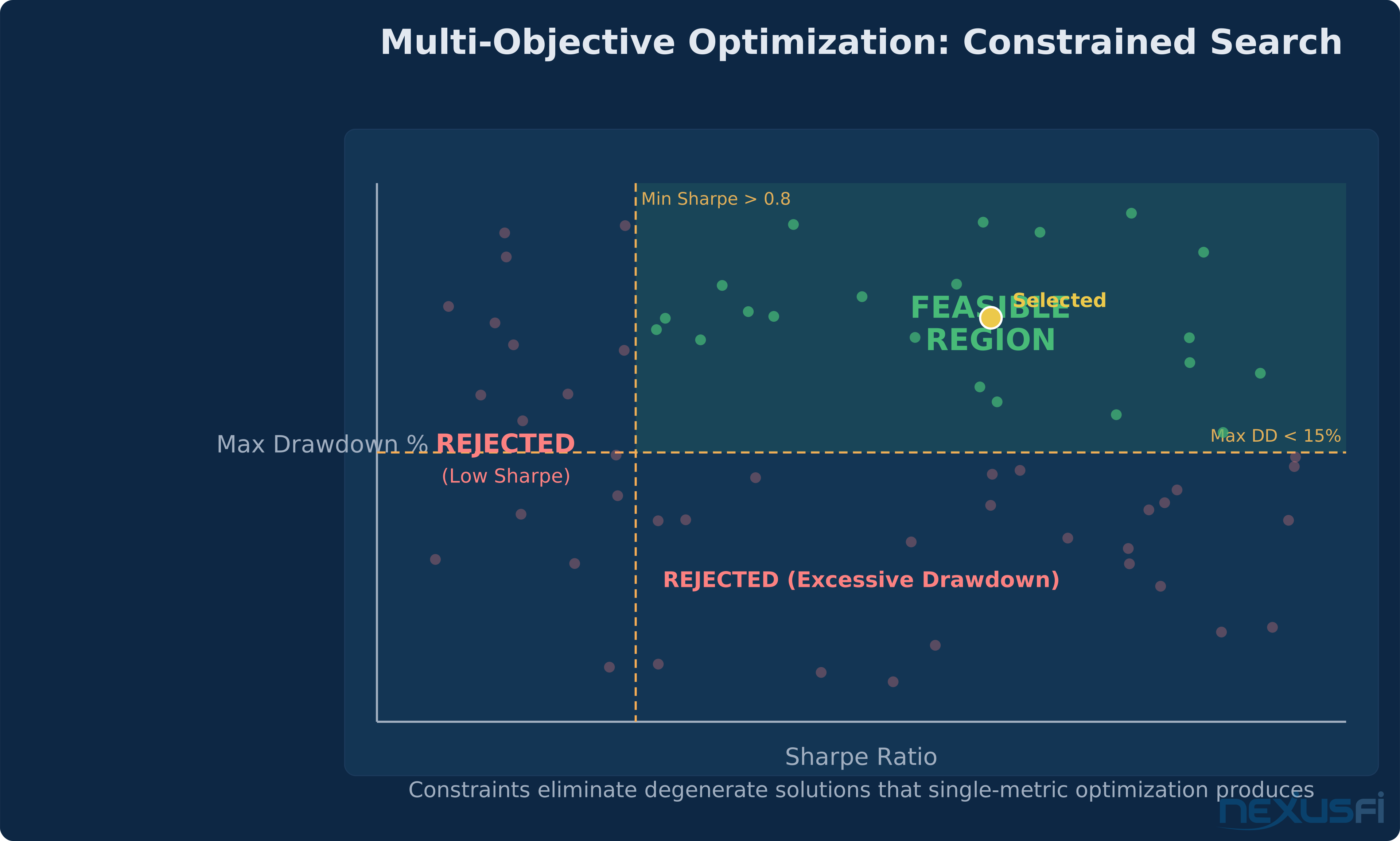
The solution is constrained multi-objective optimization:
Primary objective: Maximize risk-adjusted return (Sharpe or Sortino)
Hard constraints that must be satisfied:
- Maximum drawdown < 15% of equity
- Profit factor > 1.3
- Minimum 100 trades in the test period (prevents flukes)
- Cost-adjusted performance (include commissions, slippage, spread)
How this helps: The constraints eliminate the degenerate solutions that single-metric optimization loves. You can't achieve infinite Sharpe with one trade because the minimum trade count blocks it. You can't ignore risk because the drawdown constraint blocks it.
Include realistic frictions in the objective function, not as a post-hoc adjustment. For ES futures, that means at least $5.00 round-trip commission, 1-tick slippage per side on market orders, and wider slippage during the open and close. A strategy that looks profitable with zero slippage but dies at 1-tick slippage per side doesn't have an edge
Monte Carlo Validation: Stress-Testing Your Results #
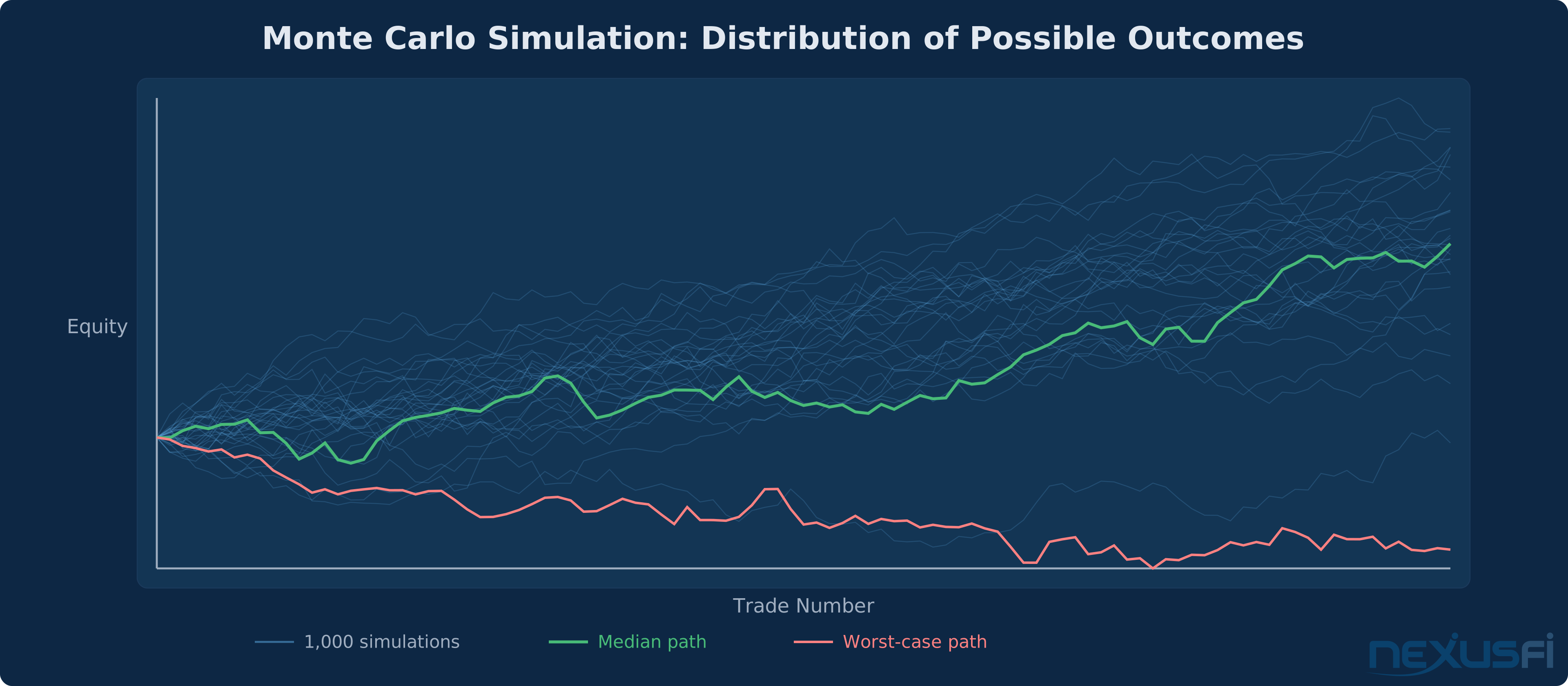
Monte Carlo simulation answers a question walk-forward can't: "How sensitive are my results to the specific sequence of trades?"
The technique: take your strategy's trade results and resample them thousands of times to generate a distribution of possible equity curves. This reveals the range of outcomes you might experience, not just the one path that actually happened.
Block bootstrap (not IID resampling). Market returns have serial correlation
Run 1,000+ simulations and examine:
- Median drawdown
- 95th percentile drawdown
- Probability of ruin
- Distribution of annual returns
Add execution stress tests on top: run Monte Carlo with slippage varying from 0.5 to 2 ticks per side. If your strategy's median Sharpe drops below 0.5 at 1.5-tick slippage, the edge is too thin for live trading.
[Fat Tails demonstrated on NexusFi] [4] that "the question of curve fitting also applies to the discretionary trader"
Degrees of Freedom: The Budget You Can't Overspend #
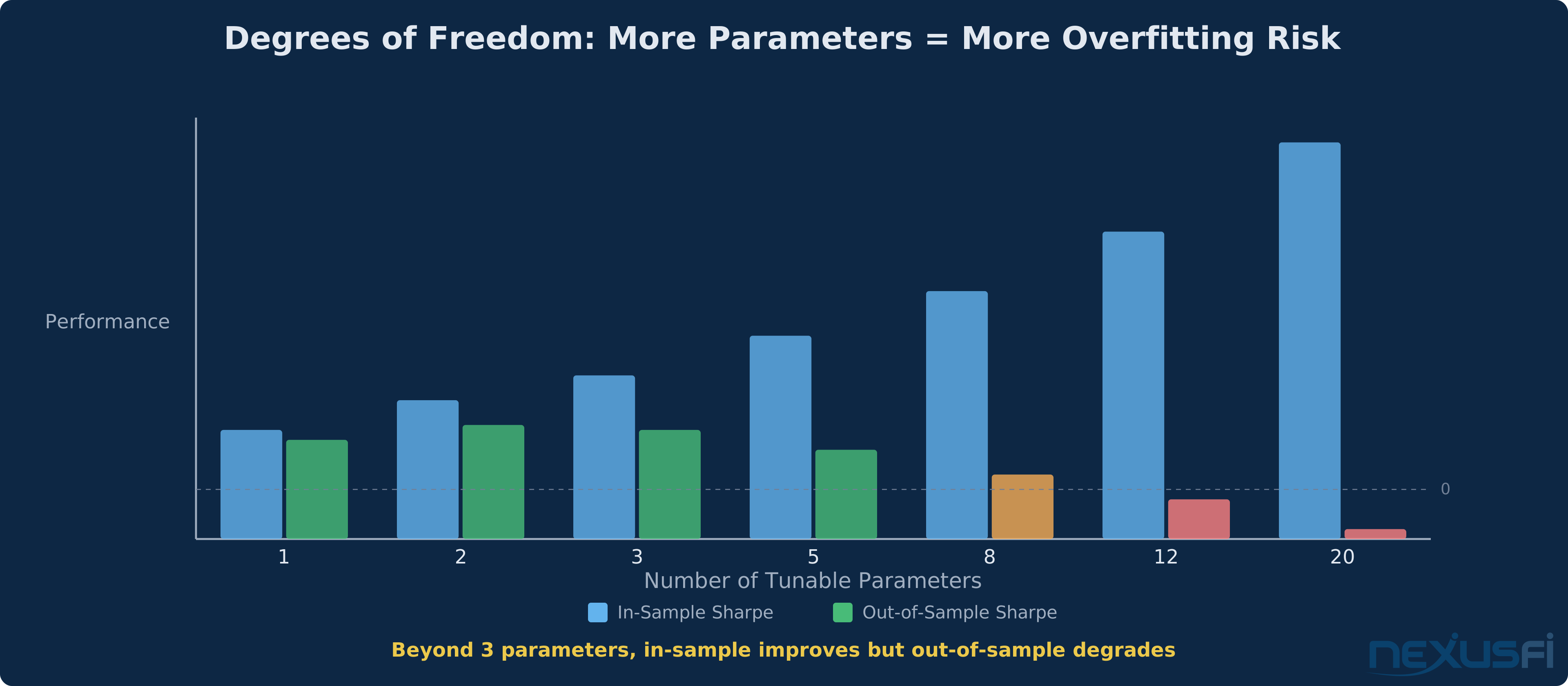
Every parameter you tune costs you statistical power. A strategy with 2 tunable parameters and 5 years of daily data has reasonable statistical grounding. The same strategy with 15 parameters needs decades of data to avoid fitting noise.
The practical rule: Keep tunable parameters to 3 or fewer for most futures strategies. Each additional parameter requires roughly 2x more data for the same statistical validity.
Use economically meaningful parameters. A moving average period of 20 corresponds to roughly one month of trading days
As [rleplae listed on NexusFi] [6], the top ways to minimize curve fitting include "Limited number of rules (Degrees of Freedom), Parameter relevance, Meaningful parameter ranges."
The Practical Workflow: From Hypothesis to Live Capital #
- Write your hypothesis in one sentence. "This strategy captures mean-reversion in ES when price deviates more than X ATR from VWAP during the first two hours of RTH." If you can't state the hypothesis clearly, you don't have one
- Define minimal parameters. Identify the 2-3 parameters that directly express your hypothesis. Everything else stays fixed at sensible defaults.
- Set parameter bounds from market structure. Don't search MA periods from 1 to 500. If your hypothesis involves intraday mean-reversion, a lookback of 5-60 bars makes structural sense. Wider bounds just invite curve-fitting.
- Run walk-forward optimization. 12-month training, 3-month test, purge gap equal to your longest lookback. Minimum 4 folds, preferably 6-8.
- Check parameter stability. Compute stability regions for each fold. Require overlap across at least 75% of folds.
- Decision gate. Accept only if: cost-adjusted OOS Sharpe > 0.8, profit factor > 1.3, max drawdown < 15%, stability region width > 25% of parameter range.
- Monte Carlo stress test. 1,000 block bootstrap simulations with variable execution costs. Verify median performance remains acceptable.
- Paper trade. Run live data through the strategy for 1-3 months without capital. Compare actual fills, slippage, and latency against backtest assumptions.
- Go live small. Start at 25% of intended position size. Monitor for 3 months. If live performance tracks OOS expectations within reasonable variance, scale up.
[Big Mike shared this lesson directly] [5]: "The hardest lessons to learn with automation have to do with curve fitting."
Common Pitfalls Checklist #
You're probably curve-fitting if:
- Your optimal parameters change dramatically between walk-forward folds
- In-sample Sharpe is above 3.0 (almost certainly noise)
- Adding a parameter improves in-sample results but degrades OOS
- Your strategy only works on one instrument and you haven't tested it on similar contracts
- Performance depends heavily on the exact entry/exit timing (sensitive to 1-bar shifts)
- You keep "discovering" new parameters to add after seeing OOS results
You're probably on solid ground if:
- Optimal parameters cluster in a tight range across folds
- OOS performance is 40-60% of in-sample performance (the expected degradation)
- The strategy works on related instruments (ES and MES, NQ and MNQ)
- Performance degrades gradually with parameter perturbation, not abruptly
- You can explain why the parameters are what they are in market-structure terms
As [Trembling Hand observed] [7], a strategy "tested backwards on old data is a huge flag of possible curve fitting." The sequence of your workflow matters
Futures-Specific Considerations #
Futures strategies face optimization challenges that equity strategies don't:
Contract rolls. Test performance specifically around roll dates. A strategy that generates phantom signals from roll price gaps isn't strong
Session structure. RTH and ETH have different characteristics. Parameters optimized across the full 23-hour session may perform differently during the 6.5-hour RTH. Test them separately.
Liquidity variation. The first and last 30 minutes of RTH have wider spreads and more slippage than midday. Stress-test with session-dependent slippage models.
Cross-contract validation. If your strategy works on ES but fails completely on NQ, the "edge" is likely data-specific rather than structural. A genuine mean-reversion or trend-following signal should transfer at least partially to correlated contracts.
The Bottom Line #
A strategy with Sharpe 1.2 across a flat parameter plateau that survives walk-forward, Monte Carlo, and execution stress testing will make you money. A strategy with Sharpe 3.0 perched on a needle-thin parameter peak that only works in one backtest will bankrupt you.
Robustness beats perfection. Every time.
Knowledge Map
Prerequisites
Understand these firstReferences This Article
Articles that build on this topicCitations
- — Optimization without curve fitting (2009) 👍 6“Technically both of the approaches you describe above are curve fitting =) Global parameter search (method #2) is a much better approach because a disjoint search does not take into consideration the relationships between the different indicators.”
- — How much Money for faster Optimization Backtesting: Willing to Pay. (2022) 👍 8“I can tell you how to reduce that time by a factor of 360. >> follow my advice and 48 hours becomes about 8 minutes. I won't even charge you. Reduce the number of iterations to no more than 100.”
- — Walk Forward Analysis - the only logical successor to backtesting [DISCUSS] (2013) 👍 2“Walk Forward Analysis - the only logical successor to backtesting Hello, I'm Darwin and this is my second article in which I will try to explain how a walk-forward-analysis works and what benefits it brings you as an EA trader.”
- — An experiment on curve fitting (2010) 👍 3“Hi shodson, first of all, thanks for bringing the subject up. I have not traded automated systems and I do not intend to do so during the next year, as this is much more demanding than discretionary trading and requires a larger variety of skills.”
- — QuadTrend Algo Strategy Journal (2010) 👍 4“I hope you guys have learned something from this strategy. The hardest lessons to learn with automation have to do with curve fitting, and with having patience and discipline (just like with discretionary trading).”
- — Approaches to Avoid Curve Fitting (2018) 👍 1“10 ways to mimise curve fitting Limited number of rules (Degrees of Freedom) Parameter relevance Meaningful parameter ranges Meaningful parameter steps Performance clusters/parameter robustness Independent variable optimisation Using in and Out-of-sa...”
- — How quickly do algos go bad? (2021) 👍 5“I think the fact that you have tested on the latest data and then tested backwards on old data is a huge flag of possible curve fitting. Time series testing is hard. It requires a good amount of honesty.”
- — Strategy Optimization and trusting the results (2011) 👍 4“In the end, I think curve fitting and optimization of money mangement, exits and profit taking and loss tolerance isn't such a bad thing, it's natural and everyone does it to a certain extent (simple things like MFE analysis is technically, curve fit...”
- — Strategy Optimization and trusting the results (2011) 👍 5“There's more than one issue at work here. The reason you forward test is to gain confidence for both edge and execution. Many people do not trust the results of a backtest for execution reasons.”