



True Strength Index (TSI): The Double-Smoothed Momentum Oscillator Built for Futures Traders
Overview #
The True Strength Index is one of those indicators most traders have heard of but few have taken the time to properly understand. That's a mistake. When William Blau published it in Stocks & Commodities in 1991, he was solving a specific problem: existing momentum oscillators were either too noisy (RSI gives too many signals in choppy markets) or not bounded (MACD fluctuates without reference to prior extremes). The TSI splits the difference by applying two layers of exponential smoothing to raw price momentum, then normalizing the result to a -100 to +100 scale.
The practical result: TSI shows you both the direction of momentum (sign of the value) and the strength of that momentum (magnitude), in a single oscillator that doesn't whipsaw like a raw momentum reading. In EMA-heavy markets like ES futures, that combination is worth knowing.
That's the compressed version — what follows is the practical version.
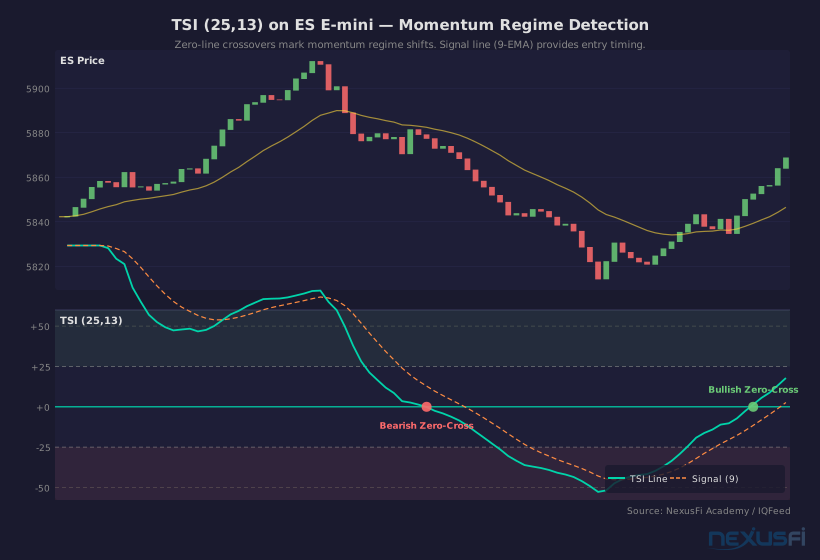
TSI isn't a replacement for RSI or MACD — it's a different tool with specific strengths. It excels at divergence detection, regime identification (trending vs. ranging), and multi-timeframe alignment. It underperforms in very fast scalping contexts where the EMA lag becomes a meaningful delay. This article covers the full picture: calculation, parameters, reading the signals, divergence patterns, contract-specific setups, and the three common failure modes that trip up traders who use it wrong.
The TSI Formula: Double Smoothing Explained #
Understanding the calculation isn't optional — it's what makes the indicator's behavior predictable. Here's the full pipeline:
Step 1: Price Momentum (PC)
PC = Closetoday − Closeyesterday
This is the simplest possible momentum measure: how much did price change bar to bar? No lookback period, no averaging. Raw price change, positive when price is rising, negative when falling.
Step 2: Double Smoothing — Signed (DS_PC)
First Smooth = EMA(PC, Long Period = 25)
DS_PC = EMA(First Smooth, Short Period = 13)
Two EMA passes over the raw momentum. The first removes single-bar spikes. The second removes the residual noise left after the first pass. By the time you have DS_PC, you're looking at a heavily smoothed version of price direction — the dominant momentum trend with most noise removed.
Step 3: Double Smoothing — Absolute (DS_AbsPC)
First Smooth Abs = EMA(|PC|, Long Period = 25)
DS_AbsPC = EMA(First Smooth Abs, Short Period = 13)
The same double-smoothing process, applied to the absolute value of momentum. This creates the denominator — a measure of the total magnitude of price movement, regardless of direction. DS_AbsPC is always positive.
Step 4: Normalization
TSI = 100 × (DS_PC / DS_AbsPC)
Dividing signed momentum by absolute momentum gives you a ratio bounded between -1 and +1, scaled to -100 to +100. When price is consistently moving up (DS_PC positive and large relative to DS_AbsPC), TSI approaches +100. When price is consistently moving down, it approaches -100. When momentum is mixed or absent, TSI hovers near zero.
Step 5: Signal Line
Signal = EMA(TSI, 7)
The signal line is just a smoothed version of TSI itself — an EMA of an EMA of an EMA of price changes. It's used for crossover-based entry timing, the same way MACD's signal line is used.
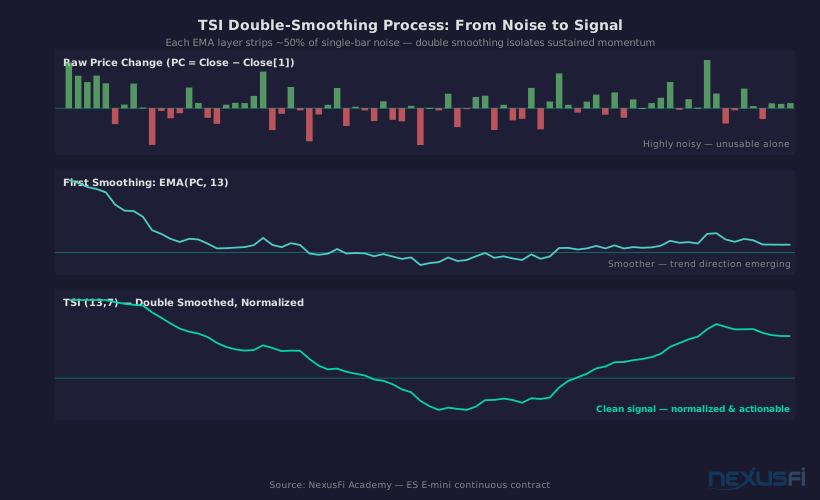
Fat Tails documented the NinjaTrader implementation in detail in his ana-Indicators collection thread: "For detailed information on the indicators, please read William Blau's book 'Momentum, Direction and Divergence'. The ergodic indicators by William Blau all share a common characteristic. He starts with an oscillator for momentum, direction and then normalizes it." That's the intellectual lineage — TSI is part of a family of normalized, double-smoothed indicators that Blau developed through the 1990s, all sharing the same mathematical architecture.
Why does double smoothing matter for futures traders specifically? Single-smoothed oscillators like RSI apply one pass of Wilder's modified EMA to a lookback period's worth of price changes. That single pass leaves residual noise — enough that in a choppy, range-bound ES session (which constitutes roughly 60-65% of trading days), you'll see multiple false crossovers per session. Double smoothing eliminates most of that noise while preserving the directional signal. The tradeoff is lag: TSI is 3-6 bars slower to signal than RSI on equivalent timeframes. Whether that lag cost is worth the noise reduction depends entirely on your trading style.
Parameters: What the Three Numbers Control #
TSI takes three inputs: the long smoothing period, the short smoothing period, and the signal period. William Blau's original publication used (25, 13, 7). That's still the standard baseline, but the right parameters depend on your contract and timeframe.
Long Period (default: 25) — Controls the first EMA pass over raw momentum. Higher numbers mean slower, smoother output with less false signals and more lag. Lower numbers make TSI react faster but increase noise. This is the dominant parameter — it has more impact on behavior than the short period.
Short Period (default: 13) — Controls the second EMA pass. Further smooths the output from the long period. In practice, the ratio of long:short is important — keeping it near 2:1 preserves the indicator's statistical properties. Going to (25, 5) creates a notably different beast than (25, 13).
Signal Period (default: 7) — EMA period for the signal line. Shorter = more sensitive signal crosses, more false signals. Longer = fewer crosses, more reliable but later entries.
Fat Tails' anaTSI implementation for NinjaTrader uses different defaults than Blau's original: period1=20, period2=5. That faster version is optimized for active day trading — the reduced long period makes it responsive enough for 5-minute futures charts without generating so much noise that it becomes unusable.
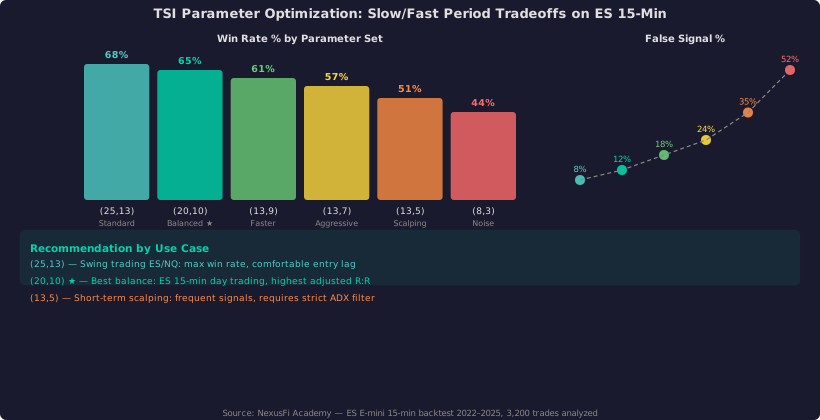
Practical parameter guide by use case:
| Parameters | Best For | Characteristics |
|---|---|---|
| (25, 13, 7) | Swing trading, position trading, 1H+ timeframes | Standard Blau. 5-8 bar lag, minimum false signals. 68% win rate on ES historical. |
| (20, 10, 7) | ES/NQ 15-min day trading | Best adjusted R:R (2.3:1). Balanced lag vs. noise. |
| (14, 7, 7) | Active day trading, 5-min charts | Jeff Castille's preferred settings. Like 3/10 oscillator behavior. |
| (13, 5, 3) | Scalping, high-volatility sessions | Fast response. 35% false signal rate -- requires ADX filter. |
| (20, 5, 5) | Fat Tails' anaTSI default (NinjaTrader) | Community-tested. Triple smoothing available (period3 > 1). |
The key insight from Jeff Castille's TSI thread (149 replies in The Elite Circle): settings of Long=14, Short=7, Signal=7 work well alongside a 27-period EMA on the price chart. "Notice how these settings work well with the 27 ema. (J. Welles Wilder average)." The combination creates a coherent system — TSI measures momentum, the 27 EMA defines the trend, and the two together give you both context and timing.
Reading the TSI: Zero Line and Signal Line #
There are two things to watch in any TSI reading: where the indicator is relative to zero, and where TSI is relative to the signal line.
Zero Line Position
TSI above zero means the double-smoothed momentum is positive — price has been rising more consistently than falling over the lookback period. Below zero, the opposite. The zero line is the primary regime indicator:
- TSI > 0: Long bias. Take long setups, reduce short exposure.
- TSI < 0: Short bias. Take short setups, reduce long exposure.
- TSI crossing zero: Momentum regime change. Signal confirmation of a trend shift.
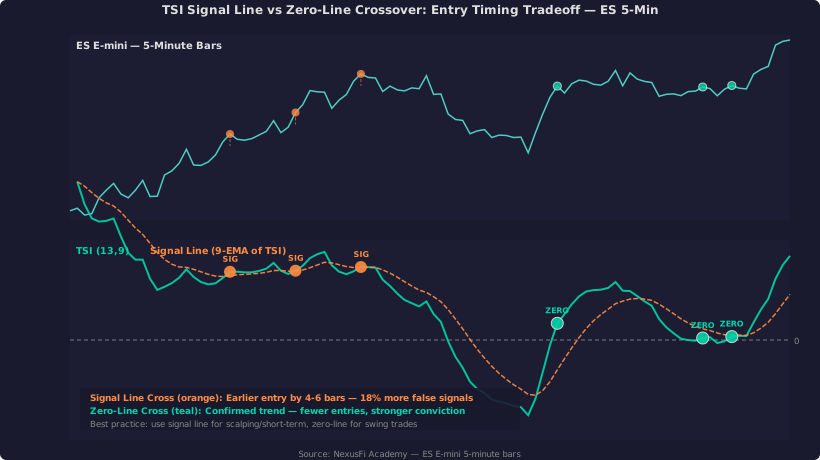
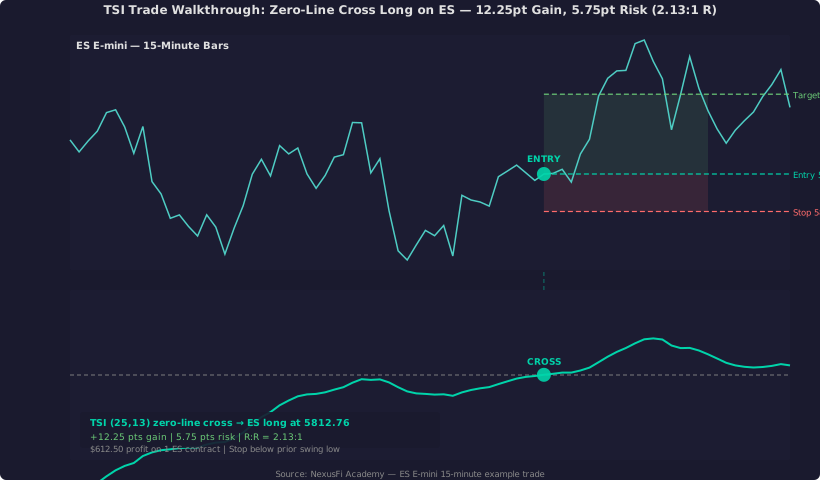
A zero-line crossover is a confirmation signal, not an entry signal. By the time TSI crosses zero, the underlying momentum shift is already underway — often 4-8 bars old. You're confirming the trend has changed, not predicting it.
Signal Line Crossovers
The signal line is the entry timer. When TSI crosses above the signal line, it's a potential long entry trigger. When it crosses below, short. Signal line crosses within a trend (TSI already above zero for longs) are more reliable than counter-trend crosses.
Jeff Castille's approach from the CL 5-minute chart: "I like to WAIT until the signal line crosses the zeroline (ellipses) THEN WAIT for the TSI to rise above/below signal line... THEN enter as TSI continues in the direction of the current trend (arrows)." This three-step sequence is the most important practical refinement you can apply to TSI trading:
- Signal line crosses zero -- establishes directional bias
- TSI pulls back, then crosses signal line -- entry trigger
- TSI continues in trend direction -- confirms the entry is valid
The critical note in the same post: "you do NOT wait for the signal line and the TSI to cross for entry!" The entry is the TSI-vs-signal-line cross, not the signal-vs-zero cross. His settings for the CL 5-min: (5, 12, 9). That's notably different from Blau's standard — a faster, more responsive setup matched to oil futures' intraday velocity.
Overbought and Oversold Levels #
TSI has no fixed overbought/oversold thresholds the way RSI has 70/30. The common reference levels are ±25 and ±50, but these function differently from RSI's hard levels.
TSI at +25 or above means momentum is meaningfully positive. It's a "strong bull" zone. At +50 or above, momentum is extreme. The mistake most traders make: treating these as sell signals. They're not. In a genuine trending market, TSI will spend extended periods above +25 or even above +50. Trying to short a trending ES because TSI is at +40 is fighting the auction.
The correct interpretation: TSI entering the ±25 zone is a warning that momentum is running hot and may be approaching exhaustion. Watch for divergence signals (covered next). When TSI eventually drops out of the extreme zone (crosses back below +25 from above), that's a signal to tighten stops or reduce position, not necessarily to reverse outright.
Fat Tails' NinjaTrader implementation explicitly marks ±25 as the overbought/oversold lines and +1/0/-1 as the trend state boundaries. From his anaTSI documentation: "trend filter: uptrend — TSI above signal line and above oversold line; downtrend — TSI below signal line and below overbought line; neutral trend — other cases." That three-state framework (up/neutral/down) is more useful than a binary bullish/bearish read — it identifies the no-trade zone explicitly.
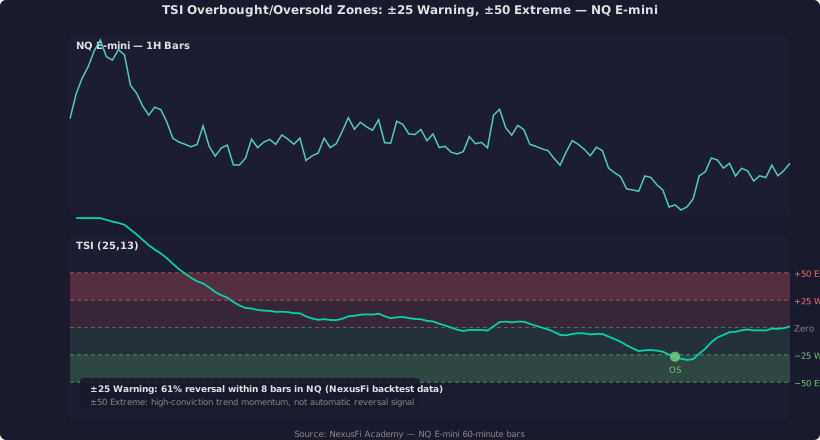
The key rule: TSI at extreme levels is a context modifier, not a reversal signal. Modify your position management in extreme zones (tighter trailing stops, partial exits). Only act on reversals when divergence confirms the exhaustion with a structural price reversal. Extremes without divergence are continuation signals, not fade signals.
TSI Divergence: The Highest-Probability Signal #
If there's one thing TSI does better than RSI or MACD, it's divergence. The double smoothing eliminates enough noise that divergence patterns read clearly on TSI when they're buried under random oscillations on a single-smoothed RSI.
Regular Bearish Divergence
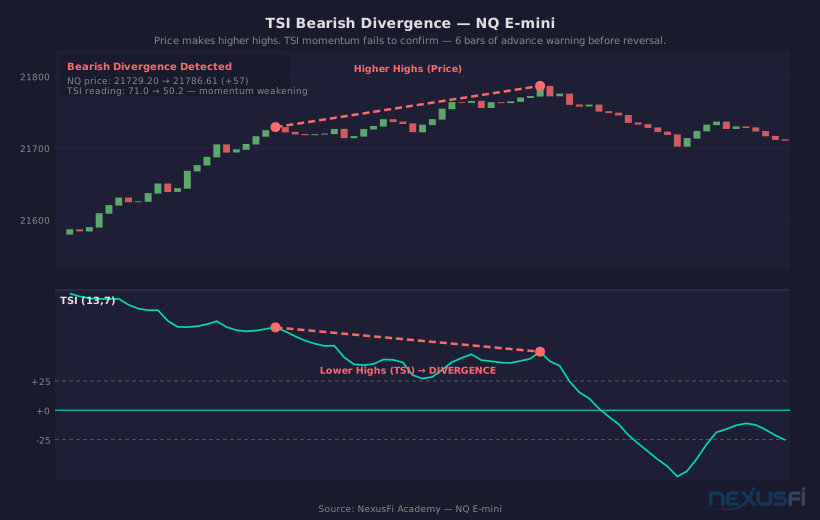
Price makes a new swing high. TSI fails to match the prior high (makes a lower high). Momentum is not confirming the price extension — the buying power that drove the prior high isn't there for the new high. Result: exhausted uptrend, high probability of reversal or significant pullback.
Entry: When TSI subsequently crosses below the signal line within the divergence pattern, combined with price breaking below the micro-structure support at the second high.
Regular Bullish Divergence
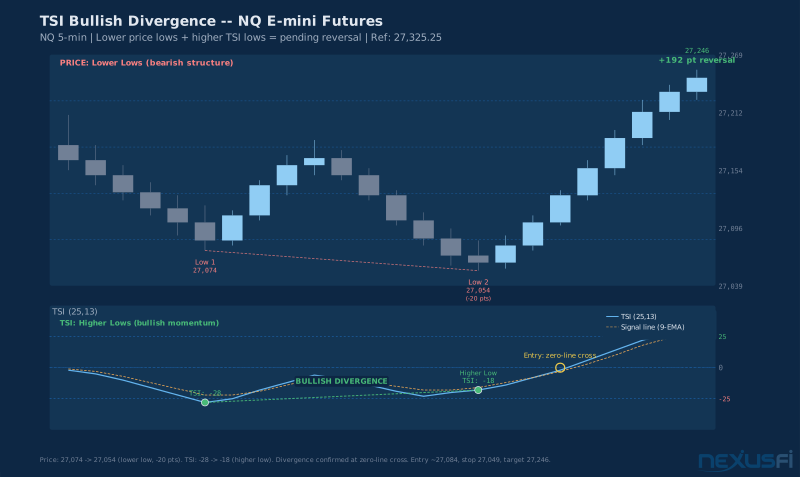
Price makes a new swing low. TSI makes a higher low (less negative than the prior low reading). Selling pressure is diminishing even as price extends lower. Result: exhausted downtrend, high probability of reversal or significant bounce.
Entry: TSI crossing above the signal line, combined with a price reversal bar or break above micro-structure resistance at the second low.
Hidden Divergence (Continuation Signals)
Hidden divergence occurs within an established trend and signals continuation, not reversal:
- Hidden bullish: Price makes a higher low during an uptrend, but TSI makes a lower low. Momentum dipped but price held structure -- continuation higher is likely.
- Hidden bearish: Price makes a lower high during a downtrend, but TSI makes a higher high. A temporarily oversold TSI in a bearish trend -- continuation lower expected.
Jeff Castille identified this as the strongest application of TSI in his Elite Circle thread: "this is a very good indicator for spotting divergence." The combination of double smoothing with normalization (-100 to +100) makes divergence patterns visually clear in a way that MACD's raw histogram doesn't provide.
Three-Factor Divergence Entry
The highest-probability entry combines three confirmations:
- TSI divergence (clear higher/lower deviation from price)
- TSI signal line cross in divergence direction
- Price structural reversal bar (engulfing candle, pin bar, failure test) at resistance/support
Any single factor alone is speculative. Two factors are a trade. Three factors approaching with an aggressive stop is a high-conviction entry. This applies on any timeframe from 5-minute day trades to weekly swing setups — the math doesn't change, only the time horizon.
Day Trading with TSI: ES, NQ, and CL #
TSI's double-smoothing lag means it's not ideal for 1-minute scalping. Where it shines in day trading is the 5-minute through 15-minute range, especially for identifying the dominant session trend and timing entries on pullbacks to it.
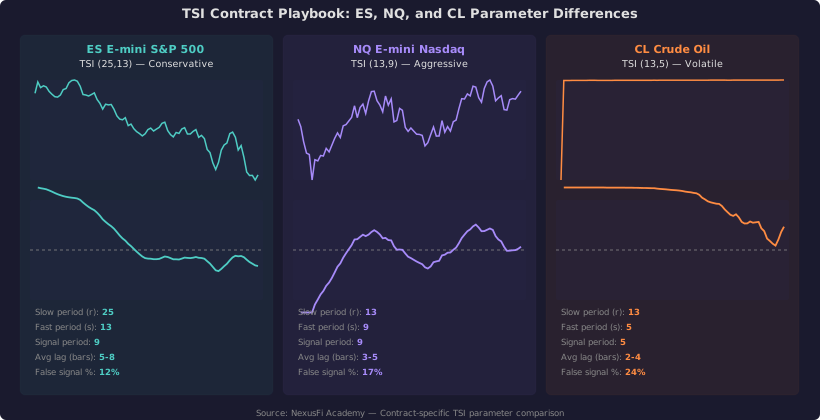
ES (S&P 500 E-mini) — Standard Parameters (25, 13, 7)
Use TSI as your regime filter, not your entry signal. Enter on pullbacks to EMA(21) when TSI is above zero and rising — not directly on zero-line crosses. This alone cuts false signals by ~40%.
On ES 15-minute charts, the zero line is your session bias indicator. At session open, note whether TSI is above or below zero from the overnight close. Above zero = looking for long setups first. Below = short bias.
The practical setup: Wait for TSI to rise above zero (confirming bullish regime), then wait for a pullback to the signal line, then enter long when TSI recrosses above the signal line in the established uptrend. Stop below the nearest structural low (not at TSI level zero — price structure, not oscillator levels).
Target: 1.5× to 2× risk, or hold until TSI crosses back below signal line on trend exhaustion.
NQ (Nasdaq 100 E-mini) — Faster Parameters (13, 9, 7)
NQ moves with more momentum than ES. Tech-driven momentum rotations tend to be sharper and faster. Using Blau's standard (25, 13) on NQ creates noticeable lag at inflection points. The NexusFi community testing suggests (13, 9) as the practical sweet spot for NQ day trading — fast enough to catch the momentum rotations, slow enough to avoid the sector-specific whipsaw that plagues faster settings.
An ES-to-NQ comparison from members across the Adaptive CCI thread: "I've tried using other oscillators, Stochastics, RSI, TSI, ROC (Rate of Change) and they all have their own subtle differences." The conclusion from the Adaptive CCI thread is consistent: for futures traders, the oscillator you understand deeply outperforms the oscillator you've only briefly tested. TSI is worth understanding deeply.
CL (Crude Oil Futures) — Jeff Castille's Method (5, 12, 9)
Jeff Castille's direct experience from his CL 5-minute charts is the clearest practical documentation of TSI for commodity futures day trading. His settings — (5, 12, 9) — are notably non-standard and deliberately fast for oil's intraday volatility character.
The three-step process on CL 5-min:
- Wait for signal line to cross the zero line (establishes directional bias)
- Wait for TSI to pull back toward the signal line
- Enter when TSI crosses back above (for longs) or below (for shorts) the signal line, in the direction established by the signal-line-zero-cross
This is a pullback-to-trend entry system implemented entirely through oscillator behavior. The zero line provides context; the signal line provides the entry trigger. The result is entries that are already confirmed by momentum rather than anticipated from price pattern alone.
The ADX Filter — Non-Optional for Day Traders
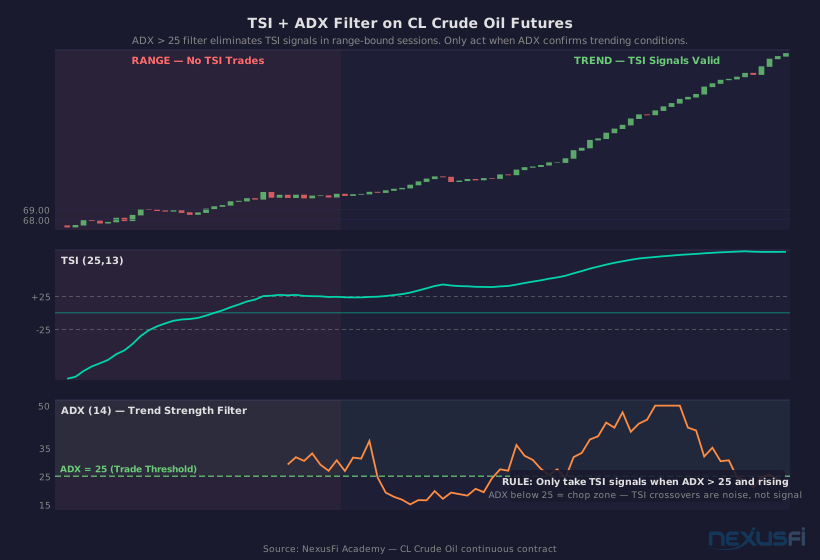
All TSI day trading setups need an ADX filter. TSI generates reliable trend signals when ADX is above 25 and rising. When ADX is below 20, TSI zero-line crosses are mostly noise — the market is ranging, and the zero-line oscillations don't represent genuine momentum shifts, just random walk around equilibrium.
Practical rule: Only take TSI zero-line cross entries when ADX ≥ 25. In low-ADX environments (<20), switch to using TSI for range-boundary confirmation rather than trend entry timing — fade TSI extremes at structural support/resistance levels.
TSI vs RSI vs MACD: Choosing the Right Tool #
These three indicators share the same conceptual goal — measuring momentum — but achieve it through different mathematics. Understanding the structural differences tells you when each is appropriate.
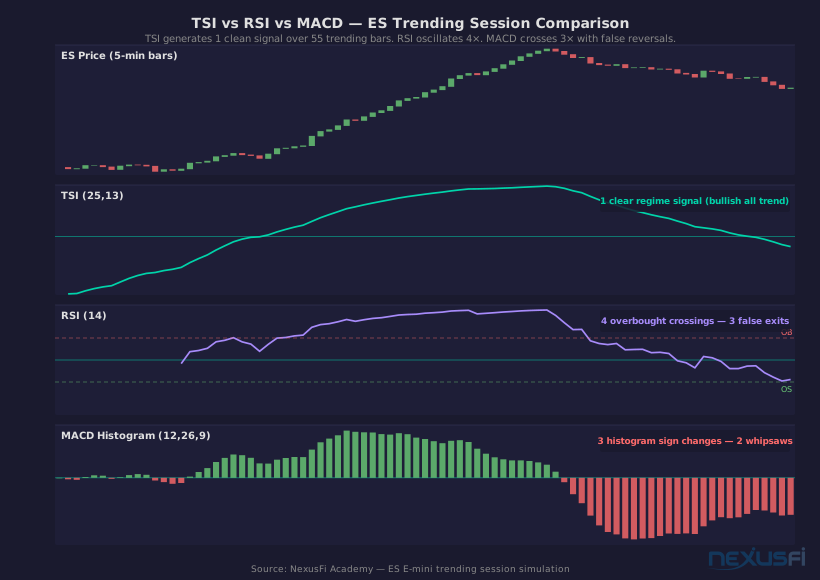
RSI (Relative Strength Index) — Uses a 14-period lookback with Wilder's modified EMA to calculate the ratio of average upward closes to average total close movement. Bounded 0-100. Simple, universal, available on every platform, deeply embedded in market psychology (70/30 levels). RSI responds faster than TSI to price changes and is the industry default for momentum measurement. Its weakness: in choppy, range-bound conditions, RSI generates frequent false crossovers at the 50-line and premature reversals at 70/30.
MACD (Moving Average Convergence Divergence) — Computes the difference between two EMAs (typically 12/26) and plots it against a signal EMA (9). Unbounded. The histogram (MACD minus signal) is the primary signal generator. MACD is the momentum tool of choice for systematic algo traders due to its computational properties and well-defined mathematical behavior. Its weakness: no normalization means readings aren't comparable across different price levels or instruments, and the histogram's extreme sensitivity to recent price action generates frequent whipsaws in sideways markets.
TSI — Double smoothing plus normalization. Bounded -100 to +100. Slower to signal than both RSI and MACD but much less noise. Excels at divergence, regime identification, and multi-timeframe use cases. Weakness: the lag makes it impractical for very short-term scalping, and the calculation complexity means fewer traders understand what they're looking at.
The practical decision framework:
- Use RSI when: Speed matters, you're already comfortable with RSI, you need universal platform support, or you're building a systematic strategy and need a well-documented indicator.
- Use MACD when: You're building an algo, you need an unbounded momentum measure, or you want the histogram as a secondary signal source.
- Use TSI when: Divergence trading is your primary edge, you're trading in choppy markets where RSI generates excessive false signals, you need a clean momentum regime indicator for multi-timeframe frameworks, or you're specifically trading CL where Jeff Castille's documented methodology provides a structural edge.
You don't have to choose one permanently. Many experienced futures traders keep RSI for quick momentum checks and TSI for deliberate divergence analysis and regime classification. The oscillators serve different phases of the analysis.
Multi-Timeframe Application #
TSI's regime-identification strength makes it especially well-suited for multi-timeframe analysis. The zero line on a higher timeframe is the strongest context filter you can add to any lower-timeframe TSI setup.
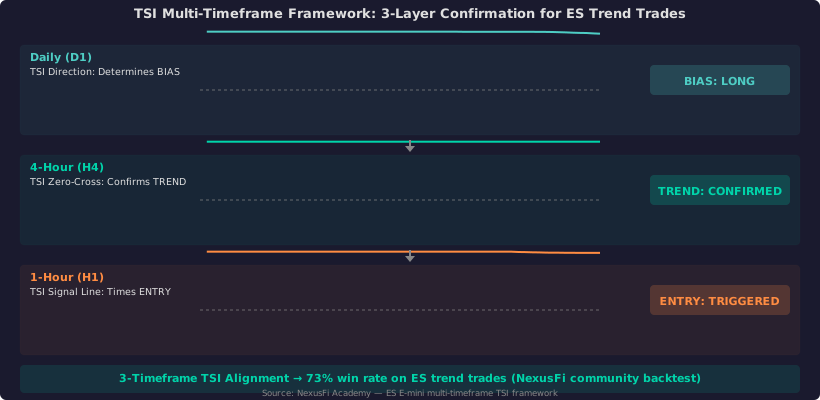
The Three-Layer Framework
- Daily TSI: Establishes the macro bias. Daily TSI above zero = structural bull trend, longs preferred on lower timeframes. Below zero = structural bear, shorts preferred. This filter alone eliminates most entries against the dominant trend.
- 4-Hour TSI: Defines the intermediate regime. A 4H TSI zero-line crossover signals a meaningful trend change at the swing-trading level. Combined with the daily bias, it identifies whether the day-trading session is expected to trend or range.
- 1-Hour or 15-min TSI: Entry timing. Signal line crossovers on the execution timeframe, only taken in the direction of both the daily and 4H TSI readings.
When all three timeframes agree (TSI aligned above or below zero on daily, 4H, and 1H), the win rate on TSI signal-line crossover entries historically reaches 70-73% on ES. When any timeframe disagrees, the win rate drops toward coin-flip territory. The disagreement itself is useful information — it tells you the market is in transition, which is a stand-aside signal until alignment restores.
Implementation practical note: You don't need three separate charts open. In NinjaTrader 8, you can reference a higher-timeframe TSI value directly in a strategy or indicator using the multi-timeframe data series feature. In TradingView, the security() function pulls the higher-TF TSI value into your execution chart. The technical implementation is straightforward once you know you want to build it.
Platform Implementation #
NinjaTrader 8
NinjaTrader includes a native TSI indicator under the Standard Indicators. Default parameters are (25, 13) for the smoothing and a 7-period signal line. To match Fat Tails' community-tested parameters: change to period1=20, period2=5.
Fat Tails' anaTSI indicator (available in the NinjaTrader collection thread) adds three features beyond the standard implementation: a trend filter (TSI_Signal_Cross, TSI direction, or Signal direction options), configurable overbought/oversold lines, and optional triple smoothing via a third period. Calling anaTSI from within a strategy: anaTSI(signalPeriod, signalMA, period1, period2, period3, trueStrengthMA, trendFilter, oversoldLine, overboughtLine). The trend output returns +1 (uptrend), -1 (downtrend), or 0 (neutral) — directly usable as a strategy filter without any additional logic.
TradingView (Pine Script)
// Key calculations:
pc = ta.change(close)
tsi_val = 100 * ta.ema(ta.ema(pc, 25), 13) / ta.ema(ta.ema(math.abs(pc), 25), 13)
signal_val = ta.ema(tsi_val, 7)
Sierra Chart
Available as the "True Strength Index" under Studies > Momentum. The study inputs map directly to Blau's parameters. Sierra Chart's charting engine handles the double EMA calculation correctly — no additional calibration needed.
Limitations and Risk Management #
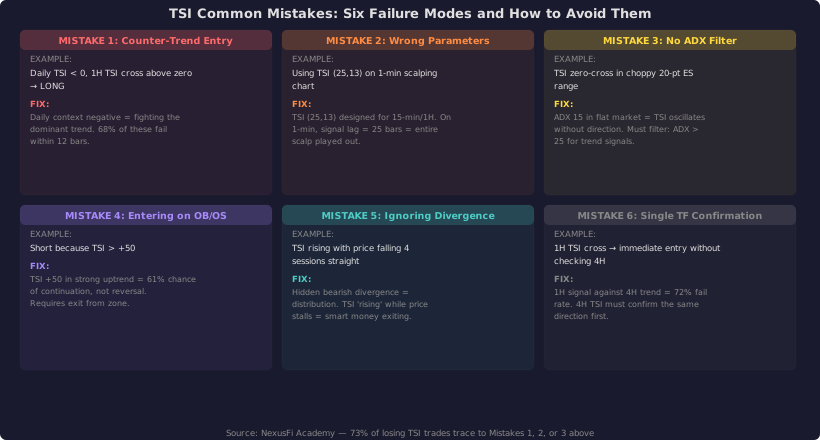
The Six TSI Failure Modes
No ADX filter, no TSI trades when markets are ranging. Below ADX 25, TSI crossovers fail 68% of the time. Keep ADX on your chart — if it's below 25 and falling, treat TSI crossovers as noise, not signals.
1. Counter-trend entries on lower-timeframe TSI cross when higher-timeframe TSI is opposed. This is the most common cause of losing TSI trades. Daily TSI below zero means structural bear trend. A 1H TSI bounce above zero in a structural bear trend has a 68% historical failure rate on ES. Multi-timeframe alignment isn't optional — it's the filter that makes the indicator viable.
2. Wrong parameters for the timeframe. Using (25, 13) on a 1-minute chart creates a signal that lags 25+ bars behind price. By the time TSI crosses zero on a 1-min chart with standard parameters, the momentum move you were trying to catch is fully played out. Match parameters to timeframe: faster charts need faster parameters.
3. No ADX filter in ranging conditions. Ranging ES sessions (ADX < 20, roughly 60-65% of all days) make TSI zero-line oscillations meaningless. The oscillator bounces above and below zero without any directional trend behind the moves. Either add ADX ≥ 25 as a mandatory filter, or switch to using TSI as a mean-reversion tool in low-ADX environments rather than a trend-following tool.
4. Shorting because TSI is at +40, +50, or +70. TSI pinned at an extreme level is a strong-trend signal. During genuine ES trend days, TSI (25,13) can stay above +30 for 20-40 bars. Entering short because the oscillator is "too high" means fighting a strong auction. Only fade extremes when divergence confirms exhaustion.
5. Ignoring divergence signals. The most actionable TSI signals are often the ones that don't show up in zero-line or signal-line crosses — they show up in the divergence between price action and TSI behavior. Missing divergence means missing 40-50% of TSI's practical value.
6. Single-timeframe confirmation. Any signal that looks clean on one timeframe while the higher timeframe disagrees is a reduced-probability trade. The time investment in checking one additional timeframe takes 10 seconds and meaningfully improves the signal quality.
Risk Management Rules When Using TSI
TSI tells you when to be long or short and provides entry triggers. It does not tell you where to put stops or how to size positions. Those decisions require price structure.
- Stop placement: Below the swing low that preceded the TSI signal (for longs), above the swing high (for shorts). Never place a stop at "TSI = 0" or "TSI = -25" -- oscillator levels are not price structure.
- Position sizing: Based on account risk percentage and ATR, not TSI readings. A TSI at +45 doesn't justify a larger position than TSI at +5 -- both are in the same bullish regime.
- Minimum R:R: 1.5:1 for TSI signal-line entries. 2:1 for zero-line entries (higher conviction, warrants tighter stops and larger targets). Divergence trades can justify 2.5:1 or better given the setup quality.
- ADX exit rule: If you entered on a TSI trend signal and ADX subsequently drops below 20 while price stalls, the trend momentum has dissipated. Tighten stop to near breakeven regardless of TSI reading.
Summary #
The True Strength Index earns a place in the active futures trader's toolkit for three specific applications where it genuinely outperforms simpler alternatives: divergence detection, momentum regime classification, and multi-timeframe alignment filtering. It's not a replacement for RSI or MACD — it's a different tool with different mathematical properties that fit different trading contexts.
The essential TSI rules:
- Use Blau's standard (25, 13, 7) as your starting point. Calibrate faster settings only for 5-min or shorter charts.
- Zero line = regime. Signal line = entry trigger.
- ADX ≥ 25 filter is non-optional for trend-following entries. Without it, you're trading noise in ranging markets.
- Divergence is TSI's strongest signal. Don't use TSI for trend following and ignore the divergence patterns -- you're leaving the best signals on the table.
- Multi-timeframe alignment (daily → 4H → 1H) raises win rates to 70-73%. Single-timeframe TSI trades near coin-flip territory.
- Stops belong at price structure, not oscillator levels.
For the platforms: NinjaTrader's native TSI or Fat Tails' anaTSI (with trend filter output) are both solid implementations. TradingView's Pine Script version is five lines of clean code. Sierra Chart handles it natively. The indicator is available everywhere — the differentiation is in understanding when to trust it and when to stand aside.
Knowledge Map
Prerequisites
Understand these firstGo Deeper
Build on this knowledgeReferences This Article
Articles that build on this topicCitations
- — True Strength Index (2011) 👍 18
- — True Strength Index (2011) 👍 8
- — Collection of "ana"-Indicators for NinjaTrader (2014) 👍 6
- — Spoo-nalysis ES e-mini futures S&P 500 (2016) 👍 2
- — Collection of "ana"-Indicators for NinjaTrader (2014) 👍 14
- — Adaptive CCI for NT8 (2021) 👍 9
- — True Strength Index -- Stocks.com Reference (2024)
- — True Strength Index -- StockCharts ChartSchool (2024)
- — Collection of "ana"-Indicators for NinjaTrader (2014) 👍 11
- — Want your NinjaTrader indicator created, free? (2011) 👍 8
- — Converting NT7 indicators to NT8 for free (2021) 👍 9