



Exponential Moving Average (EMA): The Intraday Trend Engine for Futures Traders
Overview #
The Exponential Moving Average is the most widely used technical indicator in intraday futures trading — and it's the one most traders misuse within the first week. Not because it's complicated. Because it's seductive. An EMA draws a smooth line through price action that makes trends look obvious in hindsight. Traders see that line and immediately think "buy when price touches it, sell when price breaks it." That's the first mistake.
The EMA is not a signal generator. It's a state descriptor. It tells you where price has been and at what rate it's been moving. Used correctly — as a trend filter and dynamic reference level within a multi-timeframe framework — it's one of the most powerful tools available to futures day traders. Used as a raw entry trigger, it will chew through your account on any choppy day.
Here's why the EMA matters more than the SMA for intraday futures work: the exponential weighting makes it faster. Recent price bars carry more weight than older bars, so the EMA reacts to momentum shifts before the SMA does. In ES, NQ, and CL — where institutional order flow can move the market 8-10 points in a single large lot — that responsiveness is the difference between catching the trend early and chasing it late. But speed also means more sensitivity to noise. Understanding this tradeoff is the whole game.
This article covers the EMA calculation, how to set periods for specific futures instruments, the three core applications (trend filtering, dynamic support/resistance, multi-timeframe analysis), and what the community's most experienced practitioners have learned about where the indicator breaks down. If you already know what a moving average is, read Moving Averages for Futures Trading first — this article goes deep on the EMA specifically.
Key Concepts #
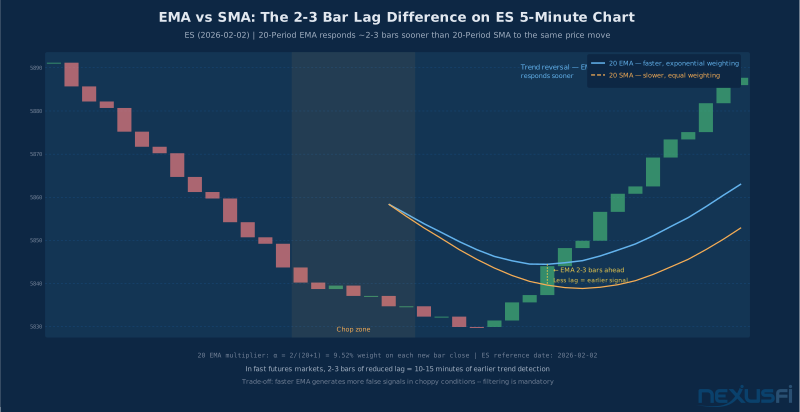
Exponential weighting. The EMA applies a multiplier to the most recent price bar: multiplier = 2 / (N + 1), where N is the period. For a 20 EMA, the multiplier is 2/21 = 0.0952. Each bar's EMA value is: EMA = (Close multiplier) + (Previous EMA (1 - multiplier)). A 20-period EMA with a multiplier of 9.52% means today's close contributes about 9.5% to the output, while everything before yesterday contributes the remaining 90.5% in exponentially decaying fashion. The most recent bars count the most. That's the entire mechanism.
Lag vs. responsiveness. Every moving average lags — that's the point. Lag filters noise. The EMA reduces lag compared to an SMA of the same period by overweighting recent data. A 20 EMA will respond to a sudden price move approximately 2-3 bars sooner than a 20 SMA. In a 5-minute ES chart, that's 10-15 minutes — enough to make a meaningful difference in entry timing. But that same responsiveness creates false signals during sideways chop. This is the fundamental tradeoff you're always managing.
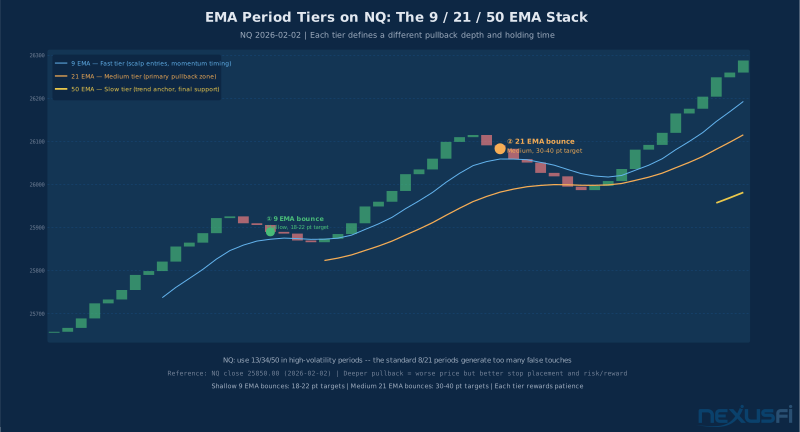
Period as time horizon. Think of EMA periods as time-horizon selectors, not magic numbers. On a 5-minute chart, a 9 EMA covers about 45 minutes of price history. A 21 EMA covers about 1 hour 45 minutes. A 50 EMA covers over 4 hours — basically the full trading session. Each period answers a different question: where are we relative to the last hour? The last two hours? The full session? The answer to those questions determines trading bias.
EMA vs. SMA in practice. The simple moving average weights every bar equally. The result is a smoother line that filters more noise but lags further behind current price action. For position traders or swing traders who hold overnight, the extra smoothing of an SMA can be valuable — it stays above minor pullbacks that would whipsaw an EMA signal. For intraday futures day traders, the EMA's faster response is generally preferred because you're making decisions in real time with tick-level precision. The SMA makes sense as a structural reference (the daily 200 SMA is the most watched line in global markets) but the EMA is the workhorse for intraday decision-making.
EMA Formula: EMAₜ = (Close × α) + (EMAₜ₋₁ × (1 - α))
where α = 2 / (N + 1)
For a 20 EMA: α = 2/21 = 0.0952 (9.52% weighting on the most recent bar)
EMA Period Selection: What Works for ES, NQ, and CL #
Period selection is the part that causes the most confusion, mostly because people try to improve. You don't need to improve. You need to understand what each tier of periods is measuring.
The fast tier (8-13 periods). On a 5-minute chart, these EMAs track roughly 40-65 minutes of price action. They're extremely sensitive and respond quickly to momentum. The 9 EMA is the de facto standard for the fast tier — it's Fibonacci-adjacent, used by enough traders to have self-reinforcing behavior, and tracks the immediate directional bias.
That's the core logic stripped to its essentials. He also added the rule that he does NOT buy/sell the crossovers themselves — he waits for price to pull back to near the fast EMA and reverses.
The slow tier (50-200 periods). The 50 EMA acts as the last line of defense in a trend. If price pulls back through the 9 and 21 and reaches the 50, either the trend is exhausted and building a new base, or it's breaking down. On a 5-minute chart, the 50 EMA covers more than 4 hours — basically the full session's structural direction. A 200 EMA on a 5-minute chart is less commonly used intraday but serves as the daily trend anchor for some traders. Traders watching this on the daily chart are seeing 200 sessions (roughly 10 months) of directional pressure — this is the one that matters for macro context, not scalping.
Instrument-specific tuning:
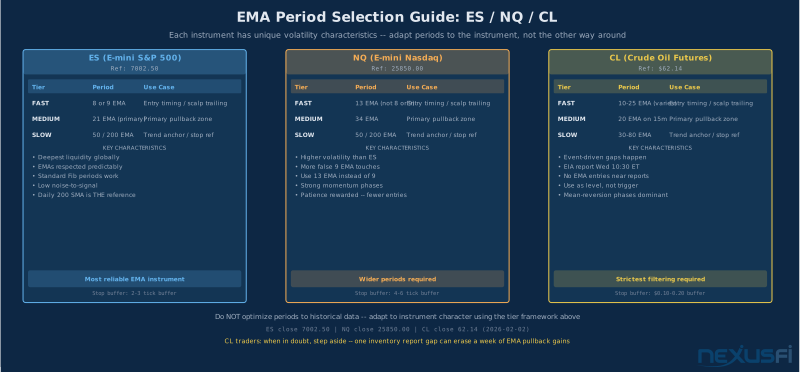
For ES (E-mini S&P 500), standard Fibonacci-adjacent periods (8, 21, 34, 50) on 5-minute charts work well. ES is the most liquid futures market in the world, and its deep institutional participation means EMAs get respected more predictably than in less liquid instruments. The 8/21 EMA combination on a 5-minute chart is the most common setup you'll see discussed by ES traders. The 21 EMA on the 15-minute chart serves as a reliable session trend indicator for intermediate holding times.
For NQ (E-mini Nasdaq), the higher volatility demands slightly wider periods. A 9 EMA on NQ 5-minute charts generates much more false touches than the same period on ES because NQ's intraday swings are larger and more frequent. Moving the fast tier to 13 or even 21, and the medium tier to 34 or 48, provides better noise filtering. The extra sensitivity that helps in ES can hurt in NQ. When NQ is in a tech-sector momentum phase, EMAs work beautifully. When it's chopping below the 50 EMA on the 60-minute chart, no EMA combination will help you.
For CL (Crude Oil), the situation is at the core different. CL is event-driven — an EIA inventory report or geopolitical headline can move it $1.50 in 60 seconds, blowing through every EMA on the chart simultaneously. For CL, EMAs work better as dynamic structural levels during calm trending periods and are nearly useless as entry triggers around report times. The 20 EMA on 15-minute charts serves as a useful session trend reference, but CL traders using EMA-based setups need to be in defensive mode around the 10:30 AM ET inventory window every Wednesday.
The Three Applications That Actually Work #
1. Trend State Filter #
This is the highest-value application of EMA — not as an entry signal, but as a market state classifier.
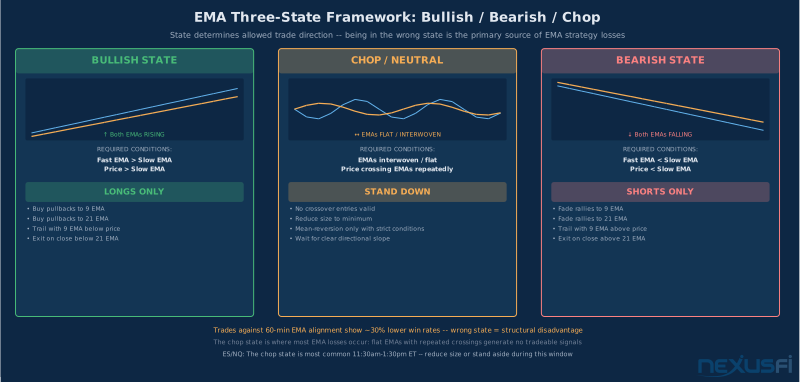
The framework is simple: define three states based on EMA alignment.
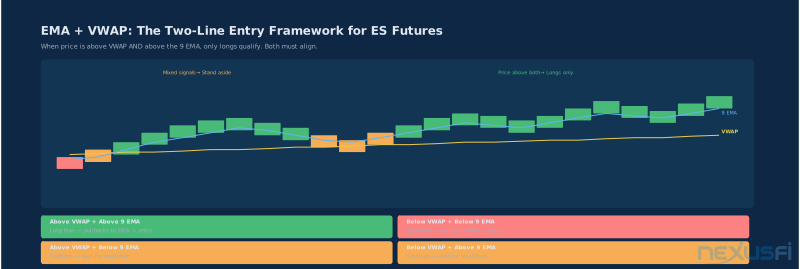
Bullish state: Fast EMA is above slow EMA, and price is above the slow EMA. Both conditions required. In this state, only take long setups. Don't short, don't fade rallies, don't argue with the tape.
Bearish state: Fast EMA is below slow EMA, and price is below the slow EMA. Short bias only.
Chop/neutral state: EMAs are interwoven, price is oscillating across the slow EMA, or the EMAs have converged and gone flat. This is the danger zone.
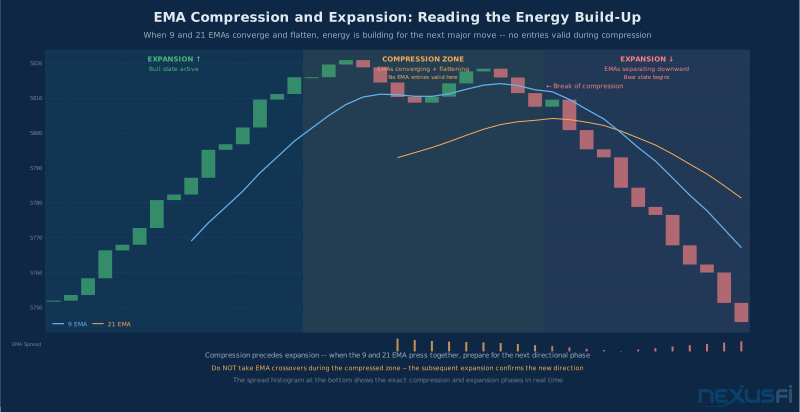
The same principle applies to any fast/medium EMA combination. When both EMAs are flat and bunched together, you're in a consolidation and the EMA crossover signals are meaningless.
The practical result of using EMA as a state filter: you trade fewer setups, but the setups you take have a higher probability of follow-through. You're no longer fighting the intraday current.
The chop state is where EMA-based traders lose the most money. When both your 9 and 21 EMAs are flat and criss-crossing, that's not a "weak signal" — it's an explicit instruction to stand down. EMA crossovers in flat EMA environments have no edge. Reduce size or stop trading until the EMAs develop a clear slope in one direction.
The multi-expert consensus from the council analysis: trades against the hourly EMA alignment show approximately 30% lower win rates than aligned trades. That's not a small effect. If your setup requires trading against the 60-minute EMA trend, you're starting every trade at a structural disadvantage.
2. Dynamic Support and Resistance #
This is where EMAs earn their keep in real-time trading. In a trending market, price doesn't move in a straight line — it surges, pauses, pulls back, then surges again. The EMA acts as the moving "floor" or "ceiling" that contains those pullbacks.
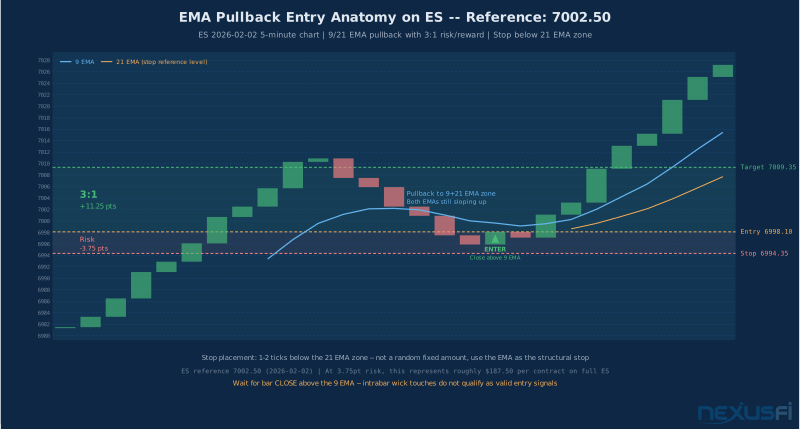
The most reliable setup: during an established uptrend (all EMAs sloping upward, price above all of them), watch for price to pull back toward the 9 or 21 EMA. When price touches the EMA and then stabilizes (a rejection wick, a doji, an absorption candle), that's your with-trend entry. Stop goes below the 21 EMA (or the last swing low, whichever is tighter). Target is the next resistance or a fixed multiple of risk.
And critically: "Once a major high/low breaks I'm in continuation mode and look for those exact pullback entries. I'll take them as long as the new highs/lows aren't weak and as long as the 1-min 20EMA holds as support/resistance."
That last clause is the key: EMA acts as dynamic S/R only in the context of a confirmed trend. When the trend ends and price starts oscillating, the EMA becomes a magnet for false signals.
The EMA stack provides graduated context:
- Fast EMA (9) bounce: shallow pullback in a fast trend — typically a scalp opportunity, 4-6 ES points
- Medium EMA (21) bounce: deeper pullback in an established trend — better risk/reward, larger target
- Slow EMA (50) bounce: significant pullback, possibly testing trend continuation — highest conviction entry but also highest potential for trend reversal
When price falls through the 9 and reaches the 21, the trend has slowed but not necessarily broken. When it falls through the 21 and reaches the 50, you're watching a key test. A close below the 50 EMA on the trading timeframe is typically when you reassess the trend entirely.
Treat the EMA as a zone, not a line. Price doesn't stop on a mathematical calculation. It stops in a region of interest where participants are watching. Add a small buffer — 1-2 ticks for ES, 3-5 ticks for NQ, 5-10 cents for CL — to avoid getting stopped out by normal noise that "touches" the EMA before bouncing. Require a close confirmation (bar close above or below the EMA) rather than an intrabar wick to define "holding" vs "breaking" the level.
3. Multi-Timeframe EMA Analysis #
Single-timeframe EMA analysis is a step up from nothing. Multi-timeframe EMA analysis is where the approach becomes genuinely powerful.
The structure that the community consistently uses:
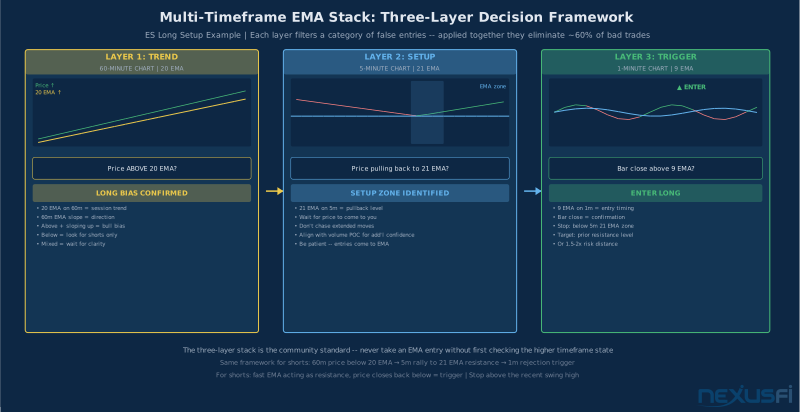
Trend/Bias Layer (60-minute or 15-minute chart): A 20 or 50 EMA on the 60-minute chart establishes the macro intraday trend. If price is above the 20 EMA on the 60-minute chart and the EMA is sloping upward, the session has a long bias. This doesn't mean every minute is bullish — it means the tide is coming in, and pullbacks are likely to find buyers. Conversely, price below the 60-minute 20 EMA means shorts are structurally favored.
Setup Layer (5-minute chart): The 21 EMA identifies pullback zones for entry preparation. You're watching for price to retrace from an extreme back toward the 21 EMA. The combination of the 60-minute trend pointing up and price pulling back to the 5-minute 21 EMA is the high-probability zone: higher timeframe says "buy the dips," the medium timeframe identifies where the dip is.
Trigger Layer (1-2 minute chart): The 9 EMA on the 1-minute chart provides precise entry timing. You're waiting for the pullback to reach the 5-minute 21 EMA zone, and then using the 1-minute 9 EMA crossover (fast crossing back above slow) or a price acceptance bar (bar closes above the 9 EMA after touching it) to time the exact entry.
This three-layer framework dramatically improves signal quality. You're no longer taking every EMA touch — you're only taking EMA touches that are with the higher timeframe trend AND at a meaningful EMA level AND confirmed on a lower timeframe. Most of the noise and whipsaws get filtered at the first gate.
@gaz0001, documenting their path in a trading journal, described a 9/20/200 EMA stack on 2-minute NQ charts: "triple EMA stack — 9/20/200 to determine the trend direction." The 200 EMA in this context acts as the long-term intraday anchor — as long as the 9 and 20 are both above the 200, the bias is long. When both cross below the 200, the bias flips.
The three-layer EMA stack is how institutional traders use moving averages. They're not watching a single EMA on a single timeframe and trading every crossover. They're using higher timeframe EMAs to define the playing field, medium timeframe EMAs to identify the opportunity zone, and lower timeframe EMAs to time the execution. Each layer eliminates a category of bad trades.
EMA Crossover Strategies: The Honest Assessment #
Crossovers are the first thing most traders try with EMAs. Buy when the fast crosses above the slow. Sell when it crosses below. It looks clean on a backtest. It bleeds in live trading, at least the naive version does.
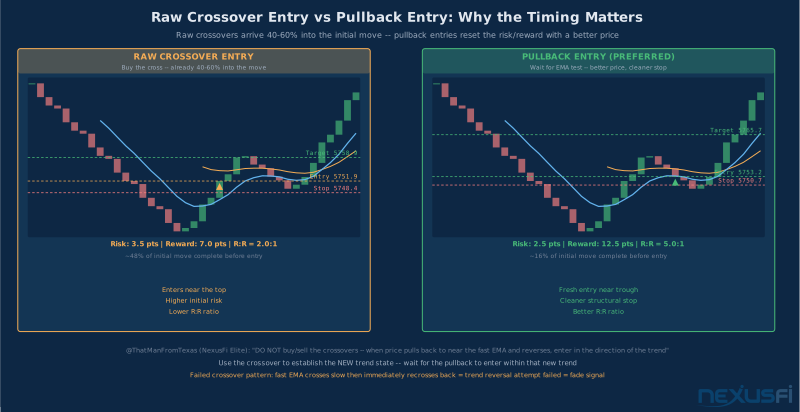
Here's the problem: by the time a crossover triggers, 40-60% of the initial move is already complete. You're buying at a point where the early momentum is already priced in. The remaining move is smaller, and the probability of a reversal is higher. On trending days, crossovers work and you still make money on that 40-60% remaining move. On choppy days, crossovers generate false signals every 15 minutes.
The crossover win rate without additional filters is approximately 45-50%. That's barely a coin flip. You can trade it profitably with tight risk management and by cherry-picking conditions, but it's a difficult edge to extract.
The filtered approach — which is what experienced practitioners actually use:
Step 1: Higher timeframe confirmation. Only take crossovers that are in the same direction as the higher timeframe EMA trend. An 8/21 EMA bullish crossover on the 5-minute chart that occurs while the 60-minute chart price is below its 20 EMA is fighting the tide. Skip it.
Step 2: Candle close confirmation. Don't react to an intrabar crossover. Wait for the bar to close with the fast EMA genuinely above the slow EMA. Intrabar noise causes false crossovers constantly, especially during high-volatility moments.
Step 3: Minimum separation. If the fast and slow EMAs are less than 1-2 ticks apart (ES) or 3-5 points apart (NQ), you're in a compressed zone where signals are unreliable. Wait for meaningful separation before treating the crossover as valid.
Step 4: The pullback entry instead of the crossover entry. @ThatManFromTexas gave the definitive community guidance: "DO NOT buy/sell the crossovers. When price pulls back to or inside the fast and reverses, enter a trade in the direction of the trend." This is the community's consensus best practice — use the crossover to establish the new trend direction, then wait for a pullback to the fast EMA to enter. You're getting in at a better price, with less risk, and with confirmation that the trend is holding.
The crossover isn't the entry — it's the filter that changes which direction of trades you're allowed to take.
The failed crossover — a useful signal. When the fast EMA crosses the slow EMA and then immediately recrosses back in the opposite direction, that's a trap signal. The market tried to establish a new trend, failed, and returned to the prior trend direction. This failed crossover — especially in the context of a strong higher-timeframe trend — is often a fade signal. The failed cross tells you the reversal didn't stick.
When EMAs Don't Work: The Conditions That Kill the Edge #
Knowing when not to use a tool is more valuable than knowing how to use it.
Balance days / inside days. When ES or NQ opens inside the prior day's range and never breaks out, the entire session is a consolidation. The 21 EMA will be flat and price will oscillate across it repeatedly. Every crossover signals nothing. Every EMA "touch" is noise. You'll recognize these days by the initial balance width — if it's less than half the average range, defensive posture is warranted. On these days, VWAP and Value Area levels are more useful than EMAs.
Around news events. Fed announcements, CPI, NFP, EIA inventory reports — these create instantaneous price moves that render all pre-event EMA levels irrelevant. The EMA needs time to "catch up" after a 20-point ES move in 5 seconds. For the first 10-15 minutes after a major report, the EMAs are lagging badly and should not be used for directional decisions. Wait for price to stabilize and for the EMAs to recalibrate to the new price environment.
EMA compression zones. When your 9 EMA and 21 EMA start to converge and press tightly together, that's a compression signal. The market has been oscillating in a range, and the EMAs are averaging out to the same value. This isn't a setup for a crossover entry — it's a warning that any crossover from this state carries very low initial conviction. @Fat Tails articulated this in the EMA Entries thread: entries at the EMA often get "tagged" by the noise before the real move happens — a rapid move into the losing direction before reversing. That sting is disproportionately common when EMAs are compressed.
First 5-15 minutes of RTH. The 9:30-9:45 AM ET window in ES and NQ is structurally chaotic. Market makers are filling orders, overnight gap adjustments are happening, and the first price discovery is often violent. EMA-based systems applied in this window without a very tight stop and very specific context generate above-average losses. Most experienced practitioners either skip this window entirely or use specific open-range protocols rather than EMA signals.
The time-of-day filter is one of the most underrated improvements to any EMA strategy. Avoiding the 9:30-9:45 open chaos window, the 12:00-1:00 PM low-volume drift, and the period around major data releases removes a significant proportion of the false signals EMA crossovers generate.
Stretched price extension. When price is more than 2 ATR units away from the 21 EMA, it's extended. Entries in the direction of the trend from this position have very poor risk/reward — you're entering after most of the move is complete. Exits from counter-trend positions are valid here, but new trend-following entries need to wait for the price to retrace and retest the EMA.
Practical Application: Building the EMA Framework #
Here's how to integrate EMAs into a practical intraday workflow for ES and NQ:
Before the open. Check the daily chart. Where is price relative to the 50-day SMA and 200-day SMA? This establishes the macro structural context. If both are sloping upward and price is above them, the long-term drift is bullish and you'll have a tailwind for long trades. Note the previous close relative to those levels.
Pre-market assessment. Look at the 60-minute chart. Find the 20 EMA. Is overnight price above or below it? If NQ opened the overnight session below the 60-minute 20 EMA and has been struggling to get back above it, the RTH session opens with resistance overhead at that level. That's critical context before the first bar prints.
Session bias establishment. During the initial balance (first 30 minutes), watch where the 5-minute 21 EMA is relative to the developing price range. If the IB forms with price consistently above the 21 EMA and the EMA is sloping up from the open, the session bias is long. If price opens, dips below the 21 EMA, and then reclaims it during the IB, the session is establishing that level as support.
Entry identification. Using the three-layer stack: 60-min EMA defines bias, 5-min 21 EMA identifies the pullback zone, 1-min 9 EMA provides the trigger. In a long bias day, you're watching for price to pull back to the 5-minute 21 EMA while the 9 EMA is still above it, and then buying the first 1-minute candle that shows rejection off that level (lower wick, close above the 9 EMA).
Trade management. Use EMAs as trailing reference points. In a strong trend, trail stop below the 9 EMA on the 5-minute chart — each new bar that holds, trail up. When the trend slows (price starts touching the 21 instead of bouncing from the 9), tighten the trail to below the most recent 5-minute swing low. Exit when price closes below the 21 EMA on the 5-minute chart for at least one bar.
Position sizing with EMA context. The confidence of your setup should affect your size. A pullback to the 21 EMA that perfectly aligns with the 60-minute EMA bias AND aligns with a volume profile support level is a maximum-conviction setup. A weak bounce off the 9 EMA in a context where the 60-minute EMA is flat is a quarter-size setup at best.
Integration with Order Flow and Volume Analysis #
EMAs tell you where price has been. Order flow tells you what's happening. The combination is materially more powerful than either alone.
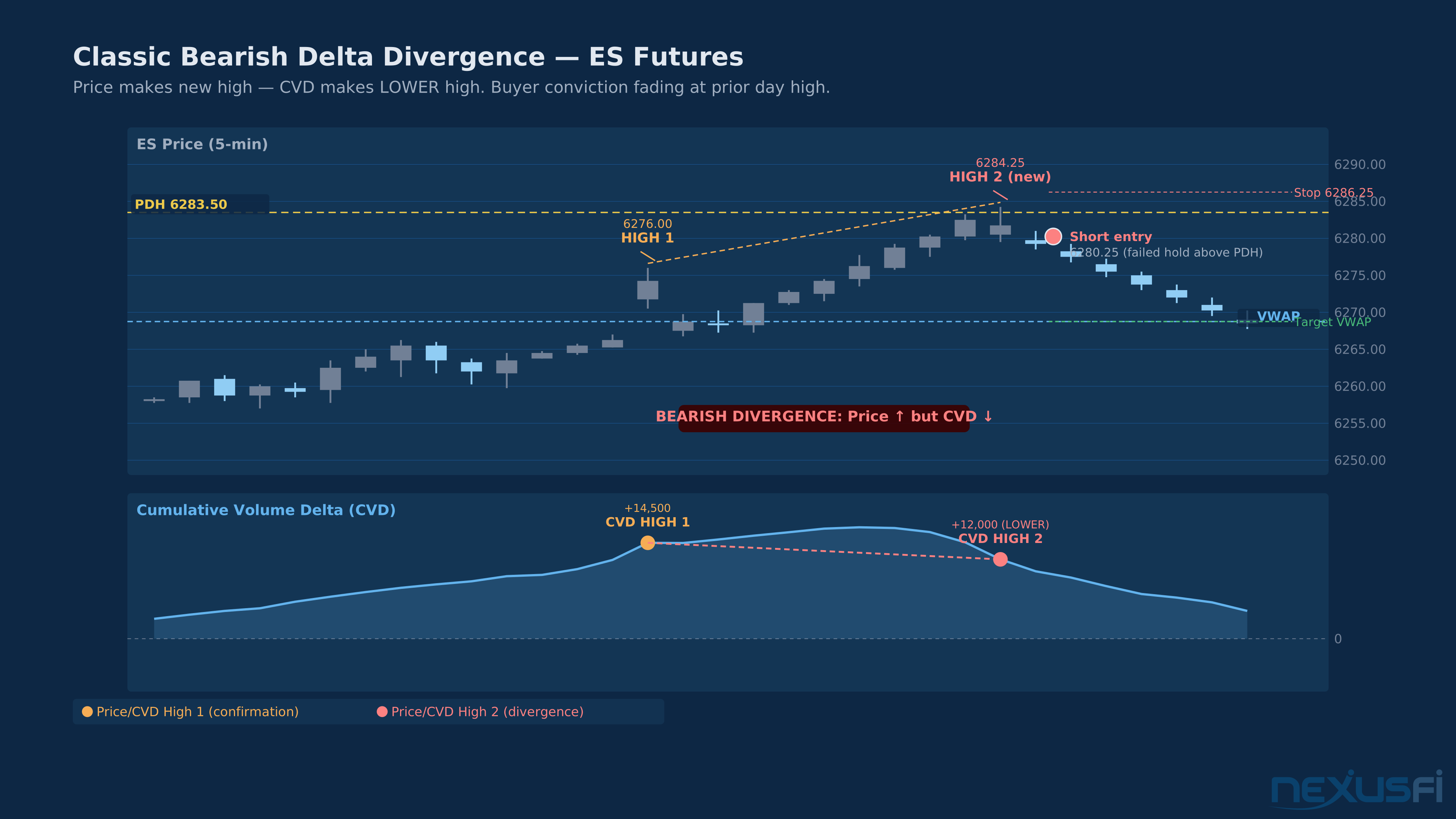
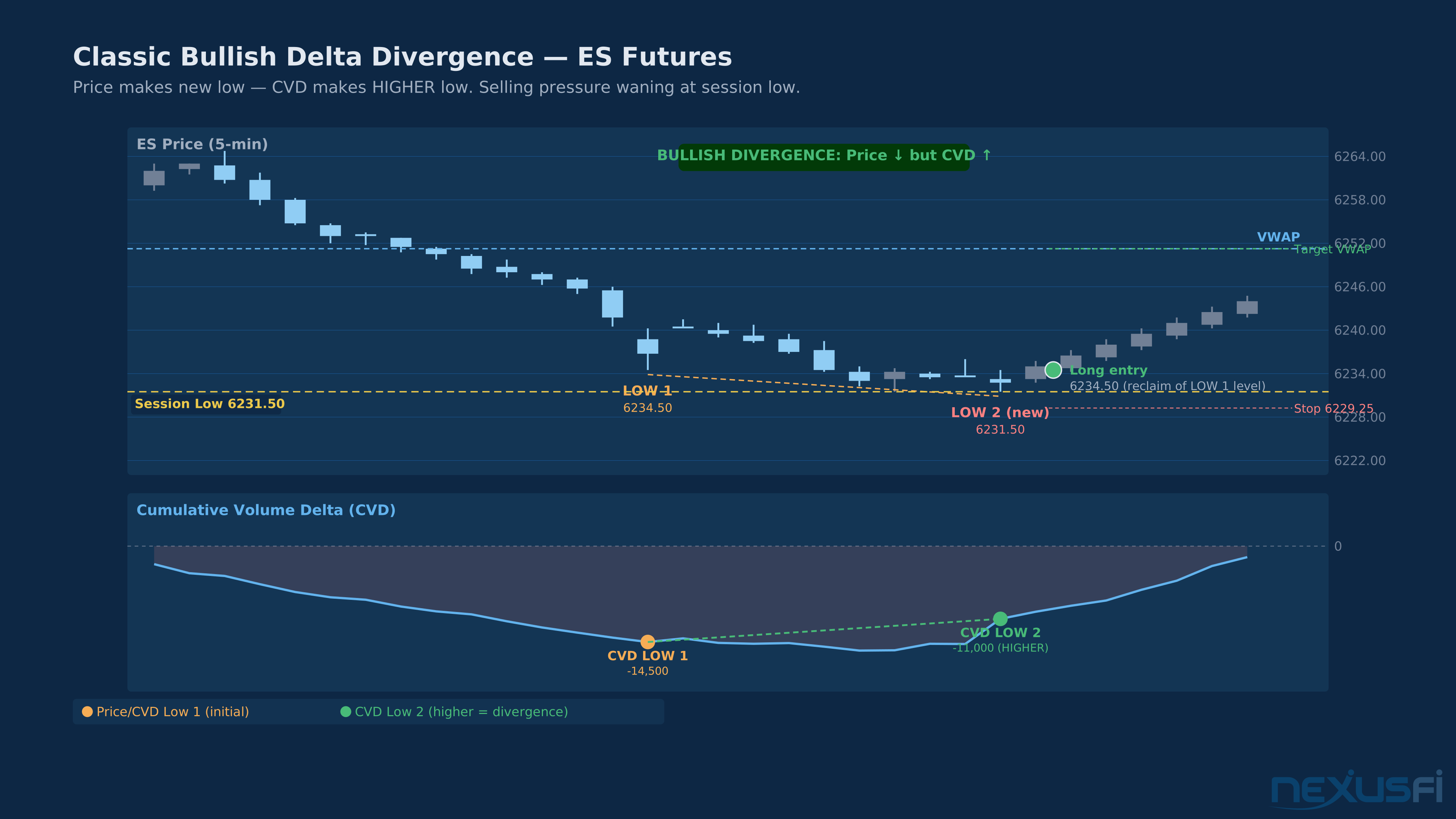
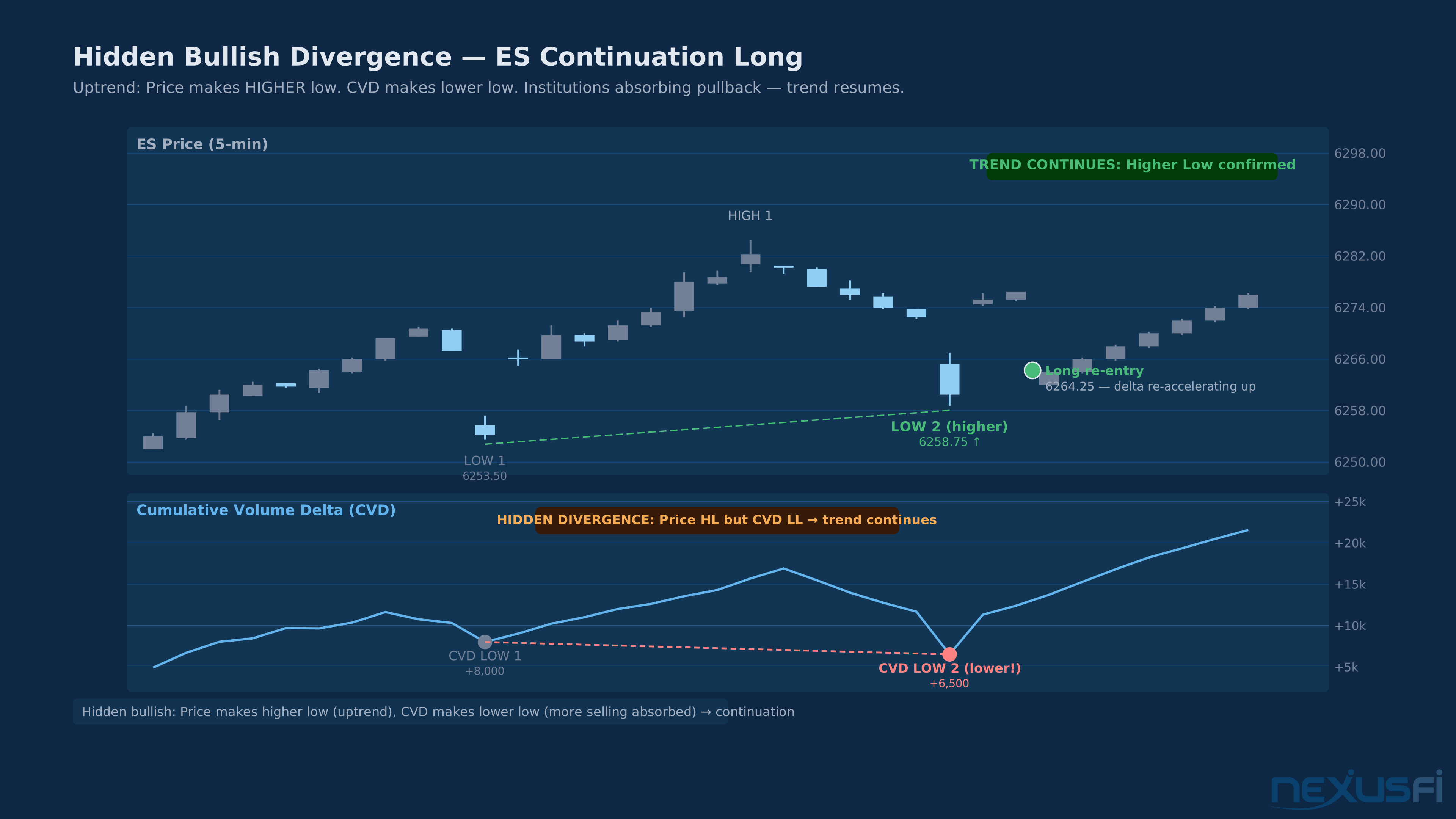
The most useful integration: when price pulls back to the 21 EMA, check the Cumulative Volume Delta (CVD). If price is touching the 21 EMA from above (in an uptrend) and CVD is showing positive — meaning buyers are absorbing the pullback — that's a strong signal. The EMA level is holding because there's actual buying interest there, not just because a line on a chart says so.
Conversely: if price pulls back to the 21 EMA and CVD is continuing to trend negative (sellers still dominant), the EMA touch is suspicious. The level is being tested but not yet defended. Waiting for CVD to stabilize or reverse before entering eliminates a significant category of failed EMA pullback trades.
Volume Profile adds another dimension. When an EMA aligns with a high-volume node (HVN) or the POC from a prior session, that level has double significance: both the EMA and the volume structure point to the same price as a reference. These combined levels tend to generate cleaner, more reliable reactions.
The ATR provides the calibration for stop placement. Rather than placing stops a fixed number of ticks below the EMA, use the ATR to define what "normal noise" looks like for the current volatility regime. In high-volatility conditions (ATR expanded), stops below the 21 EMA need to be wider to avoid normal oscillations. In compressed volatility (ATR contracted), tighter stops are justified.
EMA is best understood as the structural backbone of a multi-tool framework. It tells you the trend state and provides dynamic reference levels. CVD tells you if those levels are being defended or broken. Volume Profile tells you if those levels have structural significance beyond the EMA calculation. ATR calibrates your risk around those levels. The EMA alone is a skeleton. The other tools add the muscle and signal.
ES, NQ, and CL -- Instrument-Specific Notes #
ES (E-mini S&P 500): The most reliable instrument for EMA-based trading. Deep liquidity means EMA levels get respected cleanly — when 3,000 contracts are resting on a bid at the 21 EMA, price bounces cleanly. ES's smoothness on 5-minute charts makes it ideal for beginners learning the EMA pullback approach. Standard periods (8, 21, 50 on 5-minute charts) require minimal adaptation. The 200 SMA on the daily chart is the single most watched moving average in global markets — an ES trader needs to know where it is every day.
NQ (E-mini Nasdaq): Requires adaptation. NQ moves faster and further than ES, which means the 9 EMA gets broken more frequently by normal intraday noise. The solution isn't to give up on EMA — it's to use slightly wider periods (13 fast, 34 medium, 50 slow), require the higher timeframe alignment more strictly, and size down during high-volatility periods. NQ traders who try to use the same EMA setups they learned on ES without adjustment will get chopped up. NQ rewards traders who are patient and wait for the high-conviction EMA alignments, then take them aggressively.
CL (Crude Oil): The hardest instrument for EMA-based trading. Crude oil is event-driven — inventory reports every Wednesday at 10:30 AM ET, geopolitical news unpredictably, and energy demand data from multiple sources can all create gap moves that make every EMA level temporarily irrelevant. CL does trend well, and when it's trending, the 20 EMA on 15-minute charts provides excellent pullback levels. But the filtering requirement is much stricter: the higher timeframe trend must be unambiguous, the time of day must not be near a report window, and position sizing should be more conservative given the gap risk.
@SteveH, documenting a CL trading approach, described using a "25 regression slope MA on a 150T chart" to identify quick pullback entries AND places to take reversals. The regression-based MA (a variant of the standard EMA that fits a least-squares line through the lookback period) in CL context is preferred by some traders because it's less sensitive to individual volatile bars than a standard EMA.
Knowledge Map
Go Deeper
Build on this knowledgeReferences This Article
Articles that build on this topicCitations
- — Moving Averages - How do you use them? (2011) 👍 7“I use the EMA 8 and the EMA 21 with price set as a line on close. If the fast EMA is over the slow EMA, look for longs. Slow over fast, look for shorts. DO NOT buy/sell the crossovers.”
- — EMA Entries (2011) 👍 23“DO NOT buy/sell the crossovers. When price pulls back to or inside the fast and reverses, enter a trade in the direction of the trend. DO NOT trade against the trend when you are new.”
- — EMA Entries (2011) 👍 5“Let us replace the EMA by any support or resistance line. Could be a fib line, a floor pivot, VWAP whatever you imagine. Often price will snap back a little as traders use support to exit their short positions.”
- — Supertradersam's Thread Journal on NQ/MNQ (2024) 👍 3“I wait for candles to come down to 9 EMA as pullback, and wait for candle price touch 9 EMA. Sometime I enter early as the uptrend makes market move upwards with small pullback. Remember 9 should be above 200.”
- — Supertradersam's Thread Journal on NQ/MNQ (2024) 👍 5“I have taken similar strategy as i posted last day, the trending up, catching 9 EMA pullback, and quickly lock profit. Clearly followed basic 9 EMA pullback, though slowly grinding up nicely upwards.”
- — Supertradersam's Thread Journal on NQ/MNQ (2024) 👍 5“Repeat this, as long as you are above 200 EMA, and 9 EMA above 20 EMA. The moment there is a cross down, that gave me confidence of shorting, and I decided any pullback above, I will SHORT more.”
- — Dear Ruby (2013) 👍 12“In a trend or strong trending move, a pullback to the 5-min 20EMA can be a good with-trend entry. I've found it best to get in early off a 1-2-3 pattern on the small 1-min time frame, because the 5min 20EMA is one of the least reliable S/R levels unless in a strong trend.”
- — Dear Ruby (2013) 👍 2“Once a major high/low breaks I'm in continuation mode and look for those exact pullback entries. I'll take them as long as the new highs/lows aren't weak and as long as the 1-min 20EMA holds as support/resistance.”
- — Perry's Trading Method - Elite Members (2011) 👍 8“You cannot go against the EMA(20). Only if the EMA(5) and EMA(13) would have crossed over ABOVE the EMA(20) would then have given you a long entry. Read your chart and not your indicator -- if EMAs are FLAT, NO trade.”
- — Perry's Method Continuation and Advancement (2013) 👍 5“Although the 13 EMA just started to move down, see that the 50 SMA is going in the exact opposite direction, which means that this down will be shortly lived. When EMAs conflict across timeframes, this is not an area for trading.”
- — Discipline -> Consistency -> Success (2011) 👍 4“For me the tools are moving averages and stochastics. Setup objective: Buy weakness or pullback in an uptrend; sell strength or pullback in a downtrend. For me to take a trade, the higher timeframe must support the momentum trend.”