



Relative Strength Index (RSI): The Momentum Oscillator Every Futures Trader Needs to Understand
Overview #
The Relative Strength Index is the most misused indicator in futures trading. Not because it doesn't work — it works fine. The problem is that most traders learn the "buy below 30, sell above 70" version and never get past it. That version fails in trending markets, which is exactly where futures spend most of their time.
RSI measures momentum — the speed and magnitude of price changes over a lookback period. J. Welles Wilder introduced it in 1978 in New Concepts in Technical Trading Systems, and it's been a staple on trading screens ever since. What makes RSI genuinely useful isn't the overbought/oversold signals that get all the attention. The real edge comes from divergences, failure swings, and range shifts that reveal when the balance of power between buyers and sellers is actually changing.
This article covers how RSI works mechanically, the strategies that hold up in futures markets, and the mistakes that blow up accounts.
Key Concepts #
RSI (Relative Strength Index) — A bounded momentum oscillator that ranges from 0 to 100, measuring the ratio of average gains to average losses over a specified lookback period. Created by J. Welles Wilder in 1978.
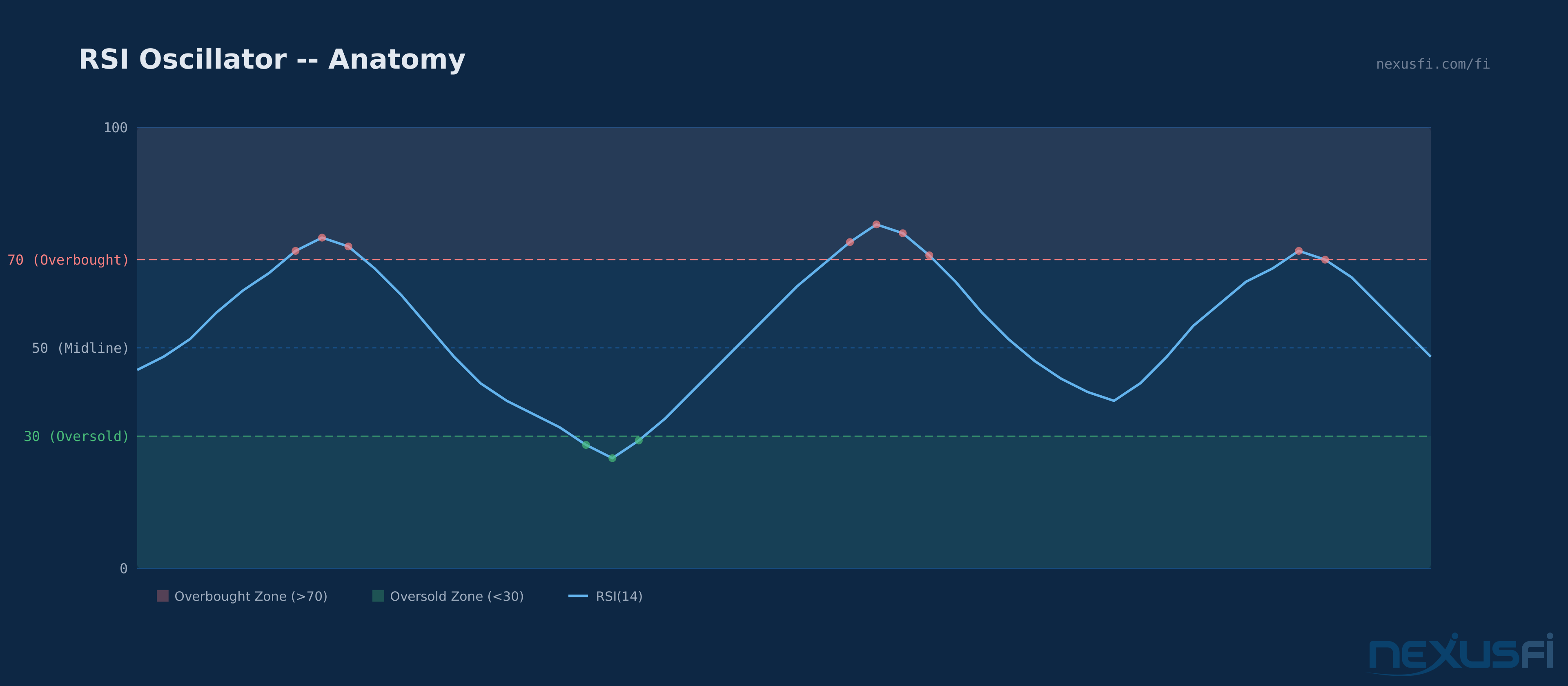
Overbought/Oversold — Traditional levels at 70 (overbought) and 30 (oversold). These levels work in range-bound markets but fail systematically in trends.
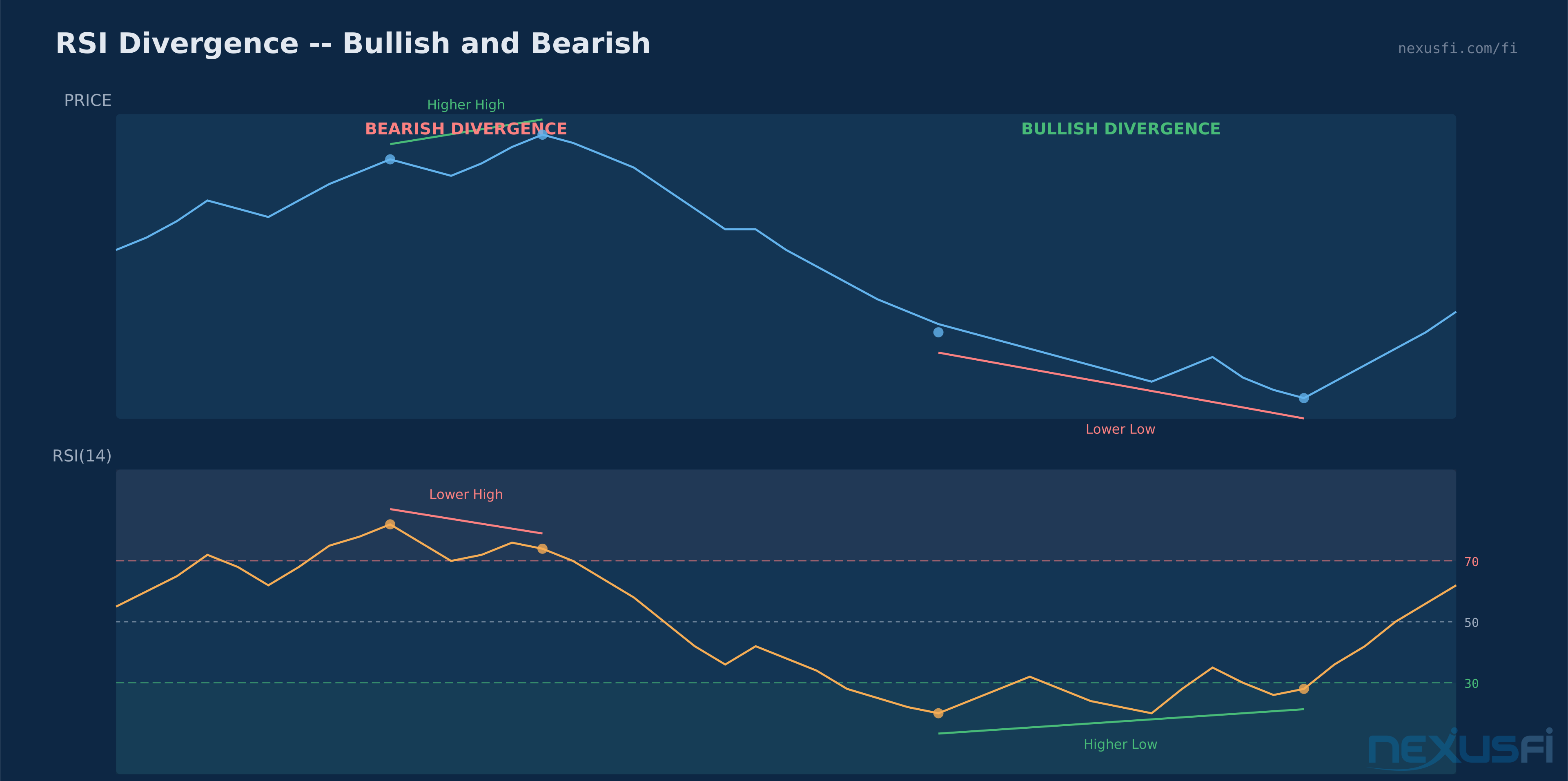
RSI Divergence — When price makes a new high or low but RSI doesn't confirm it. Bullish divergence: price makes a lower low, RSI makes a higher low. Bearish divergence: price makes a higher high, RSI makes a lower high.
Failure Swing — A specific RSI pattern where the indicator fails to make a new extreme before reversing through its prior pivot. More reliable than divergence alone because it doesn't require price confirmation.
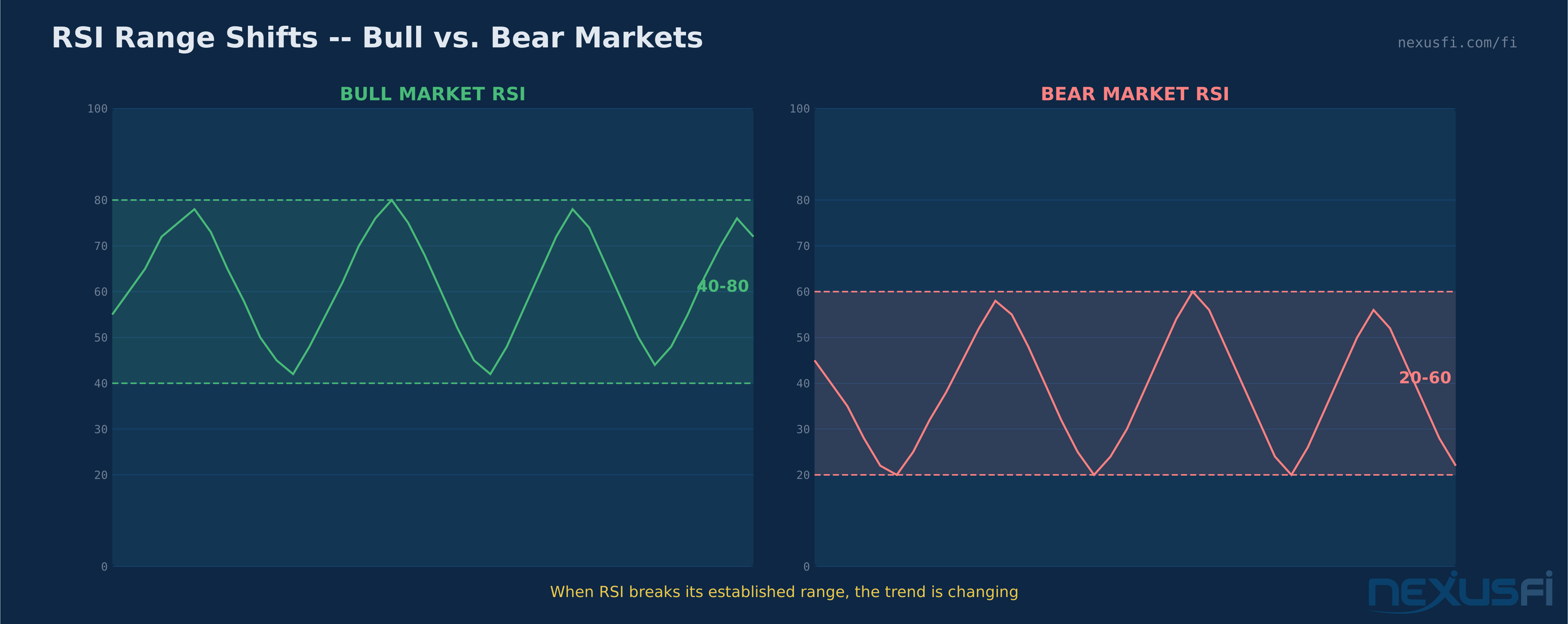
RSI Range Shift — The concept, refined by Andrew Cardwell, that RSI operates in different ranges depending on the trend. In bull markets, RSI tends to oscillate between 40-80. In bear markets, 20-60. When these ranges shift, the trend is changing.
2-Period RSI (Connors RSI) — A short-term variant popularized by Larry Connors that uses RSI(2) for mean-reversion signals. Dramatically more sensitive than the standard 14-period version.
How RSI Works -- The Math #
RSI is calculated in two steps. First, compute the average gain and average loss over the lookback period:
Step 1: Initial Averages
- Average Gain = Sum of gains over N periods / N
- Average Loss = Sum of losses over N periods / N
Step 2: Smoothed (Exponential) Averages After the initial calculation, Wilder uses exponential smoothing:
- Average Gain = (Previous Average Gain x (N-1) + Current Gain) / N
- Average Loss = (Previous Average Loss x (N-1) + Current Loss) / N
Step 3: Relative Strength and RSI
- RS = Average Gain / Average Loss
- RSI = 100 - (100 / (1 + RS))
The standard period is 14. At RSI = 50, gains and losses are equal. Above 50, gains dominate. Below 50, losses dominate.
The smoothing matters. Because Wilder's method uses exponential smoothing (not simple averaging after the first N bars), RSI carries memory from all prior bars. A massive move days ago still influences today's reading, though its weight decays exponentially. This is why RSI can get "stuck" near extremes during strong trends — the smoothing keeps pulling toward the dominant direction.
Period Selection #
The lookback period changes RSI's behavior at the core:
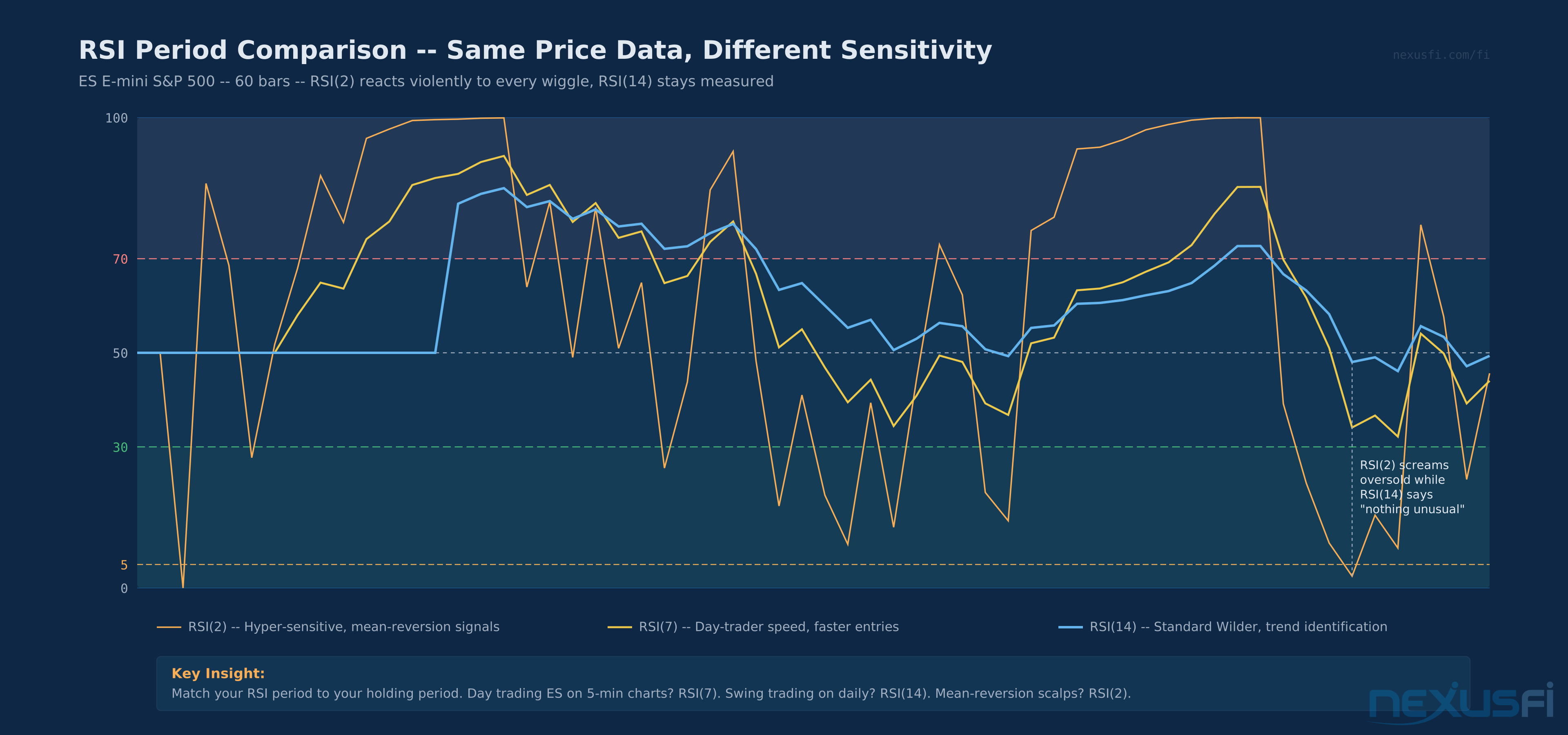
RSI(14) — The default. Smooth, fewer false signals, slower to respond. Best for identifying trend direction and medium-term divergences. This is what Wilder intended.
RSI(7) — Twice as responsive. More signals, more noise. Day traders who want earlier entries use this, accepting higher false-signal rates.
RSI(2) — Extremely sensitive. Used exclusively for mean-reversion setups. As @Jeff65 documented in their analysis of Connors' work, a 2-period RSI dropping below 5 or rising above 95 identifies extreme short-term conditions that revert quickly — "It has been well established in various articles on the web" that these extreme readings produce tradeable bounces in index futures.
RSI And How To Profit From It (@Jeff65)
RSI(25) — Longer-term. Swing traders and position traders use this for macro trend identification. Fewer signals, higher conviction.
The period you choose should match your holding period. Day trading ES with RSI(14) creates lag that kills you on 5-minute charts. Swing trading CL with RSI(2) creates noise that whipsaws you out of valid positions.
RSI in Trending vs. Ranging Markets #
Here's where most traders go wrong. The textbook says overbought means "sell" and oversold means "buy." That works when price is chopping sideways between support and resistance. It fails spectacularly in trends.
The Range Shift Concept #
Andrew Cardwell — widely considered the leading authority on RSI application — demonstrated that RSI doesn't just oscillate between 0 and 100. It operates within characteristic ranges that depend on the prevailing trend. As @TraderGB noted in a discussion about Cardwell's work alongside John Hayden and Constance Brown, these researchers at the core changed how professional traders interpret RSI.
Want your NinjaTrader indicator created, free? (@Big Mike)
Bull Market RSI Range: RSI tends to oscillate between 40 and 80. Dips to 40-50 are buying opportunities, not sell signals. RSI reaching 80 indicates strong momentum — not necessarily an immediate reversal.
Bear Market RSI Range: RSI tends to oscillate between 20 and 60. Rallies to 50-60 are selling opportunities, not buy signals. RSI dropping to 20 shows strong selling momentum.
Range Shift = Trend Change: When RSI breaks out of its established range — a bull market RSI suddenly dropping below 40, or a bear market RSI pushing above 60 — the trend is likely changing. This is one of the most reliable RSI signals.
In practice, this means: don't short ES just because RSI(14) hits 75 during an uptrend. That's normal bull market behavior. The RSI will happily sit above 60 for weeks during a sustained rally. Shorting every overbought reading in a bull market is an expensive way to learn this lesson.
Positive and Negative Reversals #
Cardwell also identified positive and negative reversals — basically divergences that confirm the trend rather than predicting a reversal:
Positive Reversal (Bullish): In an uptrend, RSI makes a lower low while price makes a higher low. Rather than signaling a reversal, this confirms the uptrend has legs. The price can't even reach its prior low despite RSI weakness.
Negative Reversal (Bearish): In a downtrend, RSI makes a higher high while price makes a lower high. Confirms the downtrend continues.
These are the opposite of what most traders expect from divergence signals. Getting this distinction right is the difference between trading with the trend and constantly getting stopped out fighting it.
Core RSI Trading Strategies for Futures #
Strategy 1: RSI Divergence #
The most powerful RSI signal for futures traders. Divergence identifies when price momentum is fading before the price itself reverses.
Bullish Divergence: Price makes a lower low, RSI makes a higher low. As @BTR411 demonstrated in their crude oil trading journal, daily chart divergences combined with inside day patterns (IDNR4) set up large moves — "Sign of a BIG MOVE: Daily chart diverged. RTH Daily with an IDNR4."
Trading Futures with Context (@mfbreakout)
Bearish Divergence: Price makes a higher high, RSI makes a lower high. The rally is running on fumes even though price keeps pushing up.
How to trade it in futures:
- Identify divergence on your higher timeframe (daily for swing trades, 30-min for day trades)
- Wait for a confirming price pattern on the execution timeframe (break of structure, failed auction)
- Enter on the lower timeframe with a stop beyond the divergence extreme
- Target the prior swing or a measured move
Critical rule: Divergence alone is not an entry signal. As @Big Mike demonstrated with the mRSI divergence indicator, even a focused RSI divergence strategy needs additional confirmation — "The only signal is from the mRSI indicator" worked as a system because it included specific entry/exit rules, not just divergence detection.
mRSI divergence indicator for NinjaTrader (@Big Mike)
Divergence is a warning light on the dashboard. It tells you the engine is losing power. It doesn't tell you exactly when the car will stop.
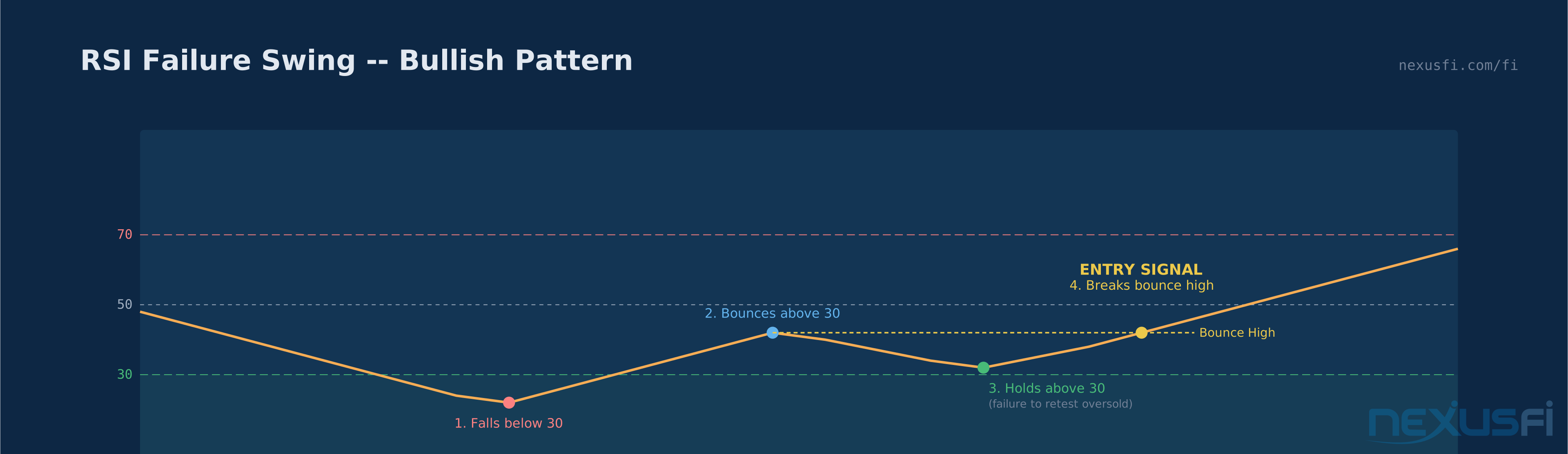
Strategy 2: Failure Swings #
Failure swings are more mechanically precise than divergence. They're pure RSI patterns that don't require price confirmation.
Bullish Failure Swing:
- RSI drops below 30 (oversold)
- RSI bounces above 30
- RSI pulls back but holds above 30 (the "failure" — it fails to return to oversold)
- RSI breaks above the bounce high
- Entry triggered
Bearish Failure Swing:
- RSI rises above 70 (overbought)
- RSI drops below 70
- RSI rallies but fails to get back above 70
- RSI breaks below the pullback low
- Entry triggered
Failure swings work because they capture the moment when the dominant side (buyers or sellers) tries to reassert control and fails. That failure is information. In ES futures, failure swings on the 15-minute chart with RSI(14) produce clean signals during range days.
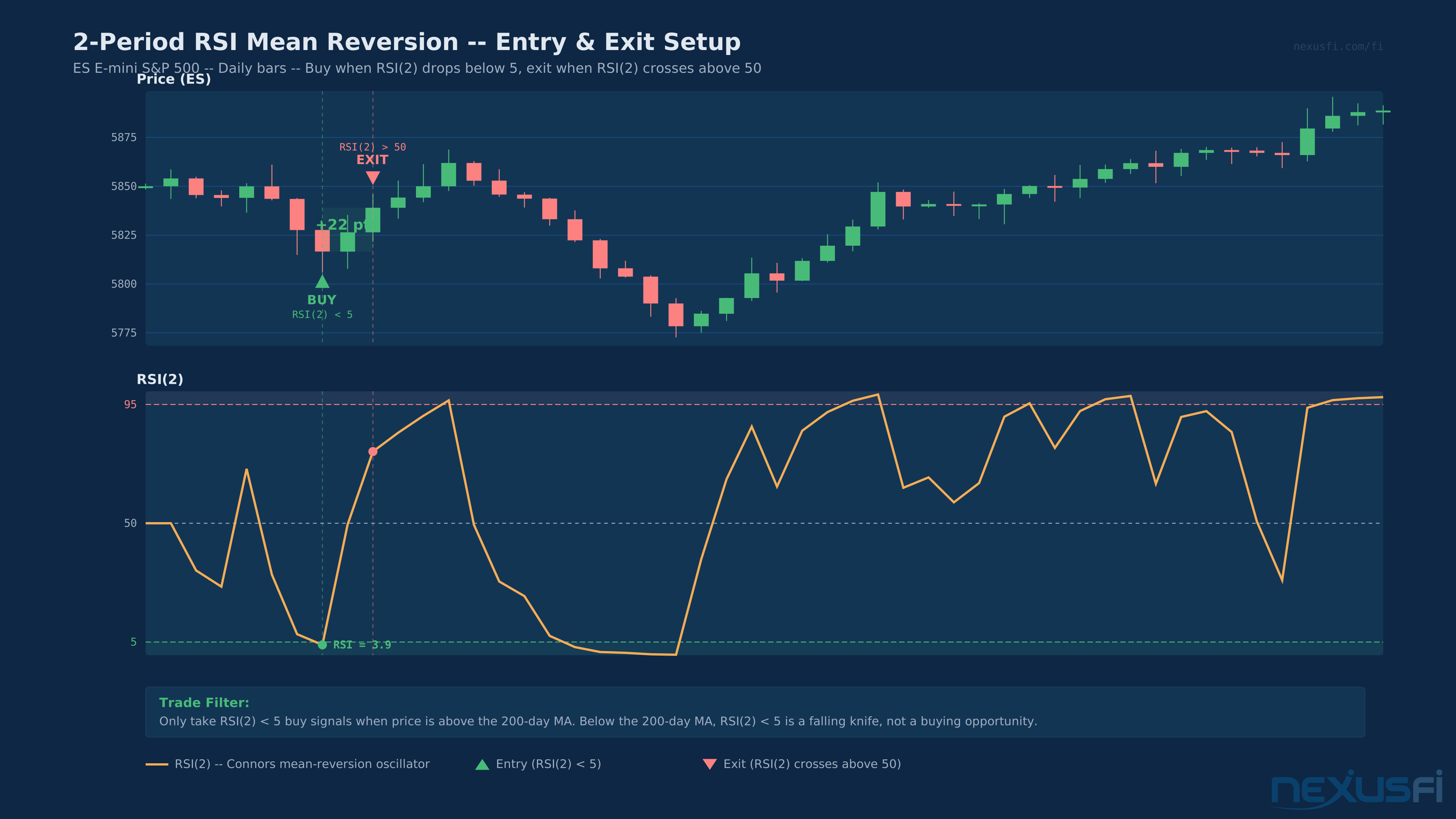
Strategy 3: 2-Period RSI Mean Reversion #
This is the short-term trader's RSI strategy. Connors' research showed that extreme readings on RSI(2) identify short-term mean-reversion opportunities with high win rates.
The setup is simple:
- Use RSI(2) on daily bars
- Buy when RSI(2) drops below 5 (extreme oversold)
- Sell when RSI(2) rises above 95 (extreme overbought)
- Exit when RSI(2) crosses back through 50
@vmodus tested this approach systematically in their algorithmic trading journal — "I entered only when the 2-period RSI moved out of oversold/overbought (30/70)" — and found it improved entry timing: "The RSI 'trick' for entry gave a better equity curve." Their follow-up analysis confirmed: "Did using the 2-period RSI improve our entries? As I had hypothesized, it did perform better."
Attack of the Robots - An Algo Journal (@vmodus)
The key is context. RSI(2) below 5 in a strong uptrend is a pullback buying opportunity. RSI(2) below 5 during a market crash is catching a falling knife. Filter with the trend — only take RSI(2) buy signals when price is above its 200-day moving average, and only take sell signals when price is below.
Strategy 4: RSI Range Shift Entries #
Use Cardwell's range shift concept as a trend-change detector:
- Track RSI(14) on the daily chart
- Identify the current operating range (40-80 for bulls, 20-60 for bears)
- When RSI breaks its established floor or ceiling, the trend is changing
- Enter in the direction of the new trend on the first pullback
For ES and NQ, a daily RSI(14) dropping below 40 after months in the 40-80 range is a significant warning signal. It doesn't mean short immediately — it means stop looking for longs and start preparing for a regime change.
Practical Application Across Futures Markets #
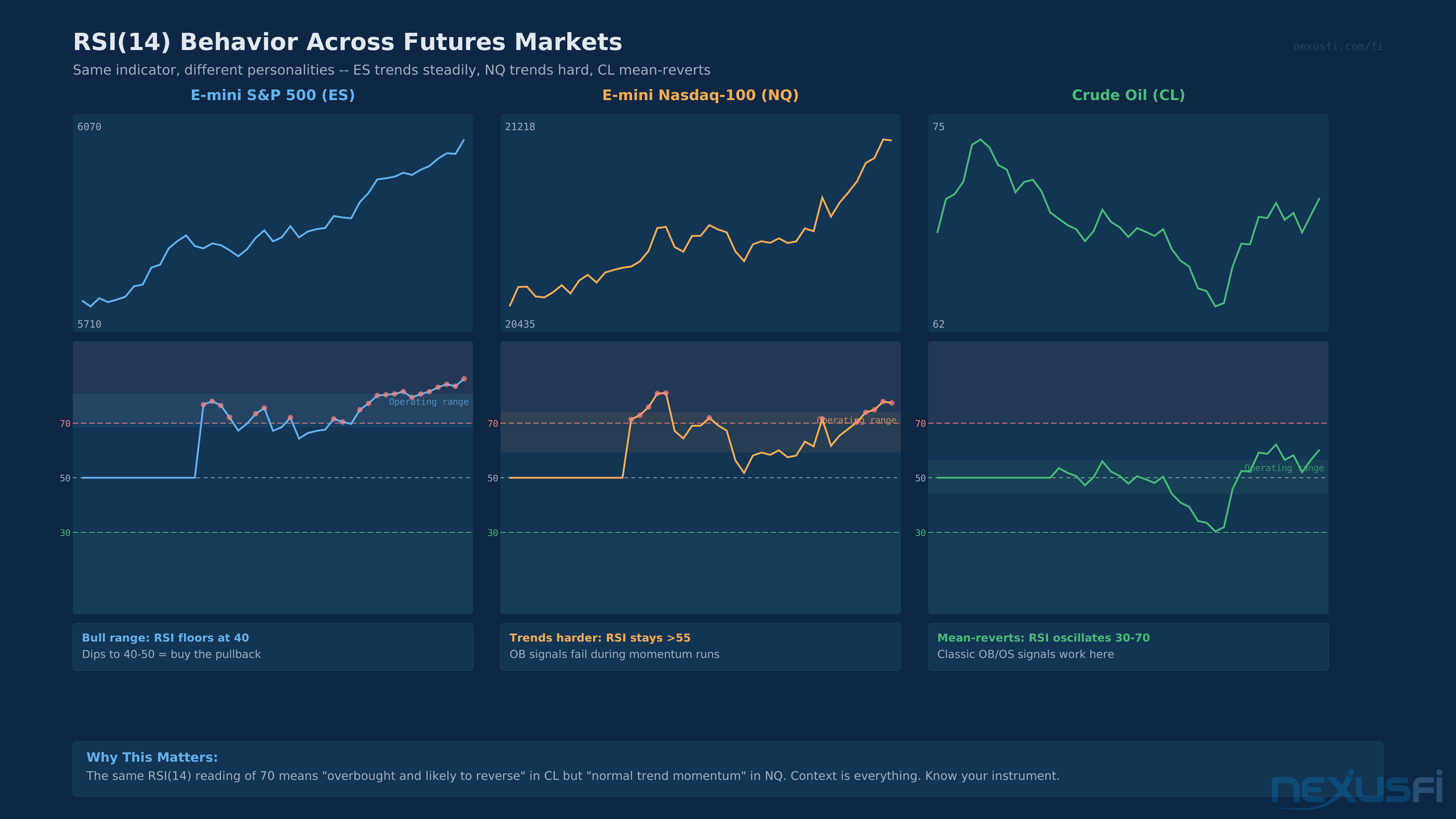
E-mini S&P 500 (ES) #
ES trends strongly during macro moves and chops aggressively during range-bound periods. Use RSI(14) on the daily for trend identification and range shift detection. On intraday charts (5-min, 15-min), RSI(7) catches momentum shifts faster. During FOMC days and major news events, RSI becomes unreliable on short timeframes — the moves are too fast and too driven by external catalysts for momentum readings to mean much.
E-mini Nasdaq-100 (NQ) #
NQ tends to trend harder and longer than ES, making overbought/oversold signals even less reliable during moves. RSI divergences on the daily chart produce excellent swing trading signals because NQ's momentum exhaustion is more visible. The tech-heavy composition means NQ responds strongly to sector rotation signals that RSI range shifts can capture early.
Crude Oil (CL) #
CL has the most violent mean-reversion characteristics of the major futures. RSI(2) mean-reversion signals work especially well here because CL's daily range is massive relative to its average move. @BTR411's extensive documentation of crude oil setups showed how daily RSI divergences combined with range compression patterns (IDNR4) preceded the largest moves — "going to be a BIG DAY....looking to go short with London."
Trading Futures with Context (@mfbreakout)
CL also responds well to RSI(14) failure swings because its trending and ranging phases are more clearly delineated than in index futures.
Common Mistakes #
Mistake 1: Trading overbought/oversold as reversal signals in trends. This is the #1 account killer with RSI. Shorting every RSI(14) reading above 70 during a bull market will produce a long string of small winners and a few devastating losers. The losers will outweigh the winners because trends persist longer than oscillator traders expect.
Mistake 2: Using one period for everything. RSI(14) on a 5-minute chart and RSI(14) on a daily chart are measuring completely different things. Match your RSI period to your trading timeframe and holding period.
Mistake 3: Ignoring the trend context. Every RSI signal must be filtered through the prevailing trend. Bullish divergence in a downtrend is just a bounce setup, not a trend reversal, until proven otherwise. Use higher-timeframe trend identification before acting on lower-timeframe RSI signals.
Mistake 4: Treating divergence as a timing tool. Divergence tells you momentum is fading. It doesn't tell you when price will reverse. Divergence can persist for days or weeks while price continues in the original direction. Always wait for price confirmation.
Mistake 5: Optimizing the period to fit historical data. If RSI(11) backtests better than RSI(14) on your sample, that's almost certainly noise. Stick with standard periods (2, 7, 14, 25) that have demonstrated robustness across instruments and time periods.
What RSI Can't Tell You #
RSI measures momentum — the rate of price change. It doesn't measure:
- Volume — A move with massive volume conviction and a move with thin holiday volume produce the same RSI reading. Combine RSI with volume analysis or Delta Analysis & CVD for a complete picture.
- Price levels — RSI doesn't know where support and resistance sit. An RSI of 30 at a major support level means something very different than RSI of 30 in open air. Pair RSI with Volume Profile levels for context.
- Volatility — RSI doesn't account for whether moves are large or small relative to recent volatility. ATR handles that dimension.
- Market structure — RSI can't tell you whether the market is in an auction phase or a trending phase. Use Market Profile or Initial Balance context to qualify RSI signals.
RSI is one lens. Profitable futures traders combine it with price structure, volume, and market context. The indicator is a tool, not a system.
Knowledge Map
Go Deeper
Build on this knowledgeReferences This Article
Articles that build on this topicCitations
- — RSI And How To Profit From It (2012) 👍 8“RSI And How To Profit From It -- Connors RSI analysis”
- — Attack of the Robots - An Algo Journal (2022) 👍 4“Attack of the Robots -- 2-period RSI entry testing”
- — Trading Futures with Context (2013) 👍 6“Trading Futures with Context -- RSI divergence in crude oil”
- — Trading Futures with Context (2013) 👍 15“Trading Futures with Context -- IDNR4 with RSI divergence”
- — mRSI divergence indicator for NinjaTrader (2012) 👍 20“mRSI divergence indicator strategy”
- — Want your NinjaTrader indicator created, free? (2021) 👍 5“Andrew Cardwell, John Hayden, and Constance Brown RSI methods”
- J. Welles Wilder — New Concepts in Technical Trading Systems (1978)
- Andrew Cardwell — RSI: The Complete Guide -- Range Shifts and Positive/Negative Reversals (2004)
- Larry Connors, Cesar Alvarez — Does Mean Reversion Still Work? Connors Research Traders Journal (2012)