



CME Globex: How the Matching Engine Actually Works
Overview #
Every futures fill you've ever gotten — on ES, NQ, CL, ZN — was decided in a data center in Aurora, Illinois. Not by your broker. Not by your trading platform. By CME Globex, the electronic matching engine that sits at the heart of CME Group's derivatives markets and makes the final call on every trade.
Most traders think of Globex as "the exchange." That's close but imprecise. Globex is specifically the matching engine and order book infrastructure. It accepts orders, validates them against a set of rules, enters them into a queue, and matches them when the conditions are right. Your broker's platform, your data feed, your API connection — all of that is infrastructure to get orders to Globex and results back. The decisioning happens inside the engine.
This matters because most execution problems traders experience — unexpected fills, stop orders that don't protect, market orders with more slippage than expected — trace back to mechanics inside Globex that aren't visible from the surface. Once you understand how the engine actually works, a lot of confusing behavior starts making sense.
This article covers the complete Globex framework: the order routing chain, session structure, FIFO matching mechanics, how market orders are really handled, price banding, latency factors, and the practical implications for how your limit orders actually get filled. Category type: REFERENCE.
What CME Globex Actually Is #
CME Globex is CME Group's electronic trading platform — but "platform" is a bit misleading. It's not a user interface. It's the exchange-side system that performs four specific functions: order acceptance and validation, order book management, matching (turning two opposing orders into a trade), and execution reporting. Everything else is external to it.
The distinction matters. When your broker's system shows "order confirmed," that confirmation is coming from your broker's system. Whether Globex actually has your order in its book is a separate question. When the exchange confirms via ACK, that's Globex saying it received your order, validated it, and placed it in the queue. The fill happens only when Globex finds a matching contra-side order.
Every CME-listed futures product — E-mini S&P 500 (ES), Nasdaq (NQ), Crude Oil (CL), Treasury bonds (ZN, ZB), Euro FX (6E), Gold (GC) — routes through Globex. When NYMEX merged with CME Group in 2008, the CL matching engine moved to Chicago as well.
[1]
The physical location of the Globex matching engine is Aurora, Illinois — a suburb about 25 miles west of downtown Chicago. This is where CME built its primary data center after moving from the Cermak facility in downtown Chicago. Knowing this is useful because it defines what "close to the exchange" means for any latency discussion.
The Order Routing Chain #
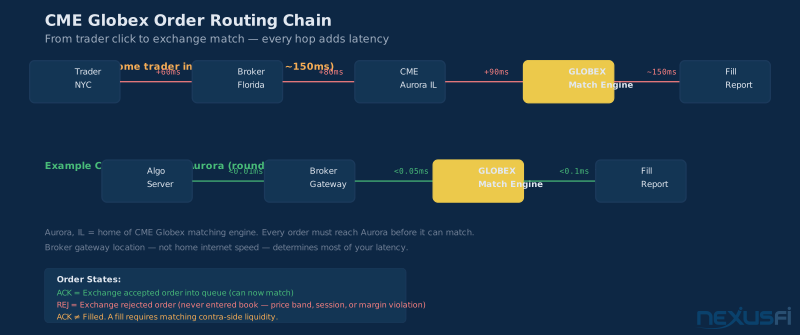
Between you clicking "buy" and Globex accepting your order, your instruction travels through several systems. Understanding this chain explains why "my order was sent" doesn't always mean "Globex has my order."
The chain works like this:
You → Trading Software/API → Broker/FCM → Exchange Gateway → Globex Matching Engine → Fill Report Back
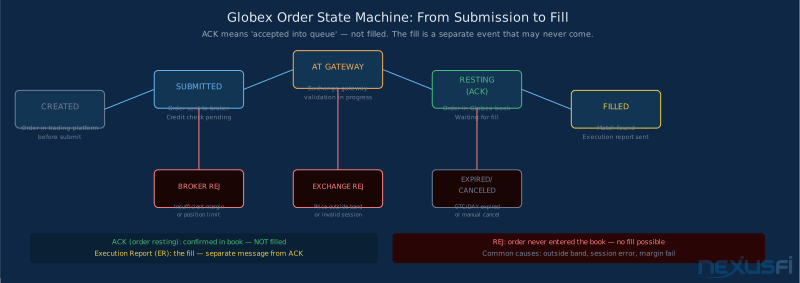
Each hop in that chain is an opportunity for latency and rejection. Your trading software (NinjaTrader, Sierra Chart, TT, etc.) formats the order and sends it to your broker. The broker's systems perform a credit check — verifying you have sufficient margin and aren't exceeding position limits. If the order passes the broker's checks, it goes to CME's exchange gateway. The gateway performs its own validation: is this a valid product? Is this a valid session? Is the price within permitted bands? If everything clears, Globex accepts the order and places it in the book with a timestamp.
The exchange responds with one of two primary outcomes:
- ACK (Acknowledgment): The order is accepted and resting in the Globex book. Now it can match when contra-side liquidity arrives.
- REJ (Rejection): The order failed validation. It never entered the book. No fill is possible.
ACK does not mean filled. It means the order exists in the queue. Fills happen separately, when the market reaches your price and there's matching liquidity.
Common rejection reasons: price outside no-bust bands, session ineligibility (trying to place an RTH-only order during overnight), order type not supported for that product, or insufficient margin flagged by the broker before the order even reaches the exchange.
[2] This is why VPS location matters less than broker gateway location — if the credit check happens in New Jersey, you're routing to New Jersey first regardless of where you're sitting.
Session Structure: RTH vs Globex #
CME futures trade nearly 24 hours a day, five days a week, but not all hours are equal. Understanding the session structure affects how you manage orders around transitions and what liquidity to expect at different times.
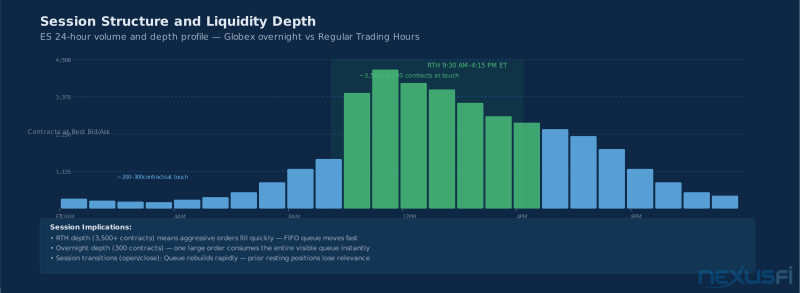
Regular Trading Hours (RTH) for equity index futures like ES and NQ run from 9:30 AM to 4:15 PM ET. These hours historically corresponded to pit trading, but now represent the primary electronic session when US equities are open. Volume concentration is highest here — typically 60-80% of daily ES volume prints during RTH.
Globex Session (Electronic/Overnight) covers the remaining hours. ES trades from 6:00 PM the prior day through 5:00 PM CT, with a brief 60-minute maintenance break from 5:00 PM to 6:00 PM CT. The overnight session runs from 6:00 PM through 9:30 AM ET, bridging the US, Asian, and European trading sessions.
Practical differences between sessions:
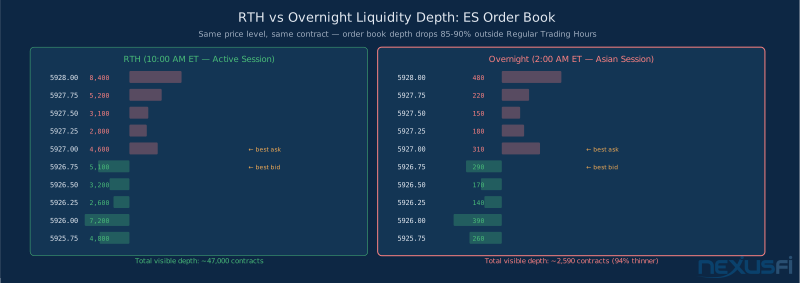
- Liquidity depth: Overnight ES typically shows 300-500 contracts at best bid/ask during quiet periods. During RTH, that depth often exceeds 2,000-5,000 contracts at the touch. Queue position matters more when depth is thin — the queue moves faster and small size consumes it.
- Spread: Overnight ES often trades 1-2 ticks wide. RTH ES frequently locks at 1 tick (0.25 points). Thin overnight spreads can invert during news events.
- Order type behavior: Certain time-in-force designations behave differently across sessions. DAY orders cancel at session end. GTC (Good Till Canceled) orders can persist across sessions but may be canceled at session boundaries depending on broker implementation.
Session transitions create volatility spikes. At the RTH open (9:30 AM ET for ES), the order book rebuilds rapidly as new participants enter. Queue position that existed at 9:29 AM may be irrelevant seconds later as new liquidity overwhelms it. The open is statistically the highest-volume minute of the day for ES — thousands of resting orders at many price levels interact simultaneously.
Products like CL maintain meaningful overnight liquidity because energy markets are global — European and Asian participants trade it around the clock. ZN (10-Year Treasury) has less overnight depth because its drivers (US economic data, Fed policy) are US-centric.
FIFO Matching: How the Queue Works #
For most liquid CME futures — ES, NQ, CL, GC, ZN, ZB — Globex uses FIFO matching, also called price-time priority. Understanding this mechanism explains nearly every counterintuitive fill result traders encounter.
The rule is simple:
- Price priority: The best price gets matched first. Best offer sells first, best bid buys first.
- Time priority: At the same price, the order that arrived first gets filled first.
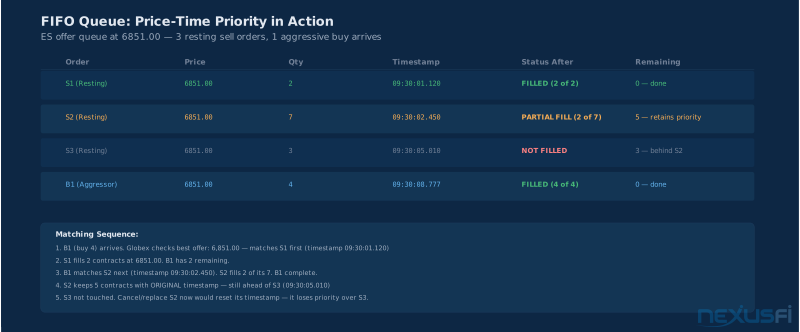
Picture the sell side of the ES order book at 5,924.75. Three limit sell orders are resting at that price:
- S1: 4 contracts, timestamp 09:30:01.120
- S2: 7 contracts, timestamp 09:30:02.450
- S3: 2 contracts, timestamp 09:30:05.010
An aggressive buy order arrives for 8 contracts. Globex processes it against the queue in strict time order:
- S1 (4 contracts) fills completely. Queue consumed: 4. Remaining buy quantity: 4.
- S2 (7 contracts) fills 4 contracts. Queue consumed: 4. S2 has 3 contracts remaining. Remaining buy quantity: 0.
- S3 untouched. S2's 3-contract remainder stays in the queue with its original timestamp — it retains its position ahead of any new orders at that price.
[3]
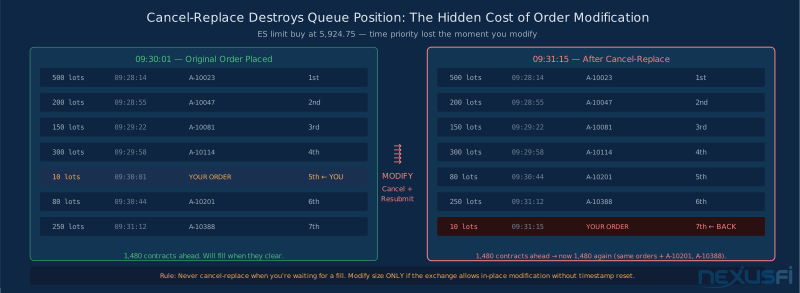
The queue position you hold is fragile. It's determined by a single timestamp — when your order entered the Globex book. Everything else is irrelevant. You can have a much larger order than someone ahead of you and still wait while they fill first. You can have a better broker and still trail someone with worse infrastructure if they got there first.
The critical implication: If you cancel and re-enter a limit order at the same price, you go to the back of the queue at that price. The cancel removes your timestamp. The new order gets a new timestamp — later than everyone who was already at that price. This is true even if you submit the cancel-replace simultaneously. @Fat Tails confirmed how this works on Corn Futures, noting that for products using FIFO algorithms, the first order that betters the market gets top order allocation, with remaining quantity distributed by time priority. [4]
Walking the book is the natural response to FIFO dynamics when you need size and speed. Instead of placing one large limit order and waiting, a trader places limit orders at multiple consecutive price levels. As the market moves through each level, orders fill one by one. The downside is that by the time the market reaches your lower levels, the trade thesis may have changed. This is a known tradeoff.
Matching Algorithm Variants: When It's Not FIFO #
FIFO is the dominant algorithm for CME's most actively traded futures, but it's not universal. Understanding which products use which algorithm prevents misapplication of queue tactics.
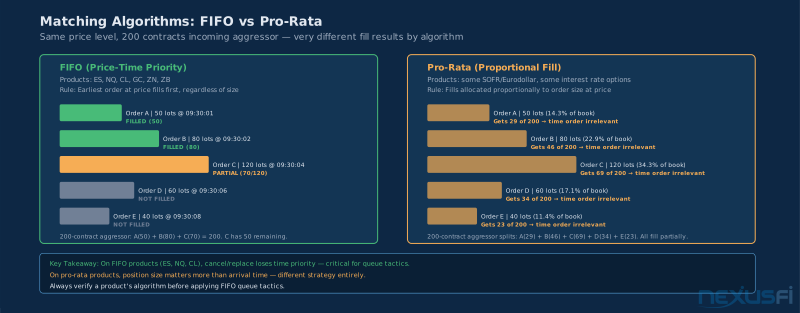
FIFO (Price-Time Priority): Applies to ES, NQ, YM (Dow), CL, GC, SI, NG, ZN, ZB, ZC (Corn), ZW (Wheat), and most CME equity index and energy futures. In these markets, cancel/replace loses queue position. Being early matters.
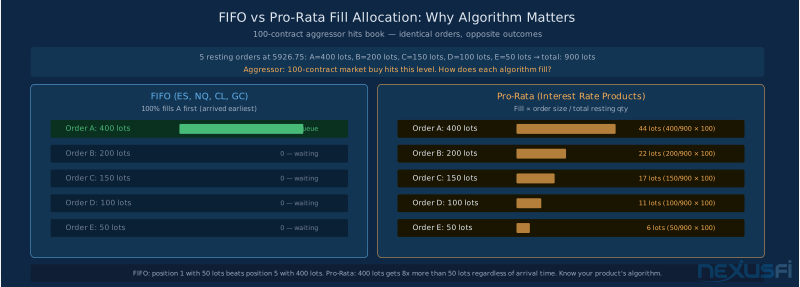
Pro-Rata: Some products allocate fills proportionally among orders at the same price when a large aggressor hits the book. If there are 100 resting sell contracts at a price and a 40-contract buy hits, each seller gets approximately 40% of their resting quantity filled (subject to rounding and minimum allocation rules). Pro-rata matching reduces the value of being first at a price — a later-arriving large order gets the same proportional fill as an early-arriving small order.
Allocation (Split FIFO/Pro-Rata): Some products use a hybrid.
[4] The top order (the first order to better the market) gets priority, then FIFO handles 40% of remaining, and pro-rata allocates 60%.
The practical consequence: don't assume your queue-building tactics for ES translate to interest rate products.
[5]
CME publishes its Globex Product Reference Sheet — a spreadsheet listing every product, its matching algorithm code, and specific parameters. Before applying queue-position tactics to a new product, verify the algorithm. The reference sheet is the canonical source.
Market Orders Don't Exist on Globex #
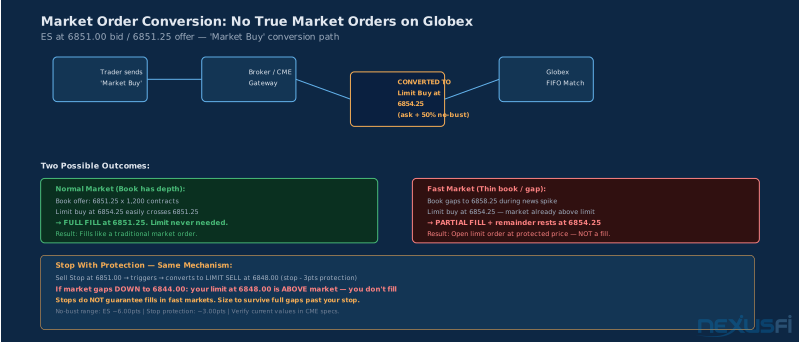
This is the single most misunderstood fact about CME Globex, and it affects every trader who uses market orders or stop-market orders. Globex does not support true market orders. Every order that enters the Globex matching engine is a limit order.
When you submit a market order to your broker, one of two things happens before it reaches Globex:
- Your broker converts it to a limit order (usually at best bid/ask ± a slippage allowance), or
- The CME gateway converts it using "Market with Protection" rules — a buy becomes a limit at the current best offer plus 50% of the no-bust range, a sell becomes a limit at the current best bid minus 50% of the no-bust range.
[6]
Market Order Reality Check Every market order on CME Globex is actually a limit order with a protection band. In fast markets or on thin products, the protection band determines whether you get filled at all — not whether you get a good price.
The practical implication: your market order will fill across multiple price levels as it walks the book, but it will stop filling once the book price would need to exceed the protection band. In normal conditions with adequate depth, this doesn't matter — you get filled in one or two ticks. In fast markets or thin books, the protection limit activates and you may get a partial fill with the remainder sitting as an open limit order, or a complete rejection.
During the ES flash crash periods and other extreme events, traders have reported "market order" submissions that resulted in partial fills with a remaining limit order sitting in the book — precisely because the protection range was exceeded. The order didn't fail. It filled up to the protection band and then sat as a limit at that protected price, waiting for the market to return to it.
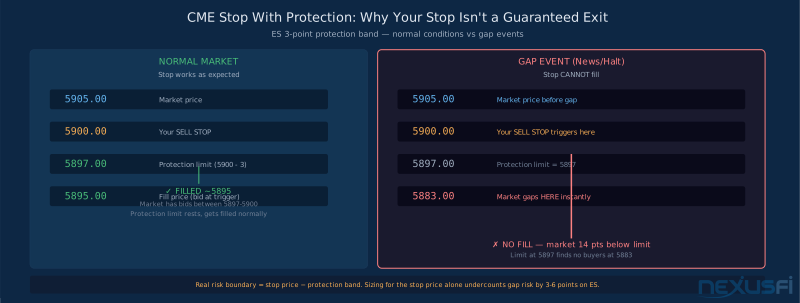
For stop orders specifically, CME implements "Stop with Protection."
[6]
This means your sell stop at 5,900.00 ES doesn't guarantee a fill at any price below 5,900.00. Once triggered, it becomes a limit order at 5,900.00 minus 3.00 points = 5,897.00. If the market gaps down to 5,890.00 before your stop order reaches the book, your limit at 5,897.00 never fills — the market is already 7 points away, outside your protected range.
[7]
This is how stop orders fail in flash crashes. The stop triggers. The converted limit is placed. The market has already moved beyond the protected range. The limit never fills. You're still long while the market is dropping.
Price Banding and No-Bust Ranges #
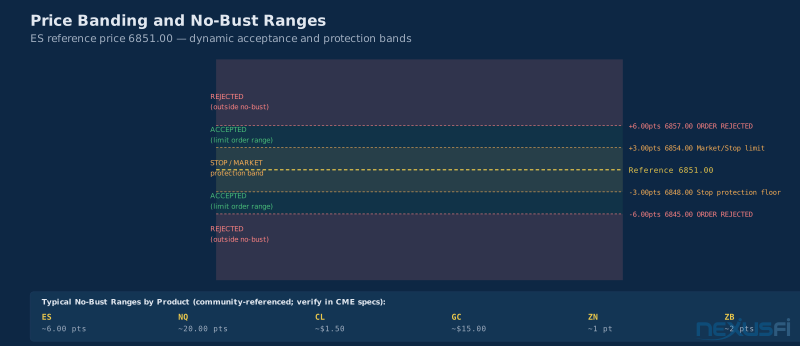
No-bust ranges exist to prevent erroneous trades — fat-finger orders, corrupted routing, or extreme dislocations that would result in clearly wrong fills. They define the maximum allowable deviation from reference prices for any order to be accepted into Globex.
The no-bust range for ES is commonly referenced in the community as 6.00 points. This means a buy order at a price more than 6.00 points above the current reference will be rejected by Globex — it falls outside the permitted band. A sell order more than 6.00 points below the reference is similarly rejected.
The protection band for stop/market orders (as described above) is typically 50% of the no-bust range — so 3.00 points for ES. Different products have different ranges based on their volatility profiles:
- ES: No-bust ~6.00 points, stop protection ~3.00 points
- NQ: Higher in absolute terms due to price level, lower as a percentage
- CL: Energy products have ranges calibrated to typical volatility
- ZN: Interest rate futures have narrower bands given lower volatility
These values are dynamic — CME adjusts them based on market conditions. The values stated here reflect community-referenced typical parameters; verify current values in CME's Globex product documentation before relying on specific numbers for strategy design.
No-bust protection also explains why certain orders placed during fast-moving markets appear to be accepted and then disappear. The order was accepted by the broker, forwarded to CME, and rejected at the gateway because the price at the moment it arrived had moved outside the band. The broker shows "submitted" because it was submitted. The exchange shows "rejected" because it failed band validation. These two status updates can arrive simultaneously or out of order, creating confusion.
The practical implication for risk management: stop orders are not guaranteed fills. In genuinely extreme conditions — May 2010 flash crash, March 2020 pandemic liquidity breaks, commodity spikes — the protection bands may not be sufficient to guarantee execution at any reasonable price. Position sizing that accounts for potential full gaps past stop levels is the correct approach.
Latency: What counts #
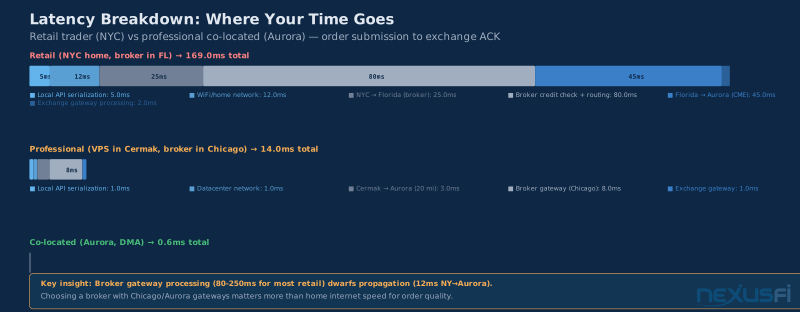
Latency in futures trading is not one number. It's a chain of delays, and most of them have nothing to do with how fast your internet connection is.
Components of end-to-end order latency:
- Propagation latency: Signal travel time through cables and routers. Speed of light through fiber is approximately 2/3 of light speed in vacuum — roughly 200 km per millisecond. The distance from New York to Aurora, IL is about 1,200 km, so the absolute minimum propagation round-trip is ~12 milliseconds. From Los Angeles, that's 20+ ms minimum.
- Routing and hops: Internet traffic doesn't take direct paths. BGP routing may add multiple hops, each adding 1-5 ms of additional latency.
- Broker gateway processing: Your broker's credit check and order formatting takes time. @iantg, who is co-located in the same building as the CME matching engine, noted: "retail applications I tested were around 250 milliseconds behind the exchange timestamps." [8] The broker gateway processing is often the largest single latency component for retail traders.
- Exchange processing: CME's own gateway and matching engine take microseconds to process orders — effectively negligible compared to network and broker delays.
- Queueing latency: Your order's position in the Globex book. Even after reaching the exchange instantly, a limit order behind 5,000 contracts at the same price must wait for all of those to fill before it becomes relevant.
The Aurora data center is the reference point because it's where the matching engine runs. Traders who co-locate servers in Aurora are reducing propagation latency to basically zero for the exchange leg of the path. But as
[2] The cost-benefit for most retail traders doesn't favor co-location.
What does matter for retail latency:
- Wired ethernet over Wi-Fi — Wi-Fi adds unpredictable jitter (5-50ms variability)
- Broker selection — brokers with gateway infrastructure in or near Chicago (Rithmic, CQG) deliver lower latency than those routing through east coast data centers
- VPS in a nearby data center (Cermak in Chicago, or similar) — can reduce your leg from home to broker
But the biggest latency impact for most traders isn't network latency — it's the 250ms display lag between the exchange and your screen. By the time you see a price and react, that information is already a quarter-second old. This is why manual scalping of the queue at best bid/ask is effectively dominated by co-located algorithms.
[8]
MBO vs MDP: Two Views of the Same Order Book #
CME provides two distinct categories of market data feeds, and understanding the difference explains why certain analysis is possible for some traders and impossible for others.
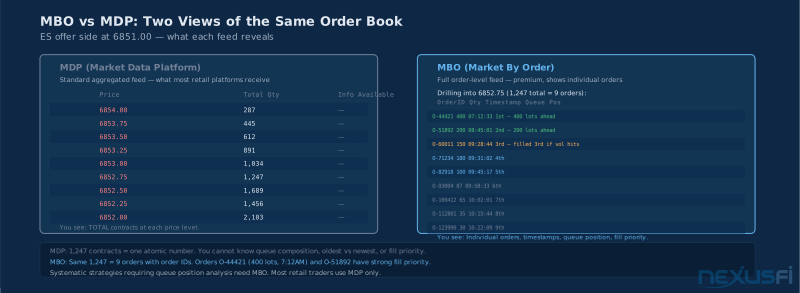
MDP (Market Data Platform) is the standard aggregated feed. It shows price levels with quantities — how many contracts are resting at each bid and offer price. This is what most retail platforms receive and display. You see that there are 1,247 contracts at the best offer of 5,924.75, but you have no idea how many individual orders make up that quantity, when those orders arrived, or where in the FIFO queue each sits.
MBO (Market By Order) is the order-level feed. It provides individual order events — each limit order entered, modified, or canceled at any price level, identified by an exchange-assigned order ID. With MBO data, you can reconstruct the exact FIFO queue at any price level: who is in position 1, position 2, position 3. You can see when orders cancel and when new orders enter, and track the real-time queue depth ahead of any specific order.
MBO is substantially more expensive — it's a premium CME data product, and processing it requires real infrastructure. Most retail platforms don't offer it.
The practical implications:
- With MDP only, "5,000 contracts at the best offer" is an atomic number. You can't know if it's one large order or 500 small ones, whether they've been resting for hours or arrived moments ago, or how they'd behave under partial fills.
- With MBO, you can model real queue position. You can see that the 5,000 contracts is actually 200 orders, that 150 of them arrived in the last 30 seconds, and that the 50 older orders account for 3,800 of the total. The 150 new arrivals will go to the back of the queue as they're relatively recent. This affects fill probability models much.
For most futures traders, MDP is sufficient. You're not competing on microsecond queue position. But if you're building systematic strategies that depend on fill probability at specific queue depths, or trying to understand why certain limit orders fill faster than expected, MBO is the data product that provides the actual picture.
Practical FIFO Implications: What Changes Your Execution #
Three mechanics determine how FIFO affects your fills:
Cancel and replace resets your queue position. If you cancel a limit order and resubmit at the same price, you lose all accumulated time priority. The new order gets a new, later timestamp. This is true even if you submit both instructions simultaneously. When you want to adjust size without losing position, reduce (don't cancel-replace) where the exchange allows it.
Queue position changes dynamically. Every fill at your price level moves you one position closer to the front. Cancellations in front of you improve your position. The fill probability at any limit order depends on how much volume trades at that price before it moves away.
Large aggressive orders walk the book. When a market order or limit order that crosses the spread is larger than the best offer, it works through multiple price levels sequentially. A 50-contract market order against a 20-contract offer at the best price takes 20 at that level, then continues to the next level for the remaining 30. Understanding walk risk determines stop and limit placement around thin spots in the order book.
Key Reference Data by Instrument #
Quick reference for the instruments most discussed in this context:
ProductSymbolTick SizeTick ValueAlgorithmNo-Bust (typical)
E-mini S&P 500ES0.25 points$12.50FIFO~6.00 pts
E-mini NasdaqNQ0.25 points$5.00FIFO~20.00 pts
Crude OilCL$0.01/bbl$10.00FIFO~$1.50
GoldGC$0.10/oz$10.00FIFO~$15.00
10-Year T-NoteZN1/64 point$15.625FIFO~1 point
30-Year T-BondZB1/32 point$31.25FIFO~2 points
No-bust ranges listed above are community-referenced typical values based on practitioner experience and forum discussion. CME adjusts these periodically; verify current values in CME's official documentation before relying on specific numbers for strategy design.
Practical Considerations: What This Changes for Your Trading #
Stop orders are last-resort protection, not guaranteed exits. In normal markets, stop-with-protection works reliably. In gap events, flash crashes, or liquidity breaks, the protected limit may never fill if the market has moved past the protection band. Sizing positions to survive full gaps past stops is the correct risk approach.
Market orders are not instant certainty. They fill across multiple price levels, are constrained by no-bust bands, and can result in partial fills with a resting limit at the protected price. In thin overnight markets or during news events, the behavior can differ much from what you'd expect in liquid RTH conditions.
Limit order queue position is determined by arrival time, not order size. You cannot buy priority with a larger order on FIFO products. The only way to improve queue position is to arrive earlier. This means submitting limit orders before the market reaches your price, not when it arrives.
Cancel/replace is a queue reset. Use it only when changing price, not when trying to preserve position. If you're already at the right price and just waiting, leave the order alone. Modifying it for any reason (size, time-in-force) typically creates a new timestamp.
The routing chain, not just the exchange, determines execution quality. Broker choice, gateway location, and VPS configuration matter. A poorly routed order through multiple international hops competes at a disadvantage with orders that arrive at the exchange directly from nearby servers. For most retail traders, choosing a broker with infrastructure in or near Chicago (Rithmic, CQG-based brokers) provides meaningfully better execution than brokers routing through east coast data centers.
Session matters for queue dynamics. The same limit order that would fill immediately during RTH may sit unfilled for extended periods overnight when depth is thin. Build your execution expectations around the session you're actually trading, not the liquid session's norms.
What Globex Doesn't Cover #
Globex handles matching and execution reporting. It doesn't handle: clearing and settlement (that's CME Clearing, which calculates margin and settles P&L after the trading day), position limits enforcement (done by the exchange and your broker in parallel), tax reporting, account risk management beyond the exchange-level price limits, or portfolio margining calculations. Understanding this separation matters when troubleshooting post-trade problems — execution issues trace back to Globex; margin and settlement issues trace back to CME Clearing and your FCM.
Knowledge Map
Go Deeper
Build on this knowledgeReferences This Article
Articles that build on this topicCitations
- — CME Globex Matching Engine and Order Routing (2016) 👍 8“The Globex matching engine is in Chicago but if your broker's order servers/credit check or anything pre-trade is in New Jersey, New York or Connecticut, then being collocated in Chicago doesn't help you because your order has to go to NJ/NY/CT first and then back to Chicago.”
- — Order Routing and Latency in Futures Trading (2022) 👍 12“Example A. You live in Chicago and trade from home using Software ABC. When you enter an order that order goes across the internet to your Brokers order gateway in Florida where your broker performs a credit check on your order, before sending it to the CME back in Chicago. So even though your in Chicago, and the exchange is in Chicago, your order is actually travelling all the way to Florida and back.”
- — How Limit Orders Work in the Queue (2012) 👍 6“When you place a limit order you are placed at the back of the limit order queue at the price you want to buy/sell at. If the market hasn't traded that price for a while, then higher time frame traders will already have their orders in at that level and will be further ahead in the queue than you. Therefore when people are hitting the price with market orders, people at the front of the queue are filled first and it is strictly a FIFO (first in first out) basis, or you could say First In First Filled.”
- — Order Matching Algorithms: FIFO vs Pro-Rata (2014) 👍 9“split FIFO and Pro-Rata algorithm -- a top order allocation of 100%, 40% FIFO allocation, 60% Pro-Rata allocation.”
- — CME Globex FIFO Products and Interest Rate Futures (2019) 👍 7“pretty much every liquid FUTURES product on Globex uses plain FIFO. The exceptions are most MGEX products, some Ag Products, some options, and most of the Interest Rate Products including Eurodollar/GE (the largest futures contract in the world that nobody's ever heard of) which uses Allocation rather than FIFO.”
- — Market Orders and Stop Orders on CME Globex (2010) 👍 15“For CME Globex, all market orders are limit orders, and all stop orders are stop limit orders. ES has a no bust range of 6.00 points. If you enter a market sell order, it actually becomes a limit order at 1047 [in a 1050 market]. A sell stop order at 1050 is actually a stop limit order with a stop price of 1050 and a limit price at 1047.”
- — Stop Orders and Stop With Protection on CME (2020) 👍 8“CME's stop orders are actually 'stop with protection.' There is a protection band, and for the ES it is (or was) +/- 3 handles, which is added/subtracted from your stop price. Example: you are long and put a sell stop for 3000. If your order is triggered and market conditions are such that the best available bid to sell into is below 2997, you will have a sell limit sitting in the book at 2997, and will NOT get a fill unless someone takes your offer.”
- — Co-location, Latency, and MBO Data Feed (2022) 👍 10“retail applications I tested were around 250 milliseconds behind the exchange timestamps. Most algorithms place orders WAY ahead of time at every price level, and use the MBO data feed to see their exact position in the queue, and they only trade orders once they get to an ideal spot... You likely couldn't land a cancel unless you were pretty far away from the top of the book. Scalping the top of the book really is exclusively the domain of HFT.”
- — Cmegroup.com (2024)
- — Cmegroup.com (2024)