



Prediction Market Fees and Costs: What You Actually Pay on Kalshi and Polymarket
Overview #
Prediction Market Fees and Costs: What You Actually Pay on Kalshi and Polymarket
A complete breakdown of every fee you'll encounter — trading fees, spreads, deposits, withdrawals, and the hidden costs that aren't labeled as fees — across Kalshi, Polymarket, and Robinhood
The True Cost of Prediction Market Trading #
New traders focus on getting the probability right. Experienced traders focus on getting the probability right and understanding the full cost of being right. In prediction market trading, you can have a 60% probability estimate on an event where the market implies 55% — a 5 percentage point edge — and still lose money over time if fees and spreads consume your edge.
This guide covers every cost component across Kalshi, Polymarket, and Robinhood. By the end, you'll be able to calculate the exact breakeven probability edge you need before a trade is worth taking, and understand which platform offers the best economics for your trading style.
A complete breakdown of every fee you'll encounter — trading fees, spreads, deposits, withdrawals, and the hidden costs that aren't labeled as fees — across Kalshi, Polymarket, and Robinhood --- New traders focus on getting the probability right.
Kalshi Fees: The P × (1−P) Formula #
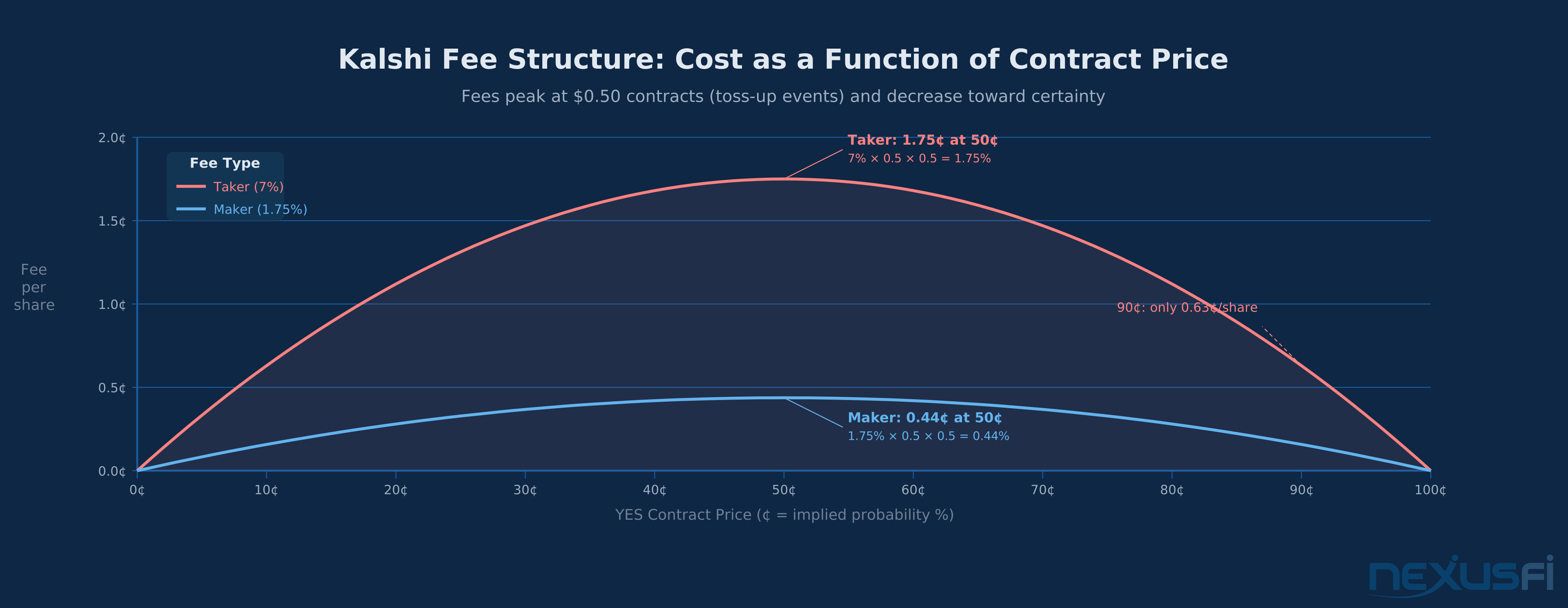
Kalshi's fee structure is elegant and slightly unusual. Rather than a flat percentage of trade value, Kalshi charges fees based on a formula that accounts for the contract's implied probability:
Taker fee: 7% × P × (1 − P) Maker fee: 1.75% × P × (1 − P)
Where P is the YES price in dollars (from $0.01 to $0.99).
The key insight of this formula: fees are highest at 50-cent contracts and decrease as you approach either extreme. This reflects the economic reality that near-certainty contracts (90¢ or higher) carry minimal information and deserve lower fees, while toss-up contracts (50¢) where price discovery is most valuable carry the highest fees.
Calculating Kalshi Fees at Different Price Points #
| Contract Price (P) | Taker Fee (7% formula) | Maker Fee (1.75% formula) |
|---|---|---|
| $0.05 (5%) | 0.33¢/share | 0.08¢/share |
| $0.10 (10%) | 0.63¢/share | 0.16¢/share |
| $0.20 (20%) | 1.12¢/share | 0.28¢/share |
| $0.30 (30%) | 1.47¢/share | 0.37¢/share |
| $0.40 (40%) | 1.68¢/share | 0.42¢/share |
| $0.50 (50%) | 1.75¢/share (maximum) | 0.44¢/share (maximum) |
| $0.60 (60%) | 1.68¢/share | 0.42¢/share |
| $0.70 (70%) | 1.47¢/share | 0.37¢/share |
| $0.80 (80%) | 1.12¢/share | 0.28¢/share |
| $0.90 (90%) | 0.63¢/share | 0.16¢/share |
| $0.95 (95%) | 0.33¢/share | 0.08¢/share |
Taker vs. Maker Orders on Kalshi #
The distinction matters much for economics:
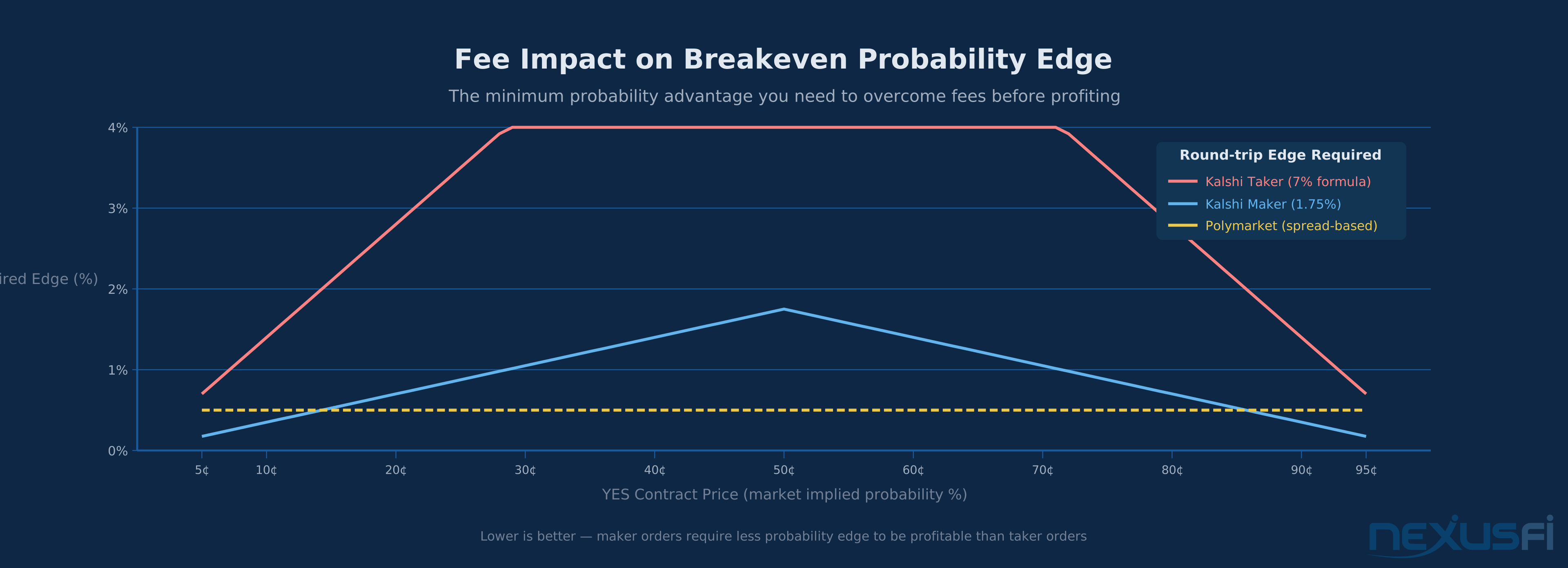
Taker orders (market orders, or limit orders that immediately execute against existing orders) pay the full 7% formula fee.
Maker orders (limit orders that rest in the book and wait for a counterparty) pay the reduced 1.75% formula fee — exactly 1/4 of the taker rate.
For active traders entering positions frequently, consistently using limit orders instead of market orders reduces your fee burden by 75%. The tradeoff is execution uncertainty: limit orders may not fill if the market moves away from your price.
Practical rule: Use limit orders at or near the best available price when you're entering a position without time urgency. Use market orders when you need immediate execution — but expect to pay 4x the fee.
Spread Costs on Kalshi #
Beyond the explicit fee, the bid-ask spread is a cost you pay every time you enter a position by market order. In high-liquidity Kalshi markets (Fed rate decisions, major political events), the spread may be just 1-2 cents. In thinner markets, the spread can be 5-10 cents or wider.
Example of combined fee + spread cost:
You're buying YES at $0.50 in a 50¢ market with a 2¢ bid-ask spread:
- Taker fee: 1.75¢
- Half the spread (your cost vs. fair value): 1¢
- Total cost to enter: 2.75¢
To profit, the contract must move in your favor enough to recoup 2.75¢ plus the cost to exit. If you're entering at $0.50 and holding to settlement, you need the event to actually be worth $0.5275 or higher at the time you correctly estimated.
This is why large spread markets require larger probability edges to be profitable. A 2¢ spread on a 50¢ market implies you need a 2-4 percentage point probability edge beyond the fee just to break even on spread.
Deposit and Withdrawal Fees on Kalshi #
Deposits #
Kalshi's deposit fee structure:
- ACH bank transfer: Free — standard bank transfers from linked US bank accounts carry no Kalshi fee
- Wire transfer: Free for incoming wires (but your bank may charge an outgoing wire fee of $15-35)
- Debit card: 2% processing fee — convenient but expensive for large deposits
- PayPal and Venmo: No Kalshi fee (though PayPal's standard transaction terms apply)
- No minimum deposit: Start with any amount, though practical minimums apply (you need enough to buy at least one share)
Withdrawals #
- Bank account withdrawal: $2 flat fee per withdrawal
- Wire withdrawals: Currently not supported by Kalshi
The $2 withdrawal fee is meaningful for small accounts but negligible for active traders. If you're withdrawing $500 in profits, the fee represents 0.4%. If you're withdrawing $50, it's 4% — another reason to let profits accumulate before withdrawing.
Deposit Speed #
ACH transfers typically take 3-5 business days to clear. Debit card deposits are instant. Wire transfers typically credit within 1 business day.
Strategy for active traders: Keep a working capital balance on Kalshi rather than making frequent small deposits. The $2 withdrawal fee and ACH delays make frequent in-and-out moves inefficient.
Polymarket Fees: The Spread-Dominated Cost Structure #
Polymarket's explicit fee structure is dramatically different from Kalshi's:
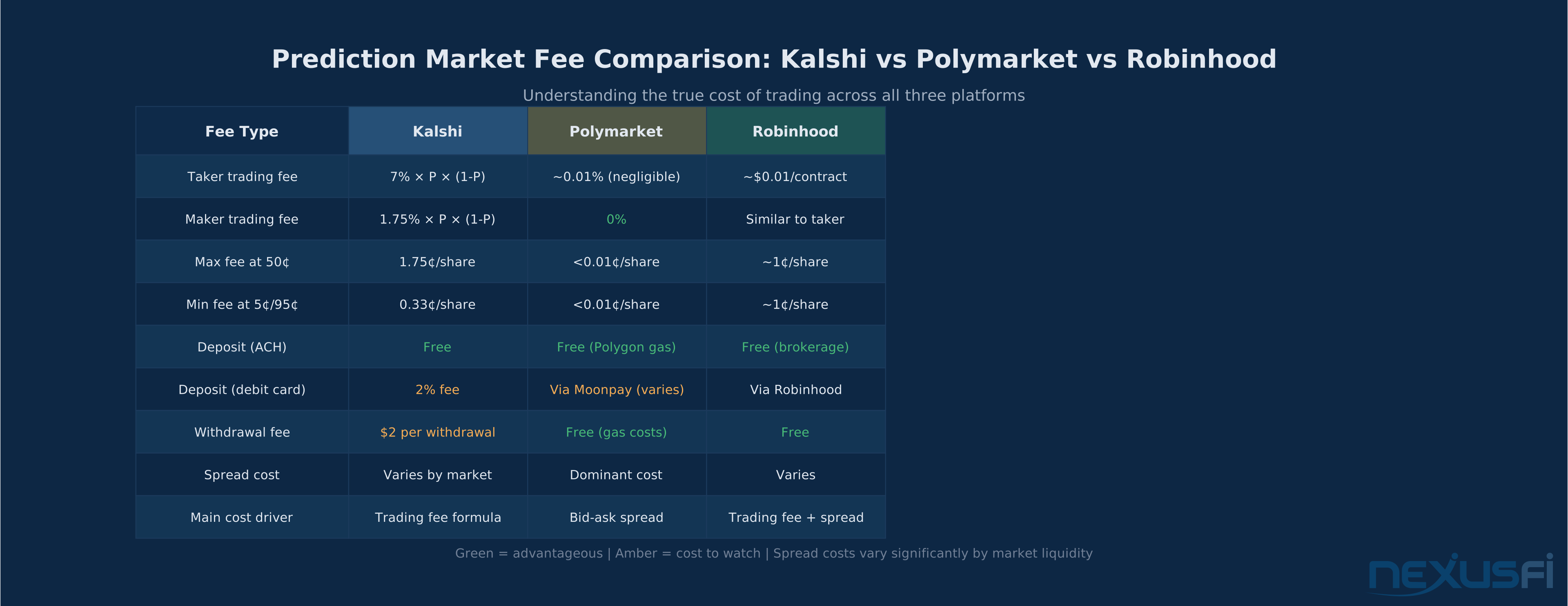
- Taker fee: Approximately 0.01% of trade value — basically zero for most practical purposes
- Maker fee: 0% — no fee for providing liquidity
- Gas fees (Polygon blockchain): Negligible — typically less than $0.01 per transaction due to Polygon's low fees
With near-zero explicit fees, why does Polymarket cost anything to trade?
The spread is everything on Polymarket.
Unlike Kalshi's centralized exchange with competitive market makers, Polymarket's liquidity varies dramatically across markets. High-profile markets (US presidential elections, major economic events) have tight spreads of 1-2 cents. Niche markets might have spreads of 10-20 cents or wider — meaning each trade effectively costs 5-10% of face value just to enter, with the same cost to exit.
Calculating Your True Cost on Polymarket #
For a liquid market with a 2¢ spread:
- Explicit fee: ~0¢ (negligible)
- Half the spread (your cost to enter at market): 1¢
- Round-trip trading cost: ~2¢ (enter + exit, if you exit before settlement)
- Hold to settlement: ~1¢ (just the cost to enter)
For an illiquid market with a 10¢ spread:
- Round-trip trading cost: ~10¢ — equivalent to a 10-20% fee on mid-price contracts
The takeaway: Polymarket is cheapest for highly liquid markets where the spread is tight. For illiquid niche markets, Polymarket's effective cost can be substantially higher than Kalshi's explicit fee, despite Polymarket having no stated trading fee.
Polymarket Deposits and Withdrawals #
Polymarket operates on the Polygon blockchain, which creates a different flow than traditional finance:
Deposits:
- Credit/debit card via MoonPay or similar providers: MoonPay charges approximately 2-4% — similar to Kalshi's debit card fee
- USDC.e directly from a Polygon-compatible wallet: Free (negligible gas fees)
- From an exchange: Depends on exchange withdrawal fees; then free on Polygon
Withdrawals:
- Withdrawing USDC.e to a Polygon wallet: Free (minimal gas)
- Converting USDC.e to USD (bank account): Requires bridging to Ethereum or using an exchange. Polymarket's bridge may charge a small fee; exchange withdrawal fees vary.
For US traders unfamiliar with crypto: The deposit/withdrawal path on Polymarket is more complex. You'll typically: (1) Buy USDC on a US exchange, (2) Transfer to Polygon, (3) Deposit to Polymarket. Reversing the process on withdrawal. Factor in the friction of this process when deciding how much capital to allocate to Polymarket.
Robinhood Event Contract Fees #
Robinhood's fee structure for event contracts is simpler than Kalshi's formula:
- Trading fee: Approximately $0.01-0.02 per contract per side (exchange fee)
- No explicit platform commission: Robinhood earns through payment for order flow and the bid-ask spread
- Deposit/withdrawal: Standard Robinhood brokerage fees apply (generally free ACH, standard wire fees)
At $0.01-0.02 per contract, Robinhood's per-contract fee is below Kalshi's formula fee for contracts near 50¢, but comparable to Kalshi's fee for near-certainty contracts. For a 90¢ contract, Kalshi charges only 0.63¢ via the formula; Robinhood's flat ~$0.01-0.02 is slightly higher.
Spread costs on Robinhood: Because Robinhood routes orders to ForecastEx or Kalshi markets, the underlying spread costs reflect the underlying exchange's liquidity. Robinhood's own app interface may aggregate this differently, but the economic spread cost ultimately comes from the exchange.
What Robinhood offers: The fee structure isn't much better than Kalshi — the value proposition is integration with your existing Robinhood account, simpler USD handling, and access to millions of existing Robinhood users who might not otherwise engage with prediction markets.
The Breakeven Probability Edge Calculation #
With fee structures understood, you can calculate exactly how much probability edge you need before a trade is worth taking.
For Kalshi Taker Orders #
Entering a position and holding to settlement:
Your fee is paid once upon entry. To profit, you need:
- Your estimated probability (P_estimated) > contract price (P_market) + fee
Formula: P_estimated > P_market + [7% × P_market × (1 − P_market)]
Example at 50¢ contract:
- Market price: $0.50
- Taker fee: 0.0175 (1.75%)
- You need: P_estimated > 0.50 + 0.0175 = 0.5175 (51.75%)
- Your edge must be at least 1.75 percentage points just to break even before considering spread
Example at 80¢ contract:
- Market price: $0.80
- Taker fee: 0.0112 (1.12%)
- You need: P_estimated > 0.80 + 0.0112 = 0.8112 (81.12%)
- Smaller edge required (1.12 percentage points) because fees are lower
For Kalshi Maker Orders #
Using the 1.75% formula instead, required edge shrinks to approximately 0.25-0.44 percentage points across the price range. This is why experienced Kalshi traders predominantly use limit orders.
For Polymarket (Spread-Dependent) #
Breakeven depends almost entirely on the spread. For a tight 2¢ spread:
- Your edge must exceed 1 percentage point (half the spread) if holding to settlement
- Your edge must exceed 2 percentage points for a round-trip trade
For a wide 10¢ spread:
- Holding to settlement requires 5+ percentage points of edge
- Round-trip requires 10+ percentage points
The implication: Polymarket is genuinely cost-effective only in liquid markets with tight spreads. Illiquid Polymarket markets require much more edge than equivalent Kalshi markets.
Tax Implications: Fees and Costs at Tax Time #
Prediction market trading has tax implications that affect your net cost. This varies by jurisdiction, but for US traders:
Kalshi (CFTC-regulated, Section 1256 contracts): Kalshi contracts may qualify as "Section 1256 contracts" under US tax law, which provides favorable treatment: 60% of gains taxed at long-term capital gains rates and 40% at short-term rates, regardless of how long you held the position. Trading fees are deductible as a cost basis adjustment.
Polymarket: As an offshore, crypto-settled platform, Polymarket gains are typically treated as short-term capital gains (since positions rarely exceed 1 year) with no Section 1256 treatment. USDC.e is typically treated as equivalent to USD for tax purposes.
Robinhood: Event contracts on Robinhood are exchange-regulated derivatives; your tax treatment depends on how Robinhood classifies them. Consult a tax professional for specific guidance.
The fee tax angle: Trading fees you pay are generally deductible against your gains. If you paid $150 in Kalshi taker fees during a year and made $1,000 in profits, your taxable gain is approximately $850. Keep records of all fees paid, which are visible in your Kalshi transaction history.
Fee Optimization Strategies for New Traders #
Use Limit Orders Whenever Possible #
The 75% fee reduction from maker versus taker orders on Kalshi is the single highest-impact fee optimization available. Build the habit of placing limit orders, even if it means slightly less price certainty on entry.
Practical approach: Place a limit order 1-2 cents away from the current best offer (for YES buying). You'll often fill quickly in active markets, and you get the maker rate.
Trade Liquid Markets First #
Higher liquidity means tighter spreads, which reduces your effective cost (especially on Polymarket). As a new trader, stick to markets with:
- Kalshi: Markets with 10,000+ contracts open interest
- Polymarket: Markets in the millions of dollars of liquidity
- Robinhood: Markets visibly active with frequent price updates
Minimize Deposit Method Fees #
On Kalshi: Use ACH, not debit card. The 2% card fee on a $1,000 deposit costs $20 — more than your trading fees on several trades. On Polymarket: If using a credit card on-ramp, compare MoonPay rates and consider funding directly from an exchange if you have existing crypto holdings.
Consolidate Withdrawals #
On Kalshi, the $2 withdrawal fee is flat regardless of amount. Withdrawing $100 costs 2%; withdrawing $1,000 costs 0.2%. Accumulate profits before withdrawing.
Calculate Edge Net of All Costs Before Trading #
Before entering any position, run the quick math:
- Your estimated probability (P_est)
- Market implied probability (P_market = contract price)
- Kalshi taker fee = 7% × P_market × (1 − P_market)
- Minimum required edge = fee / P_market (simplified)
- Your available edge = P_est − P_market
- Trade only if available edge > minimum required edge
This takes 30 seconds and prevents you from taking trades where fees consume your entire probability advantage.
Common Fee Mistakes New Traders Make #
Mistake 1: Ignoring the spread and focusing only on stated fees
Polymarket's near-zero stated fees sound attractive until you realize the spread is where the real cost lives. Always check the actual bid-ask spread before placing an order, not just the fee schedule.
Mistake 2: Using market orders exclusively on Kalshi
Paying 4x the maker fee on every trade compounds much over time. Even a partial shift to limit orders materially improves long-term returns.
Mistake 3: Depositing via debit card on Kalshi for regular trading
The 2% debit card fee works out to $20 per $1,000 deposited. On a $1,000 deposit that generates $50 in trading profits, you've just surrendered 40% of your profit in deposit fees. ACH is always better unless you need the speed.
Mistake 4: Not accounting for fees when estimating probability edge
A 3% probability edge sounds comfortable until you realize the breakeven on a 50¢ Kalshi contract is 1.75% (taker) or 0.44% (maker). A 3% edge is decent if you're a maker, but you need to confirm that edge consistently overcomes taker fees if you're regularly taking liquidity.
Mistake 5: Treating Polymarket USDC.e as free money
USDC.e on Polygon needs to be bridged and converted to reach your bank account. That bridge process has costs (blockchain gas, potential conversion fees). Factor the full path to cash when calculating net profits.
Fee Summary: Which Platform Costs Less? #
Kalshi is cheaper when:
- You're trading contracts far from 50¢ (high or low probability)
- You're consistently using limit (maker) orders
- You want simple USD deposit/withdrawal with no crypto complexity
Polymarket is cheaper when:
- You're trading in extremely liquid markets with <2¢ spreads
- You already hold USDC and avoid fiat conversion costs
- You trade frequently enough that near-zero explicit fees matter at scale
Robinhood is cheapest when:
- Simplicity and existing account integration matter more than fee optimization
- You're trading small positions where the absolute fee difference is negligible
For most new traders starting on Kalshi: the priority is minimizing fees through limit orders, avoiding debit card deposits, and calculating edge net of fees before each trade. The fee structure is transparent, predictable, and manageable.