



Prediction Market Tax Treatment: Section 1256, the 60/40 Split, and What Futures Traders Need to Know
Overview #
Prediction markets sit at a tax crossroads most traders walk into blindly. Trade on Kalshi or CME and you're holding Section 1256 contracts — the same favorable treatment that applies to ES and NQ futures. Trade on Polymarket and you're in crypto property territory, with every settlement creating a separate taxable event under capital gains rules.
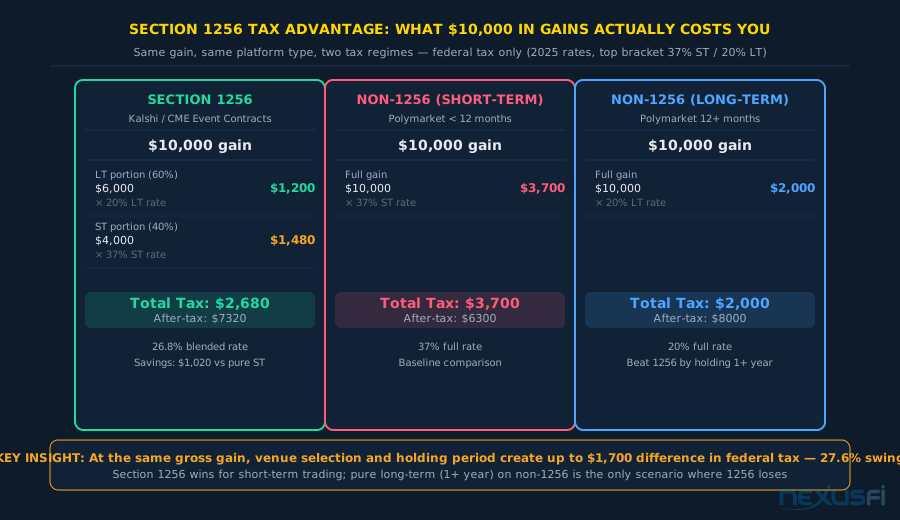
The structural difference isn't subtle. A $10,000 gain on Kalshi event contracts costs roughly $2,680 in federal tax at the top bracket. The same gain on Polymarket, if held less than a year, costs $3,700. That's a 27.6% difference before you even factor in the wash sale exemption and the three-year loss carryback — two features that make Section 1256 treatment one of the most powerful tax regimes available to US retail traders.
This article covers the mechanics of both treatments in detail: which platforms qualify, how the 60/40 split actually works with real numbers, year-end mark-to-market planning, the carryback strategy that generates actual tax refunds, and what Polymarket traders need to track. If you've been trading prediction markets without thinking about venue selection and tax optimization, this is where you start.
Which Platforms Get Section 1256 Treatment #
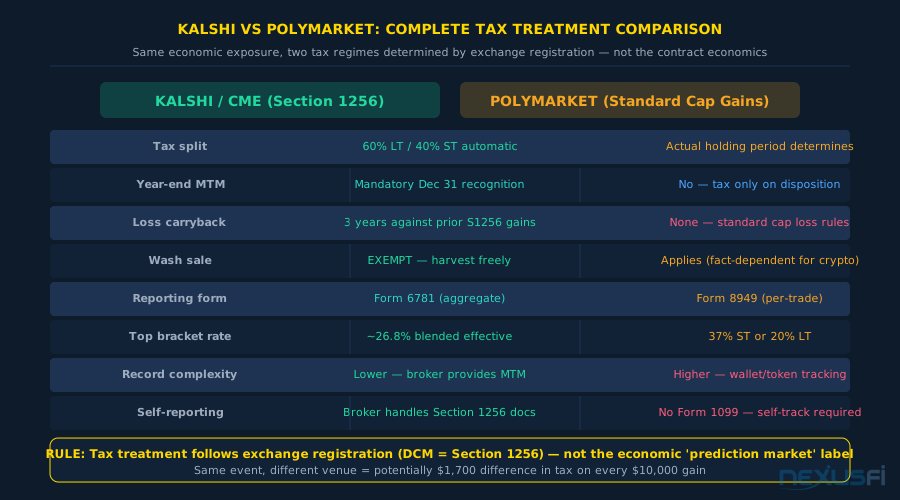
Tax treatment in prediction markets flows from regulatory infrastructure, not economic exposure. Two contracts with identical payoffs — one on Kalshi, one on Polymarket — are taxed under entirely different regimes because of how the exchange is registered.
The 38-Month Tax Window: Section 1256's most powerful feature isn't the 60/40 split — it's the three-year loss carryback combined with year-end mark-to-market. A bad year on Kalshi can generate actual cash refunds against gains from 2022, 2023, or 2024. No other retail trading instrument has this combined feature.
Kalshi: CFTC-regulated Designated Contract Market (DCM). This designation is the critical qualifier. DCMs are registered qualified boards or exchanges under IRC Section 1256(g)(7). Kalshi's federal event contracts on economic data, political outcomes, and other events are Section 1256 contracts by default. Same tax treatment as your ES or NQ futures.
CME Group Event Contracts: CME is the largest DCM in the US. Its event contracts on Bitcoin price levels, S&P 500 moves, and economic data outcomes inherit full Section 1256 treatment. The derivatives infrastructure is what qualifies the instrument, not the underlying event.
Polymarket: Not a DCM. Polymarket operates as a CFTC-registered prediction market exchange (different regulatory category), but its contracts use USDC as collateral and are settled on blockchain infrastructure. Under current IRS guidance, positions are treated as property under IRC Section 1221. Standard capital gains rules apply.
Robinhood Event Contracts: Robinhood offers event contracts powered by Kalshi's infrastructure. These likely inherit the same Section 1256 treatment, but verify with your broker's year-end tax documentation — the relationship between platform, liquidity provider, and exchange registration can affect classification.
The practical rule: Before trading a new prediction market platform, identify the exchange registration. If you see "CFTC-regulated Designated Contract Market," you're likely in Section 1256 territory. If you see blockchain-based settlement, crypto wallet, or offshore registration — you're in property/capital gains territory.
This distinction compounds over time. A futures trader allocating capital to event contracts can often tilt toward Section 1256 venues at minimal cost in liquidity or contract availability. The tax difference over a multi-year trading career is significant.
The 60/40 Split: How It Works and What It Actually Saves #
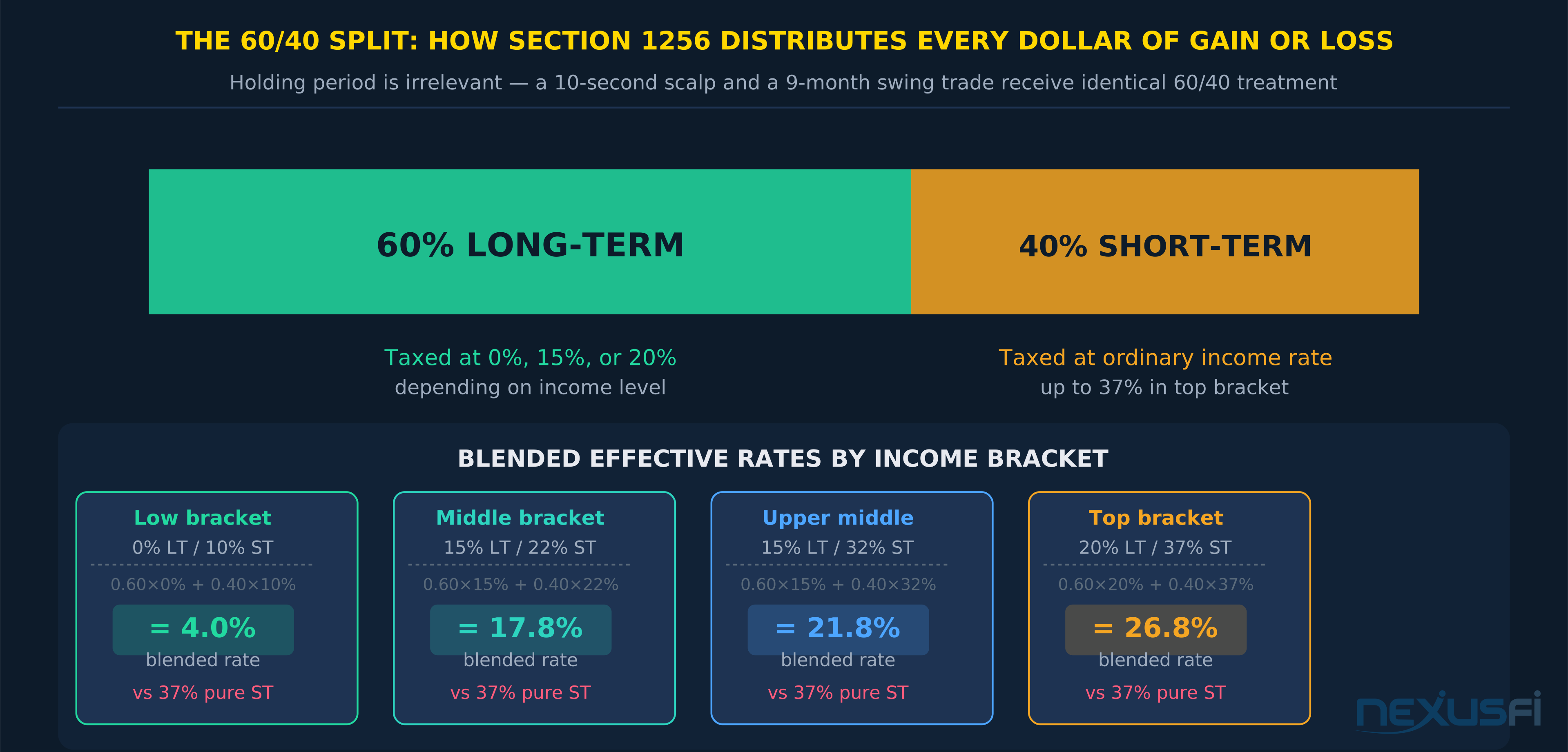
Section 1256's defining feature is the 60/40 capital gains split. Every dollar of gain or loss — regardless of how long you held the position — is treated as 60% long-term and 40% short-term capital gain or loss.
A scalp you held for 45 seconds and a position you held for nine months receive identical treatment. This is a structural advantage over standard capital gains rules, where holding period determines everything.
The math at the top bracket (2025 rates):
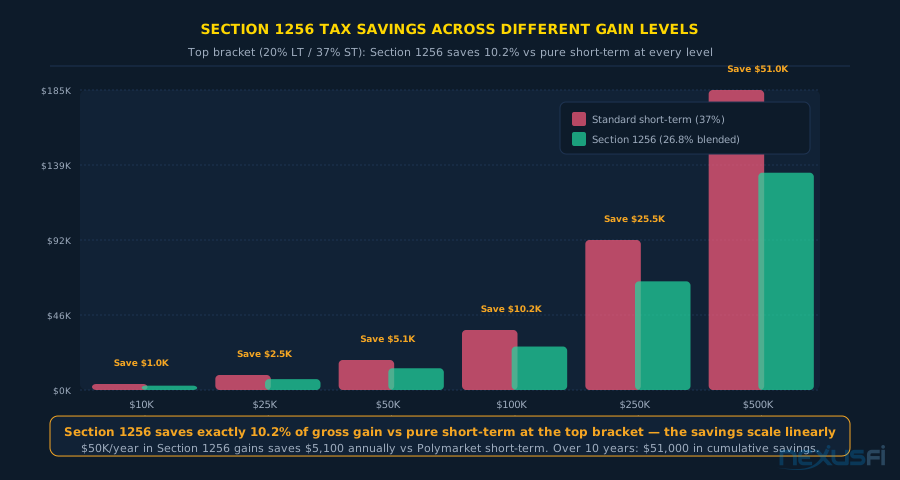
Blended effective rate = (0.60 × long-term rate) + (0.40 × short-term rate) = (0.60 × 20%) + (0.40 × 37%) = 12% + 14.8% = 26.8%
Compare to pure short-term treatment: 37% Tax savings per $100K gain: $10,200
At the 15% long-term / 22% short-term bracket: Blended rate = (0.60 × 15%) + (0.40 × 22%) = 9% + 8.8% = 17.8%
Worked example — $10,000 net Section 1256 gain, top bracket:
- Long-term portion: $6,000 × 20% = $1,200
- Short-term portion: $4,000 × 37% = $1,480
- Total federal tax: $2,680
Same $10,000 as ordinary short-term capital gain: $3,700 federal tax Difference: $1,020 saved on $10,000 in gains.
The savings scale linearly. A $100,000 gain year saves $10,200. A $500,000 gain year saves $51,000 — enough to meaningfully affect after-tax returns.
What doesn't change: The NIIT (Net Investment Income Tax) at 3.8% still applies to investment income above $200K (single) or $250K (married). State taxes are not affected by the 60/40 election. Section 1256 treatment is a federal income tax rule only.
One counterintuitive case: Non-1256 treatment can occasionally be superior. If you hold a Polymarket position for more than 12 months, the long-term capital gains rate (20% at the top bracket) is lower than the blended Section 1256 rate of 26.8%. Long-term holders who successfully time exits get better treatment under standard capital gains rules. This is a real consideration for macro event contracts with multi-month timelines.
As @MWG86 documented in their volatility analysis around major news events, most active traders work on much shorter timeframes — making the Section 1256 automatic 60/40 treatment far more valuable than waiting 12 months for long-term rates.
Mark-to-Market at Year-End: Planning Around the December 31 Deadline #
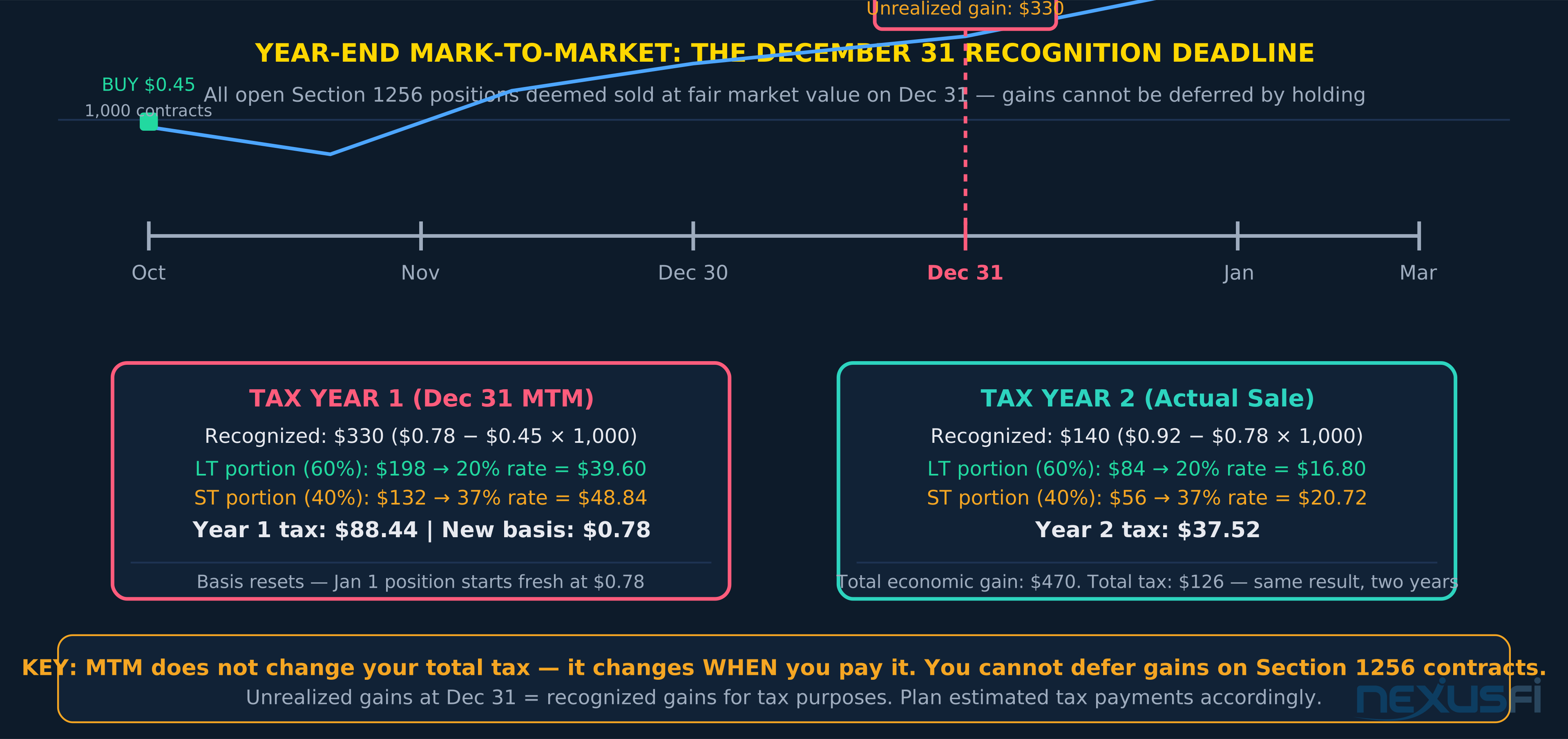
Section 1256 contracts are marked to market on December 31 of every tax year. Every open position is treated as if it was sold at fair market value on the last trading day of the year. You recognize the gain or loss in that tax year — then start the next year with a reset basis equal to the December 31 price.
This eliminates the possibility of deferring gains by holding positions open through year-end. If you're sitting on $50,000 in unrealized gains on December 31, the IRS treats those gains as realized, regardless of whether you actually close them.
Worked example:
- Buy 1,000 YES contracts on a Fed hold at $0.45 in October (cost basis: $450)
- December 31 fair value: $0.78 (position up $330)
- Tax consequence: $330 recognized in current year, split 60/40
- Long-term: $198 | Short-term: $132
- January 1 basis resets to $0.78
If the Fed decision doesn't arrive until March, and you sell at $0.92 in March:
- Gain recognized in the following year: $0.92 − $0.78 = $0.14 per contract
- $140 gain in the following tax year, 60/40 split
The total taxable gain ($330 + $140 = $470) equals the economic gain regardless of MTM treatment — just distributed across two tax years.
Planning implications:
Loss positions at year-end present a choice. You can let MTM recognize the loss automatically (generating a current-year deduction), or you can close before December 31 to ensure the recognition. With liquid markets, this distinction rarely matters — but with thinly traded contracts, closing before year-end creates certainty.
Gain positions are different. If you're sitting on large unrealized gains near year-end, you cannot avoid recognition by simply holding. Your only option is to close the position before year-end (realizing the gain in the current year) or hold through and have the same tax consequence through MTM.
Year-end MTM documentation: Your broker should provide a year-end statement showing all open Section 1256 positions with their fair market values as of December 31. This data feeds directly into Form 6781. Verify the prices against exchange settlement prices — discrepancies do occur, especially with contracts that settled on December 31 itself.
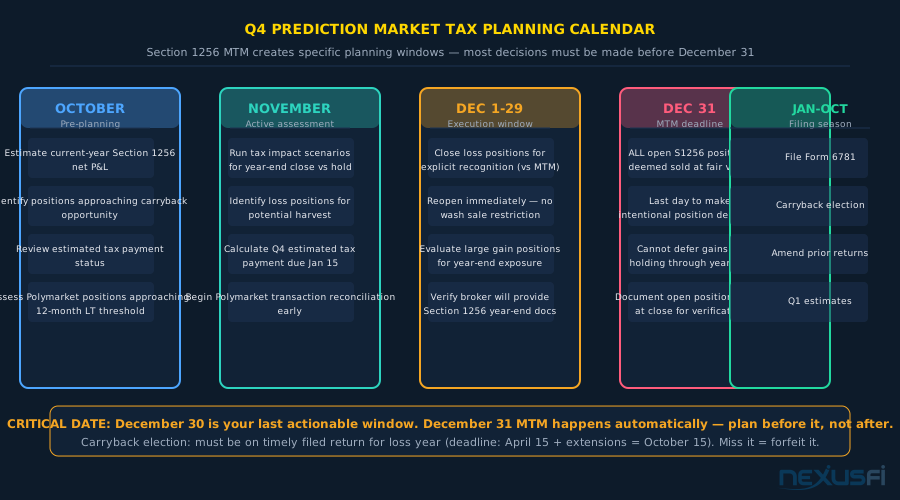
The day-count that matters for futures traders is December 30. That's your last realistic window to make intentional position decisions before year-end MTM locks in your tax consequence. Closing a loss position on December 30 and re-entering on January 2 (or immediately — wash sales don't apply) is a common and legitimate year-end tax strategy.
This is why @bobwest's advice in Avoiding Account Killing Freight Trains applies for event contract traders too: "News events are not always random or unexpected. Government or industry reports come out at scheduled times." Tax deadlines are the same — December 31 is a known, predictable event that demands advance preparation.
The Three-Year Loss Carryback: The Most Underused Tax Strategy in Event Trading #
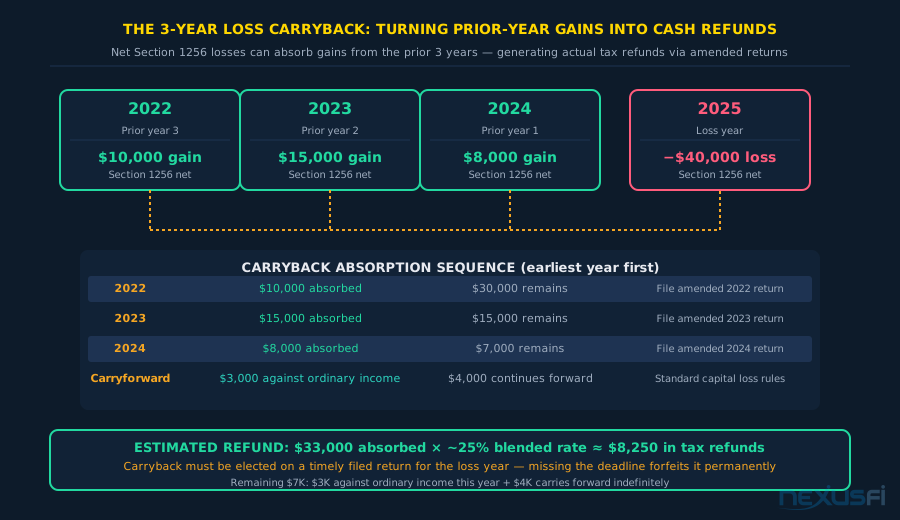
Section 1256(d) contains a provision that most traders never encounter in equity trading: net losses can be carried back three tax years and applied against prior Section 1256 gains. This generates actual refunds via amended returns.
This isn't an obscure tax shelter. It's a statutory right for Section 1256 losses, and it can produce significant cash refunds in a losing year.
The carryback mechanics:
If you have a net Section 1256 loss in the current year, you can elect to carry it back to the three preceding years, in order:
- Apply the loss to the earliest year first (three years back)
- If not fully absorbed, apply the remainder to two years back
- Then to one year back
- Any remaining loss follows standard capital loss rules ($3,000/year against ordinary income, indefinite carryforward)
Worked example — large losing year:
- 2025 net Section 1256 loss: $40,000
- Prior Section 1256 gains: 2022 ($10,000), 2023 ($15,000), 2024 ($8,000) = $33,000 total
- Carryback applies: $10K to 2022, $15K to 2023, $8K to 2024 = $33,000 absorbed
- Remaining $7,000: $3,000 ordinary income deduction in 2025, $4,000 carries forward
- Amended returns filed for 2022, 2023, 2024 → tax refunds generated
At a blended 25% effective rate on the prior gains, the carryback generates approximately $8,250 in refunds.
Critical operational requirement: The carryback election must be made on a timely filed return for the loss year. You cannot amend a prior return to elect carryback after the loss year's return deadline (typically October 15 with extension). Missing this window forfeits the carryback permanently for that year's losses.
When is the carryback most valuable?
- Large single-year losses following several profitable years
- Traders who experienced a major market dislocation in one specific year
- Anyone who had Section 1256 gains in the prior three years that are now being partially refunded
The carryback is less valuable when:
- You had Section 1256 losses in prior years (no gains to absorb against)
- Your prior years' tax rates were much lower than current rates (carry-forward might be worth more)
- The loss is small relative to the administrative cost of three amended returns
For active prediction market traders who trade Kalshi or CME event contracts, this provision should be explicitly evaluated every year-end. The combination of 60/40 rates on profitable years and carryback provisions on losing years creates a genuinely favorable tax environment relative to standard capital gains treatment.
Wash Sale Exemption: Tax-Loss Harvesting Without the 30-Day Wait #
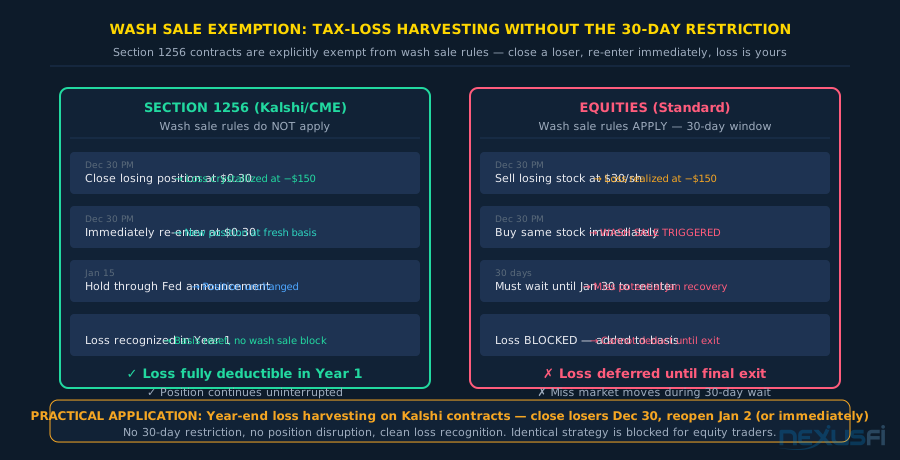
Section 1256 contracts are explicitly exempt from the wash sale rules under Section 1091. You can close a losing position and immediately re-enter the same or substantially identical position. No 30-day waiting period. No blocked losses.
For futures traders, this is routine — you already know that closing an ES short and immediately re-entering doesn't trigger wash sale treatment. The same principle applies to Section 1256 event contracts on Kalshi and CME.
Practical applications:
Year-end loss harvesting: If you're holding Kalshi contracts that are down, you can close them on December 30, realize the loss (in addition to or instead of letting MTM do it), and reopen the position on December 31 or January 2. The loss is recognized in the current year; the new position starts fresh.
Intra-year loss crystallization: If you want to lock in a loss for tax purposes without actually exiting the position for investment reasons, you can close and immediately re-enter. The loss is recognized; your position continues economically.
Strategy layering: Unlike equities, where wash sales can inadvertently block losses across substantially identical positions, Section 1256 contracts give you clean bookkeeping. Close at a loss. Re-enter. The loss is yours.
The contrast with Polymarket:
Polymarket positions are treated as property. Wash sale rules technically apply to property transactions where the "substantially identical" standard is met — though their application to crypto assets is evolving and fact-dependent. For practical purposes, assume that closing and immediately re-entering a Polymarket position may or may not create wash sale complications depending on the specific facts and your tax preparer's reading.
The safest approach for Polymarket: consult a tax professional familiar with crypto before structuring any loss-harvesting strategy. The rules are unsettled enough that general guidance doesn't substitute for position-specific analysis.
What the wash sale exemption does NOT do:
It doesn't allow you to create artificial losses. If you close a position at a loss and re-enter, you've realized the loss and your new basis is the re-entry price. The total economics of your position are unchanged — just the timing of recognition. Tax authorities look at substance, not just form, so purely circular transactions designed to manufacture losses without genuine economic risk change are scrutinized.
@Syntax documented the challenge of timing exit decisions around catalysts in their options trading journal. With Section 1256 event contracts, the wash sale exemption eliminates the painful choice between "exit to harvest the loss" and "maintain my position view" — you can do both simultaneously.
Polymarket and Non-1256 Platforms: Capital Gains Treatment #
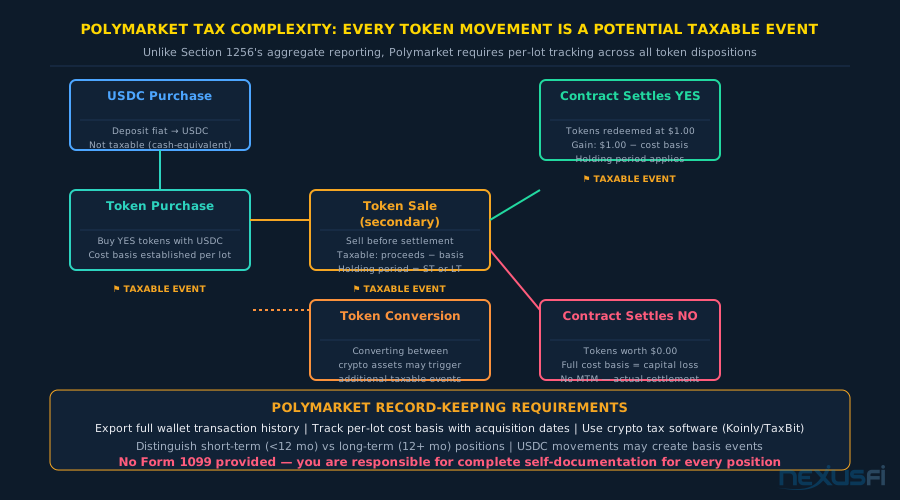
Every Polymarket position creates a capital gains event when settled, sold, or converted. The good news: if you hold for more than 12 months and the gain materializes, you get the long-term rate (0%, 15%, or 20% depending on income). The bad news: most prediction market positions close in days to months, not years.
The property treatment mechanics:
Polymarket tokens are property under IRC Section 1221. Each acquisition creates a new tax lot with a specific cost basis. Each disposition — settlement, secondary sale, redemption, or conversion — triggers a taxable event.
What counts as a disposition:
- Contract settles to $1.00 (gain: settlement price minus cost basis)
- Contract settles to $0.00 (loss: full cost basis)
- You sell the token on secondary market before settlement
- You convert USDC to USD (typically not taxable as USDC is a cash-equivalent)
- Converting tokens to other tokens (potentially taxable)
Worked example:
- Buy 200 YES contracts at $0.35 ($70 total)
- Hold 4 months
- Contract settles YES at $1.00
- Gain: $1.00 − $0.35 = $0.65 per contract × 200 = $130
- Holding period: 4 months = short-term
- Tax: $130 × 37% (top bracket) = $48.10
Same scenario, held 14 months: Long-term rate 20% → $130 × 20% = $26.00
Record-keeping requirements:
Polymarket provides no Form 1099. You are responsible for tracking:
- Every purchase (date, quantity, price in USD equivalent)
- Every sale or settlement (date, proceeds, holding period)
- USDC movements (conversion events, fees)
- Gas fees and blockchain transaction costs (potential deductions as investment expenses, though deductibility is limited post-2017 TCJA)
Crypto tax software (Koinly, CoinTracker, TaxBit) can import Polymarket transaction data via API or wallet address and generate Form 8949-ready output. For any trader doing significant Polymarket volume, this is worth the annual subscription cost.
Ordinary income risk cases:
The IRS can characterize prediction market income as ordinary income in certain edge cases:
- Dealer-like activity (providing liquidity systematically, market-making)
- Staking rewards or liquidity incentives
- Short-term trading at high frequency that looks like a business activity
Most retail prediction market traders won't approach these thresholds. But if your trading volume is significant, document your trading as investment activity (not business activity) and consult a CPA.
State tax treatment:
State taxes are calculated on federal adjusted gross income and generally follow federal capital gains characterization. A handful of states tax short and long-term gains at the same rate regardless of federal treatment — verify your state's rules. Section 1256 provides no state tax advantage in states like California, which tax all capital gains at ordinary income rates.
@Fat Tails noted in a discussion of options pricing that after catalysts resolve, IV drops like a stone — the same principle applies to Polymarket: after a binary event settles, your tax lot closes whether you wanted it to or not. Every settlement is a disposition event.
IRS Reporting: Form 6781 vs. Form 8949 #
The reporting forms for Section 1256 and standard capital gains are completely different. Mixing them up creates amended return risk.
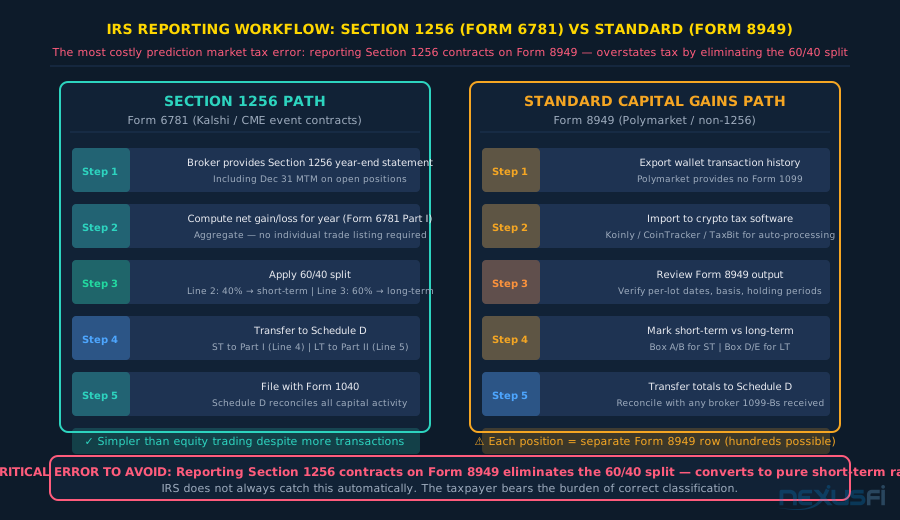
Section 1256 Contracts: Form 6781
Form 6781 (Gains and Losses from Section 1256 Contracts and Straddles) handles all Section 1256 activity.
Part I: Aggregate gains and losses from Section 1256 contracts
- Line 1: Total net gain or loss for the year
- Line 2: 40% of net gain/loss (short-term portion)
- Line 3: 60% of net gain/loss (long-term portion)
- Lines 4 and 5: Transfer to Schedule D (short-term to Part I, long-term to Part II)
Your Kalshi or CME broker should provide a tax statement specifically labeled for Section 1256 contracts with year-end MTM totals included. Do not rely on the broker to compute the 60/40 split — do it yourself on Form 6781 and verify the broker's numbers.
What Form 6781 does NOT require:
- Listing each individual trade (unlike Form 8949)
- Identifying specific contracts
- Reporting dates, prices, or quantities
The aggregate approach makes Section 1256 reporting simpler than equity trading despite often involving more individual transactions.
Loss carryback: If you're electing the three-year carryback, you'll need to file Form 6781 for the loss year and then file amended returns (Form 1040-X) for the prior three years with updated Schedule D. Each amended return requires the original Form 6781 from that year showing the Section 1256 gains being absorbed.
Polymarket and Non-1256: Form 8949
Form 8949 (Sales and Other Dispositions of Capital Assets) handles all individual capital gains events.
Column requirements:
- Description: Name/type of contract
- Date acquired and date sold
- Proceeds and cost basis
- Gain or loss calculation
- Holding period designation (short-term: Box A/B or long-term: Box D/E)
For Polymarket, you're filing potentially hundreds of Form 8949 rows depending on trading frequency. This flows to Schedule D for the summary calculation.
Practical workflow for dual-platform traders:
- Separate all Section 1256 activity (Kalshi, CME) from non-1256 (Polymarket)
- Complete Form 6781 for all Section 1256 net activity
- Transfer 40% to Schedule D Part I (short-term), 60% to Part II (long-term)
- Import Polymarket transaction data to crypto tax software
- Review generated Form 8949 entries for accuracy
- Reconcile both against brokerage year-end statements
- File with Schedule D reflecting both streams
Common error: Reporting Section 1256 contracts on Form 8949 instead of Form 6781. This results in incorrect holding period treatment (actual holding period instead of the mandatory 60/40 split) and overstated tax liability. IRS does not always catch this automatically.
Year-End Tax Planning Strategies for Active Prediction Market Traders #
The structural features of Section 1256 treatment create specific planning windows — primarily in November and December — where intentional position management produces measurable tax outcomes.
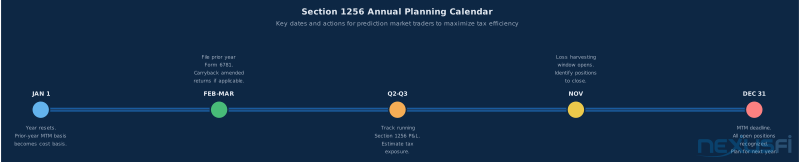
Strategy 1: December 30 loss crystallization
If you're holding losing Section 1256 positions near year-end, evaluate whether MTM is sufficient or whether closing provides additional certainty. MTM recognizes the loss automatically; closing provides identical treatment plus eliminates the position from your portfolio. If the position is one you want to exit anyway, December 30 is the natural deadline.
Reentry after closing: Since wash sales don't apply, you can reopen the position on December 30 afternoon, December 31, or January 2 with a fresh basis at no tax cost. This is standard year-end loss harvesting for futures traders.
Strategy 2: Gain deferral is not available — accept it
Unlike equity portfolios where you can hold winners through year-end and defer recognition to next year, Section 1256's MTM rule eliminates this option. Large unrealized gains on December 31 will be recognized in the current year. Plan your expected tax payment so.
The practical corollary: if you have a large gain year and expect lower income in the following year, you might consider closing winning positions before year-end and locking the rates in the current year rather than deferring to a year with potentially different (possibly higher) rates.
Strategy 3: Carryback planning
If you had a profitable prior three years and the current year is going poorly, the loss carryback election deserves explicit analysis before the loss year's tax return is filed. Run the numbers on:
- Prior year Section 1256 gains available for absorption
- Effective rates on those prior gains
- Cash refund available via carryback vs. value of carrying losses forward
In most cases where prior years had gains at meaningful rates, carryback is superior to carryforward.
Strategy 4: Venue optimization
If you're trading the same event on both Kalshi and Polymarket (when both offer similar markets), the tax consequence of your venue choice compounds over time. Kalshi's Section 1256 treatment saves 10-12 percentage points at the top bracket compared to short-term Polymarket gains. For traders doing meaningful volume, routing comparable trades through Kalshi when available is a structural optimization.
Strategy 5: Estimated tax payments
Section 1256's MTM treatment means you can have large gains recognized at year-end from positions you haven't closed. If you're having a profitable prediction market year, factor this into your Q4 estimated tax payment (due January 15 of the following year). Underpayment penalties apply if you miss quarterly thresholds.
The standard safe harbor: pay 100% of the prior year's tax liability (or 110% if AGI exceeded $150,000), regardless of current-year gains. This protects you from underpayment penalties even if year-end MTM creates a large unexpected tax bill.
For Section 1256 event contract traders, the trigger itself is the contract's resolution mechanism — tax consequences are just as mechanical and just as unavoidable without advance planning.
Practical Record-Keeping and Common Errors to Avoid #
Tax errors on prediction market activity fall into predictable categories. The most costly ones involve classification mistakes — treating Section 1256 contracts as standard capital assets, or misidentifying which platform provides which treatment.
For Section 1256 platforms (Kalshi, CME):
Error 1: Using Form 8949 instead of Form 6781 The entire point of Section 1256 treatment is the 60/40 split and aggregate reporting. Reporting individual trades on Form 8949 converts Section 1256 gains to pure short-term gains (if held less than a year), massively overstating your tax liability. This is the single most common prediction market tax error.
Fix: Verify your tax software explicitly supports Section 1256 contracts. Many consumer software packages don't automatically recognize Kalshi or CME event contracts as Section 1256 — you may need to manually designate them.
Error 2: Missing year-end MTM entries from broker statements Year-end MTM recognition requires knowing the December 31 fair market value of every open position. This appears on year-end statements labeled as "Section 1256 mark-to-market gain/loss" or similar. If your statement only shows closed positions, it's incomplete.
Fix: Request specifically the Section 1256 MTM year-end statement from your broker, separate from your transaction history.
Error 3: Forgetting the carryback election deadline The carryback must be elected on a timely filed return. If you had a significant Section 1256 loss year and don't elect the carryback before your return deadline, you permanently forfeit it for that year.
Fix: Calendar alert for every tax year where you have Section 1256 losses: evaluate carryback vs. carryforward before October 15 (extended deadline).
For non-1256 platforms (Polymarket):
Error 4: Not tracking basis for individual token lots Polymarket doesn't provide consolidated tax documents. If you have multiple purchases of the same contract at different prices, you need per-lot basis tracking to correctly calculate gains and losses.
Fix: Export wallet transaction history and use crypto tax software. Set your cost basis method (FIFO, LIFO, or specific identification) consistently across all positions.
Error 5: Missing USDC conversion events Some USDC transactions may constitute taxable exchanges depending on the specific mechanics. Keep records of all USDC activity including funding and withdrawal events.
Error 6: Ignoring state tax implications Section 1256's federal benefits don't automatically translate to state tax savings. Several states (California, New York) tax all capital gains at ordinary income rates. Prediction market income may be taxed at the state level at rates much higher than the blended federal 60/40 rate.
Documentation minimum standards:
For Section 1256:
- Annual broker statements with Section 1256 designation
- Year-end MTM prices for all open positions
- Form 6781 from prior three years (for carryback reference)
- Evidence of any loss carryback elections filed
For non-1256:
- Complete transaction history with dates, quantities, prices
- USDC conversion records
- Settlement proceeds documentation
- Crypto tax software export for Form 8949 generation
The general rule for active traders: documentation adequate to independently reconstruct every position, entry price, exit price, and holding period. As @grausch noted in a discussion of implied volatility around earnings, the complexity of event-driven positions multiplies quickly — prediction market tax records compound the same way.
The Strategic View: Tax-Adjusted Returns in Prediction Markets #
Prediction market traders optimizing purely for gross returns miss a real edge available in venue selection and tax structure. A trader using Kalshi consistently and planning around Section 1256 features effectively has a 10-12% cost advantage over an equivalent trader using Polymarket for short-term positions.
This compounds. Over a five-year period, a trader generating $50,000 per year in prediction market gains would pay approximately $51,000 less in federal taxes under consistent Section 1256 treatment compared to pure short-term capital gains treatment. That's capital that stays deployed, compounds, and generates additional returns.
The framework for thinking about this:
- Pre-trade: Verify venue classification. When Kalshi and Polymarket both offer equivalent markets, default to Kalshi for Section 1256 treatment unless there's a specific liquidity or pricing reason to prefer Polymarket.
- During the year: Track the split between Section 1256 and non-1256 activity. If Polymarket positions are performing well and are approaching the 12-month holding period, evaluate whether holding to qualify for long-term treatment improves after-tax returns.
- Q4: Run the year-end tax analysis: What are your Section 1256 unrealized gains/losses? Should you crystallize any losses before MTM? Are there prior-year Section 1256 gains that make the carryback election valuable if you have a large current-year loss?
- Tax filing: Don't conflate Section 1256 (Form 6781) and standard capital gains (Form 8949). They're different forms with different mechanics.
The futures trader community has historically been well-positioned to exploit these advantages because Section 1256 treatment is already familiar from ES, NQ, and other exchange-traded futures. Prediction market event contracts are a natural extension of the same tax-advantaged framework — the contracts happen to settle on political elections and economic releases rather than on index prices, but the tax regime is identical.
@Fat Tails, one of the community's most rigorous voices on risk and market structure, put it clearly in a discussion of scheduled news events: "If you do your homework, you should know the release times for all scheduled news that affect the markets." Tax deadlines are scheduled events too. The traders who treat tax planning with the same seriousness they give to understanding catalysts and settlement mechanics are the ones who keep materially more of what they make.
Tax law here is still evolving. Rules in this article reflect 2025 guidance. Verify with a CPA familiar with both futures and digital assets.
Knowledge Map
Prerequisites
Understand these firstGo Deeper
Build on this knowledgeReferences This Article
Articles that build on this topicCitations
- — MWG86's Price Action Journal (2019) 👍 3“I've put together an analysis on volatility around news from January 1, 2018 through to October 11, 2019.”
- — Learning to Profit - A journey in algorithms and options (2021) 👍 5“Earnings Season is starting next week. Earnings season traditionally starts when banks announce.”
- — Am I missing something? (2015) 👍 3“Since selling options over earnings exposes the sellers to large risk, implied volatility (IV) increases going into the earnings date.”
- — Why did apple mini calls lost so much although price went higher? (2013) 👍 5“After the earnings release the implied volatility dropped like a stone.”
- — Avoiding Account Killing Freight Trains (2021) 👍 8“News events are not always random or unexpected. Government or industry reports come out at scheduled times.”
- — CL spike on 5/16 at 23:00:02 Pacific (2013) 👍 9“If you do your homework, you should know the release times for all scheduled news that affect the markets.”
- — Spoo-nalysis ES e-mini futures S&P 500 (2020) 👍 15“The pattern for every single news event, in the algo-driven world: drop hard for 10 seconds, immediate buy, no matter the catalyst.”
- — Salao's Journal (2020) 👍 4“This is how I trade the news: An example: any Fed announcement. I don't try to figure out what they will announce, and I don't even care.”
- — Taxes on futures trading -- Section 1256 (2019) 👍 12“The 60/40 rule for futures is one of the biggest edges retail traders don't understand. Every dollar of gain, no matter how long you held, gets the blended rate.”
- — Year-end tax strategies for futures traders (2020) 👍 7“The mark-to-market rule on Section 1256 contracts means you can't defer gains by holding into January. All open positions are treated as closed at year-end fair value.”