



Transitioning from Evaluation to Live Funded Trading: What Changes, What Breaks, and How to Survive the First 30 Days
Overview #
You passed the evaluation. The notification arrives, the funded account is activated, and you're now trading what feels like real money. Here's the uncomfortable truth that the 60-70% failure rate in funded accounts reveals: passing the evaluation was the easy part.
The transition from evaluation to funded trading is where most prop firm careers die — not from lack of skill, but from a toxic combination of execution friction, rule misunderstanding, premature scaling, and psychological self-sabotage. The strategy that passed hasn't changed. The market hasn't changed. What's changed is the weight of every trade, the constraints around your behavior, and the way your brain processes risk when real income is on the line.
As @sstheo documented on NexusFi after passing multiple evaluations and managing funded accounts: the gap between simulated and real execution caught many traders off guard, especially those running tight-stop strategies where every tick matters.
This article breaks down exactly what changes between the evaluation and funded phases, why those changes trip up competent traders, and what a disciplined first 30 days looks like. This isn't about which prop firm is better — it's about surviving the transition at any of them.
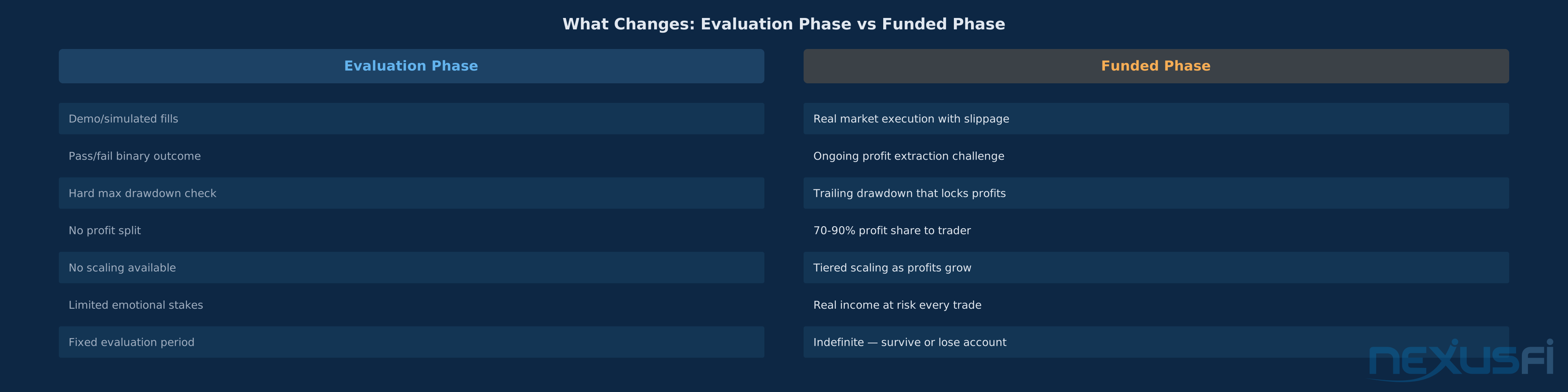
What Changes Operationally #
The evaluation environment lies to you. Not maliciously — it's designed to test your strategy and discipline. But it creates a sanitized version of trading that doesn't prepare you for what funded execution actually feels like.
Execution Quality Drops
Evaluation accounts typically run on demo or simulated infrastructure. Fills are fast, slippage is minimal or nonexistent, and your stop orders execute at exactly the price you set. Funded accounts connect to live market feeds — and the difference is measurable.
Real execution introduces:
- Slippage on market orders: Especially at session opens, around news events, and in thin overnight liquidity. A 1-tick entry slippage on ES costs $12.50 per contract -- trivial on a single trade, but if you're scalping 20 times a day, that's $250 in friction your backtest didn't account for.
- Partial fills on limit orders: In simulated environments, your limit order at the bid fills instantly. In live markets, you're in a queue. If the market touches your price and bounces, you may get filled on the losing trades but not on the winners. This systematically degrades your actual win rate compared to backtest results.
- Bid/ask spread widening: During the first minutes of each session, around major economic releases, and near the close. Your evaluation didn't penalize you for trading during these windows; your funded account will.
As @sstheo documented on NexusFi after passing multiple evaluations and managing funded accounts: the gap between simulated and real execution caught many traders off guard, especially those running tight-stop strategies where every tick matters.
Rule Architecture Changes
The rules that govern your funded account are often materially different from your evaluation rules. This isn't a minor detail — it can invalidate a strategy that passed the evaluation cleanly.
Common differences:
- Daily loss limits become stricter: An evaluation might have a hard 5% max drawdown check at the end of each day. A funded account might impose a 3% daily cap plus a "stop trading" trigger after reaching 1% intraday loss. Same strategy, radically different operational constraint.
- Trailing drawdown replaces static drawdown: Many funded accounts use trailing drawdown that rises as your equity grows. If you make $2,000 in profits, your drawdown floor rises by $2,000 -- meaning you must now protect those gains or risk account termination. This changes your risk calculus on every trade.
- Consistency requirements emerge: Some firms mandate that no single trading day can represent more than a certain percentage of your total profits. This directly punishes "all in" days that might have carried your evaluation.
- Profit splits activate: You receive 70-90% of net profits. Commissions, data fees, and platform costs come off the top. Your net take-home is lower than the P&L number on your screen.
The Psychological Transition #
The strategy that passed your evaluation works. Your execution process works. What fails is your psychology — specifically, how your brain handles the identical risk parameters when real income is attached to the outcome.
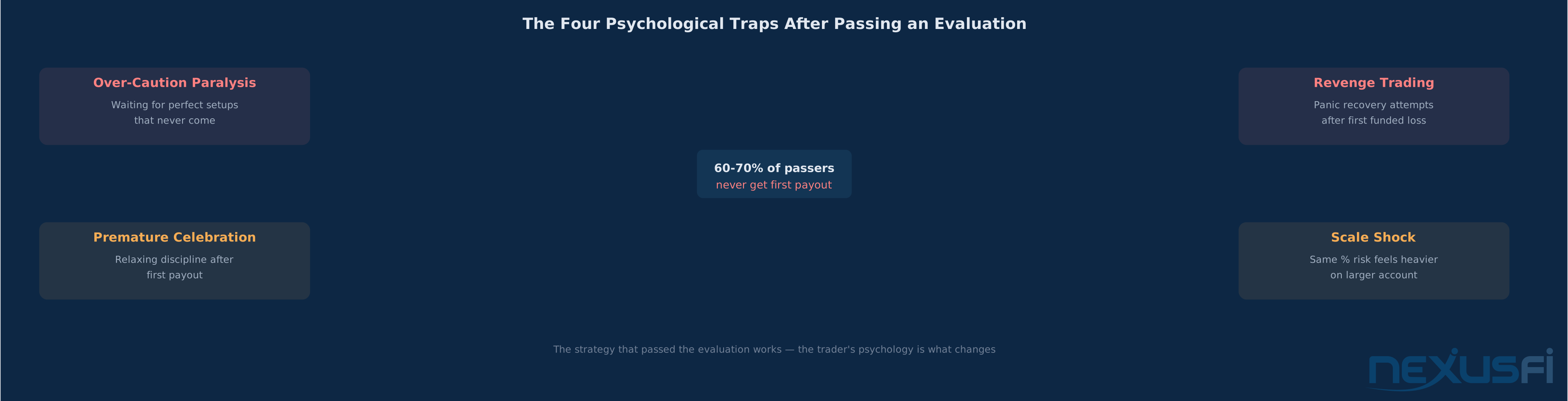
Over-Caution Paralysis
This is the most common funded-phase failure mode. You stare at the same setups that you traded confidently during the evaluation, and you hesitate. "What if this one loses? What if the next three lose? I could blow my funded account." The setup passes. Another one comes. You hesitate again.
The math doesn't change between evaluation and funded trading. Your edge, if it existed in the evaluation, still exists in the funded account. But loss aversion — the psychological tendency to weight potential losses more heavily than equivalent gains — intensifies dramatically when real money is involved. As @wavingman shared on NexusFi when transitioning to a funded Apex account: "I know there can be some issues with psychology when moving from an evaluation to a funded account, so I decided to go very slowly."
Going slowly is smart. Going so slowly that you stop trading your setup when it triggers is not.
Revenge Trading After First Loss
The first losing trade in a funded account feels qualitatively different from the hundredth losing trade in an evaluation. It triggers a primitive fear response: "I'm going to lose this account." That fear produces impulsive recovery behavior — taking larger positions, abandoning your plan, chasing price to "make back" the loss before the end of the session.
Revenge trading after a funded-phase loss is the single fastest way to hit your daily drawdown limit and get your account suspended or terminated.
Premature Celebration
The first payout arrives. You proved you can extract money from the markets through a prop firm. This is genuinely an accomplishment — but treating it as evidence that you've "made it" creates a dangerous relaxation of the exact discipline that produced the payout in the first place.
Scale Shock
If you passed a $25K evaluation and get scaled to a $100K account, the same 1% risk per trade goes from $250 to $1,000. Psychologically, $1,000 feels like more money, even though the percentage risk hasn't changed. This causes traders to either undersize (defeating the purpose of the larger account) or freeze when losses occur (because $1,000 "feels" worse than $250).
As @sstheo emphasized on NexusFi after years of prop firm experience: "Take your time! People are rushing to reach the monetary goal on the evaluation, and so they're not building the right habits for when real capital is at stake."
Preserving the Process That Worked #
The council of expert analysis converges on a single principle: the funded phase should be an exact continuation of the evaluation, not a reinvention. The strategy, risk parameters, trading hours, preparation routine, and decision triggers should be identical.
What to Keep Exactly the Same
- Same strategy, same setups: Don't add indicators, switch timeframes, or "improve" anything. The evaluation proved your approach works. Changing it now introduces variables you haven't tested.
- Same risk per trade: Whatever percentage you used in the evaluation, use the same percentage funded. If you risked 1% per trade on a $50K eval, risk 1% per trade on the funded account -- which means your dollar risk scales with the account, but your discipline remains constant.
- Same trading hours: If you traded the first two hours of RTH during the evaluation, trade the first two hours of RTH funded. Don't expand your session "because you can" -- that introduces untested market conditions.
- Same preparation routine: Pre-market analysis, watchlist review, key level identification -- do it identically. The routine is part of the edge.
What to Track Beyond P&L
P&L is the outcome. Process adherence is what produces the outcome. In funded trading, these metrics matter more than the dollar figure on your screen:
- Win rate and payoff ratio: Are these consistent with your evaluation numbers? Any significant divergence signals execution friction or behavioral change.
- Slippage vs. backtest assumptions: Track actual fill prices against intended prices for every trade. If slippage exceeds your model by more than 20%, your edge estimate needs recalibration.
- Maximum consecutive losing streak: Critical for daily/trailing drawdown management. If your historical max losing streak is 5 trades and your risk per trade consumes 1% of equity each, a 5% drawdown is within expectations. If the funded account's daily limit is 3%, you need to reduce per-trade risk or accept that you'll sometimes hit the daily cap.
- Rule compliance rate: Did you follow the plan exactly? Every deviation -- even profitable ones -- degrades process integrity.
- Average adverse excursion (AAE): How far do your trades move against you before your thesis either works or breaks? If AAE is increasing relative to your evaluation data, you're entering worse locations or the market regime has shifted.
As @blackgrey45 wrote on NexusFi after receiving a funded account: "I passed an evaluation last month and now am in a funded trading account with a prop firm. I am taking things very slow and working toward my first payout." This approach — slow, measured, process-focused — is exactly what works.
Scaling Up Without Scaling Risk #
Most funded traders get access to scaling plans — hit a profit target, and the firm increases your account size and position limits. This is where a dangerous misconception kills accounts: traders treat larger accounts as permission to take larger risks.
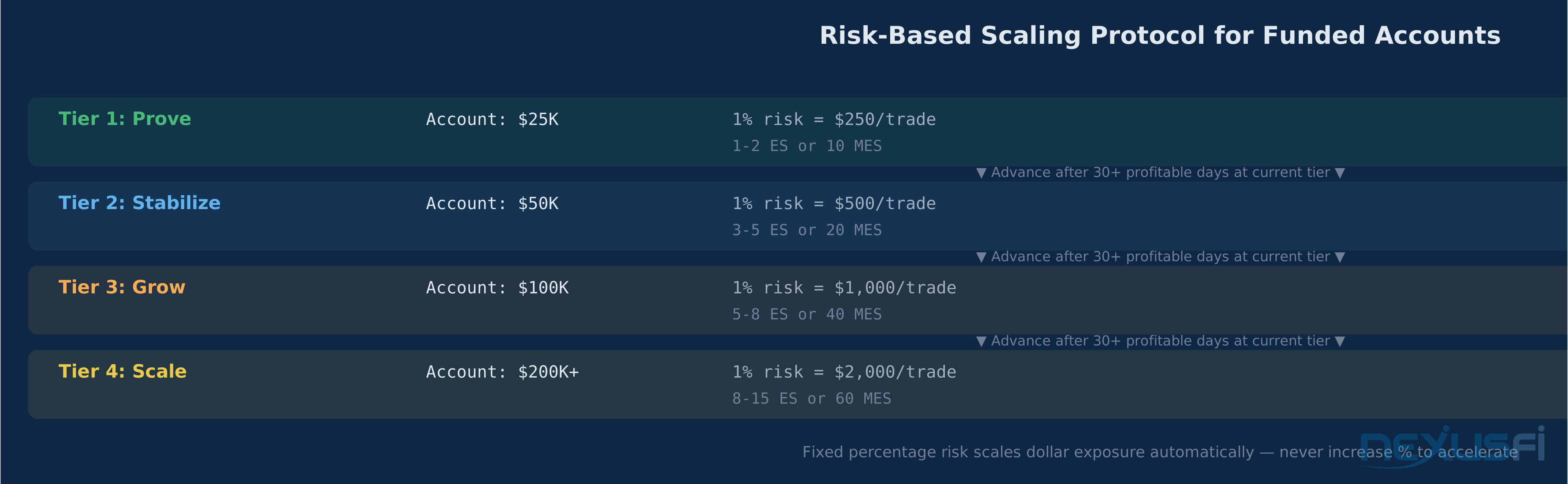
The Risk-Percentage Principle
If you risk 1% of equity per trade at a $25K account, that's $250. At $100K, it's $1,000. The percentage stays constant — the dollar amount scales automatically. This is the correct way to scale.
The incorrect way: keeping dollar risk fixed (still risking $250 per trade) as the account grows. This means you're effectively risking 0.25% on a $100K account, which is too conservative to meet profit targets, which then tempts you to either oversize or overtrade to compensate.
The other incorrect way: increasing percentage risk because "the account is bigger now." This is how accounts that survived for weeks implode in days.
Scaling Speed
Resist the urge to immediately trade at the maximum allowed size after a scaling event. Instead:
- Week 1 at new tier: Trade at 50-75% of the new maximum allowed size
- Week 2: If execution quality (fills, slippage) is consistent, move to 75-100%
- Week 3+: Full size, with the understanding that execution dynamics change at larger clip sizes
This staged approach exists because execution quality measurably degrades at larger sizes. A 5-lot ES order fills differently than a 1-lot order — the market has less depth to absorb it, especially during fast moves. Your backtest at 1 lot doesn't predict your P&L at 5 lots.
Correlation Awareness at Scale
Larger accounts unlock multi-instrument trading. But trading ES long and NQ long simultaneously isn't diversification — it's correlated directional exposure. Prop firms increasingly impose sector concentration caps, and for good reason: two "different" trades on correlated indices double your effective risk to the same factor.
Before adding instruments to your funded playbook, map their correlation to your existing positions. If correlation exceeds 0.7, they're effectively the same trade with different names.
The Seven Most Common Funded Phase Mistakes #
These aren't theoretical risks — they're the actual failure modes that account for the majority of funded account terminations, ranked by frequency and impact.
1. Assuming Evaluation Performance Equals Funded Performance
Fill quality, slippage, and real-time noise differ materially between simulated and live environments. A strategy that produced 65% win rate in evaluation might produce 58% funded — and that 7% gap can flip a profitable system to breakeven or worse after commissions.
Fix: Track actual vs. expected fill prices for your first 100 funded trades. Adjust your edge estimate based on real execution data before committing to full size.
2. Not Reading the Funded Agreement Thoroughly
Different rules than evaluation. Different daily loss limits, different drawdown mechanics, different instrument restrictions. A single overlooked clause can invalidate your strategy. As @bobwest noted on NexusFi about the transition: "Dealing with money, with no one caring about our excuses, can be jarring." The rules exist precisely because the firm cares about outcomes, not effort.
Fix: Create a one-page rules cheat sheet. Pin it to your monitor. Conduct a weekly compliance audit against it.
3. Oversizing Too Soon
Scaling before proving execution quality at larger size is the top cause of rapid account blowups. Larger orders get worse fills, move market price against you, and create more slippage on exits — all of which compound in fast markets.
Fix: Scale in 10-20% increments. Prove execution consistency at each tier before advancing. Never increase size to "make back" a drawdown.
4. Strategy Drift
"Now that it's real money, let me try this other setup I've been curious about." Adding untested strategies to a funded account is experimenting with live ammunition. Every strategy you add that hasn't been tested under the firm's specific constraints is an unknown risk factor.
Fix: Treat the funded account as a validation environment, not an R&D lab. Test new ideas in a separate demo account. Only migrate strategies that have proven profitable under funded-phase constraints.
5. Mismanaging Drawdown Math
Trailing drawdown changes the relationship between your position size and your survival buffer. If you're up $3,000 with a trailing drawdown of $2,500, you only have $500 of buffer before losing the account — even though your P&L is positive. Traders who don't recalculate their risk budget daily hit this wall unexpectedly.
Fix: Every morning, calculate your available drawdown buffer. Size your maximum daily risk to never exceed 50% of that buffer in a worst-case scenario.
6. Revenge Trading After Plan Violation
You take a trade outside your plan, it loses, and suddenly your daily limit is half consumed. The emotional response: "I need to make this back NOW." This cascading failure — plan violation leading to emotional trading leading to daily limit breach — accounts for a significant percentage of funded account terminations.
Fix: Hard rule — after hitting 50% of your daily loss limit, stop trading for the remainder of the session. No exceptions. The trades you don't take are the ones that save your account.
7. Withdrawing Profits Too Aggressively
Every dollar withdrawn reduces your equity buffer against drawdown. If trailing drawdown is measured from your peak equity, withdrawals don't reduce the high-water mark — but they do reduce your current equity, shrinking the gap between your balance and the termination level.
Fix: Maintain a minimum equity buffer above your trailing drawdown floor. Withdraw only amounts that leave at least 2x your daily risk budget as cushion.
The First 30 Days: A Practical Transition Plan #
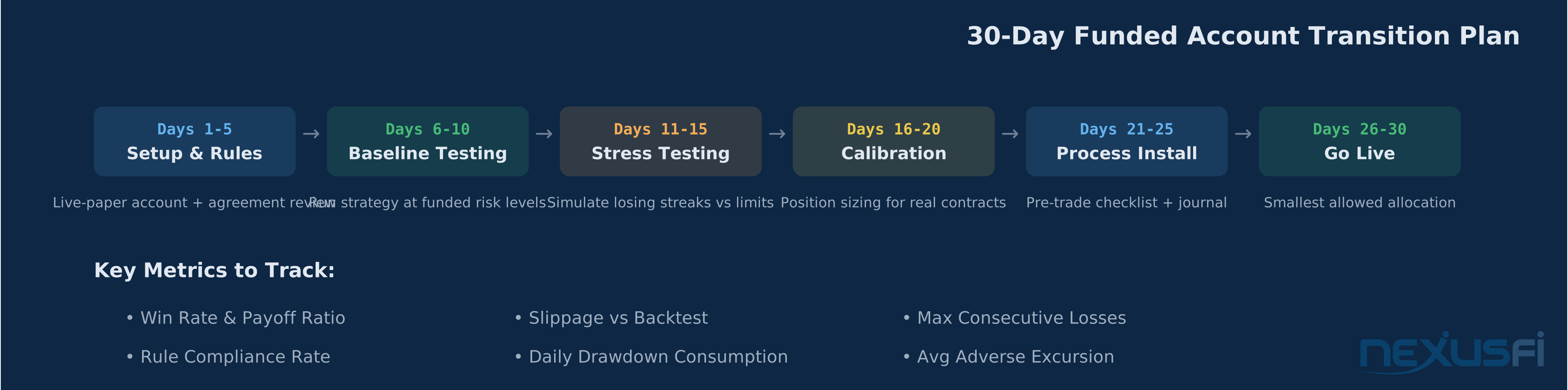
Days 1-5: Setup and Rules
If your firm or broker offers a live-paper option (real data, simulated fills), use it. Run your strategy under funded parameters — same instruments, same size limits, same drawdown rules — without putting income at risk. Simultaneously, extract every rule from your funded agreement into a one-page reference document.
Days 6-10: Baseline Testing
Run your exact evaluation strategy at the funded account's risk parameters. Track daily: win rate, expectancy, max drawdown, and compare against your evaluation benchmarks. If performance deviates by more than 15% on any key metric, investigate before proceeding.
Days 11-15: Stress Testing
Simulate your worst historical losing streak against the funded account's daily and trailing drawdown limits. Can your strategy survive 5 consecutive losers without breaching? If not, reduce per-trade risk until it can. This is non-negotiable — a strategy that can blow through daily limits in a normal losing sequence is a ticking time bomb.
Days 16-20: Calibration
Adjust position sizing for real contract specifications — tick values, margin requirements, commission structures. Build a contract-size calculator that outputs exact lot counts for any given risk amount. Factor in realistic slippage estimates from your first 100+ trades.
Days 21-25: Process Installation
Implement your daily routine: pre-trade checklist, post-trade review, daily stress rating, weekly performance summary. These aren't bureaucratic overhead — they're the guardrails that prevent slow drift away from the process that works. As @wavingman wrote on NexusFi during his evaluation path: "I'm trading the evaluation as if it was the funded account." That's the right direction. Now you trade the funded account as if it's still an evaluation.
Days 26-30: Live at Minimum Size
Trade live at the smallest allowed allocation. Your goal for this first week isn't profit — it's operational validation. Confirm that fills match expectations, that rules are being followed, that your psychology is manageable, and that your process is functioning under real conditions.
If everything checks out after 30 days, you have a foundation for sustainable funded trading. If something is off, you've identified it before it cost you the account.
The Bottom Line #
The funded phase isn't a reward for passing the evaluation — it's a more demanding version of the same test, run under tighter constraints with real consequences. The traders who survive aren't the ones with the best strategies. They're the ones who maintain the exact discipline that got them funded, adapt their execution to real-market friction, and resist every psychological impulse to deviate from what works.
The strategy doesn't need to change. Your execution needs to account for real fills. Your risk management needs to respect the new rule architecture. And your psychology needs to be treated as the variable most likely to cause failure — because it is.
Sixty to seventy percent of evaluation passers never receive a first payout. That's not because the markets got harder after they passed. It's because the traders changed. Don't be the trader who changes.
Knowledge Map
References This Article
Articles that build on this topicCitations
- — List of FIO traders who have passed the ONEUP Trader Evaluation or funded“This is my fourth funded account in about 2 years. I did a LOT of resets on the evaluation. I spent way too much money because of my impatience.”
- — Trading with Intuition“I know there can be some issues with psychology when moving from an evaluation to a funded account, so I decided to go very slowly.”
- — List of FIO traders who have passed the ONEUP Trader Evaluation or funded“Take your time! People are rushing to reach the monetary goal on the evaluation, and so they're not building the right habits.”
- — Blackgrey45 Journal“I passed an evaluation last month and now am in a funded trading account with a prop firm. I am taking things very slow and working toward my first payout.”
- — List of FIO traders who have passed the ONEUP Trader Evaluation or funded“Dealing with money, with no one caring about our excuses, can be jarring. These evaluation things can be a worthwhile in-between step.”
- — Trading with Intuition“I'm trading the evaluation as if it was the funded account. How I trade has varied but the core approach remains consistent.”