



Tax and Legal Considerations for Prop Firm Funded Traders: What You Owe, What You Can Deduct, and What the Contract Actually Says
Overview #
You pulled $5,000 from your funded account. Congratulations — that's real money. Now here's the question nobody thinks to ask until April: how much of it does the IRS get?
The tax treatment of prop firm income catches most funded traders off guard because it doesn't work like trading your own account. When you trade personal capital in futures, you benefit from Section 1256's favorable 60/40 long-term/short-term split. When you trade a prop firm's capital and receive a profit share, that money is almost always classified as ordinary income — taxed at your full marginal rate, plus self-employment tax on top.
This classifies you as an independent contractor, which means: Income tax: Taxed at your marginal federal rate (10% to 37% depending on total income) Self-employment tax: 15.3% on net earnings up to the Social Security wage base ($168,600 in 2025), 2.9% above that.
This article covers what you need to know about the tax and legal environment of funded trading in the United States. This is educational guidance, not tax advice — your specific situation requires a CPA who understands both trading taxation and independent contractor classification. But understanding the framework before you file your first return prevents the most expensive mistakes.
How Prop Firm Income Is Classified #
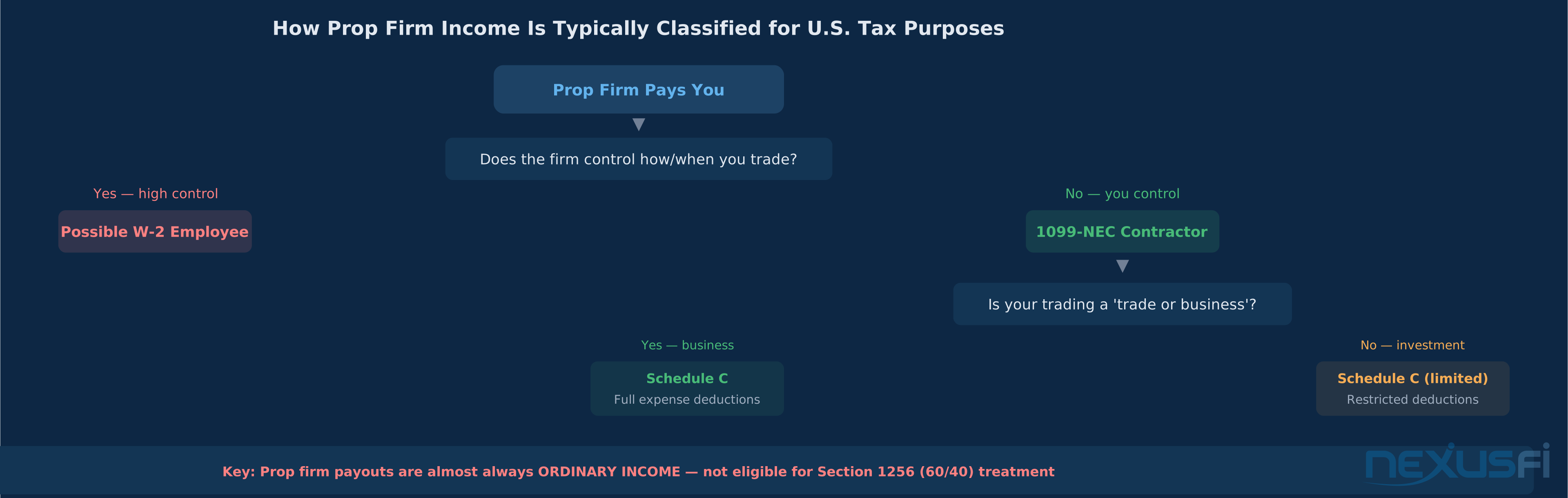
Here's the distinction that matters most: when you trade your own futures account, you're generating capital gains and losses. When you trade a prop firm's account and receive a payout, you're receiving compensation for services — and the tax code treats those two things very differently.
Ordinary Income, Not Capital Gains
In a prop firm arrangement, the firm owns the trading account and the capital. You make trading decisions, and the firm pays you a percentage of the profits. From the IRS's perspective, this is compensation — ordinary income taxed at your full marginal rate. Section 1256's 60/40 treatment doesn't apply because you're not the account holder generating the trading gains.
As @vantojo confirmed on NexusFi when researching prop firm taxes: "This would be ordinary 1099 income... subject to the full tax rate, not eligible for the 60/40 tax rules for Futures." This distinction alone can represent a 10-15% effective tax rate difference on the same dollar amount.
The 1099-NEC Reality
Most prop firms issue a 1099-NEC (Nonemployee Compensation) for U.S. traders whose annual payouts exceed the reporting threshold. This classifies you as an independent contractor, which means:
- Income tax: Taxed at your marginal federal rate (10% to 37% depending on total income)
- Self-employment tax: 15.3% on net earnings up to the Social Security wage base ($168,600 in 2025), 2.9% above that. This covers both the employer and employee portions of Social Security and Medicare.
- State income tax: Varies by state -- some states have no income tax; others add 5-13% on top of federal
- No withholding: Unlike W-2 employment, nothing is withheld from your payouts. You're responsible for paying estimated taxes quarterly.
The math gets real fast. On $50,000 of prop firm income, a trader in the 22% federal bracket paying 15.3% self-employment tax plus 5% state tax effectively loses over 40% to taxes. That $50K payout nets roughly $29,000. Compare that to $50,000 in personal futures trading gains under Section 1256, where the blended rate is much lower.
As @bobwest explained on NexusFi regarding prop firm payouts: "You're an independent contractor, and your income is reported on a 1099 MISC." The reporting form may vary (1099-NEC is now more common than 1099-MISC for contractor payments), but the tax treatment is the same.
W-2 Employment: Rare but Possible
A small number of prop firms structure the relationship as employment, issuing W-2s and withholding payroll taxes. This is uncommon because it imposes significant obligations on the firm. If you receive a W-2, your tax situation is simpler (withholding handles most of the tax burden), but your ability to deduct business expenses is more limited.
The IRS examines the substance of the relationship, not just the form: if a firm exercises extensive control over how, when, and where you trade, the relationship may legally be employment regardless of what the contract says. Most funded trading arrangements, where the trader controls their own methodology and schedule, genuinely qualify as contractor relationships.
Tax Reporting Requirements #
If you're receiving 1099-NEC income from a prop firm, here's what the IRS expects from you.

Estimated Quarterly Tax Payments
Since no taxes are withheld from your prop firm payouts, you're required to make estimated tax payments if you expect to owe $1,000 or more when you file. These are due:
- Q1: April 15
- Q2: June 15
- Q3: September 15
- Q4: January 15 (of the following year)
Underpayment penalties apply if your quarterly estimates are insufficient. The safe harbor rule: pay at least 100% of your prior year's total tax liability (110% if your AGI exceeds $150,000) across the four quarterly payments to avoid penalties, even if you end up owing more at filing.
Schedule C Reporting
Most funded traders report prop firm income on Schedule C (Profit or Loss from Business) as sole proprietors. This is where you report both your gross income from prop payouts and your deductible business expenses. The net profit from Schedule C flows to your Form 1040 and is also subject to self-employment tax via Schedule SE.
Record-Keeping Requirements
Maintain thorough records of:
- All payout statements from the prop firm -- amounts, dates, and classification
- 1099 forms received (reconcile against your actual payouts)
- Evaluation and platform fees -- these may be deductible business expenses
- Trading-related expenses with receipts and categorization
- Contract terms -- the legal agreement defines your tax classification
- Account statements -- especially if you also trade personal accounts
Keep these records for at least 3 years from the filing date (the standard IRS audit window), and ideally 6-7 years for complete protection.
What You Can Deduct #
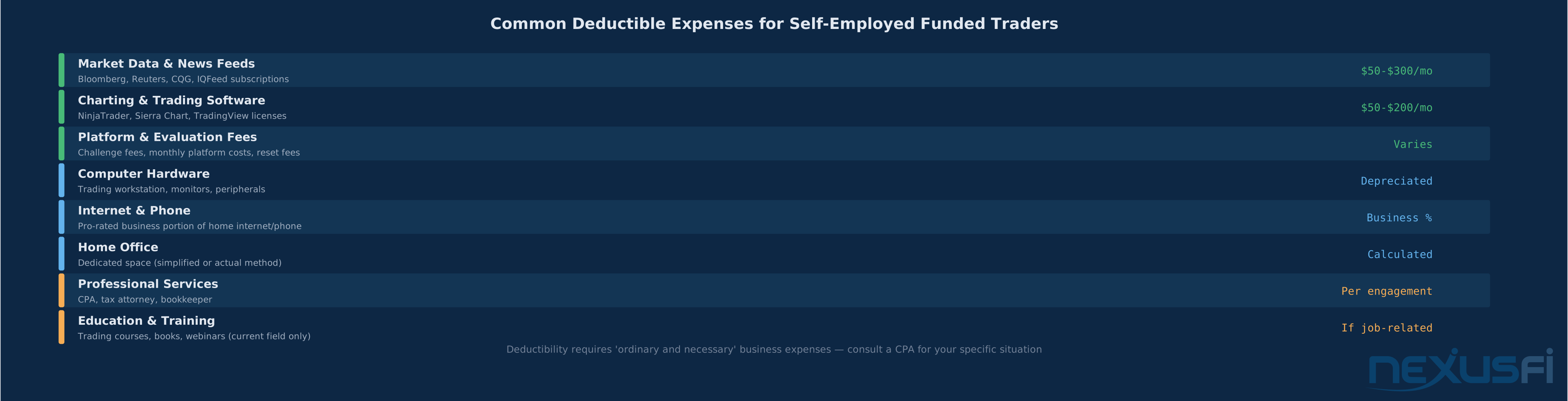
If your funded trading activity qualifies as a "trade or business" (not merely investment activity), you can deduct ordinary and necessary business expenses against your prop firm income. This is where careful planning can meaningfully reduce your tax bill.
Clearly Deductible Expenses
- Market data subscriptions: CQG, Rithmic, IQFeed, Bloomberg terminal costs -- if you pay for data to trade, it's a business expense
- Trading software: NinjaTrader licenses, Sierra Chart subscriptions, TradingView plans
- Platform and evaluation fees: The cost of your evaluation challenge, monthly platform fees, reset fees -- all directly related to generating prop firm income
- Professional services: CPA fees, tax preparation costs, legal review of contracts -- deductible as business expenses
Partially Deductible Expenses
- Internet and phone: The business-use percentage of your home internet and phone bill. If 60% of your internet usage is trading-related, 60% of the monthly cost is deductible.
- Computer hardware: Your trading workstation, monitors, and peripherals. Can be depreciated over several years or potentially deducted in full under Section 179 if used primarily for business.
- Home office: If you have a dedicated space used exclusively for trading, you can deduct home office expenses using either the simplified method ($5/sq ft, up to 300 sq ft) or the actual expense method (proportional share of rent/mortgage, utilities, insurance).
The "Trade or Business" Qualification
The IRS distinguishes between trading as a business and trading as investment activity. Business treatment (which enables broader deductions) requires that your trading demonstrates:
- Frequency and regularity: Trading daily or near-daily, not occasionally
- Continuity: Sustained activity over time, not sporadic bursts
- Profit intent: Trading with the intention of making a living, not as a hobby
Most full-time funded traders who trade daily during evaluation and funded phases will meet this standard. Part-time traders who trade a few times per month may face IRS challenges to their business deduction claims.
As @puapwr discussed on NexusFi in a thread titled "Trading is a Business": with prop firms, it's actually easier to write off losses and expenses because the firm structure clarifies that you're operating as a business, not a hobbyist. Fi added the critical caveat: "Ensure your prop firm's reporting method (1099-NEC vs 1099-MISC vs no form) aligns with how you're claiming expenses."
Business Entity Structure #
Should you form an LLC? An S-Corp? For most funded traders, the answer is less clear-cut than social media finance gurus suggest.
Sole Proprietorship (Default)
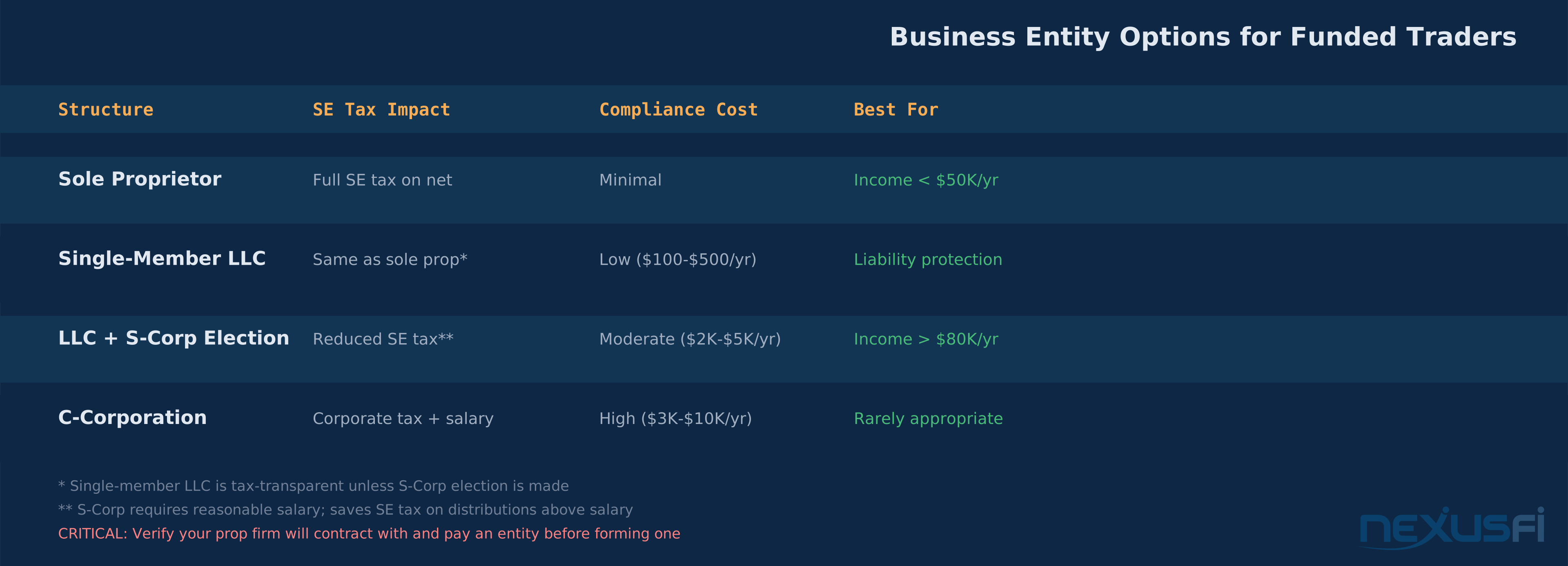
If you don't form an entity, you're a sole proprietor. This is the simplest structure: income and expenses flow directly to your personal tax return via Schedule C. No separate filing required. No formation costs. No annual compliance fees. For traders earning under $50K annually from prop payouts, this is often the most practical option.
Single-Member LLC
An LLC provides liability separation between your business and personal assets, but by default, a single-member LLC is "disregarded" for tax purposes — meaning the IRS treats it exactly like a sole proprietorship. The LLC doesn't change your tax bill; it only adds a layer of legal protection.
Cost: $50-$500 in state formation fees plus $0-$800 in annual franchise/renewal fees depending on your state.
LLC with S-Corp Election
This is the structure that gets the most attention for self-employment tax optimization. An S-Corp election allows you to split income between "reasonable salary" (subject to employment tax) and "distributions" (not subject to self-employment tax). If your prop income exceeds roughly $80K-$100K annually, the SE tax savings can outweigh the additional compliance costs.
The catch: S-Corps require payroll processing, quarterly payroll tax filings, W-2 issuance to yourself, and potentially higher accounting fees ($2,000-$5,000+ annually). And here's the critical constraint — many prop firms will not contract with or pay a business entity. They require the individual's personal participation and issue 1099s to the person, not the LLC. Verify this before spending money on entity formation.
The Right Decision Framework
Before forming any entity, confirm two things:
- Will your prop firm contract with and pay the entity? If the firm only pays individuals, an entity adds cost without tax benefit.
- Do the tax savings exceed the compliance costs? At $40K of prop income, the potential S-Corp SE tax savings (~$2,000-$3,000) may be entirely consumed by accounting and payroll costs. At $120K, the math works decisively in favor of an S-Corp.
As @dannyinhouston noted on NexusFi when discussing funded trader tax treatment: income from prop firms is ordinary income regardless of entity structure. The entity changes how self-employment tax is calculated, not whether the income is ordinary.
The Legal Relationship: What the Contract Actually Says #
The contract you signed with your prop firm isn't just legal formality — it's the document that determines your tax classification, your liability exposure, and your rights if a dispute arises over payouts.
Key Contract Provisions to Review
- Account ownership: The firm owns the account and capital. You have no property interest in the trading account itself -- only a contractual right to a share of profits generated by your trading activity.
- Payment characterization: How the contract describes your payout matters. "Compensation for services" is clearly ordinary income. "Profit share" may seem ambiguous but is typically treated the same way. "Bonus" has specific tax implications.
- Independent contractor vs. employee language: Most contracts explicitly state you're an independent contractor. This language supports 1099 treatment -- but if the firm's actual behavior contradicts it (excessive control over your methods), the IRS looks at substance, not labels.
- Termination and clawback rights: Can the firm reverse payouts for rule violations discovered after the fact? This affects when income is "recognized" for tax purposes.
- Non-compete and exclusivity clauses: Some firms restrict you from trading at competitors or managing personal accounts. These clauses have implications for both your tax filing (concentration of income) and your legal flexibility.
- Dispute resolution: Most contracts include mandatory arbitration clauses and class-action waivers. Know what forum and governing law applies before a dispute arises -- not after.
Simulated vs. Live Capital
A legally important distinction: some "funded accounts" trade on simulated infrastructure where the firm mirrors live market data but doesn't actually execute trades on an exchange. Others connect to real brokers with genuine market execution. Both can generate taxable income — the payout is compensation either way — but the distinction affects how the firm structures its own risk and, in some cases, how your contract describes the arrangement.
As @bobwest explained on NexusFi regarding the Topstep model: "It's not as if you had your own account with a 10k profit, which would be taxable to you. You are a contractor who is paid, in this case, 8k as income. The firm keeps the remaining 2k. You never had 10k." This framing — contractor paid for services, not trader generating gains — is the lens through which the IRS views most funded trading arrangements.
International Tax Considerations #
If either you or your prop firm is outside the United States, the tax situation becomes much more complex. Cross-border funded trading sits at the intersection of multiple tax jurisdictions, and the stakes for getting it wrong are high.
Non-U.S. Traders Working with U.S. Firms
If you're not a U.S. tax resident but receive payouts from a U.S.-based prop firm:
- The firm may require a W-8BEN or W-8BEN-E form to establish your foreign status
- Withholding tax may apply (typically 30% unless reduced by a tax treaty between your country and the U.S.)
- Your home country likely taxes the income as well -- check whether a double taxation treaty provides relief or credits
- The income is probably taxable in your country of tax residence regardless of where the firm is located
U.S. Traders Working with Offshore Firms
If your prop firm is based outside the U.S.:
- The income is still fully taxable in the U.S. -- you cannot avoid U.S. taxes by working with a foreign firm
- FBAR and FATCA reporting may be required if payouts flow through foreign bank accounts
- The firm may not issue any U.S. tax forms, making your record-keeping responsibilities even more critical
- Currency conversion gains/losses on payouts may create additional tax events
VAT and GST Considerations
Some jurisdictions (EU, UK, Australia, others) may impose VAT or GST on services rendered. Whether your trading activity as a funded trader constitutes a "service" subject to consumption tax varies by jurisdiction and requires local professional guidance.
The universal rule for international funded trading: engage a tax advisor with specific cross-border experience. The cost of professional advice is a deductible business expense — and it's vastly cheaper than penalties, interest, and back taxes from incorrect filing.
The Bottom Line #
Prop firm income is ordinary income. You are almost certainly an independent contractor. The firm's contract — not its marketing — determines your tax obligations. These are the three sentences that should frame every tax decision you make as a funded trader.
The practical implications: set aside 30-40% of every payout for taxes. Make quarterly estimated payments. Keep careful records of income and expenses. Don't form an entity until you've confirmed the firm will pay it and a CPA has modeled the net benefit. And get that CPA involved before your first filing season — not during it.
The cost of professional tax guidance is a legitimate, deductible business expense. It's also likely the highest-ROI investment a funded trader can make. A CPA who understands trading taxation and independent contractor classification will save you more in avoided mistakes than they cost in fees. Every year.
Knowledge Map
References This Article
Articles that build on this topicCitations
- — US taxes for prop trading, for example Top Step Trader“This would be ordinary 1099 income...subject to the full tax rate, not eligible for the 60/40 tax rules for Futures.”
- — The Scalper's Journey“You're an independent contractor, and your income is reported on a 1099 MISC.”
- — Trading is a Business“With prop firms and funding companies its actually even easier to write off all of those losses because they do not qualify as capital gains losses.”
- — Trading is a Business“Ensure your prop firm's reporting method (1099-NEC vs 1099-MISC vs no form) aligns with how you're claiming expenses.”
- — Any long term success stories from funded traders in these get-funded programs?“Ordinary income if you did not set up an LLC, or business income if you set up an LLC. From a live account you pay futures taxes 60/40.”
- — Topstep's Nick Dolby (Social Media and Community Coordinator) - Ask me Anything (AMA)“It's not as if you had your own account with a 10k profit. You are a contractor who is paid 8k as income. The firm keeps the remaining 2k.”