



Futures Trading Taxes in Canada: CRA Business Income vs. Capital Gains
Overview #
Canadian futures traders face a tax framework at the core different from the 60/40 rule that US traders enjoy under Section 1256 of the Internal Revenue Code. There is no Canadian equivalent. Instead, every trading decision flows from a single question from the Canada Revenue Agency (CRA): are your futures profits business income or capital gains?
The answer isn't based on the instrument. It's based on how you trade — frequency, intent, organization, and the overall pattern of your activity. That determination drives your effective tax rate, how losses are treated, whether you can deduct trading expenses, and your exposure to an audit. The difference between the two characterizations can exceed 25 percentage points of effective rate.
This article covers the full Canadian tax framework: the CRA factors test, Income Tax Act provisions (sections 9 and 38), the three interpretation bulletins governing characterization, after-tax math, TFSA and RRSP restrictions, US withholding under the Canada-US treaty, CAD translation requirements, deductible expenses, record-keeping, and audit triggers.
The Central Question: Business Income or Capital Gains? #
The CRA doesn't care what instrument you trade. Corn futures, E-mini S&P 500 contracts, crude oil — the instrument is irrelevant to characterization. What the CRA cares about is the nature of your trading activity under the Income Tax Act.
There are two possible outcomes:
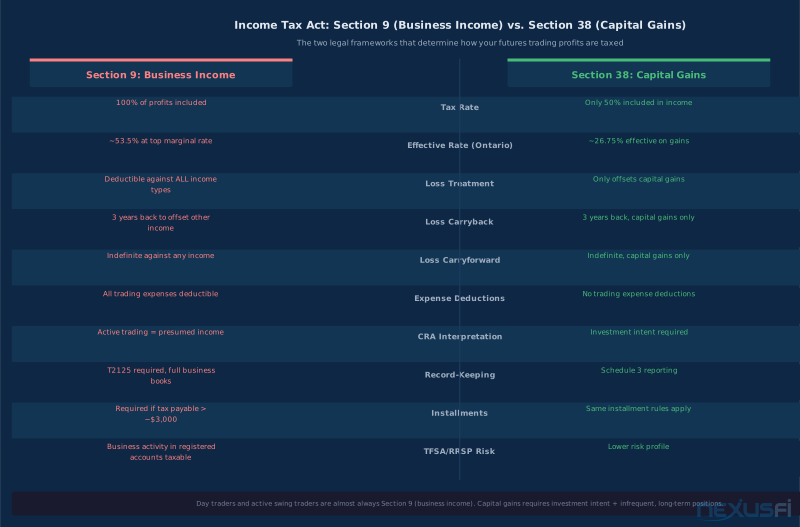
Business Income (Income Tax Act, section 9): Your trading profits are 100% taxable as ordinary income, included in your T1 return as business income. Your losses are deductible against other income without the restrictions that apply to capital losses. You can deduct trading-related expenses — data feeds, software subscriptions, a portion of internet costs, professional development. The downside: you're paying at your full marginal rate on every dollar of profit.
Capital Gains (Income Tax Act, section 38): Only 50% of your net capital gains are included in taxable income (the "inclusion rate"). Capital losses can only offset capital gains — you can't deduct them against employment income, interest income, or other ordinary income. You cannot carry them back or forward in most cases without restriction. Trading-related expenses generally aren't deductible. The upside: the effective tax rate on trading profits is substantially lower.
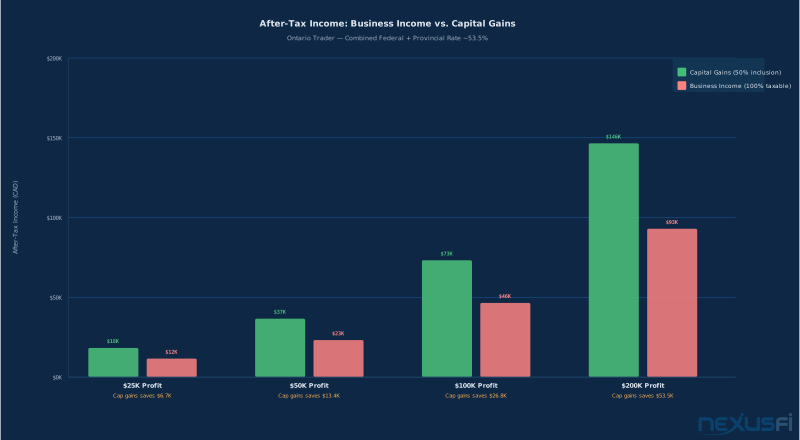
The practical math for an Ontario trader with $100,000 in futures profits:
| Scenario | Taxable Amount | Combined Federal + Provincial Rate | Tax Payable |
|---|---|---|---|
| Business income | $100,000 | ~52% (top marginal, Ontario) | ~$52,000 |
| Capital gains (50% inclusion) | $50,000 | ~52% (top marginal, Ontario) | ~$26,000 |
| Net difference | -- | -- | ~$26,000 |
That's a $26,000 difference on $100,000 of trading profits. At lower income levels where marginal rates are lower, the dollar difference shrinks but the proportional impact stays significant.
The obvious response is: everyone wants capital gains treatment. But CRA isn't going to let active day traders claim capital gains status just because they want the lower rate. The characterization follows the facts, not the preference.
The CRA Factors Test: How Your Trading Gets Characterized #
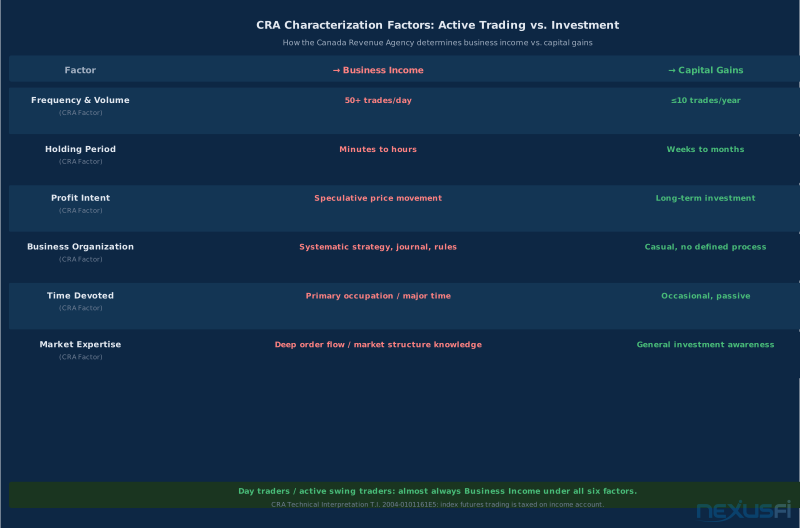
CRA doesn't apply a bright-line rule or a checklist with a passing score. Characterization is a facts-and-circumstances determination that weighs multiple factors. Courts have developed these factors through cases like Mittal v The Queen, 2012 TCC 417 and others. The key factors:
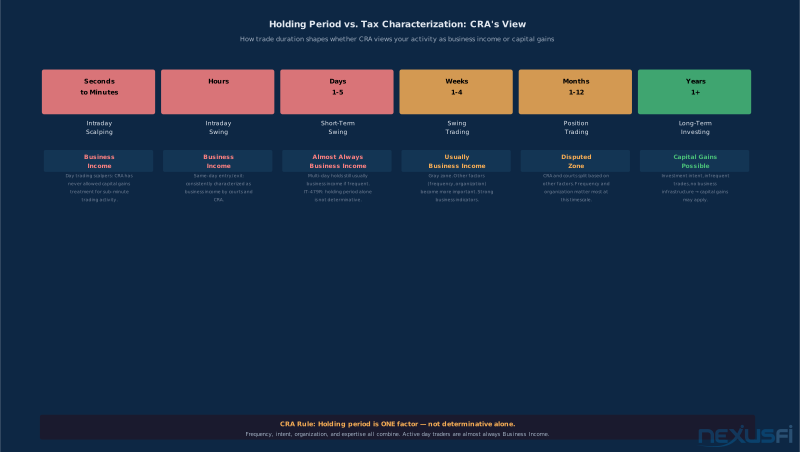
1. Frequency and volume of transactions. A trader placing 50 trades per day clearly operates differently from someone who takes 10 positions per year. High frequency points toward business income. This is the single biggest factor for most active futures traders — day trading and short-term swing trading almost always result in business income characterization.
2. Holding period. Short holding periods (minutes, hours, days) point toward business income. Longer-term positions held for weeks or months point toward investment and capital gains. If your average holding time is measured in minutes, you're running a business by CRA's definition.
3. Intent to profit from price movement. This sounds obvious — of course you're trying to profit. The distinction is between trading for speculative price movement (business) versus acquiring a position as a long-term investment or hedge (capital). A trader who enters ES contracts to capture intraday price movement is speculating. A farmer hedging crop exposure in corn futures might be on capital account.
4. Business-like organization and continuity. Do you have a systematic strategy? Risk management rules? A trading journal? Do you treat this like a professional operation? CRA looks for evidence that you're running something resembling a business — regular activity, organized process, dedicated resources. Occasional, casual activity points toward investment.
5. Knowledge and expertise. Specialized knowledge of order flow, market structure, and futures mechanics suggests professional engagement. Not determinative alone, but one factor among several.
6. Time devoted. Primary occupation or major time commitment points toward business. Occasional, passive position-taking points the other direction.
CRA technical interpretation T.I. 2004-0101161E5 is explicit: "Trading in stock option futures would normally be taxed on income account... Generally, an individual who makes trades in stock index futures every day, especially where those trades constitute the major source of income to that individual, will be taxed on the profit so on income account."
On commodity futures (T.I. 9404215): "Trading in commodity futures or commodities is either a business or considered to be an adventure in the nature of trade, such that related gains and losses would be on income account."
The baseline: active futures trading in Canada is almost always business income.
Bottom line for most NexusFi members: If you're day trading or swing trading futures — placing multiple trades weekly with the intent to profit from short-term price movements — you're almost certainly operating as a business for CRA purposes. Don't let anyone tell you otherwise without a strong legal argument based on your specific facts.
Income Tax Act Section 9: Business Income #
When futures trading is characterized as a business, all profits flow through section 9 — full inclusion in income, taxed at your marginal rate.
Revenue recognition: Realized profits from closed futures positions are business income in the year realized. Mark-to-market accounting (annual inclusion of unrealized gains) is not a standard requirement for individual Canadian traders.
Loss treatment: Business losses offset other income without the capital loss restrictions. Employment income, interest income, rental income — all fair game for offset. This is a genuine advantage of business characterization that gets overlooked in the rush to pursue capital gains treatment.
Loss carryback/carryforward: Non-capital losses carry back 3 years and forward 20 years. Capital losses carry back 3 years and forward indefinitely — but only against capital gains, not other income.
Expense deductibility: Reasonable expenses incurred to earn trading income become deductible — data feeds, software, home office, professional fees. This offsets some of the rate disadvantage vs. capital gains treatment.
Filing: Individual traders file a T2125 — Statement of Business or Professional Activities with their T1 return. Report gross trading revenue, itemized expenses, and net income. Net futures business income flows into total income and is taxed at applicable marginal rates.
Income Tax Act Section 38: Capital Gains #
Capital gains treatment under section 38 means only 50% of net capital gains are included in taxable income — the other 50 cents of every dollar of gain is entirely tax-free. Always confirm the current inclusion rate with a professional, as it has changed historically and may change again with federal budget legislation.
The major downside: capital loss restrictions. Capital losses can only offset capital gains — not employment income, interest income, or other ordinary income. A losing year in futures with no other capital gains means those losses sit trapped in carryforward until you generate future capital gains. For a year with significant losses and no offsetting capital gains, this is a serious constraint.
The section 39(4) election allows Canadian traders dealing in "Canadian securities" to lock in capital gains treatment on securities. This election does not apply to futures — it's securities-only.
Who legitimately gets capital gains on futures? Very few active futures traders. The defensible cases are: positions held weeks to months, low trade frequency (a handful per year), clear investment intent rather than speculation, and no systematic trading strategy. Anyone trading futures regularly for income should expect business income characterization.
The Three CRA Interpretation Bulletins Futures Traders Should Know #
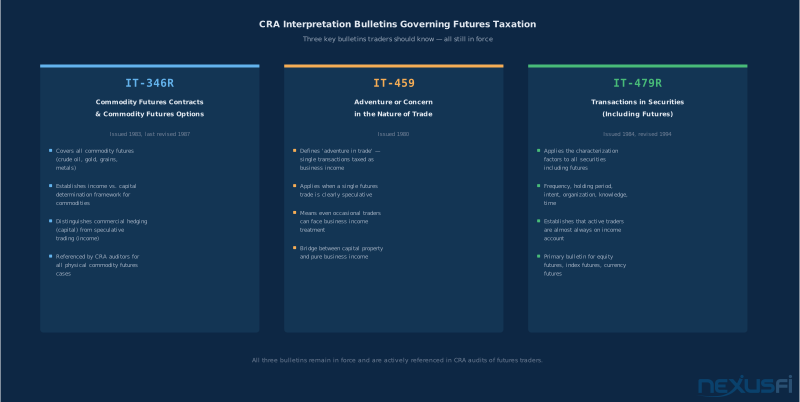
Three CRA interpretation bulletins directly govern how futures trading is characterized:
IT-346R — Commodity Futures and Certain Commodities: Distinguishes between commercial hedgers (farmers hedging crop sales) and pure speculators. For speculators — which covers most futures traders — gains and losses are on income account (business income), not capital. This is the primary authority establishing that commodity futures speculation is a business activity.
IT-459 — Adventure or Concern in the Nature of Trade: Explains what constitutes an "adventure or concern in the nature of trade." Even an isolated transaction can produce business income if the intent is short-term profit from price movements. Factors examined: the nature of the subject matter, the circumstances of the transaction, and the taxpayer's course of conduct.
IT-479R — Transactions in Securities: While primarily addressing securities, IT-479R's framework for distinguishing capital gains from income account treatment is applied broadly to derivatives. Courts use it to examine the "whole course of conduct" rather than individual transactions in isolation.
These bulletins are aging documents that predate electronic trading. CRA hasn't substantially updated them for high-frequency futures strategies, order flow trading, or micro futures mechanics. Courts have applied the underlying principles to modern trading and consistently found business income characterization for systematic, high-frequency approaches.
TFSA and RRSP: Why Futures Trading in Registered Accounts Is Dangerous #
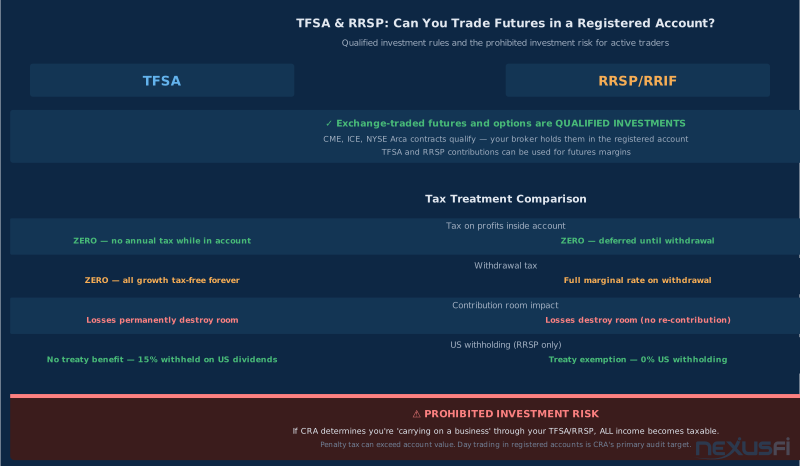
The TFSA and RRSP are Canada's tax-advantaged accounts. The appeal is obvious — tax-free futures profits. The reality: futures trading in registered accounts is largely prohibited and carries serious risk.
TFSA: The Income Tax Act defines "qualified investments" for TFSA accounts. Exchange-traded futures contracts are generally not qualified investments — futures require margin and create obligations rather than ownership of an asset. If you hold non-qualified investments in your TFSA, the penalty is 1% per month on the fair market value of the non-qualified position. On $50,000 of non-qualified futures positions, that's $6,000 per year in penalties alone.
RRSP: Same qualified investment rules apply. Futures contracts are not on the qualified investment list. Attempting to trade them directly in an RRSP creates the same penalty structure.
The "carrying on a business" risk: Even for technically qualified investments, CRA has pursued day traders who traded aggressively inside a TFSA and deemed them to be "carrying on a business" through the account — which strips the tax-exempt status for that business income. The same logic applies to high-frequency trading of futures-related ETFs inside a TFSA.
Do not attempt to trade futures in a TFSA or RRSP without explicit confirmation from your broker that the specific contracts are qualified investments, verified with a tax accountant. The downside — penalty taxes, loss of tax-exempt status — far exceeds any potential benefit.
The ETF workaround: Futures-tracking ETFs (leveraged, commodity, or sector ETFs) are generally qualified investments for TFSA/RRSP. You get equity exposure to futures-correlated products without holding contracts directly. The limitation: you're not getting direct futures exposure, execution quality, or the exact contract mechanics. It's a different instrument with different tax and risk characteristics.
US Futures Withholding Tax and the Canada-US Tax Treaty #
Most Canadian futures traders operate on US exchanges (CME, CBOT, NYMEX, ICE US) through US brokers. The good news on withholding: generally no US withholding tax applies.
Why futures gains aren't withheld: When you close a futures position for a gain, that gain isn't classified as a dividend, interest payment, or royalty — the categories covered by US non-resident withholding under the IRC and the Canada-US Tax Convention. Exchange-traded futures gains are trading gains, not passive income. Standard case: you trade ES or CL, you make money, no withholding statement, no IRS obligation. Report to CRA, pay Canadian taxes.
Where it gets complicated: Your account also generates non-futures income streams:
- Cash balance interest: Broker interest on uninvested cash or margin credit is US-sourced income. Subject to withholding under the treaty (generally 15% for Canadian residents). Broker issues a 1042-S form.
- Dividend-equivalent payments: Certain equity index futures (especially S&P 500-related contracts) can generate payments classified as "dividend equivalents" under IRC Section 871(m) near index dividend dates. Rare for standard ES/NQ but worth checking.
- Treasury collateral interest: If your broker invests your margin in T-bills or short-term Treasuries, the interest is US-source income with potential withholding.
Foreign tax credit: Any US withholding you pay is creditable against Canadian taxes on your T1 — prevents double-taxation. US withholding offsets part of your Canadian bill, not added on top.
Practical step: Pull every income line from your year-end broker statements — not just the P&L summary. Look for 1042-S forms. Identify interest payments, any dividend equivalents, and securities income. Your accountant needs all of it, not just the futures bottom line.
Currency Translation: Reporting USD Futures in Canadian Dollars #
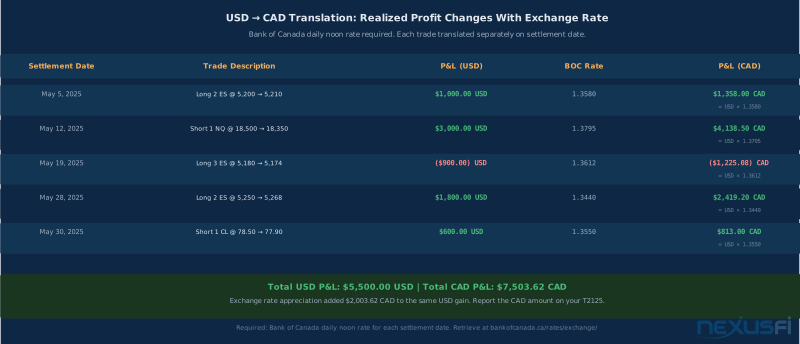
Every trade in a USD-denominated futures contract must be translated to Canadian dollars for CRA reporting. The USD P&L your broker shows you is not the number you report.
The requirement: Income Tax Act requires income reported in CAD. Convert at the Bank of Canada's noon exchange rate for the transaction date.
The calculation: Each futures position has two events — open and close — each at a different day's CAD/USD rate:
CAD P&L = (USD Exit Price × CAD/USD rate on exit date × contract multiplier)
         - (USD Entry Price × CAD/USD rate on entry date × contract multiplier)
         - (CAD equivalent of commissions)
ES bought at 5,900 with CAD/USD at 0.72 and sold at 5,950 with CAD/USD at 0.74 produces a different CAD result than the same trade at a constant rate. The exchange rate movement itself creates or destroys CAD profit independent of your futures P&L.
For high-frequency traders with thousands of trades, this is a real burden. Most US brokers report in USD only. T5008 slips from Canadian brokers are notoriously inaccurate for futures. You're largely on your own for accurate CAD calculation.
Consistency principle: Choose a method — Bank of Canada noon rate is standard — and apply it uniformly across all trades, all years. Switching methods is an audit flag.
Tools: Specialized accounting software (TradeLog, spreadsheet templates with Bank of Canada API integration) can automate the translation. Worth the investment for any trader with more than a few dozen annual trades.
Deductible Business Expenses for Canadian Futures Traders #
Business income characterization under section 9 comes with the right to deduct legitimate trading expenses — a meaningful offset that partially compensates for the higher marginal rate.
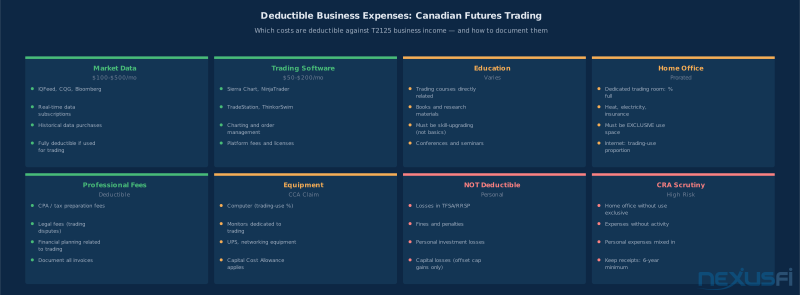
Deductible items:
- Data feeds and market data: CME real-time data, IQFeed, charting platform subscriptions, order flow tools. Keep invoices.
- Trading software and platform fees: NinjaTrader licenses, Sierra Chart subscriptions, platform-specific add-ons. If commissions are charged separately (not netted in P&L), they're deductible too.
- Professional development: Books, courses, webinars directly related to trading skill. The directly-connected test applies — general business education usually fails it.
- Home office: Pro-rated portion of rent or homeowner costs (mortgage interest, property taxes, utilities) for dedicated trading space. CRA requires the space be used "exclusively or primarily" for business. Pro-ration based on square footage.
- Internet and phone: Business-use percentage of internet costs. If dedicated to trading, 100%. Shared home connection, use a reasonable allocation.
- Professional fees: Accounting and legal fees for trading-related matters.
What you can't deduct: Personal expenses. Capital expenditures like computers and monitors — these are capitalized and depreciated via the Capital Cost Allowance system, not immediately expensed. Expenses without a connection to earning trading income.
Record-Keeping Requirements #
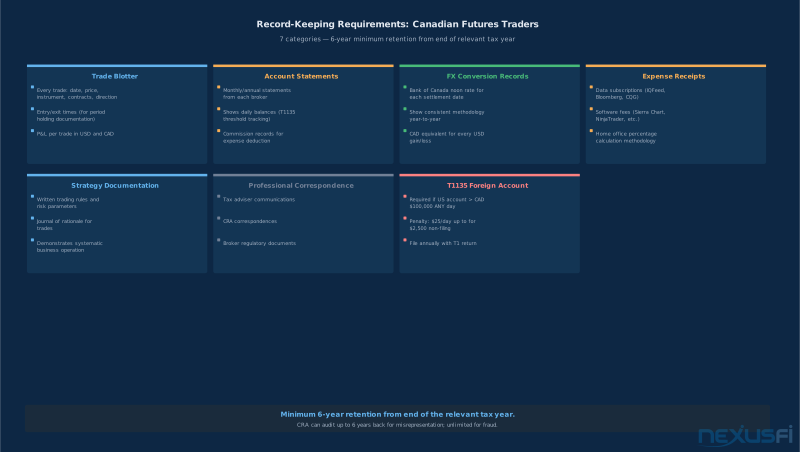
CRA expects business-income traders to support every number on the T2125. Year-end account summaries alone aren't sufficient.
Minimum documentation:
Trade journal/blotter: Every closed position — date, time, contract symbol, exchange, quantity, direction (long/short), entry price, exit price, commissions, and net P&L. Most platforms export this (NinjaTrader trade performance report, Sierra Chart trade statistics). Export alone isn't enough — you need the CAD-translated figures attached.
Account statements: Full monthly statements from your broker. These are the primary supporting documents if CRA questions your total P&L calculation.
FX conversion records: A spreadsheet or file documenting the Bank of Canada daily rate used for each trade or settlement date. This is your audit defense for the CAD translation methodology.
Expense receipts: Invoices for every data subscription, software fee, educational purchase, and home office calculation. Organize by year.
Strategy documentation: A trading journal with rationale for trades, risk management rules, and systematic process documentation strengthens the case that you're running a business. If CRA questions your characterization, the quality of your records is itself evidence.
Retention minimum: 6 years from the end of the relevant tax year. CRA can audit up to 6 years back for misrepresentation.
Provincial Tax: The Layer Federal Rules Don't Cover #
The Income Tax Act is federal, but provinces add their own rates on top. For high-income futures traders, the combined federal-plus-provincial marginal rate is what counts.
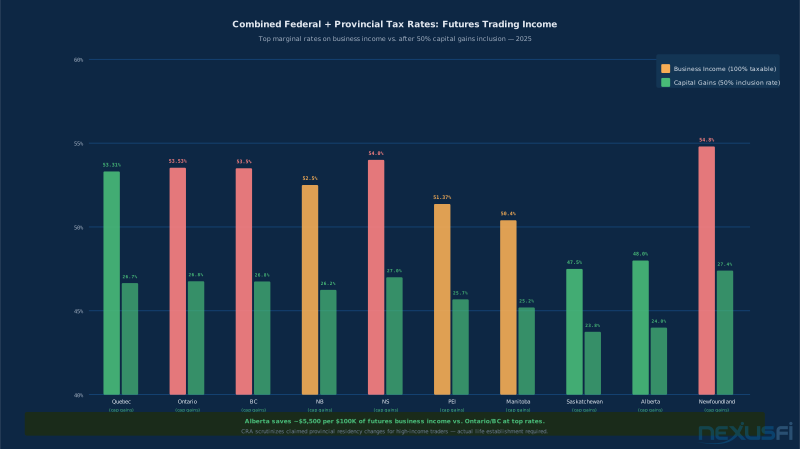
Top combined rates vary much by province (2024 approximations — always verify current rates): Ontario and BC sit near 53.5%, Quebec and New Brunswick around 53.3%, Alberta at approximately 48%, and Saskatchewan at 47.5%. For capital gains (50% inclusion), effective rates are roughly half these figures on the gain itself.
The Alberta differential: The 48% vs. 53.5% combined rate difference between Alberta and Ontario/BC represents roughly $5,500 per $100,000 of futures business income in additional taxes. For traders with consistent six-figure income and genuine residential flexibility, this matters. CRA scrutinizes claimed provincial residency changes by high-income individuals — actual life establishment in the new province is required, not just a mailing address.
Filing Mechanics: T1, T2125, and Getting It Right #
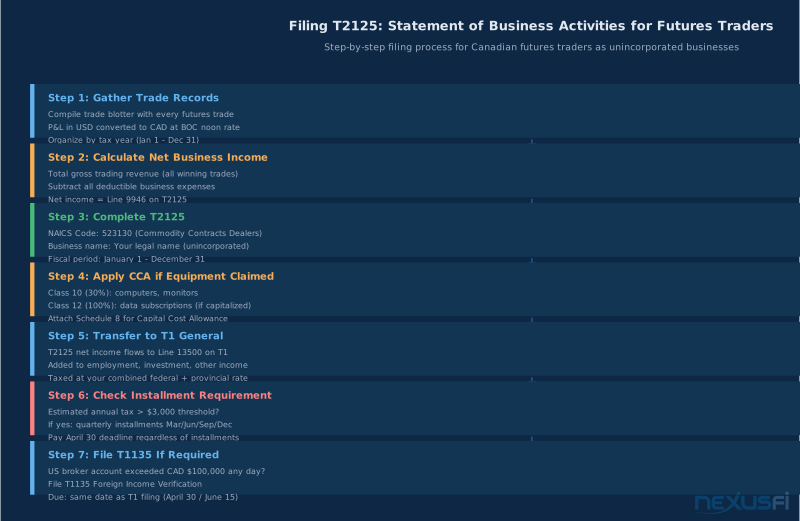
Individual traders (unincorporated): File a T1 General. Your futures business income flows through Form T2125 — Statement of Business or Professional Activities. Use NAICS industry code 523130 (Commodity Contracts Dealers and Brokers). Report gross trading revenue, deductible expenses, and net income — which flows into your total T1 income.
The T5008 problem: Most US brokers don't issue Canadian-specific tax slips. T5008 slips that some Canadian brokers issue for futures are frequently inaccurate — they don't properly handle open/close futures mechanics or apply CAD translation. Use your own detailed trade records as the primary documentation.
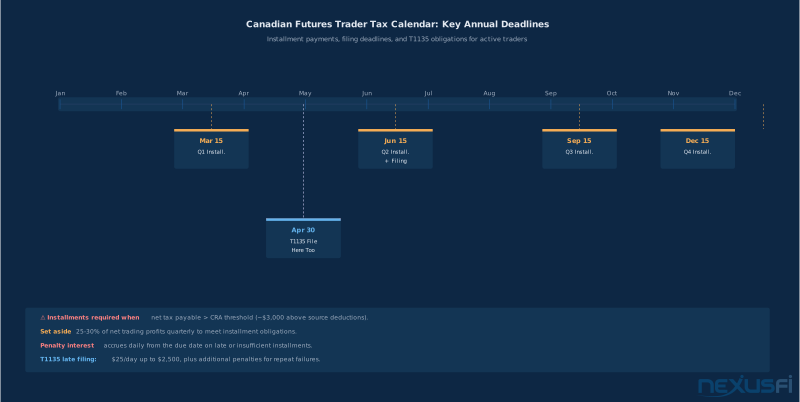
Installment payments: Net futures income above CRA's threshold (roughly $3,000 in taxes payable above source deductions) triggers quarterly installment requirements. Dates: March 15, June 15, September 15, December 15. Interest accrues daily on missed payments. Set aside 25-30% of net trading profits quarterly.
Filing deadline: April 30 for most Canadians. June 15 for self-employed individuals, but any balance owing is still due by April 30 to avoid interest.
Incorporation: Some high-volume traders incorporate a professional trading corporation to access the small business deduction (lower corporate rates on the first $500,000 of active business income). Worth modeling with an accountant if annual trading income consistently exceeds $150,000-200,000. Added compliance — corporate T2 return, legal structure, separate accounting — must be weighed against the tax benefit.
Common Audit Triggers for Canadian Futures Traders #
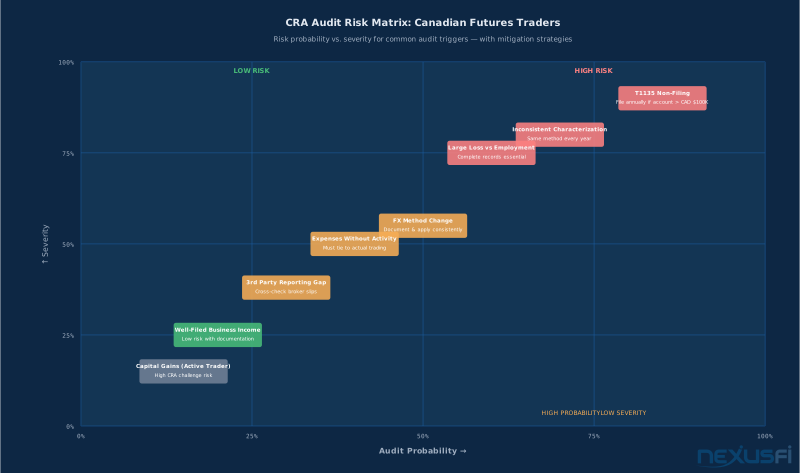
Inconsistent characterization: Claiming capital gains in profitable years and business income in loss years. CRA looks for this explicitly. Pick a characterization based on actual trading activity and maintain it consistently.
Large losses against employment income: A $100,000 trading loss claimed against $50,000 of employment income gets reviewed. Have complete records ready before filing.
Expenses without activity: Claiming data feed, home office, and software deductions on a return with little trading activity is a mismatch. Expenses must connect to actual operations.
FX methodology inconsistency: Switching conversion methods between years or using rates not tied to a legitimate source (Bank of Canada daily rate is standard). Document your methodology and apply it consistently.
T1135 non-filing: If your US futures account exceeded CAD $100,000 at any point during the year, you must file Form T1135 — Foreign Income Verification Statement. Penalty: $25/day up to $2,500, plus additional penalties for repeat failures. This is separate from your T1 and is the single most commonly overlooked compliance obligation for traders with US accounts.
Third-party reporting mismatches: CRA matches income reported by financial institutions with individual returns. If your broker reports amounts to CRA that don't appear on your return, you'll receive a query.
Practical Tax Planning Strategies #
1. Choose your characterization early. Don't wait until tax time. Active futures day trading means business income — plan around that from day one. Build your infrastructure, expense tracking, and CAD conversion system before your first trade.
2. Model the after-tax return. At a combined rate of 50%+ in Ontario or BC, your edge needs to survive a 50% haircut. If your strategy generates 15% gross return on capital, that's 7.5% after tax. Run the math before committing capital.
3. Set up record-keeping before you trade. Reconstructing records after the fact is painful. Use a spreadsheet or software that tracks every trade with CAD conversion built in from day one.
4. File T1135 every year your US account exceeds CAD $100,000. Even one day above the threshold in the year triggers filing. The penalty for non-filing is $25/day up to $2,500, plus additional penalties for repeat failures. This is separate from your T1 and is frequently overlooked.
5. Get a tax accountant who understands trading. General practitioners often don't know the nuances of futures characterization, T5008 limitations, or the technical interpretations. A specialist in trading taxation costs a few hundred dollars and can save you thousands.
6. Don't import US assumptions. Section 1256 and the 60/40 rule don't exist in Canada. US-focused trading tax content is actively misleading for Canadian traders. The CRA framework is entirely different — treat it as such.
Knowledge Map
Go Deeper
Build on this knowledgeReferences This Article
Articles that build on this topicCitations
- — futures tax rate in Canada? (2021) 👍 1“Bulletins of interest here would be IT-346R, IT-459, and IT-479R. Noteworthy technical interpretations include T.I. 2004-0101161E5 [on index futures]: 'Trading in stock option futures would normally be taxed on income account... An individual who makes trades in stock index futures every day, particularly where those trades constitute the major source of income to that individual, will be taxed on the profit therefore on income account.'”
- — futures tax rate in Canada? (2015) 👍 2“Is it just me or can most Canadian futures day traders on NexusFi be treated as 'speculators', since we probably don't trade as part of an activity in a market related to that futures market. Hence, only having half of our gains being taxable? Unless by default, if you trade at a very high frequency, you'd be considered to be in the 'business of trading.'”
- — futures tax rate in Canada? (2018) 👍 2“When I was trading futures I was flat at the end of the day. I do my own taxes with TurboTax Canada. With the tax program you can input the data from the T5008 issued by your broker. I had to adjust the T5008 numbers for the exchange rate. I filed using NetFile. I keep a detailed spreadsheet of all trades for backup.”
- — canadian trader and IRS / US taxes (2016) 👍 4“You don't worry about the IRS at all but when it comes to CRA if you trade more than a certain amount (and there is no real definition of what that is) then you would be considered to be running a business and would pay income tax rather than capital gains tax. The W-8BEN form protects you from US IRS obligations as a foreign national.”
- — New-is trader looking for guidance (2020) 👍 2“I have a Canadian TFSA and have bought stocks, mainly to hold onto for the long run as longer term investments. I've been reading a lot about the differences between trading within a TFSA versus a regular account. The tax treatment is fundamentally different and gets complicated quickly for futures traders.”
- — futures tax rate in Canada? (2015) 👍 1“Day trading is considered the same as if you were being an autonomous worker or independent contractor. If you trade the stock markets within a TFSA, it is different. But futures day trading generates business income -- there is not much ambiguity for active traders. You're running a business whether you like it or not.”
- — Regarding minimum balance and taxes (Canadian trader, Ninjatrader) (2016) 👍 3“As a Toronto-based futures trader, the CRA tax treatment for futures is something you should understand before you go live. The W-8BEN form with US brokers handles the US side. The Canadian side depends on your trading frequency -- active day trading is income, not capital gains.”
- — futures tax rate in Canada? (2015) 👍 1“Not an expert in Canadian tax, but am an expert in South African tax which typically refers to UK case law. If you apply a lot of your time to the buying and selling of futures, it will most likely be considered your business. The frequency of trading and the time spent are key factors, regardless of the jurisdiction.”
- — IT-479R -- Transactions in Securities (1994)
- — Technical Interpretation 2004-0101161E5 -- Index Futures Trading (2004)
- — Mittal v The Queen, 2012 TCC 417 -- Characterization of Futures Trading (2012)