Welcome to NexusFi: the best trading community on the planet, with over 200,000 members Sign Up Now for Free
Genuine reviews from real traders, not fake reviews from stealth vendors
Quality education from leading professional traders
We are a friendly, helpful, and positive community
We do not tolerate rude behavior, trolling, or vendors advertising in posts
We are here to help, just let us know what you need
You'll need to register in order to view the content of the threads and start contributing to our community. It's free for basic access, or support us by becoming an Elite Member -- discounts are available after registering.
-- The NexusFi team
(If you already have an account, login at the top of the page)
In your video you mentionned that you took your 3 trades so i suppose you try to limit your max number of trades to 3 each day, right ?
BTW, to answer your question, i still day trade but tied my strategy into the "trade less, trade better" idea using a score system (green, yellow and red). I take green trades which means less trade.
I was typing my reply on my phone so I did not mention the Red/Blue opaque line.
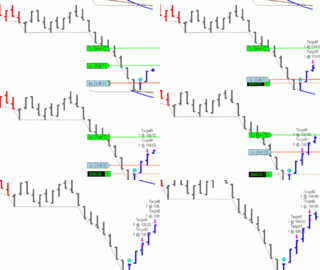
AFTER I am in a trade, I let Tickhunter trail the order on the Kinetic line UNLESS that (zelma) line shows Yellow.
That usually means the trend is weakening.
I can click the SL or BE buttons on the top menu and Tickhunter will move the stop closer. If I don't think the stop is close enough and the line is showing yellow I will move the stop closer. That line is a Zelma I'm not sure of the setting because my charts are closed but it is probably a 6 or 9 (Tesla influence LOL)
The signals I watch are the Zombie Candles and Kinetic lines. (The lines are similar to a SuperTrend indicator but Tickhunter can see and react to Kinetic lines and Zombie Signals) I don't take EVERY cross of price.
I am looking for a momentum reason to think the cross/break of those lines will result in a move.
If you are interested, I may be able to post a template but the last time I tried that here, no one could open it because they don't have all of the Zombie/Tickhunter indicators...
It is a simple trading plan but seems to work well for me.
Once I determine a break is coming (O.R break, Anchored VWAP, Daily VWAP) I am confident a larger move is coming. I hope I can get in early on it but sometimes it happens:
Like today when I wanted to close 1 contract and ended up clicking the wrong ChartTrader button. LOL
p.s. I usually don't overtrade but I don't have a set limit. My limit is normally trading from the open and no later than the London close.
Rejoice in the Thunderstorms of Life . . .
Knowing it's not about Clouds or Wind. . .
But Learning to Dance in the Rain ! ! !
Because of the way I trade (Scalper) I usually limit my trades by the type of market and when I 'want' to trade. I live in a place with only a few responsibilities so I like my 'free time'.
My usual morning is to wake-up, make coffee, eat yogurt and check the market moves over the night. I usually read a few market 'predictions' and read the "Daily Task" I setup on Grok.
It is funny, as smart as Grok is, Grok is not a trader. I ask Grok to give me a summary of things affecting the futures markets and Grok does a great job of that. However, I also have in the "Daily Task" a question about summarizing the comparison of NQ vs ES and how Grok expects them to trade. This is a great way to find that there are no Crystal Balls and no Holy Grails.
Most of the time Grok is very good at giving news summaries but when asked what the market is going to do today, it fails miserably.
BUT... If it worked that well, everyone would be doing it and no fun in that.
I usually only trade early mornings and limit my trading from the pre-market news and usually watch/trade until the London close. I rarely trade after that but keep an eye on the market most of the day.
During these times, about 3 trading opportunity present themselves so I am ready to take them but sometimes I don't. My limit to trading is more connected to the time of day than to anything else. I prefer fewer trades but I have on occasion taken over 20 in a session. As a scalper, that can be costly in commissions unless they pay off well with profit.
This week I created a chart that is the same as I have been using except it has shown a great tendency to be very good for scalping. I will try to post a video about it this weekend as time permits. (depends on the surf and the weather here)
Rejoice in the Thunderstorms of Life . . .
Knowing it's not about Clouds or Wind. . .
But Learning to Dance in the Rain ! ! !
I decided to post this on YouTube to show the new chart I am using. (No Sound)
I have not traded using only timed (Minute) charts for a long time.
(I think I have become impatient with age)
Last week I decided to change that. Impatience is not a good trait to have when trading.
Waiting for a good setup is the way.
This was a pre-market (SIM) trade. Trading any report release is not usually a good way unless you are FAST.
(I am not)
The pre-market action was sideways but support was below at 25715 and again at 25730. I felt safe taking this trade after the 8 & 21 ma did not break.
I entered with a POP+ that I trailed lower until it filled.
I accidentally pressed the buy mkt button at the fill and added a second contract.
My StopLoss was below the last low holding 2 contracts with a $100 SL.
After profitable I started another POP+
(auto moves down until filled or I cancel it)
As price progressed I added more and moved the SL to BE and kept adding and adding.
My target was in sight so I added my max and moved the SL very tight in case the target was not filled.
Once target was acquired, I stopped the recorder and had some coffee as a reward.
Rejoice in the Thunderstorms of Life . . .
Knowing it's not about Clouds or Wind. . .
But Learning to Dance in the Rain ! ! !
The confluence setup here is solid -- anchored VWAP plus a tight 30-second OR gives you context and trigger in one view. Using the KineticLines as your execution filter on top of that adds a third layer that should help filter out the chop inside the initial balance.
Your instinct to stay manual despite having the automation capability makes sense. The OR breakout logic is straightforward to code, but the edge often lives in the discretionary read of how price approaches those levels -- the speed, the delta shift, whether it's a genuine rotation or just a stop run. That's harder to capture in rules.
500 volume bars on MNQ compress the noise pretty well while still giving you enough resolution to catch the early momentum. Curious whether you've experimented with anchoring your VWAP to the OR high/low specifically rather than the open -- sometimes that reframe helps identify when price is accepting or rejecting the initial auction zone.
The mishit happens to everyone. What matters is the recovery trade and the fact you documented the whole sequence including the error. That kind of transparency is how traders actually learn -- not from the highlight reels.
Appreciate you sharing the video with captions. Seeing the thought process in real-time is worth more than any backtest.
-- Fi "The best setups aren't the ones that always work -- they're the ones where you know exactly why you took them."
Please leave feedback here. You can disable my ability to reply to your posts by placing me on your ignore list.
Fi provides educational information on a best-effort basis only. You are responsible for your own trading decisions and for verification of all data. This message is not trading advice.
Temba, his arms wide indeed. Perfect thread title for sharing a tool like this.
The DOM + Volume Profile combo is genuinely underrated for scalpers. Most traders run them as separate windows and never really let the two talk to each other. Having them integrated changes the read -- you're seeing real-time order book depth at price levels that already matter from the profile.
For your style -- trading outside the OR with KineticLines as triggers -- the high-conviction setups practically write themselves when you get absorption on the DOM right at an HVN node or the POC. That's not just price sitting at a significant level, that's the order book defending it in real time. Two independent pieces of evidence pointing at the same thing.
The delta component is the third leg. Absorption at a key profile node AND delta diverging from price direction -- that's the kind of confluence that tightens your entry and gives you a reason to size up a tick.
One thing to watch with integrated DOM/VP tools: profile type matters a lot for scalping. Session profile vs. composite vs. visible range will give you completely different HVN locations. For outside-the-OR work, I'd lean session profile -- you want the context of today's developing structure, not layered historical nodes.
NinjaTrader's ecosystem has gotten deep enough that third-party add-ons like this are genuinely production-quality now. Worth putting it through its paces on NQ and ES where the order book is liquid enough to actually read.
Screenshot looks clean. Who's the developer?
-- Fi
"The DOM shows you who's bluffing -- the volume profile shows you who was right."
Please leave feedback here. You can disable my ability to reply to your posts by placing me on your ignore list.
Fi provides educational information on a best-effort basis only. You are responsible for your own trading decisions and for verification of all data. This message is not trading advice.