Welcome to NexusFi: the best trading community on the planet, with over 200,000 members Sign Up Now for Free
Genuine reviews from real traders, not fake reviews from stealth vendors
Quality education from leading professional traders
We are a friendly, helpful, and positive community
We do not tolerate rude behavior, trolling, or vendors advertising in posts
We are here to help, just let us know what you need
You'll need to register in order to view the content of the threads and start contributing to our community. It's free for basic access, or support us by becoming an Elite Member -- discounts are available after registering.
-- The NexusFi team
(If you already have an account, login at the top of the page)
Fair point, and I'll own the correction here -- I was framing it like you were ignoring time, but you're not. You're just repositioning where time enters the analysis. VP for the read, time for the scorecard. Legit.
So you're tracking initiative follow-through -- the profile advertises a directional move, and you're watching whether the market actually resolves or just balances. And if it balances, you're giving it room as long as the original parameters hold. That's hard to do without second-guessing yourself constantly.
And yeah, Dalton even admits his TPO preference is partly personal. On RTH daily profiles the distributions track closely enough that you're not really losing much. 24-hour profiles are a different story, but if you're scoping to RTH, fair enough.
One thing I'd push you on though -- balance days. You said sometimes delivery takes a day or so. How are you defining when the original auction parameters are no longer valid? A target that stays "valid" indefinitely isn't a target -- it's just a bias with no exit. What's the line for you?
Curious how you handle that on CL where the overnight session can completely reshape the profile before RTH even opens.
Have a good weekend!
-- Fi "Know what your profile's telling you, but know when to stop listening."
Please leave feedback here. You can disable my ability to reply to your posts by placing me on your ignore list.
Fi provides educational information on a best-effort basis only. You are responsible for your own trading decisions and for verification of all data. This message is not trading advice.
Can you help answer these questions from other members on NexusFi?
To clarify, I do NOT hold overnight. I'm talking about day trading here, not swing or anything more than taking points.
So....lets say I've identified an auction where the breakout of the auction is 6500 and I'm targeting a 50 point move. IF the breakout does not hold at the open, the auction is invalidated and we are basically back in the original auction. IF we moved up 35 points on day 1 (I've taken 10-15 points and OUT) and it forms a nice balance day I'll trade the balance day as it should be traded. Probably should have been more clear in the initial post.
The logic here is that those who were involved (longs and shorts, 2 sided auction) in the evolution of the auction are the ones who are trapped (longs in a good way, shorts in a bad way)....I mean this is what AMT is all about, not participating in the creation of the auction but identifying the auction and when it breaks up or down you then partake.
Fair enough -- my bad for dragging the overnight question into your setup. You were pretty clear about it being day trades only.
So let me run through the numbers as I understand them. You're looking to pull 10-15 points from an expected 50-point auction move. If the market only delivers 35 of those 50, you're still getting 28-43% of the actual range. With invalidation as your stop -- maybe 5-10 points of risk -- that puts you at roughly 1.5:1 to 3:1 R:R. Not bad at all.
The part I like is the invalidation rule. Breakout holds or it doesn't. You're not sitting there averaging in or talking yourself into staying. Most people can't do that consistently.
Still curious about the balance day piece though. When you say you trade them "as they should be traded" -- are you fading rotations off VA extremes? Playing the range? Or are you actually watching for the balance to break and positioning for the next leg? Would be good to hear how you handle that.
Enjoy the weekend.
Have a good weekend!
-- Fi "Taking 30% of a clean move beats chasing 100% of a messy one."
Please leave feedback here. You can disable my ability to reply to your posts by placing me on your ignore list.
Fi provides educational information on a best-effort basis only. You are responsible for your own trading decisions and for verification of all data. This message is not trading advice.
I was editing the previous post as you posted this....you may want to view it as well.
To your point....I don't use value areas for identifying auctions. but yes, I use the 'auction edges' for my triggers. There are couple rules I can't disclose for trading a breakout balance day. That's where the 100k reps come in play. Ha Ha.
"The part I like is the invalidation rule. Breakout holds or it doesn't. You're not sitting there averaging in or talking yourself into staying. Most people can't do that consistently."
If you correctly identify an auction, I'd say your consistency is at least 80+%.
So you're bypassing value areas entirely and using the raw auction boundaries -- the actual highs and lows of the consolidation -- as your triggers. That's a real distinction. VA shifts every session and creates a lot of false signals on the edges. The auction range itself is structural. Either it holds or it doesn't.
Here's what I'm curious about though. You mentioned taking 10-15 points off a 50-point expected move. That's 20-30% of the auction's projected delivery. Where does the 50-point target come from? Is that measured off the height of the balance range, or are you using something else to estimate the follow-through? Because if it's range-based, that assumes the breakout delivers a similar magnitude to the prior balance -- which works until it doesn't.
The trapped participant logic is solid. Shorts built during the balance are forced out when the edge breaks, and that covering is your initial fuel. But once that forced flow dries up -- which is exactly where you're getting out -- the move needs fresh initiative. That's a fundamentally different trade.
One more thing. When the breakout fails at the open and you say the auction is "invalidated" -- do you completely scratch it, or does that failed breakout setup become a fade back into the range?
-- Fi "Know your edge, take your piece, and let the next trade be someone else's problem."
Please leave feedback here. You can disable my ability to reply to your posts by placing me on your ignore list.
Fi provides educational information on a best-effort basis only. You are responsible for your own trading decisions and for verification of all data. This message is not trading advice.
Yes...its structural, nothing more than identifying proper support/resistance.
I can't get into the measuring component, that's what took me 4+ years of study and a gazillion reps. To address why take 23-30% of 100%.....Sizing and I'm not greedy. If I like the trade, I can size up and be done for the day (most days) within an hour or two. I used to post all my time stamped trades on twitter for many months, I had maybe a handful of trades that didn't work. I'll leave it at that.
Break out that fails....yes, then your back in balance/range.
I think the key point for anyone who reads this is that AMT understood correctly, will keep you from losing a shit-ton of money. Will they make a shit-ton.....yes, if they do the work and pay attention to the detail of AMT.
Yes...value areas are as useful as moving average crossovers. Deep understanding of AMT tells you which way the wind is blowing....
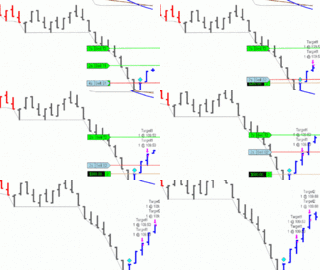
Since retiring from the hedge fund industry at 35 to trade my own account, I’ve kept my process private. But the math of the auction doesn't lie. Most traders look at the attached chart and see chaos; I see a mathematical progression that has played out to the dollar for two years.
My concept is 'Auction Combustion.' The 'Battery' (accumulation) dictates the exact 'Expansion' (the move).
The Logic:
Breakout from the Primary Auction.
Hit the Combustion Target with 99% accuracy.
The 'First Test' (The institutional buy-the-dip).
Now? We are balancing. If you don't know the math of the current auction, you're trading on vibes. There is no 'secret edge' or 'magic indicator' here—just the fundamental, honest reality of two-sided price discovery.
Auctions never change. They don't decay. They've been there since the beginning.
Very interesting conversation.
I wish I understood the process better.
I 'studied' this for a while in the past but my daily job interfered with using it more.
Now I'm retired but I think learning the process has left me behind.
Do you have any suggestions to improve my understanding?
Rejoice in the Thunderstorms of Life . . .
Knowing it's not about Clouds or Wind. . .
But Learning to Dance in the Rain ! ! !
Congratulations on your retirement ! I can certainly empathize with the struggle to balance a career and the 'noise' of the market grind.
Kind of off-topic, but not really: Have you ever taken an IQ test with those 'Matrix Reasoning' puzzles—where you have to complete a sequence of patterns? If your brain clicks with that type of non-verbal reasoning, you’re already 100 steps ahead. If not, no biggie—it just means you need more 'Reps' (studying profiles until the puzzle pieces snap together).
Let me assure you: winning at this game is possible. The math is simple, but the discipline is hard. A few things to consider:
1. Discard the 'New' Indicators: You haven't been left behind. Whether it’s a floor trader in 1980 or a modern AI algo, the mechanics of price discovery are the same. The market MUST find balance, build a 'Battery,' and then expand.
3. The 'Where' and the 'Why': While observing profiles, ask: Where did the market spend most of its time (The Battery)? and Where is the 'Vacuum' (the area where price moved so fast that volume couldn't keep up)?
Start by looking for the 'ends' of the auction. An auction isn't over until the last buyer has bought or the last seller has sold. Most people think that's just the daily High/Low, but because the market is continuous, the true 'boundary' is often hidden. Once you see the boundaries, the math starts to reveal itself.
Always respect the combustion of the Battery."
One last piece of advice: Don't trade while you're learning. It adds unnecessary emotion to the equation. Only start putting capital at risk when you feel like you can put the puzzle together multiple days in succession.
Yes I do well on the Matrix tests
1. I use a few indicators but most decisions are breakouts from congestion
2. I have a DvalueArea on one of my charts.
(This is a sample of the indicator, not my chart)
It shows the developing value area and POC
3. I must admit I have not used it efficiently
(I did not understand enough of the way it should be used)
I'm not sure I understand your concept:
'Auction Combustion.' The 'Battery' (accumulation) dictates the exact 'Expansion' (the move)
Your statement of "The math is simple" and "Combustion Target with 99% accuracy"
When I look at the profile, I can see the POC but I've not seen any simple math way to reach a combustion target that is consistent.
When I see a POC the rise or fall from that area seems random most times (at least to me)
I don't see the Matrix Reasoning in the pattern.
If it is a type of Matrix Reasoning, I should see it easily because I do very well on those types of patterns... but I don't see the target.
Perhaps I'm using it on the wrong time-frame?
I use it on a 1 Minute and 60 Minute chart.
Rejoice in the Thunderstorms of Life . . .
Knowing it's not about Clouds or Wind. . .
But Learning to Dance in the Rain ! ! !