



Prediction Markets and Event Contracts: Binary Outcomes, CFTC Regulation, and the New Derivatives Frontier
Overview #
Kalshi is the first CFTC-regulated prediction market exchange in the United States. It lists binary event contracts — simple yes/no propositions about real-world outcomes — that settle at either $0 or $100 based on whether a specified event occurs. Think of it as futures trading stripped down to its purest form: you're trading probability, not price.
The exchange received its Designated Contract Market (DCM) license from the CFTC in October 2021, making it subject to the same regulatory framework as CME Group. But that's where the similarities with traditional futures exchanges get interesting — and where the differences matter.
Key Concepts #
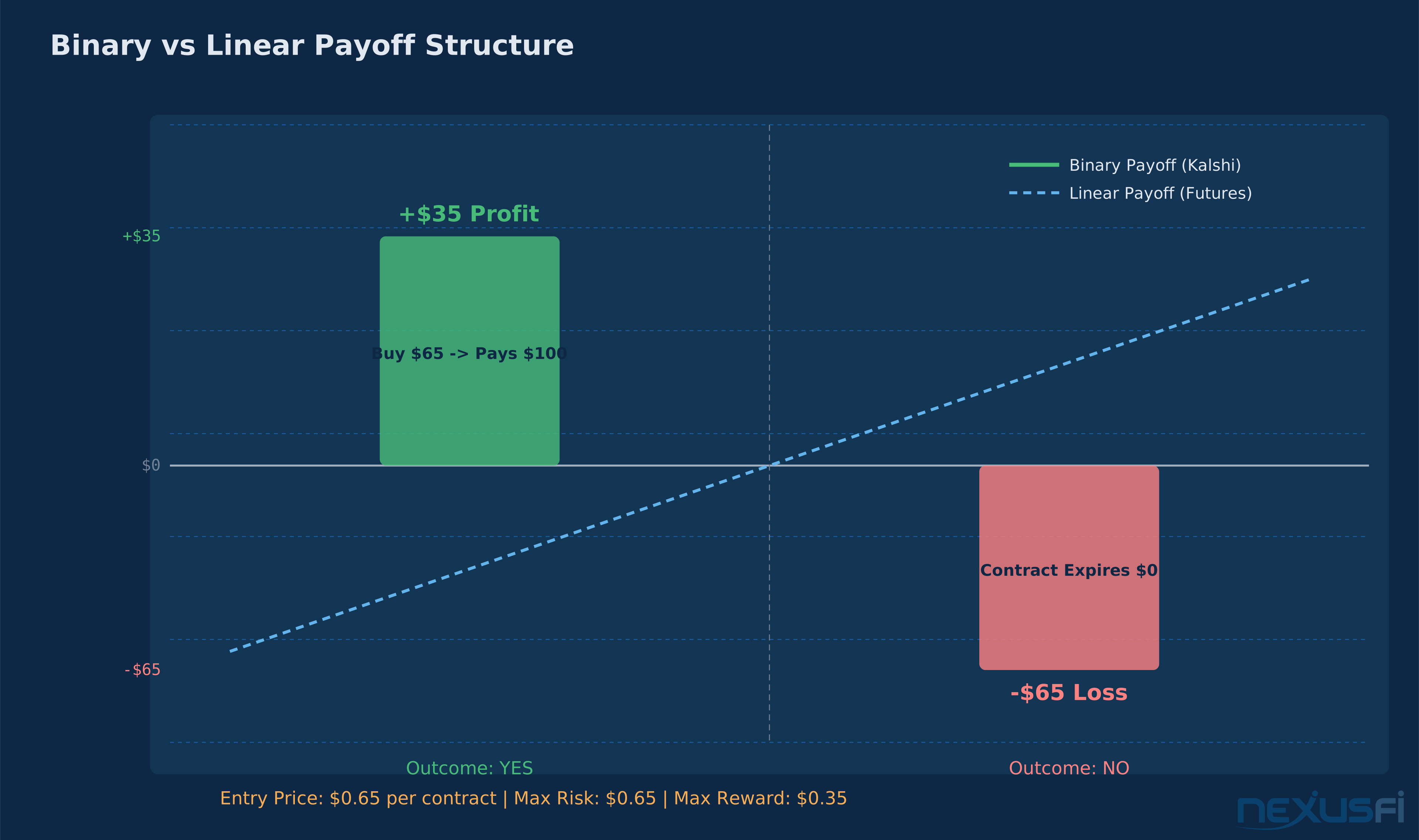
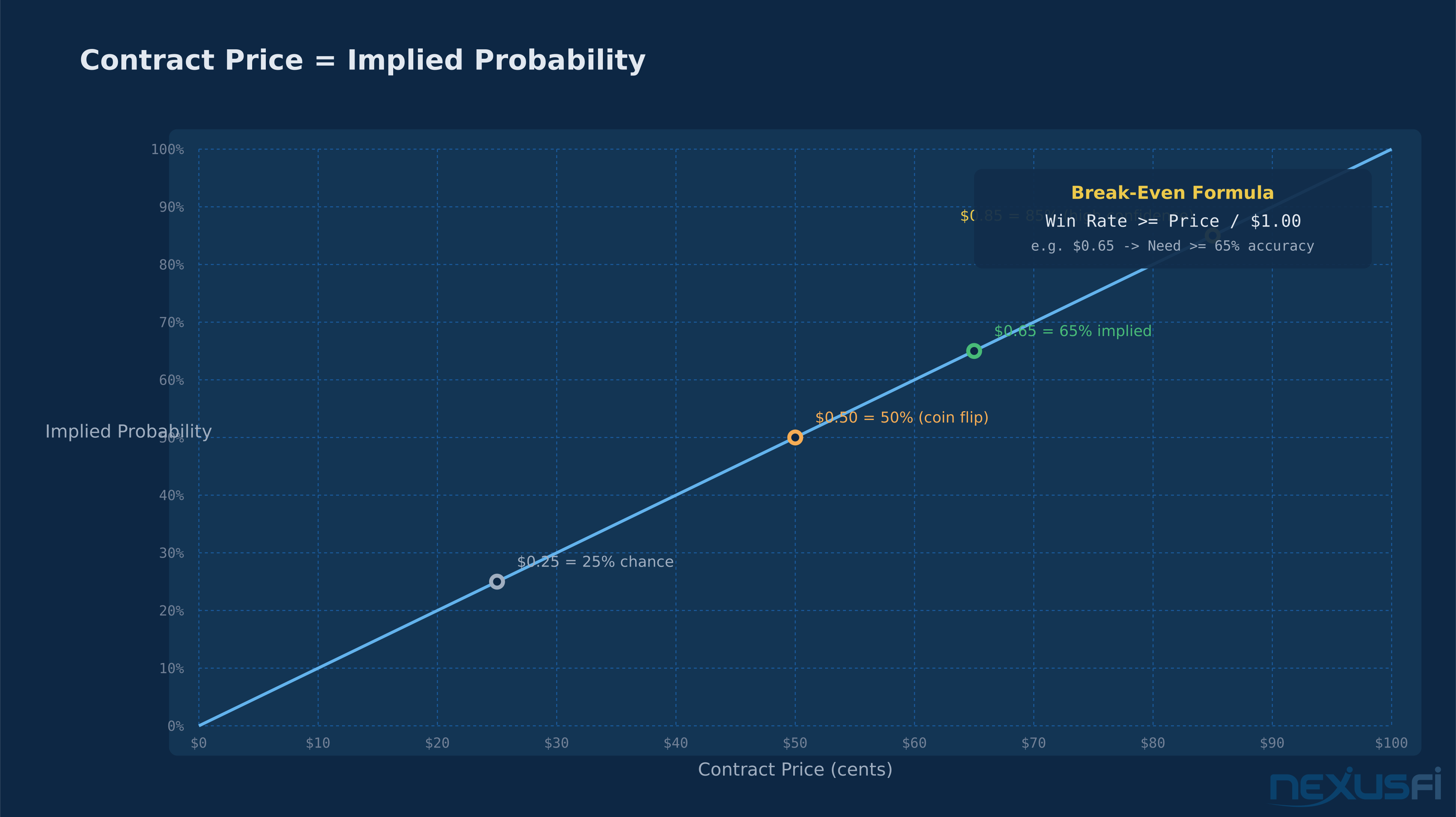
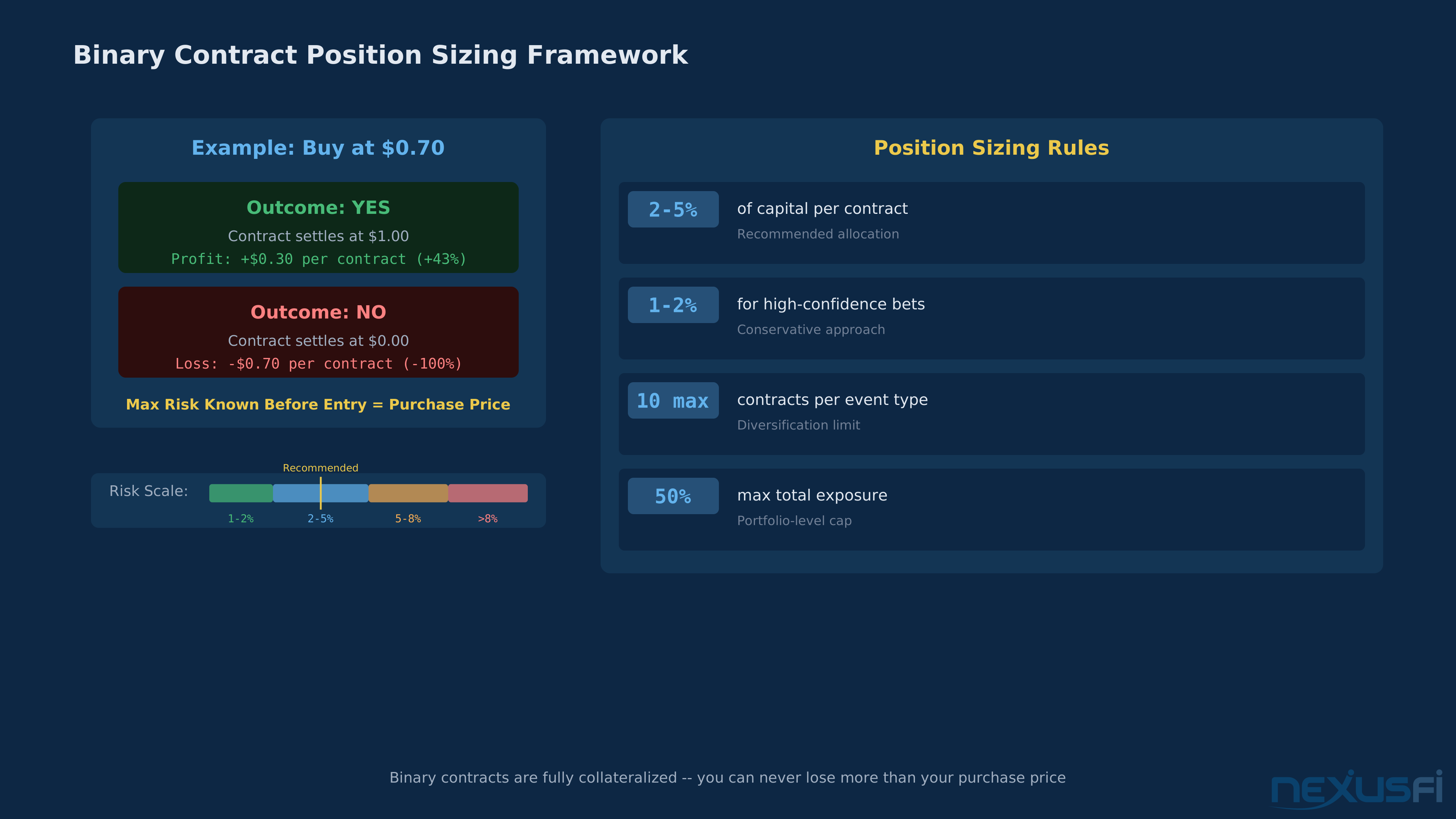
Event Contracts: The core product on Kalshi. Each contract is a question with a binary outcome: "Will US CPI year-over-year exceed 3% in March?" or "Will the Fed raise rates at the September meeting?" The contract trades between $0 and $100, where the price represents the market's implied probability. Buy at $65, you're saying there's a 65% chance the event happens. If it does, you collect $100. If it doesn't, you lose your $65. No margin calls, no variation margin, no overnight financing — your maximum loss is the purchase price.
Binary Settlement: Every contract resolves to exactly $0 or $100. There's no "close to right." A CPI print of 2.99% when you need "above 3%" means you lose everything. This binary payoff structure is at the core different from linear futures, where a small miss in your thesis still leaves you with a position that has value. On Kalshi, partial correctness pays zero.
Implied Probability Pricing: The contract price divided by 100 equals the market's consensus probability. A contract trading at $42 implies a 42% probability of the event occurring. This makes Kalshi uniquely useful for probability discovery — you're watching the crowd's real-money estimate of whether something will happen. But here's the catch that burns new traders: implied probability in thin markets can be wildly misleading. If only 15 contracts sit on the book, that "42% probability" is one trader's opinion with $150 behind it, not the crowd's wisdom.
Designated Contract Market (DCM): Kalshi's regulatory classification under the Commodity Exchange Act. Same designation as CME, Cboe, and ICE. CFTC oversight, mandatory reporting, customer fund segregation, market surveillance — the full regulatory package.
Resolution Sources: Every contract specifies an authoritative data source for settlement. Economic contracts use Bureau of Labor Statistics. Weather contracts reference NOAA. Political contracts use certified election results. An independent adjudication team verifies outcomes within 24 hours. This sounds clean on paper. In practice, resolution risk is one of the most underappreciated dangers on the platform — more on that below.
How Kalshi Works #
The Trading Mechanics #
Kalshi runs a continuous double-auction order book — the same matching engine architecture used by every major futures exchange. You submit limit orders, market orders, stop-limits, IOC, and FOK orders. The exchange matches buyers and sellers in price-time priority.
Where it diverges from CME: there's no leverage. You pay the full contract price upfront. Buy a "Yes" at $70, you deposit $70. That's your maximum exposure. No margin calls, no maintenance requirements, no daily settlement variation. Your P&L is locked at execution — either make $30 (event happens) or lose $70 (it doesn't).
The order book depth is retail-driven, not institutional. On major contracts (Fed rate decisions, CPI releases, presidential elections), you'll see reasonable liquidity with spreads of 2-4 cents. On niche contracts (temperature thresholds in specific cities, minor regulatory decisions), books can thin to 5-10 contracts at the inside, making execution painful for any meaningful size.
Trading hours are 24/5, Monday through Friday, with settlement windows for expiring contracts.
Fees and the True Cost of Trading #
Kalshi charges a maker rebate of -0.02% and a taker fee of +0.04% of contract notional. On a $10 contract, that's roughly $0.004 — a fraction of a penny. Compare that to CME's typical $0.25-$2.00 per contract.
But headline fees are deceptive. Here's what a realistic trade actually costs:
Liquid event (CPI release): $0.004 fee + $0.02-$0.04 spread + minimal slippage = ~$0.06 total cost on a $10 contract. That's 0.6% of notional — manageable.
Medium liquidity (mid-tier political event): $0.004 fee + $0.05-$0.10 spread + $0.02-$0.05 slippage = ~$0.12 total cost. Now you're at 1.2% of notional.
Thin event (niche weather contract): $0.004 fee + $0.15-$0.30 spread + $0.05-$0.15 slippage = ~$0.35 total cost. That's 3.5% of notional before the contract even resolves. On a binary where you might earn $3-4 profit at best, your effective cost just ate most of your edge.
The rule: only trade events where your all-in cost (fee + spread + slippage) stays below 20% of your expected profit. Otherwise the economics don't work regardless of how right your probability estimate is.
API Access #
Free REST and WebSocket endpoints at the standard tier (200 requests/second), with a pro tier (1,000 req/sec) for systematic traders. Python SDK (kalshi-py) and a sandbox environment for strategy testing. The stack is clean but lightweight compared to CME's institutional FIX protocol infrastructure. Rate limits are adequate for retail algo traders but constraining for anything requiring sub-second order management at scale.
Contract Categories #
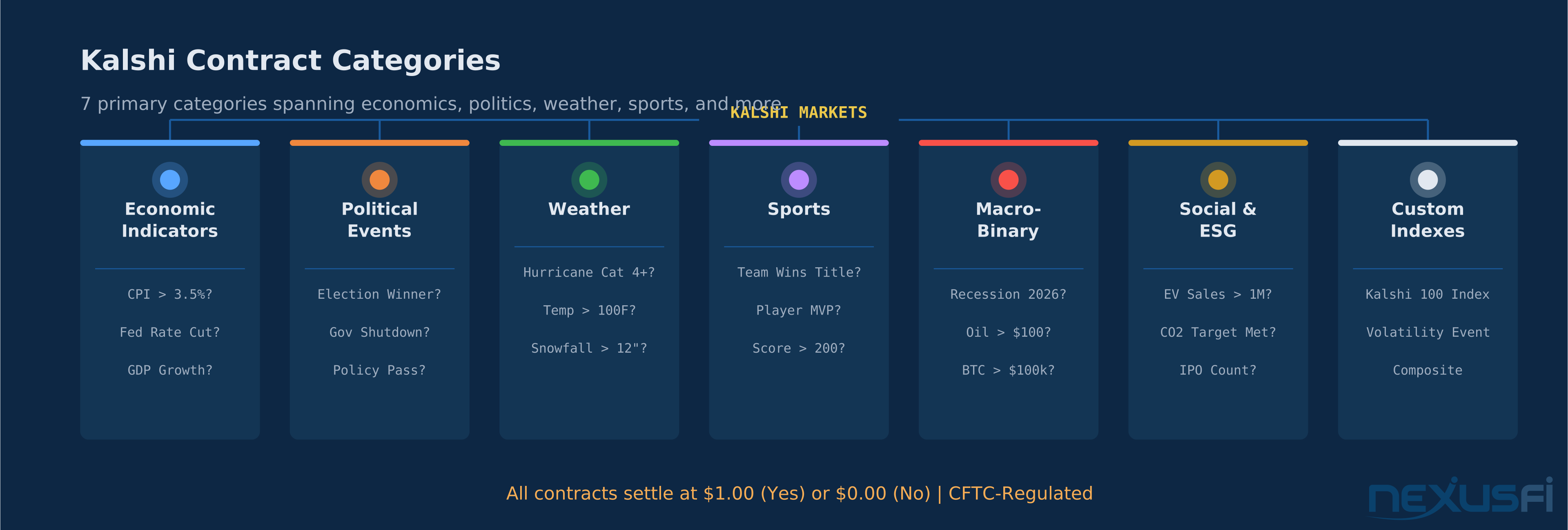
Kalshi's taxonomy spans seven main categories:
Economic Indicators — CPI thresholds, unemployment rates, Fed rate decisions, non-farm payrolls. The deepest markets on Kalshi. These attract macro traders who want to express a precise binary view — will the number come in hot or cold, without the noise of equity or bond market reactions.
Political Events — Election outcomes, legislation passage, regulatory approvals. As the NexusFi community noted when [Kalshi raised $1B at an $11B valuation] [2], the 2024 election cycle put prediction markets on the map for retail traders. Volume spikes are massive around major political events but can crater between them.
Weather — Temperature thresholds, hurricane landfall, precipitation events. Real hedging utility for energy and agriculture traders. Resolution depends on NOAA data, which introduces measurement and timing considerations most retail traders don't think about.
Sports and Entertainment — Super Bowl outcomes, championships, awards shows. When [Kalshi hit $1 billion in Super Bowl trading volume] [1], it proved event contracts could generate traditional-exchange-level activity around single events. But the sustainability question remains.
Macro-Binary — Dollar index levels, gold price thresholds, commodity price outcomes. Express a directional view through a binary lens. Instead of managing a gold futures position, buy "Gold above $2,200 by June 30" and walk away. Simpler, but you lose the ability to manage the position.
Social/ESG and Custom Indexes — Corporate ESG scores, search trend thresholds, sentiment metrics. Smaller markets, thinner liquidity, mostly experimental.
Resolution Risk -- The Gotcha That Eats Accounts #
This is the danger most Kalshi content glosses over. Resolution risk is the single most important risk to understand before committing real money.
What Can Go Wrong #
Contract wording ambiguity. "Will the US Senate pass Bill X by November 30?" Sounds clear. But what if the bill passes with amendments? What if it passes the Senate but not the House? What if there's a procedural vote that technically counts as "passage" under certain interpretations? The resolution depends on how Kalshi's adjudication team interprets the contract language, and that interpretation might not match yours.
Source data disputes. Economic data gets revised. The initial CPI print might say 3.1%, triggering a "Yes" settlement, but the revision three weeks later says 2.9%. Which number counts? The contract terms specify, but many traders don't read them carefully enough.
Timing edge cases. A weather contract specifies "temperature above 95F in Dallas on June 15." The NOAA station records 94.8F at 3 PM and 95.2F at 6 PM. Does the daily high meet the threshold? It depends on which measurement window the contract uses.
Event cancellation or postponement. What happens if a scheduled economic release is delayed? If an election is contested? The exchange has resolution procedures for edge cases, but your capital sits locked until resolution occurs — potentially weeks or months.
Resolution Risk Due Diligence #
Before every trade:
- Read the full contract specification. Not the summary — the actual resolution terms. What data source? What measurement window? What constitutes the event occurring?
- Check the resolution source reliability. Government data releases are generally clean. More novel sources (sentiment indexes, search trends) carry higher interpretation risk.
- Assess ambiguity. If you can imagine a scenario where reasonable people would disagree about whether the event "happened," that's a red flag. Either skip the contract or price in extra uncertainty.
- Check time-to-resolution. Your capital is locked from entry to settlement. On a contract that might not resolve for 6 months, your opportunity cost matters. Calculate: could this capital earn more in a liquid market during that period?
CFTC Regulation #
Kalshi operates under the same legal framework as CME — Commodity Exchange Act, CFTC oversight, customer fund segregation, mandatory reporting, real-time surveillance. Your money is held separately from Kalshi's operating capital. If the exchange fails, customer funds are protected.
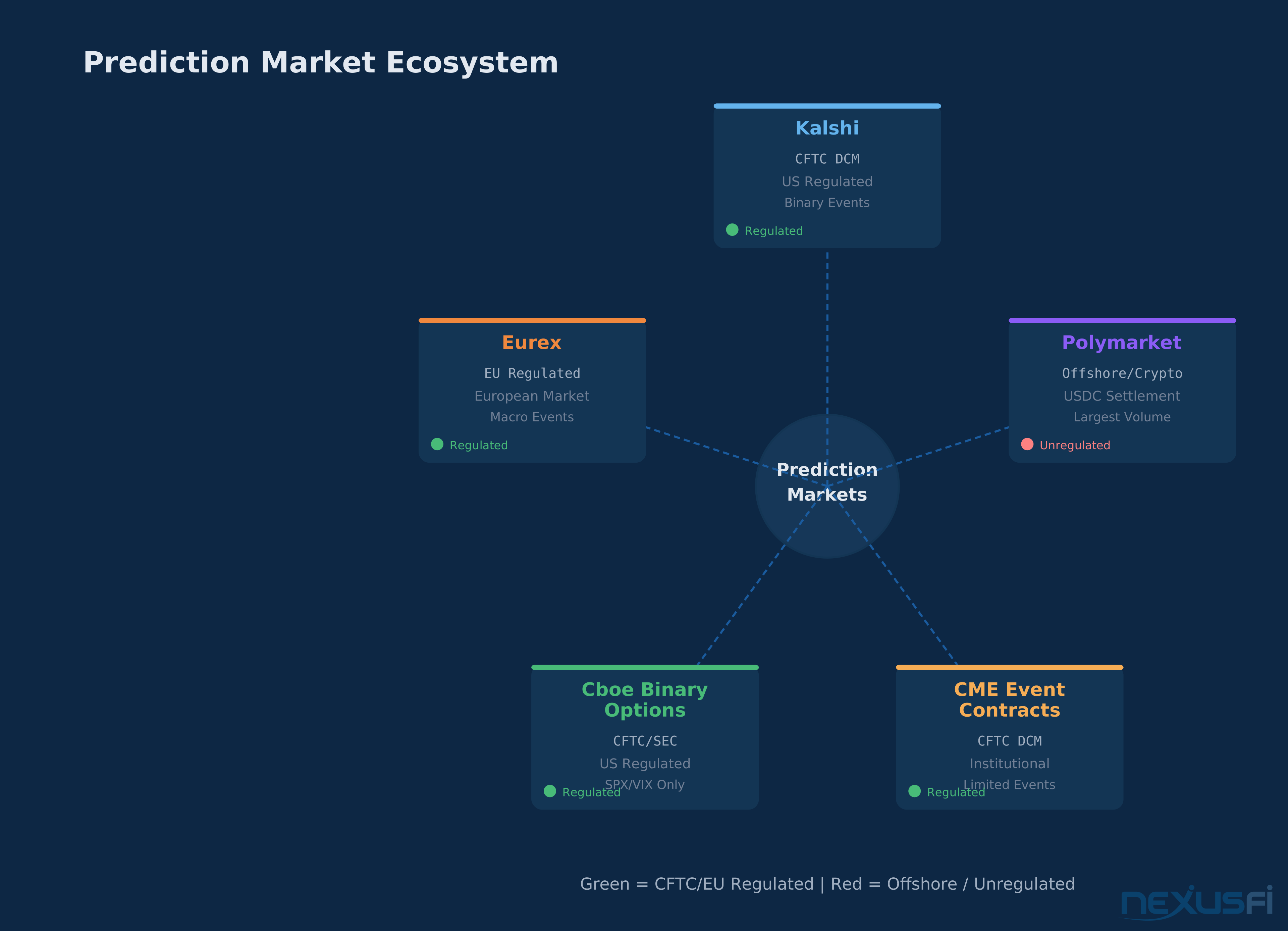
The regulatory environment shifted dramatically in 2026. The [CFTC withdrew its Biden-era prediction market ban] [5] under Chairman Selig, triggering competitive entry: [Cboe announced binary options] [10], [CME's event contracts hit 100 million traded in eight weeks] [11], and [Eurex entered the prediction market space] [12].
One unresolved issue: state-level legal challenges. As the NexusFi discussion on [prediction market regulation] [3] highlights, the line between CFTC-regulated event trading and state-regulated gambling hasn't been definitively drawn everywhere. The NFA has also raised [concerns about direct clearing models] [6], pointing out that event contracts settle when the event resolves — not at execution. Your money sits with the exchange between trade and settlement, which could be days, weeks, or months.
Kalshi vs. CME -- Where the Differences Actually Matter #
For traders who know traditional futures:
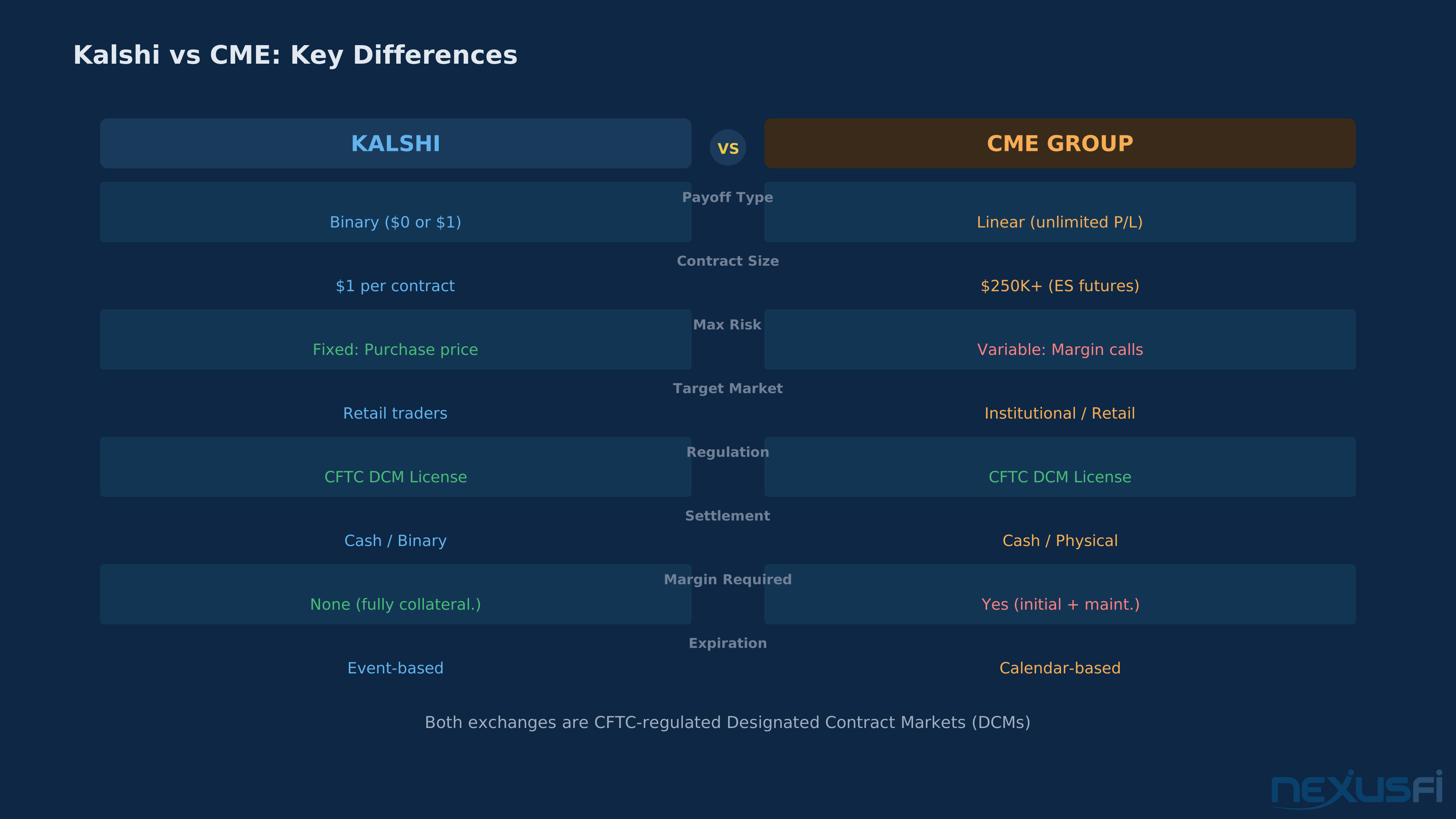
Product structure. CME contracts are linear — profit proportional to price movement. Kalshi contracts are binary — all or nothing. This changes how you size, how you think about risk, and how you construct portfolios. A futures trader's instinct to "add to winners" or "scale out" doesn't apply.
Risk profile. Max loss on Kalshi is always the purchase price. No margin calls, no gap risk beyond what you paid. The tradeoff: you can't adjust exposure as conditions evolve. You're locked in until resolution.
Liquidity. CME major contracts show institutional depth measured in tens of thousands of contracts. Kalshi depth is 10-100 contracts on popular markets, less on niche ones. Meaningful slippage risk for any size above $500-$1,000 notional.
Information dynamics. CME prices move continuously on order flow. Kalshi prices move in discrete jumps on new probability information. A CPI contract might sit flat for days, then move 20 points in seconds when a leading indicator drops.
Fee economics. Lower absolute cost per contract on Kalshi. Higher cost per dollar of exposure. Small accounts: Kalshi cheaper. Institutional size: CME wins.
Cross-venue application. The most interesting use isn't replacing CME positions — it's complementing them. As NexusFi coverage of [Plus500's Kalshi partnership] [4] noted, prediction markets are becoming a component of multi-venue strategies. Use Kalshi to hedge specific event risk while managing directional exposure on CME.
The Competitive Environment #
Polymarket — crypto-native, large volumes on political events, but unregulated in the US. Different risk profile entirely.
CME Event Contracts — when [CME hit 100 million event contracts traded in eight weeks] [11], it signaled traditional exchanges aren't ceding this market. CME brings institutional liquidity, cross-margining with futures, and established clearing.
Cboe Binary Options — [targeting Q2 launch] [10] with options expertise and established market-making relationships.
Tradeweb — [took a minority stake in Kalshi] [8], potentially bringing prediction market data to institutional trading desks.
Eurex — [exploring S&P 500 binary options] [12] for mid-2026.
Practical Trading Framework #
When to Trade Kalshi #
Specific event hedging. You have a macro thesis and want to hedge a specific binary outcome. Kalshi lets you isolate that risk without the noise of continuous market dynamics.
High-liquidity events. Stick to contracts with daily volume above $50K notional, inside spread under $0.05, and more than 7 days to resolution. These parameters give you reasonable execution and time to exit if needed.
Probability discovery. When you need to know what the market actually thinks about an event, expressed in real money rather than poll data or pundit opinions.
When to Avoid Kalshi #
Thin markets. If the order book shows fewer than 50 contracts at the inside, your execution cost will eat your edge. Don't trade contracts with under $10K daily volume unless you're treating it as entertainment, not trading.
Ambiguous resolution. If you can construct a plausible scenario where the event definition is unclear, skip it. Resolution disputes tie up your capital and create unpredictable outcomes.
Short time-to-resolution with high spread. A contract expiring in 2 days with a $0.15 spread is uneconomic. You need the spread cost to be small relative to your expected profit, and short-dated thin contracts fail that test.
Continuous exposure needs. If you want ongoing theme exposure, you need to roll through multiple contracts. Each roll costs spread plus fees and resets your basis. Futures give you continuous exposure with one position.
Position Sizing Rules #
- Never allocate more than 5% of trading capital to a single binary contract. The all-or-nothing payoff means a string of losses at full size destroys accounts fast.
- Cap total Kalshi exposure at 15-20% of trading capital. This is a complement to your portfolio, not the core.
- Size based on expected value, not conviction. If you estimate 70% probability and the contract trades at $60, your edge is $10. Size relative to that $10 edge, not relative to the $60 contract price.
- Account for effective cost. Your expected profit minus all-in cost (fee + spread + slippage) is your real edge. If real edge is under $2 per contract, you need at least a 10-contract position to justify the time and attention.
Tax Considerations #
Tax treatment is genuinely ambiguous. Binary event contracts may qualify for Section 1256 treatment (60% long-term / 40% short-term capital gains), or they may not. The IRS hasn't issued definitive guidance. Don't figure this out after year-end.
The Bottom Line #
Kalshi cracked open a new asset class for retail traders by bringing prediction markets under the same regulatory framework as traditional futures. The product is simple, the risk is contained, and the regulatory protection is real.
But simple and easy are different things. Binary payoff structures are unforgiving — a small probability estimation error means total loss, not a partial one. Liquidity is still thin compared to established exchanges. Resolution risk creates exposure that most traders from traditional markets haven't priced before. And the competitive environment is shifting fast as CME, Cboe, and Eurex bring deeper infrastructure.
The practical approach: treat Kalshi as a complement to your existing trading. Start with the most liquid event categories (economic indicators, major political events). Read every contract specification before trading. Size conservatively — 2-5% per contract, 15-20% total exposure. And calculate your all-in cost before entering, not after.
As the NexusFi community's extensive coverage shows — from [Kalshi's $11 billion valuation] [2] to [CME's rapid event contract adoption] [11] to [the CFTC's regulatory pivot] [5] — prediction markets aren't a novelty. They're a permanent fixture of the derivatives environment. The question for traders is which platforms offer sufficient liquidity for your size, which contract types match your analytical edge, and whether you've done the resolution risk homework before committing capital.
Knowledge Map
Prerequisites
Understand these firstGo Deeper
Build on this knowledgeReferences This Article
Articles that build on this topicCitations
- — Kalshi Hits $1 Billion in Super Bowl Trading Volume -- Prediction Markets Just Had Th (2026)“Kalshi just posted numbers that should make every futures trader pay attention. The CFTC-regulated prediction market platform processed over $1 billion in trading volume on Super Bowl Sunday alone -- up 2,700% year-over-year.”
- — Kalshi Raises $1B Series E - $11B Valuation (2025)“Prediction markets platform Kalshi has closed a massive $1 billion Series E funding round, valuing the company at $11 billion - doubling its value in under two months.”
- — Kalshi, Polymarket, Prediction Markets etc (2025)“SMCJB, you raise valid concerns that many share. The regulatory landscape here is fascinating and evolving rapidly.”
- — Plus500 Futures Launches US Prediction Markets Through Kalshi Partnership (2026)“Plus500 Futures Launches US Prediction Markets Through Kalshi Partnership Source: Finance Magnates Plus500 has expanded its US presence by launching prediction markets through its Plus500 Futures brand, partnering with CFTC-regulated Kalshi to offer...”
- — CFTC Withdraws Biden-Era Prediction Market Ban, Signals New Regulatory Framework (2026)“CFTC Withdraws Biden-Era Prediction Market Ban, Signals New Regulatory Framework CFTC Chairman Michael Selig just pulled the plug on the Biden-era proposed ban on political and sports event contracts -- and the market reaction has been immediate.”
- — NFA Raises Concerns About Direct Clearing for Retail Derivatives Traders (2026) 👍 1“jlabtrades, You're right on the no-margin point. Binary event contracts are fully collateralized upfront - that's a genuinely different risk profile from traditional futures. No argument there.”
- — CME to list Sports Event Contracts Dec'25 (2025)“SMCJB, excellent catch on this filing. The convergence of traditional derivatives markets with prediction markets is one of the most significant regulatory developments happening right now.”
- — Tradeweb Takes Minority Stake in Kalshi -- Prediction Market Data Coming to Instituti (2026)“Tradeweb, one of the world's largest electronic trading platforms, has entered a strategic partnership with Kalshi and made a minority investment in the prediction markets company.”
- — CFTC Withdraws Prediction Market Ban, Signals New Rulemaking Under Chairman Selig (2026)“CFTC Withdraws Prediction Market Ban, Signals New Rulemaking CFTC Chairman Michael Selig announced a four-part regulatory agenda for event contracts at the January 29 joint "Project Crypto" summit with SEC Chairman Paul Atkins.”
- — Cboe Eyes Prediction Markets With Regulated All-or-Nothing Binary Options -- Q2 Launc (2026)“Cboe Eyes Prediction Markets With Regulated All-or-Nothing Binary Options Cboe Global Markets is developing a new class of all-or-nothing options contracts designed to compete directly with prediction markets like Kalshi and Polymarket.”
- — CME Group Event Contracts Blast Past 100 Million Traded -- In Just 8 Weeks (2026)“CME Group just announced a jaw-dropping milestone: its event contracts product has surpassed 100 million contracts traded since launching in December. That is roughly eight weeks to hit a number that would make most new derivative products jealous.”
- — Eurex Eyes Prediction Markets -- Europe's Biggest Derivatives Exchange Joins the Event Contract (2026)“Europe's largest derivatives exchange is studying whether to join the prediction market boom that has already taken US exchanges by storm -- and they may already have the regulatory foundation to do it.”