



Crypto and Technology Event Contracts: Bitcoin Price, AI Milestones, and Tech Outcomes
**How to trade cryptocurrency and technology prediction markets on Polymarket and Kalshi
Overview #
Crypto and technology event contracts represent one of the most active and rapidly evolving categories in prediction markets. Polymarket, as a blockchain-native platform, naturally attracts crypto traders who want to express opinions on Bitcoin price targets, Ethereum protocol upgrades, altcoin rankings, and broader technology outcomes. Kalshi also lists cryptocurrency and technology contracts, though with more limited selection compared to Polymarket's depth in this category.
This article covers the types of crypto and tech contracts available, what drives their pricing, strategies for trading them, and the unique risks this category carries.
Format examples: - "Will Bitcoin (BTC) reach $150,000 by December 31, 2026?" - "Will Bitcoin close above $100,000 on any day in Q2 2026?" - "Will Bitcoin's 7-day average price exceed $80,000 by April 30, 2026?" Resolution sources: Typically CoinGecko, CoinMarketCap, or a specified centralized exchange (Binance, Coinbase).
This article builds on Introduction to Prediction Markets and Blockchain-Based Prediction Markets.
Types of Cryptocurrency Event Contracts #
Bitcoin Price Target Contracts #
The most liquid crypto prediction markets ask whether Bitcoin will reach a specific price level by a specific date.
Format examples:
- "Will Bitcoin (BTC) reach $150,000 by December 31, 2026?"
- "Will Bitcoin close above $100,000 on any day in Q2 2026?"
- "Will Bitcoin's 7-day average price exceed $80,000 by April 30, 2026?"
Resolution sources: Typically CoinGecko, CoinMarketCap, or a specified centralized exchange (Binance, Coinbase). Always verify which data source the contract specifies
Pricing dynamics: Bitcoin price contracts follow the spot price directly. When BTC rallies, YES contracts for near-term upside targets move sharply higher. These markets are often more reactive than traditional derivatives markets because prediction market participants include retail traders who respond to news quickly.
Key consideration for Bitcoin contracts: The price is highly path-dependent. A contract asking if BTC will reach $150,000 by year-end doesn't just depend on where BTC "ends up"
Ethereum and Altcoin Contracts #
Ethereum protocol milestone contracts have been some of Polymarket's most popular markets:
- Will Ethereum complete [specific upgrade] by [date]?
- Will ETH's price exceed [threshold] by [date]?
- Will [altcoin] surpass Ethereum in market capitalization by [date]?
Ethereum upgrade contracts: These involve technical knowledge about Ethereum's development roadmap. The Ethereum Foundation publishes rough timelines for upgrades, but delays are common. Historical context helps calibrate expectations.
Altcoin competition contracts: "Will Solana's market cap exceed Ethereum's by end of 2026?" These long-horizon speculative contracts are priced based on investor sentiment and technical analysis of each network's growth trajectory.
Stablecoin and DeFi Contracts #
- "Will USDC maintain its $1.00 peg throughout Q1 2026?"
- "Will Tether's total supply exceed $200 billion by year-end?"
- "Will a major DeFi protocol be hacked for more than $100M in 2026?"
These markets attract risk-hedgers as well as speculators. Institutional USDC holders might buy "USDC maintains peg" YES contracts as a quasi-insurance play.
Crypto Regulatory and Institutional Contracts #
- "Will the U.S. SEC approve a spot Ether ETF in 2026?"
- "Will a G7 nation adopt Bitcoin as legal tender by 2027?"
- "Will [major bank] publicly announce a Bitcoin custody product in 2026?"
These contracts blend crypto knowledge with regulatory and political analysis. The SEC regulatory contracts became extremely liquid in 2023-2024 around the Bitcoin spot ETF approval process.
Technology and AI Event Contracts #
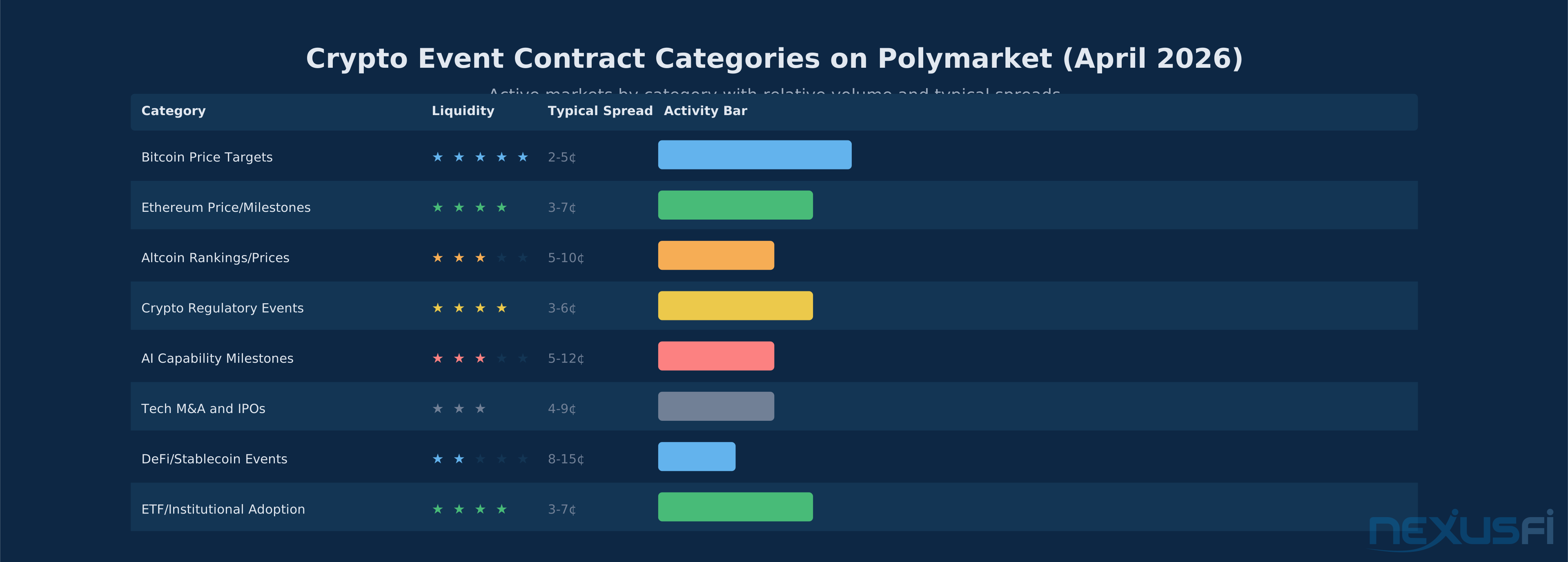
Polymarket hosts a growing category of artificial intelligence and technology milestone contracts. As of April 2026, Polymarket lists 143+ live contracts related to AI, crypto, and technology.
AI Benchmark and Capability Contracts #
- "Will an AI system surpass human performance on [benchmark] by Q3 2026?"
- "Will GPT-5 or equivalent model be released in 2026?"
- "Will AI-generated content account for more than 50% of [platform] posts by 2026?"
These contracts require tracking AI research publications, company announcements, and benchmark competitions. The AI research community's pace of progress has consistently surprised both optimists and pessimists.
Resolution challenges: AI milestone contracts often have naturally ambiguous resolution criteria. What constitutes "human-level performance" on a benchmark? Which benchmark counts? These definition questions make resolution disputes more common in this category than in, say, sports or economic data contracts.
Technology Sector Contracts #
- "Will [tech company] acquire [target] in 2026?"
- "Will [tech company]'s market cap exceed $[trillion] by year-end?"
- "Will a major social media platform lose more than 20% of monthly active users in 2026?"
Corporate event contracts require tracking M&A activity, earnings trajectories, and regulatory developments. These can be highly liquid around major corporate events (earnings, product launches, regulatory decisions).
What Drives Crypto Contract Pricing #
Spot Price Correlation #
Bitcoin and Ethereum price contracts are directly tied to spot prices. When BTC moves, prediction market prices for price-threshold contracts update in near-real-time. The relationship is roughly:
For "Will BTC reach $X by date Y?" where X > current price:
- As BTC approaches X, the YES contract price approaches $1.00
- As BTC falls further from X, the YES price approaches $0
- Time remaining until expiry matters enormously
Options-style dynamics: Long-dated crypto price contracts behave similarly to out-of-the-money call options. They have high sensitivity to implied volatility
News and Sentiment #
Crypto prediction market prices react dramatically to:
- Regulatory news: ETF approvals, government bans, exchange shutdowns
- Protocol events: Forks, upgrades, security incidents
- Institutional adoption: Corporate treasury announcements, ETF inflows
- Macro factors: Interest rates, dollar strength, risk appetite broadly
Information asymmetry opportunities: Crypto markets move fast. Traders with access to high-speed news feeds or who monitor on-chain metrics (large wallet movements, exchange inflows) may be able to identify emerging trends before they're fully priced into prediction market contracts.
Developer Activity and On-Chain Metrics #
For Ethereum upgrade contracts, relevant data includes:
- GitHub commit activity on the Ethereum core client repositories
- Testnet progress (Sepolia, Goerli testnets for pre-launch testing)
- Developer conference announcements (Devcon, ETH Denver)
- Core developer consensus in public forums (ethereum-magicians, protocol development calls)
Tracking these data sources can provide an edge on Ethereum milestone contracts that most prediction market participants (who may be primarily traders, not developers) underweight.
Strategies for Crypto and Tech Contracts #
The Technical Analysis Overlay #
Many crypto prediction market traders apply standard technical analysis to inform their probability estimates for price target contracts. Key techniques:
- Support and resistance levels: Major price levels with historical trading volume suggest where breakouts or rejections are likely
- Moving averages: 200-day MA crossovers historically precede major trends in Bitcoin
- On-chain metrics: MVRV ratio (Market Value to Realized Value) has historically indicated overvaluation/undervaluation
Limitation: Technical analysis works probabilistically, not deterministically. A contract expiring in 30 days has significant randomness even with strong technical setups.
The Fundamentals Approach #
For regulatory and institutional crypto contracts, fundamental analysis is more applicable than technical analysis:
- Track public SEC filings and comment letters
- Monitor Congressional bills and regulatory agency statements
- Read official Ethereum Foundation and developer communication channels
- Track corporate 10-K filings for mentions of Bitcoin/crypto treasury strategy
This research-intensive approach tends to be lower frequency but higher confidence when a genuine information edge is identified.
Positioning Around Catalysts #
Crypto markets have known catalysts with predictable market impact:
- Bitcoin halving: Approximately every 4 years, Bitcoin's block reward halves. Markets are aware this event has historically preceded price appreciation
- ETF approval decisions: SEC has set deadlines for ETF decisions; pre-decision trading often shows elevated volatility
- Protocol upgrade mainnet launches: Ethereum's major upgrades have historically resolved price uncertainty after extended periods of development uncertainty
Prediction market contracts around these known events can be positioned ahead of the trigger.
Unique Risks in Crypto Event Contracts #
Extreme Volatility #
Cryptocurrency markets can move 20-50% in a single day during major events. A Bitcoin contract that seems safely "in the money" can quickly become uncertain after a major market dislocation. Crypto event contracts carry higher gamma risk (sensitivity to price movement) than most other categories.
Risk mitigation: Maintain lower position sizes in crypto contracts relative to your overall portfolio. Never leverage beyond what you can afford to lose entirely.
Resolution Disputes #
Crypto markets operate 24/7 across hundreds of exchanges. When a contract asks "Will BTC exceed $100,000?"
Well-written contracts specify the resolution source precisely (e.g., "Coinbase daily close price at midnight UTC"). Poorly written contracts may generate disputes if the outcome is ambiguous. Always read the resolution criteria before trading
Correlation with Your Crypto Holdings #
If you already hold Bitcoin or other cryptocurrencies, buying "BTC reaches $150,000" prediction market contracts creates a correlated position
Conversely, buying "BTC does NOT reach $X" contracts can serve as a partial hedge against spot holdings.
Regulatory Risk for Crypto-Specific Markets #
Regulatory actions can dramatically affect crypto prices
Platform Comparison for Crypto Markets #
Polymarket: Dominant for crypto and tech contracts, given its blockchain-native user base and international accessibility. Hundreds of active crypto/tech markets, with the deepest liquidity in this category globally.
Kalshi: More limited crypto selection, but offers regulated U.S. access with dollar settlement. Bitcoin and Ethereum price contracts are available. Better suited for U.S. traders who prefer regulated environments.
Decision rule: For the broadest crypto market selection, Polymarket. For regulatory certainty and dollar-denominated trading, Kalshi where available.
Getting Started with Crypto Event Contracts #
- Start with Bitcoin price contracts: The most liquid, most data-available, and most intuitive for anyone who follows crypto markets
- Use the same research process as crypto investing: Fundamental and technical analysis skills you already apply to spot trading apply to prediction market contracts
- Pay attention to resolution details: Crypto contracts are especially prone to resolution ambiguity
- Size conservatively: Crypto's volatility makes even well-researched positions risky; use smaller percentage of bankroll than for economic or sports contracts