



Blockchain-Based Prediction Markets: How Polymarket Uses Smart Contracts and USDC
**Understanding the decentralized infrastructure behind Polymarket
Overview #
Polymarket is the world's largest prediction market by volume, built on an entirely different technical foundation than regulated U.S. platforms like Kalshi. Where Kalshi operates as a CFTC-regulated exchange using traditional financial infrastructure, Polymarket runs on the Polygon blockchain as a peer-to-peer market where smart contracts automate every aspect of trading and settlement.
This distinction has profound implications for how you deposit funds, trade, withdraw winnings, and how your positions are resolved. Understanding the blockchain mechanics isn't optional for Polymarket traders
Chain ID: 137 Polymarket is planning a significant infrastructure upgrade in 2026, including improvements to its settlement infrastructure and the introduction of a new pUSD token (1:1 USDC-backed), designed to reduce bridge risks and give Polymarket more control over its trading environment.
This article builds on Introduction to Prediction Markets and complements Kalshi vs Polymarket: Choosing the Right Platform.
What Is a Blockchain Prediction Market? #
A blockchain prediction market is a trading venue where:
- Smart contracts hold your funds, not a company or brokerage
- Trades settle automatically on-chain when outcomes are verified
- No intermediary can freeze your account or unilaterally change the rules
- All market activity is publicly auditable on the blockchain
Traditional prediction markets like Kalshi are custodial
This design has tradeoffs. You get transparency and censorship resistance. You give up regulatory protections, FDIC insurance, and the familiar comfort of dealing with a regulated U.S. company.
The Polygon Blockchain: Polymarket's Infrastructure #
Polymarket runs on Polygon (also called MATIC), an Ethereum Layer 2 blockchain. Key characteristics:
Speed: Polygon transactions confirm in 2-5 seconds, compared to 12-15 seconds on Ethereum mainnet. This is fast enough for real-time trading.
Cost: Polygon gas fees are typically less than $0.01 per transaction
Security: Polygon inherits Ethereum's security model through periodic checkpoints. Your funds are secured by the same cryptographic infrastructure as Ethereum.
Chain ID: 137
Polymarket is planning a significant infrastructure upgrade in 2026, including improvements to its settlement infrastructure and the introduction of a new pUSD token (1:1 USDC-backed), designed to reduce bridge risks and give Polymarket more control over its trading environment.
USDC: The Stablecoin That Powers Polymarket #
All trading on Polymarket uses USDC (USD Coin), a stablecoin pegged 1:1 to the U.S. dollar and issued by Circle. Unlike volatile cryptocurrencies like Bitcoin or Ethereum, USDC maintains a stable $1.00 value, making it functionally equivalent to cash for prediction market purposes.
Why USDC instead of USD?
- Blockchain cannot natively hold dollars
- USDC is legally backed by cash and short-term U.S. Treasuries held by Circle
- USDC transfers are instant, irreversible, and globally accessible
- USDC is programmable
Current implementation: Polymarket uses USDC on Polygon (sometimes called USDC.e, the bridged version from Ethereum). Polymarket's 2026 upgrade plans to introduce pUSD
USDC stability risk: While USDC has maintained its peg reliably, it briefly lost its $1.00 peg in March 2023 when Silicon Valley Bank (an authorized custodian for Circle) failed. The depeg was brief and quickly resolved, but it illustrates that even stablecoins carry tail risks. For prediction market traders, this risk is relevant for large, long-duration positions.
How Smart Contracts Work in Prediction Markets #
When you buy a YES share on Polymarket, what really happens at the technical level:
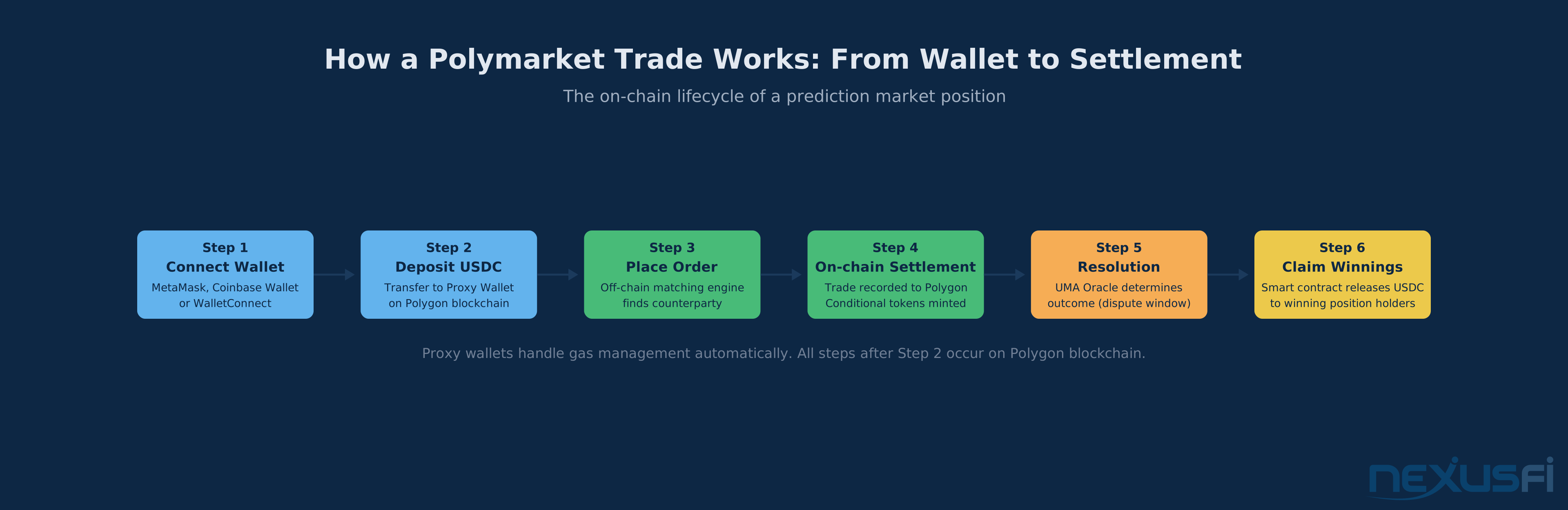
1. USDC transferred to smart contract: Your USDC moves from your wallet into Polymarket's conditional token framework smart contract. This is on-chain
2. Conditional tokens created: The smart contract creates two types of tokens: YES tokens (worth $1.00 if the event occurs, $0 if not) and NO tokens (the inverse). When you buy YES, you're receiving YES tokens; the person selling YES receives your USDC (or collateral from the smart contract, depending on the trade structure).
3. Price discovery via CLOB: Polymarket uses a Central Limit Order Book (CLOB) that runs on a hybrid model
4. Resolution: When an event resolves, the UMA Oracle (see below) determines the outcome and updates the smart contract. YES tokens can then be redeemed for $1.00 USDC each; NO tokens expire worthless.
5. Automatic payout: You claim your USDC winnings by calling the contract's redeemPositions function
The UMA Optimistic Oracle: Decentralized Resolution #
The most challenging problem in decentralized prediction markets is who decides the outcome? Without a trusted central authority, how does the smart contract know whether an election was won or a price target was hit?
Polymarket uses UMA's Optimistic Oracle system for most market resolutions:
How it works:
- When a market's end date arrives, anyone can propose the outcome by posting a bond (typically ~750 USDC.e)
- The proposal enters a challenge period (typically 2 hours to 2 days)
- During this period, anyone can dispute the proposed outcome by posting a counter-bond
- If undisputed, the proposed outcome is accepted and becomes final
- If disputed, UMA token holders vote to resolve the dispute; the winning side receives the losing side's bond
Why "optimistic"? The system is optimistic because it assumes proposals are correct and only requires on-chain voting for disputed cases. This design keeps costs low while maintaining censorship resistance.
Practical implications:
- Most markets resolve correctly without dispute
- Ambiguous outcome markets (where the question is poorly written) are more likely to trigger disputes
- Resolution disputes can delay your payout by days or weeks
- Polymarket's team can also resolve markets directly for events with unambiguous outcomes (sporting events, official government data)
Resolution sources: Polymarket specifies the resolution source in each market's description. For financial markets, this might be CoinGecko prices or official exchange data. For political events, official government announcements. Always verify the resolution source before trading a market.
Getting Funds In and Out: Deposits and Withdrawals #
The deposit and withdrawal process for Polymarket is more complex than Kalshi's simple bank transfer, because it involves converting traditional currency to blockchain-native USDC.
Depositing to Polymarket #
Method 1: Crypto wallet bridge
- Have ETH, USDC, or other supported assets on Ethereum mainnet or another chain
- Use Polymarket's built-in bridge (powered by Socket Protocol) to bridge to Polygon
- Supported chains: Ethereum, Polygon, BNB Chain, Solana, Bitcoin (via bridging)
- Supported tokens: USDC, USDT, ETH, BTC, SOL, and others (all converted to USDC on Polygon)
- Bridge fees: Varies by token and chain; typically $2-15 for cross-chain bridges
Method 2: Centralized exchange to Polygon
- Buy USDC on Coinbase, Kraken, or Binance
- Withdraw USDC directly to Polygon network (most major exchanges support direct Polygon withdrawals)
- Cost: Exchange withdrawal fee (~$0 on Coinbase for USDC, $0.25-1 on others)
- This is generally the cheapest method for U.S. users
Method 3: Credit/debit card (via Coinbase Onramp)
- Polymarket has integrated fiat on-ramps through third-party providers
- Purchase USDC directly with a credit card through the Polymarket interface
- Fees: 2-4% credit card processing fee (the most expensive method)
Minimum deposit: No enforced minimum, though practical minimums exist due to gas costs.
Withdrawing from Polymarket #
- Close all open positions (Polymarket does not allow withdrawal with open positions in some workflows)
- Initiate withdrawal from the Polymarket interface
- Select destination chain and wallet address
- For conversion to USD: Withdraw to Coinbase on the Polygon network, sell USDC for USD, then bank transfer (1-3 business days)
- Withdrawal from Polymarket to wallet: Free (only gas costs, which are < $0.01 on Polygon)
Important: Ensure your destination address is correct. Blockchain transactions are irreversible
Proxy Wallets: How Polymarket Simplifies the UX #
One of Polymarket's UX innovations is the Proxy Wallet system. Rather than requiring every trade to be signed by your main wallet (which would require MetaMask popups for every order), Polymarket creates a secondary wallet specifically for trading:
- You connect your main wallet (MetaMask, Coinbase Wallet, etc.) to Polymarket
- Polymarket creates a proxy wallet derived from your main wallet
- You approve USDC spending from your proxy wallet once
- Subsequent trades are handled by the proxy wallet without individual approvals
This design dramatically speeds up trading
Security note: Your proxy wallet's security is tied to your main wallet. If your main wallet is compromised, your proxy wallet and its funds are also at risk.
Smart Contract Security and Audits #
Polymarket's smart contracts have undergone multiple security audits from reputable blockchain security firms. Contract addresses for all Polymarket smart contracts are published in their documentation at docs.polymarket.com/resources/contract-addresses.
Key risk considerations:
- Smart contract bugs: Even audited contracts can have vulnerabilities. The blockchain prediction market space has seen several exploits of similar protocols
- Oracle manipulation: If a bad actor can manipulate the resolution source (e.g., briefly move a price on an exchange before resolution), they could exploit the market
- Bridge risk: Cross-chain bridges have historically been the highest-risk component in the DeFi ecosystem. Major bridge hacks have occurred in the space
- Regulatory risk: Polymarket has faced regulatory scrutiny from U.S. authorities. The platform blocked U.S. IP addresses in 2021. U.S. traders using VPNs to access Polymarket may violate terms of service and face potential legal risk
Polymarket vs. Kalshi: The Core Architecture Difference #
| Aspect | Kalshi | Polymarket |
|---|
|
| Custody | Kalshi holds your USD | Smart contracts hold your USDC |
|---|---|---|
| Deposits | ACH bank transfer, wire | Crypto/USDC, fiat on-ramps (3rd party) |
| Resolution | Internal process + official data | UMA Optimistic Oracle (decentralized) |
| Account freeze risk | Yes (regulatory/compliance) | No (non-custodial) |
| Fund recovery if platform shuts down | Potentially via SIPC-adjacent process | Via smart contract (self-custody) |
| Global access | U.S. only (KYC required) | Global (no KYC required for crypto) |
| Transparency | Internal order matching | Full on-chain auditability |
Tax Treatment of Polymarket Winnings #
Polymarket does not issue 1099 forms
How to calculate your taxable income from Polymarket:
- Track every trade: entry price, quantity of shares, exit price or resolution value
- Each winning position: difference between what you received and your cost basis is taxable income
- USDC is treated as USD for tax purposes
- Consider consulting a tax professional familiar with cryptocurrency and prediction market treatment
IRS treatment: Prediction market winnings are generally treated as ordinary income, not capital gains. Some tax professionals argue Kalshi contracts may qualify for Section 1256 treatment (60/40 long-term/short-term split), but this remains an unsettled area of tax law. Polymarket's decentralized structure makes Section 1256 treatment even less likely to apply.
Getting Started on Polymarket #
- Install a Web3 wallet: MetaMask (browser extension) or Coinbase Wallet are most widely supported
- Acquire USDC on Polygon: Easiest path is to buy USDC on Coinbase and withdraw directly to Polygon network
- Connect wallet to Polymarket: Visit polymarket.com, click "Connect Wallet," approve the connection
- Deposit USDC: Transfer USDC from your wallet into your Polymarket trading account
- Browse markets: Explore the market categories
- Place your first trade: Start with markets you understand well and have opinions on
Start small: Blockchain transactions are irreversible. Make a few small trades ($5-20) to understand the interface and confirm you know how to deposit and withdraw before committing significant capital.