



Genetic Algorithms and Evolutionary Optimization for Futures Strategy Development
Subtitle: How evolution-inspired search finds strong parameter sets in the high-dimensional, noisy environment of futures trading — and why it beats grid search by orders of magnitude.
Overview #
You built a trend-following strategy for ES. It has 11 parameters: entry threshold, exit threshold, stop distance, profit target, trend filter lookback, volatility filter lookback, minimum daily range, maximum holding time, entry window start, entry window end, and a volatility scaling toggle. You want to find the best combination.
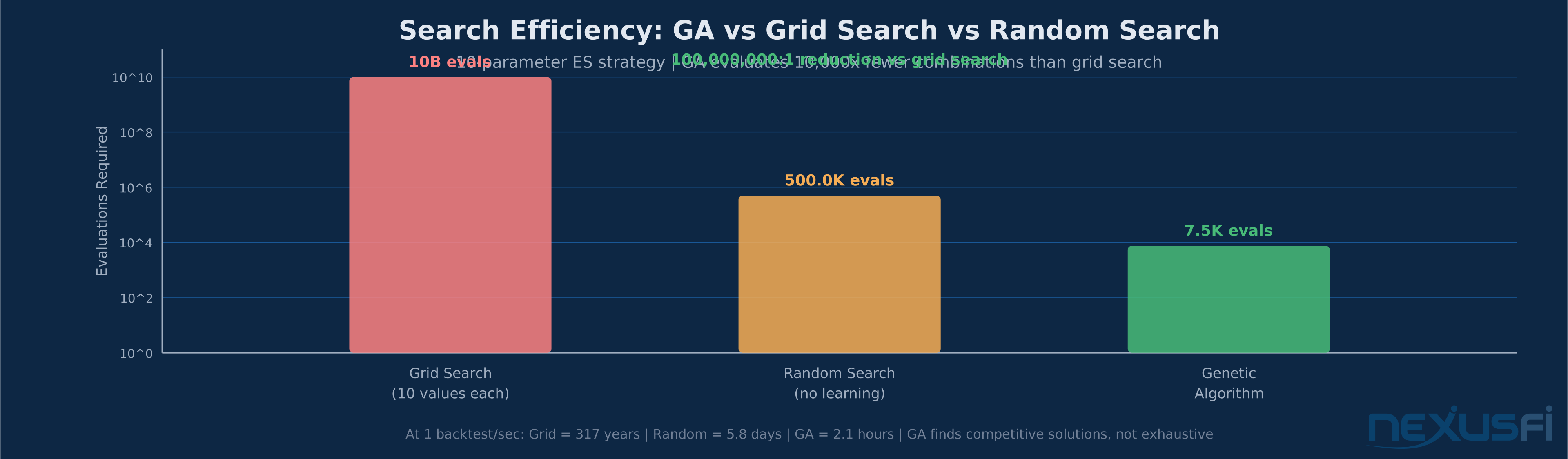
Grid search with 10 values per parameter: 10^11 evaluations — over 3 years at 1,000 backtests/second. Random search improves on this but has no memory; good ideas don't compound.
Genetic algorithms solve this combinatorial explosion by borrowing evolution's most powerful insight: solutions that work well should breed together. Over generations, good partial solutions combine into better complete solutions. A well-configured GA finds competitive solutions to that 11-parameter problem in 5,000 to 15,000 evaluations, not 100 billion.
This article covers how to design and run a genetic algorithm for futures strategy optimization: from encoding your strategy into a chromosome, through fitness function design, through the full evolutionary cycle, to integrating walk-forward validation to prevent overfitting. The focus is on what practitioners actually need — the decisions that determine whether your GA produces strong, tradeable strategies or efficiently finds the most overfit parameterization possible.
PREREQUISITES: Backtesting Trading Strategies, Walk-Forward Analysis, Strategy Optimization and Parameter Tuning, Overfitting and Curve-Fitting Detection.
The Optimization Problem in Futures Strategy Development #
Before you write a single line of GA code, you need to understand what you're actually optimizing and why it's hard.
The Fitness Environment #
Every combination of your strategy's parameters defines a point in parameter space. The "height" of each point is its performance — whatever metric you choose. The full surface formed by all possible combinations is the fitness environment.
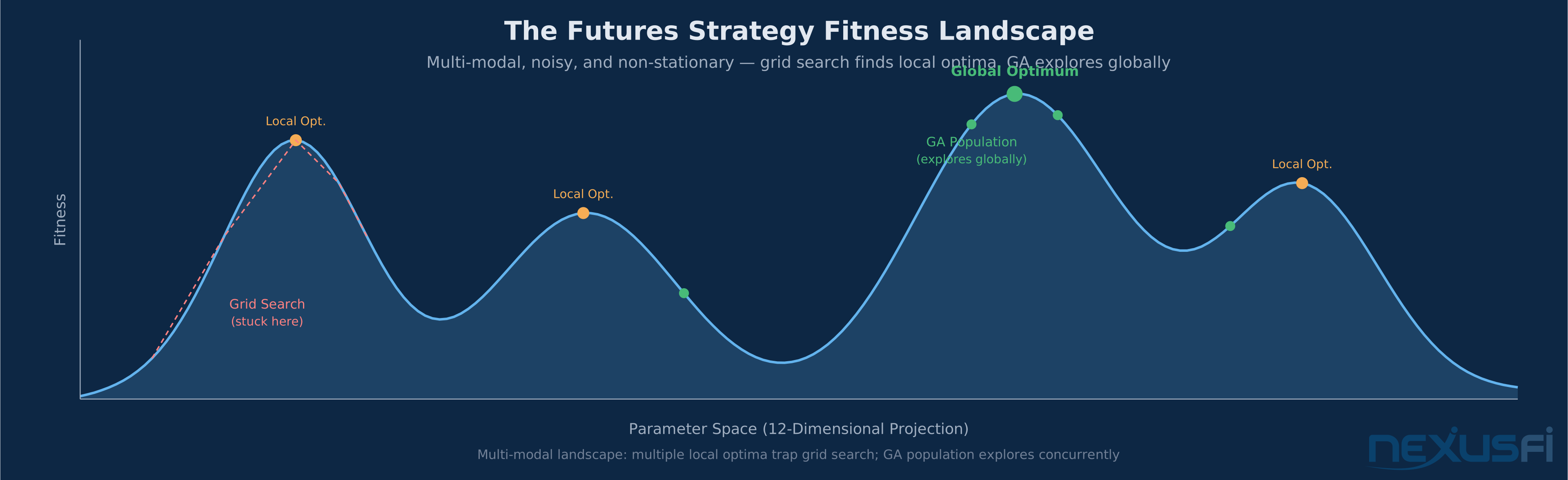
In well-behaved optimization problems, the fitness environment is smooth. You can follow a gradient. In futures strategy development, the environment is none of these things.
It is noisy. Price data is stochastic. Two nearly identical parameterizations may produce very different backtested performance due to random variation in fills and the timing of specific news events. The environment surface vibrates.
It is multi-modal. Multiple distinct parameter regions produce good performance, not just one. A trend filter with a 14-bar lookback and 8-tick profit target performs well. So might a 21-bar lookback with a 12-tick target. These are different "mountains." Grid search finds whichever it samples. Random search has no mechanism to recognize it found a mountain and explore nearby.
It is non-stationary. The environment you're optimizing represents past market conditions. Parameters that dominated the 2018-2020 environment may fail in 2023-2025 conditions. This is the root cause of out-of-sample failure.
It has rugged local optima. Between the peaks of good performance are valleys. Many optimization methods get trapped on small hills nowhere near the best solutions.
Genetic algorithms are specifically designed for rugged, multi-modal, noisy landscapes — population-based search explores multiple regions concurrently, and recombination lets good partial solutions combine into better complete ones.
Part 1: Genetic Representation -- Encoding Your Strategy #
The first and most consequential design decision is how you represent a candidate solution as a chromosome. The representation determines what evolutionary operators can discover and what the fitness function must validate.
What Goes in a Chromosome #
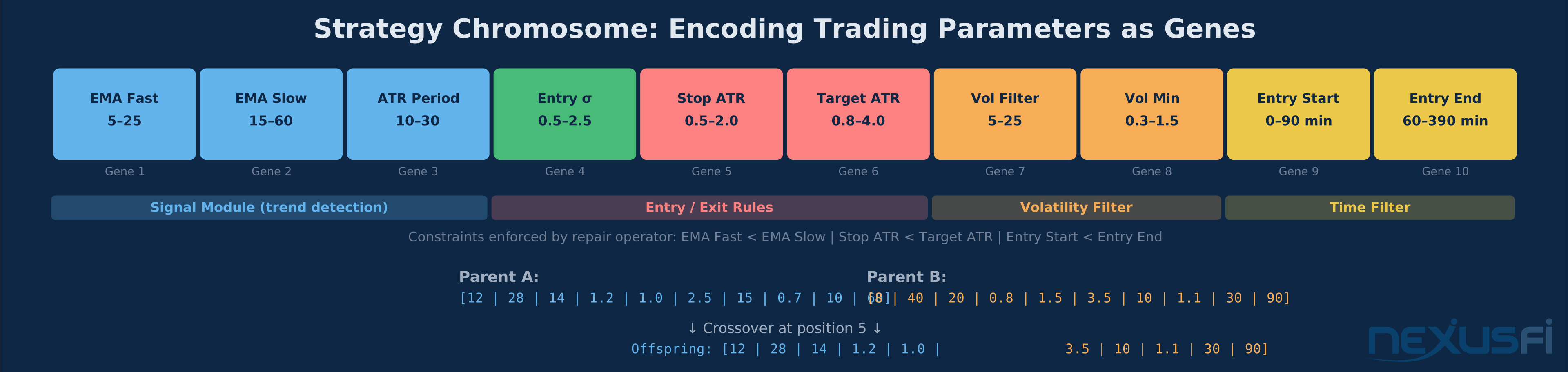
A chromosome fully specifies one candidate strategy parameterization. Every parameter the GA can improve becomes a gene. For a trend-following ES strategy:
| Gene | Type | Range |
|---|---|---|
| Trend filter lookback | Integer | 5--50 bars |
| Entry threshold (σ moves) | Float | 0.3--2.0 |
| Stop distance (ticks) | Integer | 4--40 |
| Profit target (ticks) | Integer | 8--80 |
| Volatility filter lookback | Integer | 10--30 bars |
| Min daily range (ticks) | Integer | 20--80 |
| Max holding bars | Integer | 5--60 |
| Entry window start (minutes after open) | Integer | 0--60 |
| Entry window end (minutes before close) | Integer | 0--120 |
| Position size scalar | Float | 0.5--2.0 |
| Volatility scaling toggle | Boolean | True/False |
Each row is one gene. The chromosome is the full vector of all gene values.
Encoding Types #
Real-valued encoding represents continuous parameters directly as floating-point numbers. This is the natural encoding and the default for most GA implementations.
Integer encoding handles parameters that must be whole numbers: bar lookbacks, tick distances, time windows. Most GA frameworks enforce integer constraints during crossover and mutation.
Categorical encoding handles discrete choices: which indicator type, whether a filter is active. These require special handling to avoid meaningless intermediate values during crossover.
Modularity: Preserving Logical Coherence #
If your strategy has distinct functional modules — signal generation, position sizing, risk management — encode them as separate gene blocks within the chromosome. Crossover points constrained to module boundaries swap entire modules rather than mixing incompatible gene fragments from unrelated components. A chromosome structured as [Signal genes | Risk genes | Execution genes | Time filter genes] allows segment-aware crossover to recombine complete functional units.
Constraint Enforcement #
Hard constraints must be respected: stop distance less than profit target, entry window start before end, lookbacks within data availability. Two approaches:
Repair operators fix constraint violations before evaluation — preferred for futures optimization since infeasible chromosomes waste backtest compute. Penalty functions evaluate violating chromosomes but apply heavy fitness penalties — simpler but less efficient.
Part 2: The Fitness Function -- Where GA Succeeds or Fails #
The fitness function defines what "better" means. If it measures the wrong thing, the GA will efficiently find the most overfit solution possible.
The Wrong Fitness Functions #
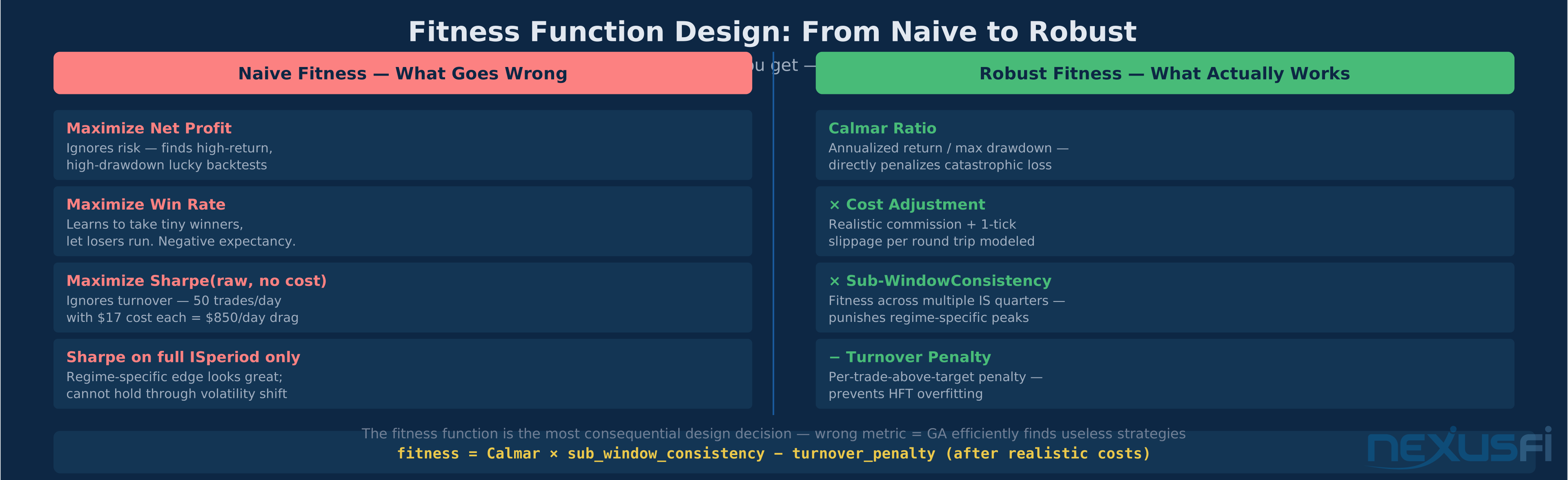
Maximizing net profit: Finds the parameter set that made the most money historically. Strongly biases toward high-frequency strategies that traded during favorable periods. Ignores risk completely.
Maximizing win rate: The GA learns to take tiny winners and let losers run. High win rate, negative expectancy.
Maximizing Sharpe ratio alone: Better, but ignores turnover. A Sharpe of 3.0 with 50 trades per day has very different live-trading prospects than a Sharpe of 2.2 with 3 trades per day. Commissions and slippage that don't appear in a backtest destroy the high-frequency version.
A Fitness Function That Actually Works #
For strong futures strategy optimization, the fitness function must simultaneously capture:
Risk-Adjusted Return: The Calmar ratio (annualized return / maximum drawdown) is often more useful than Sharpe for futures because it directly penalizes the worst-case outcome a trader would actually experience. Sharpe is fine too — the important thing is measuring risk-adjusted, not raw, performance.
Transaction Cost Realism: Model realistic commissions, round-trip slippage, and roll costs. For ES, a round-trip cost of $5 per contract plus 0.5 tick ($12.50) average slippage = ~$17.50 per round trip. A strategy generating 10 round trips per day at $17.50 = $175/day in costs. If the gross strategy earns $200/day, that barely survives. The 2-trade version earning $150/day nets $115/day with far less variance. Without realistic cost modeling, the GA finds profitable illusions.
Drawdown Penalty: Maximum drawdown is the practical limit — it kills live trading accounts and breaches prop firm rules. A composite fitness:
fitness = Calmar × (1 - penalty_multiplier × max_drawdown_pct)Where the multiplier penalizes drawdowns beyond an acceptable threshold.
Turnover Regulation: A gentle penalty for trades-per-day above your target frequency prevents the GA from finding high-frequency micro-edge that disappears under realistic execution costs.
Robustness Component (Critical): Evaluate fitness not just on the full in-sample period but on multiple sub-windows within the sample. Average performance across windows and penalize variance:
fitness = mean(sub_window_returns) / (std(sub_window_returns) + ε) × min(sub_window_calmar)This single addition is one of the most effective overfitting defenses available. The GA cannot find a parameter set that works in one regime and fails in all others — the multi-window fitness immediately punishes regime-specific performance.
Multi-Objective Fitness #
For competing objectives — return vs drawdown vs turnover — NSGA-II and similar multi-objective GA implementations produce a Pareto front: strategies where no single solution dominates on all dimensions. Choose the operating point based on your risk tolerance and drawdown limit.
Part 3: The Evolutionary Cycle #
Selection: Choosing Parents #
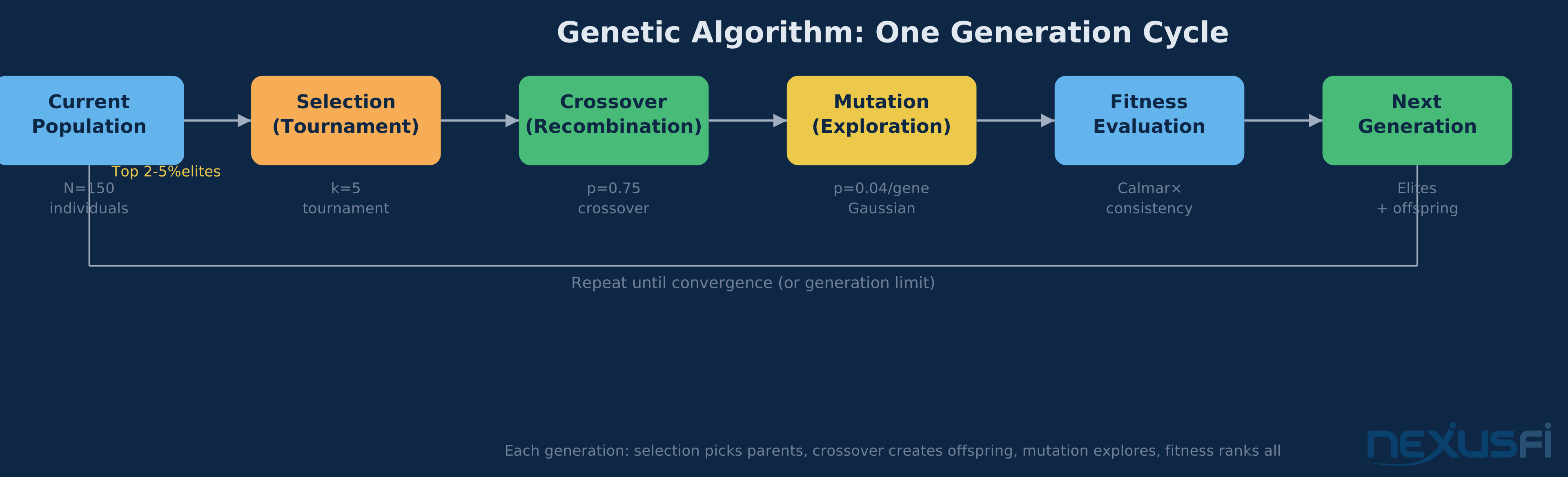
Tournament selection is the practical standard. Pick k chromosomes at random from the population, select the best-performing one as a parent. Repeat for each parent position. The parameter k controls selection pressure: small k gives even weak chromosomes reproductive opportunity (high diversity, slow convergence); large k means only the best reproduce (low diversity, rapid but risky convergence).
For futures strategy optimization with noisy backtests, k values of 3--7 are typical. This provides moderate pressure without eliminating diversity prematurely.
Rank-based selection assigns probability by rank rather than raw fitness value, preventing super-chromosomes from a lucky historical period from dominating the gene pool.
Crossover: Recombining Solutions #
Crossover creates new chromosome combinations by mixing genetic material from two parents. If parent A has a good trend filter and parent B has a good risk module, crossover might produce offspring with both.
Single-point crossover selects one random cut position; all genes before come from parent A, after from parent B. Simple and effective for chromosomes with relatively independent parameters.
Two-point crossover uses two cut points, creating offspring with the middle segment from one parent and outer segments from the other. Better for preserving meaningful blocks.
Segment-aware crossover (preferred for modular chromosomes) constrains crossover points to module boundaries. Signal genes swap with signal genes; risk genes with risk genes. Preserves logical integrity while still recombining between parents.
Crossover probability is typically high: 0.6--0.9. Most individuals should be created by crossover, not copied unchanged.
Mutation: Exploring New Territory #
Mutation introduces random changes to individual genes. Without it, the GA can only combine alleles present in the initial population — if the optimal value for a parameter doesn't appear in any initial chromosome, crossover can never produce it.
Gaussian mutation adds a normal-distribution perturbation proportional to the gene's range (e.g., σ = 1.8 ticks for a 4--40 tick stop gene). Integer mutation randomly assigns from the valid range or applies ±1, ±2 increments.
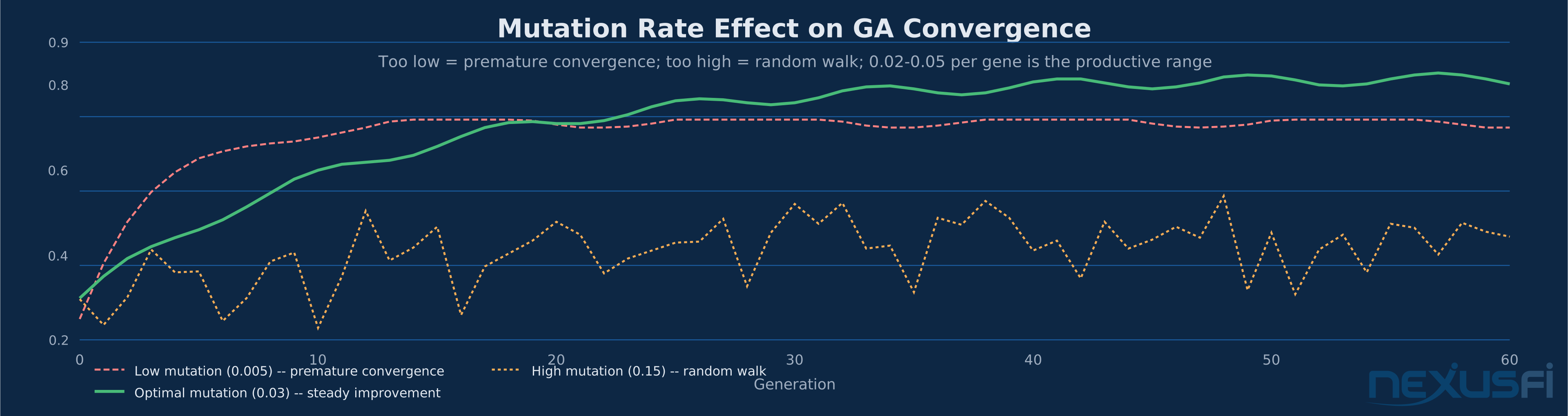
Mutation probability is typically low: 0.01--0.05 per gene. Too much turns the GA into random search. Too little allows premature convergence.
Adaptive mutation dynamically adjusts rates based on population state. When population diversity collapses — measured by fitness variance or genetic similarity between chromosomes — mutation rate increases to reintroduce variety. Particularly valuable for noisy futures fitness landscapes where diversity can collapse faster than in smoother problems.
Part 4: Population Management #
Population Size #
| Parameter count | Practical population size |
|---|---|
| 5--8 parameters | 50--100 individuals |
| 9--15 parameters | 100--250 individuals |
| 15+ parameters | 200--500 individuals |
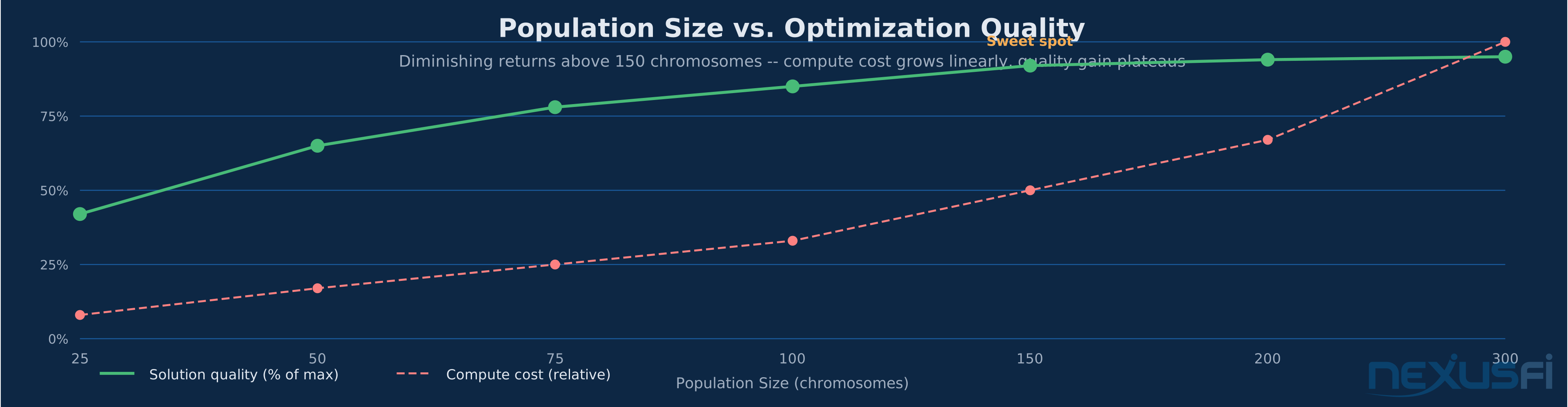
The tradeoff is runtime: 200 chromosomes × 100 generations × 0.5 sec ÷ 8 cores = ~25 minutes. Know your compute budget before setting population size.
Initialization #
Random initialization samples each gene uniformly within its valid range and repairs constraint violations before the first evaluation.
Latin hypercube sampling ensures the initial population covers the full range of each gene evenly — better than random initialization for small populations.
Elitism and Diversity #
Elitism preserves the top 2--5% of chromosomes across generations without modification. This ensures the best solution found never gets destroyed by random operators.
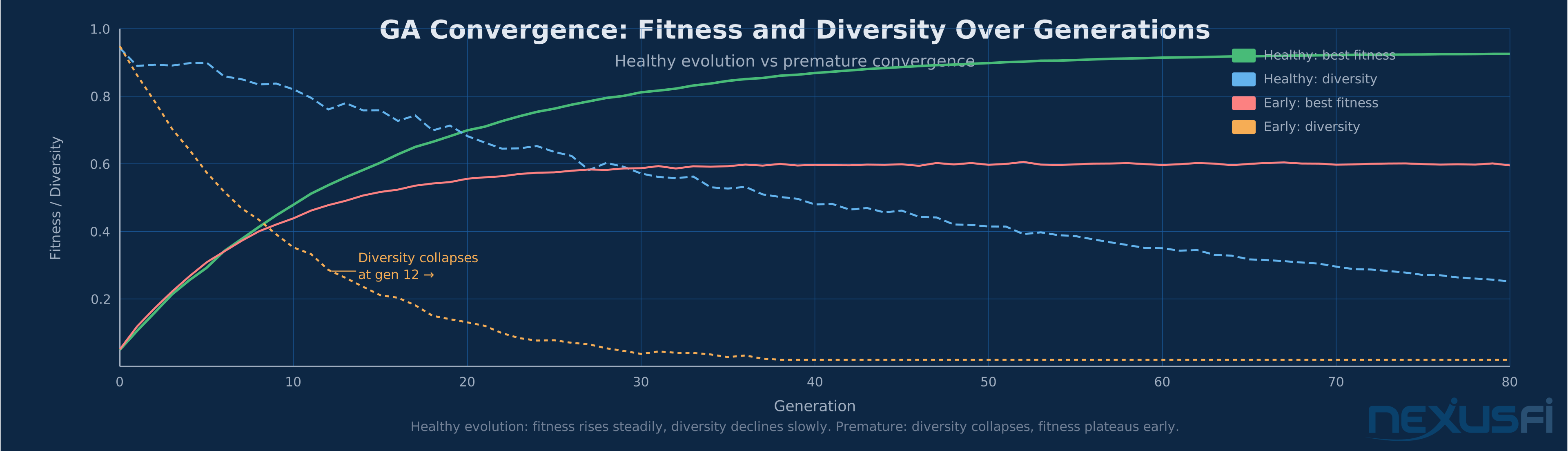
Premature convergence occurs when the population collapses before finding a good solution. Monitor diversity via fitness variance; when it collapses, increase mutation rate or inject new random chromosomes.
Part 5: Walk-Forward Integration -- The Overfitting Defense #
This is where futures strategy GA diverges critically from textbook GA. You are not optimizing to perform well on historical data. You are optimizing to find parameter sets that will perform well in the future. These are not the same thing.
The Overfitting Trap #
Every parameter you optimize risks overfitting. With enough parameters and generations, the GA will find a chromosome that turns historical losses into wins through tortuous parameter contortions — essentially useless going forward.
The mechanism: the population gradually converges on parameters that explain specific historical events (a news shock on a particular date, an unusual volatility regime in one quarter) rather than genuine structural edge. The specific events won't repeat, so the parameters won't work.
The GA Overfitting Trap A GA with naive fitness and no walk-forward integration is an efficient overfitting machine. Every generation finds new ways to exploit historical accidents. The walk-forward protocol is not optional — without it, IS Sharpe ratios of 3+ commonly produce OOS Sharpe of -0.5 or worse.
Nested Walk-Forward Protocol #
The only reliable protection is a nested walk-forward evaluation:
- Divide historical data into in-sample (IS) and out-of-sample (OOS) windows.
- Run the GA on the IS period. Let it converge to the best chromosome.
- Evaluate that chromosome on the OOS period. Record OOS performance.
- Slide both windows forward by one OOS period. Repeat.
- Assess the strategy using concatenated OOS performance across all windows — not the IS backtest the GA optimized.
| Window | IS Period | OOS Period |
|---|---|---|
| 1 | 2019--2021 | 2022 Q1 |
| 2 | 2019--2022 Q1 | 2022 Q2 |
| 3 | 2019--2022 Q2 | 2022 Q3 |
| 4 | 2019--2022 Q3 | 2022 Q4 |
| 5 | 2019--2022 | 2023 Q1 |
Rolling IS windows force the GA to find parameters relevant to recent conditions. Expanding windows give more data but may include outdated regimes.
Critical signal: If OOS performance is dramatically worse than IS across all windows, the GA found overfit solutions. If OOS is modestly below IS but still positive and consistent, the strategy has genuine edge.
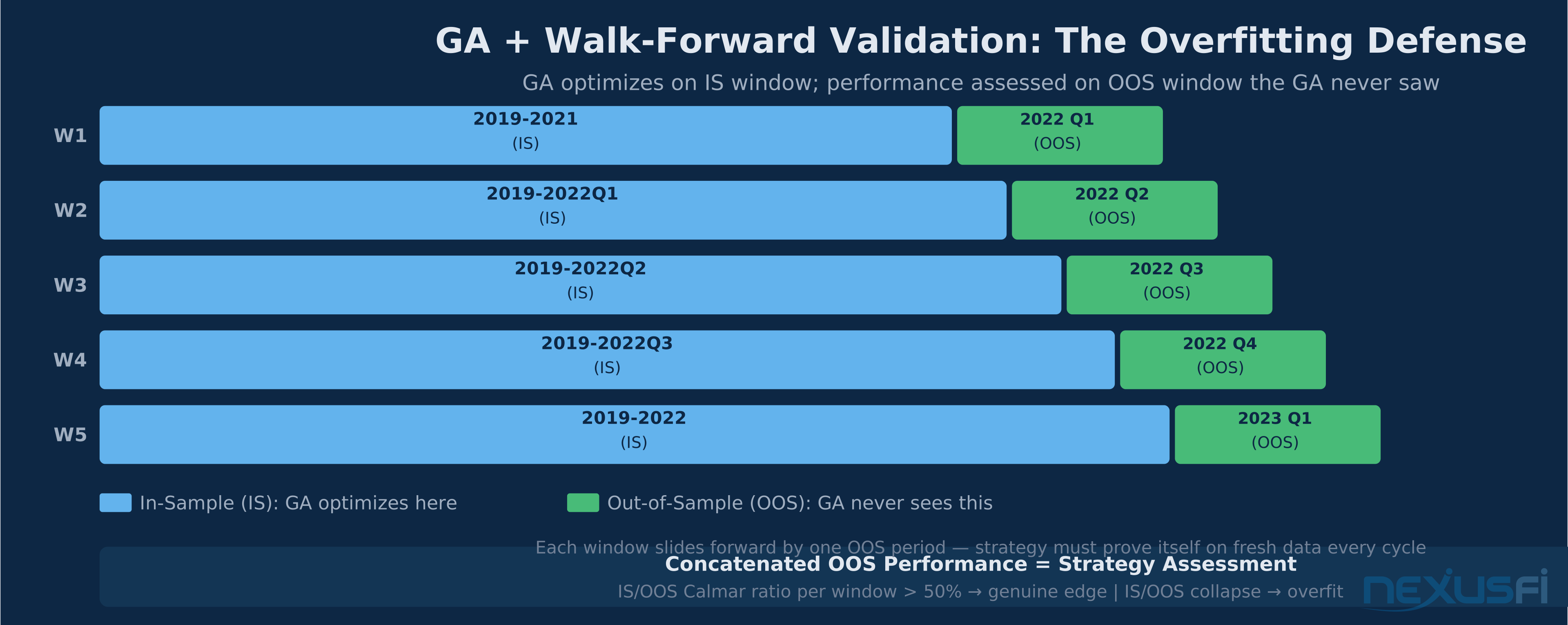
IS/OOS Ratio as Edge Detector A consistent OOS/IS performance ratio above 0.5 across all walk-forward windows is one of the strongest signals of genuine edge. Below 0.3, the chromosome primarily explains historical noise. Track this ratio systematically — it is the single most reliable diagnostic for GA-produced strategies.
Parameter Stability #
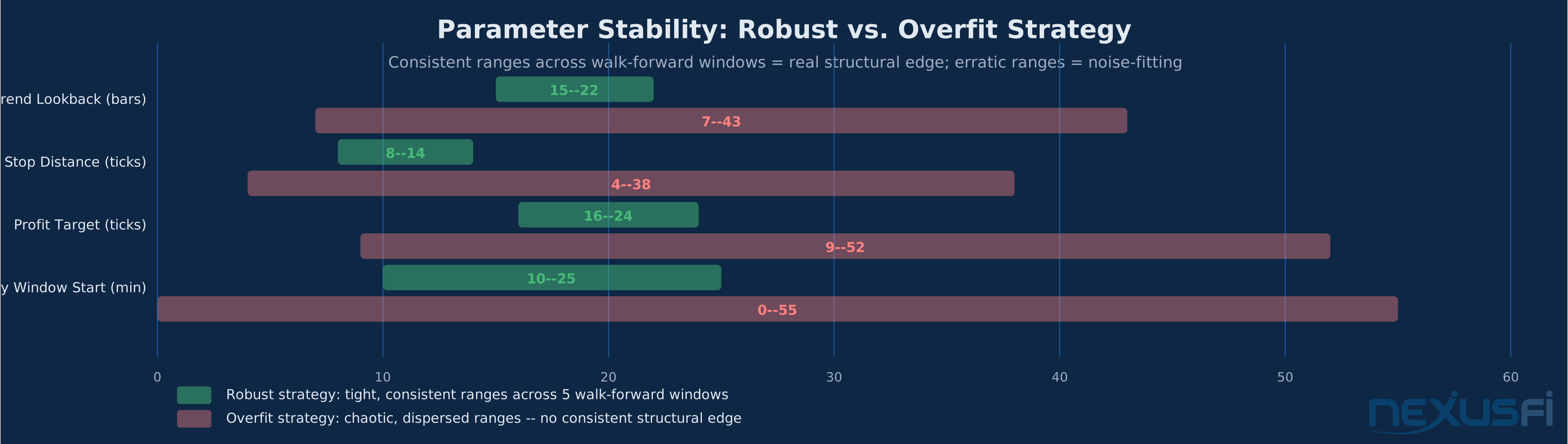
Track the parameters emerging from each walk-forward window's optimization. If the GA consistently selects similar values across windows (trend filter lookback of 15--22 bars, stop of 8--14 ticks), the strategy has a stable parameter region with real structure the optimizer keeps rediscovering.
If parameters jump dramatically between windows (lookback of 7 in one, 43 in another), the strategy's edge is regime-specific and fragile. The data contains no consistent signal for the optimizer to lock onto.
Part 6: Practical GA Configuration #
A concrete reference configuration for a parameterized trend-following NQ strategy with 10 parameters:
| GA Parameter | Recommended Value | Rationale |
|---|---|---|
| Population size | 150 | 10 parameters × 15 = adequate diversity |
| Maximum generations | 80 | Diminishing returns visible after ~60 |
| Crossover rate | 0.75 | Most offspring from crossover |
| Mutation rate | 0.04 per gene | Low enough to preserve, high enough to explore |
| Selection method | Tournament (k=5) | Moderate pressure, preserves diversity |
| Elitism | Top 3 chromosomes | Protect best across generations |
| Convergence criterion | No IS improvement for 20 generations | Practical stopping rule |
| Parallel evaluation | Yes, across all cores | GA is embarrassingly parallel |
| Fitness | Calmar × sub-window consistency − turnover penalty | Risk-adjusted + robustness |
Runtime estimate: 150 chromosomes × 80 generations × 0.5 sec/backtest ÷ 8 cores = ~125 minutes per walk-forward IS window. Adjust population or generation count to meet your time budget.
Starting Configuration For most 8-12 parameter futures strategies: population 100-150, crossover 0.75, mutation 0.03/gene, tournament k=5, elitism top 3. Run 60-80 generations. If IS/OOS degradation exceeds 50%, reduce free parameters — the problem is overparameterization, not insufficient history.
After each walk-forward window converges, evaluate the best chromosome on the OOS window. Accept the strategy if OOS Calmar exceeds 50% of IS Calmar across the majority of walk-forward windows.
Part 7: Pitfalls and Anti-Patterns #
Premature Convergence #
Symptom: Population fitness variance collapses within 20--30 generations. Best fitness stops improving. The solution found is mediocre.
Cause: Selection pressure too high, mutation too low, population too small.
Fix: Reduce tournament k, increase mutation rate, add immigrant injection (replace 10% worst chromosomes with new random individuals every 15 generations).
Overfitted Fitness Function #
Symptom: IS Sharpe of 3.2. OOS Sharpe of -0.4. Every walk-forward window shows dramatic IS/OOS degradation.
Cause: Fitness maximizes on specific historical events. The GA found parameters that profited from particular price paths that won't repeat.
Fix: Add sub-window consistency requirement. Increase OOS window length. Reduce free parameters. Add penalty for parameters near constraint boundaries (edge-of-range values are fragile signals of overfitting).
Transaction Cost Blindness #
Symptom: GA finds a strategy with 50 trades per day, Calmar of 4.0 in backtest. Loses money immediately live.
Cause: Backtest didn't include realistic commissions and slippage. Small per-trade costs at high frequency create large aggregate drag.
Fix: Always model exchange + NFA fees, brokerage commission, and at least 1-tick slippage. For intraday strategies, add bid-ask spread crossing costs explicitly.
Too Many Free Parameters #
Symptom: Each walk-forward window produces completely different parameters. No consistency. OOS performance is basically random.
Cause: With 15+ free parameters, the GA has enormous freedom to find historically coincidental combinations. Degrees of freedom exceed what the data can constrain.
Fix: Anchor domain knowledge as fixed parameters. Reduce free parameters until walk-forward windows show consistent ranges.
Ignoring Regime Changes #
Symptom: GA-optimized strategy works beautifully from 2015--2019, then fails catastrophically when deployed in 2020.
Cause: Parameters captured the low-volatility grinding market of 2015--2019 specifically.
Fix: Include multiple distinct regimes (high/low volatility, trending/ranging) in your IS window. Rolling IS windows force the GA to find parameters relevant to recent conditions.
Part 8: GA vs. Alternative Optimization Methods #
When GA Is the Right Choice #
Grid search beats GA for narrow spaces with 4 or fewer parameters — use it when you want the full sensitivity surface, not just the peak. Random search works well when the good region of parameter space is large; use it as a quick initial sweep. GA wins decisively when:
- High dimensionality: 8+ parameters that all matter
- Parameter interactions: Entry threshold and stop distance interact; grid search misses synergies
- Mixed variable types: Integer lookbacks, continuous thresholds, categorical choices
- Multi-objective: Optimizing return AND drawdown AND turnover simultaneously
- Compute is limited: More possible combinations than you can evaluate
The killer example: A 12-parameter futures strategy with 10 values per parameter requires 10^12 grid evaluations. A well-configured GA finds competitive solutions in 5,000--10,000 evaluations — a 100-million-fold reduction in compute.
Alternative Methods #
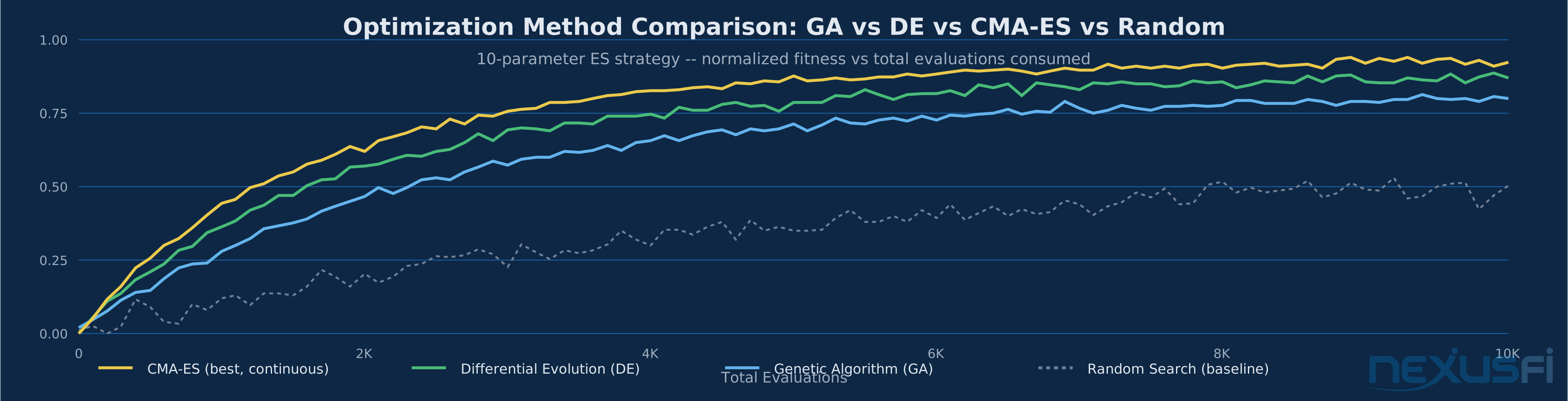
For detailed comparisons of Differential Evolution (DE), CMA-ES, and Bayesian Optimization against GA — including benchmark convergence curves on 10-parameter futures strategies — see Alternative Optimization Methods for Trading Strategies.
Bringing It Together: The Full Workflow #
- Define the strategy and parameter space: Identify every free parameter, set valid ranges based on domain knowledge, fix parameters that domain knowledge constrains.
- Design the chromosome: Choose encoding types (real-valued, integer, categorical), implement modular structure, build repair operators for constraints.
- Build and test the fitness function: Include realistic costs, Calmar ratio, multi-window consistency, and turnover penalty. Test manually on 10+ known parameterizations before running the GA.
- Configure the GA: Scale population to parameter count, crossover 0.7--0.85, mutation 0.02--0.05 per gene, tournament selection k=4--6, elitism 2--5%, stopping criterion of 20 generations without IS improvement.
- Run nested walk-forward: Divide into IS/OOS windows, improve on IS, evaluate on OOS, concatenate OOS performance across windows.
- Analyze parameter stability: Consistent ranges across windows indicate real structure; erratic ranges indicate regime-specific noise — reduce free parameters.
- Forward test before live capital: Paper trade for at least 3 months before risking real money. Walk-forward OOS is still historical data.
Three Non-Negotiables Three design decisions determine whether GA produces tradeable strategies: (1) A fitness function that includes realistic costs, risk adjustment, and multi-window consistency. (2) Nested walk-forward where OOS windows are never exposed to the optimizer. (3) Free parameter count calibrated to data length — more than one free parameter per 200 OOS trades and you are optimizing noise.
GA is not a silver bullet. With poor representation or naive fitness, it efficiently finds the most overfit parameterization possible. Its power comes from thoughtful design at every stage: chromosome structure, fitness measurement, and walk-forward protocol. Get those three right and GA gives genuine search efficiency over a space no other method can work through.
Knowledge Map
Go Deeper
Build on this knowledgeReferences This Article
Articles that build on this topicCitations
- — Tip for backtesting on Renko charts (2014) 👍 7“Learn how to properly do walk forward optimization. I cannot stress this enough. And not just once -- learn your strategies' ratio of Optimization Period and Validation Period.”
- — Walk Forward Testing & Optimization Experiences and Best Practices (2014) 👍 6“How many have you successfully walked forward? Any pointers from experts would be helpful.”
- — KJ Trading Systems Kevin Davey - Ask Me Anything (AMA) (2015) 👍 6“Walkforward with unanchored testing (the in sample optimization window moves). This is the most rigorous test.”
- — Taking a Trading System Live (2013) 👍 3“Run walkforward analysis for different combinations of In/Out periods, select the best In/Out. This process identifies the most robust parameterization.”
- — An experiment on curve fitting (2010) 👍 3“Walk-forward analysis cuts the sample period into bits and pieces to use the same data several times, both as in-sample and out-of-sample.”
- — NinjaTrader Genetic Optimizer (2009) 👍 45“In your strategy analyzer optimize dialog choose 'PH Genetic' as the Optimizer -- you can select whichever 'Optimize on...' metric you like.”
- — NinjaTrader Genetic Optimizer (2009) 👍 11“A pretty much complete rewrite -- it uses a different way of extracting the tested strategy's score using a hack in base Strategy.Dispose.”
- — Index to Genetic Optimizers for NinjaTrader (2010) 👍 18“I've done some Google and NinjaTrader Forum sleuthing to come up with what I hope is a comprehensive index to all things Genetic Optimizer for NinjaTrader. Please respond with other links if I have missed any.”
- — NinjaTrader Optimizer Types (Custom Fitness) (2013) 👍 3“It is hard to say. For a real optimization approach, you specify constraints carefully -- the fitness function definition matters as much as the algorithm itself.”
- — Artificial Bee Colony (ABC) Algorithm (2013) 👍 9“5000 generations in 20 minutes sounds super fast. Can I ask what the population size of each generation is and how much sample data you're running each individual through?”
- — Building the ULTIMATE NT8 Strategy, lets break Topstep (2021) 👍 28“I have been wanting to do this project for some time now. The goal: build a systematic, automated strategy that passes a funded account challenge using rigorous walk-forward validation.”