



TradingView Spread Charts: Custom Formulas, Pairs Trading, Ratio Charts, and Inter-Market Analysis
Overview #
Most traders use TradingView to look at one instrument at a time. Price goes up, price goes down, you make a call and take a trade. Clean, simple, and leaves half the analytical picture off the table.
Spread charts change that. Enter a formula into TradingView's symbol search bar — something like ES1!-NQ1! or GLD/GDX — and the platform renders a synthetic instrument showing the relationship between two markets as a single chart. Every indicator you'd apply to a regular chart works on the spread. Bollinger Bands, moving averages, RSI, MACD, Pine Script alerts — all of it runs on the relationship rather than the price.
This is pairs trading infrastructure that was once exclusive to institutional desks, now sitting in a browser tab. The spread chart makes divergence visible. The math tells you whether it's extreme enough to trade. The alert system notifies you when the entry zone triggers, without you watching the screen all day.
But "straightforward" is where most retail traders stop, and that's where the trouble starts. Spread trading has sharp edges that a lot of people don't see until they've lost money on both legs simultaneously. This guide covers the mechanics, the math, the practical setups across multiple pairs, and the specific ways spread charts can fail you if you don't know what to look for.
Spread chart formulas (entering custom expressions in the symbol bar) require a TradingView Plus subscription or above. The Basic and Essential tiers only allow single-symbol charts. The Plus plan at ~$30/month is the entry point for serious spread analysis.
Key Concepts #
Spread: A synthetic instrument created by applying a mathematical operation to the prices of two real instruments. The result represents the relationship between the two, not either one's absolute price.
Ratio chart: A spread using division (A/B) showing proportional relationships — how many units of B you'd get for one unit of A. Useful when the two instruments have very different price scales.
Log ratio: The natural logarithm of a ratio: ln(A) - ln(B). Equivalent to A/B in direction, but more stable for statistical analysis over long time periods and symmetric around zero.
Beta-hedged spread: A spread of the form A - (beta * B), where beta is calculated to remove the common market factor. The residual is the "pure" relative performance, stripped of broad market movement. This is the form used in serious pairs trading. For the volatility-adjusted sizing logic that underpins beta calculation, see Volatility-Based Position Sizing.
Cointegration: A statistical property where two non-stationary price series share a long-term equilibrium relationship. If two instruments are cointegrated, their spread is stationary — it reverts to a mean rather than drifting indefinitely. This is the statistical foundation for pairs trading. See Statistical Arbitrage Systems for Futures for a full treatment of cointegration testing, the Engle-Granger method, and how to validate mean-reversion assumptions before entering a spread.
Correlation vs. cointegration: Correlation measures how assets move together daily. Cointegration measures whether they share a long-term equilibrium. Two assets can be highly correlated without being cointegrated, or cointegrated without tight daily correlation. For spread trading, cointegration is the meaningful test.
Z-score: Converts the raw spread into units of standard deviation from its rolling mean: z = (spread - mean) / standard_deviation. A z-score of +2.0 means the spread is 2 standard deviations above its average — the primary signal for mean reversion entries. The z-score framework is a direct application of the statistical edge concept to spread relationships — it quantifies how unusual the current divergence is relative to the spread's historical distribution.
Hedge ratio: The number of contracts of instrument B needed to offset one contract of instrument A. Getting this wrong is the most common mistake in spread trading — an incorrect hedge ratio means your "spread" is actually a directional bet in disguise.
Half-life: The expected time for a spread to revert halfway from its current deviation back to the mean. Shorter half-life means faster reversion. Typical range: 3-8 days for futures inter-market spreads, 20-60 days for equity sector spreads.

Creating Spread Charts on TradingView #
TradingView's spread functionality is built into the symbol search bar. You type the formula where you'd normally type a ticker symbol, and the platform renders the result as a standard chart.
The basic syntax:
- Subtraction:
ES1!-NQ1!-- absolute price difference - Division (ratio):
GLD/GDX-- proportional relationship - Complex formulas:
(AAPL-MSFT)/SPY-- custom relationships with normalization
Every native indicator works on the resulting series — RSI, MACD, Bollinger Bands, volume profile on Plus. As @rlstreet explained on NexusFi: "Tradingview.com pro has the option where you can use different instruments in any formula: like A-B (pair spread) or A/B (ratio) and use it as it is one instrument. All indicators work just like you would expect."
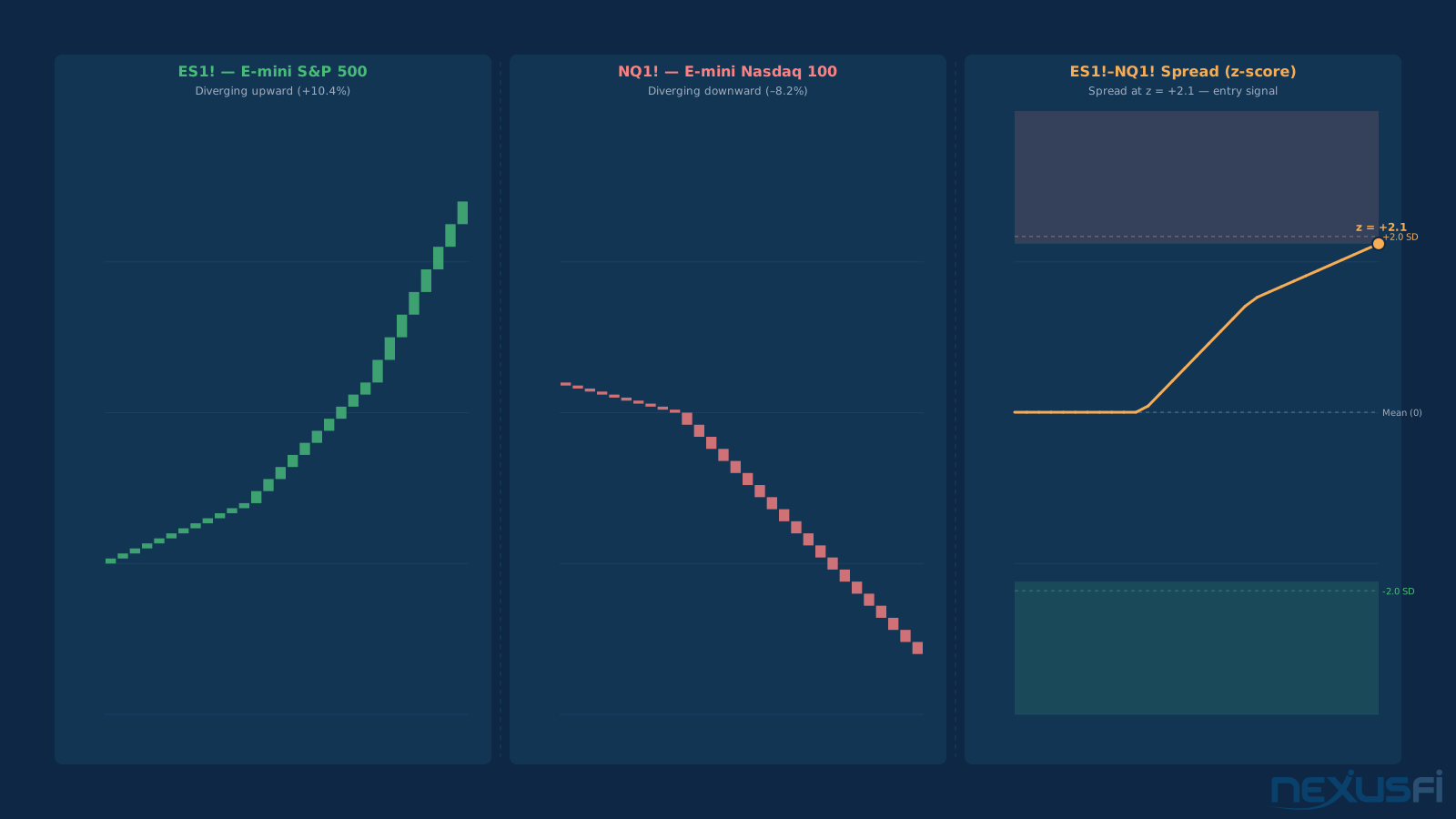
The symbol-bar method is convenient but limited. For rolling beta adjustment, z-score normalization, and dynamic alerts -- Pine Script is the right tool. Use request.security() to pull the second instrument's data, calculate the spread, and normalize to z-score in a single indicator. The full template is shown in the SVG image above.
The Pine Script core structure:
price_b = request.security("NQ1!", timeframe.period, close)
beta    = ta.linreg(close, price_b, 30)
spread  = close - beta * price_b
zscore  = (spread - ta.sma(spread, 30)) / ta.stdev(spread, 30)
This gives you a beta-adjusted spread normalized to z-score. Layer on entry/exit lines with hline(), set alerts at your threshold levels, and plot colored background zones for visual signals. One important distinction: TradingView's ta.linreg() approximates a hedge ratio but isn't identical to OLS on returns. For daily swing trades, the difference is small. For high-precision intraday work, calculate beta externally and enter it as a fixed input.

The Math Behind Spread Formulas #
Understanding which formula to use is the difference between a meaningful spread chart and a noisy chart that produces phantom signals.
Subtraction (A - B): Shows absolute price difference. Works when both instruments trade in comparable units and at similar price levels — like WTI crude (CL1!) minus Brent (BZ1!), both in dollars per barrel. Fails when price scales differ dramatically.
Ratio (A / B): Scale-invariant — if both prices double, the ratio stays the same. GLD/GDX is the textbook ratio chart: GLD around 190-240, GDX around 30-45. The ratio (running 4-7 historically) shows whether gold is expensive or cheap relative to miners, regardless of the absolute price of either.
Log Ratio (ln(A) - ln(B)): The logarithm transformation makes the series symmetric — a 10% outperformance shows up as the same magnitude as a 10% underperformance, which the raw ratio doesn't do. For long-term ES/NQ analysis, the log ratio is usually cleaner. Enter as log(ES1!)/log(NQ1!) in TradingView.
Beta-Hedged Spread (A - beta B): This is the professional version. Beta is calculated from regression of A's returns on B's returns. Subtracting (beta B) removes the common factor, leaving only residual divergence.
As @kkfx detailed in the NexusFi spread trading thread, even for a familiar pair like ES/NQ, the ratio requires careful adjustment:
This is exactly why a naive 1:1 contract ratio fails — you need to account for both dollar value and volatility.

The Four Core Spread Pairs #
ES/NQ: The Classic Equity Index Spread
The most-traded spread in US equity index futures. ES and NQ track similar macro factors but diverge meaningfully on tech-specific events, sector rotations, and interest rate sensitivity changes.
On correlated days, ES and NQ move in lockstep at 0.87-0.90 correlation. On divergence days — big tech earnings, rate-sensitive events, sector rotation — that correlation drops to 0.70 or lower, creating clear trading opportunities. These fracture windows are visible in real time on the ES/NQ spread chart before they're obvious on either individual chart.
@josh's live trade analysis on NexusFi captures the intraday opportunity directly: "while the S&P was clearly holding strong and making new highs, the NDX was making new lows. The divergence from INDU was even more glaring." That's the spread trader's entry signal — the ES/NQ spread screaming "short NQ" while both indices look superficially similar on separate charts.
@kkfx summarized the CME's published guidance for the ES/NQ ratio: "in this case its 2NQ:1ES, so tick values are roughly equal and CME offers 70% margin credit for this spread." That margin credit is significant — it reduces capital requirements by 70% when using the exchange's published hedge ratio, making this one of the most capital-efficient spread trades available.
As @kkfx detailed in the pairs trading forum thread: "NQ/ES — Buy when Tech stocks are expected to outperform the broader markets. Always check news about FAANG stocks and any good news about FAANG stocks would cause NQ to outperform ES. Intraday difference between NQ%-ES% change ranges from 0-1% but hardly ever more than that."
As noted in the NexusFi discussion on ES vs NQ/YM: the 0.87-0.90 correlation fractures during big tech earnings (NVDA, AAPL, MSFT single-handedly dragging NQ), rate-sensitive events where NQ faces more duration pressure, and sector rotation days when money shifts from growth to value. Enter the spread trade when z-score hits ±2.0 during a fracture window with an identifiable trigger.
And as @bobwest observed in the What Causes Divergence thread:
GLD/GDX: Gold vs. Miners
GLD is a direct proxy for gold spot price. GDX is a basket of gold mining stocks. They should track each other closely — miners' revenue is denominated in gold. But GDX carries an embedded equity beta that GLD doesn't have: operational costs, leverage, management risk, and corporate actions.
During broad equity selloffs, GDX falls harder than GLD because investors dump all equity exposure, including miners, even if gold itself is rising as a safe haven. @Studier's intermarket analysis journal on NexusFi applies exactly this logic: "the spread between GLD and SPY is suggesting that SPY is overbought compared to GLD" — the same framework applies to GLD/GDX when the ratio reaches extreme levels.
The GLD/GDX ratio has historically oscillated between roughly 3.5 and 6.5. Extreme readings above 5.5 suggest miners are severely lagging gold and a potential catch-up trade exists. As @FlyingMonkey noted in his trading journal: "recently the miners are severely lagging and don't show any signs of being in an uptrend. Gold still looks OK and could be poised for a bounce." That's the GLD/GDX divergence in action — and the potential long GDX trade when the spread normalizes.
CL/BZ: WTI vs. Brent Crude
Both track global crude oil markets but reflect different supply/demand dynamics: WTI is US landlocked crude influenced by Cushing storage, while Brent reflects North Sea and global seaborne crude. The spread normally runs tight but spikes on US-specific inventory data, pipeline bottlenecks, or geopolitical disruptions. CME offers approximately 85% margin credit for this intermarket spread. Enter in TradingView as CL1!-BZ1! — subtraction works here since both trade in dollars per barrel at similar prices.
ZN/ZF: Yield Curve Trading
10-year Treasury Note futures (ZN) versus 5-year (ZF) creates a synthetic yield curve steepener/flattener. When the spread rises, the 10yr-5yr portion is steepening — pricing in growth or inflation. When it falls, the curve is flattening, often preceding rate hike expectations. CME offers over 90% margin credit on curve spreads. This spread requires DV01 adjustment — dollar value of a basis point differs between 10yr and 5yr notes, so a raw 1:1 ratio is not market-neutral.

The Z-Score Framework #
Raw spread prices drift. You can't look at a raw ES/NQ spread chart and know if the current level is extreme or normal. The z-score solves this by converting the spread into standard deviations from its rolling mean. This is the core mechanic behind mean reversion trading — the z-score converts the abstract concept of "deviation from fair value" into a concrete, actionable number in standard-deviation units.
The formula: z = (current_spread - rolling_mean) / rolling_standard_deviation
A z-score of +2.0 means the spread is 2 standard deviations above its average. Over a standard normal distribution, this is historically extreme roughly 95% of the time — but whether that holds for your specific spread is what backtesting determines.
Entry and Exit Rules
The standard mean reversion setup:
- Entry: Z-score crosses +2.0 (short the spread -- sell outperformer, buy underperformer) or -2.0 (long the spread)
- Profit target: Z-score returns to 0 (mean reversion complete)
- Stop-loss: Z-score reaches +3.0 or -3.0 (the relationship is breaking, not reverting)
Variations based on your pair and timeframe:
- More volatile pairs (GLD/GDX, sector ETFs): widen entry to ±2.5, targets to ±0.5
- Tighter pairs (CL/BZ, ZN/ZF): entry at ±1.5 viable with fast half-life
- Trend-filtered: only take mean reversion trades when the spread's 5-bar MA is turning back toward zero
@kkfx laid out the cointegration framework that determines which spread strategy applies:
That's the decision tree: pairs that are cointegrated get mean-reversion plays at z-score extremes; pairs with high correlation but low cointegration are trend-following plays on the divergence direction.
Bollinger Bands as a visual shortcut: If you don't want to build a z-score indicator, Bollinger Bands applied directly to the spread chart serve as a reasonable visual proxy. The middle band is the rolling mean, outer bands are ±2 standard deviations. The limitation: Bollinger Bands use a fixed multiplier and don't let you set asymmetric thresholds or adapt lookback periods independently. For serious spread work, Pine Script's z-score is more flexible.

Inter-Market Analysis Applications #
Spread charts aren't just for pairs trading setups. They're powerful diagnostic tools for understanding what the macro environment is doing, separate from what any single instrument's price is saying.
SPY/TLT — The Risk Barometer: Stocks divided by long bonds is the clearest real-time risk-on/risk-off indicator in markets. Rising ratio means risk appetite is high; falling means money is moving to safety. Traders who watched SPY/TLT in late 2021 saw the ratio deteriorate months before equities peaked. The fracture risk: during acute crisis (March 2020), both sell off simultaneously as investors liquidate everything for cash, making the SPY/TLT relationship unreliable as a safety signal.
GLD/GDX — Miner Premium/Discount: Above its long-term mean signals miners lagging gold — potential catch-up trade. Below its mean signals miners leading gold — equity confidence in mining sector. @Fat Tails, in the Comparing Index Futures thread on NexusFi, traced a spread divergence to a specific macro driver: "one of the reasons for the divergence between ES and TF is the strong move of the Euro. If the Euro moves up, this benefits large companies, because their exports may increase." The same macro attribution applies to GLD/GDX — currency moves, mining cost inflation, and risk-on/off dynamics all create traceable spread divergences.
ES/NQ Ratio — Tech vs. Broad Market: When NQ outperforms ES, growth/tech is in the driver's seat. When ES outperforms, value rotation is in play. Day traders use ES/NQ divergence as a real-time session signal. If ES is making new highs but NQ is failing to follow, that's a warning sign for continuation. If NQ is ripping and ES is lagging, the move has tech momentum not yet confirmed by broad markets.
ZN/ZF Yield Curve: A rising spread indicates steepening — growth expectations rising, Fed on hold. A falling spread indicates flattening or inversion — recession fears or hiking cycle. Futures traders use this to contextualize equity index trades: a rapidly flattening curve tends to precede equity weakness, while a steepening curve often coincides with cyclical leadership.

Execution Reality #
This section is where spread trading guides usually go quiet, which is where the real risk education starts.
Leg Risk: When you execute a spread trade, you're placing two separate orders in two separate instruments. The time between filling leg 1 and leg 2 creates exposure to the market moving against you on one leg before you're hedged. During fast markets — FOMC announcements, earnings — the market can move 20 points while you're filling the second leg. Your spread entry is immediately underwater through no fault of the strategy.
Mitigation: use simultaneous bracket orders where your broker supports them, size down so legging cost is acceptable, and avoid entering spreads during the highest-volatility windows unless the setup is extremely clean.
Hedge Ratio Drift: The beta relationship between instruments changes over time. The volatility-adjusted ratio you calculated last month might be wrong today if NQ's volatility has changed relative to ES. This produces "ratio slippage" — both legs moving the same direction at different velocities, creating losses on both sides. Recalculate your hedge ratio at minimum weekly. When the current vol-adjusted ratio differs from your initial ratio by more than 10%, adjust your position.
The Regime Shift Problem: Mean reversion strategies assume the spread has a stable mean to revert to. Sometimes it doesn't. @josh's original analysis in the NexusFi spread trading thread identified this directly:
A spread that's been mean-reverting for 2 years can trend for 18 months in one direction during a structural regime shift. Tech dominance in the 2010s made NQ/ES trend strongly in NQ's favor. The 2022 rate hiking cycle reversed it temporarily. Your stop-loss at ±3.0 SD is the circuit breaker -- use it without hesitation when the spread keeps moving against you after entry.
The False Safety of Market Neutrality: Spread trading is marketed as "market neutral" because you're long one instrument and short another. This is true at initiation only. It's neutral at the specific hedge ratio you entered, for the specific volatility regime that ratio was calculated in. As the market moves, your delta changes. A 2NQ:1ES spread might be dollar-neutral at initiation, but if NQ drops 500 points while ES drops 100 points, you've gone from "neutral" to "net long" without making any new decisions. Monitor your spread's delta continuously.

Building Your Spread Trading Workflow #
Step 1: Start with a familiar pair. If you trade ES, the ES/NQ spread is the natural starting point — you understand both instruments, you know when they typically diverge, and you can interpret the spread chart contextually. Don't start with sector ETF pairs or cross-asset relationships until you've worked through at least 20-30 ES/NQ setups.
Step 2: Set up your charts. The standard spread trading layout in TradingView: top panel shows the spread chart (ratio or log ratio) with Bollinger Bands or your z-score indicator, bottom panels show the individual instruments. This lets you see the spread's extreme level while monitoring both underlying instruments for context — is the divergence driven by one spiking or both moving differently?
Step 3: Define your signal protocol before you trade. Entry threshold (z-score level), hedge ratio (exact contract ratio), position size (dollar amount per leg), profit target (z-score), stop (z-score level), and trend filter (condition required for entry). Write these down before you enter a position.
Step 4: Set TradingView alerts. TradingView's alert system works on spread chart series exactly the same as on regular instruments. Set "Price crossing above" at your entry threshold for the z-score indicator, and "Price crossing below" for the long-side entry. For Pine Script z-score indicators, use alertcondition() to define the trigger directly in the script. The platform monitors 24/7 and sends push notifications when your level triggers.
Step 5: Execute on your broker platform. TradingView is analysis, not execution. Close TradingView and open your broker's order management system. Place both legs as close to simultaneously as possible. Track the position through the spread chart, not the individual prices — you're indifferent to whether both go up or down, what matters is the ratio returning to its mean.

Common Mistakes #
Wrong formula for the pair. Applying subtraction to instruments with different price scales produces a spread dominated by the higher-priced instrument. GLD (190) minus GDX (38) = 152, which tells you almost nothing useful. Use the ratio: GLD/GDX = 5.0, which you can compare against its historical range of 3.5-6.5.
Assuming 1:1 contracts is the hedge. A 1:1 contract ratio is almost never neutral for futures pairs. Calculate the volatility-adjusted ratio from ATR data before every trade.
Ignoring the regime. As @josh's analysis demonstrated, mean reversion can fail catastrophically during structural regime shifts. A spread that's mean-reverting for years can trend against you for 18 months. Your stop at ±3.0 SD is not optional.
Treating the spread chart as execution. TradingView is analysis only. You cannot click "buy" on a spread chart and have it automatically leg into both instruments simultaneously. Your execution risk starts the moment you leave the analysis platform.
Overlooking tick sizes and contract specs. A 1-tick move in ES is $12.50. A 1-tick move in NQ is $5.00. These differences affect P&L calculations, slippage estimates, and position sizing in ways that aren't visible on the spread chart. Always think in dollar terms, not tick terms, when sizing spread positions.

TradingView vs. Dedicated Spread Platforms #
TradingView handles visualization, signal generation, and alerting very well. It's weak on execution, portfolio-level spread management, and statistical testing. Dedicated spread trading platforms like CQG Spreader offer simultaneous multi-leg order execution (eliminates legging risk), exchange-native spread orders (with margin credit applied automatically), and built-in statistical analysis for cointegration testing and hedge ratio calculation.
The workflow most active spread traders land on: TradingView for signal identification (the spread chart tells you when to look), CQG or your execution broker for actual order entry (the platform executes both legs together). Analysis layer and execution layer as separate applications — each tool doing what it does best.

Knowledge Map
Prerequisites
Understand these firstGo Deeper
Build on this knowledgeReferences This Article
Articles that build on this topicCitations
- — TradingView Pro spread formulas (2017) 👍 3“Tradingview.com pro has the option where you can use different instruments in any formula: like A-B (pair spread) or A/B (ratio) and use it as it is one instrument. All indicators work just like you would expect.”
- — Pairs trading in futures (2013) 👍 5“every tick movement of ES (3 lots) will create $37.5 difference and every tick movement of NQ (4 lots) will create a difference of $20. The daily ATR of ES is currently 14 and NQ is around 37 so one needs to adjust the hedge ratio based on volatility too.”
- — Pairs trading in futures (2013) 👍 8“while the S&P was clearly holding strong and making new highs, the NDX was making new lows. The divergence from INDU was even more glaring.”
- — Pairs trading mechanics (2017) 👍 4“NQ/ES -- Buy when Tech stocks are expected to outperform the broader markets. Always check news about FAANG stocks and any good news about FAANG stocks would cause NQ to outperform ES.”
- — What causes ES/NQ divergence (2014) 👍 6“if the ES (S&P futures) is moving up but NQ (Nasdaq futures) is moving down, you have two things that are somewhat similar (both stock index futures) that are out of step. This kind of divergence can be very informative. It means, Be alert, something unusual is happening.”
- — Intermarket analysis journal (2015) 👍 2“the spread between GLD and SPY is suggesting that SPY is overbought compared to GLD”
- — Gold miners vs gold price analysis (2015) 👍 3“recently the miners are severely lagging and don't show any signs of being in an uptrend. Gold still looks OK and could be poised for a bounce.”
- — Comparing Index Futures ES NQ YM (2010) 👍 7“one of the reasons for the divergence between ES and TF is the strong move of the Euro. If the Euro moves up, this benefits large companies, because their exports may increase.”
- — Pairs trading cointegration framework (2013) 👍 6“High correlation, High co-integration -- trade for mean reversion. High correlation, Low co-integration -- trade for diversion/widening of the spread pair.”
- — Pairs trading in futures -- regime shift risk (2013) 👍 9“since 2002 the NDX has been steadily gaining strength vs the S&P 500 and as such has remained largely below the mean. In other words, it has been trending down. A mean reversion strategy would have failed miserably in 2000 and 2001, as the tech bubble burst and the Nasdaq fell out of bed.”