



No Dealing Desk (NDD) Brokers: What the Label Actually Means and When It Matters
Overview #
No Dealing Desk execution means the broker routes your order electronically to external liquidity venues instead of sitting on the other side of the trade. In forex, this distinction is fundamental to how you get filled, who profits from your losses, and whether the price you see is the price the market is actually offering. In futures, the concept barely applies — because the exchange is already doing what NDD promises.
Understanding the difference saves you from paying for marketing language when what you actually need is low-cost, reliable execution. If you trade forex, NDD is a structural choice that affects your fills, your costs, and whether your broker has a financial incentive to see you fail. If you trade futures, you already have what NDD brokers are selling — and your broker selection criteria should focus on entirely different factors.
What a Dealing Desk Actually Does #
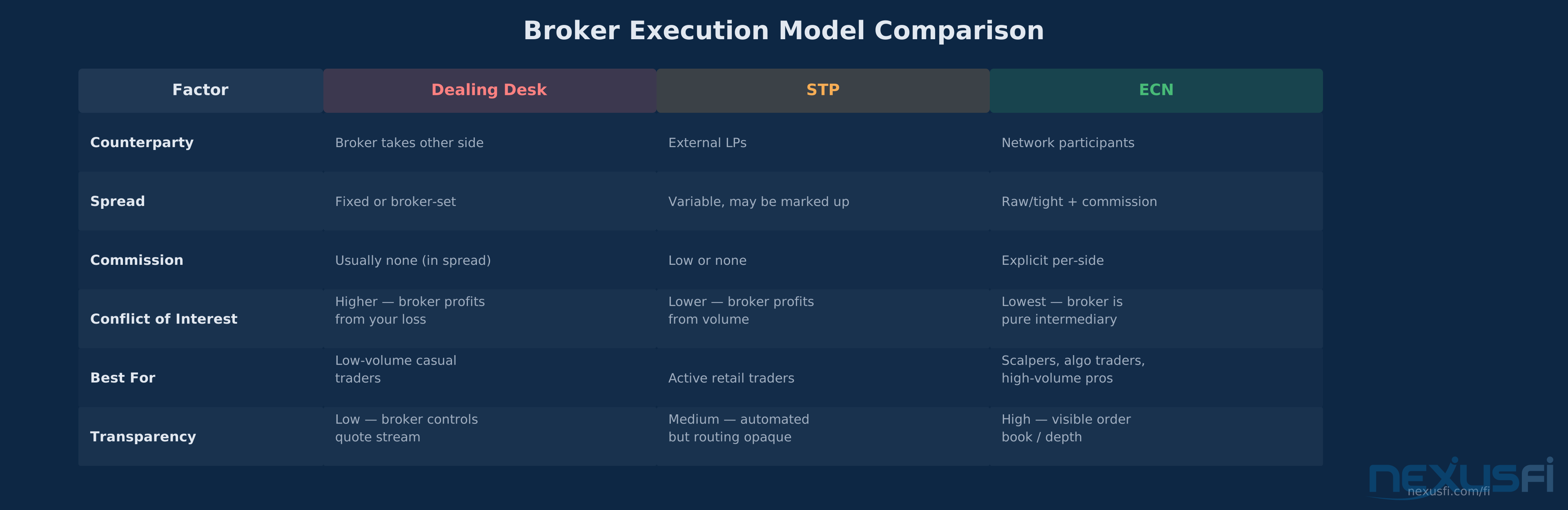
A dealing desk (DD) broker acts as the market maker for your trades. When you buy EUR/USD, the broker's dealing desk takes the other side — they sell it to you. The broker sets the price, decides the spread, and profits directly from the difference between what they offer you and what the interbank market is actually trading at.
This creates a structural conflict of interest. When you lose money, the broker keeps it. When you make money, the broker pays it out of their own book. The broker is not a neutral intermediary — they are your counterparty.
As @Fat Tails explained in a [NexusFi discussion on forex broker selection] [1]: "If your broker operates a dealing desk, he will be on the other end of your trades and you are trading against someone who knows exactly where you put your stops. I would not want to trade against a market maker, who has direct access to the interbank market and just marks up the price to his advantage before passing it on to me."
The dealing desk model is not naturally fraudulent. Many regulated DD brokers operate honestly and manage their risk books professionally. But the incentive structure is misaligned — the broker does better when you do worse. This is why stop hunting accusations, requotes during volatile markets, and asymmetric slippage have plagued the DD model for decades.
DD brokers typically offer:
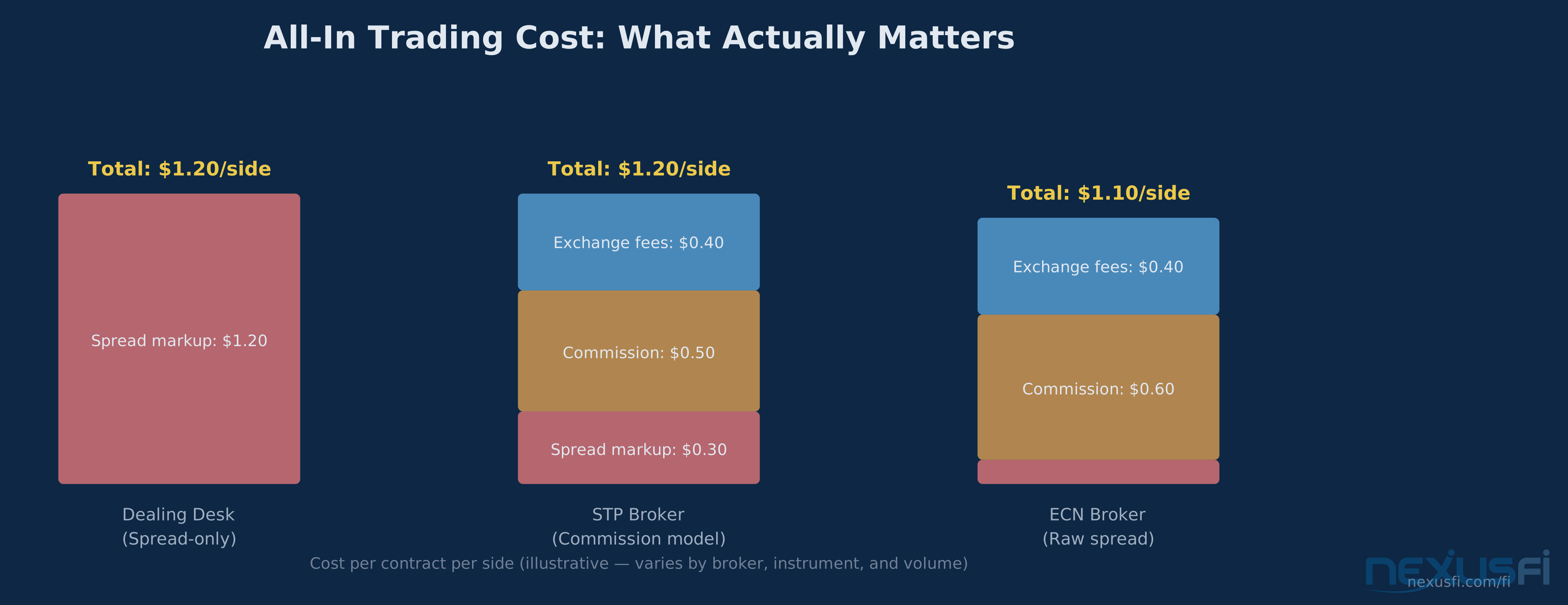
- Fixed or artificially wide spreads — because the broker sets the price, not the market
- No commission — the spread is their compensation
- Potential requotes — the desk can reject your order if the price moves before they accept it
- Restrictions on scalping — because high-frequency profitable traders eat into the desk's book
How NDD Execution Works #
No Dealing Desk execution removes the broker from the other side of your trade. Instead of internalizing your order, the broker routes it to external liquidity providers — banks, prime brokers, hedge funds, and other institutional counterparties.
@Jason Rogers, representing FXCM on [NexusFi's broker review forum] [3], provided a detailed breakdown of how NDD pricing works: The broker receives pricing from multiple liquidity providers, displays the best bid and ask plus a pip markup as compensation, and when you trade, the order is "immediately executed back to back with one of the several liquidity providers." The broker's revenue comes from the markup — not from your losses.
Here is the key structural difference: with NDD, slippage affects you but not the broker's revenue. If your order slips a pip, the broker still earns only their fixed markup. With a dealing desk, slippage can work in the broker's favor because they are the counterparty.
As @FXCM Suhail explained during an [AMA on NexusFi][7]: "We make money off client volume, not client losses. So, scalpers are some of our best clients, because of the trading volume they generate." This is the NDD incentive in a nutshell — the broker wants you to trade more, not lose more.
NDD execution also means your orders are anonymous to liquidity providers. They see the aggregate flow from the broker, not your individual account. This eliminates the possibility of being singled out for requotes or order restrictions based on your profitability.
STP vs ECN: Two Flavors of NDD #
NDD is the umbrella term. Under it sit two distinct routing models that handle your orders differently.
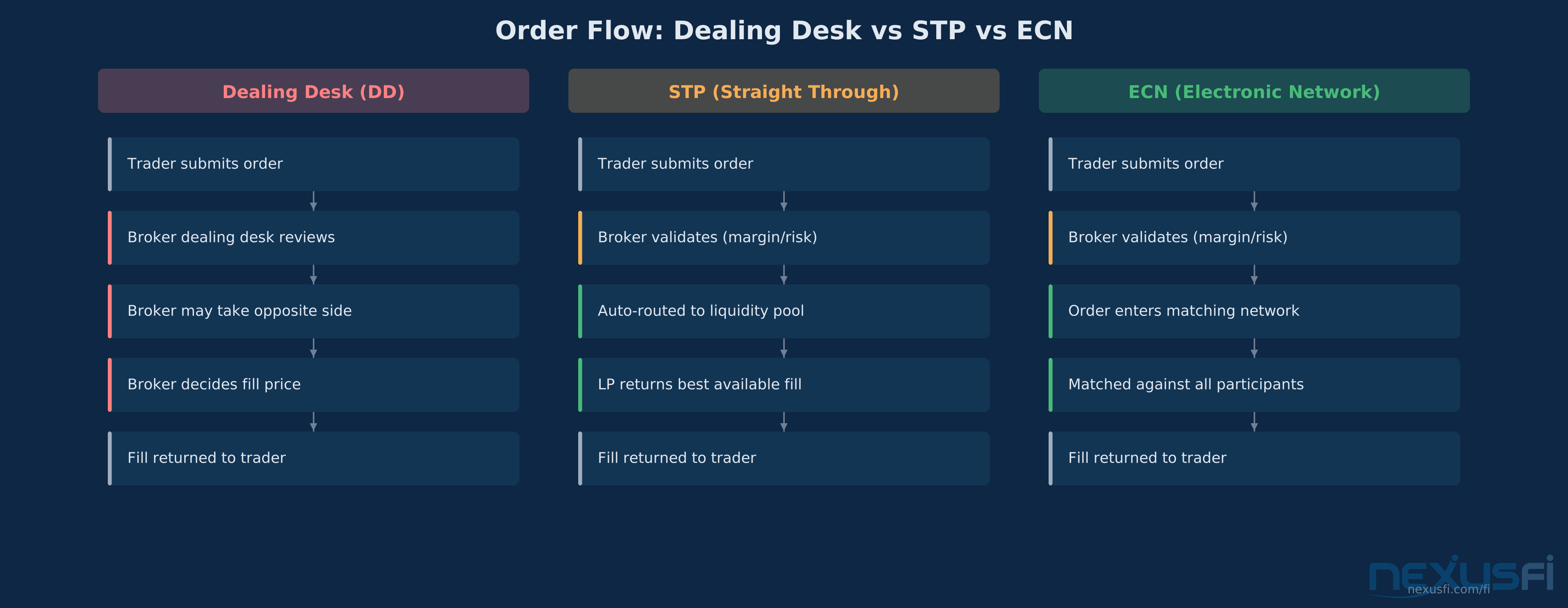
Straight Through Processing (STP) routes your order directly to one or more liquidity providers with minimal intervention. The broker's system validates your margin and risk parameters, then passes the order through. The liquidity provider becomes your counterparty — typically a bank or prime broker.
STP characteristics:
- Variable spreads that reflect LP pricing plus broker markup
- Low or no explicit commission (cost embedded in spread)
- Fast execution but limited visibility into the LP pool
- The broker selects which LPs receive your order
Electronic Communication Network (ECN) connects you to a network of multiple participants — banks, institutions, hedge funds, and other retail traders. Your order enters a matching system similar to an exchange order book, and gets filled against the best available price across all participants.
ECN characteristics:
- Raw, tight spreads directly from the network
- Explicit per-trade commission (broker's compensation)
- Visible depth of market — you can see liquidity at multiple price levels
- Orders matched against all network participants, not routed to a single LP
@Fat Tails summarized the practical choice in a [NexusFi discussion on broker dynamics] [2]: "Any broker who does not take the opposite side of your trade, makes more money the longer you trade. So you want to select an ECN or STP broker, who has no dealing desk."
The distinction matters for cost calculation. A DD broker might show a 2-pip spread with no commission. An STP broker might show a 1.2-pip spread with no commission. An ECN broker might show a 0.2-pip raw spread plus a $7 per lot commission. The all-in cost can be similar — or dramatically different depending on your trading frequency and position size.
For scalpers and high-frequency traders, ECN typically wins because the raw spreads are tightest and the visible depth helps with order placement. For swing traders, the execution model matters less because a few tenths of a pip on entry is noise relative to a 100-pip target.
Why NDD Is Mostly a Forex Marketing Term #
The NDD label exists because forex has a problem that futures do not: there is no central exchange.
Forex is an over-the-counter (OTC) market. There is no single venue where all EUR/USD orders meet. Instead, trading occurs across a fragmented network of banks, brokers, ECNs, and dark pools. Because there is no exchange to enforce transparent matching, brokers can choose how to handle your order — internalize it, route it, or use a hybrid approach.
This structural reality created the dealing desk model. And the dealing desk model created enough bad experiences — stop hunting, requotes, asymmetric slippage — that "No Dealing Desk" became a powerful marketing claim. Brokers began advertising NDD status the way restaurants advertise "no MSG" — it signals the absence of something customers learned to distrust.
But as @CobblersAwls pointed out in a [NexusFi discussion on forex liquidity] [4]: "At the end of the day you will still be trading with a dealing desk, just one at a bank which is more automated and more sophisticated. It doesn't make it any safer though."
This is an important nuance. NDD moves the dealing desk from your retail broker to the liquidity provider. The LP is still a counterparty with its own risk management. During black swan events, LPs can widen spreads dramatically, reject orders, or withdraw liquidity entirely. The 2015 Swiss franc de-peg demonstrated this — NDD brokers suffered alongside DD brokers because the liquidity providers pulled their quotes.
NDD is better than dealing desk execution in normal market conditions. The incentive alignment is real, the pricing transparency is genuine, and the removal of broker-level conflict of interest matters. But NDD is not a magic shield. It is a marketing term for a structural improvement that still operates within the constraints of a decentralized, counterparty-based market.
Futures: The Original No Dealing Desk #
If you trade futures, you already have everything NDD promises — and more.
Futures trade on centralized exchanges. When you buy one ES contract on CME Globex, your order enters a transparent order book and gets matched against another participant's sell order by the exchange's matching engine. Your broker is not involved in the matching process. They cannot take the other side of your trade even if they wanted to. They cannot see your stops and trade against them. They cannot widen the spread to their advantage.
The exchange IS the matching engine. The clearinghouse IS the counterparty — for both sides. CME Clearing guarantees every trade, eliminating the counterparty risk that makes forex brokers so problematic.
This is what NDD was designed to approximate in forex — and what futures have provided by default since electronic trading began.
Consider the structural comparison:
Forex NDD: Broker receives your order → validates margin → routes to external LP → LP fills at their quoted price → broker earns markup. The LP is your counterparty. Their risk management determines your fill quality during stress.
Futures: Broker receives your order → validates margin → routes to exchange → exchange matching engine fills against the order book → clearinghouse guarantees settlement. No one is your counterparty in the dealing desk sense. The order book is transparent. Every participant sees the same prices.
The implications are significant. In futures, there is no stop hunting because nobody knows where your stops are except you and the exchange (and the exchange has no incentive to move the market). There are no requotes because the exchange either fills you or it does not. Slippage exists, but it is market-driven — caused by order book depth and volatility, not by broker intervention.
He recommended futures over forex in part because of this structural advantage.
When a futures broker advertises "no dealing desk," they are stating something that is true by definition. It is like a fish advertising that it can swim. The label adds no information because the exchange architecture eliminates the possibility of a dealing desk model.
What counts When Choosing a Broker #
If NDD is the wrong question for futures traders, what is the right one?
Clearing status. Is your broker a Futures Commission Merchant (FCM) that clears its own trades, or an Introducing Broker (IB) that routes through a clearing firm? FCMs hold your funds directly and are subject to stricter capital requirements. IBs add a layer of counterparty risk. See our guide on Introducing Broker vs FCM for a detailed breakdown.
Commission structure. Futures commissions are explicit — typically $0.25 to $4.00 per side per contract depending on the broker, your volume, and the instrument. There is no hidden spread markup. The spread is set by the market, not the broker. Compare all-in costs including exchange fees, clearing fees, NFA fees, and data fees. Our Futures Commissions and Fees guide covers the full cost stack.
Execution infrastructure. How does the broker connect to the exchange? Do they offer Direct Market Access (DMA) through Rithmic, CQG, or Trading Technologies? What is the typical round-trip latency? For scalpers, execution quality through proper order routing is the equivalent of what NDD means for forex traders — it is the factor that actually affects your fills.
Platform support. Does the broker support the trading platform you use? NinjaTrader, Sierra Chart, TradingView, MultiCharts, and others each have different connectivity options. Not every broker supports every platform.
Regulation and fund safety. Is the broker registered with the NFA and regulated by the CFTC? Are customer funds held in segregated accounts at an approved depository? The broker regulation and account safety framework matters more than any execution label.
Margin policy. Different brokers offer different intraday margin requirements. Lower intraday margins allow you to trade with less capital but also increase your risk of margin calls. Understand the broker's margin requirements before committing.
None of these factors have anything to do with dealing desks. They are all about infrastructure, cost, regulation, and service quality — the things that actually determine your trading experience.
The Bottom Line #
NDD is a meaningful concept in forex where the decentralized market structure allows brokers to act as counterparties to your trades. If you trade forex, choosing an NDD broker — preferably ECN for active trading, STP for simplicity — removes the structural conflict of interest that dealing desk models create.
But if you trade futures, the NDD label is marketing noise. The exchange already provides transparent, centralized execution that eliminates dealing desk mechanics by design. Your broker selection should focus on clearing status, commissions, execution infrastructure, regulation, and platform support — not on whether someone slapped an "NDD" sticker on their website.
The question is not whether your broker has a dealing desk. The question is whether the market structure you trade in even allows one to exist. In futures, it does not. Choose your broker so.
Knowledge Map
Go Deeper
Build on this knowledgeReferences This Article
Articles that build on this topicCitations
- — Forex Brokers for Ninja (2010) 👍 5“access to an electronic communications network (ECN). If your broker operates a dealing desk, he will be on the other end of your trades and you are trading against someone who knows exactly where you put your stops”
- — broker dynamics (2010) 👍 1“you want to select an ECN or STP broker, who has no dealing desk”
- — FXCM review (2011) 👍 18“With FXCM's NDD forex execution, every order is immediately executed back to back with their liquidity providers”
- — Liquidity (or market depth) of Forex (2015) 👍 5“All OTC products will be handled by a dealing desk. This is because there is no official exchange”
- — Relationship between Minis and CL (2011) 👍 7“Decision making, order routing to broker, checking for available margin, order transmission to exchange”
- — Alternatives to the US/Euro market times (such as the HSI)? (2013) 👍 3“good explanation on the difference between DD/NDD and ECN/STP brokers”
- — FXCM's Suhail Afzal and Brad Gleason - Ask Me Anything (AMA) (2014) 👍 2