



Payment for Order Flow in Futures Trading: Why the Practice Does Not Apply and What It Means for Execution Quality
Overview #
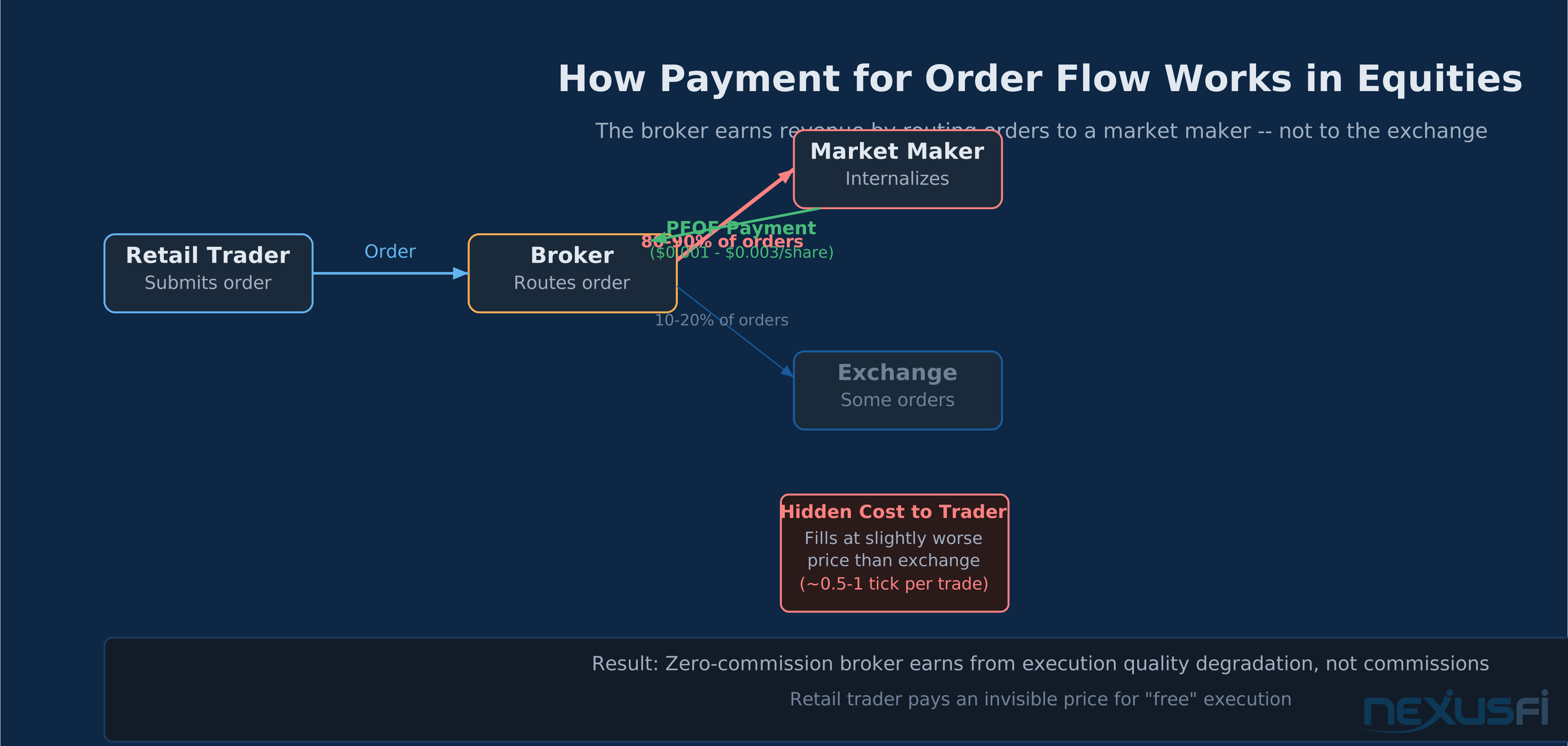
If you've traded equities before moving to futures, payment for order flow is probably already on your radar. Zero-commission equity brokers have been taking PFOF money for years — Robinhood built an entire business model on it. The concept: market makers pay brokers to receive their customers' order flow, because retail orders are generally uninformed and profitable to take the other side of.
Futures don't work this way. Not even close.
This isn't a minor regulatory difference. It's a structural one. The way futures markets are built makes PFOF economically meaningless and architecturally impossible in the standard sense. Understanding why reveals something fundamental about how futures execution works — and why retail futures traders get a fairer deal at the market execution level than equity traders, even when the commission line looks higher.
What Payment for Order Flow Is #
Payment for order flow is an arrangement where a broker routes customer orders to a specific market maker in exchange for payment. The market maker gets to see and interact with retail orders before they reach the public exchange. They profit by filling orders at slightly worse prices than the best available market, then trading out of those positions against the exchange.
The numbers involved are small per trade — fractions of a cent per share in equities — but the volume is enormous. In 2021 and 2022, PFOF payments from Citadel Securities, Virtu, and Susquehanna to equity brokers combined exceeded $3 billion annually. Those payments didn't come from nowhere. They came from the spread between what retail customers received and what the market would have given them without the internalization step.
PFOF exists primarily in U.S. equities and equity options. It's banned in the UK, EU, Canada, and Australia. For futures, the question is different — it's not banned, it's structurally impossible in the same form.
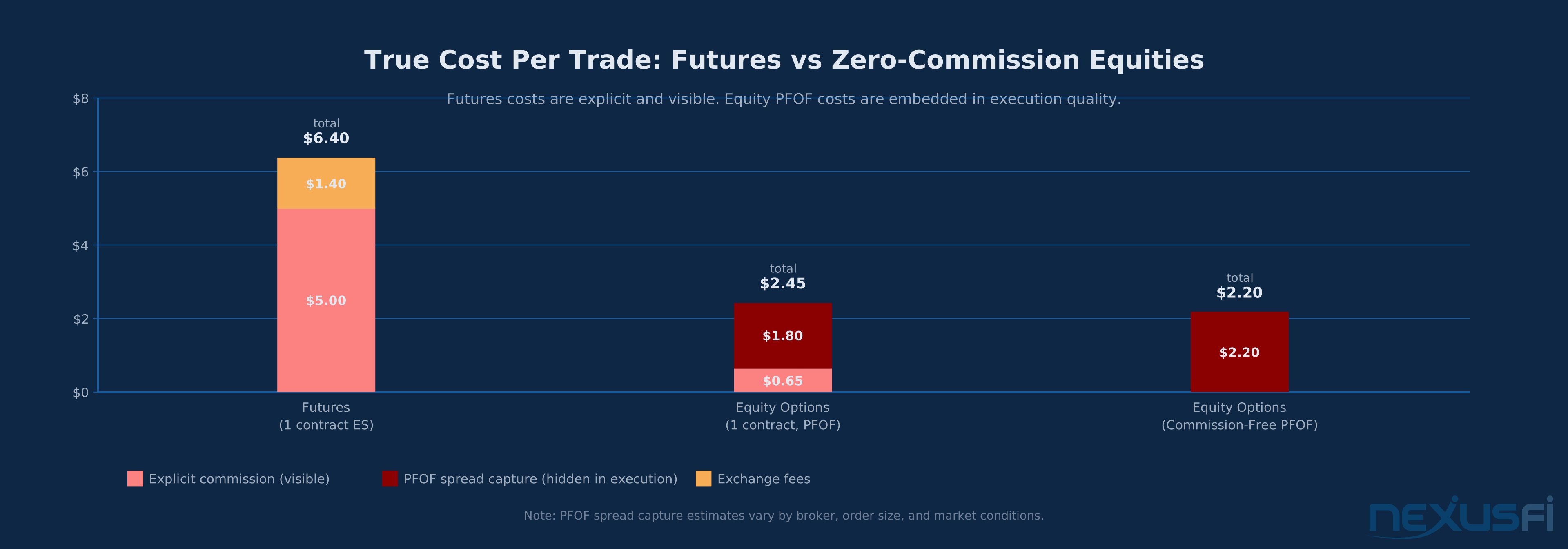
PFOF is the mechanism that lets equity brokers advertise "zero commissions" while still earning revenue. The cost is invisible to traders but real — it appears as slightly worse execution prices compared to routing orders directly to the public exchange.
Why Futures Are Structurally Different #
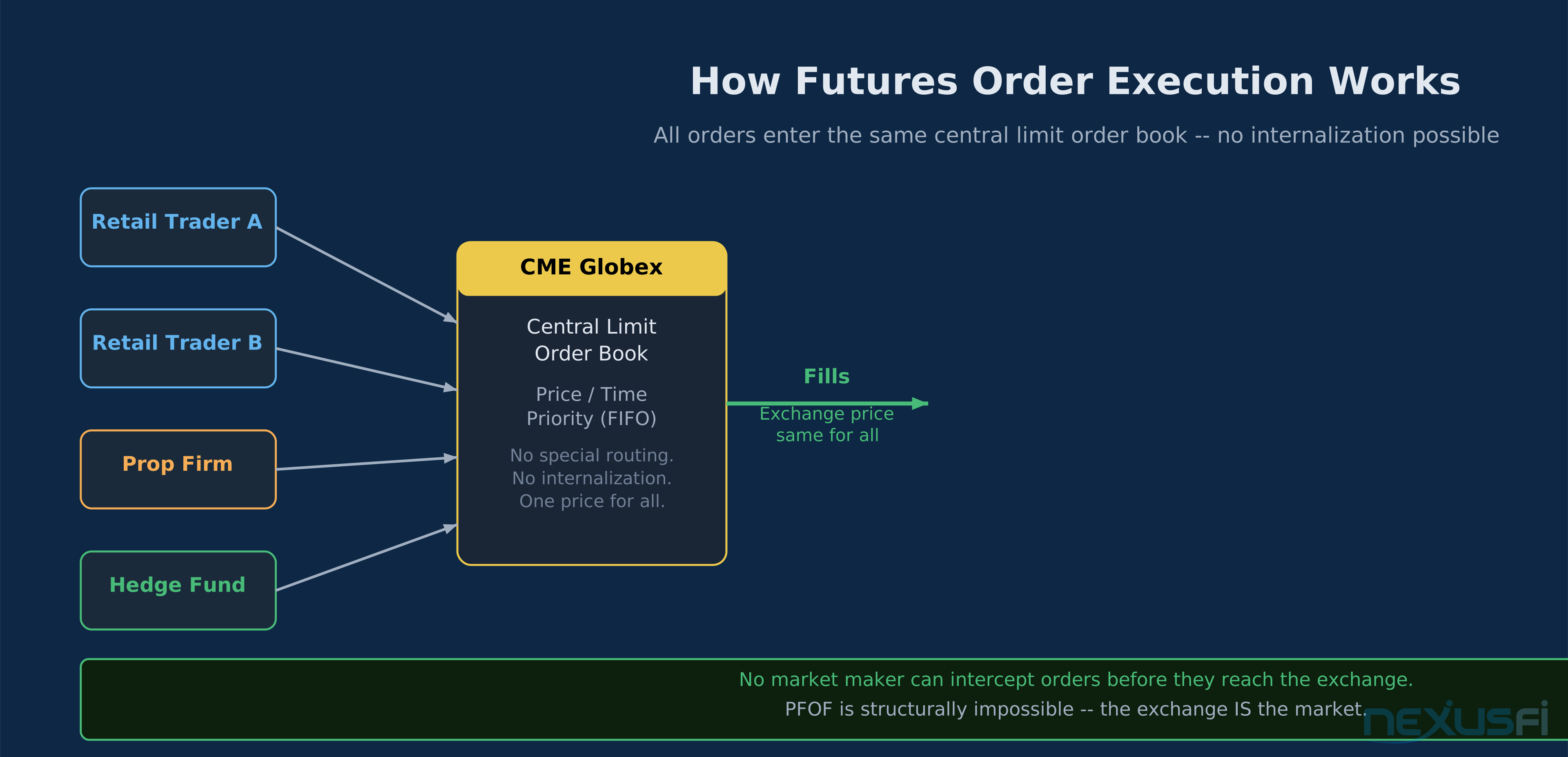
Futures contracts trade on centralized exchanges — CME, CBOT, NYMEX, ICE. Every order, from every participant, goes to the same central limit order book. There's no off-exchange internalization. There's no market maker a broker can route your order to before it hits the public market. There's no gap between "what you'd get at the exchange" and "what the market maker will give you."
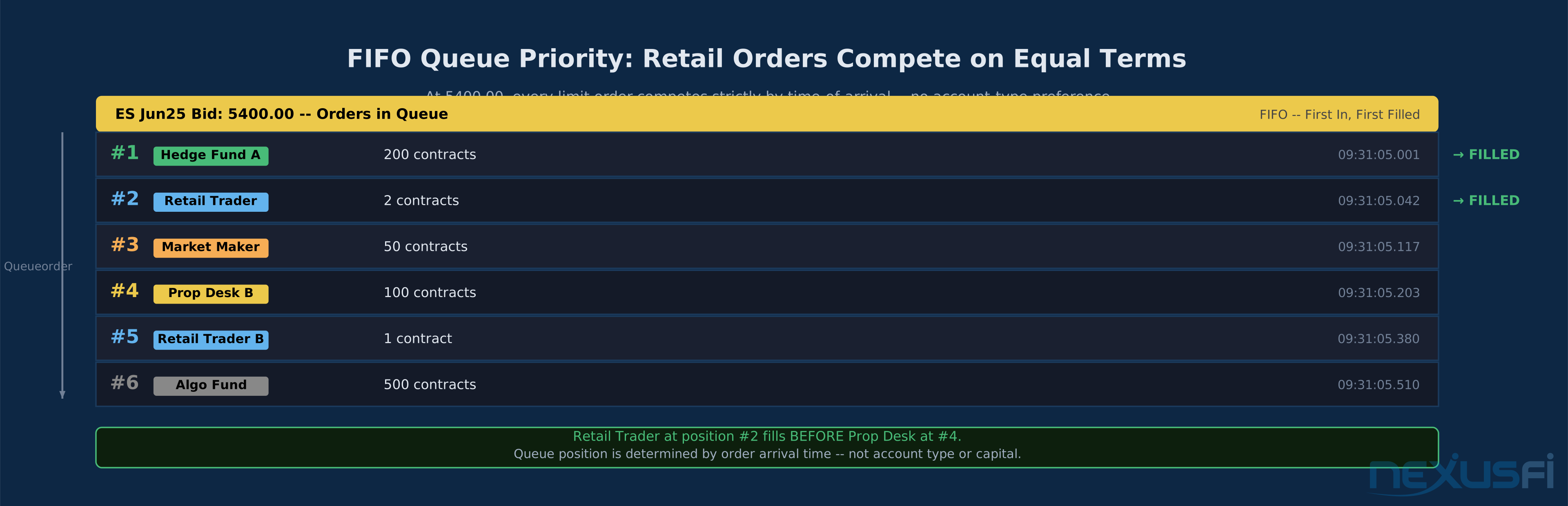
The exchange matching engine applies price/time priority (FIFO) to all orders. Your limit order at 5400.00 in ES sits in the queue behind every order at 5400.00 entered before yours — and ahead of every order entered after. A retail order from NinjaTrader Brokerage has the same priority claim as a limit order from a prop desk at the same price and time.
This architecture makes PFOF economically pointless. A market maker can't internalize your futures order because there's no mechanism for off-exchange execution. There's no "dark pool" for exchange-traded futures. There's no NBBO-better-than standard because there's one book and every order competes in it.
The legal framework reinforces this. The Commodity Exchange Act requires futures to trade on designated contract markets (DCMs) or other CFTC-regulated facilities. Off-exchange futures trading between customers and market makers — the model that enables PFOF in equities — is prohibited for standard exchange-traded futures products.
@HiLatencyTRDR, a former Series 3 broker with over a decade in futures, stated it directly: "In futures specifically, the structure doesn't allow for the same PFOF arrangements as equities. The exchange rules and CFTC regulations don't permit off-exchange internalization of customer futures orders. The exchange is the market — there's no gap to exploit." [1]
How Equities Got Here: Multiple Venues and Market Fragmentation #
To understand why futures don't have PFOF, you need to understand why equities do.
U.S. equities trade on 16+ exchanges and dozens of alternative trading systems (ATSs) and dark pools. The National Best Bid and Offer (NBBO) is a synthetic construct assembled from quotes across all these venues. A market maker can offer you a price technically "at or better than NBBO" while profiting because they're filling you against private inventory rather than routing to the exchange with the actual best liquidity.
Futures don't have this fragmentation problem. The ES contract trades on CME Globex and only CME Globex. There's one order book for each contract. You can't internalize an order against "the market" when your market maker and the market are the same thing.
The Regulation NMS framework governing equities — which created the trade-through rule and best execution obligations — was built around the reality of a fragmented market. PFOF is a symptom of that fragmentation. Futures markets never fragmented in the same way because the CME's near-monopoly on U.S. futures contracts gave a single venue sufficient liquidity. There was never an economic reason for fragmentation.
Futures contracts have one primary trading venue per contract. This structural centralization is what makes PFOF impossible — not just regulation, but market architecture.
What This Means for Execution Quality #
The absence of PFOF has concrete, practical implications for how futures execution works:
Slippage is the real execution quality metric. In equities, execution quality comparisons involve spread capture, price improvement statistics, and SEC Rule 606 disclosure reports. In futures, those concepts don't apply. Execution quality reduces to: did your market order walk the book, and how far? For liquid contracts like ES, a 1-contract market order during normal conditions fills at the ask with basically zero slippage. The slippage question becomes meaningful when you're trading larger size.
The commission is your real cost — and it's fully visible. In futures, you pay explicit commissions. There's no hidden spread tax. When your broker charges $2.50 per side per contract, that's your cost. Zero-commission equity brokers embed cost in execution quality. Futures makes the cost explicit. For a 1-lot ES round turn at $2.50/side, you're paying $5.00 — plus exchange fees typically embedded in that commission. The bill is what the broker shows you.
Your limit order competes on equal terms. When you post a bid in the ES order book at 5400.00, your order sits ahead of every order at 5400.00 entered after yours. This is mechanically enforced by the exchange. A retail limit order has the same claim on the fill as any institutional limit order at the same price. In equities, your retail limit order might be internalized rather than entering the public book at all.
The SEC reform conversation doesn't touch futures. The SEC's ongoing effort to reform PFOF, Rule 605/606 disclosure, and equity market structure has generated years of regulatory debate. The CFTC has no parallel agenda for futures because the structural issue doesn't exist.
Maker/Taker Dynamics in Futures #
Although PFOF doesn't exist in futures, exchanges do have a maker/taker fee structure that creates differential costs between participants.
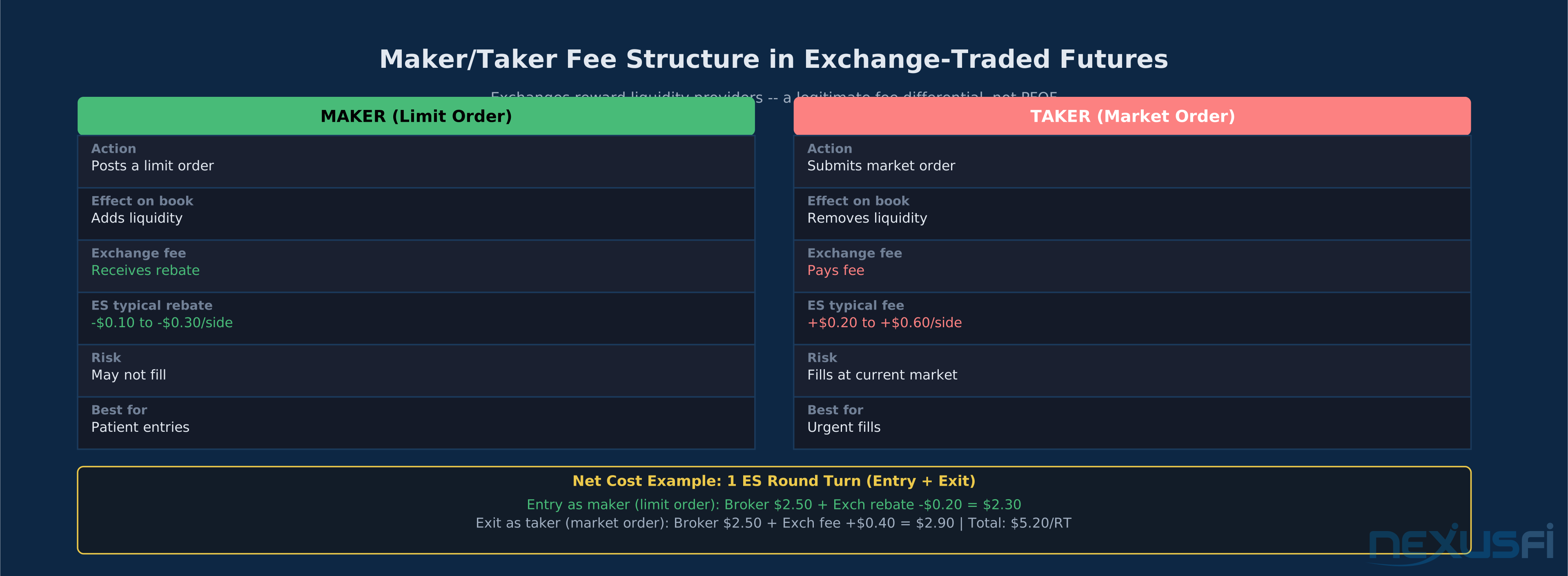
Limit orders that add liquidity (makers) typically receive exchange rebates. Market orders that remove liquidity (takers) pay exchange fees. Designated market makers on some exchanges receive higher rebate tiers than retail participants. This isn't PFOF — the exchange is paying for liquidity provision to improve market depth, not compensating a broker for routing a customer order to a specific firm.
The practical impact for retail traders:
- A limit order (maker) might receive an exchange rebate of -$0.10 to -$0.30 per side on ES
- A market order (taker) pays an exchange fee of +$0.20 to +$0.60 per side
- These exchange fees are typically bundled into the broker commission, not shown separately
The maker/taker structure creates an incentive for retail traders using limit orders. You're adding liquidity, which the exchange values. The execution risk is that your limit order might not fill if price moves away. Market orders fill immediately but absorb the taker fee plus whatever spread exists.
This is a transparent cost differential based on order type, not a hidden payment from a market maker to your broker. The mechanism is visible, documented in exchange fee schedules, and applies equally to all participants at the same tier.
Where Execution Isn't Level in Futures #
Acknowledging all of the above, futures aren't a perfectly equal market. The absence of PFOF doesn't mean retail traders compete on identical terms with all other participants.
Speed advantages are structural and significant. Firms co-located at CME's Aurora data center get to the matching engine in microseconds. Retail traders connect over the internet in milliseconds. For strategies that compete on price priority at the best bid/offer — scalpers, market makers, latency arbitrageurs — this speed gap matters. Being 10ms slower in a fast market means being further back in the FIFO queue. Your limit order at the same price as a co-located algo's order loses queue position simply because it arrived later.
Regulatory enforcement catches broker-side execution manipulation. The Gain Capital NFA enforcement case illustrates what does happen when brokers manipulate execution quality through order filtering — similar in spirit to the conflicts PFOF creates. Gain was found to block fills when slippage would benefit the customer but allow fills when slippage would benefit the firm.
That case involved a Retail Foreign Exchange Dealer (RFED), where the dealer model creates conflicts similar to PFOF. Exchange-traded futures don't have this structural conflict — but it illustrates that broker execution integrity is still worth monitoring even in the centralized futures model.
Informational advantages exist at institutional levels. The CME offers proprietary market data products with additional depth and analytics available to premium subscribers. Large clearing firms have access to aggregate flow data patterns that retail traders don't see. These are market structure features, not broker routing decisions, but they represent real advantages for well-resourced participants.
Regulatory Comparison: Why the CFTC Has No PFOF Agenda #
The SEC spent years attempting to reform PFOF under both recent administrations and earlier Rule 605/606 reform proposals. The CFTC doesn't have a parallel agenda because the practice doesn't exist in the same form for exchange-traded futures.
What the CFTC focuses on instead:
Best execution for managed accounts. Registered CTAs (Commodity Trading Advisors) and CPOs (Commodity Pool Operators) have best execution obligations when trading on behalf of clients, documented under NFA Rule 2-9. These obligations cover factors like order timing, size selection, and avoiding conflicted routing — but they address the institutional side of execution management, not retail broker-to-market-maker payment arrangements.
Order handling fairness. The Gain case illustrates this. The CFTC and NFA prohibit broker manipulation of fill decisions — the order filtering that amounts to front-running or adverse selection against customers.
Pre-arranged trading and fictitious transactions. The Commodity Exchange Act prohibits wash trades and pre-arranged block trades that don't go through the public book. This isn't about PFOF but about preventing the kind of non-competitive trading that subverts centralized price discovery.
Market manipulation. CME Regulation 575 and related CFTC rules address spoofing, layering, and other order book manipulation tactics that distort price discovery.
The futures regulatory framework assumes the centralized exchange model naturally resolves the routing conflict that makes PFOF problematic in equities. The exchange is the market. There's no routing decision to be made.
The CFTC's relative silence on PFOF isn't regulatory neglect — it's confirmation that the structural conditions enabling PFOF don't exist for exchange-traded futures.
Practical Takeaways #
For retail futures traders, the absence of PFOF is a genuine structural advantage compared to equities. Your order goes to the same exchange as everyone else's. Your commission is your cost — there's no embedded spread tax. The price you pay is the exchange price.
When evaluating futures brokers, the execution quality questions that actually matter:
Latency to the exchange. Lower latency means better queue position in the FIFO queue during fast markets. Where are your broker's servers? What middleware provider do they use? Rithmic and CQG co-located at Aurora are meaningfully faster than cloud-hosted routing.
Commission structure. This is your real cost per round turn — explicit and visible. Compare it directly across brokers. The variation in retail futures commissions is typically $1.50 to $5.00 per side, all-in. That spread matters over volume.
Data feed quality. Your middleware provider's data feed quality affects your ability to see and respond to market conditions. Rithmic is preferred by order flow traders for complete tick delivery. CQG is strong for European market access.
Order types supported. Not all brokers support synthetic order types (bracket orders, OCO orders, stop-limits) that can improve execution in certain conditions. Know what your platform and broker support.
The PFOF question doesn't belong on that list for futures. Your broker isn't choosing between routing your order to a market maker who pays them or routing it to the exchange where you'd get a better fill. The exchange is the only option. That's the structural advantage working in your favor.
Knowledge Map
Go Deeper
Build on this knowledgeReferences This Article
Articles that build on this topicCitations
- — payment for order flow??? (2019) 👍 10“In futures specifically, the structure doesn't allow for the same PFOF arrangements as equities.”
- — zero commision and Stops (2022) 👍 2“Payment for order flow is how zero-commission brokers make money.”
- — Are stop orders placed in queue? (2014) 👍 10“Futures matching uses price/time priority -- FIFO.”
- — At which exchanges are US stocks being traded? (2014) 👍 2“IB receives payments for order flow in US stocks and from dark pool ATSs.”
- — Ninjatrader Brokerage and Slippage (2022) 👍 5“When the orders don't match exactly, the order has to keep going through the book to fill.”
- — Gain Capital (Forex.com) fined by NFA for fraud. (2010) 👍 6“Orders involving greater than five standard contracts were blocked when slippage was favorable to customers.”
- — payment for order flow??? (2017) 👍 1“Some claim HFT firms pay for retail order flow.”
- — payment for order flow??? (2017) 👍 6“The topic of payment for order flow in futures is distinct from equities.”