



Crypto Cold Storage Security: Hardware Wallets, Seed Phrases, and Self-Custody for Active Traders
Overview #
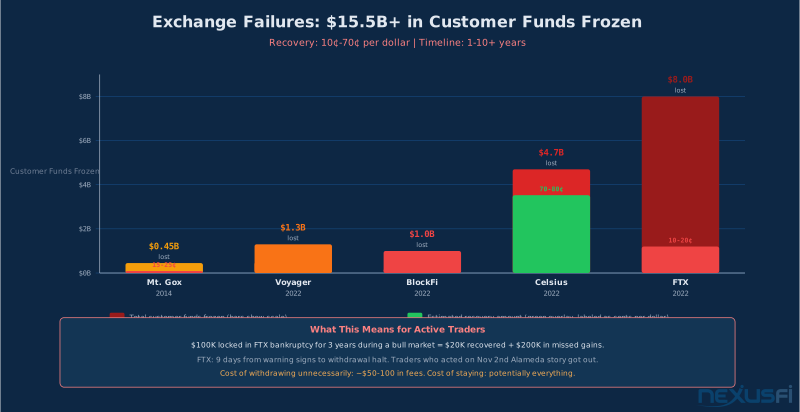
Crypto exchanges have lost — or stolen — tens of billions of dollars in customer funds. FTX: $8 billion gone overnight in November 2022. Mt. Gox: 850,000 BTC (~$450 million in 2014 prices) evaporated over months of silent theft. Celsius: $4.7 billion frozen when the music stopped. Voyager: $1.3 billion. BlockFi: another $1 billion. The list keeps going.
Every single trader who lost money in those collapses made the same mistake: they treated the exchange like a bank. They left funds sitting in a custodial account, trusting that because they saw a balance on screen, they actually owned something. They didn't. They owned an IOU from a counterparty that turned out to be insolvent.
Core Principle
Self-custody is how you avoid that fate. It means holding your own private keys — controlling your own crypto directly — so no exchange failure, hack, regulatory seizure, or executive fraud can touch your holdings. "Not your keys, not your coins" isn't a slogan. It's the only thing standing between you and the next FTX.
This article covers how custody actually works, why exchanges fail, and how active traders — who need funds on exchanges to trade — can structure their holdings to minimize the damage when the next collapse happens. Because there will be a next one.
Key Concepts #
Private key: A 256-bit number that proves ownership of crypto funds. Whoever controls the private key controls the funds. Full stop.
Public key / address: Derived from the private key via elliptic curve math. Anyone can send funds to your public address. Only the private key can authorize sending funds out.
Custodial wallet: The exchange holds your private keys. You hold an account balance that represents the exchange's promise to give you your funds on request. Your balance is a database entry, not actual crypto ownership.
Non-custodial wallet: You hold the private keys. You can authorize transactions directly. No third party can freeze, seize, or lose your funds.
Hot wallet: Keys are accessible from an internet-connected environment. High convenience, higher attack surface.
Cold wallet: Keys are kept offline — never touching an internet-connected device during storage. Low convenience, dramatically lower attack surface.
Seed phrase (mnemonic): A 12- or 24-word sequence that encodes your private key material. It's the root of your wallet. Anyone who gets it owns everything derived from it.
Hardware wallet: A dedicated physical device that generates and stores private keys in an isolated chip, signs transactions offline, and never exposes the raw key to connected computers.
Multi-signature (multi-sig): A setup requiring M-of-N signatures to authorize a transaction. 2-of-3 means any two of three keyholders can move funds — one compromise doesn't unlock anything.
BIP-39: Bitcoin Improvement Proposal 39 — the standard defining how seed phrases work, including the 2048-word wordlist and the entropy-to-mnemonic conversion.
Proof of Reserves (PoR): Cryptographic evidence that an exchange holds assets sufficient to cover customer liabilities. Better than nothing, not sufficient on its own.
Counterparty risk: The risk that the entity holding your funds can't return them — due to insolvency, fraud, hack, or regulatory action.
The Custody Spectrum #
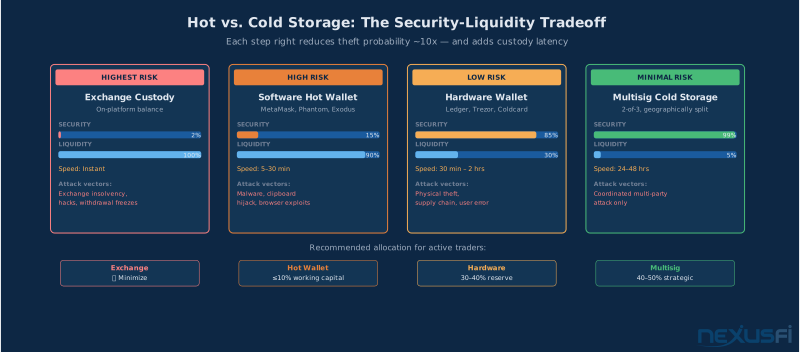
Security-liquidity tradeoff across four custody tiers. Exchange custody offers instant access with zero cryptographic ownership. Hardware wallet cold storage provides maximum security at the cost of 30-minute to 2-hour access latency.
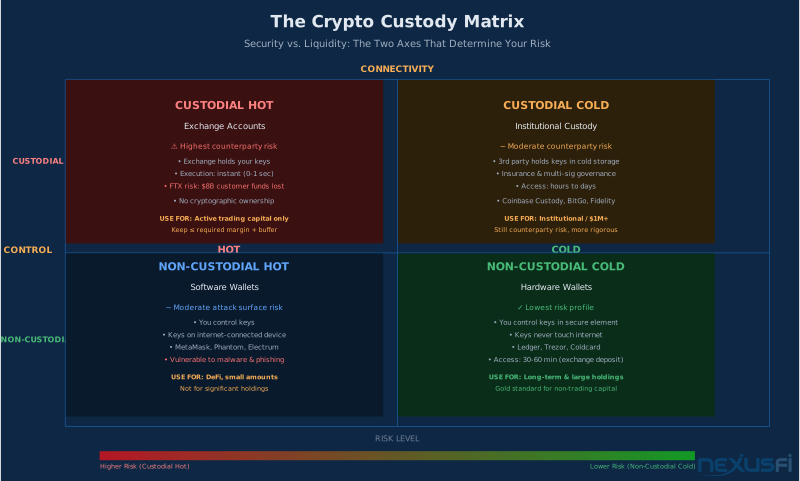
The four custody types on two axes. Non-custodial cold is the only configuration where you control keys AND they stay offline — the only quadrant where exchange failure cannot touch your holdings.
Custody exists on two independent axes: who controls the keys (custodial vs. non-custodial) and how those keys are stored (hot vs. cold). That creates a 2×2 matrix.
Custodial Hot — Exchange accounts, most crypto apps. The exchange holds your keys in internet-connected systems (typically Hardware Security Modules for the hot wallet portion). You have instant access. You have zero cryptographic control. If the exchange is compromised or insolvent, your "balance" is a creditor claim in bankruptcy court.
Custodial Cold — Institutional custody services like Coinbase Custody, Fidelity Digital Assets, or BitGo. The custodian holds keys in cold storage, often with multi-sig governance and insurance. Still counterparty risk, but more rigorous than retail exchange custody. Relevant for funds of $1M+.
Non-Custodial Hot — Software wallets you control: MetaMask, Phantom, Exodus, Electrum. You hold the keys, but they're stored on an internet-connected device (your phone, your laptop). Exposed to malware, phishing, browser extension attacks. Better than custodial, but not cold.
Non-Custodial Cold — Hardware wallets (Ledger, Trezor, Coldcard) and air-gapped signing setups. Keys are generated and stored on an offline device. Signing happens offline. The host computer only sees unsigned input and signed output — never the key. This is the gold standard for crypto storage.
The liquidity tradeoff: Custodial hot gives you instant execution (0-1 seconds). Non-custodial cold means retrieve device, connect, verify, sign, deposit to exchange, wait for confirmations — 30 minutes to an hour minimum. For active traders, this tradeoff is real. The answer isn't to ignore cold storage — it's to size your hot allocation correctly.
The cost tradeoff: Hardware wallets run $50-250 one-time. That's the entire cost. The expected loss from leaving funds in custodial exchange custody, given historical exchange failure rates, is orders of magnitude higher.
How Hardware Wallets Actually Work #
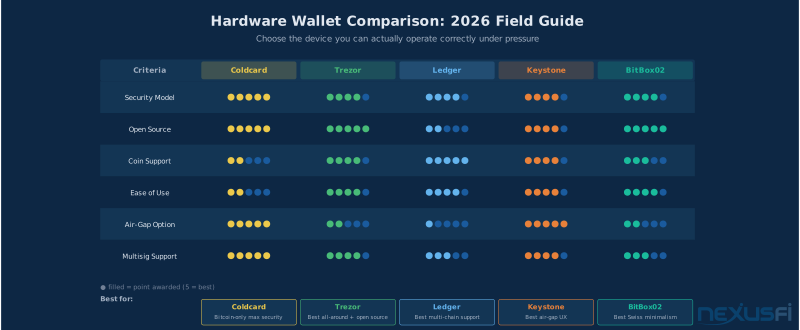
Hardware wallet comparison: secure element, price, connectivity, coin support. All three are dramatically safer than software wallets or exchange custody.
Understanding the mechanics matters. It tells you exactly what the device protects against — and what it doesn't.
The Secure Element
A hardware wallet contains a dedicated cryptographic chip — a secure element — that's at the core different from the general-purpose processor in your computer. Common implementations include Common Criteria EAL5+ certified chips (the same class used in payment cards and passports).
The secure element generates private keys internally using a True Random Number Generator (TRNG) that pulls entropy from quantum noise or thermal noise. The key is never exported from the chip in plaintext — it's generated there and it stays there. Even the device firmware can't extract it.
When you set a PIN, incorrect attempts trigger progressively harsh responses: Ledger devices wipe after 16 incorrect attempts (with increasing delays). Trezor devices wipe after 3. Lose the PIN, you recover from the seed phrase. Get the PIN wrong repeatedly, same outcome.
The Offline Signing Flow
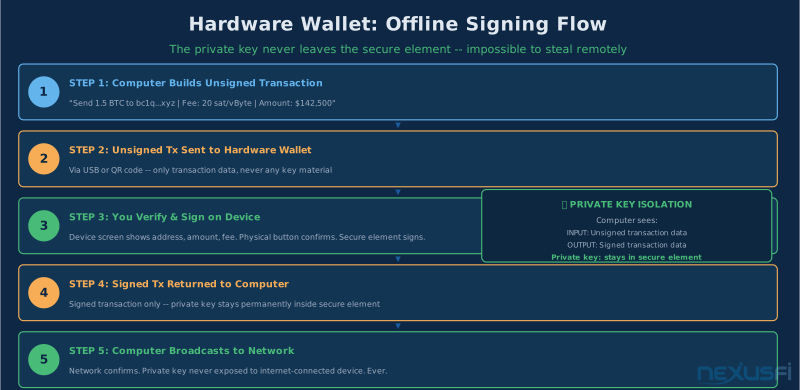
Hardware wallet offline signing: your computer builds unsigned transactions; the device signs them inside an isolated chip. The private key never leaves. Malware on the host sees unsigned input and signed output — nothing else.
This is what actually protects you.
Your computer builds an unsigned transaction: "Send 1.5 BTC to address bc1q...xyz with 20 sat/vByte fee." That unsigned transaction transfers to the hardware wallet via USB or QR code. The device screen shows you the recipient address, amount, and fee — on a display the host computer can't manipulate. You verify. You press the physical button.
Inside the secure element, the private key performs an ECDSA signature over the transaction hash. The signed transaction transfers back to your computer. Your computer broadcasts it to the network.
The host computer sees: unsigned transaction in, signed transaction out. The private key never leaves the chip. Malware on your computer can't steal what it never sees.
One critical point: clipboard malware exists. It watches for crypto addresses copied to your clipboard and replaces them with the attacker's address. This is exactly why you verify the recipient address on the hardware wallet's display — not in the software on your computer. The device display is the ground truth.
Seed Phrases: The Root of Everything #
Your seed phrase is not a backup of your wallet. It is your wallet. Anyone with those words controls every address, every coin, every chain your wallet manages. Forever.
BIP-39 Mechanics
Your hardware wallet generates 128 bits (12-word phrase) or 256 bits (24-word phrase) of true random entropy. That entropy maps to words from a 2048-word BIP-39 wordlist via 11-bit segments. The final word contains a checksum — enter words in the wrong order and the wallet catches it.
12 words = 128-bit entropy = 2^128 possible wallets. That's computationally unbreakable by any technology that exists or is foreseeable. 24 words = 256-bit entropy — the choice for maximum conservatism or future-proofing against quantum cryptography. For practical purposes, both are secure.
The seed-to-wallet conversion: your mnemonic feeds through PBKDF2 (2048 rounds of HMAC-SHA512) to produce a 512-bit master seed, then BIP-32 hierarchical derivation generates every key in your wallet. Same seed, same software, same derivation path = same addresses. Every time.
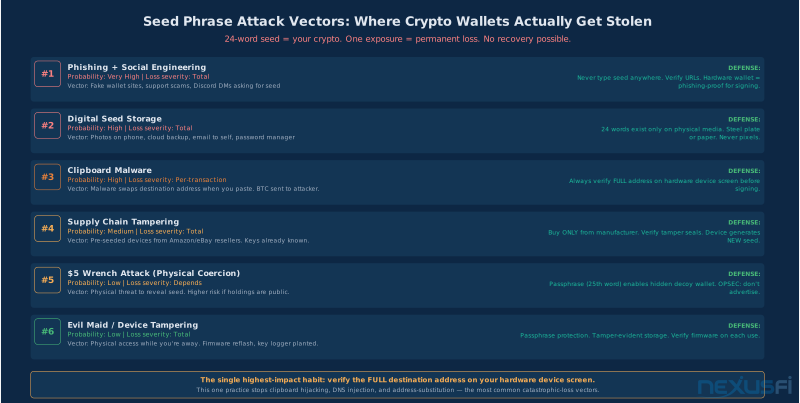
Three attack vectors cause most self-custody theft: seed phrase digitization, phishing, and clipboard malware. All three are preventable.
The Passphrase Option
BIP-39 includes an optional passphrase — sometimes called the "25th word." Mechanically, it adds a user-supplied string to the PBKDF2 computation, producing a completely different 512-bit seed and so a completely different set of wallet addresses.
Three important properties:
It's case-sensitive and has no length limit. "password" and "Password" generate entirely different wallets. A 1-character passphrase and a 100-character passphrase are both valid.
Any passphrase generates a "valid" wallet. There's no incorrect passphrase — every string generates a wallet with addresses. If you enter the wrong passphrase during recovery, you'll see empty addresses, not an error. This is by design. It also means the wrong passphrase just silently loses your funds.
It creates plausible deniability. Keep a small amount (say, $500-2,000) in the no-passphrase wallet. Keep your real holdings in the passphrase-protected wallet. If an attacker physically coerces you, you can reveal the 24-word seed and the visible small balance, and the attacker has no way to prove there's a separate wallet behind a passphrase they don't know.
The cost of the passphrase: If you forget it, those funds are permanently unrecoverable. The BIP-39 standard provides no recovery mechanism. This makes passphrase documentation — stored separately from the seed phrase, in a secure location accessible to whoever you designate — essential.
Storing Your Seed Phrase
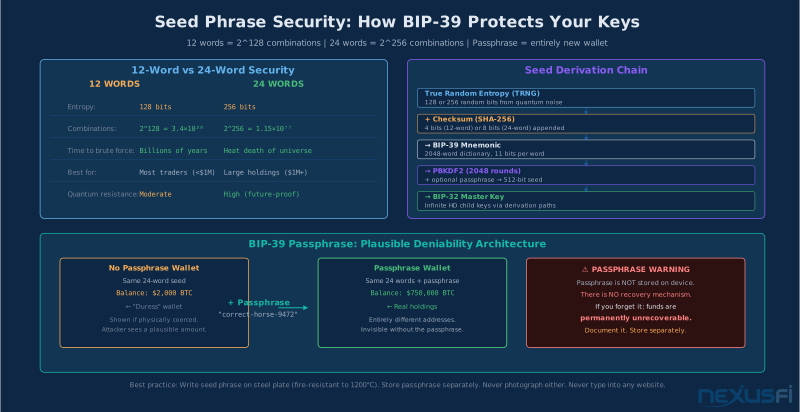
Three attack vectors account for the majority of self-custody theft: digitizing seed phrases, phishing attacks, and clipboard malware. All three are fully preventable with correct procedure.
Paper is flammable and water-damaged. Write your seed phrase on steel. Cryptosteel and Bilodl both sell stainless steel plates designed for exactly this purpose, fire-resistant to over 1,200°C.
Store the steel plate somewhere physically secure. If you use a passphrase, store it somewhere completely separate from the seed phrase. Never photograph your seed. Never type it into any website. Never enter it into any app that asks for it — legitimate recovery processes on hardware wallets happen on the device itself.
If a website or customer support agent ever asks for your seed phrase, it's a scam. Wallet support never needs your seed.
Exchange Counterparty Risk: The Numbers #
The mechanism behind every exchange collapse is the same: your account balance is a liability on the exchange's books, not actual crypto you control. If the exchange is solvent and honest, no problem — you withdraw on demand. When either condition fails, you become an unsecured creditor in bankruptcy proceedings.
How Exchange Custody Actually Works
When you deposit crypto to an exchange, they take custody and create a database balance entry. Your "balance" is the exchange's promise to return funds on demand — not actual crypto you control. Funds pool in omnibus accounts: 5-10% in hot wallets for immediate withdrawals, the rest in cold storage. If the exchange is insolvent, you're an unsecured creditor against pooled assets. How much is actually there — and whether it matches liabilities — takes years of bankruptcy proceedings to determine.
US-regulated futures brokers must hold customer funds in segregated accounts monitored by the CFTC. Most crypto exchanges, built offshore, face no such requirement — and many treated customer funds as operational capital.
The Historical Ledger
Every exchange failure follows the same pattern: commingled customer funds, bank run, withdrawal halt, bankruptcy. FTX completed that cycle in nine days. The pattern repeats because the underlying structure — custodial omnibus accounts — never changed.
| Exchange | Failure Date | Customer Funds | Estimated Recovery | Recovery Timeline |
|---|---|---|---|---|
| Mt. Gox | Feb 2014 | ~$450M (850K BTC) | $0.15-0.25/dollar | 10+ years |
| FTX | Nov 2022 | ~$8B | $0.10-0.20/dollar | 2-5 years |
| Celsius | Jul 2022 | ~$4.7B | $0.70-0.80/dollar | 1-3 years |
| Voyager | Jul 2022 | ~$1.3B | $0.35-0.40/dollar | 1-2 years |
| BlockFi | Nov 2022 | ~$1B | $0.10-0.30/dollar | 2-4 years |
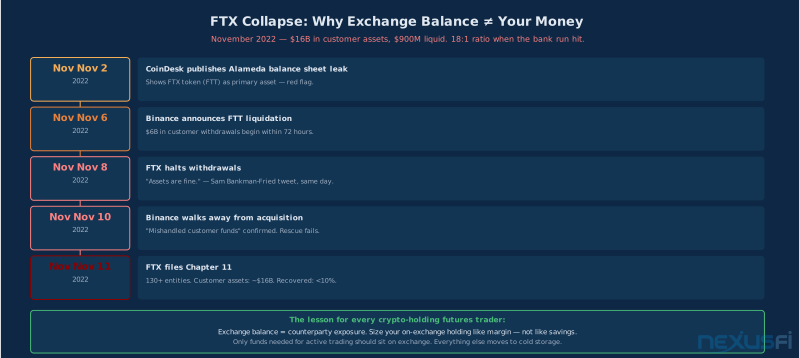
FTX went from functioning to frozen in nine days. The pattern repeats because custodial omnibus accounts are structurally identical across exchange failures.
Average recovery: 10-70 cents per dollar, taking years to arrive. The opportunity cost of locked capital during a bull market often exceeds the principal loss. $100,000 locked in FTX bankruptcy for three years while Bitcoin tripled is a $200,000 opportunity loss on top of however much of the $100K you eventually recover.
The velocity of collapse is also worth noting. FTX went from functioning exchange to withdrawal halt in nine days. Nov 2: CoinDesk published Alameda Research's balance sheet concerns. Nov 6: Binance announced it would sell its FTT holdings. Nov 7: $6 billion in withdrawal requests in 72 hours. Nov 8: FTX halted withdrawals. Nov 11: Bankruptcy. If you weren't watching and acting the moment the Alameda story broke, your window closed fast.
CME Crypto Futures as an Alternative
There's a reason regulated futures markets exist.
CME crypto futures eliminate spot custody risk entirely. You're trading a financially settled contract through a regulated FCM with US-mandated customer fund segregation. No self-custody needed because no spot crypto changes hands at settlement. The tradeoff: CME contracts are large (5 BTC per contract on the standard future, 0.1 BTC on the Micro), and you're still exposed to FCM credit risk — which is much smaller than unregulated exchange risk, but not zero.
This is what happened at Celsius: customer deposits were lent to illiquid DeFi protocols chasing yield, and when the market crashed in May-June 2022, the collateral evaporated. @djkiwi's detailed broker due diligence analysis from the PFG collapse era remains relevant: "The additional risk to customer funds occurs through the brokerage using client assets to collateralize its positions. This is perfectly legal." [10]
Proof of Reserves: What It Proves and What It Doesn't
After FTX, exchanges began publishing proof of reserves — Merkle tree cryptographic evidence that on-chain holdings exceed customer liabilities. Meaningful, but limited: a snapshot not continuous monitoring, and it typically doesn't prove liabilities. Assets without the liability side is half an equation — FTX could have published valid proof of reserves without revealing its $8B liability to Alameda Research. Exchange insurance funds (Binance SAFU: $1B against $60B+, Coinbase Lloyd's: $255M against $100B+) provide no meaningful protection against systemic events.
The Active Trader's Custody Workflow #
This is where it gets practical. You need funds on exchange to trade. You can't keep everything in cold storage. The goal is minimizing exchange exposure while maintaining trading operability.
Sizing Your Hot Allocation
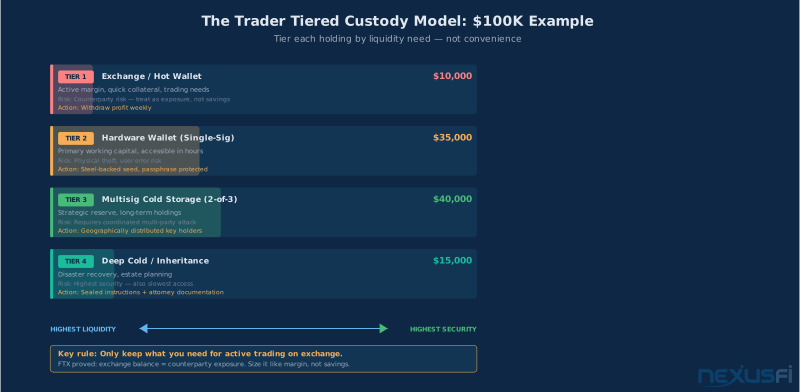
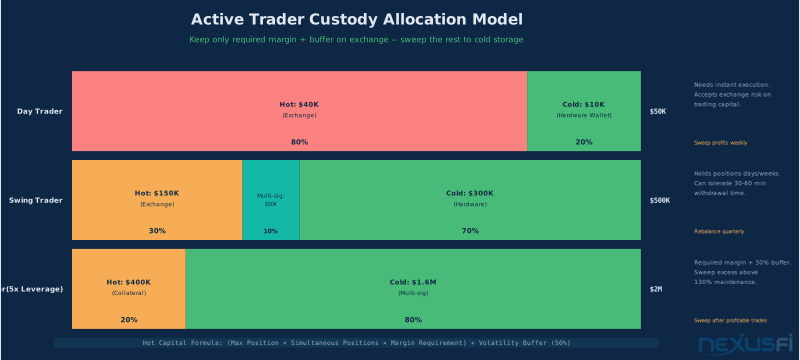
Tiered custody for a $100K portfolio. Exchange holds only margin-required capital. Hardware wallet holds the working reserve. Multi-sig cold storage holds the majority.
Trader-grade custody allocation. Hot capital = margin requirement + volatility buffer — nothing more. Weekly profit sweeps move excess above that target to cold storage.
The formula isn't complicated:
Hot Capital = (Max Position Size × Simultaneous Positions × Margin Requirement) + Volatility Buffer
Example: You trade crypto spot and perpetuals. Max notional per trade is $50,000. You run up to 3 positions simultaneously. Margin requirement at 10x leverage is 10%. Volatility buffer to handle drawdowns and margin calls: 50% of required margin.
Hot Capital = ($50,000 × 3 × 10%) + ($15,000 × 50%) = $15,000 + $7,500 = $22,500 on exchange.
That's your minimum. Keep an additional buffer for transaction fees and withdrawal processing time. Everything above that buffer belongs in cold storage.
Size your hot allocation to your actual trading requirements. Day trader with $50K: keep $35-40K on exchange for position capital, $10-15K in cold storage. Swing trader with $500K: keep $150K on exchange, $350K in cold storage — you can afford 30-60 minute withdrawal times for positions that hold days to weeks. At $2M running 5x leverage, keep $400K on exchange (required collateral plus 30% buffer) and sweep excess to cold storage after profitable sessions.
The Rebalancing Cadence
Define the trigger, don't decide it spontaneously. Options:
Time-based: Every Friday after close, sweep anything above your defined hot maximum to cold storage. Predictable, requires no judgment call.
Threshold-based: After any day that ends with more than X% above your target hot balance, transfer the excess. More responsive to trading outcomes.
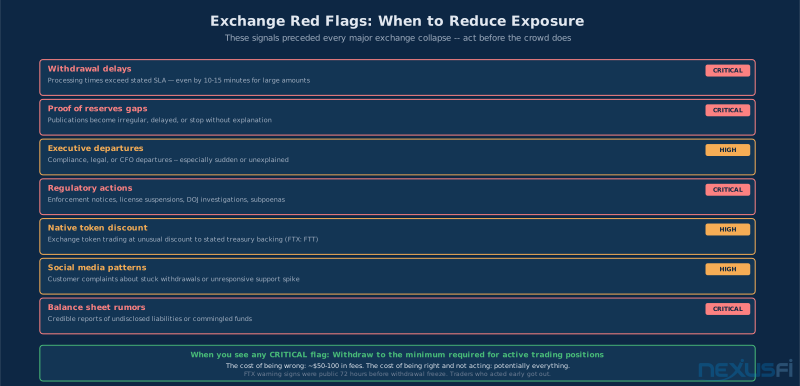
Event-based: After any exchange-related news (regulatory inquiry, executive departure, withdrawal delays, proof of reserves update missing), immediately reduce exposure to minimum required margin. The cost of being wrong is $50-100 in transaction fees. The cost of being right and not acting is potentially everything.
What to Watch for on Exchanges
These aren't guarantees of imminent failure — they're signals to reduce exposure and increase monitoring:
- Withdrawal delays longer than the exchange's stated processing time
- Proof of reserves publications becoming irregular or stopping
- Executive departures (especially compliance, legal, or finance)
- Regulatory inquiries or enforcement actions
- Native exchange tokens trading at unusual discounts to reported backing
FTX's warning signs were visible before the collapse. The Alameda balance sheet leaked. Withdrawal queues were backing up. Anyone who acted on those signals got out. Most didn't.
Multi-Signature for Larger Holdings #
Multi-signature (multi-sig) requires M-of-N private keys to authorize any transaction. 2-of-3 means any two of three keyholders can move funds — one compromise doesn't unlock anything, and one lost key doesn't lock you out permanently.
A practical 2-of-3 setup: Key A (Ledger, used for routine transactions), Key B (Trezor, home safe), Key C (Coldcard, separate physical location like a safety deposit box). Routine: A+B. If A is compromised: B+C recovers everything. If B is lost: A+C handles it. Smart contract multi-sig via Gnosis Safe works for Ethereum/EVM chains.
Multi-sig is worth the operational overhead above $500K in crypto holdings. Below that, a hardware wallet with proper seed backup is simpler and provides equivalent security against remote attacks. Multi-sig adds meaningful protection against physical coercion and coordinated attacks at scale.
For inheritance: include a trusted family member as one keyholder without giving unilateral access during your lifetime. Combined with recovery documentation stored with your estate documents, this creates a workable succession plan without the permanent lockout risk of solo self-custody.
Operational Security #
Digital OpSec
Never type your seed phrase into any device connected to the internet. Recovery always happens on the hardware wallet itself. Clipboard malware watches for crypto addresses copied to your clipboard and replaces them with an attacker's address — verify every recipient address on your hardware wallet's display, not in the software. Browser wallet extensions (MetaMask, Phantom) have been repeatedly targeted; don't use them with main holdings.
If a website or "support" contact asks for your seed phrase, it's a scam. Legitimate recovery never requires your seed phrase online. Unsolicited "support" DMs on Twitter or Telegram are always phishing.
Physical OpSec
Don't broadcast what you hold. Posting about significant crypto holdings publicly is a targeting exercise — physical theft and coercion are real threats for anyone associated with significant positions. Store seed phrase backups physically (steel plates in fireproof safes), with the passphrase at a completely separate location. When traveling, leave hardware wallets at home if possible. A stolen hardware wallet without the PIN and seed phrase is worthless — an attacker gets at most 3-16 PIN attempts before wipe.
Recovery Planning #
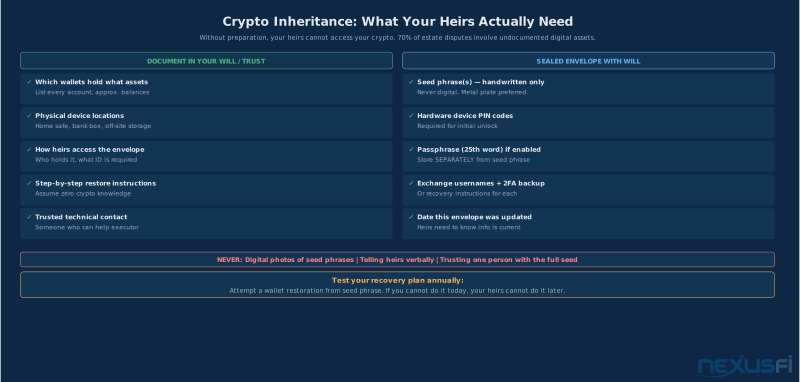
If you die or become incapacitated, your heirs need your seed phrase and passphrase to access funds. If they don't know where either is, the funds die with you. Billions in Bitcoin are already inaccessible this way.
Minimum documentation: (1) what crypto you hold and approximately how much, (2) location of each hardware wallet device, (3) location of each seed phrase backup, (4) location of each passphrase stored separately from corresponding seeds, (5) step-by-step recovery instructions assuming the reader has never used a hardware wallet, (6) who to contact for technical help. Store this with your will or attorney — not with the seed itself.
Common Custody Mistakes #
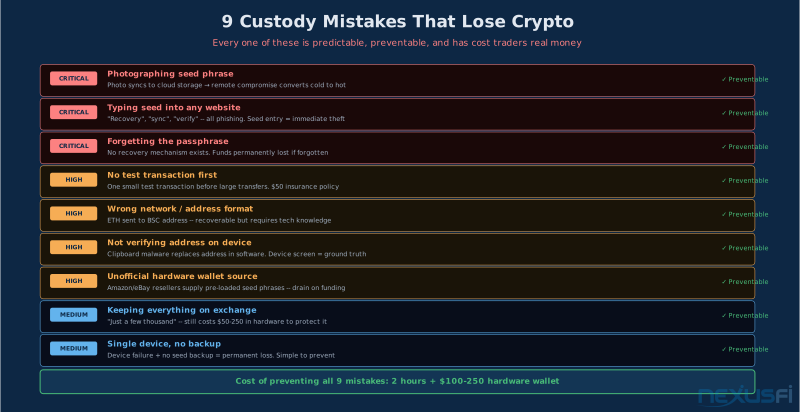
The six most common custody failures — all avoidable. Photographing seed phrases is the most frequent. Buying from unofficial resellers is the most insidious because the theft is delayed and invisible until the attacker drains the wallet.
These are the ways traders actually lose crypto — not through sophisticated attacks, but through predictable operational failures.
Photographing the seed phrase. The photo syncs to iCloud or Google Photos, which can be compromised. Your cold storage is now hot.
Entering the seed phrase into any website. "Wallet synchronization", "recovery verification", "blockchain confirmations" — these are all phishing. Legitimate processes don't require your seed phrase online. Ever.
Forgetting the passphrase. Passphrases are stored nowhere on the device. If you add one and don't document it, the funds are as inaccessible as if you'd burned the device and seed. Document it. Store the documentation somewhere recoverable.
Sending to the wrong network. ERC-20 tokens sent to a BNB Chain address (or vice versa) aren't necessarily lost — the same private key controls addresses on both networks — but recovery requires technical knowledge. Verify network before every send.
No test transaction before large transfers. Send $50 first. Confirm it arrives. Then send the rest. One test transaction is cheap insurance against sending $200K to a mistyped address or wrong network.
Buying hardware wallets from unofficial sources. Amazon resellers and eBay are not safe sourcing options. Hardware wallets purchased through unofficial channels can arrive with pre-loaded seed phrases — the attacker generated the phrase before you got the device and will drain it the moment you fund it. Buy direct from the manufacturer's website.
Keeping everything on the exchange. The most common mistake. "I only have a few thousand in crypto, it's fine." It's fine until it isn't. The cost of a hardware wallet ($100-150) and 2 hours of setup time is trivially small against any meaningful crypto position.
Not verifying addresses on the device screen. Clipboard malware is installed by malicious browser extensions, downloaded software, or phishing sites. It watches for copied crypto addresses and replaces them with the attacker's address. The hardware wallet screen is not manipulable by host malware — that's the verification point.
Where This Fits in Your Crypto Operations #
Cold storage is infrastructure. Like your trading computer, your internet connection, your charting software — you need it functioning before you can operate effectively. Treating crypto custody as an afterthought is like not having a stop-loss strategy: fine until it's catastrophic.
The active trader's custody setup is a layered system: regulated CME futures where spot exposure isn't needed, multi-sig cold storage for long-term holdings, hardware wallet cold storage for medium-term positions, and a carefully sized hot allocation on exchanges calibrated to your actual trading requirements — no more.
Self-custody doesn't protect against trading losses, bad calls, or leverage blowups. It protects against the specific, preventable disaster of losing your holdings to an exchange failure you had no control over. After Mt. Gox, after FTX, after Celsius, after Voyager — the community knows exactly how these failures unfold. The traders who came out intact were the ones who kept their exchange exposure calibrated to what they actually needed to trade.
Knowledge Map
Go Deeper
Build on this knowledgeReferences This Article
Articles that build on this topicCitations
- — What if a broker declare bankruptcy!!! Ftx first whose next? (2022) 👍 6“In the US Customer Funds are required to be held in a separate segregated account to protect the customer from a situation like this. FTX International was not American, they were based in the Bahamas, and they were not allowed to have American customers. Many fx and crypto exchanges are based in countries with lax financial rules.”
- — What if a broker declare bankruptcy!!! Ftx first whose next? (2022) 👍 6“Trading only on a regulated exchange, in a country that is serious about its regulation, is an essential if you want any safety for your money. It is a good idea never to keep more money with the broker than you absolutely have to.”
- — My 2 cents... (2017) 👍 1“When you buy on an exchange, unless you withdraw the coins, the exchange has the coins not you, which exposes you to so many risks. The futures contracts will allow you to buy Bitcoins, move them to cold storage, and then use the futures to hedge/trade them without having to remove them from cold storage.”
- — Bitcoin storage wallet recommendations (2021) 👍 2“I use a ledger nano s to hold my cryptocurrencies. However, I want a Trezor or an Ellipal wallet. They're pretty awesome.”
- — In Bitcoin We Trust (2013) 👍 3“2-factor authentication is a requirement. Your wallet should be memorable with maximum entropy. You don't want to create something super obscure and put your fortune in cold storage and forget your private key years later.”
- — Bitcoin - The Big Short? (2013) 👍 1“Think about how much a lot of you hate banks for a moment. Now pretend your bank no longer has FDIC insurance. That's what an online wallet is. There's literally nothing you can do if your account gets hacked.”
- Coldcard — Hot Wallet vs. Cold Wallet (2024)
- Bitcoin Improvement Proposals — BIP-39: Mnemonic code for generating deterministic keys (2013)
- — Bitcoin Futures by the CME (2020) 👍 4“I personally am happier with the CME credit risk than I would be with many other exchanges... since the CME contract is financially settled they don't have any actual coins in storage that can be hacked/stolen.”
- — Futures Broker Due Diligence Notes post PFG (2012) 👍 12“The additional risk to customer funds occurs through the brokerage using client assets to collateralize its positions. This is perfectly legal.”