



Crypto Funding Rates and Perpetual Swaps: The Hidden Cost Every Trader Pays
Overview #
Funding rates are the most misunderstood cost in crypto trading. Every time you hold a perpetual futures position through an 8-hour settlement window, you either receive or pay a percentage of your notional value to the counterparty on the other side. At 0.01%/8h, that's unremarkable — background noise. At 0.10%/8h, that's 109.5% annualized, and your position is bleeding faster than most traders' target profit rates.
Perpetual futures — the dominant derivative instrument in crypto — don't expire. Unlike CME Bitcoin futures that settle quarterly, perps can be held indefinitely. That creates an obvious problem: if perp prices float freely from spot prices, you'd have two disconnected price discovery markets. Funding rates are the mechanism that keeps them anchored together.
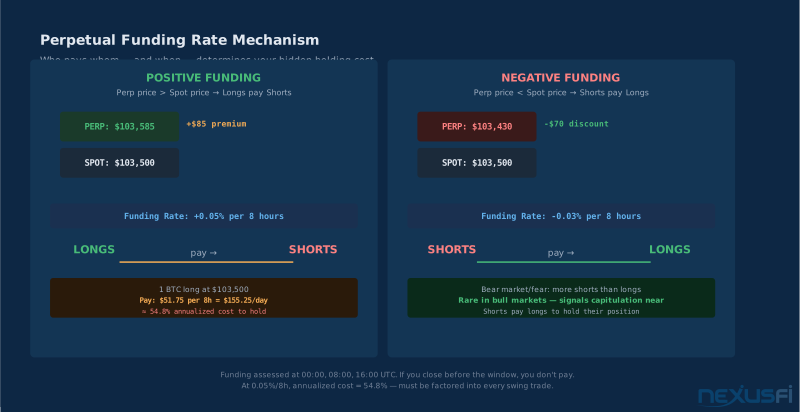
The design is elegant: if perp price is trading above spot, longs pay shorts. If perp price is trading below spot, shorts pay longs. The crowd holding the consensus position pays rent to the crowd holding the contrarian position. This self-correcting mechanism keeps perp and spot prices within a few basis points of each other across normal market conditions.
For traders, funding rates serve two distinct purposes. First, they're a cost and revenue item — every perpetual position has a funding P&L that runs parallel to its price P&L. Second, they're a sentiment signal — extreme positive funding means the market is crowded long, extreme negative funding means it's crowded short. Both purposes matter. Ignoring either one costs you money.
(Cboe Launching Bitcoin & Ether Perpetual Futures December 15)
What Are Perpetual Futures #
A perpetual futures contract gives you leveraged exposure to a crypto asset without an expiry date. You open a long or short position, post margin, and hold it until you close it or get liquidated. There's no delivery, no rolling, no settlement day forcing your hand.
The absence of expiry is what distinguishes perps from traditional futures. CME Bitcoin futures (BTC) have quarterly expiry dates. When March expiry arrives, your position settles at the final settlement price and your capital returns. You then have to open a new position in the June contract if you want to maintain exposure. This creates basis — the premium or discount between futures and spot — that reflects cost-of-carry, time value, and institutional hedging demand.
Perps solve the roll problem for retail traders but introduce funding complexity instead. The mechanical comparison matters:
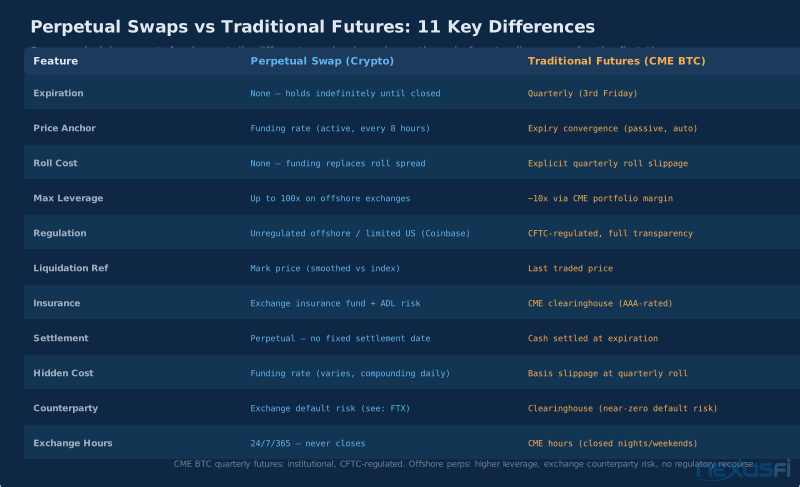
The key difference is counterparty structure. CME futures clear through CME Clearing, a CFTC-regulated entity with a strong default fund. Offshore crypto perpetuals clear through the exchange itself — if an exchange has a solvency issue, your margin is in the estate.
(Kraken Acquires Small Exchange for $100M)
The US market for crypto perps is evolving fast. When CFTC Chairman Selig announced the framework,
(CFTC Chair Selig Puts Timeline on US Crypto Perpetual Futures)
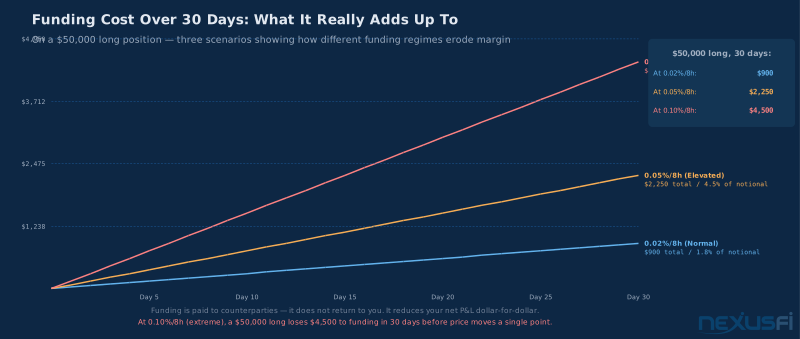
Leverage amplifies both the upside and the funding cost. A 10x leveraged long on $5,000 of margin controls $50,000 of notional. Your P&L moves on $50,000 but so does your funding cost. At 0.05%/8h, you're paying $25 per settlement — $75/day, $2,250/month — against $5,000 of capital. That's 45% annually in funding costs alone, running counter to price P&L.
How Funding Rates Are Calculated #
Funding rates aren't arbitrary. They're derived from the spread between the perpetual contract's mark price and the spot index price. The calculation has two components: the interest rate component and the premium index.
Mark price vs. last traded price
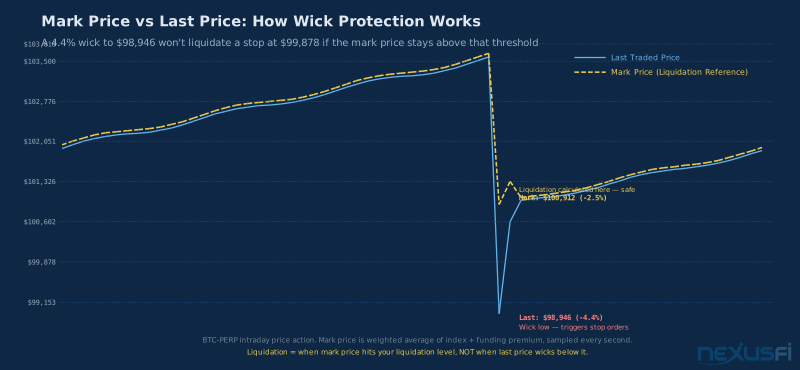
Exchanges calculate funding based on the mark price, not the last traded price. The mark price is derived from spot index prices across multiple exchanges, not from the perp order book. This matters because the last traded price can spike temporarily — a large market order or a stop cascade can push the perp 2% above spot for 30 seconds. If funding used the last price, that temporary dislocation would generate a massive one-time funding charge against longs. Instead, the mark price smooths those spikes, providing liquidation and funding calculations that reflect the underlying market, not the perp microstructure.
The clamp function
The funding rate formula for most major exchanges includes a clamp that limits how extreme the funding can get. Binance, Bybit, and OKX all use variants of:
Funding Rate = Premium Index + clamp(Interest Rate - Premium Index, -0.05%, +0.05%)The interest rate is typically 0.01% per 8-hour period (roughly 3% annualized), reflecting the cost of capital in USD relative to crypto. The premium index measures how far the perp price deviates from spot. The clamp limits the adjustment factor to 5 basis points, preventing the interest rate component from dominating the signal during extreme dislocations.
In practice, when markets are calm, funding stays close to 0.01%/8h. When crypto is in a strong bull trend and everyone is leveraged long, the premium index dominates and funding can reach 0.10%, 0.20%, or higher. During bear markets or post-liquidation events, funding turns negative as shorts pay longs to maintain their positions.
Settlement windows
Most major exchanges settle funding every 8 hours: typically 00:00, 08:00, and 16:00 UTC. Some newer exchanges have moved to hourly or even continuous funding to reduce the incentive for position manipulation around settlement windows. At 8-hour intervals, traders know exactly when the transfer happens and will sometimes open positions immediately after settlement to avoid paying the next cycle.
(Kraken in Talks to Acquire NinjaTrader) This observation about spot margin rollover fees applies equally to perpetual funding — the daily cost compounds against long-term holders.
The Funding Rate Mechanism #
The mechanics are straightforward: at each settlement time, open positions either pay or receive funding. Positive funding means longs pay shorts. Negative funding means shorts pay longs. The amount is:
Funding Payment = Notional Value x Funding RateFor a $100,000 long position at 0.05%/8h: $100,000 x 0.0005 = $50 per settlement, $150/day. Annualized: $54,750. That's against whatever price appreciation you're capturing. Your trade thesis needs to beat funding cost before it breaks even.
The direction of the payment is determined automatically by the exchange. You don't "choose" to pay; it's subtracted from your unrealized P&L at settlement time. If you don't have sufficient margin buffer, this can accelerate your approach to liquidation.
At 0.10%/8h (a common rate during bull market euphoria), holding a $50,000 long for one week costs $1,050 in funding — 2.1% of notional before price moves a tick. Your entry target needs to incorporate this cost or your trade thesis is structurally flawed from the start.
Funding as a market thermometer
Funding rate history is one of the most useful sentiment indicators in crypto because it's a revealed preference. When traders are willing to pay 0.15%/8h to hold a long, they're expressing a belief so strong they're paying 164% annualized to maintain it. That's not ambiguous. It's a crowd behavior signal extracted from actual money flows, not a survey or a social media sentiment score.
The relationship between funding and price is not linear. Extreme funding doesn't immediately reverse price — the crowd can stay irrational and funded for extended periods. But historically, sustained periods above 0.10%/8h have preceded significant corrections within 1-4 weeks, as funding cost gradually erodes the P&L buffer of leveraged longs and makes their positions vulnerable to small adverse moves.
Funding Rate Data as a Market Sentiment Indicator #
Experienced crypto traders watch three funding metrics: current rate, 7-day average, and trend direction. No single data point tells the full story.
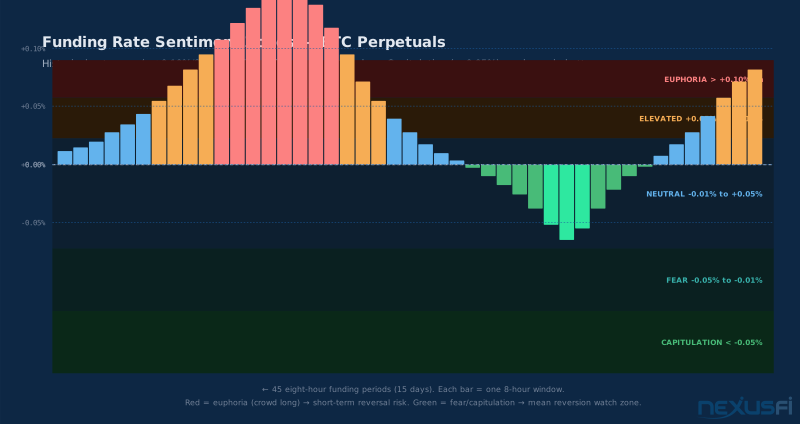
Current rate tells you what the crowd is doing right now. Above 0.05%/8h means bullish crowding. Below 0% means bearish crowding or risk-off. Extreme readings above 0.10% or below -0.05% are worth flagging as potential reversal setup triggers.
7-day average filters noise. A single 0.10% spike at one settlement is meaningless — it may reflect a short-term arbitrage opportunity getting closed. Seven days of sustained 0.08%+ funding means leveraged longs have been paying significant carry for a week, and the crowd hasn't been discouraged. That's a more reliable signal.
Trend direction is the most actionable. Funding moving from -0.02% to +0.05% over a week tells you the market is transitioning from bearish sentiment to bullish. Funding declining from 0.08% toward 0.02% suggests the leveraged crowd is closing positions or getting liquidated. The rate of change matters as much as the level.
Data sources
Primary sources for funding rate data: Coinglass (coinglass.com) aggregates funding across 15+ exchanges with historical charts. Bybit, Binance, and OKX all expose historical funding via their public APIs. Coinglass also provides the "Funding Rate Leaderboard" showing which assets have the most extreme current funding rates — useful for finding the most overcrowded positions across the entire crypto market.
Cash-and-Carry Arbitrage Using Funding Rates #
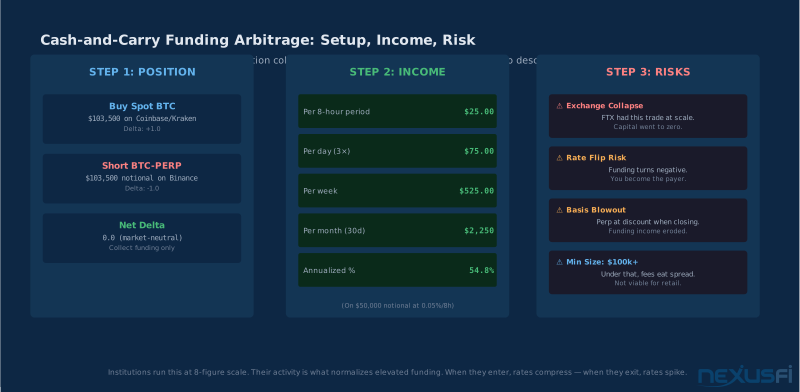
When funding rates are high, a market-neutral strategy emerges: cash-and-carry, also called funding rate farming. The setup:
- Long spot Bitcoin (or ETH, SOL, any asset with a liquid perp)
- Short the same asset's perpetual at equivalent notional
- Net delta: Zero — you profit from price movement in neither direction
- Revenue: Funding payments flowing from longs (the crowd) to your short position
At 0.05%/8h, a $50,000 cash-and-carry position earns $25 per settlement, $75/day, roughly 54% annualized on the notional.
The risks are meaningful:
Funding rate reversal: If sentiment shifts and funding turns negative, your short now pays instead of receives. The strategy can flip from profitable to costly in a single settlement window. Most successful implementations have stop-loss rules: if 7-day average funding drops below a threshold (often 0.02%), close the position.
Exchange counterparty risk: Your spot long and perp short are often on different platforms. If the perp exchange becomes insolvent, you lose the short leg and are left holding an unhedged long. The 2022 FTX collapse destroyed several large institutions running exactly this trade.
(Cboe Launching Bitcoin & Ether Perpetual Futures December 15)
Funding rate convergence during spot sell-offs: When BTC drops 15% rapidly, spot holders are down 15% but perp shorts are up 15% (roughly). The positions offset. But if the spot sell-off also triggers mass long liquidations and pushes funding negative, your short is now paying funding. You're simultaneously down on spot (temporarily) AND paying funding. The position doesn't lose money long-term if you can withstand the drawdown, but margin requirements can force liquidation before recovery.
Execution complexity: Most retail traders can't efficiently hedge a $50,000 position across spot and perp simultaneously. Price can move 0.5% in the time it takes to execute both legs manually, creating execution risk in the hedge setup. Automated bots with API access to both legs reduce but don't eliminate this slippage.
Monitoring Funding Rates in Practice #
Effective funding rate monitoring isn't constant watching — it's setting alerts for meaningful thresholds and reviewing the trend at defined intervals.
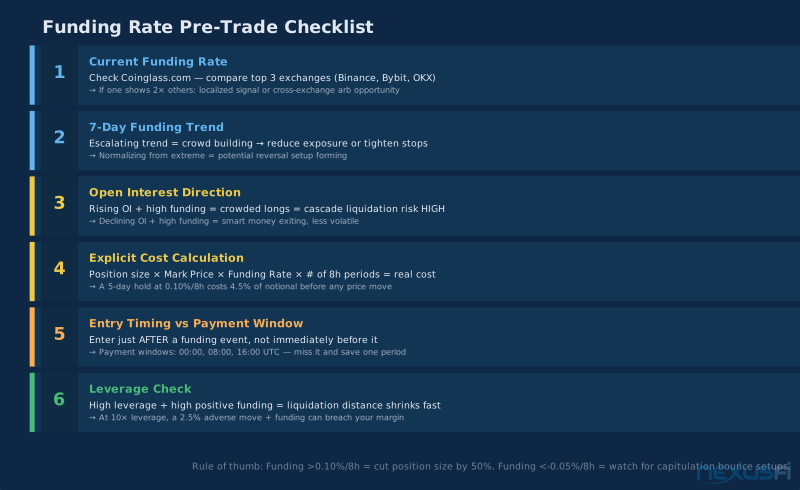
Pre-trade checklist:
- What is the current funding rate on the exchange you're using?
- What is the 7-day average and direction of travel?
- What is the open interest trend (rising, stable, falling)?
- What will this position cost or earn per day in funding at the current rate?
- Does your entry timing avoid the settlement window by 30+ minutes?
- Is your leverage appropriate given the funding environment?
Avoiding settlement window effects
In the hour before a major settlement, traders with large positions sometimes push perp prices to benefit from the settlement calculation. Entering positions immediately before settlement exposes you to this flow. Opening positions 30-60 minutes after settlement gives you a clean read on actual market direction rather than pre-settlement positioning.
Cross-exchange rate comparison
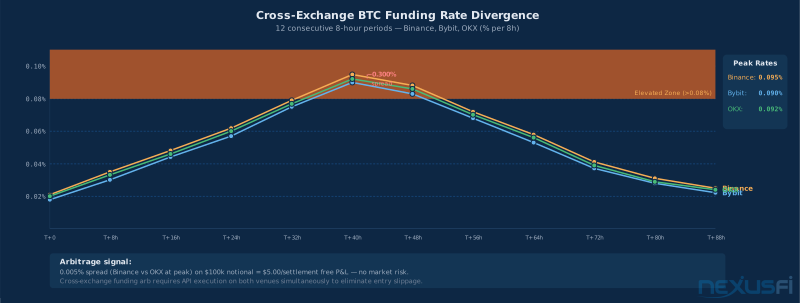
Funding rates aren't uniform across exchanges. Binance might be at 0.08% while Bybit is at 0.05% for the same asset. This divergence reflects liquidity differences, trader composition, and exchange-specific demand. Sophisticated traders can extract the spread by going long on the lower-funding exchange and short on the higher-funding exchange — capturing both rates simultaneously. This requires accounts on multiple exchanges and careful execution but generates near-pure arbitrage with minimal market risk.
Integration with Other Crypto Tools #
Funding rates are most powerful when combined with open interest data and liquidation heatmaps.
Funding rate + open interest as a risk amplifier
When funding is elevated and open interest is near recent highs, the market is maximally levered. Every 1% adverse price move forces a proportionally larger percentage of positions into liquidation territory. Liquidation cascades amplify small adverse moves into larger ones, which is why 10% BTC drops often happen faster than equivalent moves in traditional markets.
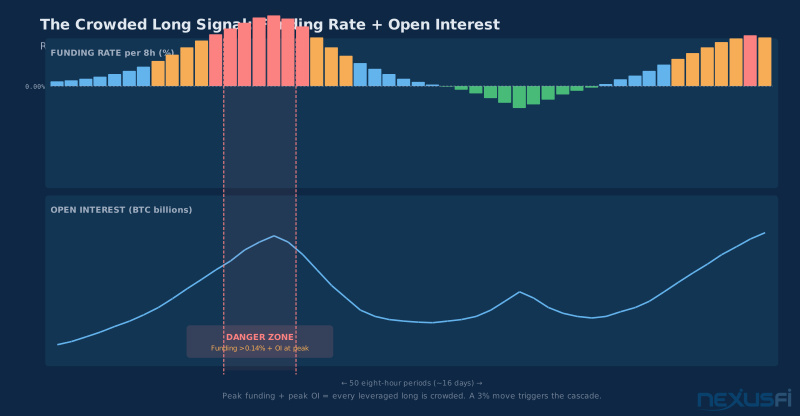
Coinglass publishes liquidation heatmaps showing where large clusters of leveraged positions would be liquidated at various price levels. Overlaid with funding rate data, these heatmaps show where the market is most vulnerable. A region with high funding (crowded longs) AND a dense liquidation cluster just below current price is a setup that technical traders watch closely — not to predict, but to understand the asymmetric risk profile of positions in that zone.
Long/short ratio
The long/short ratio shows the percentage of traders positioned long vs. short on major exchanges. At 70% long, 30% short, the crowd is heavily directional. Combined with high positive funding, this confirms the one-sided nature of the trade. When both metrics are extreme AND price starts fading, experienced traders recognize the setup: the crowd is wrong and will be forced to close, amplifying the move.
Funding rate divergence across assets
Funding rates diverge across assets based on market sentiment. ETH might be at 0.01% while BTC is at 0.07% during periods where Bitcoin is leading a rally. That divergence tells you ETH has less leveraged speculation per dollar of market cap — potentially a more stable long. Altcoins sometimes show extreme funding divergence: newly listed or trending assets can sustain 0.30%+ funding for weeks as retail traders scramble for exposure with limited short sellers willing to take the other side.
Practical Application #
The most actionable use of funding rate data for retail traders is cost-aware position management.
Cost-adjusted target: If you're long BTC at $103,500 and funding is 0.07%/8h (roughly 76% annualized), your break-even on price isn't where you entered — it's wherever the funding cost to exit equals your price profit. For a 5-day hold, funding costs: 0.07% x 3 settlements/day x 5 days = 1.05% of notional. Your target needs to be at least 1.05% above entry just to break even on the combined trade. That's $1,086 per BTC — $103,500 x 1.05% — before any price move generates actual profit.
Funding as a holding cost sensitivity test: Before any leveraged crypto position, calculate what the trade costs per day in funding, then ask: at what price am I forced to close because the daily funding exceeds my acceptable loss rate? This sets a de facto time stop even if you don't have a price stop.
Negative funding as a contrarian opportunity: When funding turns deeply negative — below -0.05% consistently — the crowd is aggressively short. Shorts are paying longs to hold their positions. At these extremes, the crowd has generally gotten too bearish. Negative funding doesn't predict a reversal, but it indicates that a long position has less crowded competition and lower (or zero) funding cost to hold.
Exchange selection based on funding: If you're planning to hold a long-term directional position (weeks to months), compare funding rates across exchanges before entering. A consistent 0.02% difference between exchanges compounds meaningfully over months. Don't let platform habit override the funding cost difference when considering a 90-day hold.
Track your monthly funding P&L separately from your price P&L. If funding costs exceed 15% of your gross price profit over a 30-day period, your position sizing or leverage is too aggressive for the current funding environment. Reduce size before the environment reduces it for you via liquidation.
Knowledge Map
Prerequisites
Understand these firstGo Deeper
Build on this knowledgeReferences This Article
Articles that build on this topicCitations
- — Kraken in Talks to Acquire NinjaTrader (2025) 👍 8“Rollover fee of 0.02% charged every four hours. If you buy and hold for 3 years, the rollover fees will take your entire investment. There's a reason why Coinbase has a market cap equal to half the CME.”
- — Kraken Acquires Small Exchange for $100M to Launch U.S. Derivatives Platform (2025) 👍 2“What would people think if CME liquidated a bunch of your positions because another customer can't perform? I personally think this is a function of the high leverage crypto exchanges offer. They can't offer leverage like that without taking risk the counterparty can't pay, so they created ADL. Exchange First. Customer Second.”
- — What if a broker declare bankruptcy!!! Ftx first whose next? (2022) 👍 6“FTX was not a 'broker' in the same sense as a broker on a regulated exchange. It was itself an 'exchange', in a totally unregulated environment, where the owner also owned a hedge fund that was heavily borrowing from FTX. Trading only on a regulated exchange, in a country that is serious about its regulation, is an essential if you want any safety for your money.”
- — New Micro Contract: Micro Ether coming 5-Dec-21 (2021) 👍 10“The fee structure for Micro Bitcoin will make it too expensive to trade except in the rarest of occasions. If you hold for extended periods your roll cost will be astronomical -- the same applies to any leveraged crypto instrument with recurring funding or fee structure.”
- — CFTC Chair Selig Puts Timeline on US Crypto Perpetual Futures -- Framework Coming Within Weeks (2026)“Top-10 crypto perpetual exchanges processed $92.9 trillion in trading volume in 2025 -- a 64.6% increase from the previous year. Growth occurred despite Q4 declines in bitcoin and other cryptocurrencies.”
- Coinglass — BTC Perpetual Funding Rate Historical Data and Exchange Comparison (2026)
- Binance — Binance Perpetual Futures: Funding Rate Mechanism and Calculation (2026)