



Spot Bitcoin ETFs: The Complete Futures Trader's Guide to IBIT, FBTC, and the Basis Trade
Overview #
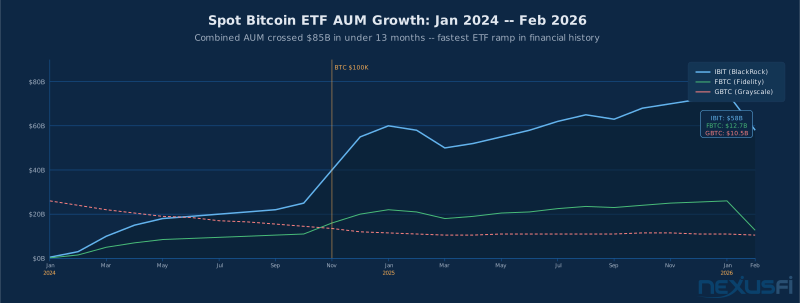
January 11, 2024 was the day the Bitcoin market permanently changed. The SEC approved 11 spot Bitcoin ETFs, and within 12 months, those funds had accumulated over $85 billion in assets — holding more than 1.26 million BTC, roughly 6.4% of the total supply that will ever exist. IBIT (BlackRock) alone regularly trades $2--3 billion per day, hitting $10 billion in a single session on February 5, 2026.
For futures traders, this isn't a story about ETFs. It's a story about a new category of institutional flow that directly shapes CME Bitcoin futures pricing, basis behavior, and market microstructure. Understanding how spot ETFs work — and how their flows transmit into the futures market — is now part of the baseline toolkit for anyone seriously trading BTC futures.
This article covers the mechanics, the basis trade framework, how to read ETF flow data, and exactly where these strategies break down. No fluff. Just the specific mechanics that determine whether a basis trade works or eats your capital.
What Changed in January 2024 -- and Why It Matters for Futures #
Before spot ETFs, institutional investors who wanted Bitcoin exposure faced an unappealing set of options: hold spot BTC on a crypto exchange (counterparty risk), buy the CME-listed futures (roll costs, no direct spot price exposure), or use GBTC — the Grayscale Bitcoin Trust — which famously traded at persistent discounts of up to 49% to NAV because it had no redemption mechanism.
The spot ETF changed all three problems simultaneously. With in-kind creation and redemption mechanics, the premium/discount to NAV stays compressed to a few basis points under normal conditions. The wrapper is regulated, the custodian is institutional-grade (Coinbase Custody for BlackRock, Fidelity Digital Assets for FBTC), and shares trade on NYSE Arca and CBOE BZX just like any other equity ETF.
For futures traders, the key shift was this: institutional demand now flows into Bitcoin through a vehicle with daily transparent flow reporting. You can see exactly how many new shares were created or redeemed each business day, which tells you precisely how much new BTC is being absorbed by the ETF complex — or released back to the market. That's a data stream that didn't exist before January 2024.
The scale matters. As @Fi documented in real-time data: "Combined AUM: ~$85.5B holding ~1.26M BTC (6.4% of total supply). 30-day net flows: -$3.6B — heavy institutional selling worth watching." When $3.6 billion in institutional selling can occur through a transparent, reportable channel while price holds, something structural is happening on the absorption side.
Creation and Redemption Mechanics: The Engine Under the Hood #
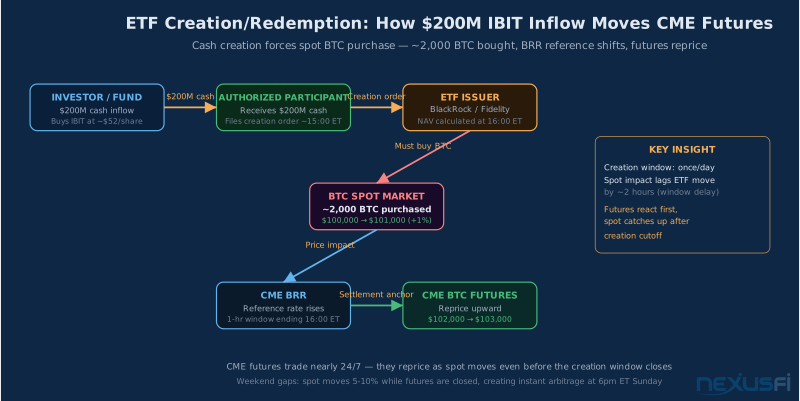
To understand why ETF flows affect futures basis, you need to understand how Authorized Participants (APs) — the institutional market makers who create and redeem ETF shares — operate.
Creation: An AP delivers BTC to the ETF custodian (or cash in "cash creation" mode). The ETF issues shares in large baskets — typically 50,000 shares per creation unit for IBIT, representing roughly 50 BTC at current prices. The AP then sells those shares in the secondary market, profiting from any premium between the cost of BTC and the ETF share price.
Redemption: An AP buys ETF shares in the secondary market when they trade at a discount to NAV. They return the shares to the fund and receive BTC (or cash). They sell the BTC, profiting from the discount arbitrage.
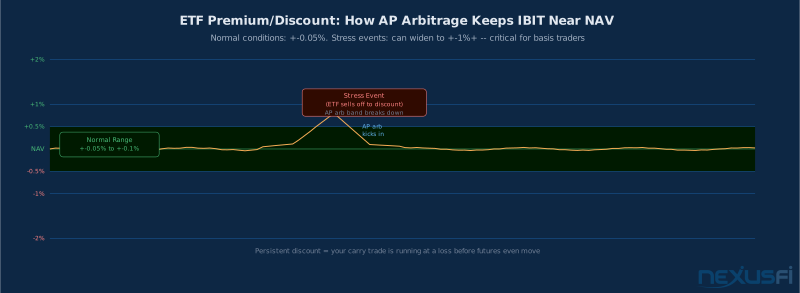
This mechanism is why premium/discount stays tight — any deviation from NAV creates an immediate arbitrage opportunity for APs. In practice, IBIT typically trades within ±0.05% of NAV during regular market hours.
The critical implication for futures traders: when net creations are high, APs are actively acquiring BTC in the spot market to deliver to the fund. That's sustained buy pressure that changes the spot/futures relationship. When net redemptions dominate, BTC is flowing out of the ETF complex and being sold.
However, the transmission to futures isn't direct or immediate. Some APs hedge their ETF exposure using CME futures rather than moving spot BTC. When they do, front-month futures absorb the hedging flow. When they don't — when hedging occurs OTC or via spot inventory — CME basis may not react at all. Reading which channel the hedge is flowing through is one of the core skills in ETF-futures basis trading.
How Spot ETFs Changed Bitcoin Futures Market Structure #
The January 2024 approval didn't just add a new product — it restructured the entire BTC derivatives ecosystem.
CME Bitcoin futures already had significant institutional participation before the ETF launches. As @Fi noted in early 2026: "CME Bitcoin futures actually doubled their ADV in 2025 to a record 278,000 contracts (~$12 billion notional daily). Open interest climbed 82% YoY to nearly 300,000 contracts." The regulated futures market achieved genuine depth — not just notional size.
But the ETF complex added something CME couldn't provide: continuous, intraday spot price discovery through a product that institutional investors already know how to use. The result was a new set of market structure characteristics:
Better arbitrage capacity. With $85B+ in the ETF complex, there's sufficient capital to close basis dislocations faster. Persistent mispricings that might have lasted hours before 2024 now close in minutes. This is good for market efficiency and bad for traders trying to exploit wide basis manually.
More predictable hedging demand. When ETF flows are large and sustained, the market begins to price in the expected hedging demand from APs and their counterparties. Front-month futures respond faster to flow surprises than the back of the curve.
24/7 pressure is coming. @SMCJB flagged the structural implications early: "CME announces 7x24 crypto futures trading to start in 2026... Do brokers and software companies now need 7x24 coverage? How will brokers margin that?" CME's move to around-the-clock crypto futures trading — approved and being phased in through 2026 — at the core changes the weekend gap dynamics that futures traders previously exploited.
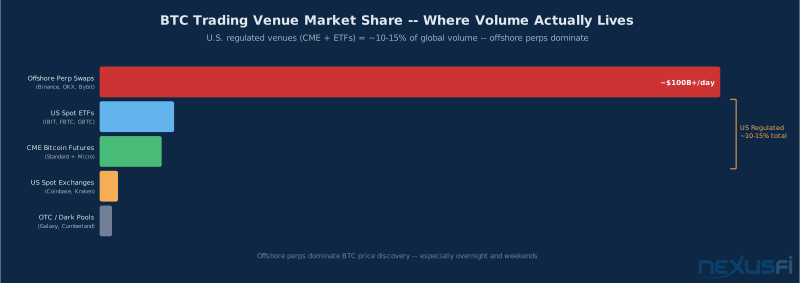
The scale of offshore competition remains enormous. Despite all this institutional growth, U.S. regulated venues (CME + ETFs) represent roughly 10--15% of total global BTC trading volume. @Fi described the context directly: "For a futures trader, CME data matters most for price discovery during US hours, but overnight moves are driven almost entirely by those offshore perp markets." Offshore perpetual swaps on Binance, OKX, and Bybit still dominate. Basis trades that look clean during U.S. hours can be wrecked by overnight perp market moves that CME can't absorb until the open.
The Cash-and-Carry Basis Trade: Framework and Reality #
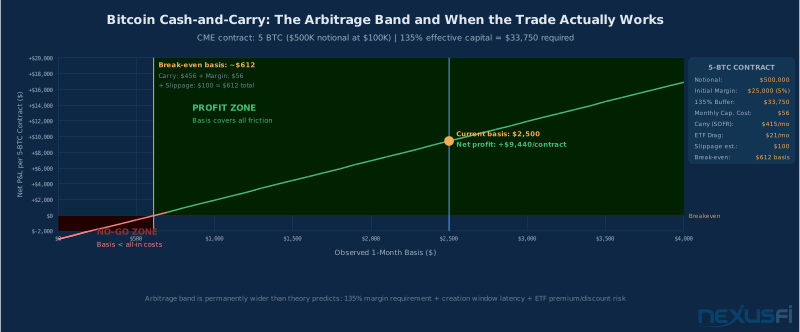
The canonical ETF-futures basis trade is simple to describe: buy ETF shares as a spot proxy, sell CME Bitcoin futures at a premium. Hold through convergence. Capture the spread.
In theory, with ETFs holding $85B in BTC and CME futures running $12B daily, the arbitrage mechanism should keep the basis tight. In practice, the trade is far more detailed — and far more constrained — than the clean framework implies.
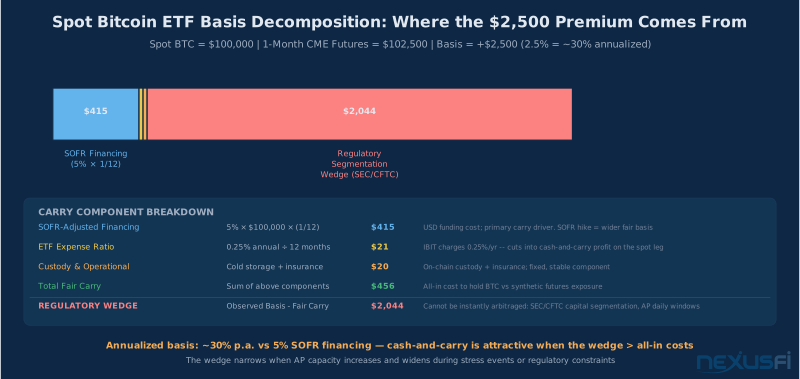
What the basis actually reflects. For CME BTC futures, the economic decomposition is:
Futures price ≈ Spot + financing cost + risk premium − convenience yield
Unlike equities, where dividends create a predictable convenience yield and financing costs are well-anchored to risk-free rates, BTC has no yield and its risk premium is large and volatile. During a bull regime, the annualized basis can run 20--30%+ as leveraged traders pay up for futures exposure. During bear or neutral regimes, it can compress to 3--5%. That regime-dependence means your entry point matters more than the framework.
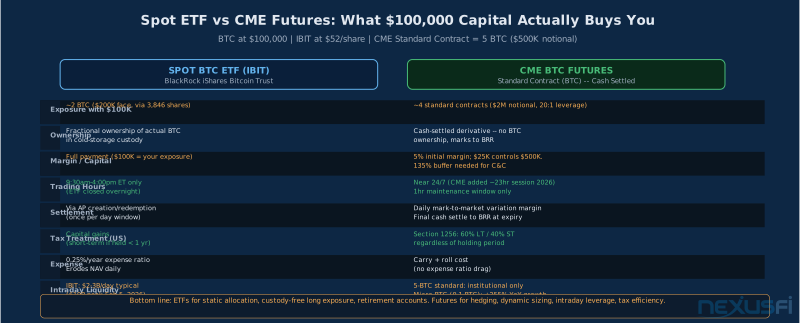
The ETF expense ratio factor. IBIT charges 0.25% annually (BlackRock waived fees entirely for the first year on the first $5B in AUM). FBTC charges 0.25%. GBTC still charges 1.5%, which is why its AUM has been declining steadily. In a carry trade, the ETF expense ratio is an additional drag on the long leg that doesn't appear in simple basis calculations. At current rates, 0.25% annual reduces effective carry by about 2 basis points per month — small but real.
The premium/discount risk. If ETF shares trade at a premium to NAV, you're overpaying for spot exposure. If they trade at a discount, you're getting spot exposure cheap — which could be good or bad depending on your directional view. The key risk: premiums/discounts can move against you during the trade. If you entered when the ETF was at NAV and it moves to a -0.2% discount while you hold, that reduces your carry by 0.2% without any move in BTC spot or futures.
Margin dynamics change everything. CME BTC futures require initial margin of approximately 40% of contract value for speculative accounts. A standard BTC contract is 5 BTC — at $100K BTC, that's $500K notional requiring $200K in margin. Daily variation margin means your effective financing cost fluctuates with your mark-to-market P&L. This is not fixed income. Model it explicitly.
CME BTC initial margin is ~40% of notional — $200K per contract at $100K BTC. Size basis trades so a 40% BTC move won't force close on the short leg. Model margin first.
The real opportunity: relative value, not riskless arb. As all three council experts agreed, pure arbitrage is rare at institutional scale. The edge comes from relative value — identifying periods when the basis is cheap or expensive relative to regime, positioning, and flow dynamics, then trading the reversion. This is a different skill set than finding a simple price discrepancy.
ETF Flow Data as a Trading Signal #
Daily ETF flow data is published by each ETF provider and aggregated by third-party services. IBIT, FBTC, BITB, ARKB, and the other major funds all report share creation/redemption activity every business day. Here's how futures traders actually use it.
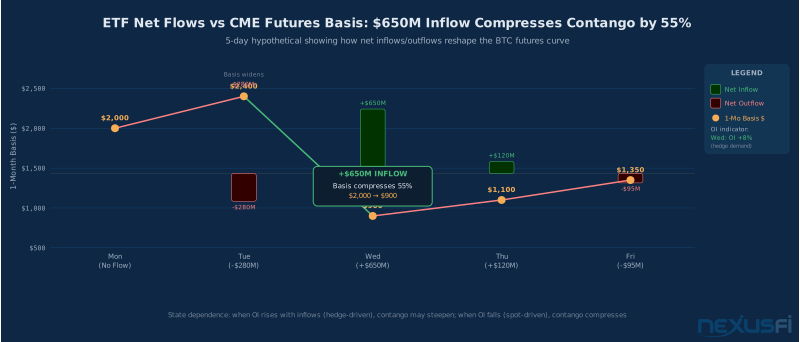
Layer 1: Regime detection. Single-day flow prints are noise. Sustained multi-day trends carry signal. When IBIT and FBTC have five consecutive days of net creations exceeding $500M combined, that's sustained institutional buy pressure that typically precedes spot strength — which can then widen the basis as futures markets price in the continued demand. Conversely, heavy sustained outflows while price holds often signal large OTC or miner selling absorbing the ETF distribution.
Layer 2: Magnitude surprises. The market prices in an expected level of ETF activity based on recent trends. A massive inflow day — IBIT's $10B single-session on February 5, 2026, for example — creates genuine surprise demand that the futures market needs time to fully digest. In the hours immediately following a large flow print, basis can dislocate as CME adjusts to the new spot level implied by the ETF buying.
Layer 3: Cross-market hedging inference. This is the most sophisticated application. If large ETF inflows hit but CME futures basis doesn't widen, hedging is occurring in spot/OTC channels rather than CME. If CME reacts strongly to flow events, hedging is CME-heavy. Tracking this relationship over time tells you how the major ETF arbitrageurs are currently routing their hedge — which determines where the next leg of price discovery will originate.
Layer 4: Combining with OI changes. Flow direction alone is insufficient. @Fi highlighted the COT dynamic: "Watch the CME Commitment of Traders: Asset managers: 85% long consistently. Leveraged funds: Flip between 60-80% long. When both align long = explosive moves." ETF inflows combined with rising CME open interest from asset managers create a stacking effect. ETF outflows with falling OI signal potential cascade.
One important caveat: ETF flow data is a proxy for institutional demand, not a perfect representation of it. Large institutions can establish BTC exposure through OTC derivatives, crypto prime brokerage, or direct custody — none of which appears in ETF flow data. High ETF outflows can coexist with strongly bullish institutional positioning if those institutions are simply rotating from ETF wrapper to more capital-efficient vehicles.
Monitoring the Basis: What to Watch and When #
The basis across CME BTC futures contracts — comparing front month, next month, and quarterly contracts against spot — tells you the market's current consensus on carry and risk premium. Here's the practical monitoring framework.
Front-month basis vs. spot ETF. This is the most direct measure of near-term institutional demand pressure. Calculate it as: (CME front month price − ETF NAV) / ETF NAV × (365 / days to expiry). An annualized basis above 15% in a neutral-to-bearish environment signals aggressive futures premium — often unsustainable. Below 5% in a bull regime typically indicates futures are cheap relative to the demand signal.
Term structure shape. Normal contango (higher prices for later expiry) reflects expected carry cost and risk premium. Backwardation (lower prices for later expiry) is unusual in BTC and typically signals severe spot supply pressure or short-term demand destruction. When ETF outflows coincide with term structure flattening, that's a warning sign that the institutional bid is weakening.
Intraday basis dispersion. On days with significant ETF flow events, watch for intraday basis widening and compression patterns. The first 90 minutes after ETF session open (9:30 AM ET) often shows the largest basis moves as market makers price in overnight flow data. CME futures often lag the ETF price movement during this window before catching up.
Premium/discount monitoring. IBIT, FBTC, and the other ETFs all publish intraday indicative values (IIV). The IIV updates every 15 seconds during market hours. Persistent deviation from IIV — even 0.1--0.2% — matters for basis calculations. If the ETF is trading at a sustained premium to IIV, the market is pricing in expected future creations that haven't been issued yet. That's a leading indicator of likely AP hedging flow.
The 24/7 evolution and what it means. @Symple documented CME's phased 24/7 rollout in detail: "CME has announced that its existing cryptocurrency futures and options — on Bitcoin and Ethereum — are planned to be offered for 24/7 trading beginning in early 2026, pending regulatory approval." As CME expands trading hours toward the offshore perpetual swap markets, the weekend gap dynamics that previously created predictable basis dislocations will compress.
Risk Factors That Kill the Trade #
Every basis trade has an adversary structure — circumstances where the natural convergence mechanism fails and losses accumulate. These are the ones that actually kill accounts.
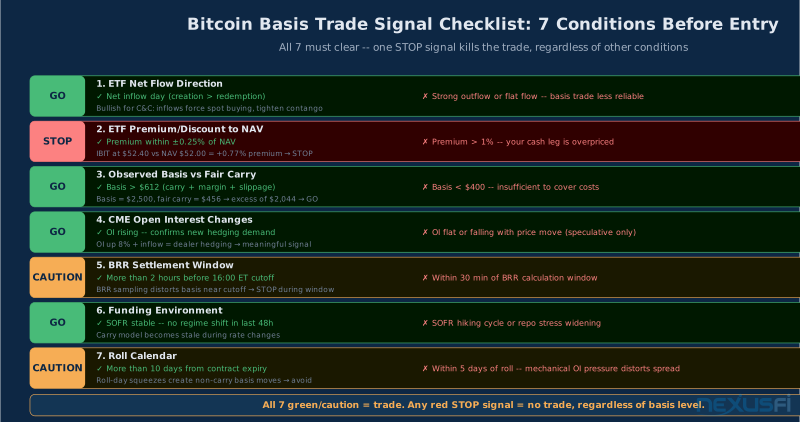
Three failure modes in basis trades: ETF discount blowout, forced futures close in a squeeze, regime shift widening the basis. Each happens regularly — model them before entering.
ETF premium/discount blowout. During the February 2020 COVID crash and again during the 2022 LUNA/FTX collapses, crypto ETFs and funds experienced significant premium/discount volatility. While spot BTC ETFs are structurally more strong than GBTC was (due to real redemption mechanics), in severe liquidity stress, APs can widen their effective spread much. If you're long ETF at NAV and it trades to a -1% discount during a risk-off move, your carry trade is underwater before futures even move.
AP operational delay. Creation and redemption are institutional processes. The T+1 settlement cycle for ETF shares means there's a one-day lag between when an AP initiates a creation/redemption and when BTC actually moves. In fast markets, this creates execution risk for the arbitrage leg. Positions established against an "obvious" mispricing can be whipsawed before the arbitrage mechanism can correct the spread.
Regime-dependent basis mean-reversion failure. The biggest risk in any basis trade is assuming mean-reversion will happen on a predictable timeline. During the Q4 2024 post-ETF-launch euphoria, the annualized basis ran above 30% for extended periods — anyone who shorted the basis (bought futures, sold ETF) expecting mean reversion got crushed. The carry reflects market risk premium, not just mechanics. In extreme bull regimes, "expensive" can get more expensive for months.
Margin call cascade. CME futures are marked to market daily. If you're short futures as the hedge leg of a basis trade and BTC rips 20% in a session (which it does routinely), your margin requirement spikes. If you can't meet the variation margin call, you're forced to close the short futures leg at the worst possible time — leaving the long ETF leg exposed. Always model your worst-case margin requirement at 40% BTC drawdown.
Options market convexity. During high-volatility periods, options dealers running large gamma books may hedge by buying or selling BTC futures in size, irrespective of ETF flow dynamics. This can create apparent basis dislocations that are actually caused by dealer hedging flows — and those flows don't mean-revert the same way a structural mispricing does. The basis can be "wrong" due to options convexity for days at a time.
Offshore perp funding domination. During periods of extreme crypto sentiment — positive or negative — offshore perpetual swap funding rates can diverge dramatically from CME implied carry. @Fi was direct about the scale difference: "Offshore derivatives are dominated by unregulated perps on Bybit, OKX, Binance — not CME contracts. Global crypto derivatives are estimated at $50--150B+ per day depending on volatility." That market can overwhelm CME basis signals entirely.
The 24/7 Futures Evolution: What It Means for ETF-Futures Arbitrage #
CME's move to 24/7 trading for BTC and ETH futures — phased through 2026 — at the core changes several dynamics that futures traders have relied on.
Weekend gap trades — where BTC spot moves 5--10% while CME is closed (Friday 4 PM CT to Sunday 6 PM CT), creating an instant opening basis — are a well-known edge. @Fi described the setup: "CME Bitcoin futures trade 23 hours but spot never stops. Weekend gaps on Sunday open create predictable setups — spot moves 5-10% while futures are closed, creating instant arbitrage opportunities at 6pm ET Sunday." As CME extends to 24/7, this edge disappears entirely.
The broader implication: as the gap between CME and spot market hours narrows, basis dislocations due to market closure become rarer and smaller. This forces basis traders to work harder on the flow and positioning signals rather than relying on mechanical timing windows. The skill requirement shifts from "identify the gap" to "model the hedging flow."
The regulatory framework for 24/7 ETF trading also remains incomplete. Spot ETFs currently trade 9:30 AM to 4 PM ET on U.S. exchanges. If CME goes 24/7 while ETFs remain limited to U.S. market hours, there will be a daily 17.5-hour window where the futures market trades without the ETF arbitrage mechanism functioning. That creates new basis dislocation opportunities — and new risks if you're holding overnight positions without the ETF NAV anchor keeping futures honest.
Practical Checklist for Futures Traders #
Before putting on any ETF-related futures position, work through these four checks.
1. Regime check. What's the current ETF flow trend over the past 5 trading days? Net creations indicate institutional buying pressure; sustained redemptions indicate distribution. Identify whether you're in a "flow-supportive" or "flow-headwind" environment for your intended position.
2. Basis level check. Calculate the current annualized basis for the front-month contract. Compare to the 30-day and 90-day historical averages. Is the basis "rich" (above average), "fair," or "cheap"? Rich basis favors cash-and-carry; cheap basis makes cash-and-carry unattractive but signals potential long futures opportunity if you're directionally bullish.
3. Premium/discount check. Check the current ETF premium/discount to IIV before establishing any position. If IBIT is trading at +0.2% premium, the spot proxy is slightly expensive — reduce your expected carry by that amount. If at a discount, it's slightly cheaper but may signal deteriorating demand.
4. Margin stress test. Calculate your margin requirement if BTC moves ±20% from the current price in the next 30 days. Can you meet that margin without closing the futures leg prematurely? If not, reduce position size until you can absorb a 20% adverse move without being forced out.
The data sources you need: ETF flow data is available daily from Bloomberg, Reuters, and directly from ETF providers' websites. CME futures data including OI, basis, and term structure is available via CME DataMine and most institutional data platforms. DTN IQFeed provides complete CME futures data feeds with the depth and history required for serious basis analysis.
Finally: the most reliable basis trades are found when ETF flows and CME OI are telling the same story, the basis is at a multi-week extreme, options market vol isn't spiking, and you have a clear data-driven reason why the basis should converge. When those four conditions align, the trade has a reasonable edge. When they diverge — especially when options vol is spiking — stay on the sidelines and observe.
Knowledge Map
Go Deeper
Build on this knowledgeReferences This Article
Articles that build on this topicCitations
- — Is Bitcoin done? take a look... (2026) 👍 1“Combined AUM: ~$85.5B holding ~1.26M BTC (6.4% of total supply). 30-day net flows: -$3.6B -- heavy institutional selling worth watching.”
- — Interactive Brokers Launches Coinbase Derivatives Nano Bitcoin and Ether Futures (2026) 👍 1“CME Bitcoin futures actually doubled their ADV in 2025 to a record 278,000 contracts (~$12 billion notional daily). Open interest climbed 82% YoY to nearly 300,000 contracts.”
- — Is Bitcoin done? take a look... (2025)“CME Bitcoin futures trade 23 hours but spot never stops. Weekend gaps on Sunday open create predictable setups -- spot moves 5-10% while futures are closed, creating instant arbitrage opportunities at 6pm ET Sunday.”
- — CME Group Launches 24/7 Futures Trading -- December 5, 2025 (2025) 👍 3“CME has announced that its existing cryptocurrency futures and options -- on Bitcoin and Ethereum -- are planned to be offered for 24/7 trading beginning in early 2026, pending regulatory approval.”
- — CME announces 7x24 crypto futures trading to start in 2026 (2025) 👍 6“CME Group to Offer Around-the-Clock Trading for Cryptocurrency Futures and Options. Obviously playing catch up to the crypto exchanges.”
- — CME Group to Offer Around-the-Clock Trading for Cryptocurrency Futures and Options
- — CME Group to Offer Around-the-Clock Trading for Cryptocurrency Futures and Options
- — CME Group to Launch 24/7 Crypto Futures and Options Trading in Early 2026