



Bloomberg Terminal for Futures Traders: Real Value, True Cost, and the Smart Alternatives Stack
Overview #
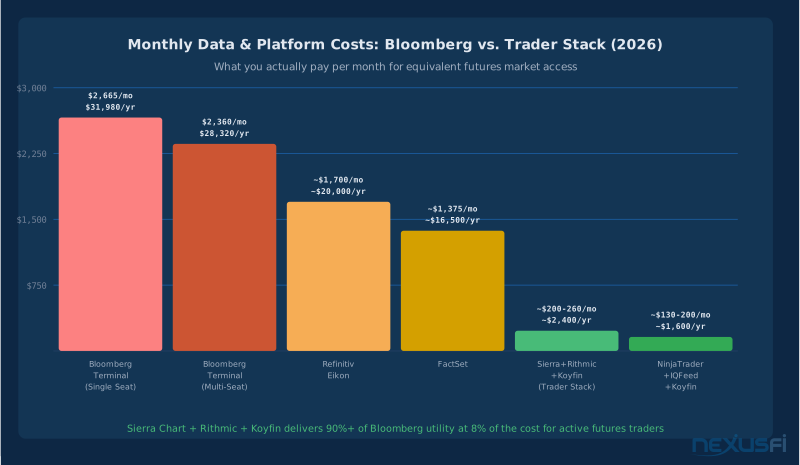
Every trader has seen it in the background of trading floor photos: the distinctive dual-screen setup with black background, orange text, and the proprietary keyboard with color-coded keys for equities, fixed income, commodities, and currencies. The Bloomberg Terminal is the most recognizable symbol of professional finance. At $31,980 per year for a single seat in 2026, it's also one of the most expensive recurring costs in the business.
The question isn't whether Bloomberg is worth the money — for institutional desks managing billions in multi-asset portfolios, it often is. The question is whether it's worth the money for you: an active futures trader running ES, NQ, CL, or GC on your own account or prop firm capital.
The answer, for most futures traders, is an unambiguous no. Not because Bloomberg is bad — it's genuinely excellent at what it does. But what it does and what active futures traders actually need don't overlap nearly as much as the marketing implies. This article breaks down exactly what you're paying for, what you're not getting, and how to build a stack that outperforms Bloomberg for active execution at less than 8% of the cost.
What the Bloomberg Terminal Actually Is #
Michael Bloomberg launched the Terminal in 1981 after leaving Salomon Brothers, targeting bond traders who needed better access to pricing data. What started as a bond-market data system evolved over four decades into an indispensable infrastructure tool for institutional finance. Today, approximately 325,000 subscribers globally pay for access, generating over $10 billion in annual revenue for Bloomberg LP.
The Terminal is at the core a workflow ecosystem, not a single tool. It bundles together:
- Real-time price data across equities, bonds, FX, commodities, and derivatives -- global coverage with institutional-grade low latency
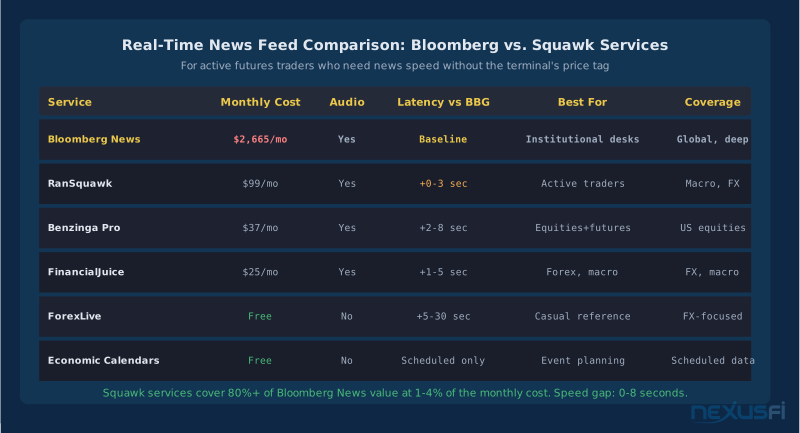
- Bloomberg News -- one of the fastest financial news desks in the world, with alerts reaching subscribers before most retail feeds
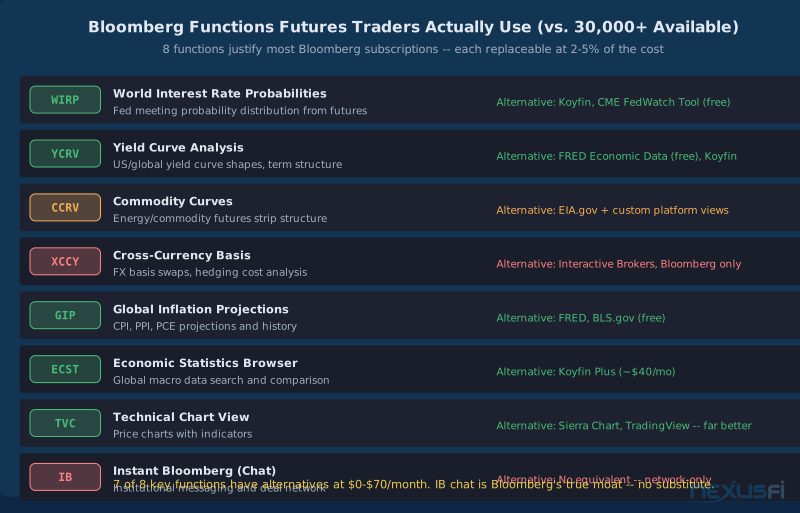
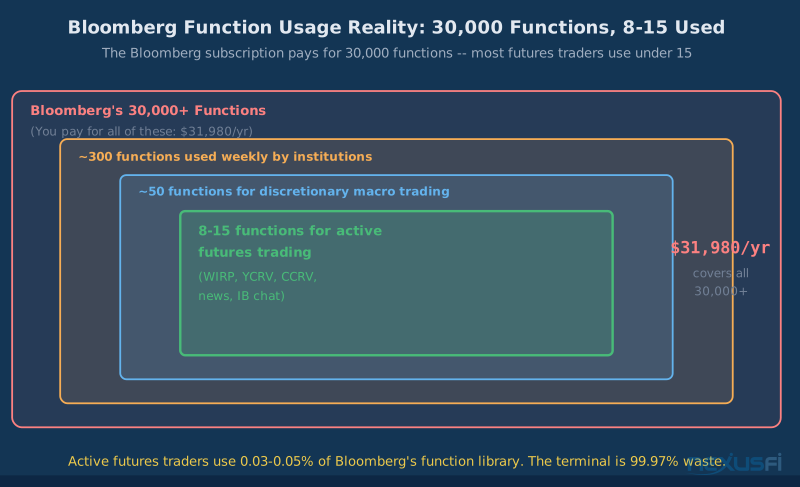
- Analytics and functions -- over 30,000 function codes covering everything from interest-rate probabilities (WIRP) to earnings analysis (FA) to currency options (OVML)
- Fixed income and credit data -- the deepest bond analytics available anywhere, covering munis, corporates, sovereigns, structured products
- Bloomberg Terminal Messenger (IB chat) -- the institutional trading community's primary communication channel, where deals close and information flows
- API access (BLPAPI) -- Python, Excel, and custom application integration for systematic workflows
- Bloomberg Anywhere -- web-based access for remote work, tablet access, supplemental screens
The distinctive hardware — dual high-resolution monitors, proprietary keyboard with fingerprint authentication, custom color-coded keys — is part of the product. The keyboard isn't just aesthetic; experienced Bloomberg users work through data 40-50% faster via keyboard shortcuts than any point-and-click alternative.
Here's the critical insight: Bloomberg is best understood as a cross-asset research, news, and analytics platform. It's designed for portfolio managers, sell-side analysts, risk managers, and multi-asset discretionary traders who need to pull information across markets quickly, maintain a running picture of macro conditions, and communicate within an institutional network. That's a very different job than active futures trading.
What Bloomberg Gives Futures Traders #
For futures traders specifically, Bloomberg's legitimate strengths come down to three areas:
1. Cross-Asset Macro Context
Active futures traders who trade ES, NQ, or macro-linked instruments need to understand what's driving markets before price moves. Bloomberg excels here. The WIRP function (World Interest Rate Probabilities) shows real-time Fed funds futures probability distributions — updated tick by tick, built from CME futures data, beautifully displayed. The XCCY function pulls cross-currency basis swaps. YCRV plots yield curves. RRPD tracks reverse repo usage. These tools give macro traders a rapid picture of how capital is positioned across asset classes.
For a trader whose edge is reading macro regime shifts — "rates just signaled, ES should follow" — this functionality has real value. Bloomberg lets you see the causal chain across markets faster than stitching together information from multiple sources.
2. Real-Time News and Event Intelligence
Bloomberg News is genuinely fast. When a Fed speaker deviates from script, when an economic number prints, when a geopolitical event breaks — Bloomberg's newsroom gets the headline to subscribers in seconds, before most retail feeds update. For CL and GC traders who trade around news events, the speed advantage is tangible. ES can move 5-15 points in the seconds after a major headline; being in the news flow earlier matters.
3. Curve and Spread Analytics for Energy and Commodities
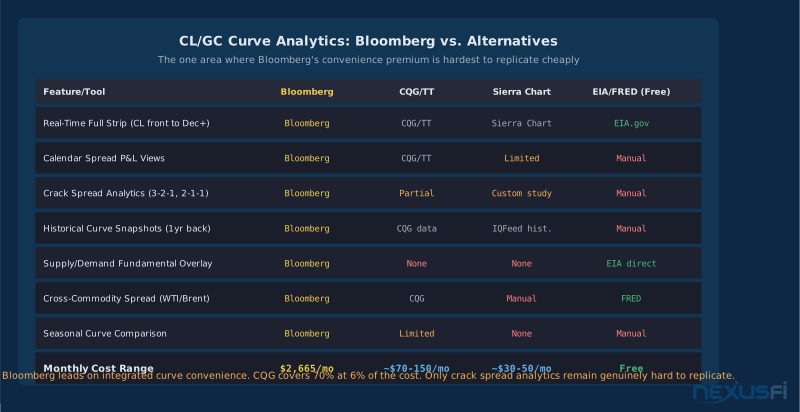
For CL traders who watch the futures curve structure — contango, backwardation, crack spreads, calendar spreads — Bloomberg's CCRV and COMB functions provide convenient, integrated curve construction across the full strip. Energy desk professionals who need to see the entire WTI curve, simultaneously compare it to Brent, and overlay supply/demand data use these tools constantly. It's the one area where Bloomberg's convenience premium is hardest to replicate cheaply.
Where Bloomberg Falls Short for Active Futures Traders #
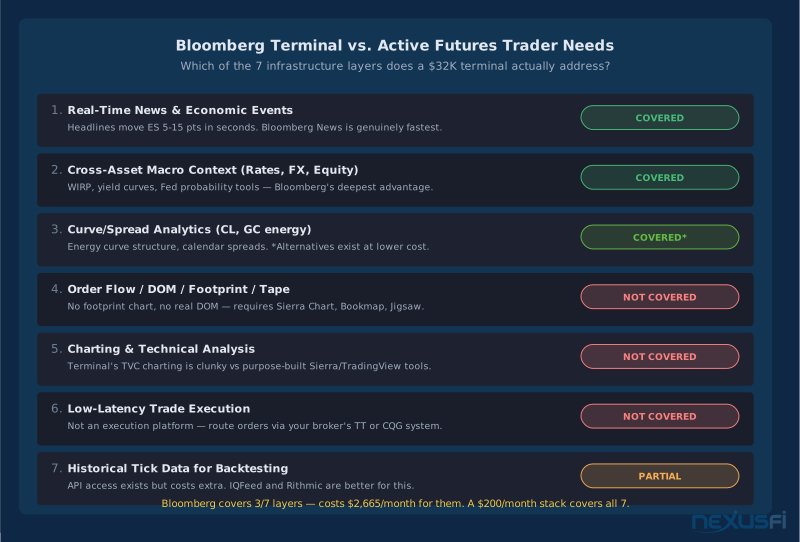
Here's where the math stops working for most futures traders. Bloomberg's strengths — news speed, cross-asset dashboards, curve analytics — cover approximately 3 of the 7 infrastructure layers an active futures trader needs. The other 4 layers? Bloomberg either doesn't address them or addresses them poorly.
Order Flow, DOM, and Footprint: Not Built for This
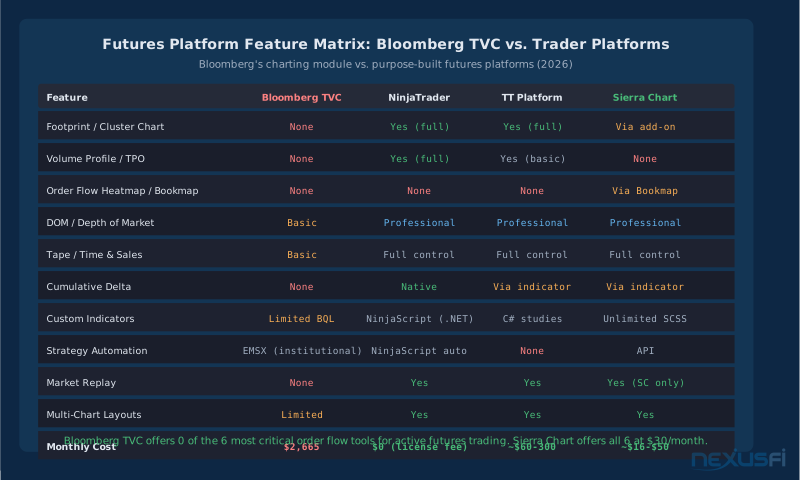
Active ES and NQ traders live in order flow. Footprint charts, depth of market, tape reading, cumulative delta — these are the instruments of the trade. Bloomberg has none of this. The Terminal's charting function (TVC) is a general-purpose financial charting tool. It shows OHLC bars with technical indicators. It does not show footprint charts, time and sales in the format traders use, DOM depth visualization, or bid/ask delta. For order flow traders, this is a disqualifying gap.
Charting Is Clunky and Slow
Bloomberg's charting interface is designed for analysts reviewing historical data, not traders executing in real time. Indicators take multiple keystrokes to add. Layouts can't be saved and recalled with the speed traders need. There's no concept of the workspace-driven workflow that Sierra Chart, NinjaTrader, or TradingView have perfected. Traders who use Bloomberg for charting typically use it alongside a separate execution platform — paying for both.
Not an Execution Platform
Bloomberg offers the EMSX (Electronic Multi-Strategy Trading) system for order routing, which is used by institutional desks to connect to multiple broker algorithms. For individual retail futures traders, this is irrelevant — you're routing through your broker's platform and clearing through their TT or CQG infrastructure. Bloomberg doesn't replace your execution environment; at best, it sits alongside it as a separate research layer.
Latency Is Not Optimized for Scalping
Bloomberg's data latency is not designed for the millisecond-level precision that systematic scalpers or aggressive DOM traders require. The Terminal is built around a message-based architecture optimized for information breadth. Purpose-built futures feeds — Rithmic, CQG, DTN IQFeed — are engineered from the ground up for low latency and data integrity at the tick level. Bloomberg's tick data is fine for reference; it's not the right tool for execution-critical latency management.
The True Cost: Breaking Down $31,980/Year #
The sticker price of $31,980/year for a single seat is just the starting point. The full cost structure breaks down as follows:
- Single-seat annual subscription (2026): $31,980/year ($2,665/month)
- Multi-seat rate (2+ terminals): $28,320/year per seat ($2,360/month)
- Volume discounts: 5-10+ seats: ~$26,900/seat; 25-49 seats: ~$24,070/seat; 50+ seats: ~$22,660/seat
- Contract minimum: Typically 2 years, non-negotiable for new subscribers
- Hardware: Proprietary keyboard (~$300), biometric scanner setup (~$200)
- Installation fees: $500-$1,000 per seat for initial setup
- Data entitlement add-ons: Specialty datasets (specific indices, alternative data, derivatives analytics) can add $2,000-$8,000+/year
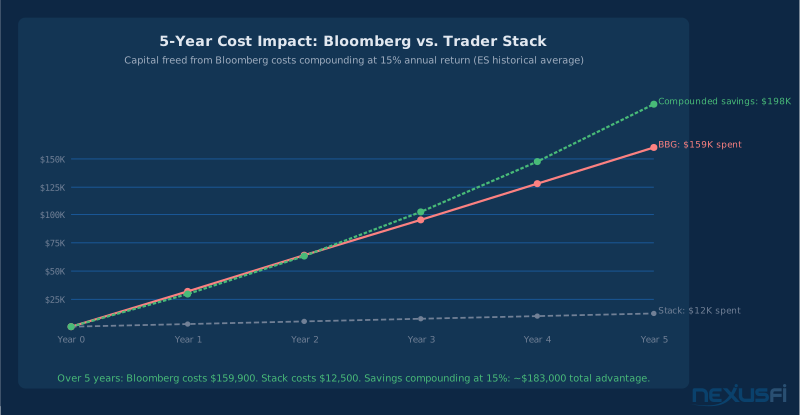
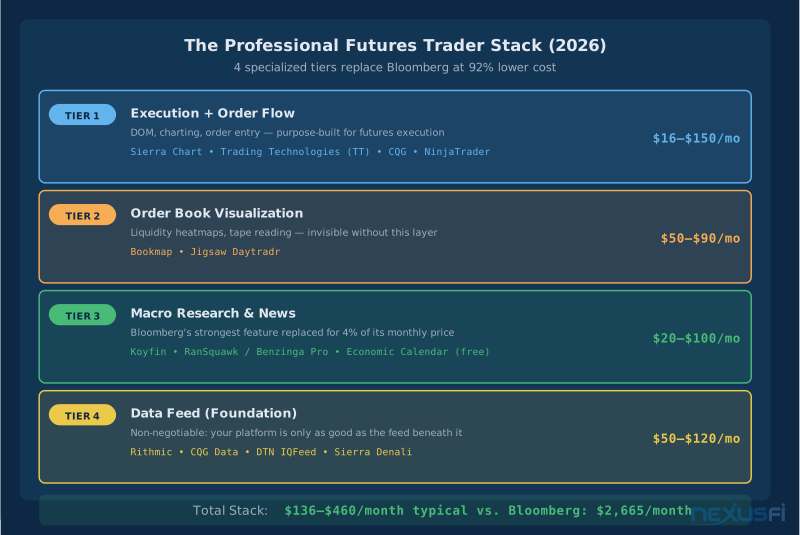
The total cost of ownership for a first-year single-seat subscriber typically runs $33,000-$35,000 when hardware, installation, and a base data package are included. For comparison, the entire professional trader stack described later in this article costs $136-$460/month — $1,632-$5,520 annually — with no minimum contract and full month-to-month flexibility.
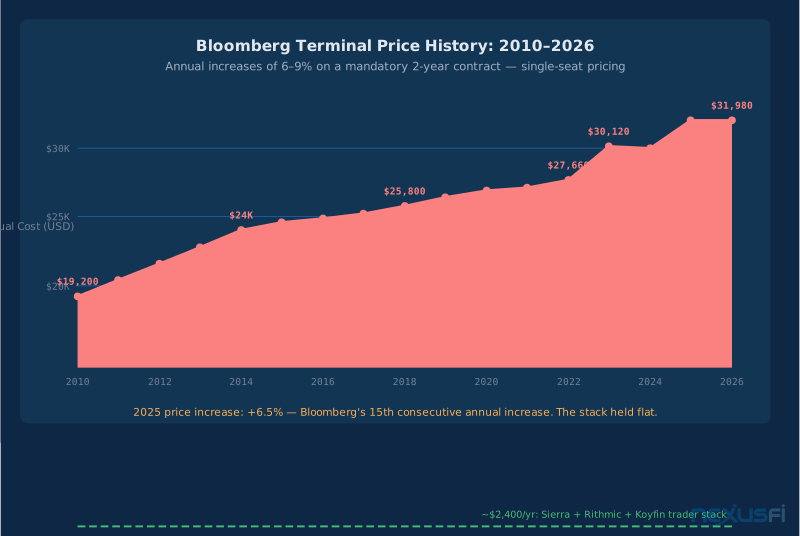
Bloomberg's pricing history is equally important context. The terminal has seen annual price increases of 6-9% for fifteen consecutive years. A subscription that cost approximately $19,200 in 2010 now costs $31,980 in 2026. If you sign a two-year contract today, you're locked into the current rate — and will face another increase at renewal. Bloomberg has consistently cited "investments in data, analytics, and infrastructure" as justification, which is accurate but doesn't change the math for traders evaluating return on investment.
Who Actually Needs Bloomberg #
Honest answer: Bloomberg earns its price for specific traders in specific roles. These are they:
Macro Discretionary Traders at Institutional Desks
A trader at a hedge fund running a macro book needs to see the relationship between German Bund yields, EUR/USD, and ES in real time. Bloomberg's integrated cross-asset view makes this effortless. When you're managing $50M+ in macro exposure, the $32K/year is a rounding error against the information advantage.
Fixed Income and Credit Professionals
Bloomberg's bond analytics are unmatched. The depth of coverage across munis, corporate bonds, structured credit, and sovereign debt has no realistic alternative. If your futures trading is overlaid on a fixed income portfolio — trading Treasury futures as a macro hedge, for instance — Bloomberg's bond intelligence has direct, tangible value.
Traders Who Live on the IB Chat Network
The Bloomberg Terminal Messenger (IB chat) is the institutional trading community's primary communication channel. Information flows through it before it reaches any public feed. Traders at shops where the rest of the desk uses Bloomberg, where broker relationships are maintained via IB, and where flow information comes through that network are effectively paying for the network as much as the data. You can't access IB without a Terminal subscription.
Energy Curve Traders Who Need Full Strip Analytics
CL traders running curve strategies — rolling calendar spreads, crack spread trades, physical-financial basis trades — have a legitimate case for Bloomberg. The integrated curve construction, historical spread analysis, and supply/demand data overlay is a genuine time-saver for desk-level commodity research. Even here, though, cheaper alternatives have improved much and can replicate most of the workflow at a fraction of the cost.
Who Probably Doesn't Need Bloomberg
If your trading profile looks like this, Bloomberg is almost certainly the wrong tool:
- Active ES/NQ day trader using technical analysis, order flow, or momentum strategies
- CL/GC swing trader who watches chart patterns and volume structure
- Prop firm trader working through any of the funded evaluation platforms
- Systematic trader running algorithms on futures with NinjaTrader or Sierra Chart
- Independent retail trader managing your own capital on a trading platform
For all of these profiles, Bloomberg's strengths — news speed, cross-asset macro, IB network — are secondary or irrelevant. The tools that actually drive trading performance (DOM visualization, order flow, low-latency execution data, footprint charting) are not in Bloomberg's product. You'd be paying $32K/year for three features you use occasionally, while still needing to pay for the execution tools that actually matter.
Before comparing Bloomberg to any alternative, audit what you actually use it for. Most futures traders need three things: real-time futures data, a platform with order flow tools, and macro research. Each of those has a purpose-built solution at 10-20% of Bloomberg cost.
The Professional Alternatives Stack #
The correct framing isn't "what's a cheaper version of Bloomberg?" It's "what stack gives a futures trader the best capabilities per dollar?" Bloomberg is an all-in-one tool optimized for institutional breadth. Active futures traders need depth and precision across a narrower set of functions. The stack approach wins decisively.
Tier 1: Execution and Order Flow Platform
This is the core of your trading infrastructure — where you chart, analyze, and execute.
Sierra Chart is the consensus choice among serious professional retail futures traders, and has been for over a decade. It's not pretty — the UI looks like it was designed in 2005 because much of it was. But underneath that aesthetic are capabilities that rival expensive institutional platforms: native TPO/Market Profile, Volume Profile, Footprint charts, customizable DOM, advanced order flow studies, full control over chart rendering. Package 3 ran about $26/month for years; the Denali data feed packages now range from about $16-$50/month depending on data entitlements, with add-on exchange fees. As @bobwest noted in a NexusFi thread on pricing, the value per dollar is unmatched in the retail space.
Trading Technologies (TT) is the institutional standard for professional futures execution. If you're executing with size, need algo order types, or require the kind of DOM that institutional prop traders use, TT is the platform. It costs meaningfully more than Sierra Chart — typically $200-$700+/month depending on licensing — but far less than Bloomberg, and it actually delivers execution capability rather than research dashboards.
CQG Integrated Client (QTrader) combines CQG's institutional-grade data feed with a capable execution interface. It's widely used at FCMs and brokerage firms as the standard execution environment. Some brokers offer it subsidized or bundled with their commission structure.
NinjaTrader remains the dominant choice for retail futures traders in the U.S. market. The platform ecosystem (thousands of third-party indicators, NinjaScript automation, ATM strategies) is unmatched at the retail level. Data costs depend on your broker connection — Rithmic via NinjaTrader is a common high-performance combination.
Tier 2: Order Book Visualization
This tier is optional — relevant if your edge depends on reading order book dynamics — but it's important to understand what it provides.
Bookmap is the best tool for visualizing liquidity provider behavior in the order book. Its heatmap DOM shows where limit orders are stacked, how they shift as price approaches, and where institutional participants are hiding size. For ES and NQ traders who trade with size and need to see the invisible order book, Bookmap's view of the market is irreplaceable. It runs approximately $50-$90/month and integrates with multiple platforms and data feeds.
Jigsaw Trading / Jigsaw Daytradr focuses on tape reading and reconstructive DOM analysis. As the Jigsaw Trading team has noted in the NexusFi community, the quality of the underlying feed matters much for tape analysis — they recommend CQG, Rithmic, or GAIN for their platform, specifically because feed accuracy in attributing which side initiated each trade is critical to their analysis.
Tier 3: Macro Research and News Intelligence
This is where you replace Bloomberg's strongest feature — and you do it for 4% of Bloomberg's monthly cost.
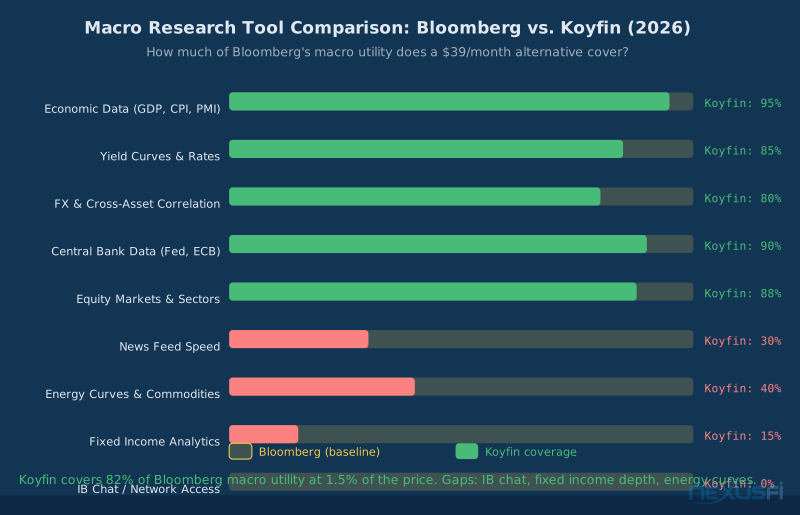
Koyfin is the closest UI/UX competitor to Bloomberg that exists at retail-accessible pricing ($20-$70/month depending on tier). It provides macro dashboards, economic data visualization, cross-asset correlation charts, earnings data, and a fundamentals research workflow that covers 90% of what macro-focused futures traders actually use Bloomberg for. The interface is modern and intuitive in ways Bloomberg's command-line system is not.
Squawk services (RanSquawk, Benzinga Pro, FinancialJuice) provide the real-time audio news feed that Bloomberg users monitor throughout the trading day. These services employ dedicated journalists who monitor newswires and provide real-time audio commentary on market-moving events. At $20-$100/month, they're accessible — and for traders who need to react to news flow without constantly scanning headlines, audio squawk during market hours is actually faster than reading Bloomberg's text alerts.
Free economic calendars (Investing.com, ForexFactory for macro events, CME's official economic calendar) cover the scheduled event risk that drives intraday futures moves. These are adequate for most traders and cost nothing.
Tier 4: The Data Feed -- Non-Negotiable
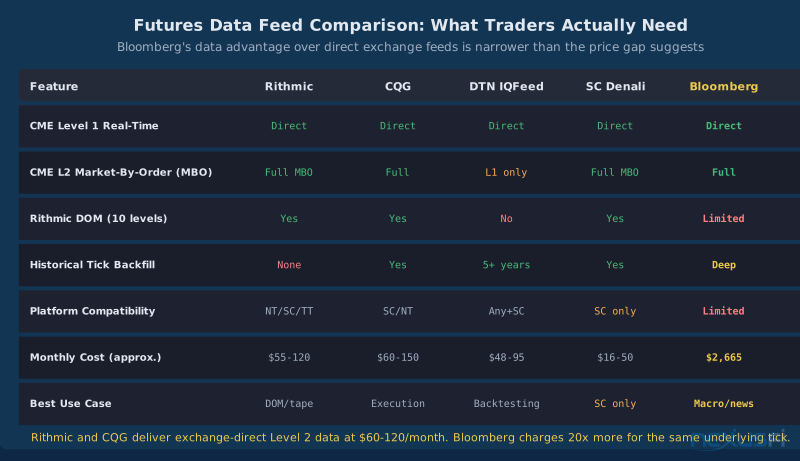
Here's the lesson every experienced futures trader knows: the quality of your data feed determines everything else. You can have the best charting platform in the world; if the data coming into it is delayed, missing ticks, or misattributing which side initiated a trade, your analysis is built on a flawed foundation. As @Big Mike put it in a NexusFi data feed comparison thread, "If you refuse to pay for data or don't prioritize data, then Rithmic or CQG is the way to go, although you are still paying for your data feed one way or another."
Rithmic is the preferred data feed for DOM-focused and tape-reading traders. Its primary advantage is full Market-By-Order (MBO) support — the ability to see the full order book at every price level, not just the aggregated bid/ask. As @qsceszwasdx noted in the NexusFi community, "Rithmic Pros: Have MBO and can see all order book (subscribe market depth)." The connection fee runs approximately $25/month on top of exchange data fees, with total costs typically ranging from $55-$120/month depending on CME data entitlements. The limitation: no historical backfill, which means you need to record your own tick data or use a separate provider for backtesting.
CQG is the institutional backbone feed. It provides full L2 data, strong historical backfill, and is widely integrated across professional platforms (Sierra Chart, TT, NinjaTrader in some configurations, Bookmap). Many FCMs offer CQG-based data bundled with their clearing services. For traders who need both good live data and historical backfill from the same source, CQG is often the choice. As @josh summarized in a broker comparison thread, "CQG, TT, Rithmic, are all technologies which provide: (1) data, and (2) order routing. DTN IQFeed is an example of a data-only technology."
DTN IQFeed is the best-value data-only feed in the futures market. It doesn't offer order routing — it's pure market data. But its historical database, extending back 5+ years of tick data for major futures contracts, makes it the go-to choice for backtesting and systematic strategy development. At $48-$95/month including professional CME data entitlements, it's much cheaper than broker-based feeds while delivering excellent data quality.
Sierra Chart's Denali Feed is the best choice for Sierra Chart users who trade through AMP, a Sierra-compatible broker, or who want an all-in-one Sierra data solution. It delivers full MBO data at $16-$50/month (before exchange fees), making it one of the most cost-effective professional feeds available. The constraint: it's Sierra Chart only, with no compatibility with external platforms.
Building Your Stack by Trader Type #
The right combination depends on what you trade and how you trade it. Here are three archetypal stacks:
Stack A: ES/NQ Microstructure Trader ($160-$270/month)
This trader's edge is reading order flow — footprint, DOM, tape, cumulative delta. Macro research is secondary; execution precision is primary.
- Platform: Sierra Chart (Package 5, ~$30/month) -- for footprint, Volume Profile, and custom order flow studies
- Data feed: Rithmic or Sierra Denali (~$55-$75/month with CME professional entitlements)
- Order book: Bookmap (~$50/month if DOM visualization is core to the edge, optional otherwise)
- News/macro: Koyfin free tier + economic calendar (free)
- Total: ~$135-$230/month
Comparison to Bloomberg: $2,665/month, with none of the footprint, DOM, or execution tools this trader actually needs.
Stack B: CL/GC Event-Driven Trader ($220-$340/month)
This trader's edge is positioning around energy/precious metal supply/demand data and news events. Curve context matters; real-time news matters; execution precision matters.
- Platform: Sierra Chart or TT (Sierra ~$30/month or TT ~$150-$300/month depending on broker)
- Data feed: CQG (~$70-$130/month) -- for historical curve data and stable L2
- Macro/news: Koyfin Plus (~$40/month) + RanSquawk or FinancialJuice squawk service (~$50-$70/month)
- Curve analytics: Custom CQG dashboards or Energy Information Administration (EIA) data direct (free)
- Total: ~$190-$370/month
Honest caveat: This is the stack where Bloomberg's CL/GC curve convenience is hardest to replicate. The setup described above works, but requires more manual configuration — custom spread sheets, curve views built in your platform, direct EIA data. Traders doing institutional energy curve trading at scale may find the Bloomberg convenience worth $2,200+/month more. For most independent CL/GC traders? Build the stack.
Stack C: Technical/Indicator-Based Trader ($50-$140/month)
This trader uses price-based technical analysis — volume profile, moving averages, support/resistance. Macro research is secondary; chart quality and execution are primary.
- Platform: NinjaTrader (free platform license) or TradingView Plus (~$40/month)
- Data feed: Broker-provided Rithmic or CQG (often subsidized or bundled at $0-$50/month depending on broker)
- News: Economic calendars (free) + Benzinga Pro light plan (~$10-$20/month if needed)
- Total: ~$50-$140/month
Where Bloomberg Still Wins: Honest Acknowledgment #
This article would be incomplete without acknowledging the cases where Bloomberg's premium is genuinely justified — even for traders who lean futures-heavy:
Real-time cross-asset correlation data, integrated. Bloomberg's ability to show how bond spreads, currency pairs, and equity futures correlate in real time — all in one interface, updatable to any timeframe, with consistent identifiers — is something no cheap stack replicates with the same fluency. You can approximate it. Koyfin gets you 70% of the way there. Getting to 95% requires engineering work — custom dashboards, API pulls, data normalization. Bloomberg charges $2,665/month for the last 25%; whether that's worth it depends on how much you rely on it.
The IB network is genuinely irreplaceable. If you work at a firm where relationships, deal flow, and market color come through Bloomberg's messenger, you're not paying for software — you're paying for network access. No alternative replicates the IB chat network. That's not a data infrastructure question; it's a professional network question.
Bloomberg's news is genuinely faster on certain event types. Earnings pre-market, fed speaker remarks, M&A announcements, credit-specific news — Bloomberg's newsroom coverage and speed of transmission is best-in-class. Squawk services are good. Bloomberg is better. If your trading strategy requires the absolute fastest news transmission, that difference exists.
Fixed income depth is unmatched. If you trade Treasury futures as part of a broader fixed income strategy and need to reference corporate bonds, munis, or structured products, Bloomberg's fixed income coverage has no serious alternative. FactSet and Refinitiv are competitive at lower prices; nothing else is close.
The Bloomberg contract is a two-year minimum commitment at $31,980/year. Cancelling mid-term is not straightforward. Sign this contract only after you have confirmed — not estimated — that your trading strategy requires cross-asset macro research that no cheaper tool provides.
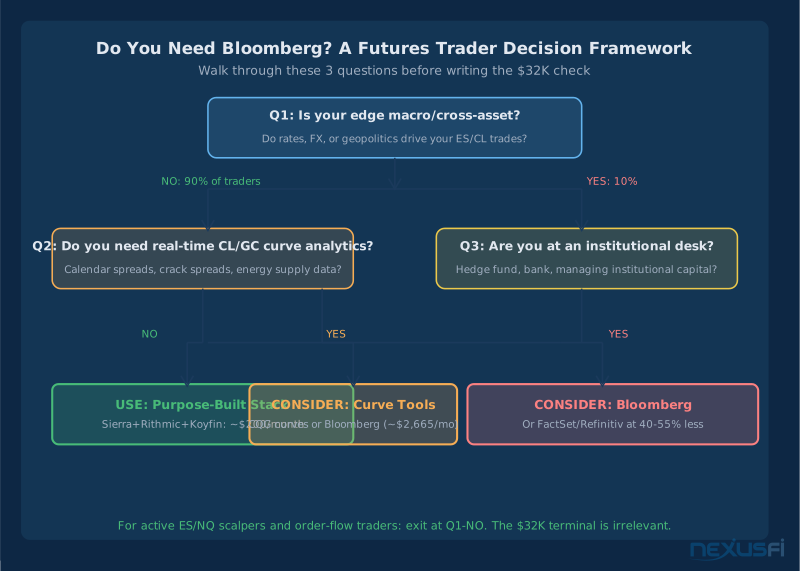
Making the Decision: The $32K Framework #
Before considering Bloomberg, answer these three questions honestly:
Question 1: Is your primary trading edge macro or cross-asset? If your core strategy depends on interpreting rates data, FX positioning, or cross-asset correlations — and you do this constantly, not occasionally — Bloomberg has genuine value. If you're primarily technical, order-flow, or systematic, exit here. The stack is the answer.
Question 2: Do you need real-time CL/GC curve analytics? If you're trading energy spreads or calendar rolls professionally and need the full strip in real time, Bloomberg's convenience is real. Consider it. If you're directional CL or GC, the stack covers your needs at 10x lower cost.
Question 3: Are you at an institutional desk where the IB network matters? If Bloomberg's messenger is how you communicate with counterparties, brokers, and sources — you're paying for the network as much as the product. For independent traders: irrelevant.
If you exit at Question 1 — and most active futures traders will — build the stack. $200/month. No 2-year contract. Better execution tools than Bloomberg provides. Keep the remaining $2,465/month for your trading capital.
Knowledge Map
Go Deeper
Build on this knowledgeReferences This Article
Articles that build on this topicCitations
- — What is best broker for intermediate term futures trader? (2012) 👍 2“If you refuse to pay for data or don't prioritize data, then Rithmic or CQG is the way to go, although you are still paying for your data feed one way or another.”
- — Rithmic independent of broker possible? (2021) 👍 3“Rithmic Pros: Have MBO and can see all order book (subscribe market depth). cons: Have monthly connect fee about 25.”
- — Looking to move brokers from TDA (2021) 👍 4“CQG, TT, Rithmic, are all technologies which provide: (1) data, and (2) order routing. DTN IQFeed is an example of a data-only technology.”
- — Sierra Chart Price Increase (2022) 👍 9“I have used package 3 for years and years, always the monthly billing, and I have been paying $26 per month all this time.”
- — Reliable datafeed for jigsaw trading (2018) 👍 3“CQG, Rithmic & GAIN are all good. Bear in mind that the most popular feed out there - TT (by the fact so many pros use it) - is a bit less accurate in matching the side a trade occurred.”
- — Bloomberg Terminal Alternatives 2026
- — Bloomberg Terminal Cost 2026: Full Pricing Breakdown
- — Bloomberg Terminal Pricing 2026: $31,980/year per seat
- — Unfiltered Data (2012) 👍 94“IQFeed's business is data. Not execution. Since their focus is on data, they send every L2 update. They send every tick. They send everything, and they also send it in the right sequence. It is the best quality feed currently available to a retail trader, in my opinion.”