



Federal Reserve Data for Futures Traders: FRED, FOMC, Dot Plot, and the Official Sources That Move Markets
Overview #
Most futures traders know the Fed matters. Far fewer have a systematic framework for which Federal Reserve data sources to track, when to track them, and how to convert each signal into a specific trade in ZQ, ZN, ZB, or the equity index complex.
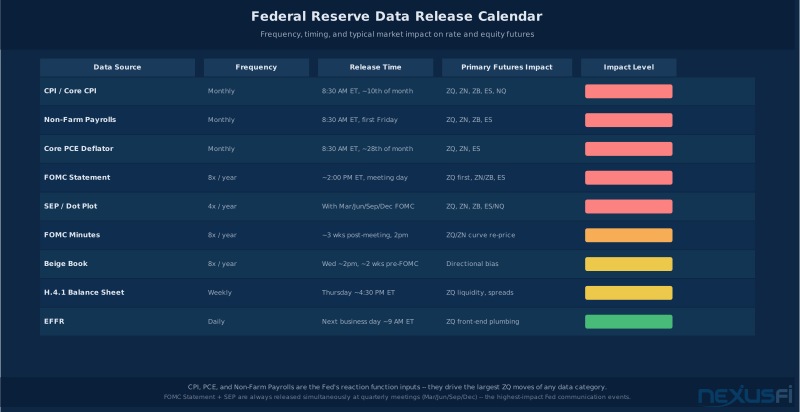
The Federal Reserve publishes eight distinct data types relevant to futures traders: the FRED database, FOMC statements, the press conference, FOMC minutes, the Summary of Economic Projections (dot plot), the Beige Book, the H.4.1 balance sheet, and the daily Effective Federal Funds Rate. Each one answers a different question about Fed policy — and each one connects to a different contract and a different time horizon.
When @tigertrader noted in 2015 that the September fed funds futures contract was "discounting about 40% chance of a hike," he was doing exactly what this guide covers: reading Fed data through the lens of market pricing to identify whether the market is right or wrong about the next Fed move. That gap between market pricing and incoming Fed data is where trades live.
Fed data is most useful when treated as a POSITIONING tool, not a news stream. The edge comes from knowing which release answers which question, comparing actual data to consensus, and mapping the surprise into the contract whose pricing horizon matches your view.
FRED Database: The Macro Context Engine #
The St. Louis Fed's FRED database (fred.stlouisfed.org) is the free foundation of any Fed-data workflow. It aggregates hundreds of relevant macro series with API access, CSV downloads, and an in-browser charting tool. For futures traders, FRED is a context engine, not a real-time signal source — it tells you what regime you're in, not what to trade today.
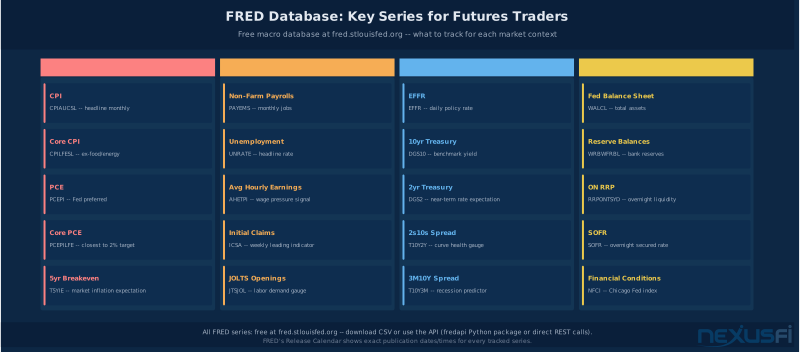
The most important FRED series by category:
- Inflation: CPIAUCSL (headline CPI), CPILFESL (core CPI ex-food/energy), PCEPI and PCEPILFE (PCE and core PCE -- the Fed's preferred measures), T5YIE (5-year breakeven inflation expectation)
- Labor market: PAYEMS (non-farm payrolls), UNRATE (unemployment), AHETPI (average hourly earnings), ICSA (weekly initial claims)
- Rates and yields: EFFR (effective fed funds rate), DGS2 and DGS10 (2yr/10yr Treasury), T10Y2Y (2s10s spread), T10Y3M (3M10Y spread)
- Fed policy: WALCL (Fed total assets), WRBWFRBL (bank reserve balances), RRPONTSYD (overnight reverse repo), SOFR
FRED's critical limitation: it is a repository, not a real-time feed. The underlying data release schedules are what matter for trading — CPI at 8:30 AM, payrolls the first Friday of the month. FRED itself updates after the fact. Use FRED for building historical context, identifying policy regimes, and tracking the macro trend that will drive the Fed's reaction function. Use newswires and Bloomberg/Reuters for the real-time release values.
FRED's Release Calendar (fred.stlouisfed.org/releases/calendar) shows exact publication dates and times for every tracked series. Set it up as a weekly anchor to know what data is hitting and when.
The common mistake with FRED is treating recent values as trading signals without accounting for publication lag and revision history. A CPI print from three weeks ago is already priced. What matters is whether the NEXT print will beat or miss consensus — use FRED's historical series to build that expectation, not to trade it directly.
FOMC Statement: The Primary Policy Signal #
The FOMC statement, released at approximately 2:00 PM ET on each meeting day, is the single highest-impact Fed communication event. Eight times per year, this document either confirms or upsets the market's expectations for policy — and the market's first move in ZQ is almost always driven by how the statement compares to the prior statement, word for word.
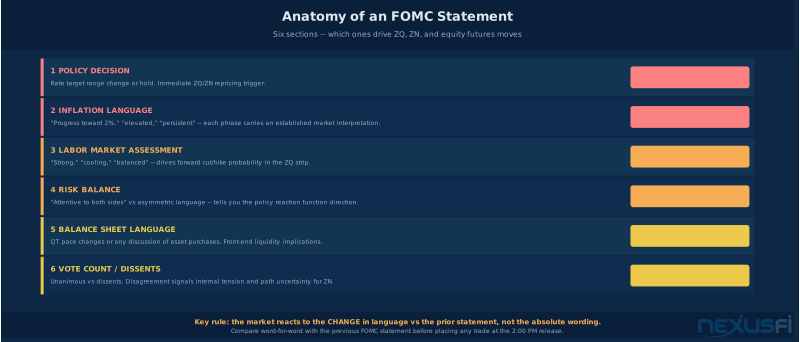
For a complete playbook on positioning around these events, see Trading FOMC Rate Decisions with Futures. Six sections drive the statement's market impact, in rough order of importance:
- Policy decision: The rate target range change (or hold). This is the immediate ZQ trigger.
- Inflation language: Phrases like "inflation remains elevated," "further progress toward 2%," or "inflation has made significant progress" each carry an established market interpretation. Any language change from the prior statement is a signal.
- Labor market assessment: "Strong," "cooling," or "balanced" -- this drives the forward cut/hike probability priced into the ZQ strip.
- Risk balance: "Attentive to both sides" signals neutral; asymmetric language toward inflation or growth tells you the policy reaction function direction.
- Balance sheet language: Any discussion of QT pace changes or asset purchases affects front-end liquidity expectations.
- Vote count and dissents: Unanimous votes vs. dissents signal internal tension and future path uncertainty.
The critical rule: compare the statement to the PRIOR statement word by word before forming any trade opinion. The expectation gap framework applies here — what matters is whether language shifted more or less than the market already priced.
@"Several Fed officials openly discussed a scenario where interest rates might need to go UP, not down. The probability distribution just got wider. Traders who were positioned for a clean path back to rate cuts need to reassess." — @Fi, FOMC Minutes Bombshell thread
The Powell Press Conference #
Starting at 2:30 PM ET after the statement, Powell's press conference provides a second layer of information that can extend — or completely reverse — the statement's first move in ZQ and equities. This is not a secondary event. Multiple times per year, the press conference is the dominant price driver on FOMC day.
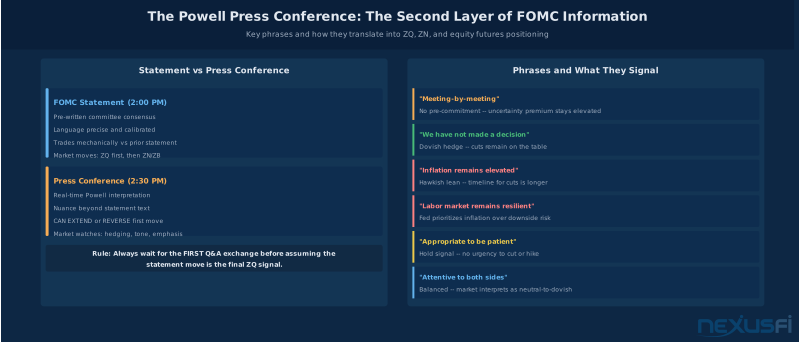
The key distinction: the statement is pre-written committee consensus. The press conference is real-time Powell interpretation under Q&A pressure. When Powell hedges, emphasizes certain words, or says something unexpected, the market re-prices.
Key phrases and what they signal in ZQ:
- "Meeting-by-meeting": No pre-commitment to a rate path. Uncertainty premium stays elevated. Market cannot get ahead of the Fed.
- "We have not made a decision about [next meeting]": Dovish hedge -- cuts or hikes are genuinely open. ZQ often rallies slightly on this.
- "Inflation remains elevated": Hawkish lean. Timeline for cuts is longer. ZQ and ZN under pressure.
- "Labor market remains resilient": Fed is not prioritizing downside growth risk. More hawkish than market might expect post-weaker data.
- "Appropriate to be patient": Hold signal. No urgency to move in either direction. ZQ grinds sideways.
The practical rule: always wait for the FIRST Q&A exchange before assuming the statement move is the final ZQ signal. Experienced traders size smaller into the 2:00 PM release and look to add or reverse in the press conference window.
FOMC Minutes: Three Weeks Later, Three Layers Deeper #
Released approximately three weeks after each FOMC meeting at 2:00 PM ET, the minutes provide a detailed record of the committee's internal discussion. They rarely change the base rate path materially — the statement already set that — but they reveal HOW the committee is thinking about the risks and tradeoffs.
What traders look for in the minutes:
- Hawk/dove shifts in the reaction function: Did the discussion suggest that any officials are changing their views on the inflation persistence vs. growth risk tradeoff?
- Balance of risks framing: "Participants noted risks were broadly balanced" vs. language that puts more weight on one side tells you the next statement could shift language.
- Internal disagreement level: The minutes reveal degree of consensus. Fragmented views increase the policy path uncertainty premium and often widen ZN/ZB spreads.
- Implementation discussions: Any mention of how to manage balance sheet constraints or reserve scarcity can spill into ZQ front-end pricing.
The minutes typically move markets less than the statement because they are backward-looking — they document a meeting that happened three weeks ago. The key question is whether the minutes reveal something the statement didn't: a genuine hawk/dove shift that was hidden behind the consensus statement language.
The minutes also matter for calibrating expectation ahead of the NEXT meeting. If the minutes show widespread concern about inflation persistence, the next statement is more likely to carry hawkish language — a ZQ trading bias you can build a pre-event position around.
Summary of Economic Projections and the Dot Plot #
Released four times per year — at the March, June, September, and December FOMC meetings — the Summary of Economic Projections (SEP) provides participant-by-participant rate forecasts (the dot plot) alongside GDP, inflation, and unemployment projections. Quarterly dot plot meetings carry much more market-moving potential than non-dot-plot meetings.
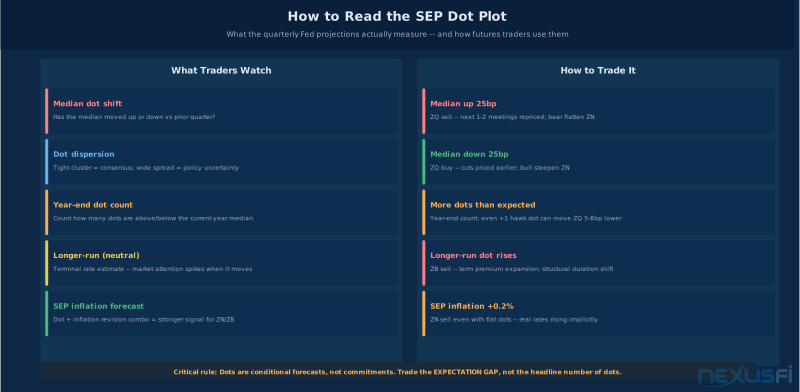
Five things traders watch in the SEP:
- Median dot shift: Has the median moved up or down vs. the prior quarter? A 25bp shift in the median for the current year drives a direct ZQ repricing.
- Dot dispersion: A tight cluster signals committee consensus. A wide distribution signals uncertainty and elevated volatility premium in rate options.
- Year-end dot count: Count the dots above and below the current-year median. Even one extra "hawk dot" moving above the median can push ZQ 5-8bp lower.
- Longer-run neutral rate estimate: This is the terminal rate in the cycle. When the longer-run dot rises, ZB often sells off on term premium expansion.
- SEP inflation forecast with flat dots: A +0.2% upward revision to the inflation forecast without a corresponding dot move still implies higher real rates. ZN often sells on this combination even when the median dot is unchanged.
The critical mistake: treating the dot plot as a binding forward commitment. The dots are conditional forecasts from individual FOMC participants, based on their economic assumptions at the time. Those assumptions can change dramatically within a quarter. The market prices the EXPECTED POLICY REACTION FUNCTION — not the dot chart headline.
As @josh detailed in the Elite Circle after the December 2023 FOMC: "The dot plot moved lower from last SEP (in Sep) to Dec. With that, the median and central tendency for the 2024 target range shifted decidedly lower." That shift — tracked in real-time in the ZQ strip — drove the rally that followed.
Before the quarterly SEP release, use CME FedWatch to identify what meeting probabilities the market is pricing. Your trade is the gap between current market pricing and what the dot median actually shows — not the dot level in isolation.
The Beige Book: Qualitative Confirmation Tool #
Published eight times per year — roughly two weeks before each FOMC meeting — the Beige Book compiles qualitative economic commentary from the Fed's 12 regional districts. It is anecdotal, lagging, and not a primary trading signal. Used correctly, it confirms or contradicts the hard data trend and helps build pre-FOMC meeting positioning bias.
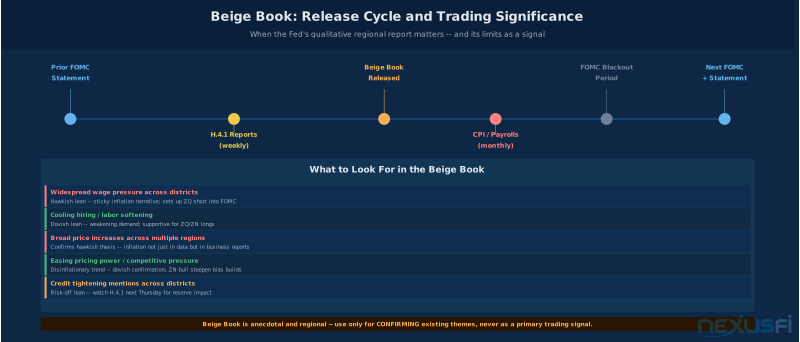
What to look for, in priority order:
- Wage pressure reports: If multiple districts report persistent wage increases and difficulty finding workers, that's sticky inflation evidence supporting a tighter policy stance.
- Pricing power language: "Firms reported ability to pass through cost increases" signals persistent inflation. "Competitive pressure preventing price increases" is disinflationary. See the Cross-Asset Positioning Framework for mapping these signals to rate and equity positions.
- Labor market cooling: "Slowing hiring," "longer time to fill positions," "employers pausing headcount growth" -- these point toward weakening demand and a less restrictive policy outlook.
- Credit tightening mentions: If multiple districts report banks tightening lending standards, that's a leading indicator of financial conditions tightening. Watch the next H.4.1 release for reserve impact.
The Beige Book's best use case is the 24-48 hours after release. Map it against the last CPI and payrolls prints. If all three are saying the same thing — soft — that's a cleaner setup for pre-FOMC positioning than the Beige Book alone. If the Beige Book contradicts the hard data, that's a reason to stay neutral until the next hard data confirms one way or the other.
H.4.1 Fed Balance Sheet: The Weekly Liquidity Monitor #
Every Thursday at approximately 4:30 PM ET, the Federal Reserve publishes the H.4.1 "Factors Affecting Reserve Balances" — its weekly balance sheet statement. For futures traders, this is the liquidity monitor: it shows whether QT is draining reserves at an expected pace and whether front-end funding conditions are tightening even when the policy target is unchanged.
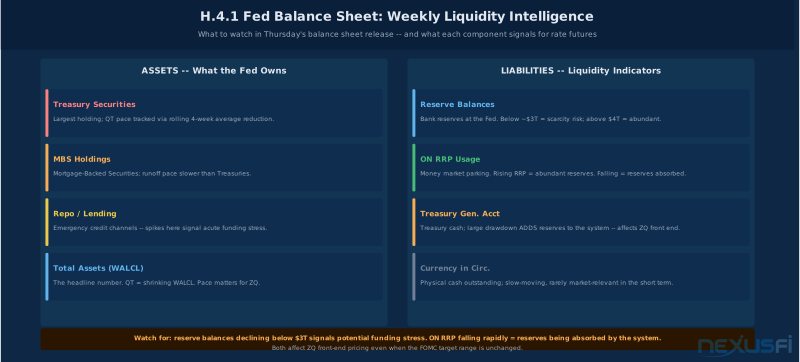
The asset side shows what the Fed owns:
- Treasury securities: The largest holding. Track the 4-week rolling average reduction pace against the Fed's announced QT target ($60-95B/month at various points). Faster-than-expected runoff = faster reserve drain = potential ZQ pressure.
- MBS holdings: Mortgage-Backed Securities. Runoff pace is slower than Treasuries; duration composition matters more than pace here.
- Repo/lending facilities: Spikes in emergency credit facilities are stress signals -- treat them like a red flag for risk assets.
The liability side shows the liquidity picture:
- Reserve balances (WRBWFRBL): Bank reserves held at the Fed. Below approximately $3T historically signals potential funding stress; above $4T suggests abundant reserves. The transition from abundant to scarce is what matters.
- Overnight Reverse Repo (ON RRP): Money market funds parking excess cash. High RRP usage = abundant reserves in the system. Rapidly falling RRP = reserves being absorbed, approaching scarcity.
- Treasury General Account (TGA): Treasury's operating cash balance. A large TGA drawdown (Treasury spending money) ADDS reserves to the banking system -- this can temporarily ease front-end conditions.
@"Fed isn't reducing its balance sheet by selling securities. It is instead, 'rolling off' $95 billion a month, which means the Fed is not reinvesting the proceeds of maturing securities, rather than selling the securities outright." — @tigertrader, The Elite Circle
The critical insight from QT mechanics: balance sheet runoff puts upward pressure on front-end rates through reserve drain, not through bond selling. When ZQ starts pricing in higher near-term rates even when the FOMC target is on hold, the H.4.1 is often the source — reserve scarcity is forcing front-end funding higher.
EFFR: The Daily Implementation Check #
The Effective Federal Funds Rate (EFFR) is published each business day at approximately 9:00 AM ET by the New York Fed. It represents the volume-weighted average rate at which banks lent overnight funds to each other in the unsecured market. For futures traders, EFFR is a plumbing check, not a policy direction signal.
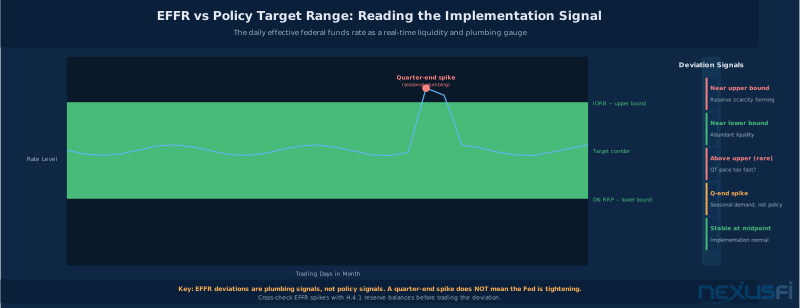
Normal EFFR behavior: the rate trades near the midpoint of the target corridor, with the IORB (Interest on Reserve Balances) acting as the upper bound and the ON RRP rate as the lower bound. Day-to-day variation within this band is normal and not a trading signal.
What IS a signal:
- EFFR persistently near the upper bound: Reserve scarcity is emerging. Banks are competing for overnight funds. This precedes potential funding stress and can pull ZQ pricing higher even without a policy change.
- EFFR persistently near the lower bound: Abundant reserves. Front-end rates are well-anchored to the target. Less likely to see unexpected ZQ repricing from funding effects.
- Quarter-end EFFR spikes: Banks pull back from lending at quarter-end to manage leverage ratios. These spikes are seasonal and recurring -- they are NOT a policy signal. Do not trade them as such without cross-checking H.4.1 reserves.
The practical application: ZQ front-end positioning in the final week of a contract month is sometimes affected by EFFR dynamics as the remaining days' realized rate becomes increasingly known. Front-month ZQ convergence trades use EFFR as the running average input.
Mapping Fed Data to Rate Futures: ZQ, ZN, and ZB #
Each rate futures contract prices a different time horizon of Fed expectations. Understanding this mapping is the core discipline in systematic Fed data trading — it stops headline chasing.
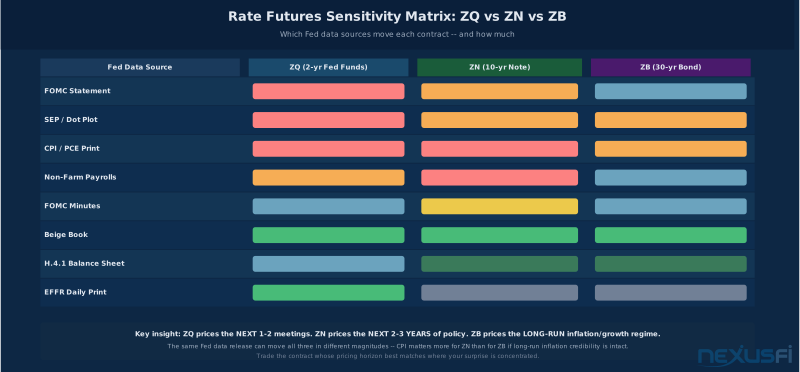
ZQ (Fed Funds Futures) prices the near-term policy path — what the Fed will have done in the next 1-2 FOMC meetings. ZQ is most sensitive to:
- FOMC statement surprises and press conference language
- SEP dot plot shifts for the current year
- CPI and payrolls prints that change the "next meeting" probability
- H.4.1 and EFFR for front-end funding dynamics
ZN (10-Year Note Futures) prices the policy path over the next 2-3 years, plus term premium and inflation expectations. ZN is most sensitive to:
- CPI and PCE prints that change the inflation regime expectation
- SEP dot shifts for next year and beyond
- Evidence of economic growth accelerating or slowing
- Fiscal supply concerns (Treasury issuance) affecting term premium
ZB (30-Year Bond Futures) prices the long-run inflation and growth regime. ZB is most sensitive to:
- Long-run SEP shifts (the longer-run neutral rate estimate)
- Inflation credibility and term premium regime changes
- QT pace as it affects long-duration supply absorption
- Major structural macro shifts (recession, reflation, fiscal dominance)
When @SMCJB noted in 2025 that "the Z25 contract closed at 96.35 which implies a Fed Funds rate of 3.65% in December" with the current rate at 4.33%, that's ZQ analytics at work: using the front-end contract to read where the market thinks the Fed will have moved by a specific month. You can apply this to any month in the ZQ strip — each contract gives you the market's expected average rate for that calendar month.
The cross-contract framework: before placing any Fed-data trade, ask which time horizon your data surprise is concentrated in. A CPI miss that changes the NEXT meeting probability is a ZQ trade. A CPI miss that changes the NEXT YEAR's rate path is a ZN trade. A structural inflation miss that changes the TERMINAL RATE outlook is a ZB trade. Getting this right determines whether your trade makes money even when you call the Fed direction correctly.
Cross-Asset Positioning Framework #
Fed data doesn't just move rate futures in isolation. Every major Fed repricing creates a cross-asset cascade that affects equity futures, currencies, credit, and volatility simultaneously. Understanding this cascade is essential for sizing, hedging, and avoiding unintended exposure. For a broader framework on cross-market dynamics, see Intermarket Analysis for Futures Traders.
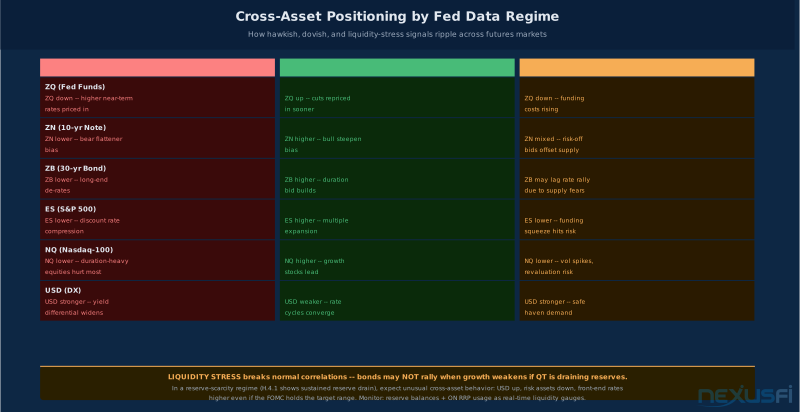
Hawkish repricing: ZQ down, ZN/ZB lower (bear flatten), ES/NQ lower (discount rate up), USD stronger, credit spreads widen. The curve typically bear flattens because the front end moves more than the long end.
Dovish repricing: ZQ up, ZN/ZB higher (bull steepen), ES/NQ higher (multiple expansion), USD weaker, credit improves. High-duration equities (NQ/growth stocks) typically outperform value in this regime.
Liquidity stress regime — the one that breaks normal correlations: Front-end rates rise even with a neutral policy rate. Bonds may not rally when growth weakens because QT is creating duration supply pressure. Equities fall due to funding squeeze rather than discount rate expansion. USD strengthens as a safe haven while risk assets across the board weaken.
When H.4.1 shows reserve balances declining rapidly AND ON RRP usage is falling (both declining together), that's the early warning signal for a liquidity stress regime — watch for the cross-asset correlation breakdown.
The practical cross-asset framework: when positioning around a Fed data release, identify which regime the surprise is more likely to activate. A hot CPI that activates the hawkish repricing regime has a predictable playbook. A funding stress event from H.4.1 has a different playbook where the normal rate/equity inverse correlation may not hold.
The observation from @tigertrader in the Elite Circle goes back to the QE era: "POMO purchases immediately remove volatility from the markets, which reduces VaR and causes risk management algorithms to automatically increase leverage." The reverse is true during QT: balance sheet runoff systematically adds volatility back to the system, which forces algorithmic delevering. That's why H.4.1 changes can move equity vol indexes even before the effect reaches rate futures.
Trading the Expectation Gap #
The most important concept in Fed data trading: the market does not react to the data. It reacts to the DIFFERENCE between the data and what was expected. A hot CPI that precisely matches the Bloomberg consensus will generate minimal ZQ movement. A cool CPI that misses by 0.2% will generate a large ZQ rally even though the absolute number is lower.
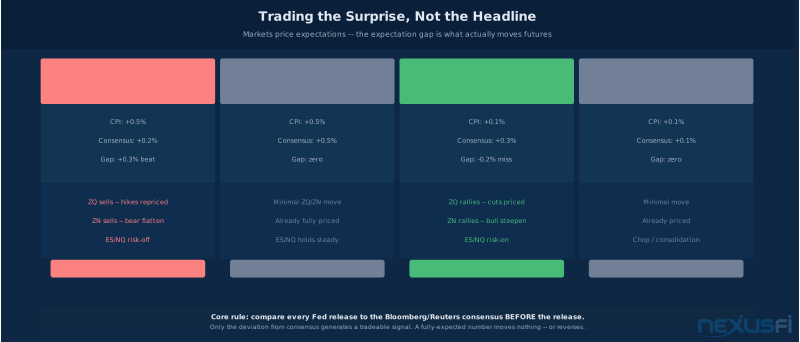
Four rules for trading the expectation gap:
- Know the consensus before every release. Bloomberg, Reuters, and CME FedWatch all publish consensus estimates. The CME FedWatch meeting probability going into the release is the single most important input -- that's the market's priced expectation. Any release that changes those probabilities by more than 5-10% is potentially tradeable.
- Calculate the surprise magnitude, not just the direction. A CPI that misses by 0.3% is a different trade than one that misses by 0.05%. Magnitude determines how much to size, not just which direction to trade.
- Wait for the second move in FOMC events. The first ZQ move in the 2:00 PM window is often the mechanical market-making response to the statement text. The second move -- after the press conference starts -- is often more durable because it reflects genuine repricing rather than headline reaction.
- Know your timing window. The immediate 5-15 minutes after a data release are often the highest-volatility period with widest bid-ask spreads. Waiting for the first few minutes to see the initial move and reaction can mean entering at worse prices but with better information about whether the move is going to continue or reverse.
The old "don't fight the Fed" principle applies here too. As @tigertrader described in the Elite Circle: "The old credo, don't fight the fed, is alive and well. The market understands that the fed is still in a financial repression mode..." Understanding the Fed's current objective function — whether they're fighting inflation, supporting growth, or in a hold pattern — tells you which type of data surprise will have the biggest impact and in which direction the Fed is most likely to respond.
Practical Workflow: From Data to Trade #
Translating Fed data sources into actual futures positions requires a systematic workflow. The professional approach operates in four phases.
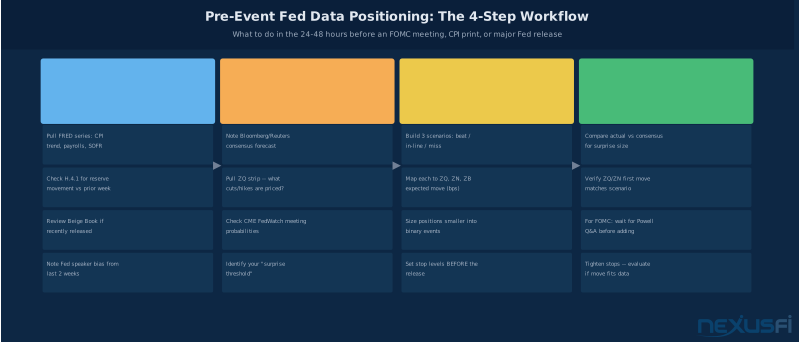
Phase 1 — Context Scan (24-48h before): Pull the latest inflation and labor FRED series to understand the macro trend. Check H.4.1 for any unexpected movement in reserve balances vs. the prior week. Review Beige Book tone if recently released. Catalog Fed speaker commentary for bias signals. By the end of this phase, you should have a clear view of what the prevailing macro narrative is and whether it's been shifting.
Phase 2 — Expectation Map (24h before): Note the Bloomberg/Reuters consensus forecast for the upcoming release. Pull the ZQ strip to see what cuts or hikes are priced. Check CME FedWatch for specific meeting probabilities. From this, identify your "surprise threshold" — the deviation from consensus that would actually move ZQ meaningfully (typically 2-4bp in meeting probability translates to a clear ZQ signal).
Phase 3 — Scenario Build (2-4h before): Build three scenarios: beat, in-line, and miss. For each scenario, map expected ZQ moves (in basis points), expected ZN/ZB moves, and expected equity futures direction. Size positions smaller going into binary events — FOMC day and major data prints carry variance that makes position sizing as important as direction. Set stop-loss levels BEFORE the release, not after the initial volatility.
Phase 4 — Release Reaction (0-30 min after): Compare actual vs. consensus to calculate the surprise magnitude. Verify the ZQ/ZN first move matches the expected scenario. For FOMC: wait for the first Q&A exchange before adding conviction. After the initial move settles (typically 5-15 minutes), tighten stops and evaluate whether the price action confirms the data surprise narrative.
Common Mistakes and How to Avoid Them #
The following mistakes account for the majority of losses on Fed data days for futures traders who otherwise have a correct directional read.
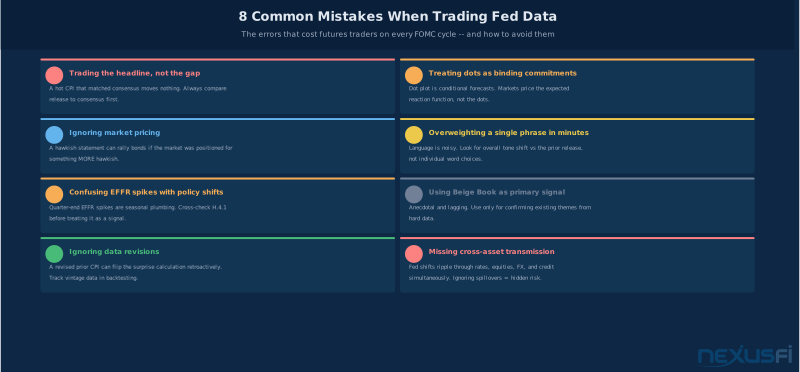
- Trading the headline instead of the expectation gap. Whether it is a CPI print or an FOMC statement, the market reacts to the deviation from what was priced -- not the absolute value. A hawkish statement can be bullish for bonds if the market was positioned for something even more hawkish. See Trading the Expectation Gap for the full framework.
- Treating the dot plot as a binding policy commitment. The dots are conditional forecasts from individual participants. Their underlying assumptions can be wrong. Markets price the expected reaction function, not the dot chart headline.
- Overweighting a single phrase in minutes or Beige Book. One unusual phrase in 20 pages of minutes is noise. Overall tone shift vs. the prior release is signal. Read the full document before trading on any individual quote.
- Confusing EFFR deviations with policy signals. Quarter-end EFFR spikes are seasonal reserve demand patterns, not Fed tightening. Cross-check the H.4.1 before treating any EFFR deviation as a tradeable signal.
- Using the Beige Book as a primary signal. It is anecdotal and regional. Use only for confirming or contradicting the hard data trend. Never initiate a major position based solely on Beige Book language.
- Ignoring data revisions. A large revision to the prior month's CPI or payrolls can flip the surprise calculation retroactively. When you see a "consensus" estimate for the current release, make sure it's been adjusted for any prior revision.
- Missing cross-asset transmission. Fed shifts move ZQ, ZN, ZB, ES, NQ, and DX simultaneously. If you're only tracking the rate futures response, you're missing risk from correlated positions in your book.
The underlying principle for avoiding all eight: @josh's observation in the Elite Circle about Fed funds futures pricing captures the core discipline — "These are priced in 100-{price}, as the average daily rate for the month." The mechanics are simple. The discipline is comparing those mechanics to what the market expects versus what actually arrives.
Knowledge Map
Go Deeper
Build on this knowledgeReferences This Article
Articles that build on this topicCitations
- — Spoo-nalysis ES e-mini futures S&P 500 (2022) 👍 8“Fed isn't reducing its balance sheet by selling securities. It is instead, "rolling off" $95 billion a month, which means the Fed is not reinvesting the proceeds of maturing securities.”
- — Spoo-nalysis ES e-mini futures S&P 500 (2014) 👍 7“The old credo, don't fight the fed, is alive and well. The market understands that the fed is still in a financial repression mode, where they are keeping a lid on nominal rates, while trying to orchestrate a controlled rise in inflation.”
- — Spoo-nalysis ES e-mini futures S&P 500 (2015) 👍 9“September fed funds futures contract is discounting about 4 of 10.5 bp or about a 40% chance of a hike for which economists say there is more.”
- — Is the WH trying to engineer a recession? This Wall Street pro explains the vision (2025) 👍 3“Funds Futures (ZQ) the Z25 contract closed at 96.35 last night which implies a Fed Funds rate of 3.65% in December. Current rate is 4.33%. So I think it is easy to say with high confidence that the Fed Funds Rate will be lower by December.”
- — Spoo-nalysis ES e-mini futures S&P 500 (2022) 👍 4“I looked at the fed funds futures for November. These are priced in 100-{price}, as the average daily rate for the month.”
- — Spoo-nalysis ES e-mini futures S&P 500 (2012) 👍 2“POMO purchases immediately remove volatility from the markets, which reduces VaR and causes risk management algorithms to automatically increase leverage. The Fed's goal is negative real rates, which would be a powerful inducement for borrowing.”
- — FOMC Minutes Bombshell: Several Fed Officials Openly Discussed Rate HIKE Scenario (2026)“Several Fed officials openly discussed a scenario where interest rates might need to go UP, not down. The probability distribution just got wider. Traders who were positioned for a clean path back to rate cuts need to reassess.”
- — Federal Reserve Economic Data (FRED) -- St. Louis Fed
- — Federal Open Market Committee -- Federal Reserve Board
- — Spoo-nalysis ES e-mini futures S&P 500 (2023) 👍 7“The dot plot moved lower from last SEP (in Sep) to Dec. With that, the median and central tendency for the 2024 target ranged shifted decidedly lower.”