



London Metal Exchange (LME): The Global Benchmark for Industrial Metals Futures
Overview #
The London Metal Exchange is 147 years old and still the only place on earth where you can discover the global price of copper, aluminum, zinc, nickel, lead, or tin with genuine authority. When a Chilean miner contracts to sell copper, when an automotive manufacturer hedges its aluminum input costs, or when a European utility locks in nickel for battery production — those prices derive from the LME. The exchange does not just help futures trading; it generates the reference prices that underpin physical metal transactions worldwide.
For futures traders, the LME matters for two distinct reasons. First, LME contracts themselves offer direct exposure to base metals with prompt dates stretching years into the future — a structure unavailable anywhere else. Second, LME price action and the cash-to-3-month spread provide macro intelligence that helps traders understand industrial demand conditions before that signal reaches equity markets or CME copper. The LME is simultaneously a trading venue and a data source, and understanding which role you're using it for at any moment changes how you read its signals.
This guide covers the LME's unique structure — ring trading, prompt dates, the warehouse system — and the practical implications for traders who use it for either direct exposure or as an indicator for related markets.
What the LME Is #
The London Metal Exchange was founded in 1877, formalizing a metals trading market that had operated informally for centuries in London's Royal Exchange. Copper from Chile and tin from Malaysia required futures markets before either commodity reached Europe — the long shipping times created price risk that needed hedging. The LME was built to solve that specific problem, and its structure still reflects those origins.
In 2012, Hong Kong Exchanges and Clearing (HKEX) acquired the LME for approximately £1.4 billion ($2.2 billion), making it a subsidiary of Asia's largest exchange operator. The acquisition reflected the shifting center of gravity in base metals demand — China now consumes over 50% of global copper, aluminum, and zinc production. The LME remained in London with its existing structure intact, but its ownership now connects it directly to the Asian markets where the majority of its contracts' underlying commodities are consumed.
Regulatory oversight falls to the FCA (Financial Conduct Authority) in the UK. LME Clear, the exchange's clearing house, guarantees all trades and manages daily mark-to-market variation margin calls. The LME is a Category 1 Recognised Investment Exchange under UK regulation.
The scale of the LME's role: approximately $9-12 trillion in annual trading value across all contracts. That figure understates the exchange's actual influence, because every metric ton of base metal traded globally — whether on exchange or off — references LME prices in some form.
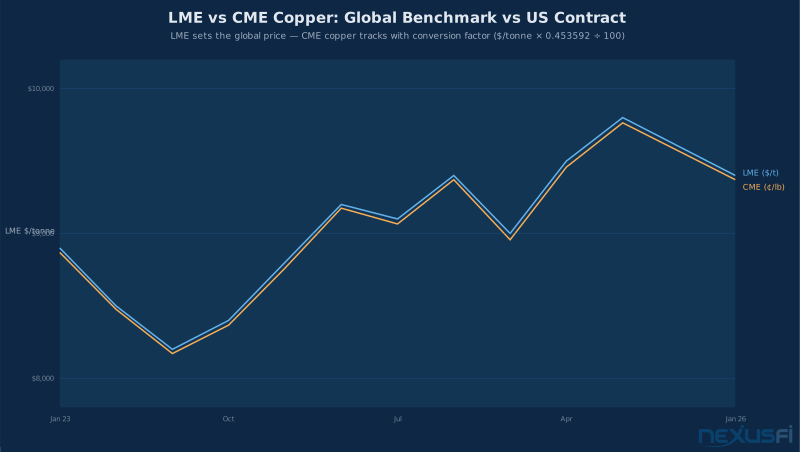
The LME is not just a trading venue — it's global price infrastructure. When you read that copper hit $9,500/tonne, that number came from the LME. The CME copper price is a derivative of the LME price, converted to US dollars per pound.
LME Trading Methods: The Ring, Electronic, and Telephone #
The LME operates three parallel trading mechanisms that coexist and interact throughout the trading day. Understanding which mechanism sets official prices — and which provides liquidity for the rest — is essential to reading LME data correctly.
The Ring
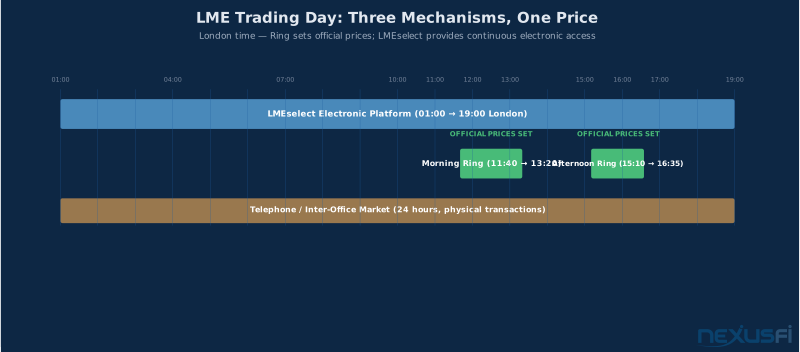
The Ring is open-outcry pit trading, conducted in a circular trading room with representatives from LME member firms seated around the perimeter. Ring sessions are where official LME settlement prices are set. Two Ring sessions run daily: morning sessions typically from 11:40 AM to 1:20 PM London time, and afternoon sessions from 3:10 PM to 4:35 PM. Each metal trades for five minutes in sequence per session.
Official prices — the reference prices used in physical contracts worldwide — are set at specific Ring sessions. The LME official settlement price for each metal is set at the close of the second morning Ring session. This price becomes the basis for millions of dollars in physical metal transactions, derivatives settlements, and index calculations.
The Ring's continued existence in a digital era is not nostalgia. The five-minute ring session concentrates liquidity for each metal at a known time, producing the official price through direct competitive price discovery among the major market participants. Electronic trading is more efficient for continuous liquidity; the Ring is more efficient for official price-setting where concentration matters.
LMEselect Electronic Platform
LMEselect is the exchange's electronic trading platform, operating continuously from 1:00 AM to 7:00 PM London time Monday through Friday. Most speculative and financial trading in LME contracts occurs through LMEselect. The platform provides the liquidity that allows continuous trading outside Ring hours while Ring sessions remain the authority for official prices.
Telephone (Inter-Office) Market
The inter-office telephone market operates 24 hours through LME-registered Category 2 members. This is where large physical transactions and block trades occur. A mining company selling forward copper production, an airline hedging aluminum for aircraft manufacture, a battery manufacturer locking in nickel costs — these transactions often execute via telephone between the LME member firms that serve as principals and brokers for physical market participants.
LME Contracts: Metals and Specifications #
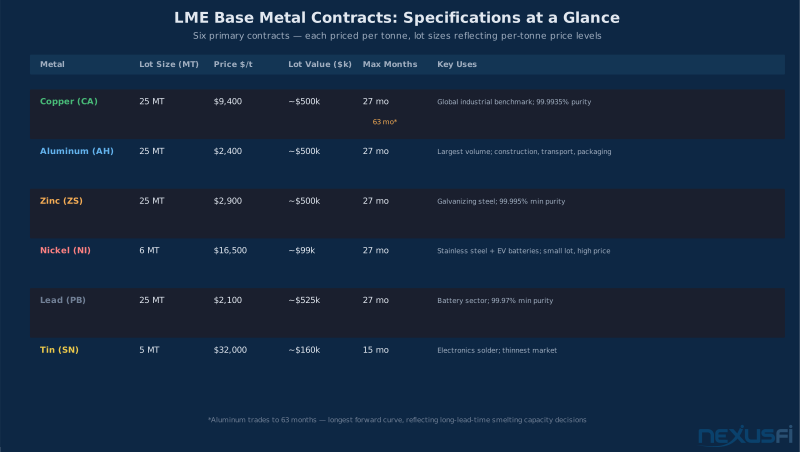
The LME lists futures contracts on six primary base metals, plus ferrous contracts and battery materials. Each contract's specifications reflect the physical reality of trading that metal in industrial quantities.
Primary Base Metal Contracts
Copper (CA): 25 metric tons per lot. Traded as Grade A copper, the highest purity standard (minimum 99.9935% Cu). LME copper is the global benchmark — the price against which every mine, smelter, and fabricator in the world measures their exposure. Tick size: $0.50/tonne ($12.50/lot). Trading months: daily out to 3 months, weekly for months 4-6, monthly out to 27 months.
Primary Aluminum (AH): 25 metric tons per lot. One of the most actively traded LME contracts given aluminum's enormous consumption in construction, transport, and packaging. The LME aluminum contract specifically covers primary (not scrap) aluminum with a minimum purity of 99.7%. Monthly trading to 63 months for aluminum — the longest forward curve on the LME, reflecting the capital-intensive, long-lead-time nature of aluminum smelting capacity.
Zinc (ZS): 25 metric tons per lot. Zinc is primarily used for galvanizing steel — protecting it from corrosion. Automotive production and infrastructure spending directly affect zinc demand. Monthly trading out to 27 months.
Nickel (NI): 6 metric tons per lot. Nickel's smaller lot size reflects its much higher per-tonne price. Nickel demand has bifurcated between traditional stainless steel consumption and the battery sector (nickel-manganese-cobalt cathodes for EVs). This creates unique demand dynamics — stainless steel is economically sensitive while battery demand is structurally growing. Monthly trading out to 27 months.
Lead (PB): 25 metric tons per lot. Lead's primary use remains automotive and industrial batteries (lead-acid). Relatively less volatile than copper or nickel given more stable, if declining, industrial use. Monthly out to 27 months.
Tin (SN): 5 metric tons per lot. Tin is the smallest LME contract by lot size and one of the thinnest markets. Electronics solder and plating dominate demand. Tin's small tradeable supply relative to demand makes it prone to large price swings. Monthly out to 15 months.
The lot size tells you something important. Nickel at 6 MT and tin at 5 MT have smaller lots not for retail accessibility but because the higher per-tonne prices kept lot values in the same range as larger-lot contracts. A nickel lot and a copper lot represent similar dollar exposure at normal price ratios.
Prompt Dates: The LME's Unique Settlement Structure #
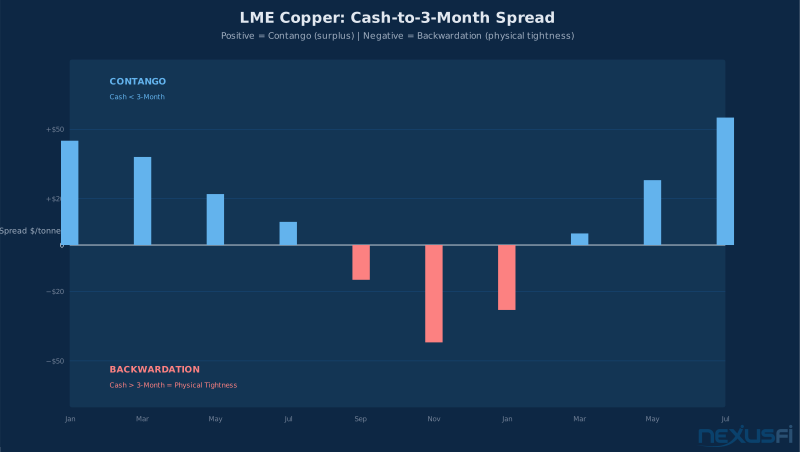
The LME prompt date system is at the core different from CME futures. CME contracts expire on specific monthly dates — third Friday of the month, for example. LME contracts can expire on virtually any business day, creating a continuous forward curve with far more granularity than any other commodity exchange.
The structure:
- Spot (Cash): Settlement in two business days (like FX spot settlement)
- Tom/Next (Tom): Overnight, settling tomorrow
- Daily dates: Every business day from cash to three months forward
- Weekly dates: Every Wednesday from three to six months forward
- Monthly dates: Third Wednesday of each month from six months out to the contract maximum (27, 63, or 15 months depending on metal)
The practical consequence: you can trade LME copper for delivery on any specific business day up to three months from now. Need to hedge a specific cargo arriving on August 14th? You trade the August 14th prompt. This date precision is why physical commodity users prefer LME over CME — they can match their hedge exactly to their physical commitment without basis risk from date mismatches.
The third Wednesday of each month — especially the third Wednesday that is three months forward from any given date — is the single most actively traded date in the LME system. This is called the "3-month" or "3M" contract, and cash-versus-3M spread is the most quoted LME spread and a key market health indicator.
The LME Warehouse System #
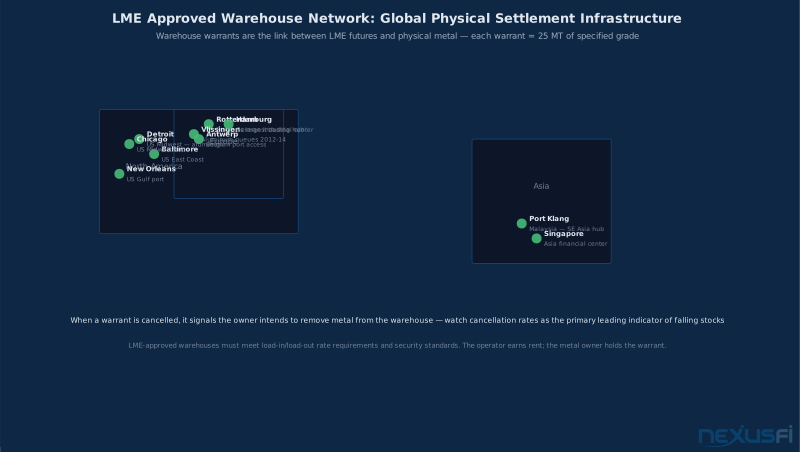
The LME operates a global network of exchange-approved warehouses where physical metal can be deposited to create LME warrants — electronic certificates of title to specific lots of metal. A warrant represents ownership of a specific quantity and grade of metal stored at a specific LME-approved location. These warrants trade; buying or selling them transfers physical ownership.
Approved warehouse locations span Rotterdam, Vlissingen, Antwerp, Hamburg, Bremen, Port Klang (Malaysia), Singapore, New Orleans, Detroit, Chicago, Baltimore, and others. The geographic spread reflects where metal actually moves — European production and transit hubs, Southeast Asian trading centers, and US delivery points.
How Warehouse Stocks Affect Price
LME reports daily stock levels for each metal. These figures are watched extremely closely by traders and physical market participants. The direction and rate of change in stocks — not just the absolute level — is the primary warehouse signal:
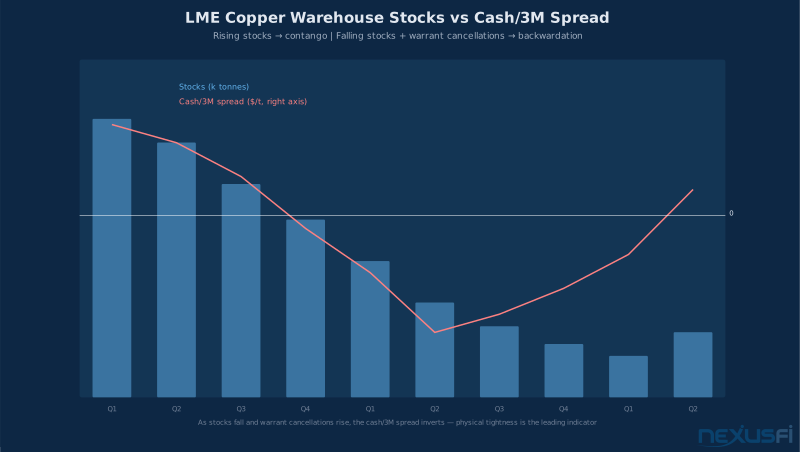
- Rising stocks: Metal is arriving in warehouses faster than it's leaving. Physical supply is adequate or in surplus. This creates upward pressure on contango (forward prices exceed cash) as the market pays for storage.
- Falling stocks with increasing warrant cancellations: Metal is being removed from exchange warehouses. Someone wants physical metal now. This typically indicates tight physical supply and correlates with backwardation (cash price exceeds forward).
- Warrant cancellations: Before metal can leave a warehouse, the owner must cancel the warrant -- basically ordering delivery. High warrant cancellation rates are a leading indicator that stocks will fall. This is the most watched single data point in LME monitoring.
The Detroit-Vlissingen Warehouse Controversy (2012-2014)
The LME warehouse system became infamous between 2012 and 2014 when queue times at specific warehouses — especially in Vlissingen, Netherlands and Detroit, Michigan — stretched to 500+ days. Metal could not physically leave the warehouses fast enough to satisfy demand. The perverse result: aluminum was sitting in warehouses in massive quantities, but physically buying and taking delivery took 18 months. The aluminum market was in strong contango, but physical users faced cash market shortages.
The issue stemmed from LME rules requiring minimum daily load-out rates that were smaller than load-in rates — warehouses could accept metal faster than they had to release it. This had the effect (and, some argued, the intent) of generating enormous rent revenues for warehouse operators while creating an artificial queue. Major commodity trading firms owned the warehouses and allegedly paid incentives to metal owners to deposit metal, generating rental income while queue times (and thus rents) compounded.
The LME changed its rules in 2014 and 2015, requiring load-out rates to increase at warehouses with long queues. Queue times gradually declined. The episode at the core changed how the market thinks about the relationship between LME stocks and physical availability — they can diverge much under perverse incentive structures.
Cash-to-3-Month Spread: The Key LME Indicator #
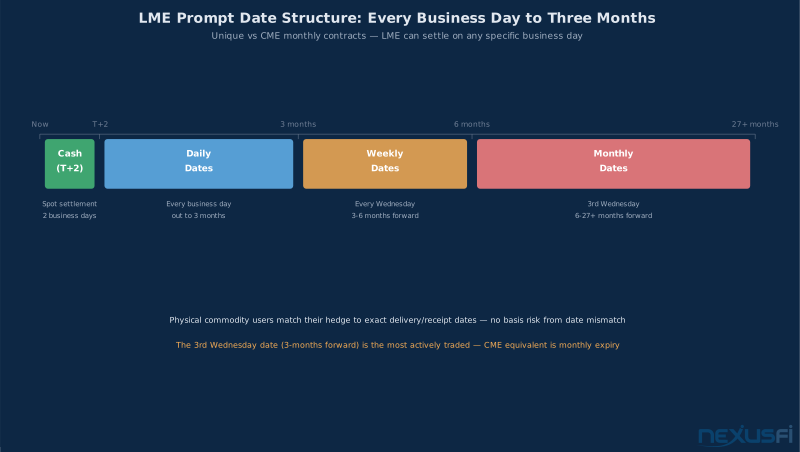
The cash-to-3-month (cash/3M) spread is the single most quoted LME metric in market commentary and the most direct real-time signal of physical tightness or surplus for any base metal.
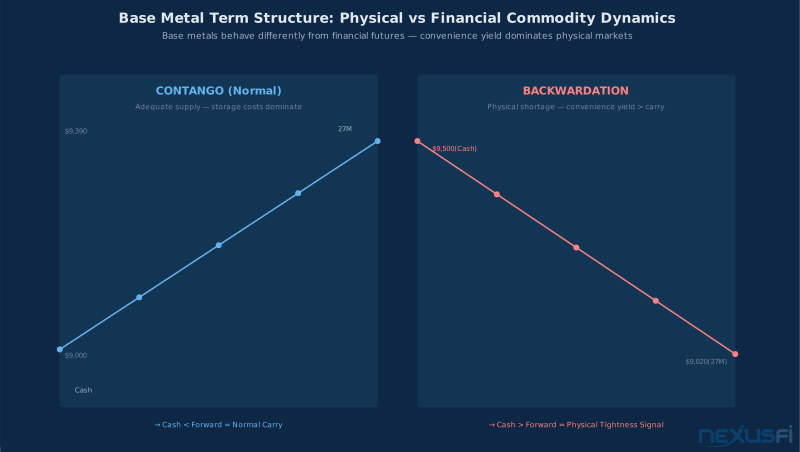
The spread measures the difference between the price for immediate delivery (cash) and delivery in three months. In a normal market with storage costs and financing, three-month metal should cost more than cash metal — you're paying for someone to store it for 90 days plus finance the position. This state is contango.
When cash metal is more expensive than 3-month metal (backwardation), the physical market is signaling immediate shortage. Industrial users need metal now more than they need it in three months. They're willing to pay a premium for immediate delivery. This is the strongest buy signal the physical copper market produces.
The cash/3M spread tells you what the physical market thinks, not what speculators think. When hedge funds are buying copper futures on China demand expectations but the cash/3M is flat or in contango, they're trading sentiment. When the cash/3M inverts into backwardation, physical users are actually short copper right now. The latter is a stronger signal.
Contango and Backwardation in Base Metals #
Base metals exhibit contango and backwardation dynamics that differ from energy commodities in important ways. Understanding those differences is essential for interpreting the LME forward curve correctly.
@tigertrader provided a definitive framework for understanding commodity term structure dynamics in the NexusFi Commodities forum, covering the mechanics of contango, backwardation, convenience yield, and roll yield:
@"One of the most overlooked and misunderstood aspects of trading futures is the shape of the futures curve. With a commodity and a normal term structure, the premiums are determined by storage costs, financing costs (carry), and convenience yield. Backwardation is when futures prices are below the expected spot price and the implication is that price will rise."
The key concepts applied to base metals:
Contango in base metals is the normal state when supply is adequate. Storage costs for copper in a warehouse run approximately $2-4/tonne/month. Financing costs depend on the prevailing interest rate environment. During periods of surplus, the forward curve prices in full carry — the full cost of storing and financing the metal — creating contango that mirrors the cost of holding physical inventory.
@SMCJB described the commodity forward curve dynamics with precision in a dedicated thread on commodity spreads:
@"Many commodities have extremely seasonal supply and demand profiles, and their forward curve often reflects that supply/demand profile rather than any indication of absolute price strength or weakness. Other commodities have forward curves that have very well defined (and arbitragable) carrying costs — precious metals, currencies, equity indices. There is also the phenomenon called the roll yield."
Backwardation in base metals occurs when physical demand exceeds available supply at cash market prices. Industrial users who need metal now — to fill orders, maintain production, or service contracts — bid up the cash price above the forward price. The convenience yield of having metal on hand exceeds the cost of carry. In copper, sustained backwardation has historically been a reliable indicator that prices will rise further as the supply chain tightness works through the system.
The difference from energy: crude oil backwardation often reflects geopolitical supply disruption or OPEC production cuts — macro forces. Base metal backwardation more often reflects genuine physical demand growth outpacing supply ramp-up. Chinese manufacturing activity, infrastructure investment, and EV production targets are the primary demand drivers. Mine production disruptions in Chile, Peru, Indonesia, and the Democratic Republic of Congo are the primary supply-side risks.
LME vs CME Copper: Which Matters for Your Trading #
CME copper (ticker HG) and LME copper (CA) are different contracts on the same underlying metal, priced in different units and settling under different rules. For US-based traders, understanding the relationship between them is more useful than choosing between them.
Contract Differences
CME copper trades in US cents per pound, with a lot size of 25,000 pounds (approximately 11.34 metric tons). LME copper trades in USD per metric ton, with a lot size of 25 metric tons (approximately 55,115 pounds). A single LME lot is roughly 2.2x the size of a single CME lot at comparable prices.
CME copper settles monthly with a specific monthly delivery cycle. LME copper can settle on any business day via its prompt date system.
Price Relationship
LME copper is the global benchmark. CME copper tracks LME copper with a conversion factor: LME price in $/tonne × 0.453592 ÷ 100 = CME price in cents/pound. In practice the conversion is never exact because the two contracts have different delivery points, grades, and settlement procedures, creating a basis between them that fluctuates modestly around the theoretical conversion rate.
What this means for traders: if you're watching CME HG and news breaks about Chilean mine disruption, Chinese demand data, or LME warehouse stock movements — you're watching the effects on the LME filter through to CME copper. The LME cash/3M spread that reflects physical tightness will show up in CME copper's front-month premium to back months, just with less granularity.
For US Retail Traders
Most US retail futures traders access copper through CME HG, which is offered by every major futures broker. LME copper access requires either a broker with LME Category 2 membership or a cleared LME account — more infrastructure than most retail brokers support.
The practical implication: US retail traders use CME HG for copper exposure and use LME data — cash/3M spread, warehouse stocks, warrant cancellations — as intelligence to inform their CME positions. You don't need LME access to benefit from LME information.
Accessing LME Markets as a US Trader #
Direct LME access for retail US traders is limited. The exchange operates a membership structure with different categories:
- Ring Dealing Members (Category 1): The 12 firms that trade in the Ring and can deal with each other directly on all three trading platforms. Goldman Sachs, Morgan Stanley, Marex, Sucden, and similar institutional trading firms.
- Associate Broker/Clearing Members (Category 2): Can access all three trading methods but cannot trade in the Ring. Provide client clearing and execution services.
- Associate Trade Members (Category 3): Can trade LMEselect electronically only; cleared through Category 1 or 2 members.
For US retail traders, the practical access routes are:
- Through an LME-accessing futures broker: Some US-facing futures brokers offer LME contract access via their prime brokerage relationships with LME members. Interactive Brokers is the most accessible US broker for LME contract access.
- CME copper as proxy: For copper exposure, CME HG provides liquid, US-regulated access to basically the same underlying market.
- ETFs and structured products: Various exchange-traded products provide broad industrial metals or specific base metal exposure without futures infrastructure requirements.
LME Copper as a Macro Indicator #
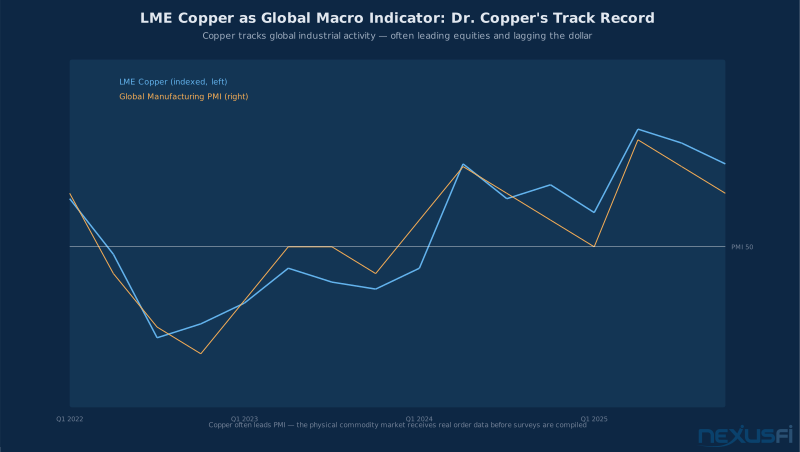
Copper's role as "Dr. Copper" — the commodity with a PhD in economics — is not a metaphor. Copper is used in construction wiring, automotive manufacturing, electrical grid infrastructure, consumer electronics, and renewable energy systems. When global industrial activity accelerates, copper demand accelerates with it. The LME copper price so reflects global industrial activity with reasonable lead time relative to data releases.
Three macro relationships that futures traders in any asset class should monitor:
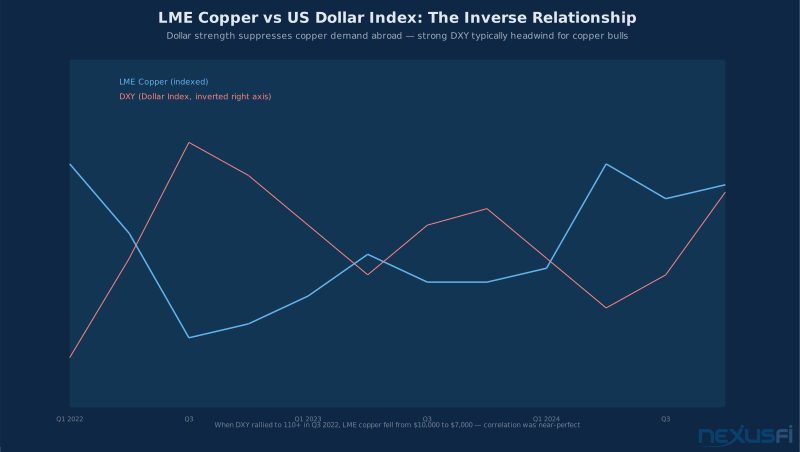
LME copper vs USD: A strong USD makes dollar-denominated commodities more expensive in foreign currency, reducing demand. When the DXY rises much, copper typically faces headwinds. The inverse is also true: a weakening dollar often accompanies copper strength. The correlation isn't perfect but is consistent enough to be a useful macro check.
LME copper vs Chinese economic data: China consumes over 50% of global copper. Official PMI data, industrial production figures, and property market indicators from China are the primary demand-side drivers. LME copper often moves before the official data releases if proprietary traders are getting early reads from port flows and warehouse activity in China.
LME copper vs equity markets: Copper and risk assets tend to correlate in direction. When global growth expectations are rising, copper rises with equities. When recession fears dominate, copper often leads equities down. Significant divergence between copper and equity direction is worth noting — it suggests one market is pricing growth correctly and the other isn't. Historically, copper's divergence has been the more reliable signal.
Risk Management and Position Limits #
LME position limits are more complex than CME position limits because the daily prompt date structure creates the potential for a dominant position across multiple nearby dates — effectively a delivery squeeze. The LME's Position Management Regime (PMR) and Lending Guidance rules address this.
Lending Guidance: Any holder of more than 50% of available warrants and cash positions for a given metal on a given date is required by LME rules to lend metal to the market at a limited backwardation rate. This prevents a single holder from cornering the market on a specific prompt date — they cannot extract unlimited backwardation premiums from shorts who need to borrow.
For retail and institutional spec traders, the practical risk management issues are:
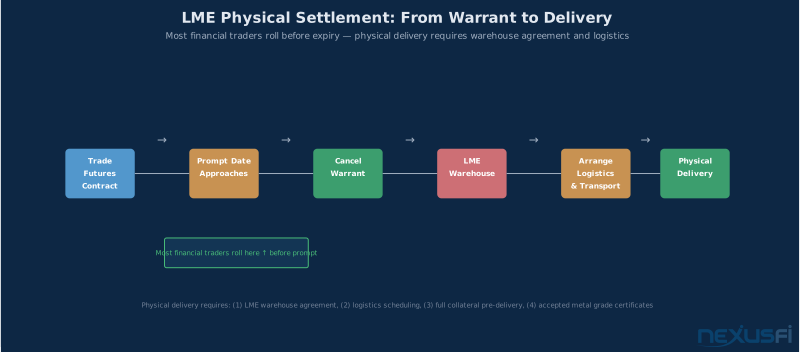
- Roll risk: Unlike CME monthly contracts, LME prompt dates require active management. If you're holding a specific prompt date position, you must roll before the prompt to avoid physical delivery obligations.
- Backwardation roll cost: When the market is in steep backwardation, rolling a long position forward costs money -- you're selling a high cash price and buying the cheaper forward. This erodes returns on long positions held through tight physical markets. Understanding the roll cost structure is essential before holding LME positions over multiple prompt dates.
- Warrant and delivery obligations: At expiry of an LME prompt, long positions receive a warrant (physical delivery obligation). Most financial participants close before this point. The logistics of physical LME delivery -- specific warehouse locations, scheduling, warrant transfer -- are significant barriers to accidental physical delivery that retail traders must manage by rolling positions well before their prompt dates.
@Fat Tails explained the convergence mechanics and physical delivery risk in the context of oil futures, with direct application to LME base metals:
@"If you go long 1 futures contract and do nothing until expiry, you will get delivered the physical oil. This means that if the contract price for the futures is not converging to the price of physical at expiry, a physical trader can make a significant profit by arbitraging the difference. Arbitrage opportunities make prices converge."
The same arbitrage mechanism governs LME price convergence. If LME copper futures drift much above physical copper, a physical trader buys spot metal, deposits it into an LME warehouse to create warrants, and sells the futures — capturing the differential. This arbitrage keeps LME futures prices anchored to physical reality in a way that purely cash-settled contracts cannot achieve.
Knowledge Map
Go Deeper
Build on this knowledgeCitations
- — Reminiscences of a Bean Trader or Why These Ain't Yo Daddy's Beans No-Mo (2014) 👍 15“One of the most overlooked and misunderstood aspects of trading futures is the shape of the futures curve. With a commodity and a normal term structure, the premiums are determined by storage costs, financing costs (carry), and convenience yield. Backwardation is when futures prices are below the expected spot price and the implication is that price will rise.”
- — commodity spreads (2015) 👍 6“Many commodities have extremely seasonal supply and demand profiles, and their forward curve often reflects that supply/demand profile rather than any indication of absolute price strength or weakness. Other commodities have forward curves that have very well defined (and arbitragable) carrying costs. There is also the phenomenon called the roll yield.”
- — futures-convergence to the physical market? (2015) 👍 8“If you go long 1 futures contract and do nothing until expiry, you will get delivered the physical oil. This means that if the contract price for the futures is not converging to the price of physical at expiry, a physical trader can make a significant profit by arbitraging the difference. Arbitrage opportunities make prices converge.”
- — commodity spreads (2015) 👍 2“Roll yield is very important in two scenarios: when you have a fixed number of dollars to invest and are using futures to proxy the underlying, and when your in an index fund that is always long. Contango markets (negative roll yield) normally kill these types of investments.”
- — Rollover dates for GC, SI, ZC and ZS (2013) 👍 13“For metals the situation is much easier. For the gold contract there is a known first notice date. Gold futures typically roll 1 or 2 days prior to first notice day. The metal does not perish, it is basically a financial contract and the rollover gap does not depend on the day on which you roll.”
- — Backadjust futures contracts for spread trading backtesting (2023) 👍 4“For something like ES/NQ or ZB/ZN this probably isn't as a big an issue as it is for Gasoline/Brent. There is a whole world of people managing billions of dollars looking at the ES/NQ spread, so finding an edge in there may be difficult. On the other hand there are very few people looking at a basket of Energies vs a basket of Metals.”
- — Trading ratios long term (2020) 👍 4“Spreads behave very differently than outright contracts and can actually be easier to trade as they have less noise. They are also a lot cheaper from a margin perspective. Exchanges list many native spreads -- and their bid-ask is normally tighter than trading an outright month, with no legging risk in execution.”
- — Lme.com (2024)
- — Hkex.com.hk (2012)