



Average Daily Range (ADR): The Volatility Ruler Every Futures Trader Needs on Their Chart
Overview #
The Average Daily Range tells you one thing: how far this instrument typically moves in a single session. Not how far it could move. Not how far you want it to move. How far it actually moves, measured in cold historical data.
For ES, that number might be 50 points. For NQ, 250 points. For CL, $2.50. These aren't theoretical — they're the arithmetic average of the last N sessions' high-to-low ranges, and they anchor every intelligent decision about stop placement, profit targets, and position sizing.
ADR doesn't predict direction. It predicts magnitude. And that's the part most traders get backwards — they obsess over where the market is going while ignoring how far it's likely to travel. The trader who knows today's ES session will probably cover 50 points can size stops and targets rationally. The trader who doesn't know that number is guessing.
ADR predicts magnitude, not direction. Knowing how far an instrument typically moves in a session is more actionable than guessing where it's going.
Key Concepts #
What ADR Measures #
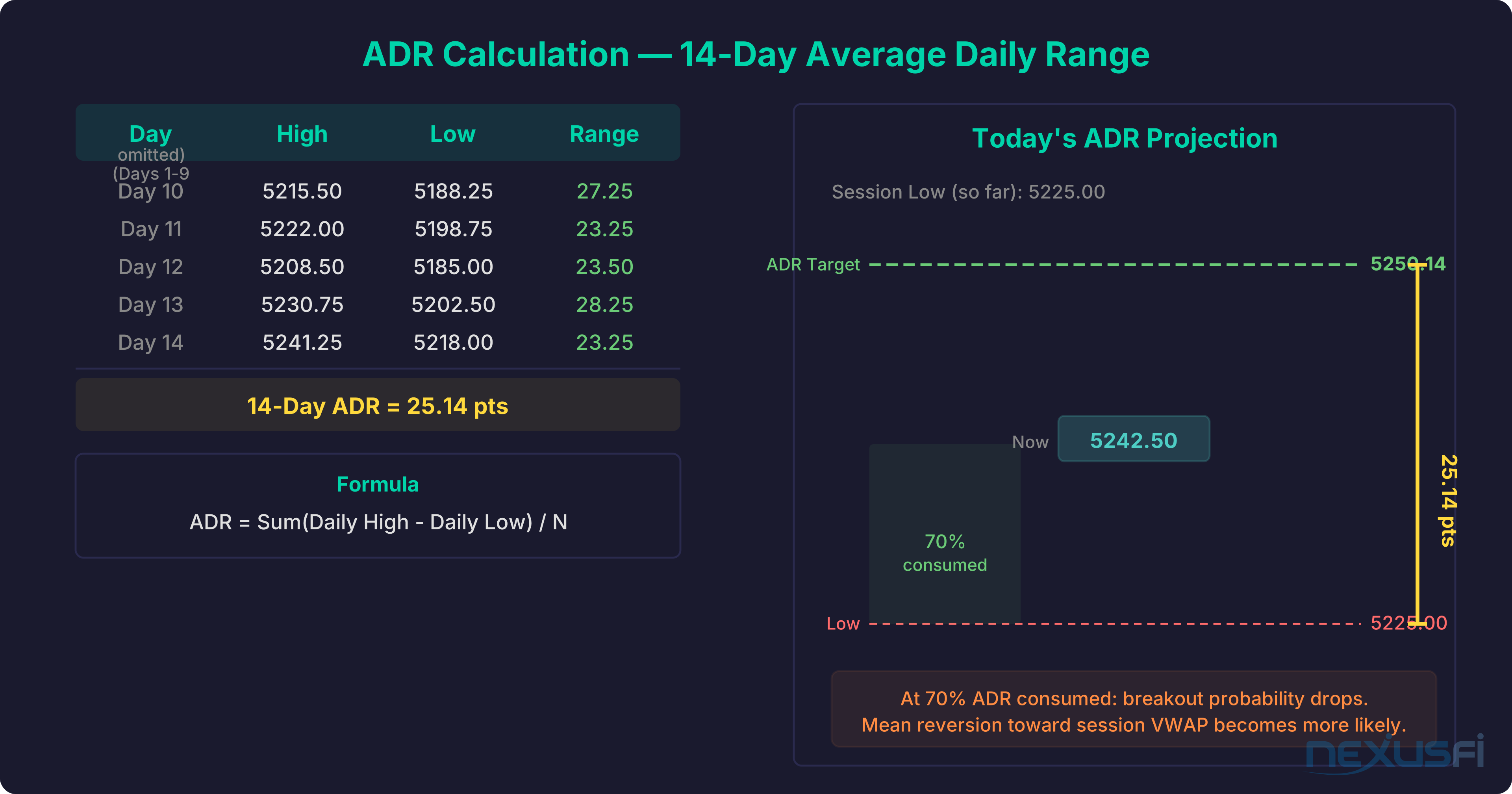
ADR is the simplest volatility metric in a futures trader's toolkit. Take the high-to-low range for each of the last N sessions, add them up, divide by N. That's it. No true range adjustment for gaps, no exponential smoothing, no Wilder magic. Just the arithmetic mean of recent daily ranges.
This simplicity is its strength. ADR answers a single question with zero ambiguity: on an average day, how many points (or ticks, or dollars) does this market travel from its high to its low?
As @Fat Tails [demonstrated when building the original NexusFi ADR indicator] [1]: the core idea is monitoring range expansion intraday — comparing how far price has moved today against the average range over the last 3 and 10 sessions. When today's range exceeds the historical average, the probability of further extension drops and the probability of mean reversion rises.
ADR vs. ATR: Know the Difference #
ADR and ATR measure related but distinct things, and confusing them will mess up your risk calculations.
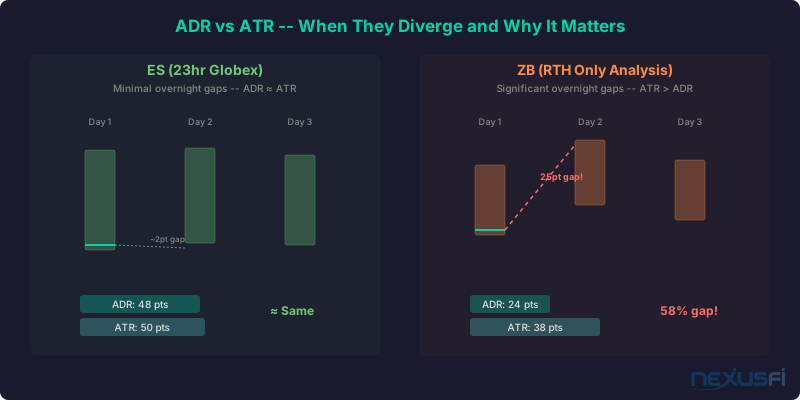
ADR = Average of (High - Low) over N sessions. Pure intrabar range. Simple arithmetic mean.
ATR = Average of True Range over N periods. True Range accounts for gaps by including the distance between the previous close and the current high or low (whichever is greater). Uses Wilder's exponential smoothing.
The practical difference: ATR captures gap volatility, ADR doesn't. In markets with significant overnight gaps (many futures during RTH-only analysis), ATR will read higher than ADR. In markets that trade nearly 24 hours with minimal gaps (ES during Globex), the two converge.
As @Fat Tails [explained in the NexusFi ADR thread] [8], the indicator evolved to track both ETH and RTH session ranges separately — because the range behavior during the overnight Globex session is at the core different from what happens during regular trading hours.
As @rahulgopi [observed on NexusFi] [6]: "I am using ATR average (volatility) to project daily range. I have found the projected range have much better accuracy over ADR itself, given projected range is a percentage of ADR itself." This suggests that for projection purposes, ATR's gap-adjusted calculation may produce tighter estimates — but ADR remains the more intuitive, visual measure of what the market actually does within a session.
Lookback Period Selection #
The lookback period determines how responsive ADR is to recent volatility shifts:
- ADR(3-5) — Highly responsive. Reflects the most recent sessions. Good for identifying sudden volatility spikes or contractions. Too noisy for sizing decisions.
- ADR(10-14) — Standard. Smooths roughly two weeks of data. The most common choice for intraday range targets and stop calibration.
- ADR(20-27) — Smoother, slower to react. Better for position sizing and longer-term volatility assessment. ADR(27) captures roughly a calendar month of sessions.
As @trendwaves [documented in their CL combine journal on NexusFi] [7]: "The Average Daily Range of the CLH4 contract over the last 5 trading sessions is $1.49 or 149 ticks. Over the last 20 days the average daily range is $1.54, because of a slight spike up in volatility in the last half of January." The difference between the 5-day and 20-day ADR told the full story — short-term volatility was contracting while the broader regime remained slightly elevated.
How It Works #
ADR creates dynamic support and resistance levels based on historical volatility. The logic is straightforward: if ES has averaged a 50-point daily range over the last 14 sessions, you can project where today's likely high and low will land based on that average distance.
Range Projection #
The most practical ADR application is projecting today's likely range boundaries. Starting from the session open (or the overnight low/high for Globex traders), you project the ADR value in both directions to create dynamic high and low targets.
As @Fat Tails [built into the original ADR indicator] [1]: the indicator calculates dynamic targets for the current day's high and low using two different lookback periods. The short lookback (3 days) captures recent conditions, while the longer lookback (10 days) provides the broader context. When price reaches either target, the indicator signals that the average range has been met.
ETH vs. RTH Range Behavior #
For futures traders, a critical distinction is whether you measure ADR across the full electronic trading hours (ETH) or only regular trading hours (RTH). The answer depends on your trading style:
- Globex/ETH traders need the full session ADR, including overnight price action
- RTH-only traders should measure ADR from their session's open to close (typically 9:30 AM - 4:00 PM ET for equity index futures [11])
- The two can diverge much — a market that has already traveled 80% of its ADR during the overnight session may have limited range left during RTH
As @silver99 [demonstrated in their trading journal on NexusFi] [4]: "At the NY open these facts were known to me: a.) The ADR had been achieved in the overnight session b.) There was a strong downtrend underway." This is the exact scenario where ADR earns its keep — knowing the average range was already consumed during overnight trading informed their decision-making for the RTH session.
Range Exhaustion: ADR's Most Powerful Signal #
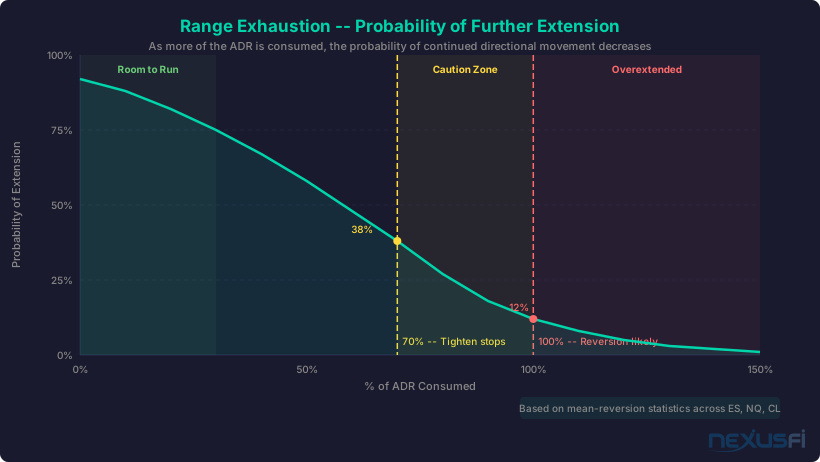
Range exhaustion is the concept that makes ADR genuinely useful for trade management, not just background context. The idea is simple: once a market has consumed most of its typical daily range, the probability of further extension in the same direction decreases.
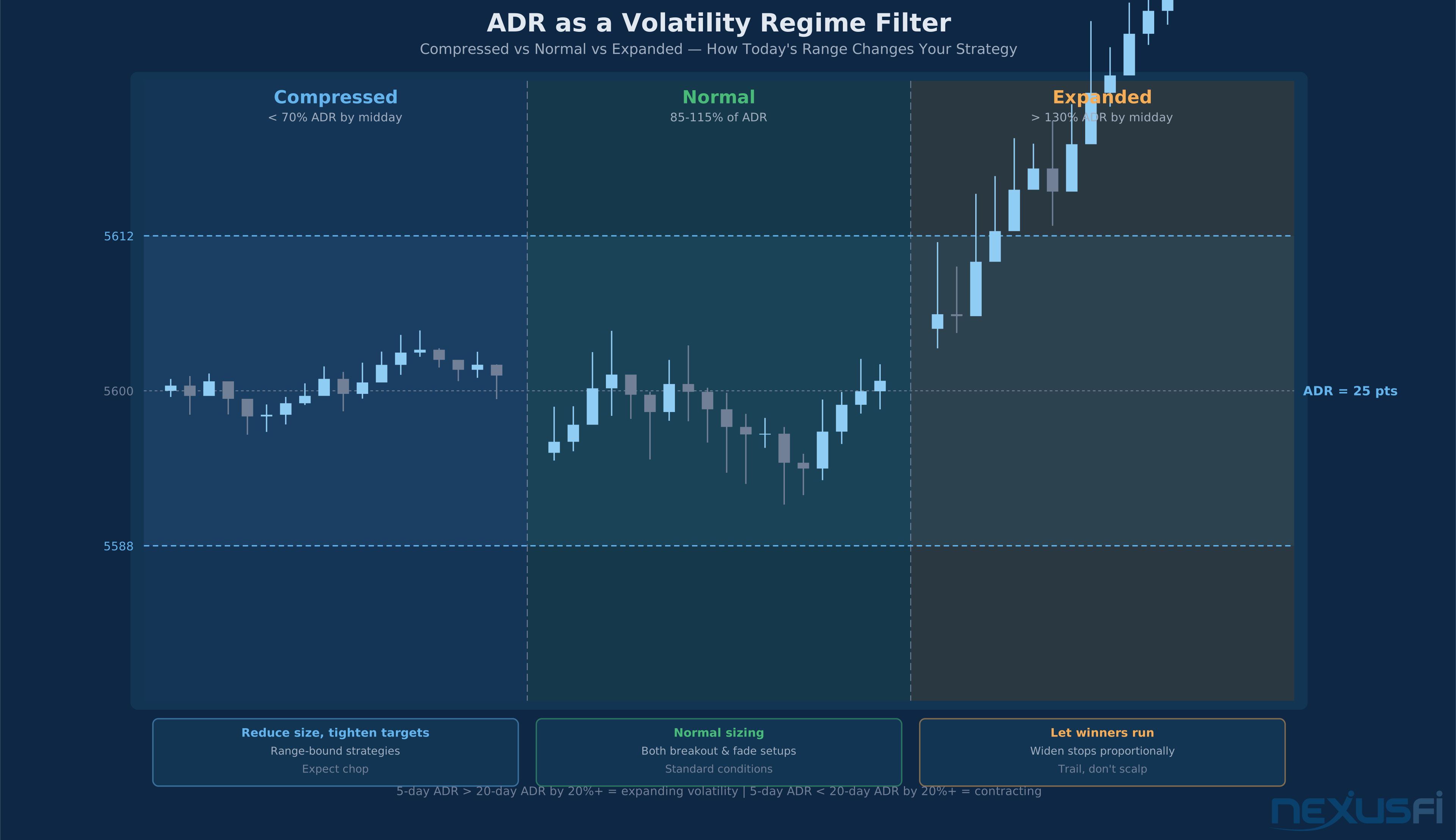
When a market has consumed 70-80% of its ADR, the probability of mean reversion rises much. This doesn't mean the move is over — but the odds shift, and smart traders adjust their risk so.
The Statistical Basis #
As @tigertrader [explained in the NexusFi ES range expansion thread] [9]: "In the case of the S&P which has poor trending properties due to the high amount of arbitrage and high frequency trading, 70% of all trading days retrace to their previous days average trading price. 88% of all trading days trade above their prior day's close, but only 54% actually close higher."
These statistics reveal why range exhaustion matters. Most days are mean-reverting, and the probability of reversion increases as the market moves toward range extremes. ADR quantifies where those extremes are.
How to Use Range Exhaustion #
Scenario 1: Range approaching exhaustion (70-80% of ADR consumed)
- Tighten trailing stops on existing positions
- Reduce new position sizes in the direction of the move
- Begin watching for reversal setups near the projected ADR high or low
Scenario 2: Range exceeded (100%+ of ADR consumed)
- The move may have legs (trend day), but the base case is reversion
- Countertrend entries at ADR extensions become higher-probability
- Volume and momentum become critical — if they're fading, reversion is likely
Scenario 3: Range barely developed (<30% of ADR at midday)
- Watch for a breakout — the range has to develop eventually
- Low-range days often precede high-range days (volatility clustering)
- This is the "coiled spring" setup that range traders love
ADN/ADR Box Framework #
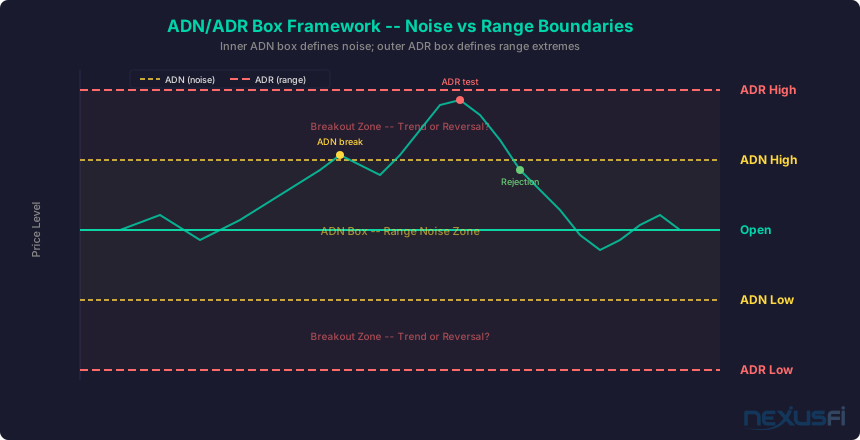
As @tturner86 [detailed in their NexusFi trading journal] [10], a structured way to use ADR is through the Average Daily Noise (ADN) and ADR box framework. ADN defines the inner "noise" range, while ADR defines the outer range extremes:
- Price inside ADN box: Range activity. Buy bounces off ADN low, sell pivots off ADN high. Scalp.
- Price breaks ADN box: Potential trend developing. If price breaks above ADN high, look for continuation to ADR high.
- Price reaches ADR extreme: Full range exhaustion. Look for reversal or range contraction.
- Failed breakout of ADN: If price tests one ADN boundary and fails, high probability it moves to test the other.
This framework turns ADR from a passive measurement into an active trade management tool.
Stop Placement with ADR #
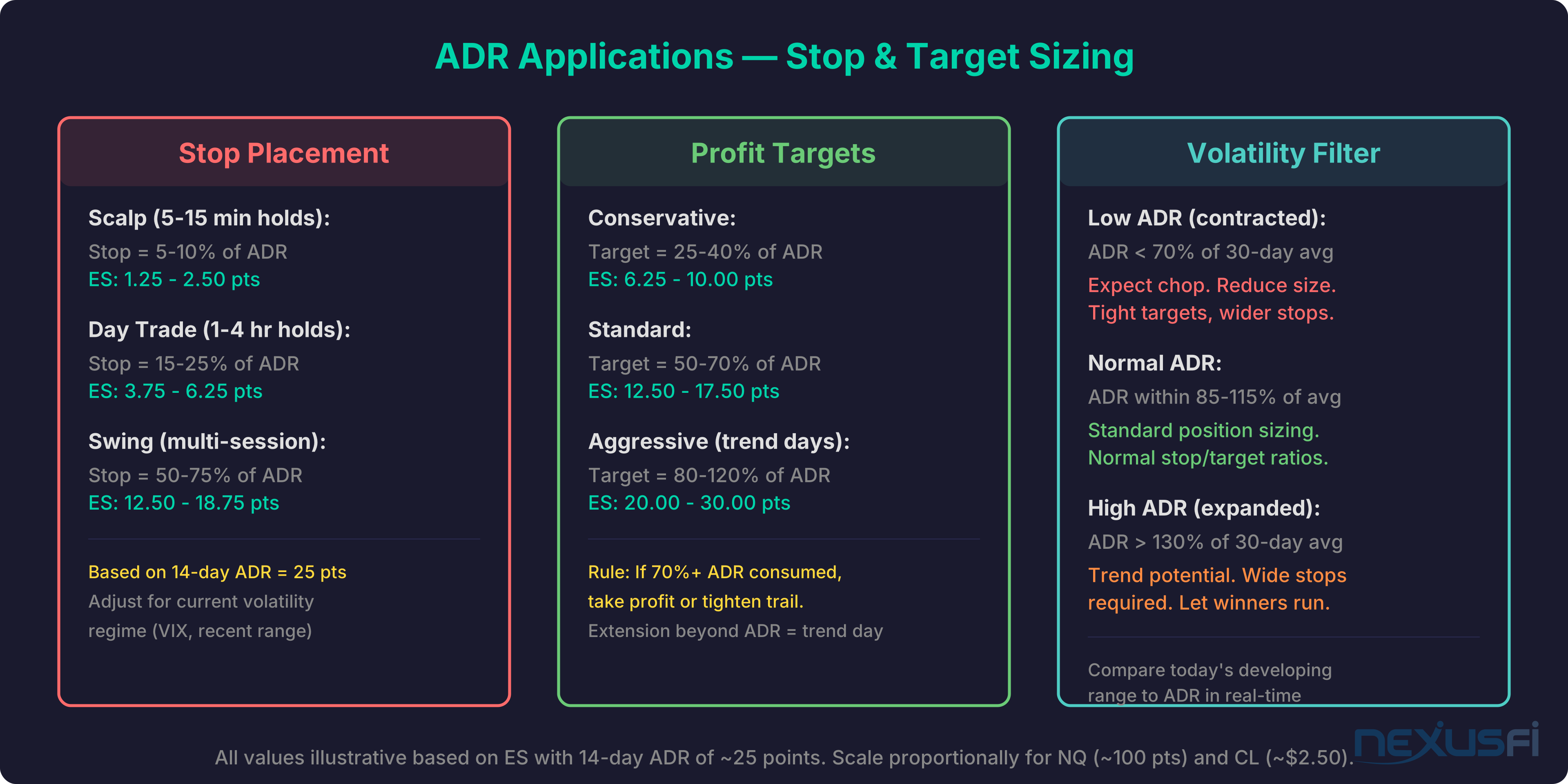
ADR provides a logical framework for stop placement that adapts to current volatility — similar to ATR stops but using the simpler range measure.
Fractional ADR Stops #
The most common approach: set your stop at a fraction of the current ADR value.
- 0.25× ADR — Very tight. Only for scalps where you expect immediate follow-through.
- 0.33× ADR — Moderate. Filters most intrabar noise on intraday charts.
- 0.50× ADR — Standard for day trades. Allows a half-range retracement before stopping you out.
- 0.75× ADR — Wide. Swing trade territory. You're giving back most of the daily range to stay in.
Example: ADR(14) on ES reads 50 points.
- Tight stop: 0.25 × 50 = 12.5 points ($625 per contract)
- Standard stop: 0.50 × 50 = 25 points ($1,250 per contract)
- Wide stop: 0.75 × 50 = 37.5 points ($1,875 per contract)
As @Inletcap [demonstrated in their NexusFi TopStep combine journal] [5], combining ADR with key support/resistance levels creates a strong stop framework: "In both scenarios you are risking less than 1/2 the Average daily range, trading with trend, using key levels as support areas to trade around."
ADR-Based Profit Targets #
ADR also gives you rational profit targets. If the average daily range is 50 points and your entry is near the session low, targeting the full ADR value (50 points from the low) gives you a realistic, historically-validated profit objective.
Target hierarchy:
- First target: ADR midpoint from entry — conservative, high probability
- Second target: Full ADR projection — standard target for a normal day
- Extended target: 1.25-1.5× ADR — only realistic on trend days
Position Sizing with ADR #
ADR normalizes position sizing across instruments with different tick values and volatility profiles. The logic mirrors ATR-based sizing but uses the simpler range calculation.
Formula: Contracts = Dollar Risk / (Fractional ADR × Point Value)
Suppose you risk $1,000 per trade using 0.50× ADR stops:
| Instrument | ADR(14) | Point Value | 0.50× ADR | Dollar Stop | Contracts |
|---|---|---|---|---|---|
| ES | 50 pts | $50 | 25 pts | $1,250 | ~1 (or use MES) |
| NQ | 250 pts | $20 | 125 pts | $2,500 | ~1 MNQ ($500 stop) |
| CL | 2.50 pts | $1,000 | 1.25 pts | $1,250 | ~1 |
| GC | 25 pts | $100 | 12.5 pts | $1,250 | ~1 |
The beauty: every trade risks approximately the same dollar amount, regardless of instrument. A CL trade and an ES trade carry the same risk — $1,000-$1,250 — even though the point values and ranges are completely different.
Pre-Session ADR Checklist #
Before trading any session, three numbers define your day's risk framework. This is the simplest, most impactful preparation routine a futures trader can adopt.
Before every session, know three numbers: (1) ADR value for your instrument, (2) how much of today's range has already been consumed, and (3) your maximum position size based on ADR-derived stops. These three numbers prevent 90% of the impulsive sizing and stop placement errors that blow up accounts.
Number 1: Today's ADR value
- Pull ADR(14) from your charting platform or calculate manually
- Note whether it's expanding or contracting versus the 20-day average
- Expanding ADR = wider stops needed, smaller positions
- Contracting ADR = tighter stops possible, potentially larger positions
Number 2: Range consumed so far
- Calculate current session range (today's high - today's low) and divide by ADR(14)
- Use the range exhaustion thresholds from the section above to adjust your risk so
Number 3: Maximum position size
- Use your fractional ADR stop to calculate max contracts
- This number should be fixed BEFORE the session, not adjusted on the fly
- Emotional sizing decisions during live trading are the enemy of survival
ADR Across Different Markets #
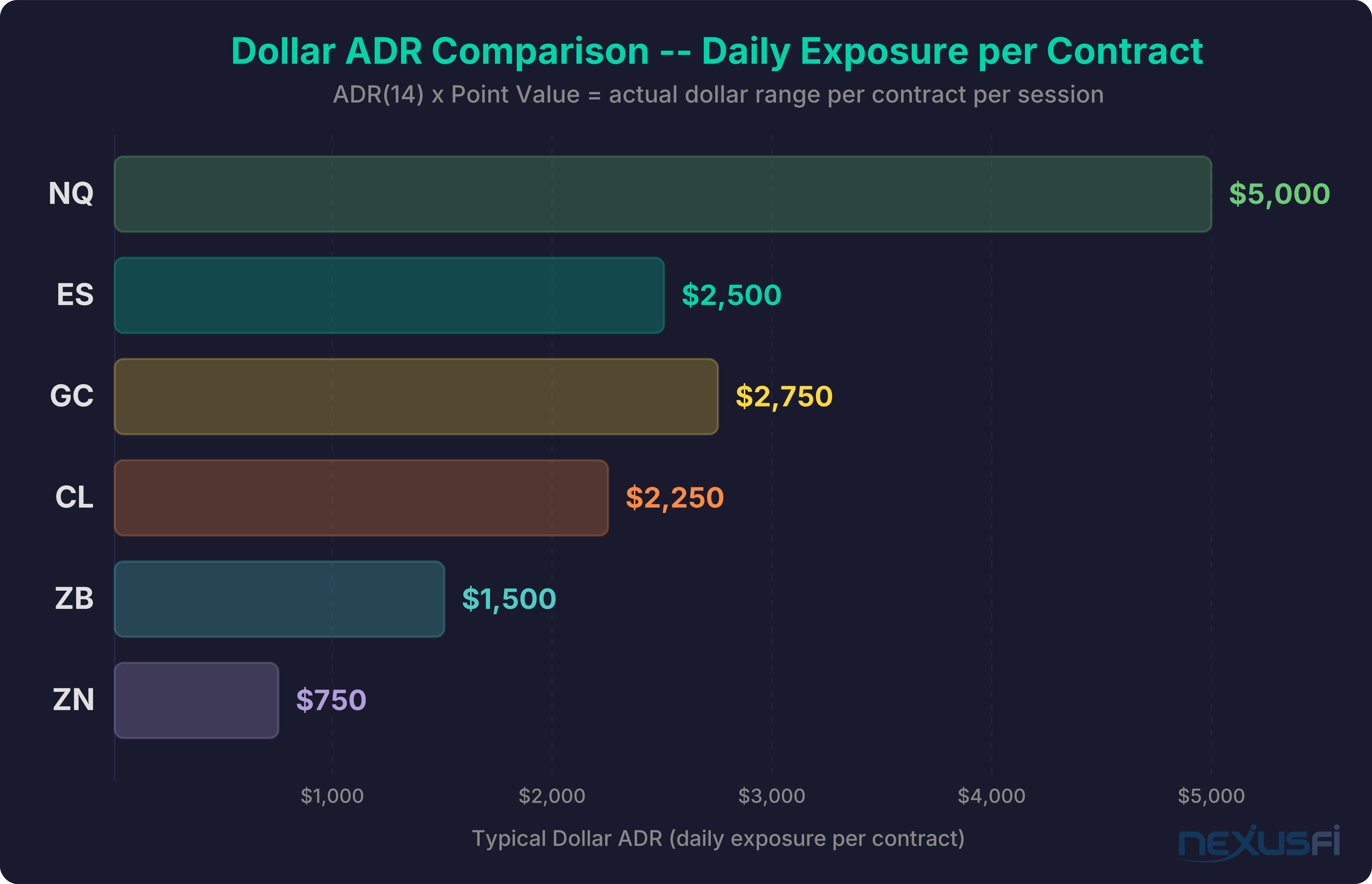
ADR values vary dramatically across futures markets, and the raw numbers are meaningless without context. What matters is the dollar ADR — the ADR multiplied by the contract's point value.
| Instrument | Typical ADR(14) | Point Value | Dollar ADR |
|---|---|---|---|
| ES | 40-60 pts | $50 | $2,000-$3,000 |
| NQ | 200-300 pts | $20 | $4,000-$6,000 |
| CL | 1.50-3.00 pts | $1,000 | $1,500-$3,000 |
| GC | 20-35 pts | $100 | $2,000-$3,500 |
| ZN | 0.50-1.00 pts | $1,000 | $500-$1,000 |
| ZB | 1.00-2.00 pts | $1,000 | $1,000-$2,000 |
Dollar ADR tells you the actual daily dollar exposure per contract. NQ consistently shows the highest dollar ADR, making it the most volatile major futures contract by this measure. ZN sits at the other end — its subdued dollar ADR makes it popular for traders who prefer smaller daily swings.
When ADR Misleads #
ADR is backward-looking and arithmetic. These properties create specific blind spots.
Trend days blow through ADR. On strong trend days, the market can travel 1.5-2× ADR with minimal retracement. Blindly fading the ADR extreme on a trend day is a fast way to compound losses. The fix: check for trend day signatures (strong open, persistent one-directional volume, poor rotation) before using ADR as a mean-reversion trigger.
As @tigertrader [noted on NexusFi] [9], "the 70% probability of mean reversion expands much when markets are losing volume and momentum." The corollary: when volume and momentum are strong, mean reversion probability drops — and ADR exhaustion signals become unreliable.
Overnight range consumption. Futures that trade electronically 23 hours can consume most of their ADR during the overnight session, leaving very little range for RTH. This catches RTH-only traders who didn't check overnight price action.
Regime changes. When volatility shifts abruptly — after a Fed decision, a geopolitical shock, or a liquidity event — ADR takes N sessions to catch up. Forward-looking volatility measures like the VIX can signal these regime shifts before ADR catches up [12]. Your first few trades in the new regime will be sized for the old volatility.
Low-volume days. ADR treats all days equally. A holiday-shortened session with half the normal volume gets the same weight as a FOMC day. If you're trading around holidays or early closes, the standard ADR overstates the expected range.
ADR doesn't account for gaps. Unlike ATR, ADR only measures high-to-low within a session. A market that gaps 30 points and then trades a 20-point range shows an ADR contribution of 20 — even though the actual move was 50 points from the prior close. For gap-heavy markets, ATR provides a more complete volatility picture.
Practical Application #
Here's a complete ADR-based trade framework for an ES day trade:
Pre-session: ADR(14) = 48 points. Overnight range was 15 points (31% of ADR consumed). Plenty of range expansion expected.
Entry: Long at 5600 based on your setup. ADR suggests the session high could reach approximately 5624-5648 above the overnight low (full ADR projection).
Stop: Using 0.33× ADR: 0.33 × 48 = ~16 points. Stop at 5584. Risk per ES contract: $800.
Position size: Account is $100,000, risking 1% = $1,000. Contracts = $1,000 / $800 = 1 ES contract.
Target: ADR midpoint from entry = ~24 points = 5624. First scale point. Full ADR projection = 5648 for runner.
Management: At 15:00 ET, range has reached 38 points (79% of ADR consumed). Per the range exhaustion framework above, move stop to breakeven and take partial profits on the remainder.
As @silver99 [demonstrated on NexusFi] [4], the pre-session ADR check directly informed every trade decision — from identifying that the overnight range was already met to adjusting RTH positioning so.
ADR Combined with Other Tools #
ADR works best as a filter layered on top of other analysis, not as a standalone signal.
ADR + Market Profile: Once ADR exhaustion is reached near a Market Profile Value Area boundary, the confluence creates a high-probability reversal zone. As @tigertrader [explained] [9], when volume and momentum dissipate at range extremes, the market tends to revert to the POC.
ADR + VWAP: If price reaches ADR exhaustion above VWAP, the VWAP pull-back trade becomes higher probability. If at exhaustion below VWAP, mean-reversion back toward VWAP gains edge.
ADR + Volume Profile: Range exhaustion at a high-volume node (HVN) or point of control (POC) from a previous session creates strong confluence for reversal trades.
ADR + Opening Range: Combining ADR with the opening range breakout framework gives you targets. If the opening range breaks out, the ADR projection gives you a realistic first target for the move.
Knowledge Map
Go Deeper
Build on this knowledgeReferences This Article
Articles that build on this topicCitations
- — Average Daily Range (ADR) (2010) 👍 22“Monitoring the Daily Range This is a new indicator, work in progress. The idea is to monitor the range expansion intraday and get an alert, when today's range hits the 3-day average range or the 10-day average range, for both historical ETH and RTH ranges.”
- — How to judge market context and volatility (2021) 👍 3“Volume profile, specifically intraday, is IMO the single best way to gauge current market conditions.”
- — The PandaWarrior Chronicles (2012) 👍 14“I don't trade bar to bar, and although I keep candle charts, I pay very little attention to what kind of bar is formed, with the exception of bars with extremely long tails.”
- — Trading Futures with Context (2014) 👍 10“At the NY open these facts were known to me: a.) The ADR had been achieved in the overnight session b.) There was a strong downtrend underway c.) We were opening under yesterday's RTH low.”
- — rbars $150K TopStep Combine (2016) 👍 17“So as not to get into building a trading system- lets just use P&F chart buy/sell signals for simplicity and use daily hi, lo and close as key support/resistance levels and targets along with ADR(14) to give an idea of the expected daily range.”
- — Spoo-nalysis ES e-mini futures S&P 500 (2016) 👍 11“I am using ATR average (volatility) to project daily range. I have found the projected range have much better accuracy over ADR itself, given projected range is a percentage of ADR itself.”
- — BC's TST CL Combine (2014) 👍 3“The Average Daily Range of the CLH4 contract over the last 5 trading sessions is $1.49 or 149 ticks. Over the last 20 days the average daily range is $1.54.”
- — Average Daily Range (ADR) (2011) 👍 5“I have made a few changes since the last update, so here comes the latest version, which I have reworked following suggestions of several users.”
- — Determining range expansion for the ES (S&P eminis) (2010) 👍 4“In the case of the S&P which has poor trending properties, 70% of all trading days retrace to their previous days average trading price. 88% of all trading days trade above their prior day's close, but only 54% actually close higher.”
- — Price Action Ripper's Journal (2014) 👍 27“Below are some simple diagrams to explain how I see the ADN/ADR boxes and how I use them to determine trend from range.”