



The Strategic Petroleum Reserve: How 375 Million Barrels in Salt Caverns Move Crude Oil Markets
Overview #
The Strategic Petroleum Reserve is 375 million barrels of crude oil sitting in salt caverns along the Gulf Coast — and every CL trader needs to understand how it works. When the U.S. government announces a release or a refill, front-month crude moves. Sometimes violently. The SPR is the single largest government-controlled stockpile of emergency oil on the planet, with a design capacity of 714 million barrels spread across four sites in Texas and Louisiana. It was born from the gasoline lines of the 1973 Arab oil embargo, codified into law two years later, and has been a political and market football ever since.
What makes the SPR relevant to traders right now: inventory just dropped below 375 million barrels after the largest weekly drawdown on record in May 2026 — roughly 10 million barrels in a single week. WTI spiked above $114 during the Iran-Hormuz crisis. The IEA coordinated an emergency release across member nations in March 2026. And the Biden administration executed a notable trade between 2022 and 2024 — selling 180 million barrels at an average of $95 and buying back 200 million barrels at an average of $74.75. That's a government trade that would make most hedge funds jealous. The mechanics follow directly from how contango and backwardation shape commodity market behavior — sell into acute backwardation, repurchase in contango.
This article covers everything a crude oil trader needs to know: where the SPR came from, how releases and refills actually work, who has authority to pull the trigger, the exact math on Biden's fiscal play, how U.S. reserves compare to China, Europe, and Japan — and what to watch for when SPR headlines cross the tape.
SPR release announcements move front-month CL immediately. The actual barrels take weeks to flow. Trade the announcement, not the barrels — the maximum market impact window is 24-48 hours.
The 1973 Embargo That Built the Reserve #
October 1973. Arab OPEC members slapped an oil embargo on the United States and other nations supporting Israel during the Yom Kippur War. Crude prices quadrupled. Gas stations posted "NO GAS" signs. The American economy — built on cheap, abundant oil — got a crash course in supply vulnerability.
Congress responded with the Energy Policy and Conservation Act (EPCA) of 1975, signed by President Ford on December 22, 1975. EPCA created the legal framework for the Strategic Petroleum Reserve — authorizing the federal government to acquire, store, and release crude oil as an emergency buffer against supply disruptions. The law established governance mechanisms, set out criteria for when reserves could be tapped, and gave the executive branch operational control within Congressional guardrails.
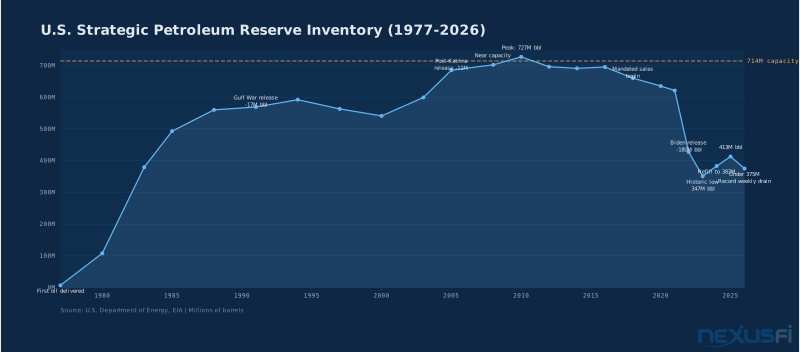
The first crude oil was delivered to the Bryan Mound site near Freeport, Texas, on July 21, 1977. Within a decade, the SPR held over 500 million barrels. By the early 1990s, it was pushing toward its full design capacity of 714 million barrels — the largest strategic oil stockpile any government had ever assembled.
The logic was straightforward: if a hostile nation could weaponize oil supply, the United States needed a buffer large enough to absorb the shock. That logic held for 50 years. Whether it still holds in 2026 — with U.S. production above 13 million barrels per day and the country functionally a net exporter — is one of the central policy debates in energy markets right now. As @SMCJB noted on NexusFi, with production at nearly 14 million bpd, the SPR is "far less important than it used to be. The US is virtually oil self sufficient." He pointed out that SPR plus 90 days of production now equals roughly 1.54 billion barrels — even with the reserve depleted — compared to just 1 billion when tracking began in 1982.
The SPR was designed for a world where the U.S. imported 35-40% of its crude. Today the U.S. is a net petroleum exporter. The reserve still matters — for price stabilization and geopolitical signaling — but the energy-security calculus is at the core different than in 1975.
714 Million Barrels of Salt #
The SPR stores crude oil in solution-mined salt caverns at four sites along the Gulf Coast:
- Bryan Mound -- Freeport, Texas
- Big Hill -- Winnie, Texas
- West Hackberry -- Lake Charles, Louisiana
- Bayou Choctaw -- Baton Rouge, Louisiana
Combined, these four sites contain 60 salt caverns — each large enough to hold Chicago's Willis Tower. Total authorized storage capacity: 713.5 million barrels. That's roughly 35 days of total U.S. crude consumption sitting underground in hollowed-out salt formations.
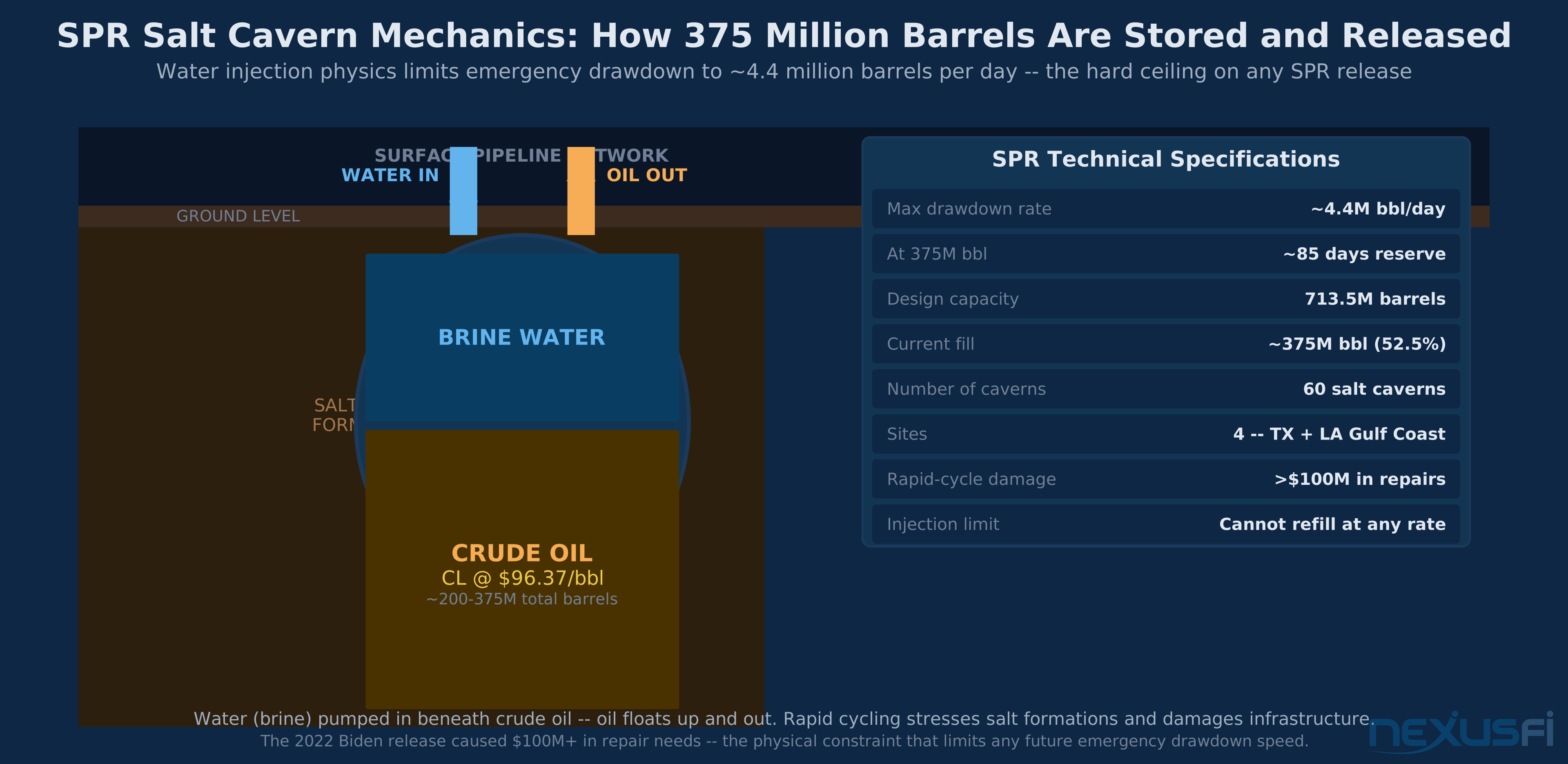
Salt caverns work because salt is impermeable to oil. The caverns were created by pumping water into underground salt domes, dissolving the salt, and pumping the brine out — leaving massive underground voids. Crude oil is pumped in, and when it needs to come out, fresh water is pumped underneath the oil (oil floats on water), pushing crude to the surface and into the Gulf Coast pipeline network.
Maximum drawdown rate: The SPR can deliver approximately 4.4 million barrels per day during an emergency release. At full capacity, that means the reserve could sustain maximum outflow for about 162 days. At current depleted levels (~375 million barrels), that window shrinks to roughly 85 days.
There's a catch the headlines don't mention: rapid drawdowns damage infrastructure. Energy Secretary Chris Wright testified to Congress in 2025 that the Biden-era releases caused structural damage to SPR facilities, with more than $100 million in repairs needed. Salt caverns degrade when cycled too quickly — the temperature and pressure changes from rapid injection and withdrawal stress the geological formations. This isn't just an accounting problem. It's a physical constraint on how fast the reserve can be used and refilled.
The 4.4 million barrel per day drawdown rate is a hard ceiling — not a number you can exceed with more political will. Infrastructure condition further limits realistic output. And rapid cycling damages cavern integrity, raising the cost of any future refill.
Who Pulls the Trigger -- Presidential Authority vs. Congressional Control #
SPR operations sit at the intersection of executive power and Congressional funding. Understanding who controls what is critical for trading SPR headlines, because the speed and certainty of action depends entirely on which authority is being invoked.
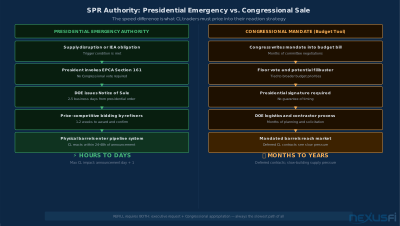
Emergency drawdowns are primarily executive-branch actions. Under EPCA Section 161, the President can order an SPR release when there's a "severe energy supply interruption" or to meet International Energy Agency obligations. The Department of Energy handles the mechanics — issuing Notices of Sale, running price-competitive bidding, and managing delivery logistics. The President doesn't need Congressional approval to authorize an emergency release, though reporting requirements kick in.
Congress controls the money. Appropriations for SPR acquisitions, storage operations, infrastructure maintenance, and replenishment come through the federal budget process. Congress can also mandate SPR sales as budget offsets — which it has done repeatedly. The Bipartisan Budget Act of 2015 and subsequent legislation authorized hundreds of millions of barrels in mandated sales to fund other government priorities, basically treating the SPR as a piggy bank.
Replenishment requires both — executive direction on timing and procurement strategy, plus Congressional appropriations to fund the purchases. This is why refilling the SPR after a drawdown is politically harder than releasing oil. Releasing lowers gas prices and makes voters happy. Buying oil back requires spending taxpayer money when nobody's paying attention.
For CL traders, the practical implication: release announcements move fast because they're executive actions with clear legal authority. Refill programs move slowly because they depend on budget cycles, procurement logistics, and political will. Price the asymmetry so.
When a president invokes emergency SPR release authority, expect maximum CL market impact within the first session. Executive action = fast. But when the story is "Congress is working on SPR refill funding" — that process takes months. Don't trade it like it's the same speed.
Biden's $4 Billion Crude Oil Trade #
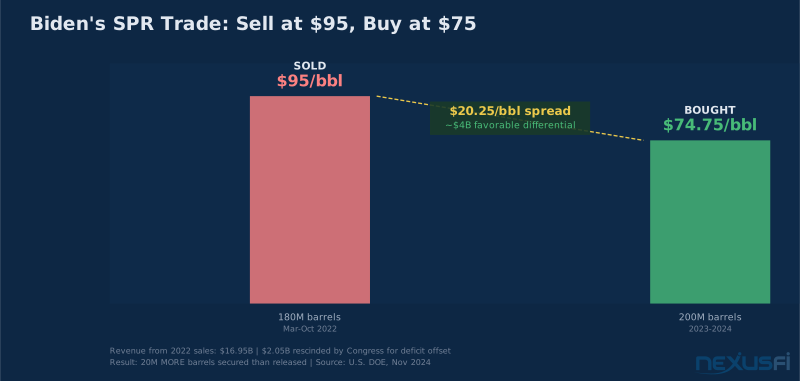
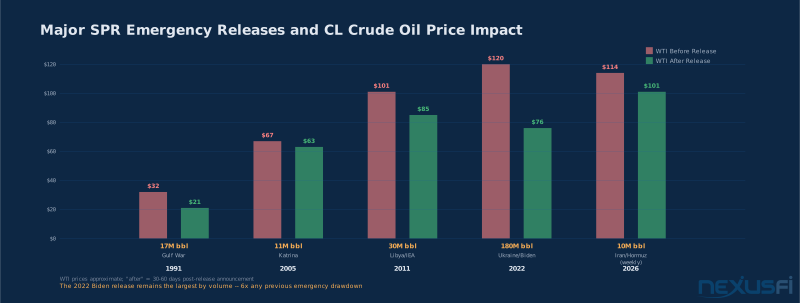
Between March and October 2022, the Biden administration executed the largest emergency SPR drawdown in history — releasing 180 million barrels into the market as WTI crude surged above $120 following Russia's invasion of Ukraine. The average sale price across all release tranches: approximately $95 per barrel. Total revenue generated: $16.95 billion.
Then came the buyback. Starting in late 2022 and continuing through November 2024, the Department of Energy executed a systematic repurchase program:
- Direct purchases: 59 million barrels at an average price of approximately $76 per barrel -- roughly $20 below the average sale price
- Cancelled mandated sales: Working with Congress, the administration secured cancellation of 140 million barrels of previously mandated Congressional sales at an implied value of approximately $74 per barrel
- Accelerated exchange returns: Approximately 5 million barrels in exchange returns were accelerated to maximize refill windows
Total barrels secured: approximately 200 million — 20 million more than were released. Average acquisition cost: $74.75 per barrel. The spread between average sale price ($95) and average buyback price ($74.75) across 200 million barrels implies roughly $4 billion in favorable price differential.
The DOE's November 2024 announcement stated it plainly: all $16.95 billion in emergency revenue from the 2022 sales was reinvested into replenishment, except for $2.05 billion rescinded by Congress for deficit offset. Understanding how those mandated Congressional sales function requires knowing the fundamental supply/demand data that frames government intervention decisions.
Is it accurate to call this a "fiscal surplus"? The arithmetic is directionally correct — the government sold high and bought low. But calling it a clean profit oversimplifies things. The release price isn't a realized sale price in the commercial sense. Transport, quality differentials, delivery logistics, handling costs, and the fact that not all barrels were bought and sold simultaneously all complicate the accounting. Still, as government commodity operations go, the Biden SPR trade was about as well-executed as it gets.
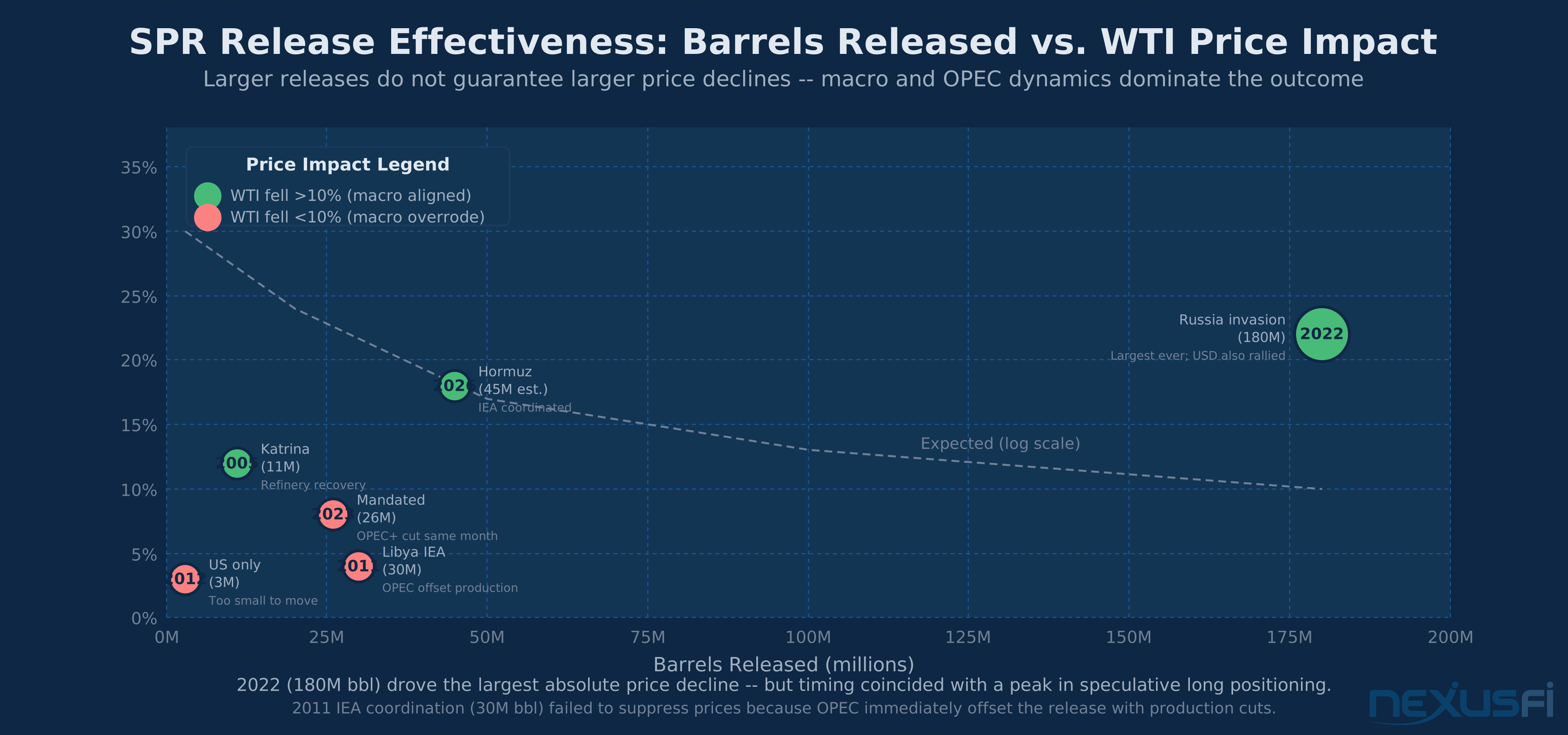
The market impact was mostly through expectations. The 180-million-barrel release was large enough to credibly signal that the government was serious about adding supply, which compressed near-term risk premia in CL. But OPEC+ production cuts, Russian supply disruptions, and global demand dynamics ultimately drove the medium-term price path more than SPR volumes did. The SPR is a blunt instrument — useful for dampening short-term panic, less useful for setting long-term equilibrium prices.
The Global Strategic Reserves Scoreboard #
The United States isn't the only country sitting on emergency crude. After the 1973 crisis, the International Energy Agency established a framework requiring member nations to maintain oil stocks equivalent to at least 90 days of net imports. Different countries structure this differently — some hold government reserves, others mandate industry stockholding, most do both.
Here's how the world's major strategic oil inventories compared as of late 2025, before the March 2026 IEA coordinated release:
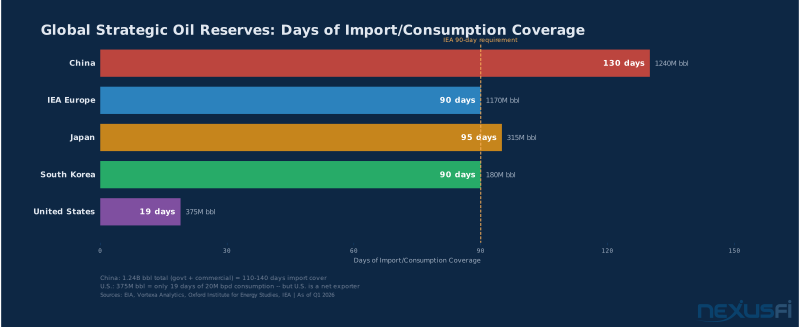
Convert all SPR headlines to "days of consumption" — not raw barrels. The U.S. sitting on 375 million barrels sounds massive but covers only ~19 days of domestic consumption. China's 1.24 billion barrels covers 110-140 days of imports. Raw barrel counts mislead; coverage days reveal the actual strategic position.
United States
December 2025 inventory: 413 million barrels (SPR only)
Design capacity: 714 million barrels
Fill rate: 58%
Days of consumption: ~20 days (based on ~20 million bpd total consumption)
Days of net imports: Effectively not applicable — the U.S. is a net petroleum exporter
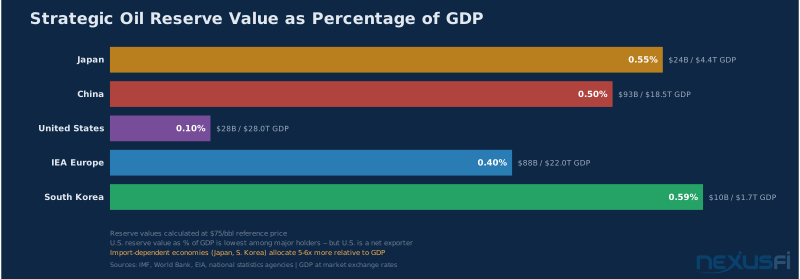
As % of GDP: At $75/bbl, the SPR's value is approximately $31 billion — roughly 0.1% of U.S. GDP
The U.S. is in a unique position among major economies. As a net petroleum exporter, the traditional "days of net imports" metric doesn't apply the same way. The SPR exists more for national security and price stabilization than for import coverage.
China -- The Opaque Giant
Estimated total crude stocks: 1.24 billion barrels (record, April 2026, per Vortexa Analytics)
Government strategic reserves: ~401 million barrels
Commercial/state-mandated storage: ~668+ million barrels
Days of import coverage: 110-140 days (per Oxford Institute for Energy Studies)
Daily crude imports: ~9.25 million bpd (April 2026, though normally ~11 million bpd)
As % of GDP: At $75/bbl, China's strategic stocks are worth approximately $93 billion — roughly 0.5% of GDP
China holds the world's largest strategic oil inventory — and it doesn't publicly disclose exact numbers. Analysts piece together estimates from satellite imagery, tanker tracking (Vortexa, Kpler, Kayrros), and cross-referencing imports minus refinery throughput minus domestic production. China's revised Energy Law, effective January 2025, enshrined stockpiling requirements in statute and shifted storage costs onto corporate entities, accelerating the buildup.
China's reserve strategy is at the core different from the U.S. approach. Beijing views oil stockpiles as a hedge against three risks simultaneously: supply disruption (especially through the Strait of Hormuz), price volatility, and currency volatility. With nearly 75% of its crude arriving by tanker through potentially contested waterways, China's reserve calculus is existential in a way the U.S. — sitting on 13+ million bpd of domestic production — doesn't face.
As of April 2026, China was still adding approximately 430,000 barrels per day to its reserves even during the Hormuz crisis, demonstrating much greater resilience compared to Europe, Japan, and South Korea, which were all scrambling to manage supply disruptions.
IEA Europe
IEA requirement: 90 days of net imports (or equivalent coverage)
Structure: Mix of government-held reserves and mandated industry stockholding
Key feature: Compliance varies by country. Germany, France, and the UK maintain significant government reserves. Smaller members rely more heavily on mandated commercial stocks.
As % of consumption: European OECD members collectively consume roughly 13 million bpd. Reserves at 90 days of net imports represent approximately 1.17 billion barrels across all member states.
March 2026 coordinated release: European IEA members participated in the coordinated release following the Strait of Hormuz closure
Japan
Structure: Government reserves plus mandated industry stockholding
Import dependence: Nearly 100% for crude oil
Estimated coverage: Exceeds IEA 90-day requirement when government and industry stocks are combined
Strategic priority: Extremely high — Japan's economy is almost entirely dependent on imported energy
As % of GDP: Japan consumes ~3.5 million bpd. At 90+ days of coverage, its reserves (~315+ million barrels) are worth roughly $24 billion at $75/bbl — approximately 0.5% of GDP
South Korea
Structure: Similar to Japan — government reserves plus mandated industry stocks
Import dependence: ~95% for crude oil
Strategic priority: Critical — the fifth-largest crude importer globally
Coverage: Meets or exceeds IEA 90-day requirement
The key takeaway for traders: days of consumption is the metric that matters. Raw barrel counts are meaningless without context. The U.S. sitting on 375 million barrels sounds massive, but that's only ~19 days of domestic consumption. China's 1.24 billion barrels covers 110-140 days of imports. Japan's reserves, though smaller in absolute terms, cover 90+ days of its near-total import dependence. When SPR headlines hit, convert to days of coverage to assess the real impact.
How SPR Headlines Move CL Futures #
SPR releases and refill announcements transmit into crude oil markets through three channels:
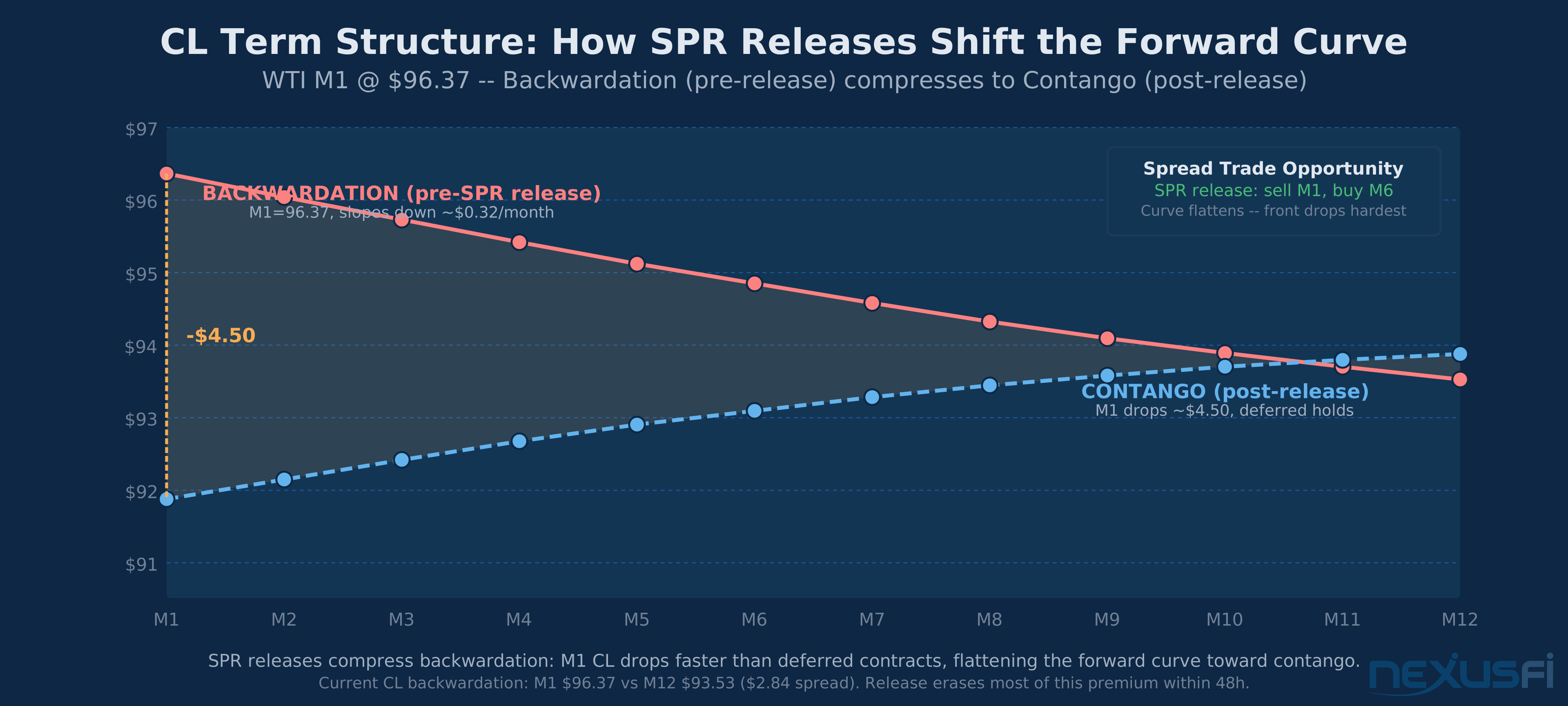
1. Prompt supply expectations. An SPR release adds physical barrels to the market within weeks. This compresses the front-month premium relative to deferred contracts — flattening or inverting backwardation. When the Biden administration announced the 180-million-barrel release in March 2022, the WTI M1-M2 spread tightened immediately as the market priced in additional near-term supply. As @SMCJB has analyzed, the interplay between term structure shape and producer hedging behavior means that backwardation vs. contango isn't just a theoretical distinction — it determines who's winning between OPEC non-hedgers and shale drillers who hedge forward.
2. Policy credibility. Markets don't just price the barrels — they price the government's willingness to act. A large, credible release signal can dampen speculative long positioning before any physical oil moves. Conversely, a tepid or politically motivated release might be dismissed by the market. The 2022 release worked partly because 180 million barrels was credibly large and accompanied by coordination with IEA partners.
3. Refill demand as a price floor. Here's what most retail traders miss: SPR replenishment creates incremental government demand that acts as a soft price floor. When the DOE announces it's buying crude for the SPR, that's a guaranteed buyer entering the market. During the 2023-2024 refill program, DOE purchases were widely understood to target sub-$80 WTI, which created a psychological floor around that level. Traders front-run government buying just like they front-run any large, predictable flow.
Practical trading signals to watch:
- DOE Notice of Sale announcements (release signal -- bearish short-term)
- DOE procurement solicitations for SPR purchases (refill signal -- bullish short-term)
- Weekly EIA petroleum status reports showing SPR inventory changes
- IEA emergency coordinated release statements
- Congressional budget language mandating SPR sales (supply increase signal)
Historical pattern: SPR release announcements have their maximum market impact in the first 24-48 hours. The actual barrels take weeks to months to flow through the system. Front-month CL reacts immediately on the announcement — then the effect fades as the market returns to pricing fundamentals (OPEC+, demand, positioning). Don't fade the initial move, but don't expect the SPR to override the macro either.
When the EIA weekly petroleum report shows SPR inventory changes, that's historical data — the market already traded the announcement days or weeks earlier. Focus on forward-looking signals: DOE Notices of Sale and procurement solicitations, not the inventory number after the fact.
May 2026 -- Under 375 Million and Falling #
The SPR's current situation is the most strained since it was established. Here's the scorecard as of late May 2026:
- Current inventory: Under 375 million barrels -- the lowest since the early 1980s buildup phase
- Largest weekly drawdown on record: Approximately 10 million barrels in a single week (May 2026)
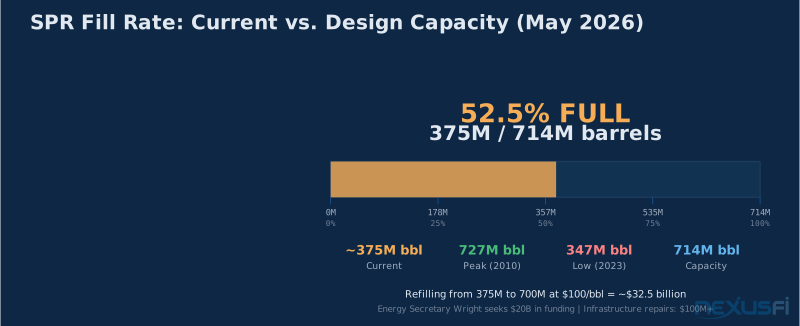
- Fill rate: 52.5% of design capacity -- roughly half full
- WTI price environment: $101+ per barrel, with a spike to $114.58 on April 7 during the acute Iran-Hormuz crisis
- Infrastructure: More than $100 million in repairs needed from the 2022 rapid drawdown
- Political context: The Trump administration campaigned on refilling the SPR but has overseen the largest single-week drain in history
The IEA coordinated an emergency release across member nations in March 2026 following Iran's effective closure of the Strait of Hormuz. That release drew U.S. SPR levels from approximately 415 million barrels down to 409 million. The subsequent May drawdown pushed inventory below 375 million.
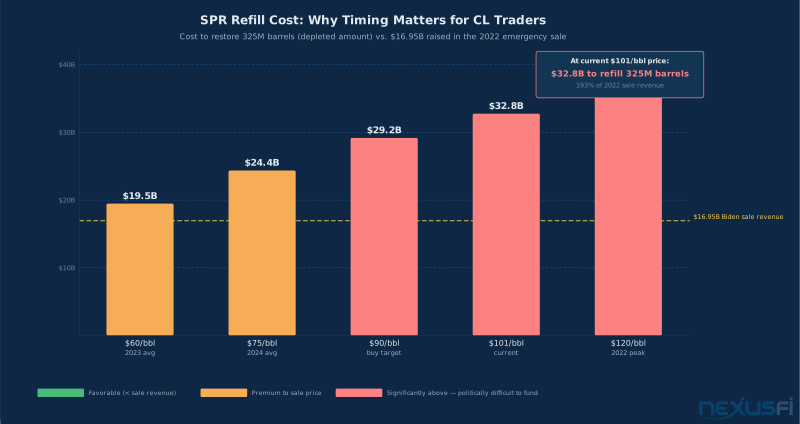
Energy Secretary Chris Wright has publicly sought $20 billion in funding to refill the reserve to approximately 700 million barrels. At current crude prices above $100/bbl, the math is brutal: replenishing 325 million barrels at $100 each would cost roughly $32.5 billion. That's more than the entire $16.95 billion revenue from Biden's 2022 emergency sales. The fiscal "surplus" from the Biden buy-low-sell-high trade has been completely erased by the price environment.
This is the fundamental tension in SPR management: the reserve is most needed when oil prices are high, but that's also when refilling is most expensive. The Biden administration's playbook — release during a price spike, refill during a price trough — only works if you get the timing right. The current administration faces the opposite problem: prices are elevated, the reserve is depleted, and geopolitical risk is acute.
At current CL prices (~$96-101/bbl), refilling 325 million barrels to approach design capacity would cost $31-33 billion. Congress hasn't authorized that funding. Any administration that starts aggressive SPR buying at these prices faces enormous political and fiscal headwinds — which means refill pace will be slow regardless of stated intentions.
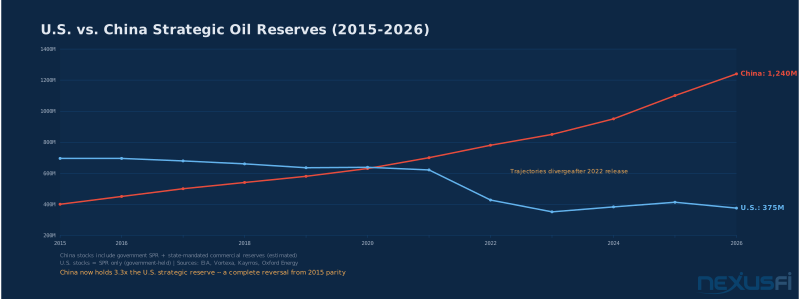
Meanwhile, China continues to add to its reserves. That asymmetry — the world's largest oil consumer building stockpiles while the world's most advanced economy drains them — is the strategic backdrop that every CL futures trader should have on their radar.
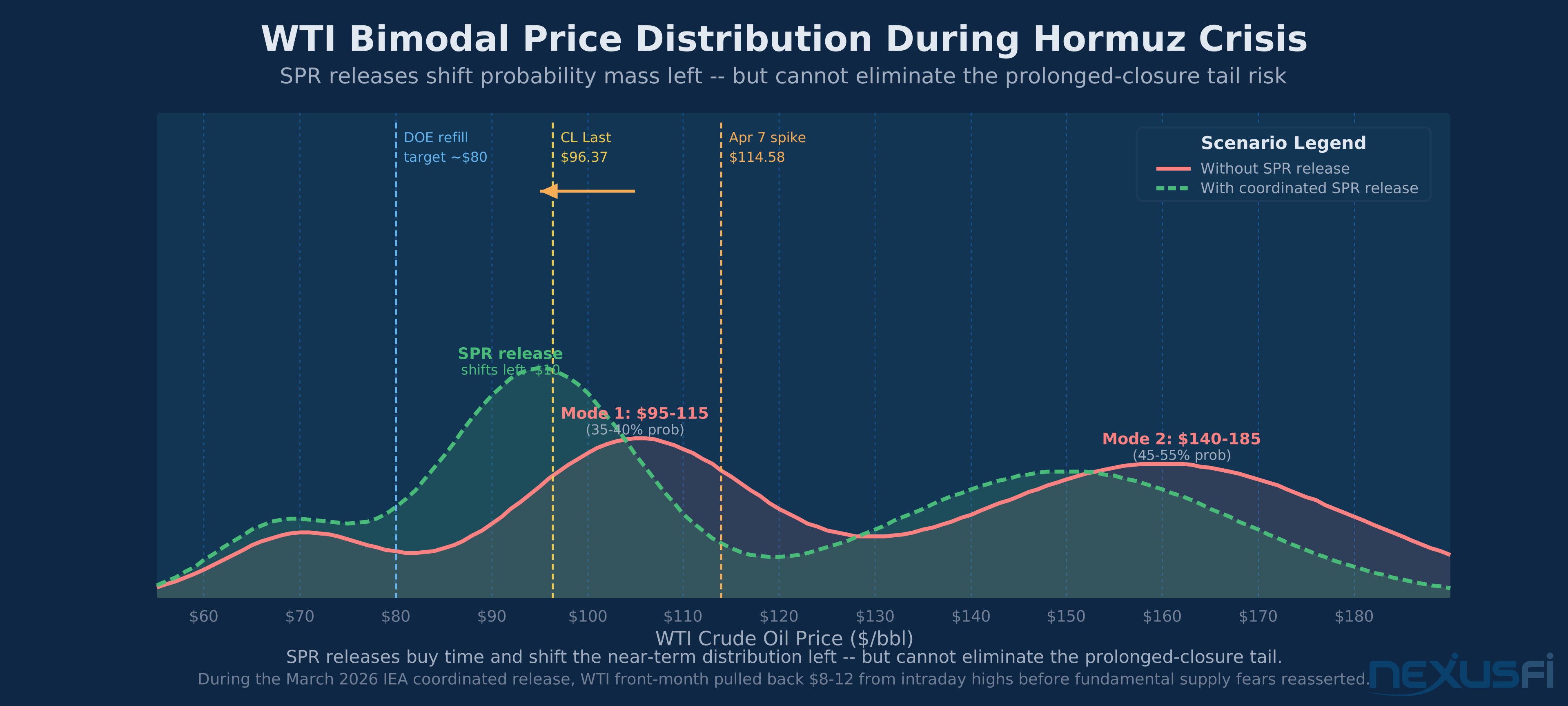
The market's bimodal pricing during the Hormuz crisis illustrated the stakes. As @jlabtrades laid out on NexusFi during the acute crisis, the options market was pricing two distinct modes: containment at $95-115 (35-40% probability) and prolonged closure at $140-185 (45-55% probability). In both modes, SPR releases appear in the analysis — but @jlabtrades noted explicitly that "SPR releases — US/IEA coordinated release buys time but doesn't solve it." That's the correct framing: the SPR is a time-buyer, not a price-setter.
What CL Traders Need to Watch #
The SPR is a policy tool with real market consequences. Here's the watchlist:
DOE refill pace. Any announcements about SPR procurement — solicitations, target prices, volume commitments — act as near-term demand signals. At current price levels, large-scale refilling is politically and fiscally difficult. If crude drops back below $80, watch for aggressive DOE buying.
Congressional action. Budget language mandating SPR sales (used as deficit offsets) has been a recurring pattern. Mandated sales add known future supply to the market and can weigh on deferred contracts. Conversely, Congress blocking mandated sales (as Biden secured in 2023-2024) is bullish for term structure.
IEA coordination. The March 2026 coordinated release demonstrated that IEA members can still act collectively. Future emergency releases could come quickly if Hormuz escalates further. Watch for IEA emergency meeting announcements — they precede coordinated releases.
China stockpile data. Vortexa, Kpler, and Kayrros satellite data provide estimated Chinese inventory levels. When China is buying aggressively, it tightens the global physical market. When it draws down, that's incremental supply. The opacity means market-moving estimates can differ by hundreds of millions of barrels depending on methodology.
Infrastructure constraints. The SPR can't be refilled at any arbitrary rate — salt cavern physics and infrastructure condition limit injection speed. If the Trump administration gets funding, actual refill pace will be slower than the headline numbers suggest.
As @SMCJB shared on NexusFi, the concept of the "Strategic Resilience Reserve" — reimagining the SPR to address broader commodity shocks beyond just oil — is gaining traction in policy circles. If that conversation moves from FT op-eds to Congressional hearings, it would at the core change how the market prices SPR capacity and its relationship to CL futures.
The five signals that actually move CL when they cross the tape: (1) DOE Notice of Sale — bearish, fast, trades within hours; (2) DOE procurement solicitation — bullish, front-run to sub-$80; (3) IEA emergency meeting announcement — bearish, coordinated release incoming; (4) Congressional mandated-sale language in budget bills — mild bearish on deferred contracts; (5) China stockpile estimate revisions — directional bias shift, slow-moving but structural.
Bottom line: the SPR is a blunt instrument, but it's a real one. It moves physical barrels, shifts term structure, and signals government intent. At 52% capacity with crude above $100 and geopolitical risk elevated, the reserve has less room to maneuver than at any point in its 50-year history. For CL traders, that means the next SPR headline — whatever direction it goes — will carry more weight than usual. The buffer is thin. Price it so.
Knowledge Map
Prerequisites
Understand these firstGo Deeper
Build on this knowledgeReferences This Article
Articles that build on this topicCitations
- — The CL Crude-analysis Thread (2023) 👍 2“With production at nearly 14 million bpd, the SPR is far less important than it used to be. The US is virtually oil self sufficient. SPR plus 90 days of production now equals roughly 1.54 billion barrels.”
- — The CL Crude-analysis Thread (2024) 👍 2“The concept of the Strategic Resilience Reserve -- reimagining the SPR to address broader commodity shocks beyond just oil -- is gaining traction in policy circles.”
- — The CL Crude-analysis Thread (2023) 👍 2“These charts cherry-pick a short-term price spike to make the case that demand has somehow collapsed. The extraordinary SPR maneuvers were employed in the wake of Russia invasion. If 600k b/d are dumped from the SPR, oil prices should drop, and they did. But demand was not that terrible -- $80 Brent is not consistent with a global recession.”
- — Trading CL (Crude Oil futures) #2 (2014) 👍 6“Like any of these data releases the difference to expectation is far more important than the absolute number itself. Oil inventory numbers are complicated -- divided into regions, crude vs products, imports by boat have uneven supply profiles, and stocks are seasonal.”
- — The CL Crude-analysis Thread (2017) 👍 4“Because OPEC members do not hedge, their revenues are linked to spot prices. Shale drillers hedge and their earnings are linked to futures prices one or two years forward. Since 2014, WTI generally in contango -- shale hedgers realised higher prices than OPEC non-hedgers.”
- — US-Israeli Strikes Kill Iran Supreme Leader -- Oil Surges (2026) 👍 3“The two modes the market is now pricing: Mode 1 Escalation Contained $95-115/bbl probability 35-40%, Mode 2 Prolonged Closure $140-185/bbl probability 45-55%. SPR releases -- US/IEA coordinated release buys time but does not solve it. Critical wildcard: China position as Iran largest oil customer with enormous diplomatic leverage.”
- — DOE: Biden-Harris Administration Makes Final SPR Purchase
- — EIA: China, US, Japan hold most strategic oil inventories in 2025
- — CRS: The Strategic Petroleum Reserve -- Background, Authorities, and Considerations
- — CFR: How Does the U.S. Government Use the Strategic Petroleum Reserve?
- — Oxford Institute for Energy Studies: The Drivers of China Crude Buying Binge
- — E&E News: Aging caverns imperil Trump push to refill petroleum reserve