



Top of Book: What the Best Bid and Ask Actually Tell You About the Next Trade
Overview #
Top of Book: What the Best Bid and Ask Actually Tell You About the Next Trade
Every futures trade starts at the top of the book. When you hit "buy market," your order lifts the best ask. When you hit "sell market," your order hits the best bid. Top of Book (TOB) — the best bid price, the best ask price, and the size sitting at each — is the single most immediate piece of information about where the market stands right now.
Most traders watch price. Fewer watch how the top of the book behaves. The difference matters. TOB changes are leading indicators of very short-term price movement. A price chart shows you where the market has been. TOB shows you where the next trade is about to happen.
This article covers what TOB is, how it relates to market data levels, what specific TOB patterns signal, and how retail futures traders can use TOB analysis for execution timing and momentum confirmation.
Key Concepts #
- Best Bid (BB) — The highest price at which a limit buy order is resting in the order book. This is what you receive if you sell at market.
- Best Ask (BA) — The lowest price at which a limit sell order is resting. This is what you pay if you buy at market.
- Spread — The difference between BA and BB. In liquid ES futures, the spread is usually 1 tick (0.25 points). Spread behavior is one of the most useful TOB signals.
- TOB Size — The number of contracts resting at the best bid and best ask. Size changes at the top of the book are often more informative than price changes.
- Inside Market — Synonymous with TOB. The inside market is the best bid and best ask bracket. Some platforms include additional fields (last trade, mid-price), but the core definition is the same.
- Mid-Price — (BB + BA) / 2. Many order-flow models track mid-price rather than last trade because it reflects the current equilibrium between buyers and sellers, not just the most recent aggressor.
How the Order Book Works #
The order book is a queue of resting limit orders at various price levels. Bids (buy limits) stack below the current price. Asks (sell limits) stack above it. The top of this structure — where the highest bid meets the lowest ask — is where price discovery happens in real time.
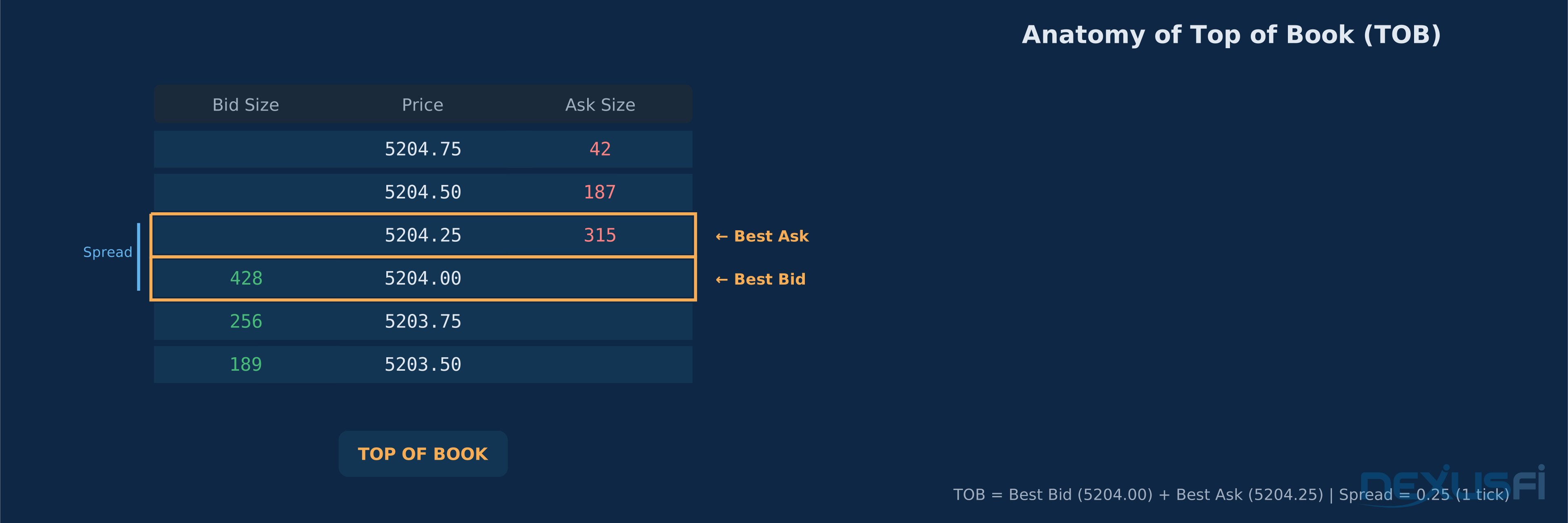
When a market order arrives, it executes against the resting order at the top of the opposite side. A market buy lifts the best ask. A market sell hits the best bid. If the size at the top gets fully consumed, the next level becomes the new top of book, and the spread may widen.
This is the fundamental mechanism of price movement in electronic futures markets. Price doesn't "move" — resting orders get consumed, and the remaining liquidity defines new price levels. TOB is where you see this happen first.
Market Data Levels: L1, L2, and Full DOM #
How much of the order book you can see depends on your data subscription.
Level 1 (L1) is basically TOB: best bid, best ask, their sizes, last trade price, and volume. This is what most basic data feeds provide. As @steve2222 noted on NexusFi, CME's Top of Book subscription is available for just $1-3 per month per exchange — "not even about penny pinching" — making it the most accessible market data tier.
Level 2 (L2) adds the ladder: multiple price levels (typically 5-10 deep) of resting bids and asks beyond the top. With L2 you can see whether the TOB is backed by deep liquidity or sitting on thin air.
Full DOM (Depth of Market) extends this to all visible levels, often including historical depth data and iceberg order detection on some platforms.
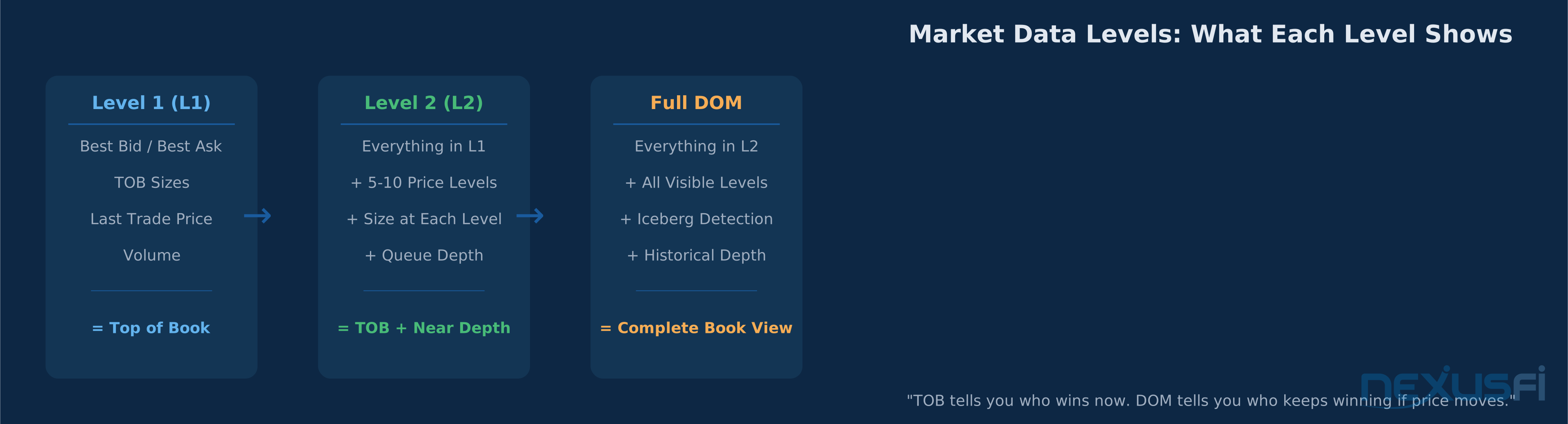
The practical distinction: TOB tells you who wins right now. Full depth tells you who keeps winning if price moves. A thin TOB with nothing behind it breaks easily. A thin TOB backed by deep liquidity at the next few levels holds.
TOB size matters, but how it gets consumed matters more.
What TOB Changes Signal #
TOB is a real-time tug-of-war between buyers and sellers at the market's edge. Here's what specific patterns typically indicate:
Spread tightens (BB rises, BA falls, or both) — Aggressive interest pulling liquidity inward. Often precedes a directional move, but the direction depends on which side is driving the tightening.
Spread widens — Liquidity withdrawal. One or both sides are pulling their quotes. In futures, widening often precedes volatility expansion. If one side suddenly disappears (ask jumps several ticks), it signals sharp imbalance.
BB stair-steps higher with asks being lifted — Persistent demand. Buyers are stepping up while sell-side liquidity gets consumed. This is textbook buying momentum at the microstructure level.
Size builds at BB or BA without price change — Accumulating pressure. A growing bid wall can signal support being defended, but as
Not all displayed size is real.
Rapid 1-tick oscillation ("flicker") — Choppy, directionless conditions. If BB and BA are flickering back and forth faster than you can process, the market is in a high-churn state where trend signals are unreliable.
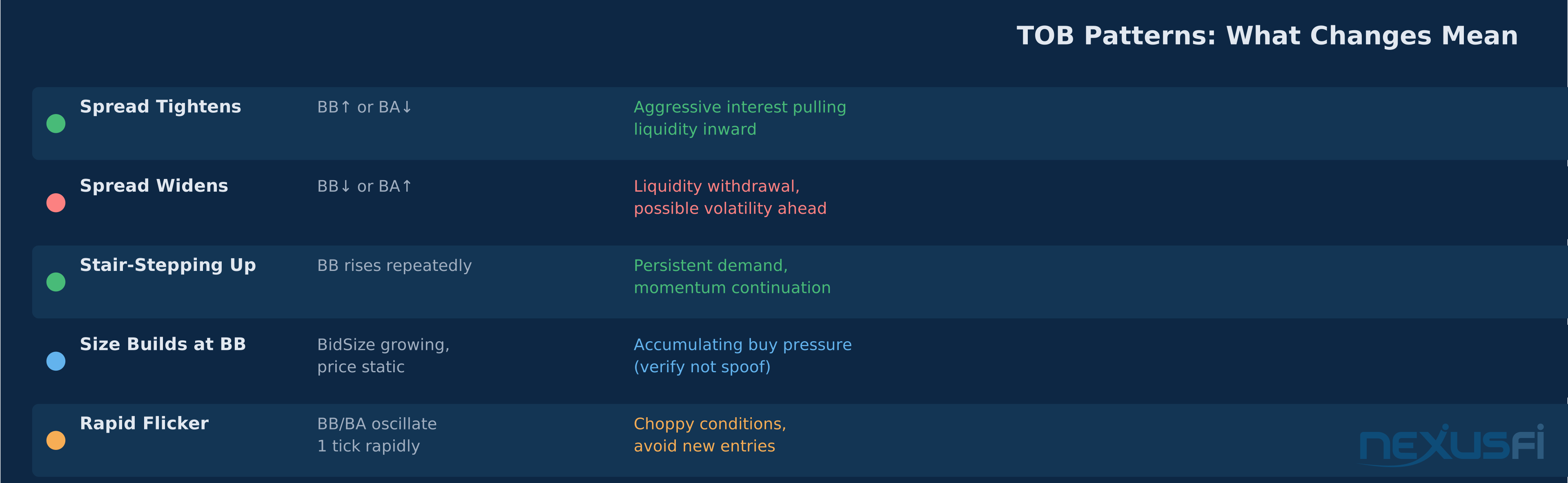
The critical principle: interpret direction, speed, spread, and size together. A single TOB price change is noise. Three consecutive BB improvements in the same direction with stable spread is signal.
TOB vs. Full Depth of Market #
TOB has a fundamental limitation: it only shows the first level. It can't tell you whether the market is well-supported beyond that level.
hold that level.
| Aspect | TOB Only | Full DOM |
|---|---|---|
| What you see | Best bid/ask and sizes | Multiple levels, queue depth |
| Strength | Speed, simplicity | Context, resilience assessment |
| Weakness | Blind to deeper support/resistance | More data to process, can be noisy |
| Best question answered | "Who wins right now?" | "Who wins if price moves 2-3 ticks?" |
For most retail traders with L1 data, the practical approach is to combine TOB with time and sales data. Time and sales shows you what's actually trading (market orders consuming resting liquidity), while TOB shows you what's resting. Together they give you most of the actionable information from L2 without the cognitive overload.
How Algorithms Use TOB #
High-frequency and algorithmic traders treat TOB as a primary input because it's the fastest-changing, most actionable data available.
Common algorithmic uses of TOB data:
- Latency arbitrage — reacting to TOB changes before slower participants
- Market making — continuously adjusting quotes at BB/BA based on TOB dynamics
- Imbalance models — feeding delta-BB, delta-BA, spread changes, and size imbalance into statistical models that predict next-tick direction
- Spoofing detection — analyzing whether large orders at TOB are persistent or get canceled as price approaches
What this means for retail traders: Not all displayed TOB size is real liquidity. High-frequency participants routinely place and cancel large orders to create false pressure signals. Look for persistence (does the size survive multiple seconds?) and consumption (do actual trades execute against it?) before treating a large TOB size as meaningful.
Practical Playbook: Using TOB for Execution #
Momentum Confirmation #
Use TOB to validate momentum signals from your primary analysis. Momentum is more likely to continue when:
- Spread is tight or tightening — stable at 1-2 ticks
- BB or BA moving in your direction — consistent for 3+ updates within 1-2 seconds
- Opposite-side size decreasing — asks thinning during an up move, bids thinning during a down move
- Tape confirms — recent trades executing on your side of the market
If all four align, the microstructure supports continuation.
Reversal Warnings #
Watch for reversal risk when:
- Spread suddenly widens — 2-3+ ticks after a sustained move
- Mid-price stalls — stops improving for several seconds while TOB churns
- Defending side thins — the side that was holding starts losing size without replenishment
- Trade direction flips — prints start hitting the opposite side of the mid
Response: tighten stops, scale out, or step aside entirely.
Execution Timing #
TOB behavior directly affects your fill quality:
- Narrow stable spread + thin opposite side: Aggressive entry works — low slippage, high fill probability
- Widening spread + high churn: Avoid market orders. Use a limit or wait for stabilization
- Large persistent wall at BB/BA: Consider joining the queue if you want to trade with the defending side. Otherwise, watch for absorption as a breakout signal
- High-frequency flicker with no direction: Stay out. The market is telling you nothing useful
Limitations Worth Knowing #
TOB is powerful but constrained:
- Short-horizon signal only — TOB reflects immediate imbalance, not underlying positioning. A 5-minute chart trend can persist through hundreds of TOB flips.
- Displayed size does not equal true liquidity — iceberg orders, hidden orders, and spoofing all reduce the reliability of what TOB displays.
- Latency matters — even a small delay between what you see and what the exchange sees means your TOB reading may be stale by the time your order arrives.
- Queue priority is invisible — TOB shows the price level and aggregate size, but not your position in the queue. Two traders with limits at the same price will get filled in the order their orders arrived.
TOB is most valuable as an execution tool and signal filter — not a standalone strategy. Combine it with price action, volume profile, and time and sales for the most strong read on what the market is doing right now.
Knowledge Map
Go Deeper
Build on this knowledgeReferences This Article
Articles that build on this topicCitations
- — CME market data Top of Book subscription (2015) 👍 7“CME market data subscriptions are now available at a 'Top of Book' level from Optimus Futures, Discount Futures and Commodity*Brokerage. E-Mini S&P Brokerage and AMP Trading.”
- — Is DOM worth using with 5 levels (2022) 👍 3“I think at this point, there is too much focus on the DOM levels. If you think about it - there's a few types of players on the DOM showing size: - spreaders - who have no directional bias after the trader - spoofers - who will pull as we get closer...”
- — A depth of market question (2013) 👍 5“The most recent price is not always an indication of the current state of the order book. Orders can be added and withdrawn before a new trade is executed. Your DOM shows an order book with the best bid at 128.61 and the best ask at 128.62.”
- — Order Flow Journal (2012) 👍 3“I trade off the DOM... When you see a thick level, it is merely a 'heads-up'. You cannot trade off it alone. There is no guarantee that price will go there. It is 50/50 Sometimes it will spook the market in the opposite direction.”