



Level 1 vs Level 2 Market Data: What Futures Traders Actually Need to Know
Overview #
Every futures trader eventually hits this question: do I need Level 2 data, or is Level 1 enough? The answer isn't "L2 is better." It's "L2 is different — and whether that difference matters depends entirely on how you trade."
Here's the core distinction. Level 1 tells you the market's current price. Level 2 tells you the market's immediate liquidity structure. One shows where price is. The other shows how price might move next — and why. For a swing trader holding ES overnight, that distinction is irrelevant. For a scalper reading absorption at a key level, it's everything.
This article breaks down exactly what each data tier contains, how the feeds work mechanically, what they cost, and — most importantly — when L2 is worth the investment and when it's expensive noise.
Key Concepts #
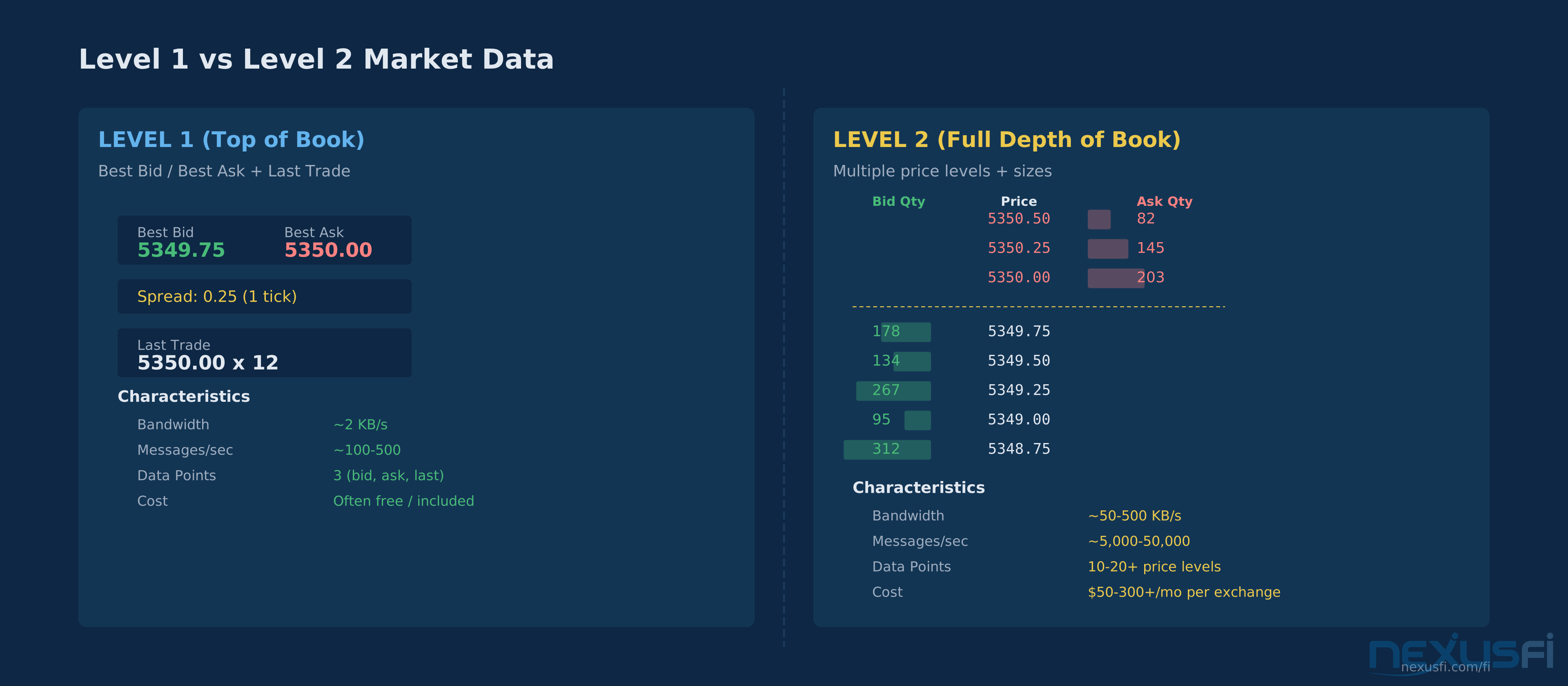
Level 1 (L1) / Top of Book: The minimum real-time quote set — best bid price and size, best ask price and size, last trade price and size, plus session aggregates like volume, high/low, and settlement. For futures, L1 is often a synthetic top-of-book for the lead contract month, delivered via consolidated feeds like CME MDP 3.0 or ICE Top-of-Book.
Level 2 (L2) / Market Depth: Multiple price levels of resting liquidity on both bid and ask sides, typically aggregated by price level rather than showing individual orders. L2 is what powers the DOM (Depth of Market) ladder display that scalpers and order-flow traders live on.
Implied Order Book: A futures-specific feature where the exchange generates synthetic liquidity from related instruments — especially calendar spreads and combination orders. This is why DOM depth for spread markets can look different than you'd expect from naively summing the legs.
Book Reconstruction: The process of building and maintaining an accurate depth display from incremental exchange messages — add, modify, remove, trade. If this process breaks down (missed packets, sequence gaps), your DOM shows phantom liquidity.
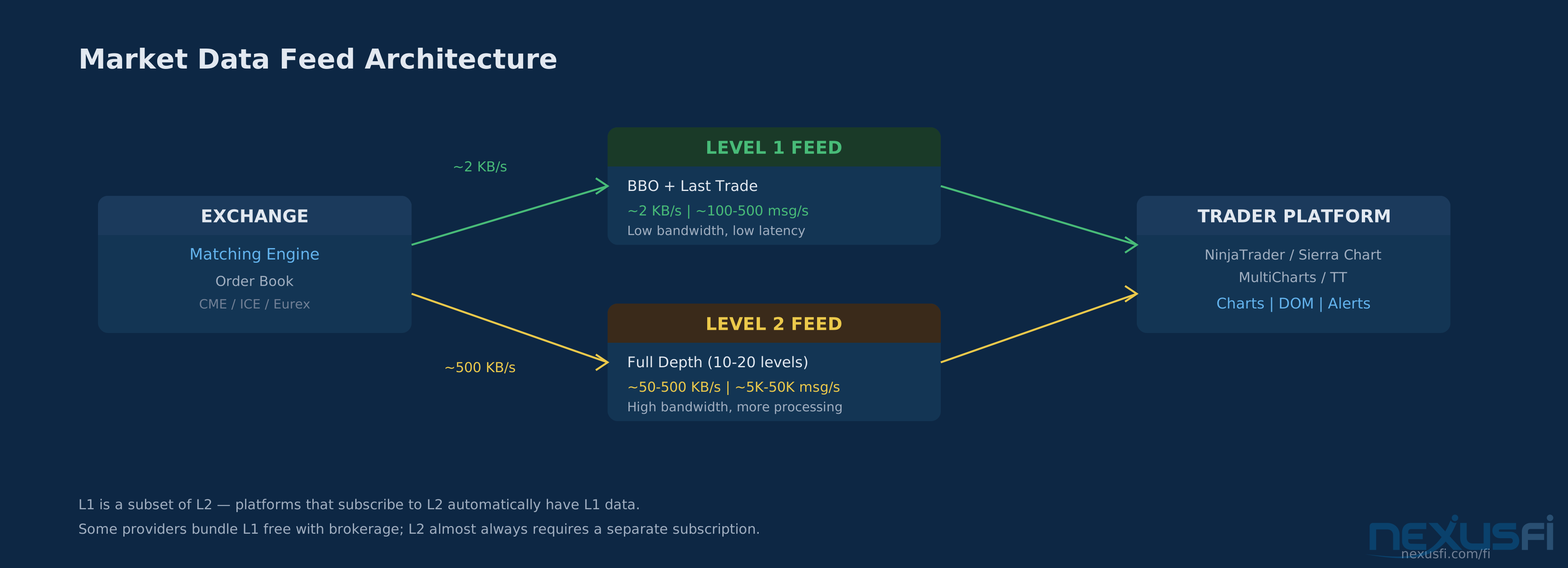
Feed Delivery Model: Market data arrives via snapshot + incremental updates with sequence numbering. L1 is lightweight (kilobytes/sec). L2 can push megabytes/sec on liquid contracts and demands serious infrastructure to process correctly.
How It Works #
What Level 1 Actually Contains #
L1 for a futures contract delivers these fields in real-time:
- Best bid: highest displayed bid price and aggregate size
- Best ask: lowest displayed ask price and aggregate size
- Last trade: price, size, and direction flags
- Session statistics: cumulative volume, open, high, low, settlement, net change
That's it. No depth beyond the inside market. No visibility into how much liquidity sits at the next 5, 10, or 50 price levels. Just the best available prices and what just traded.
For ES, a typical L1 snapshot looks like this:
- Bid: 5350.00 x 18
- Ask: 5350.25 x 22
- Last: 5350.25 x 5
- Volume: 1,245,000
You know the spread is 1 tick. You know a recent trade lifted the offer. You know daily volume. That's plenty for a swing trader watching whether ES is holding above VWAP or breaking a session high.
What Level 2 Actually Contains #
L2 adds the depth dimension — multiple price levels beyond the inside market:
| Bid Size | Bid Price | Ask Price | Ask Size |
|---|---|---|---|
| 18 | 5350.00 | 5350.25 | 22 |
| 85 | 5349.75 | 5350.50 | 135 |
| 210 | 5349.50 | 5350.75 | 290 |
| 380 | 5349.25 | 5351.00 | 440 |
| 550 | 5349.00 | 5351.25 | 370 |
Now you can see the liquidity structure. The ask side is building heavier above the market. Bids are stacking below but thinner near the inside. A scalper reads this and asks: will the offers at 5350.75-5351.00 hold, or will aggressive buying sweep through them?
Two critical clarifications experienced traders need:
L2 shows aggregated depth by price level, not individual orders. When you see "210 contracts at 5349.50," that might represent 30 separate resting limit orders. You don't see the individual order queue.
Futures L2 includes implied liquidity. For spread and combination markets, the exchange generates synthetic depth from related instruments. A calendar spread order on ES can create implied bids and offers on the outright contract. This means depth can appear or disappear "from nowhere" — it's the exchange's matching logic creating and removing implied interest as spread orders change.
Feed Delivery Mechanics #
Both L1 and L2 arrive via the same fundamental model: an initial snapshot establishes the book state, followed by incremental updates maintaining it in real time.
For L1, the updates are straightforward — best bid changed, best ask changed, trade printed. Message rates typically run 10,000-50,000 messages per second during active periods, depending on how many instruments you're tracking.
For L2, the mechanics are much more complex:
- Add: new resting interest appears at a price level
- Modify: existing level changes size
- Remove: liquidity is canceled or fully executed
- Trade: aggressive order removes resting liquidity
Each of these events generates a message. On liquid contracts like ES during RTH, L2 message rates can exceed 500,000 messages per second during volatile periods. Every message must be processed in sequence — if your system misses updates or processes them out of order, the displayed book diverges from reality.
Resync behavior matters. When the feed handler detects a sequence gap (missed packets), it must request a fresh snapshot and rebuild the book from scratch. During that resync window, your DOM is unreliable. On fast-moving instruments like NQ, a resync during a breakout means you're flying blind at exactly the wrong moment.
Latency and Bandwidth #
The resource gap between L1 and L2 is not incremental — it's an order of magnitude.
L1: kilobytes per second per instrument. Minimal CPU. Any modern machine handles it trivially. Your charting platform's biggest bottleneck is rendering, not data processing.
L2: megabytes per second for active contracts like ES. Requires efficient parsing, book reconstruction logic, sufficient CPU and memory, and low-latency network paths. DOM rendering itself can become a bottleneck — if your platform can't keep up with update rates, you see a laggy ladder that shows stale depth.
For serious L2 use — scalping, market making, or order-flow strategies — delayed or choppy DOM rendering distorts your perception of liquidity. A book that updates too slowly means you're making decisions on stale information. In a fast ES or NQ tape, your visual depth can become invalid almost instantly.
This is the dirty secret of L2: the data is only useful if your infrastructure can process it fast enough. A laptop adequate for L1 swing analysis may completely choke on full-depth NQ DOM during volatility.
Practical Application #
The Trading Style Matrix #
This is the decision that matters. Not "is L2 better?" but "does L2 improve MY trading?"
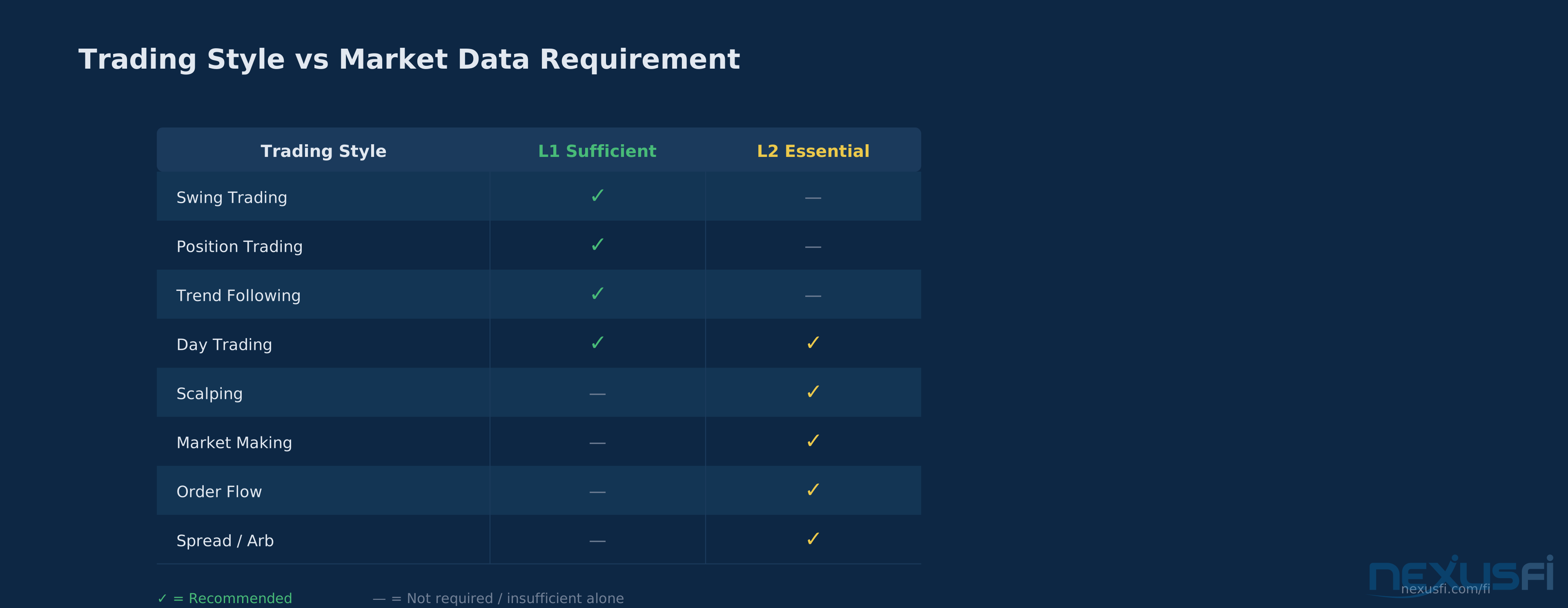
L1 is generally sufficient for:
- Swing trading — holding hours to days, entries from chart structure
- Position trading — multi-day to multi-week macro themes
- Trend following — moving average crossovers, breakout systems, momentum
- Higher-timeframe technicals — 15-minute, hourly, or daily chart setups
- Event-driven directional — trading the CPI release direction, not the microstructure
If your edge is based on where price is going — macro direction, technical structure, trigger reactions — L1 gives you everything you need. The depth 5 ticks away from the inside market is transient noise on your timeframe.
L2 becomes essential for:
- Scalping — sub-minute holding periods, reading absorption and queue dynamics
- Market making — managing inventory risk, estimating adverse selection
- Order-flow trading — imbalance detection, liquidity pulls, wall behavior
- Spread/arbitrage — calendar spreads in CL, yield curve trades in ZN/ZB, relative value
- DOM-dependent execution — one-click placement, queue position management
If your edge depends on how price gets where it's going — whether offers are being absorbed, whether bids are being pulled, whether a breakout has real sponsorship or is just thin-air movement — L2 is your primary data source.
Instrument-Specific Considerations #
ES (E-mini S&P 500): Deep, liquid book. L2 is highly informative for scalpers because you can see meaningful size stacking and clearing at nearby levels. For swing traders, L1 is more than enough.
NQ (Nasdaq-100 futures): Thinner book than ES, faster price movement. L2 is especially valuable here because the book replenishes and cancels rapidly — DOM traders need to see this dynamic to avoid getting caught in thin-air moves. But that speed also means your infrastructure must keep up.
CL (Crude Oil): Event-driven, fragmented depth around inventory releases. L2 helps traders see whether liquidity disappears before a move or whether offers are actually being defended. But during extreme volatility, the book can clear so fast that L2 barely helps.
ZN (10-Year Treasury): Highly rate-sensitive, thinner than equity index futures. L2 is useful for scalpers around FOMC/CPI releases to see queue dynamics and liquidity concentration at key yield levels. For macro directional traders, L1 suffices.
The Decision Framework #
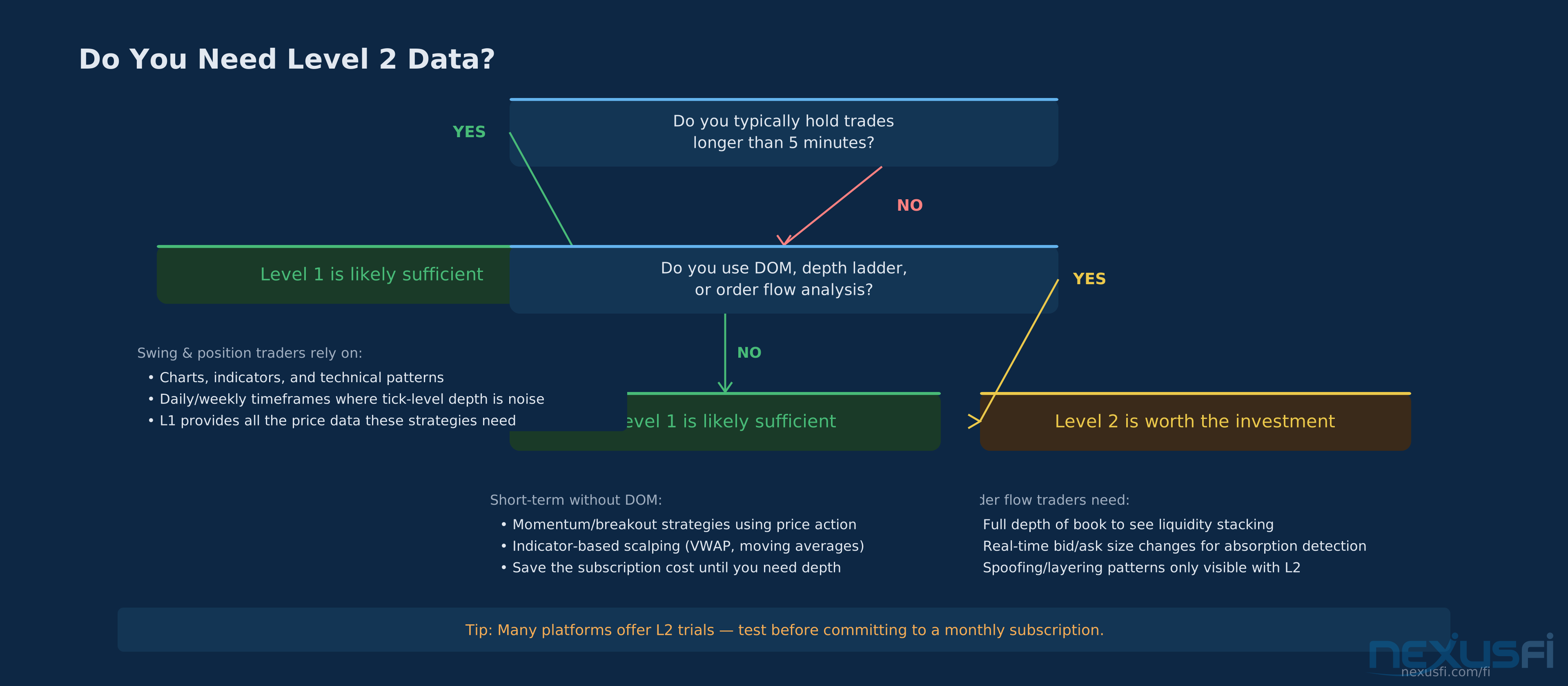
Ask yourself these questions honestly:
L2 is likely worth the investment if:
- You hold trades for seconds to a few minutes
- Your entry and exit decisions depend on liquidity at specific levels
- You actively use a DOM ladder or order-flow tools (footprint, delta)
- You trade liquid intraday instruments (ES, NQ, CL, ZN)
- You care about queue position and can react before depth changes
- You trade spreads where implied depth matters
- You can measure improvement after adding L2
L2 is likely overkill if:
- You hold trades for hours to days
- Your entries come from chart patterns, indicators, or macro themes
- You don't use DOM or order-flow tools in your decision process
- You can't react faster than the book changes
- Watching noisy depth makes you emotionally overreact
- The cost is material relative to your trading account size
That's the nuance L2 traders must internalize. Depth is context, not signal. A 500-lot offer at 5351.00 could be a real sell wall, a spoofer who will pull at the last second, or a hedger who doesn't care about direction. L2 gives you the information. Whether you can interpret it correctly is a separate skill entirely.
Cost Considerations #
L1 is typically bundled with charting platforms or brokerage data packages at low or zero incremental cost.
L2 is a premium add-on. Costs vary much:
- Exchange fees: CME, ICE, and other exchanges charge separately for depth-of-book data
- Professional vs. non-professional: Professional classification can double or triple costs
- Vendor packaging: Some bundle depth; others charge per exchange, per product family
- Realistic range: Hundreds to low thousands of dollars per month across multiple exchanges
The cost question isn't "can I afford L2?" It's "does L2 measurably improve my execution or signal quality enough to justify the expense?" If you can't quantify the improvement, you probably don't need it.
Depth Beyond the Basics #
Data Feed Quality Matters More Than Marketing #
The NexusFi community frequently debates feed quality — especially around providers like Rithmic, CQG, and others. The issues that actually matter for L2 users:
- Update completeness: Does the feed drop messages during volatility?
- Sequence integrity: Are updates delivered in correct order?
- Resync reliability: How quickly and accurately does the feed recover from gaps?
- DOM rendering: Does your platform reconstruct the book correctly from the feed?
- Latency consistency: Not just average speed — jitter and outliers matter
A "fast" feed that drops messages or reconstructs depth incorrectly is worse than a slightly slower reliable one. For scalpers, a feed that loses synchronization during the exact moments depth matters most — fast breakouts, news spikes, liquidation events — is practically useless.
What L2 Does NOT Show You #
Even with full L2 depth, you're still working with incomplete information:
- Hidden/iceberg orders: Large orders split across multiple fills at a single price level, invisible until they trade
- Individual order identities: You see aggregate size, not who placed it or why
- Order intent: That 1,000-lot bid could be a genuine buyer, a hedger, or a spoofer
- True market depth: Dark pools and internalized flow don't appear on the visible book
This is why experienced DOM traders treat depth as probabilistic context, not deterministic signal. The book shows what participants choose to display. What they choose to hide is often more important.
The Implied Book — Unique to Futures #
This deserves emphasis because it confuses traders coming from equities. In futures, the exchange's matching engine can generate implied bids and offers from spread and combination orders.
If a trader places a calendar spread order (buy June ES, sell September ES), the exchange may generate an implied offer on the June outright and an implied bid on the September outright. These appear in the L2 book alongside direct outright orders. When spread interest changes, implied depth changes — creating book movements with no direct outright order activity.
This is especially prominent in:
- CME equity index futures (ES, NQ, RTY)
- Energy products (CL, NG) with active spread markets
- Treasury futures (ZN, ZB, UB) where the yield curve generates heavy spread activity
Understanding implied liquidity is essential for anyone trading futures with L2. Depth at a given price level may partially or entirely consist of implied interest that disappears if the spread leg gets filled.
Knowledge Map
Prerequisites
Understand these firstGo Deeper
Build on this knowledgeReferences This Article
Articles that build on this topicCitations
- — What is the diff between L1 and L2, and do I need L2? (2023) 👍 5“Simple charts showing price and indicators such as moving averages, MACD and so on use level 1 which is current price, transacted volume and the inside bid and offer. Level 1 is also fine for footprint type charts, volume profile and TPO/market profile charts.”
- — What is the diff between L1 and L2, and do I need L2? (2023) 👍 5“In simple terms -- L1 = Top of Book. L2 = Typically 5-10 levels depending on provider. In some cases, like Rithmic, much more.”
- — Is DOM worth using if I only have access to best 5 bid and ask levels? (2022) 👍 3“There's a few types of players on the DOM showing size -- spreaders who have no directional bias, spoofers who will pull as we get closer, actual size who might just need their orders filled, and people that want to hold the market. I would put that latter group at less than 10%.”
- — For DOM based traders. (ES/NQ) (2025) 👍 6“DOM trading reveals the market's real-time supply and demand dynamics. Focus on absorption patterns, liquidity dynamics, and reaction to key levels.”
- — CME market data Top of Book subscription is available (2015) 👍 7“CME market data subscriptions are now available at a Top of Book level from Optimus Futures, Discount Futures and Commodity Brokerage.”