



Trading Political Event Contracts: Elections, Policy, and Government Outcomes
How to analyze and trade election contracts, legislative outcomes, and approval ratings on Kalshi, Polymarket, and Robinhood event contract platforms
Overview #
Political prediction markets have moved from obscurity to mainstream in a compressed four-year window. What began as niche academic experiments and offshore sites has become a regulated, heavily-traded category of financial instruments — with Kalshi earning a court-affirmed CFTC designation as a designated contract market (DCM), Polymarket returning to U.S. traders in 2025 following CFTC approval, and Robinhood integrating event contracts directly into its brokerage platform for millions of retail customers.
The 2024 U.S. presidential election put political prediction markets on the front page. When Kalshi showed Donald Trump trading above 60 cents weeks before election night while major poll aggregators showed a statistical dead heat, market watchers took notice. Prediction markets were more accurate, faster, and more responsive to breaking information than traditional polling — a pattern validated by academic analysis of $2.4 billion in prediction market trading volume during that cycle.
This article covers how to trade political event contracts: elections, legislation, approval ratings, and policy outcomes. Part of the NexusFi Academy Prediction Markets series — see Introduction to Prediction Markets for foundational concepts.
What distinguishes political contracts is the complexity of underlying events, the richness of research data available, and the unique resolution risk profile — where contested outcomes, litigation, and settlement ambiguity can matter as much as probability modeling.
Political event contracts follow standard prediction market mechanics: prices represent probabilities, contracts settle binary (YES = $1.00 / NO = $0.00), and your edge comes from estimating probabilities more accurately than the collective market. What distinguishes political contracts is the complexity of underlying events, the richness of research data available, and the unique resolution risk profile — where contested outcomes, litigation, and settlement ambiguity can matter as much as probability modeling.
How Political Prediction Markets Work #
Price as Probability #
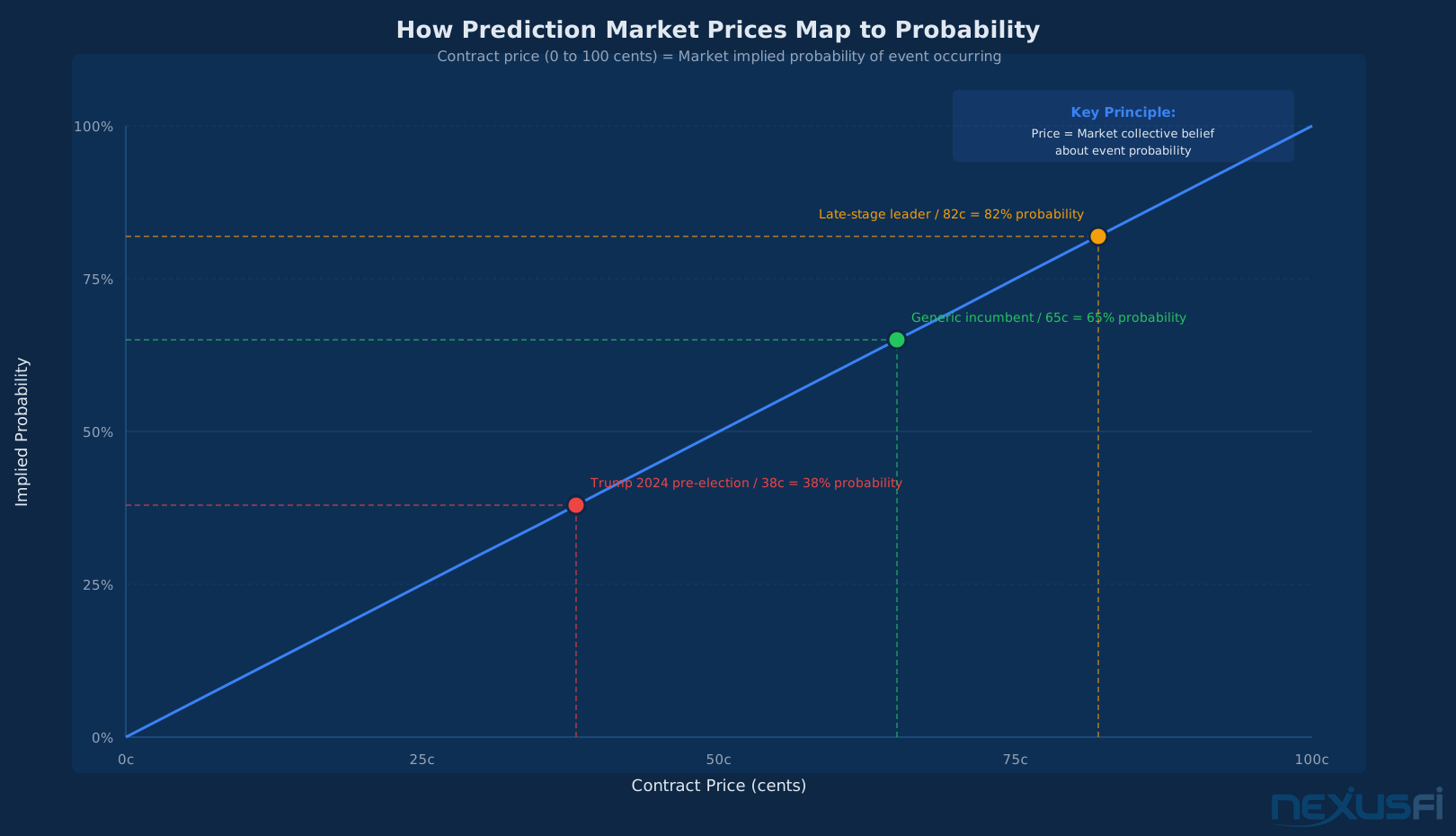
The foundational concept of political prediction markets is that contract prices map directly to implied probabilities. If a contract for "Democrats win the House of Representatives in 2026" trades at 42 cents, the market is pricing a 42% probability of that outcome. Every cent corresponds to one percentage point.
This relationship is not an assumption or approximation — it is the mechanical definition of how these contracts work. Each contract pays $1.00 at settlement if the event occurs, and $0.00 if it does not. A trader who believes the probability is higher than the market price has a positive expected value by purchasing. A trader who believes it is lower can sell (or buy the NO side).
The elegance of this system is that it aggregates diverse information from thousands of participants with real money at stake. A political analyst who has studied the Virginia governor's race for six months, a campaign staffer watching internal polling, a statistician running demographic models, and a retail trader following Twitter sentiment — all of them compete to set the price. The result is a continuously updated probability estimate that reflects genuine conviction backed by financial commitment.
The key insight for traders: The market price is not "the answer." It is the current collective probability estimate. Your job is to determine whether that estimate is accurate or whether your research supports a meaningfully different view.
Contract Settlement and Resolution #
Political event contracts resolve according to specific, documented criteria established when the market opens. These criteria define:
- The exact question: "Will the Democratic candidate win the 2026 Arizona Senate seat?"
- The official data source: "As certified by the Arizona Secretary of State"
- The resolution timeline: "Within 30 days of election night, based on final certified results"
- Dispute handling: "In the event of contested results, the market resolves based on the final determination of the relevant authority"
Understanding resolution criteria is not secondary to probability modeling — it is the foundation. Two contracts that look identical can have materially different resolution risk based on their settlement documentation. A contract that resolves on "projected winner" called by major networks differs from one that requires "certified results" — in close elections with recounts, this distinction can be the entire edge.
Reading the settlement criteria before analyzing the probability is the discipline that separates informed political trading from unsophisticated speculation.
Types of Political Event Contracts #
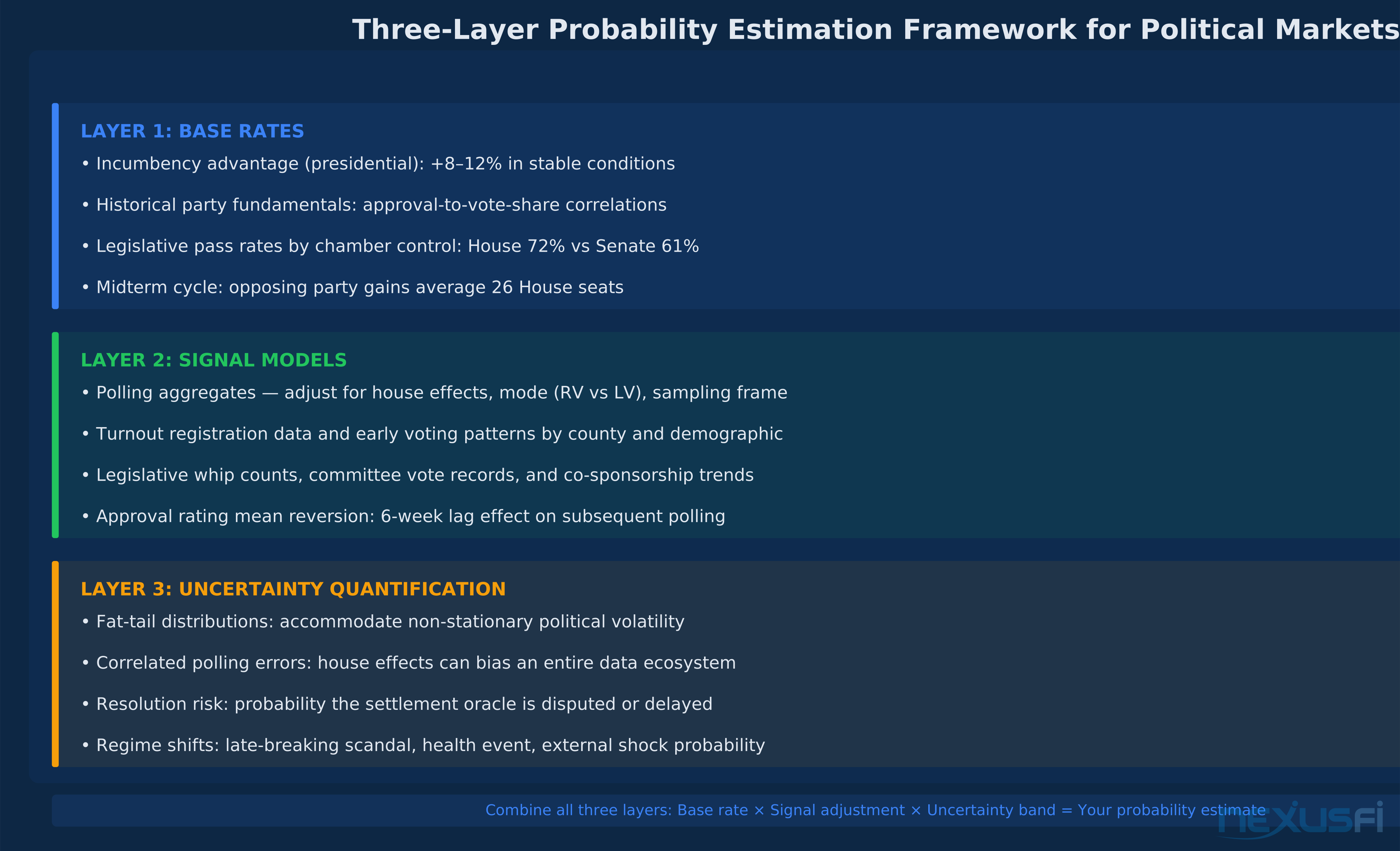
Political event contracts span four main categories, each with distinct analytical approaches and resolution characteristics.
Election Contracts #
Election contracts are the most familiar category and typically offer the deepest liquidity on major political prediction markets. They cover:
- Federal elections: Presidential, Senate, House of Representatives races
- Chamber control: Will Democrats or Republicans control the Senate? The House?
- State-level contests: Governor races, attorney general elections, key state legislative chambers
- Special elections and primaries: Fill-in races and competitive primary outcomes
- International elections: Major elections globally on Polymarket, including UK, France, Germany
Settlement mechanism: Election contracts typically resolve on official certified results from the relevant government authority — the state's secretary of state, the county board of elections, or the parliamentary authority depending on jurisdiction. Most require waiting for final certification rather than network projections, which introduces a timing consideration for traders who need to manage positions across potential recount periods.
Analytical approach: Electoral forecasting combines polling (adjusted for historical house effects and mode), fundamental models (incumbency advantage, presidential approval impact), turnout data, and demographic analysis. The skill is calibrating the uncertainty around all of these inputs, not just finding the point estimate.
Legislative Event Contracts #
Legislative contracts cover the outcomes of Congress and other governing bodies:
- Bill passage: Will the reconciliation bill pass the Senate by year-end?
- Vote outcomes: Will a specific piece of legislation pass the House with 218+ votes?
- Confirmation proceedings: Will the SCOTUS nominee be confirmed by the Senate?
- Budget and appropriations: Will a government shutdown occur? Will the debt ceiling be raised before the deadline?
- Veto and override: Will the president sign or veto the bill? Will the House override?
Settlement mechanism: Legislative contracts typically resolve on Congressional Record documentation — official records of votes, legislative action, and procedural outcomes. These are generally the clearest resolution scenarios because the data is unambiguous: a bill either passes with the required votes or it does not.
Analytical approach: Legislative probability estimation uses a at the core different toolkit than electoral forecasting. Rather than polls, it relies on whip counts (tracked by congressional reporting sources and NGOs like FiveThirtyEight's Congress Tracker and VoteSmart), committee vote records, party discipline patterns, amendment probabilities, and the legislative calendar. The path-dependent nature of legislation — a bill must survive committee, floor scheduling, amendment battles, and the full chamber vote — means that probability modeling requires tracking multiple sequential events, each with its own conditional probability.
Approval Rating Contracts #
Presidential and congressional approval rating contracts offer a unique mechanism: trading not on discrete events but on the level of a continuous metric at a future point in time.
- Presidential approval thresholds: Will presidential approval exceed 50% on a specific date?
- Approval range contracts: Will presidential approval fall between 42% and 45%?
- Congressional approval: Will congressional approval reach 25%+ by Q3?
- Specific aggregator snapshots: Will the FiveThirtyEight presidential approval aggregator show 46%+ on November 1?
Settlement mechanism: Approval rating contracts typically name a specific polling aggregator (most commonly FiveThirtyEight, RealClearPolitics, or Morning Consult) and a specific date for measurement. This creates a narrow but important definition risk: the contract settles on what that aggregator shows on that date, not on some abstract "real" approval level. If your methodology differs from the aggregator's, your probability model needs to account for measurement error relative to the settlement source, not just relative to reality.
Analytical approach: Approval rating modeling uses historical mean reversion patterns, economic indicator correlations (especially unemployment and consumer confidence), news cycle lag effects (significant events typically lag in approval polling by four to six weeks), and regime-change detection when sustained trend breaks occur.
Policy and Regulatory Event Contracts #
The fourth category covers regulatory decisions, executive actions, and policy outcomes:
- Agency rulemaking: Will the SEC finalize the rule by Q4?
- Executive orders: Will the tariff executive order remain in effect through year-end?
- Federal Reserve decisions: Will the Fed cut rates at the June meeting? Will there be a 50bp cut?
- Court rulings: Will the Supreme Court uphold the lower court ruling in the pending case?
- International policy: Will sanctions on a specific country be lifted?
Settlement mechanism: Policy contracts typically resolve on official publication — Federal Register for regulatory rules, executive order signing dates, court decisions on the official Supreme Court or appellate court website, or equivalent authority-level documentation. These are generally unambiguous in settlement but can carry timeline uncertainty when regulatory processes experience delays.
Analytical approach: Policy event probability estimation draws on specialized knowledge of regulatory timelines, judicial patterns, agency behavior under political pressure, and administrative law constraints. For Federal Reserve decisions, market-based tools like CME FedWatch provide an independent calibration reference.
Historical Accuracy: Markets vs. Polling #
One of the most important questions for political prediction market traders is: are these prices actually accurate, and where do they beat traditional polling?
The 2024 Benchmark #
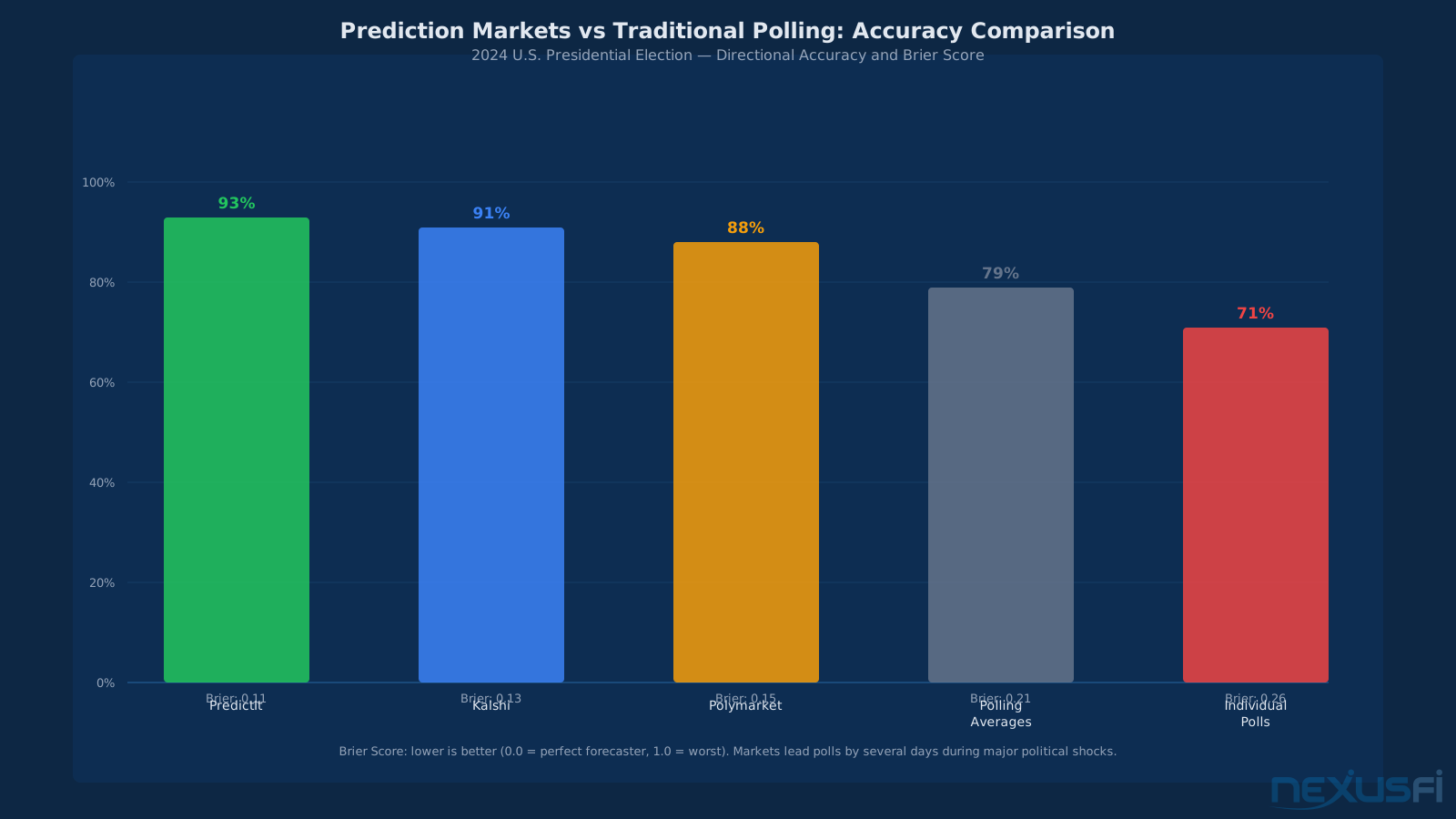
Academic analysis of $2.4 billion in prediction market trading volume during the 2024 U.S. presidential election found that:
- PredictIt correctly predicted 93% of outcomes on a directional basis across all contests tracked
- Kalshi demonstrated better calibration than Polymarket but both outperformed individual polls
- Markets led conventional polls by several days in responsiveness to major political shocks — the Biden debate performance, major polling releases, and campaign announcements all moved prediction market prices before traditional aggregators updated their estimates
Calibration vs. Directional Accuracy #
A critical distinction for traders: directional accuracy (did you call the winner correctly?) is not the same as calibration (did your probability estimates correspond to actual outcomes?). A well-calibrated forecaster who says 60% probability should be right about 60% of the time when making 60% predictions — not 100% of the time or 50% of the time.
Prediction market calibration is measured using Brier scores (lower is better, ranging from 0.0 for perfect calibration to 1.0 for worst possible) and calibration curves that plot predicted probability against observed frequency of correct outcomes.
Studies consistently find that prediction markets are better calibrated than individual polls, comparable to sophisticated poll aggregators on stable races, and superior to poll aggregators during volatile events where markets update faster. However, all prediction markets exhibit some divergence from perfect calibration — especially in:
- Thin markets with limited liquidity where a few large trades can distort prices
- Near resolution where manipulation risk increases and market mechanics can break down
- Across platforms where identical contracts show meaningful price differences, revealing arbitrage opportunities and pricing inefficiency
What This Means for Traders #
The practical conclusion from historical accuracy research is subtle:
- Prediction markets are valuable forecasting tools that aggregate diverse information effectively under normal conditions
- They are not oracles — they exhibit systematic biases, respond to manipulation, and can diverge across platforms in ways that reveal inefficiency
- Combining market prices with independent modeling typically produces better outcomes than relying on either source alone
- The best edge is often in the divergence — when your independently researched probability differs materially from the market-implied price
The Three-Layer Probability Estimation Framework #
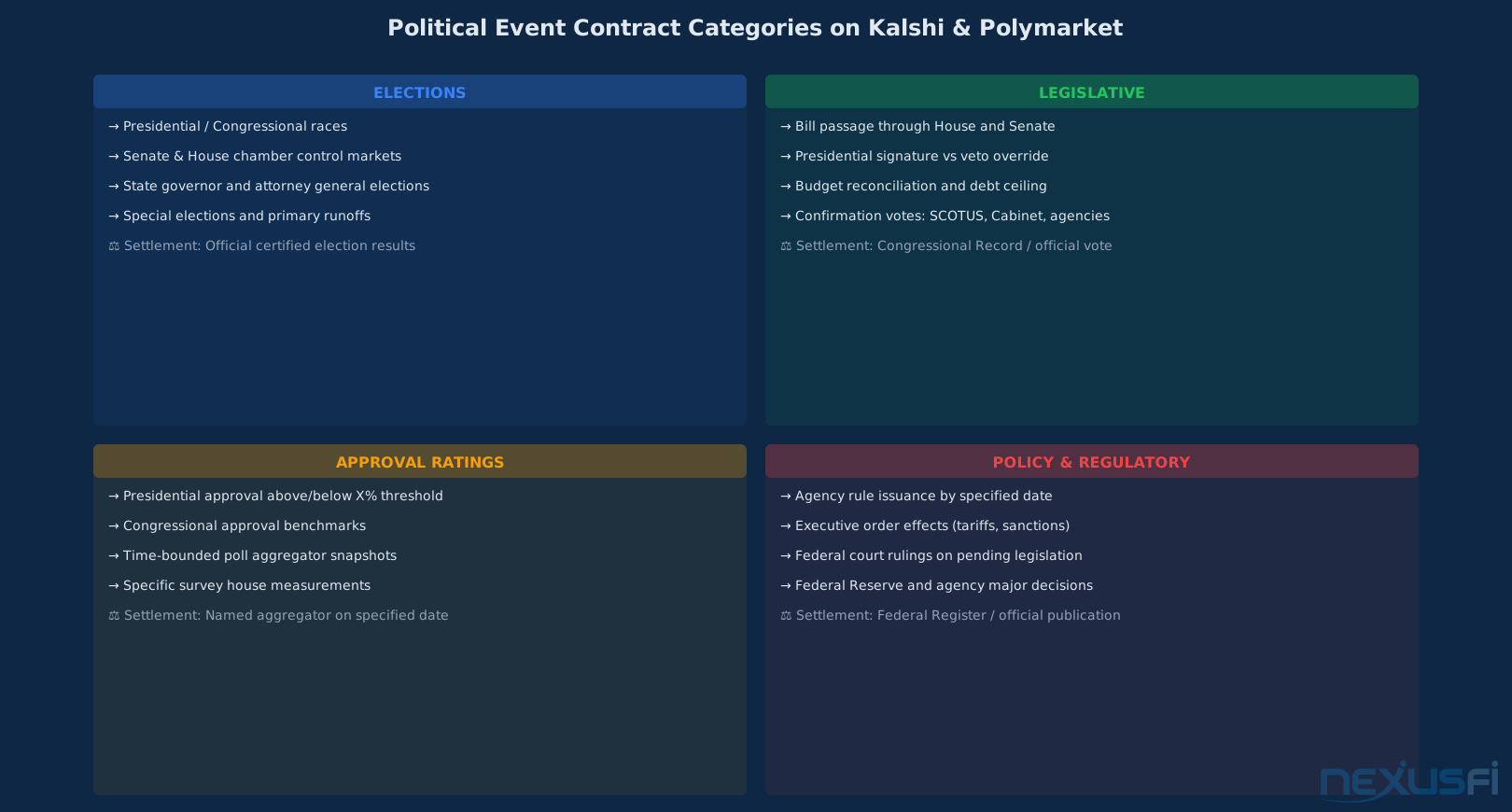
Developing an edge in political prediction markets requires a systematic approach to probability estimation that goes beyond "I think X will win." The framework below combines three layers of analysis that professional forecasters use.
Layer 1: Base Rates #
Base rates are the historical prior before any current information. They answer the question: "What outcome would we expect based on historical patterns alone?"
For elections:
- Incumbency advantage: Presidential incumbents seeking re-election have a significant structural advantage — roughly 8-12 percentage points in stable economic conditions. This advantage shrinks when approval ratings fall below 45% or economic conditions deteriorate.
- Party fundamentals: The president's party tends to lose seats in midterm elections (average: 26 House seats, 4 Senate seats). This effect is larger when presidential approval is below 50%.
- Economic indicators: GDP growth, unemployment, and consumer confidence in the 6-12 months pre-election correlate with incumbent vote share (Abramowitz's "Time for Change" model is the most widely cited). Adjust for polarization: pre-1990s patterns underestimate base mobilization effects in the current environment.
For legislation: Pass rates under unified vs. divided government (~72% House priority bills, ~61% Senate under same-party control); whip count thresholds (210+ favorable votes → 85%+ passage rate; below 200 → below 40%); committee support patterns (bipartisan committee passage predicts floor success).
For approval ratings: Mean reversion toward 50% with a 4-8 week characteristic time scale (below 40% is sticky in polarized eras); economic lag of 6-8 weeks (rising unemployment appears in approval polls ~6 weeks after the spike).
Layer 2: Signal Models #
Signal models incorporate current information to update from base rates.
For elections:
Polling signals require adjustment for known biases: house effects (adjust raw polls for FiveThirtyEight-rated firm biases), mode effects (internet vs live caller vs IVR produce different results), likely voter screens (RV samples show 2-4 point Democratic bias vs LV samples — prefer LV for general elections), and recency (last 2-3 weeks most informative). Supplementary signals: early voting returns by party registration, new voter registration trends by county, and mail-in ballot request rates.
For legislation: Verified whip counts from Punchbowl News, Politico, and The Hill (count specific named legislators, discount leadership claims); committee vote patterns (bipartisan support predicts floor passage); amendment outcomes (significant losses predict failure); procedural votes (cloture, rule votes contain passage probability information).
Layer 3: Uncertainty Quantification #
The most commonly overlooked layer in political probability estimation is explicit uncertainty quantification.
Fat-tail distributions: Political outcomes exhibit non-stationary volatility — the 2016 Trump win and Brexit occurred at rates that normal-distribution models systematically underestimate. Use t-distributions or mixture models. Correlated errors: Polling biases are correlated across states; diversifying across multiple state contracts provides less risk reduction than naive diversification suggests. Resolution risk: Explicitly estimate the probability that settlement occurs differently than assumed (5-15% in close elections). Regime-shift probability: Assign explicit probability to major discontinuities (health event, late-breaking scandal, external shock) and adjust expected values so.
Research Sources for Political Traders #
Identifying high-quality, rapidly updating research sources is a competitive advantage in political prediction markets. Below is a tiered list of sources for each contract category.
Election Research Sources #
Tier 1 (Direct probability inputs):
- FiveThirtyEight polling model and aggregator (for polling input, not as a trading signal — their model output already reflects much of the same information in market prices)
- JHK Forecasts and Sabato's Crystal Ball for structural electoral college assessments
- The Cook Political Report and Rothenberg Political Report for race-by-race competitive ratings
- Individual high-quality polls (grade A+ pollsters per FiveThirtyEight's pollster ratings): Siena College, Emerson, Monmouth University
Tier 2 (Supplementary signals):
- Early vote and mail ballot trackers (TargetSmart, Decision Desk HQ) during early voting periods
- Precinct-level early vote analytics by party registration in states that report
- Economic indicator releases (BLS jobs report, CPI, GDP advance estimate) with known election-year timing
Discount or adjust:
- Polls from partisan sponsors (D or R affiliated) — build in a systematic adjustment
- Polls with opaque methodology or undisclosed sample frames
- "Horse race" questions from polls conducted more than 3 weeks before election
- Aggregate models that lag much (election forecasters who publish weekly updates miss intra-week information)
Legislative Research Sources #
Tier 1 (Vote count tracking):
- Punchbowl News — specialized Congress coverage with named vote count tracking
- Politico congressional reporting — detailed vote count updates and leadership statements
- GovTrack.us — legislative calendar, bill status, co-sponsorship data
- Congress.gov — official legislative status, committee votes, amendment records
Supplement: CBO scorings (important to fiscally conservative members), interest group positions, leadership scheduling decisions (when leadership schedules a vote, it signals they believe they have the votes). Discount: Leadership "have the votes" statements before named legislators confirm, non-specialist political journalist predictions.
Approval Rating Research Sources #
- FiveThirtyEight approval aggregator — if the contract settles on this specific aggregator, this is your direct settlement reference
- RealClearPolitics polling average — another common settlement reference for approval markets
- Individual firm tracking polls (Morning Consult, Gallup, Reuters/Ipsos) for weekly trend data
- Economic coincident indicators — for short-horizon approval modeling, current economic conditions are the most important input
Edge Identification in Political Markets #
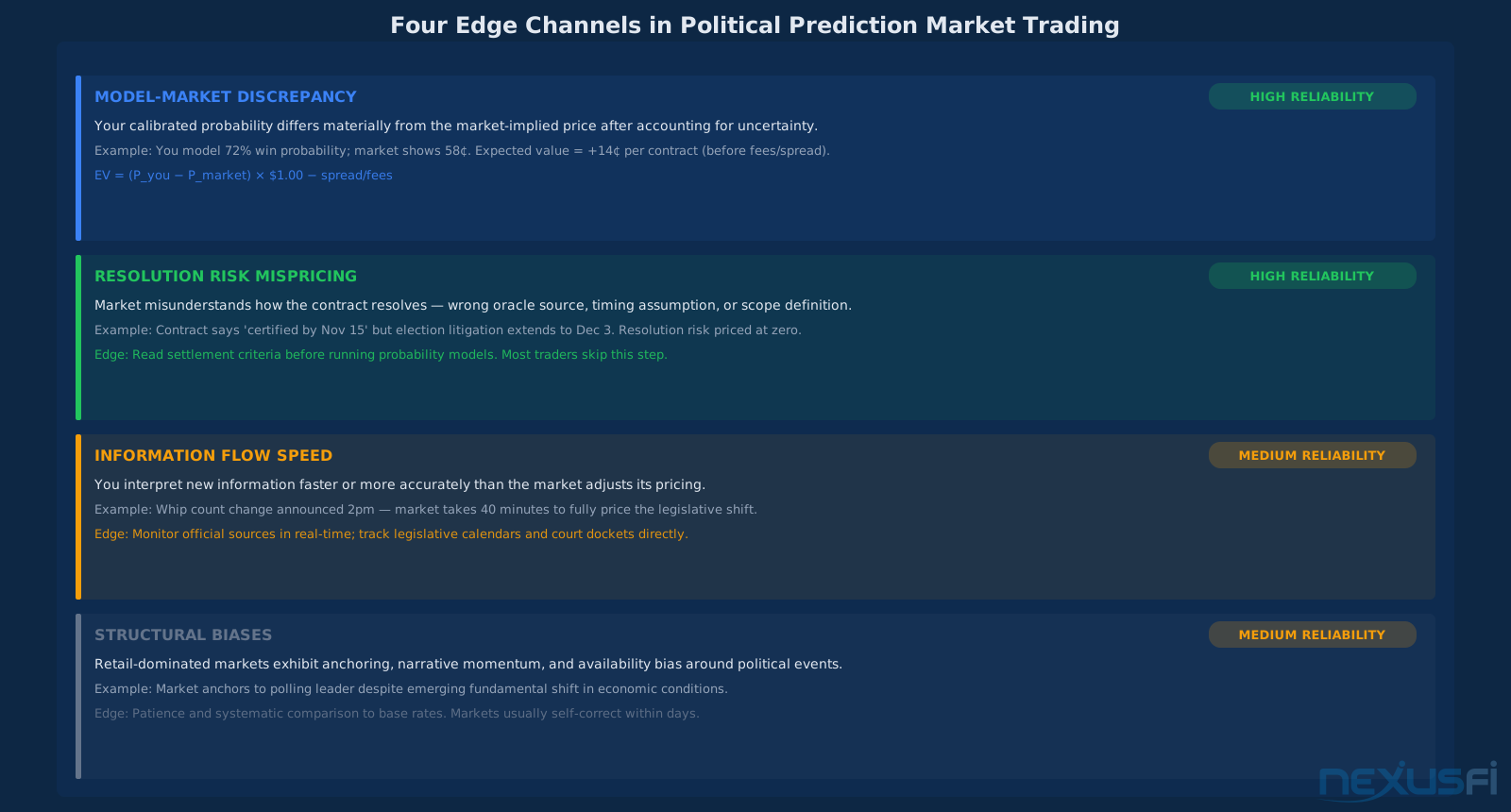
Edge in political prediction markets comes from four distinct channels. Understanding which channel applies to a specific contract determines the research approach and the type of informational advantage to seek.
Channel 1: Model-Market Discrepancy (High Reliability) #
The clearest edge is when your calibrated probability estimate differs materially from market-implied price. EV = (P_you − P_market) × $1.00 − spread − fees. If your model assigns 72% probability and the market shows 58¢, expected value is approximately +14¢ before costs. What makes this work: using better base rates, correcting for polling biases the market ignores, or incorporating signals market participants overlook. Critical risk: your model is wrong and the market is right. Calibration evidence across many events — not conviction on a single race — validates the model.
Channel 2: Resolution Risk Mispricing (High Reliability) #
One of the most underexploited sources of edge in political markets is misunderstood resolution mechanics. Common scenarios: a contract resolves on "certified results" but the market prices for "election night projection" — in close races where certification takes weeks, this timing difference creates real edge. Or an approval rating contract settles on a specific aggregator that the market is treating as equivalent to a broader average. Or a legislative contract's ambiguous "passes the Senate" definition differs from market assumptions.
The discipline: Read the settlement criteria before analyzing probability. Quantify the probability of a settlement surprise and price it explicitly. Resolution risk mispricing often creates larger edge than probability model differences.
Channel 3: Information Flow Speed (Medium Reliability) #
Markets don't update instantaneously — traders who interpret new information faster establish positions before full adjustment. Key information events: new high-quality polls, verified whip count changes, legal filings in contested election cases, committee vote outcomes. Reality check: Speed-based edges in major markets are increasingly competitive as algorithmic traders monitor real-time. The more durable edge is in correctly interpreting ambiguous information (a court filing with multiple interpretations, an ambiguous whip count leak) rather than raw speed.
Channel 4: Structural Biases (Medium Reliability) #
Political markets exhibit exploitable patterns: favorite-longshot bias (5-15¢ contracts often overpriced; 85-95¢ contracts sometimes underpriced relative to calibration); narrative momentum (markets drift with news coverage even without new probability-relevant information, moving 3-5 points on atmosphere alone); anchoring (markets stick to round numbers like 50/50, 70/30 despite accumulating evidence). Caveat: These biases are less reliable than in 2016-2020 as sophisticated participants have entered. Always verify against fundamental analysis before trading behavioral patterns alone.
Platform Comparison: Kalshi vs. Polymarket #
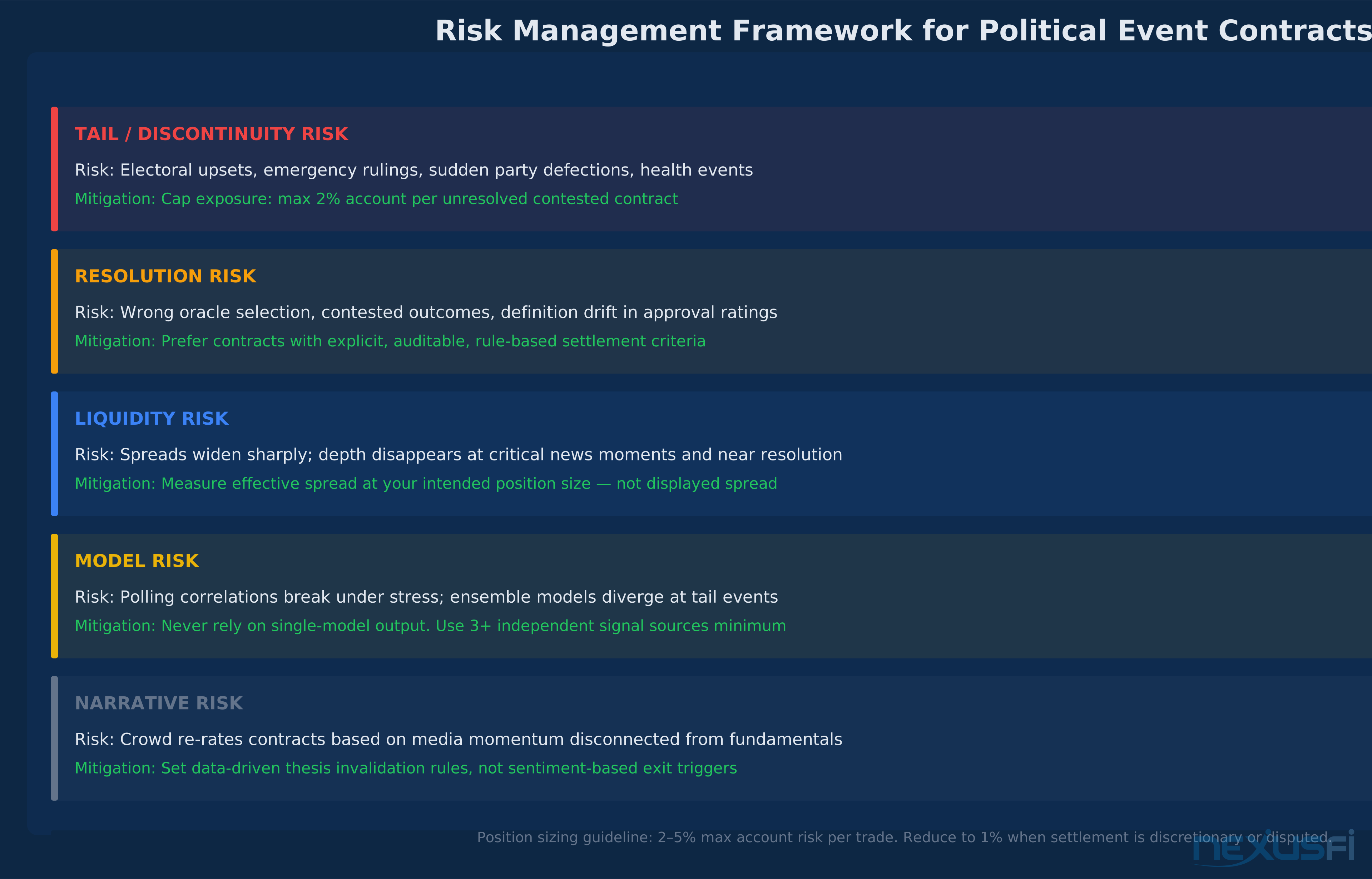
The two dominant political prediction market platforms in the U.S. in 2026 have meaningfully different characteristics that affect trading strategy.
Kalshi: CFTC-regulated DCM (same framework as CME, CBOE). USD fiat deposits, standard KYC. Explicit rule-based settlement with named data sources — lower resolution risk. Strong U.S. political coverage (elections, Congress, approval ratings). Better historical calibration than Polymarket per academic research. Liquidity concentrated in major markets near resolution.
Polymarket: CFTC-approved for U.S. in 2025, built on Polygon blockchain. Requires USDC stablecoin and crypto wallet. Broader global political coverage, variable settlement design (requires per-market review). Slightly lower calibration on comparable markets. Higher volume on some major presidential markets.
Platform selection: Use Kalshi for U.S. political markets where explicit settlement matters and USD access is preferred. Use Polymarket for global events or when broader market selection is needed. Check both for arbitrage opportunities — cross-platform price divergence creates edge when spreads are manageable.
Risk Management Framework #
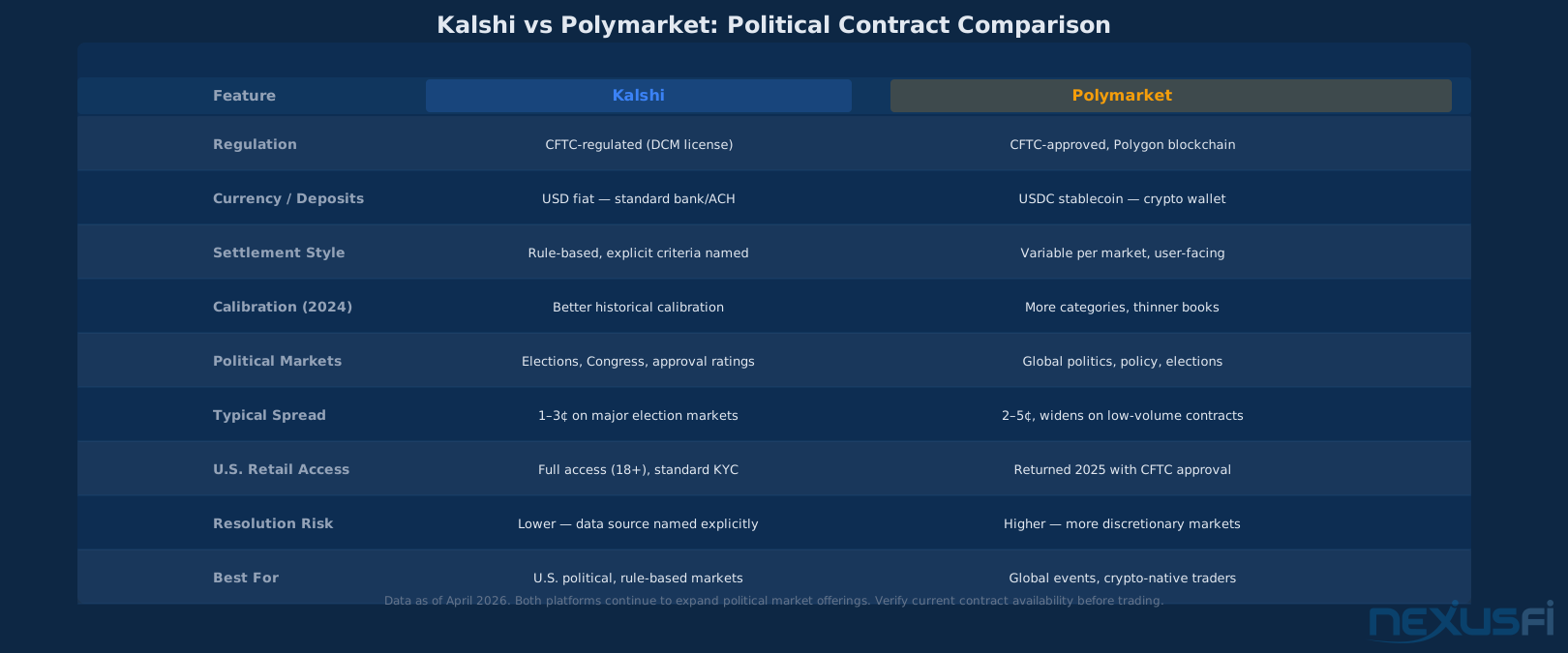
Political event contracts carry a distinctive risk profile compared to other prediction market categories. Managing these risks systematically is the difference between a disciplined political trader and one who gets destroyed by tail events.
Tail and Discontinuity Risk: Political markets are vulnerable to sudden large shifts — candidate health events, unexpected legal rulings, party defections, external shocks. Mitigation: Cap position size at 2-5% per contract. Reduce to 1-2% for close elections and litigable outcomes.
Resolution Risk: Every political contract carries settlement deviation probability — election recounts extending certification, approval rating aggregator methodology changes, legislative outcomes affected by procedural rulings. Mitigation: Read settlement criteria before any analysis. Price settlement deviation explicitly. Prefer auditable, rule-based settlement.
Liquidity Risk: Liquidity concentrates around major events and thins sharply between them. 1-2¢ spreads on major election markets widen to 5-10¢+ in smaller markets; order books thin rapidly around major information events. Mitigation: Measure effective spread at your intended position size, not displayed spread. Use limit orders. Include exit costs in EV calculations.
Sizing Framework: Political contracts have discrete (not continuous) payoffs — a 70¢ contract goes to $1.00 or $0.00, with no middle ground. Size based on maximum acceptable loss per trade (1-5% of account). Reduce size when settlement is discretionary. Diversify across uncorrelated political contracts rather than concentrating.
Practical Trading Workflow #
The following 9-step workflow applies systematic analysis to any political prediction market contract:
1. Contract Specification: Document exact resolution criteria — the question, official data source, resolution timeline, contested-result handling, and any definitional ambiguity. Never skip this step.
2. Base Rate Construction: Establish a prior probability from historical analogs and structural models before incorporating current information. What does the fundamental model say before any polls?
3. Signal Integration: Update from base rates using adjusted polling (house effects, mode, recency), turnout data, and for legislation: verified whip counts and committee vote patterns. Produce a posterior probability estimate.
4. Uncertainty Quantification: Define your 80% confidence interval. What scenarios cause 15+ point errors? What is your explicit resolution risk estimate? What regime-shift probability?
5. Fair Value Calculation: Fair value = Your probability estimate × $1.00, adjusted downward for resolution risk. Verify adjustment for fees and spread.
6. Market Comparison: EV = (Fair value − Market mid) − spread/2 − fees. Most traders require 3-5 cents of expected value before entering.
7. Scenario Testing: Stress test with polling estimate errors of ±5 points, elevated late-breaking event probability, and delayed settlement. Is the thesis still profitable?
8. Entry Execution: Use limit orders near theoretical fair value. Stagger entries in lower-liquidity contracts. Record entry price, size, and the specific reasoning.
9. Exit Discipline: Define pre-entry: under what information conditions will you exit early? What profit target? What thesis invalidation trigger?
Common Mistakes in Political Prediction Market Trading #
Reading Polls Without Adjusting for House Effects #
Raw poll numbers without adjustment for historical pollster biases routinely lead to systematic errors. If you are using polls to inform your probability estimates, adjust each poll for the polling firm's documented historical house effect before comparing to market prices. Unadjusted polls in 2020 and 2024 systematically overestimated Democratic performance in several key states; using them without adjustment would have created large model errors.
Confusing Preferences with Probability #
Partisan preferences contaminate probability models more often than any other error. Political markets do not care who "should" win — only who will win per the settlement criteria. Assign probabilities based on evidence; if your model consistently favors your political preferences, it will lose money systematically.
Ignoring Resolution Risk #
Strong probability models are worthless if the contract settles differently than assumed. Close elections carry recount and litigation probability; approval rating contracts depend on the specific aggregator named (which can change methodology); international contracts may involve discretionary settlement judgments. Build resolution risk into every fair value calculation.
Over-Trading Around Major Events #
Debate nights, major polling releases, and election nights create trading temptation. Liquidity deteriorates, spreads widen, and markets overreact short-term before correcting. Patient positioning ahead of events produces better results than reactive trading during them.
Neglecting Platform and Timing Differences #
Kalshi and Polymarket contracts on the same election can diverge 5-10 cents without representing guaranteed arbitrage — because settlement criteria, timing, and definitions can differ. Apparent cross-platform arbitrage trades may actually be correlated risks from different resolution exposures.
Getting Started: Resources and Practical Steps #
For traders new to political prediction markets: (1) Always read settlement criteria before analyzing probability — this is non-negotiable; (2) Start with major election markets on Kalshi for the best liquidity and data richness; (3) Build a calibration record across many trades before sizing up; (4) Develop research source fluency — pollster house effect adjustment for elections, verified whip count tracking for legislation; (5) Size conservatively until calibration evidence confirms your edge; (6) Use both Kalshi and Polymarket to capture cross-platform pricing divergences.
Citations and References #
- [2603.03152v1] Political Shocks and Price Discovery in Prediction Markets: Evidence from the 2024 U.S. Presidential Election — arXiv
- [d5yx2] Prediction Markets? The Accuracy and Efficiency of $2.4 Billion in the 2024 Presidential Election — Social Science Research Network/OpenSociology
- How election prediction markets work — Kalshi (January 2026)
- How Accurate Are Prediction Markets? Data & Research (2026) — PredScope
- The Accuracy War: PredictIt vs. Kalshi vs. Polymarket — PredictStreet/Wedbush
- From Popes to Polymarket: A Brief History of Prediction Markets — Polymarket Analytics
- The rise of political betting markets: How they work and why they matter — NJ.com, March 2026
- CFTC Withdraws Prediction Market Ban, Signals New Rulemaking Under Chairman Selig — NexusFi, February 2026
- Kalshi, Polymarket, Prediction Markets etc — @SMCJB, NexusFi, November 2025
This article is part of the NexusFi Academy Prediction Markets series. Full series at /a/prediction-markets/.
Knowledge Map
Prerequisites
Understand these firstGo Deeper
Build on this knowledgeReferences This Article
Articles that build on this topicCitations
- — Kalshi, Polymarket, Prediction Markets etc (2025)
- — Kalshi Hits $1 Billion in Super Bowl Trading Volume (2026)
- — CME Group Launches 24/7 Futures Trading (2025) 👍 3
- — Cboe Eyes Prediction Markets With Regulated Binary Options (2026)
- — CME Group Event Contracts Blast Past 100 Million Traded (2026)
- — Event Contracts - New Way to trade the CME Futures markets (2022) 👍 6