



News Trading on Prediction Markets: How to React to Information in Real Time
The complete framework for trading prediction market events as news breaks — from pre-event positioning to live resolution.
Overview #
News trading in prediction markets means entering or exiting positions based on new information — before the market fully incorporates that information into prices. The window is short: prediction markets are more responsive than polls but still exhibit meaningful lag between news arrival and full price adjustment.
This article covers how to structure a news trading approach: what types of news create tradeable opportunities, how to process information faster than the market, the risk management framework for time-sensitive trades, and the common mistakes that cost news traders money.
Common high-value events: - Scheduled economic data releases (CPI, jobs report, GDP, FOMC meetings) - Major political events (primaries, congressional votes, debates) - Sports events (playoffs, championships) - Corporate announcements that feed into event contracts Step 2: Build your probability model before prices move.
The Information Half-Life Problem #
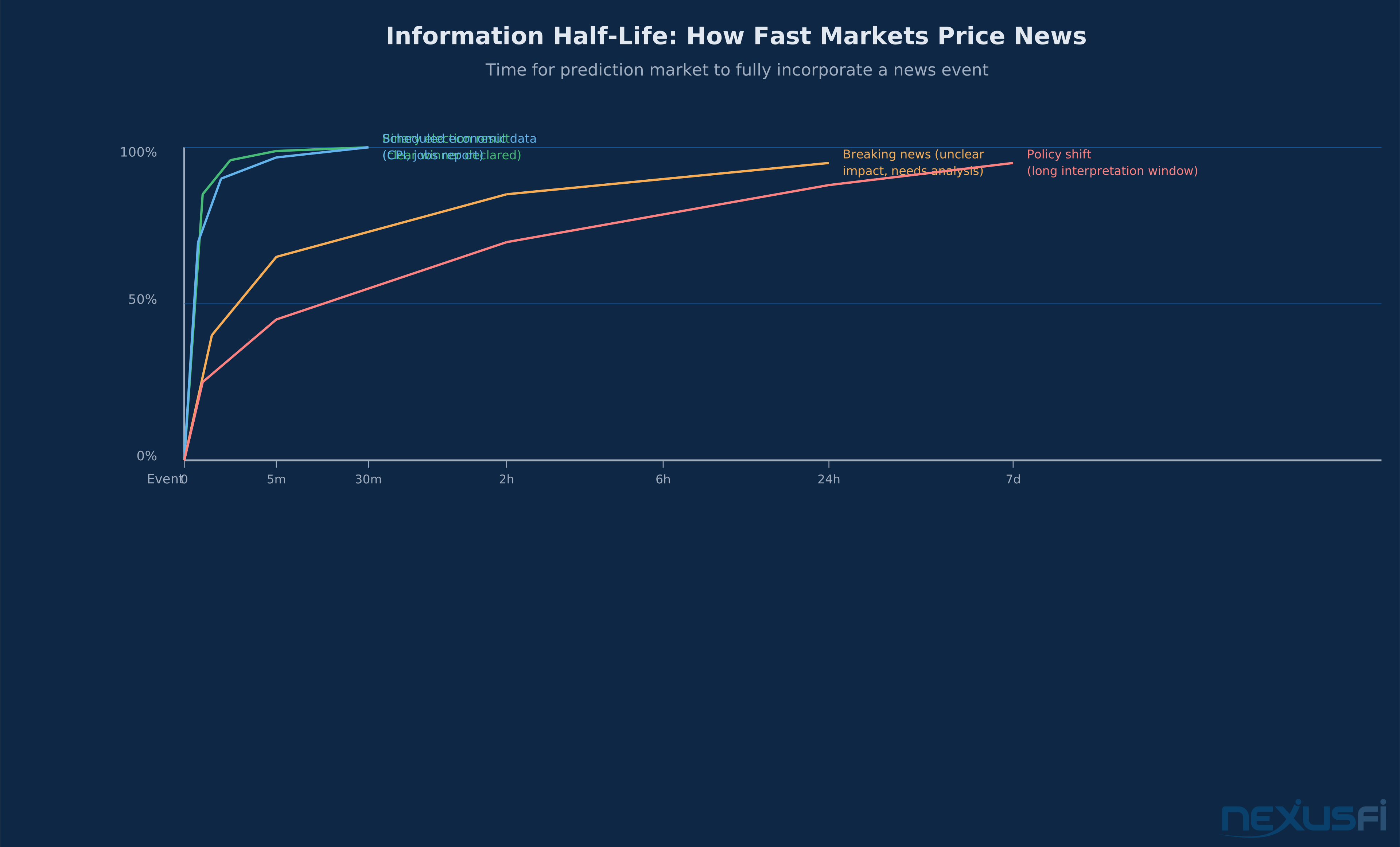
Prediction market prices update when informed participants trade. When major news breaks, the first movers process the information and trade immediately. Within minutes, arbitrageurs compare prices across platforms, amplifying the move. Within hours, most participants have seen the news and incorporated it.
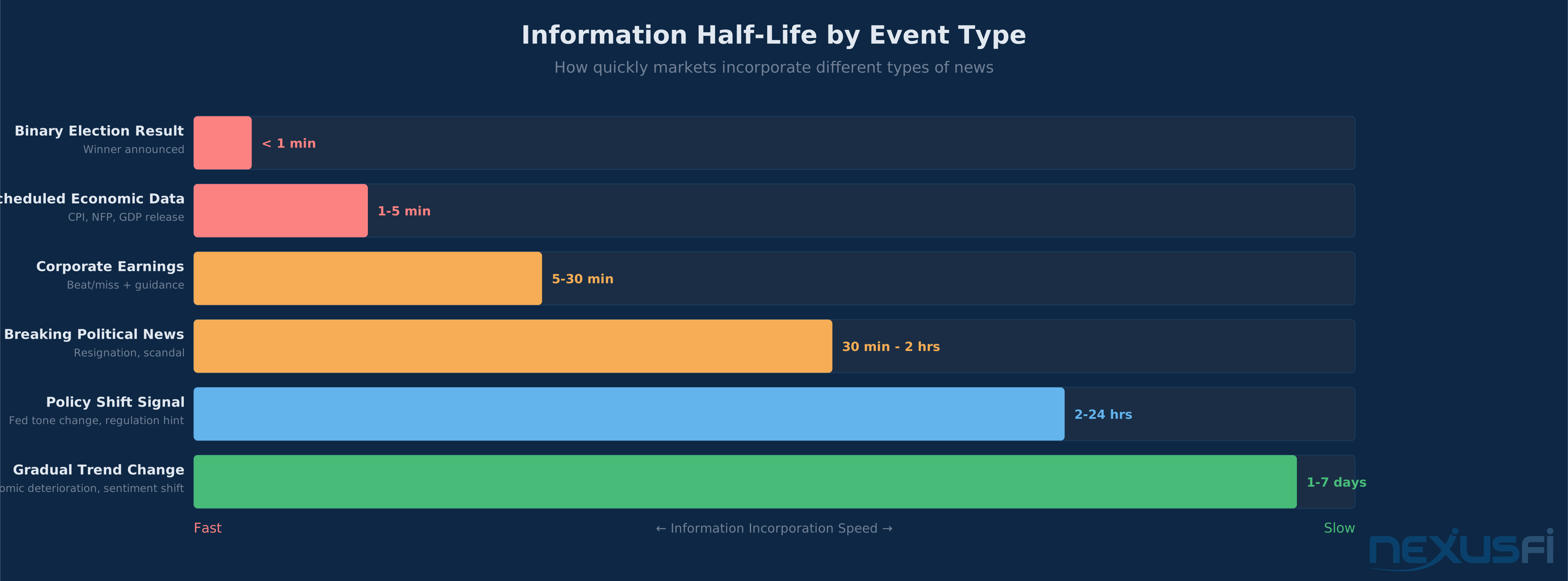
The "information half-life" — how long an edge from new information lasts — depends on the event type:
Immediate resolution (winner declared, data released): The market moves to near-certainty within minutes. Trading during this window is possible but requires extremely fast execution and often creates adverse selection issues (you're trading against people who know the outcome before you).
Clear-directional news (new polling data, major endorsement): Edge window is 30 minutes to 2 hours for sharp news traders. The directional implication is clear, but the magnitude of the update requires analysis.
Ambiguous news (speech with unclear policy implications, mixed economic data): Edge window can extend to 6-24 hours. Different analysts will interpret the same information differently, and the market will slowly converge as interpretation consensus forms.
Policy shifts with long implementation timelines: Edge window can be days to weeks. Markets often price these with significant uncertainty and overshoot/undershoot as more information arrives.
News traders who try to compete in the "immediate resolution" category are usually fighting a losing battle against faster participants. The more sustainable edge is in ambiguous news where careful analysis creates durable information advantages.
Pre-Event Positioning: Trading Into News #
Most news trading edge is earned before the news event, not during it.
The Pre-Event Setup #
Step 1: Identify upcoming events that will move prediction market prices. Common high-value events:
- Scheduled economic data releases (CPI, jobs report, GDP, FOMC meetings)
- Major political events (primaries, congressional votes, debates)
- Sports events (playoffs, championships)
- Corporate announcements that feed into event contracts
Step 2: Build your probability model before prices move. The pre-event contract price reflects consensus expectations. If you have an edge, it comes from your model differing from consensus — not from reacting faster than everyone else to the same data.
Step 3: Enter before the event if you have edge. If your model suggests 70% and the market shows 55%, entering before the event captures the full 15-point edge. Waiting until after the event means competing against everyone who has already incorporated the information.
Pre-Event Position Sizing #
Pre-event positions carry calendar risk: you're exposed to adverse price movements for the duration of your holding period. Size so:
- Pre-event positions typically merit smaller size than post-event positions
- Use limit orders to enter at your target price, not market orders
- Set stop-loss prices at levels that would falsify your thesis
- Know your exit timing: will you hold through the event, or exit before?
Live Event Trading: When News Breaks #
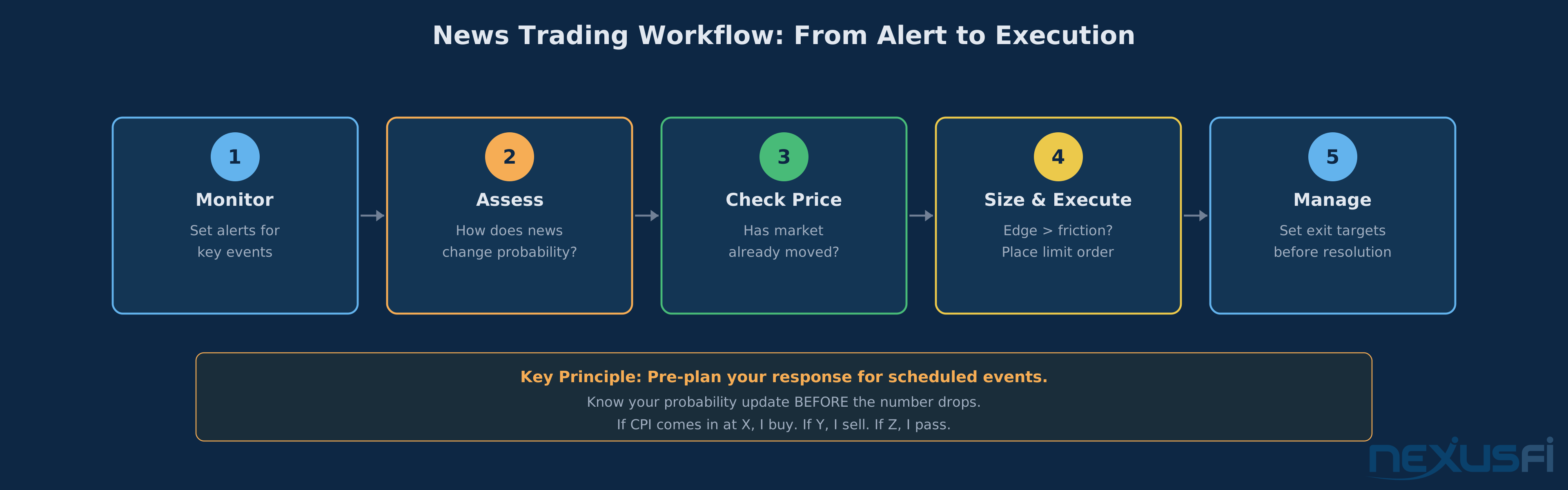
Trading as news breaks is the highest-velocity form of prediction market trading. It requires preparation, speed, and discipline.
The Information Processing Race #
When a piece of information arrives (a number is released, a statement is made, a result is announced), the market price should move to a new equilibrium. The question is: can you identify the correct new equilibrium faster than the market?
Against fast participants, you probably cannot. Institutional traders have faster data feeds, co-located systems, and pre-programmed algorithms. Retail traders reading CNBC are already late.
Where you can win: Processing ambiguous information. When economic data comes in at an unexpected value, the implications for related contracts are not always immediately obvious. An experienced analyst who understands the second-order implications (how CPI affects rate decisions, how rate decisions affect election contracts) can identify opportunities in related contracts that react more slowly than the primary one.
The Kalshi Speed Advantage #
Kalshi allows retail traders to place orders via web interface or API. If you want to trade in the first minutes after major news, API access provides meaningful speed advantage over web interface. Kalshi's API is documented at their developer portal.
For most retail traders, API speed advantage over the web interface is measured in milliseconds — not enough to compete with institutional algorithms, but enough to act faster than other web traders.
Reading Resolution Criteria Under Pressure #
A common expensive mistake in live event trading: assuming you know how a contract resolves when you haven't carefully read the criteria. Under time pressure, traders frequently buy or sell based on a misread.
Example: A CPI release comes in higher than expected. Traders rush to buy "CPI above 3.2% YES" contracts. But the specific contract resolves on Core CPI, not headline CPI. The two numbers diverged this month. Traders who didn't check the criteria bought the wrong contract.
Protocol: Before any event where you intend to trade live, read the resolution criteria completely. Write down exactly what number, threshold, or outcome triggers YES. Know this before the event, not during it.
Post-Event Information Processing #
Some of the best news trading opportunities come after the initial price reaction — not before or during.
Overreaction and Reversion #
When news breaks, prices often overshoot. The initial reaction captures the direction correctly but overshoots on magnitude. In the first 30-60 minutes after major news, some related contracts are overpriced (in the direction of the news) and some are underpriced (in the opposite direction).
The pattern is most predictable in correlated markets. If election outcome A and B are correlated (a swing state that usually mirrors national trends), but A overreacts and B doesn't yet move, there's a mean-reversion opportunity in B.
@Fi documented a real example of this in the NexusFi Traders Hideout when US-Israeli strikes on Iran's Supreme Leader caused geopolitical shock: traders who correctly identified the overreaction in crude oil contracts found mean-reversion opportunities. Similar patterns occur in prediction markets after major political shocks.
Second-Order Implications #
After major news, first-order implications are priced immediately. Second-order implications take longer because they require more analysis:
First order: FOMC announces surprise 50bp cut. "Fed funds rate" contracts move immediately.
Second order (1-4 hours to price): What does the cut imply for inflation contracts? What about employment contracts? What about contracts on specific policy outcomes that depend on the economic trajectory the cut implies?
Traders who understand the causal chain can trade second-order contracts in the hour after the announcement, when prices are still adjusting to the full implications.
The "Everything Has Changed" Trap #
When a major unexpected event occurs — a political earthquake, a crisis, a historically unusual outcome — there's a temptation to assume everything has changed and all related contracts need massive repricing. This is often wrong.
Base rates are strong. Even after major disruptions, most prediction market outcomes revert to historical frequencies. The biggest news event of the decade still doesn't make 70% probability events resolve incorrectly 80% of the time. News traders who maintain disciplined base rate anchoring avoid expensive overreaction to dramatic events.
Risk Management for News Traders #
News trading has higher inherent risk than patient, long-horizon position trading. Several risk management rules apply specifically to this context.
Time Decay and Binary Resolution #
Unlike options, prediction market contracts don't have formal time decay (theta). But there's an implicit time value concept: a contract with 30 days until resolution has more opportunity for prices to move (and for your edge to manifest) than a contract with 3 days remaining.
For news traders taking positions based on recent developments, make sure the resolution timeline is long enough for the thesis to play out. A major development that shifts probability by 10 points is useless if the contract resolves in 2 days and the development needs 2 weeks to show up in polls.
Information vs. Noise #
Not every piece of news has tradeable implications. The most common news trading mistake is treating high-volume information flow as high-value signal. Breaking news is often revised, misinterpreted, or simply not relevant to the specific contract you're trading.
Filter before trading: For every news item you consider trading on, ask:
- Is this directly relevant to the resolution criteria of the contract?
- Does this move the probability by more than my friction cost (spread + fees)?
- Am I seeing this information before it's incorporated into prices?
If any answer is no, there's no tradeable edge.
Position Management During Events #
For positions held through scheduled events:
- Know in advance what the event outcome would need to show for your thesis to be confirmed or falsified
- Establish exit levels before the event, not during it
- Accept that you may lose money even on correct analysis if the announcement comes with unexpected surprise components
For positions entered during events:
- Use limit orders — market orders during fast-moving events can result in extremely unfavorable fills
- Start with smaller size than normal until you've confirmed the price has stabilized at a new level
- Be willing to miss the trade if conditions change faster than you can safely execute
Platform-Specific News Trading Considerations #
Kalshi: Most liquid US platform for economic and political news. The fastest and deepest markets for Fed decisions, CPI, jobs, and US elections. API access available for programmatic trading.
Polymarket: Better for global events with international audiences. May have deeper liquidity for geopolitical events, certain crypto/tech events, and markets where US retail audience is smaller. Requires USDC, which adds friction for rapid deployment.
Robinhood event contracts: Best for traders who want prediction market access integrated into their existing brokerage account. Currently more limited contract selection than Kalshi.
Citations #
- @Fi: Kalshi, Polymarket, Prediction Markets etc — Community framework for prediction market analysis
- @SMCJB: US-Israeli Strikes Kill Iran's Supreme Leader — Oil Surges — Real-time overreaction pattern in correlated markets, applicable to prediction market event trading
- @Fi: CFTC Withdraws Prediction Market Ban, Signals New Rulemaking — Regulatory context affecting prediction market access during news events
- @Fi: Kalshi Hits $1 Billion in Super Bowl Trading Volume — Market depth available for live event trading
- @Pa Dax: PA Dax CL, ES and Bund Price Action Trading Log — Framework for analyzing price action around scheduled news releases
- Event Contracts: What They Are & How to Trade Them — PredScope
This article is part of the NexusFi Academy Prediction Markets series. Full series at /a/prediction-markets/.