



Implied Probability in Prediction Markets: How Prices Become Probabilities
Understanding what contract prices actually mean, how to convert between price and probability, and why identifying when the market is wrong is the core skill of prediction market trading.
Overview #
The central insight of prediction market trading: contract prices are probability estimates. A YES contract at $0.72 says the collective intelligence of all market participants — weighted by capital at risk — believes there's a 72% chance this event occurs.
Your job as a trader is to form your own probability estimate and compare it to the market's implied probability. When your estimate meaningfully exceeds the market's (after costs), you have an edge. This article explains how to form those estimates, when to trust them, and how to quantify your edge before placing a trade.
Fi covered how Tradeweb's stake in Kalshi is bringing real-time prediction market probability data to institutional traders in Tradeweb Takes Minority Stake in Kalshi — Prediction Market Data Coming to Institutional Screens — a sign that implied probability from prediction markets is increasingly treated as serious financial data alongside other market-derived signals.
Understanding what contract prices actually mean, how to convert between price and probability, and why identifying when the market is wrong is the core skill of prediction market trading.
Quick Probability Refresher #
Probability is a number between 0 and 1 (or 0% and 100%) expressing how likely an event is to occur.
- P = 1.0 (100%): Certain to happen
- P = 0.5 (50%): Toss-up, equally likely to happen or not
- P = 0.0 (0%): Certain not to happen
When we say "implied probability," we mean the probability that a contract price implies, given the structure of prediction markets where prices range from $0.01 to $0.99.
The Implied Probability Conversion #
Converting contract price to implied probability is trivially simple in prediction markets:
YES at $0.65 = market implies 65% probability
The price IS the probability. No calculation required. This is the elegant design of binary prediction markets — the price directly represents the market's collective probability estimate.
Formally:
Implied Probability = YES Contract PriceNO Contract Price = 1 - YES Contract Price
Comparing to Other Instruments #
In other markets, extracting implied probability requires calculation:
| Instrument | Implied Probability Formula |
|---|---|
| Binary prediction contract | Directly = contract price |
| Futures market | Requires options pricing model (Black-76) |
| Betting odds (American) | -Odds / (-Odds + 100) for favorites |
| Betting odds (Decimal) | 1 / Decimal Odds |
| Political polling | Doesn't capture probability well |
The directness of prediction market pricing is a feature, not an accident. It makes price-probability comparisons intuitive.
Why Prediction Markets Are Often Accurate #
Prediction markets outperform polls and expert panels in many contexts because traders have financial skin in the game. Getting probabilities right makes money. Getting them wrong loses money.
This incentive structure causes rapid incorporation of all available information. When a major piece of news breaks, traders who understand its implications faster than others can buy (or sell) at the old price, profiting as the market adjusts. This race to incorporate information pushes prices toward reflecting consensus knowledge quickly.
The 2024 U.S. election prediction markets correctly assigned higher probability to the eventual outcome earlier and with less volatility than most polling aggregators — because capital-weighted forecasting is harder to game than survey responses.
The Information Aggregation Mechanism #
Prediction markets aggregate information from diverse participants:
- Fundamental analysts who study the underlying data (economic reports, company filings)
- Domain experts who understand specific events better than generalists
- Market watchers who track sentiment and media coverage
- Statistical traders who apply base rates and historical patterns
- Arbitrageurs who bridge mispricings across markets
Each group brings different information. The market price reflects the capital-weighted average of all these views. No single poll or analyst captures this breadth.
When Markets Are Wrong: The Edge Identification Framework #
Markets can be wrong. Information asymmetry, thin liquidity, and narrative drift all cause mispricings. Understanding when and why markets misprice creates your trading edge.
Your edge = your probability estimate - market's implied probability
Scenario Analysis #
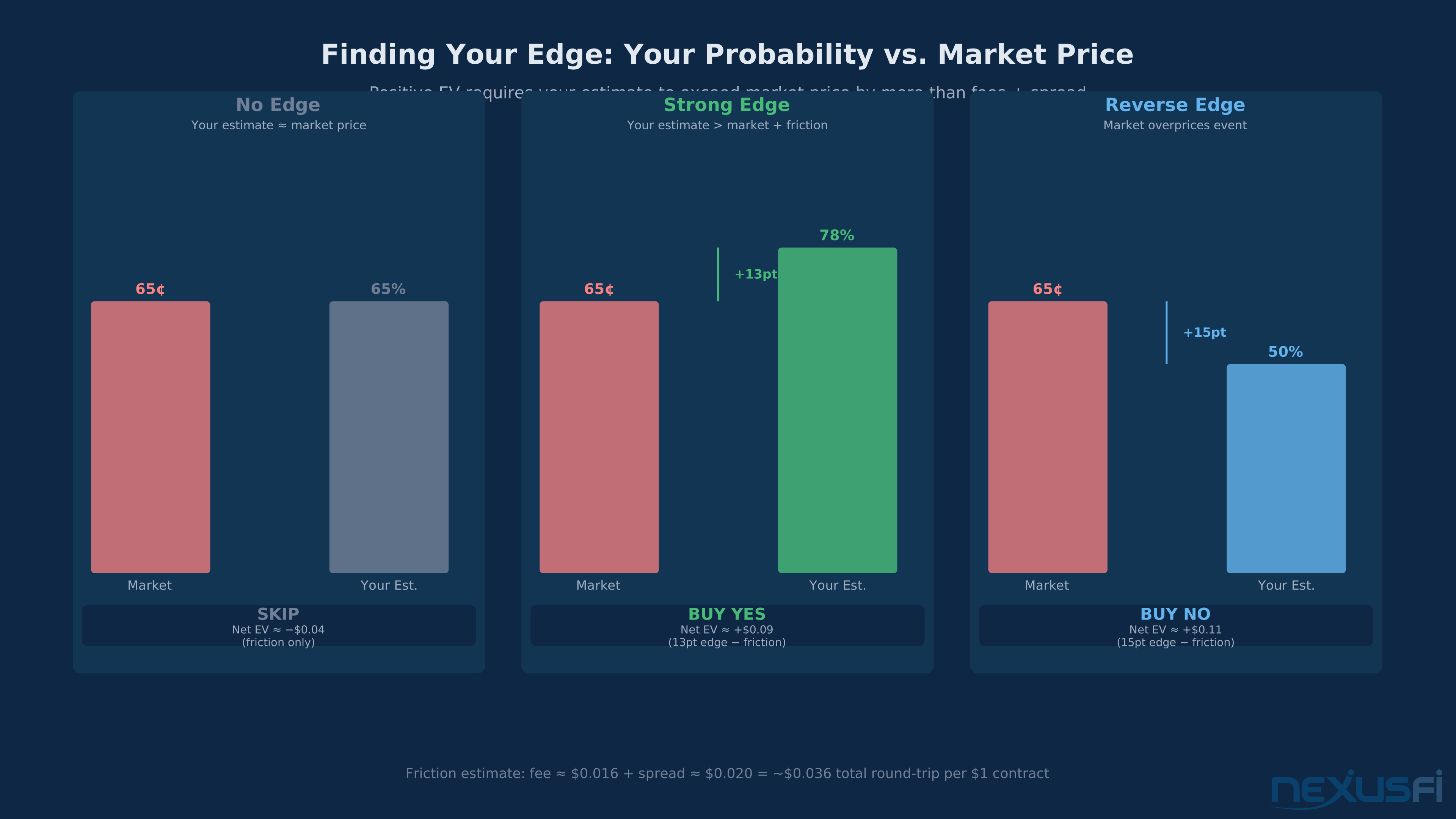
No Edge: Your estimate = 65%, market price = 65%. No trade. Friction (fees + spread) makes this negative expected value.
Strong Long Edge: Your estimate = 78%, market price = 65%. 13-point edge. Buy YES — your edge exceeds friction.
Reverse Edge: Your estimate = 50%, market price = 65%. Market overprices the event. Buy NO at 35¢ — you're buying a 50% probability event at 35% implied.
For this edge to be profitable, it must exceed friction:
- Bid-ask spread: approximately 1-5¢ of contract value for liquid markets
- Kalshi fee: 7% × C × (1-C) per contract (peaks at $0.0175 for 50¢ contract)
Edge Calculation Example #
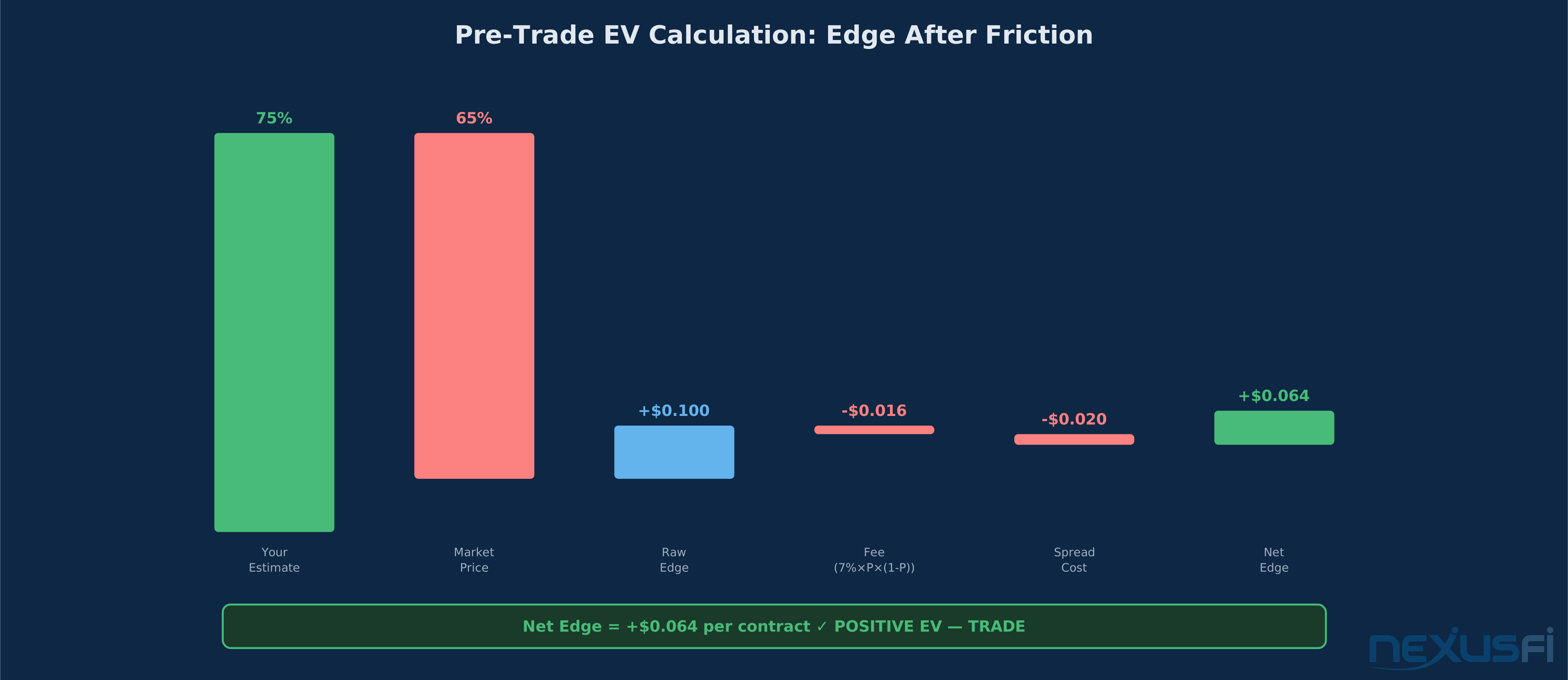
Your estimate: 75% probability of Fed cut Market price: 65¢ (65% implied probability)
- Raw edge: 75% - 65% = 10 percentage points
- Fee at $0.65: 7% × 0.65 × 0.35 = $0.016
- Spread cost: ~$0.020 (2¢ for liquid contract)
- Total friction: $0.036
- Net edge per $1 contract: $0.10 - $0.036 = $0.064 positive EV
Compare: Your estimate 68%, market 65%, raw edge 3 points:
- Friction: $0.036 (same)
- Net edge: $0.03 - $0.036 = negative EV, don't trade
When Markets Are Most Wrong #
1. Thin Markets #
Few participants means less information aggregation. A contract with 500 total open interest might have its price set by 10-15 active traders. One well-informed participant can dominate pricing. If you're the well-informed participant — or if you recognize that the current price reflects just one or two traders' views — thin markets offer the best opportunities.
Check open interest before trading. Low-OI markets often have:
- Wider spreads (less competition among market makers)
- Prices that reflect fewer perspectives
- Greater potential for sustained mispricing
2. Narrative Drift #
When media coverage dominates without new fundamental information, prediction market prices can track sentiment rather than base rates. Political contracts are most susceptible.
Example: A major newspaper runs a story about a candidate's poor debate performance. The market price drops from 55¢ to 42¢. But historical data shows debate performance rarely changes election outcomes more than 2-3%. The price overshot — a potential opportunity for traders anchored to base rates.
3. Correlated Information Shocks #
Surprise announcements move related contracts simultaneously before the market fully digests implications. Brief windows of exploitable mispricing exist between the initial announcement and the market's full recalibration.
Example: Fed Chair makes an unscheduled speech with hawkish language. Rate cut contracts immediately drop. But related contracts (inflation expectations, economic indicator contracts) may lag by minutes before updating. Speed advantage plus analytical clarity creates an edge window.
4. Near-Resolution Liquidity Gaps #
As contracts approach resolution, market makers often widen spreads or step back. The displayed price becomes less meaningful as a probability estimate — it may not reflect the true fair value, just where the last trade occurred with minimal liquidity.
For very high confidence trades ($0.90+ or $0.10-) near resolution, be cautious about the spread. The displayed price might be 90¢ but the best exit might only be 87¢ due to withdrawn liquidity.
Building Reliable Probability Estimates #
Step 1: Start With Base Rates #
Before adding any current information, anchor to historical frequency:
- Fed decisions: What % of meetings in similar macro environments resulted in a cut?
- Election outcomes: Historical win rates for incumbents with similar approval ratings in similar environments
- Weather events: Historical frequency of above-threshold temperatures at that location in that month
- Earnings surprises: Historical beat/miss rates for this company, this sector, this market environment
Base rates are your anchor. They represent the world without any special knowledge of current circumstances. Start here and update.
Step 2: Apply Bayesian Updating #
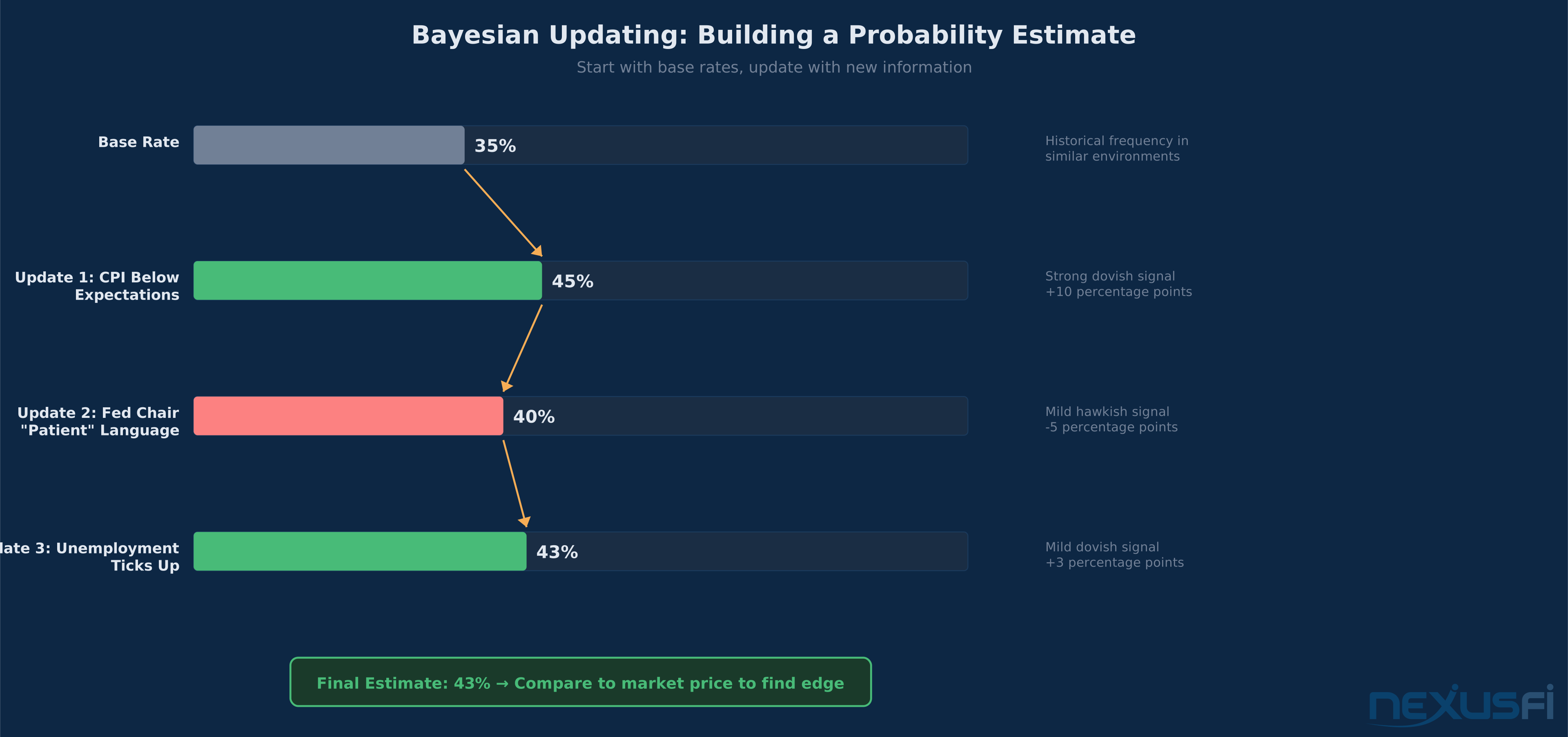
Start with your prior probability (base rate). Update it as new information arrives, asking: "How much more or less likely does this information make the event?"
Example: Fed cut by December?
| Step | Information | Probability Update | Running Estimate |
|---|---|---|---|
| Prior | Base rate (similar environments) | Start at 35% | 35% |
| Update 1 | CPI came in below expectations | Strong dovish signal: +10% | 45% |
| Update 2 | Fed Chair used "patient" language | Mild hawkish: -5% | 40% |
| Update 3 | Unemployment ticks up slightly | Mild dovish: +3% | 43% |
| Final | Your estimate | 43% |
Market says 45¢? You're 2 points below. Friction is ~$0.034. No edge — skip.
Market says 35¢? You're 8 points above. Edge is $0.08 - $0.034 = $0.046 positive EV. Buy YES.
Step 3: Check for Overconfidence #
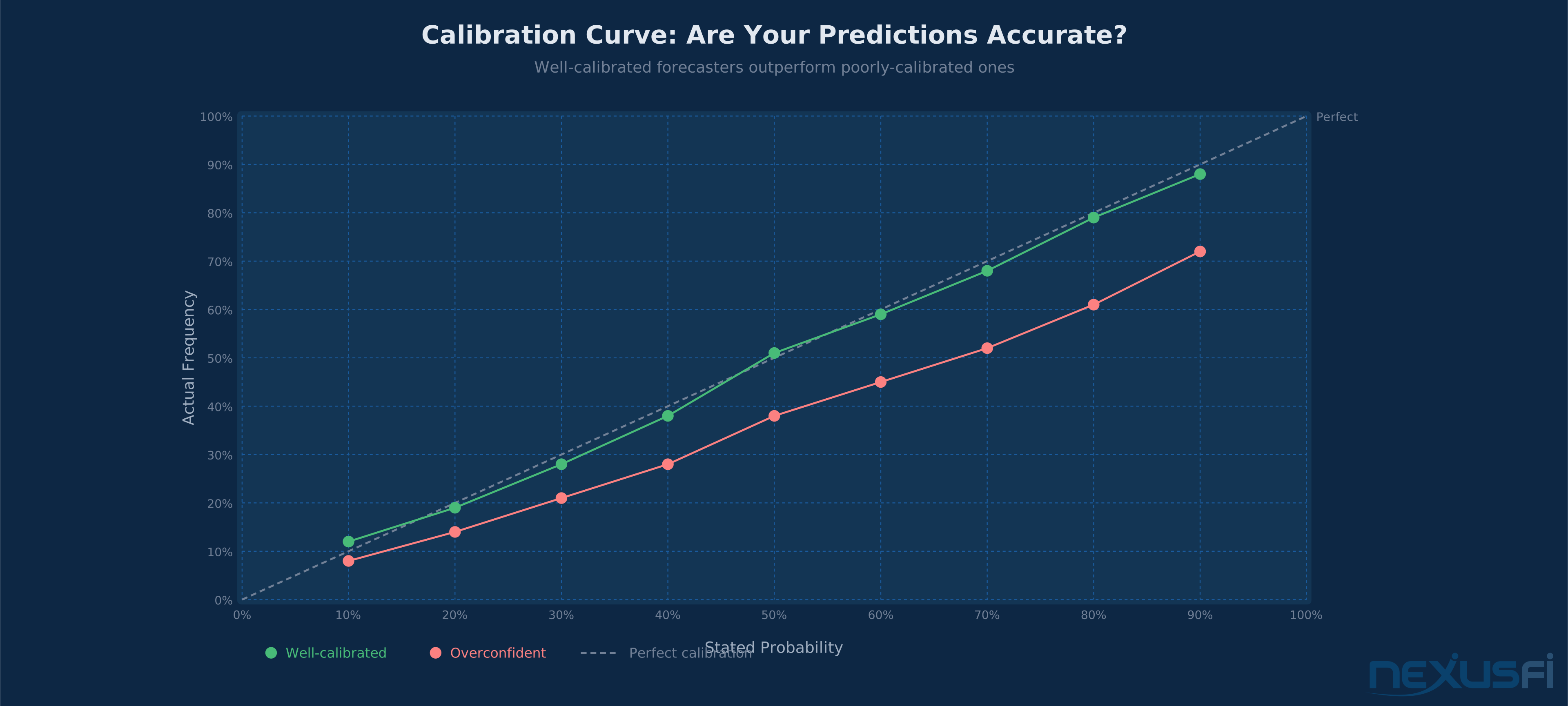
Most people are overconfident in their probability estimates. If you think something has 80% probability, it likely has about 65-70% probability based on calibration research across forecasters.
Calibration is the discipline of checking whether your predictions match actual frequencies. If you track your estimates over time, you can measure whether your 70% picks come true 70% of the time. If they come true 55% of the time, you're systematically overconfident and need to compress your estimates toward 50%.
The fastest way to improve calibration:
- Record every prediction with the exact probability
- Group predictions by stated probability (60-70% range, 70-80% range, etc.)
- After enough time, calculate the actual hit rate within each bucket
- Compare stated probability to actual hit rate — this is your calibration curve
Well-calibrated forecasters consistently outperform poorly-calibrated ones on prediction markets, even when they have less fundamental knowledge, because they avoid systematically overpricing uncertain events.
The Quick EV Calculation: Your Pre-Trade Checklist #
Before any trade:
- Your probability estimate: P_you (formed through base rates + updates)
- Contract price: P_market (the current YES price)
- Raw edge: P_you - P_market (positive = lean YES, negative = lean NO)
- Fee: 7% × P_market × (1 - P_market)
- Spread: ~$0.02 for liquid markets, up to $0.05 for thin markets
- Net edge: (Step 3) - (Step 4) - (Step 5)
- Trade if net edge > 0 and net edge > 3%. Skip if below threshold.
The 3% buffer accounts for estimation uncertainty. Your probability estimate isn't precise — build in margin for error. A 2% calculated edge might represent a 1% edge (after your estimation error) or a 3% edge. The buffer prevents you from trading on noise.
Special Case: Near-Certain Events (>85% or <15%) #
High-confidence events create a special challenge for implied probability analysis.
The paradox: A 90¢ contract that resolves NO loses $0.90. A 10¢ contract that resolves YES loses $0.10. The confidence built into the price doesn't prevent the rare outcome from occurring.
The opportunity: When high-confidence contracts are mispriced, the leverage on your edge is smaller in dollar terms. Going from 90% to 95% certainty produces a 5¢ edge on a 90¢ contract — 5.5% return on capital, which may barely beat friction after fees.
The risk: The rare 10% outcome happens 10% of the time. Position sizing must account for the full loss on the downside, not just the expected outcome.
High-probability contracts are best suited for:
- Market makers capturing spread on near-certain events
- Hedging other positions
- Capital deployment when no better-value contracts are available
For directional traders seeking returns, contracts in the 20%-80% range typically offer the best risk-adjusted opportunities because fees are a smaller fraction of the edge range.
Comparing Across Platforms: Do Prices Agree? #
Kalshi and Polymarket often have similar contracts. When they price the same event differently, an implied probability discrepancy exists.
For example: Kalshi prices a Fed cut at 45¢. Polymarket prices the equivalent at 51¢. The implied probabilities disagree. This could mean:
- Market inefficiency: One market is wrong, creating an arbitrage opportunity
- Contract difference: The resolution criteria aren't identical, so the events aren't perfectly equivalent
- Liquidity asymmetry: Less liquid market has a stale price
Before attempting cross-platform arbitrage, always verify the resolution criteria match exactly. Small differences (initial vs. final rate, exact timing, threshold definitions) can invalidate the apparent discrepancy.
Fi covered the full regulatory history in CFTC Withdraws Biden-Era Prediction Market Ban, Signals New Regulatory Framework, which explains why the US and non-US platforms have different regulatory structures that can lead to pricing differences.
Practice Exercise: Building Your First Estimate #
Let's practice building an implied probability estimate from scratch.
Event: "Will US CPI be above 3.0% for the next reading?"
Step 1: Base rate
- CPI has been above 3.0% for 14 of the last 24 months = 58% base rate
Step 2: Current conditions
- Last reading: 3.2% (above threshold)
- Fed commentary: expects gradual moderation
- Recent energy price trends: +4% (inflationary)
- Update: +5% for recent above-threshold reading, +3% for energy surge
- Revised estimate: 58% + 5% + 3% = 66%
Step 3: Overconfidence adjustment
- You're moderately confident in this estimate. Apply 10% compression toward 50%.
- Adjusted: 66% - (66%-50%) × 0.10 = 64.4%
Step 4: Market check
- Market prices YES at 61¢
- Your estimate: 64%
- Raw edge: 3 percentage points
- Fee: 7% × 0.61 × 0.39 = $0.017
- Spread: ~$0.020
- Net edge: $0.03 - $0.037 = negative, skip
The 3-point edge evaporates under friction. This is the correct outcome — marginal edges don't trade.
Same setup, market prices YES at 52¢:
- Raw edge: 64% - 52% = 12 percentage points
- Fee: 7% × 0.52 × 0.48 = $0.017
- Net edge: $0.12 - $0.037 = $0.083 positive EV — trade
Citations #
- @Fi: Tradeweb Takes Minority Stake in Kalshi — Prediction market data entering institutional trading infrastructure
- @Fi: CFTC Withdraws Biden-Era Prediction Market Ban — Regulatory framework enabling cross-platform comparison
- @Fi: Kalshi, Polymarket, Prediction Markets etc — NexusFi community discussion of market structure
- How are prices calculated? — Kalshi Help Center
- How Does Polymarket Work? — PredScope
- Complete Beginner's Guide to Kalshi — Prevayo
Knowledge Map
Prerequisites
Understand these firstGo Deeper
Build on this knowledgeReferences This Article
Articles that build on this topicCitations
- — Event Contracts - New Way to trade the CME Futures markets (2022) 👍 6
- — CME Launching Binary Option Trading (2022) 👍 1
- — NADEX Binary Options Cost Breakdown Comparison (2017) 👍 3
- — Nadex AMA - Dan Cook (2019) 👍 5
- — Cboe Eyes Prediction Markets With Regulated Binary Options (2026)
- — CME Group Event Contracts Blast Past 100 Million Traded (2026)