



Portfolio Construction for Prediction Market Traders
How to build a diversified prediction market portfolio that manages correlation risk, maximizes edge utilization, and survives the inevitable losing streaks
Overview #
Most prediction market guides focus on how to evaluate individual contracts
This article applies portfolio construction principles to prediction market trading. It assumes you already understand how to evaluate individual contracts (see Implied Probability in Prediction Markets and Value Betting in Prediction Markets) and focuses on how to combine those evaluations into a coherent capital allocation system.
Illustration: If you put 20% of your capital on a single 60% probability contract: - 40% of the time, you lose 20% of your bankroll - After 5 consecutive losses (0.40^5 = 1%), you've lost 67% of your capital Now imagine this is not rare variance but a systematic miscalibration The lesson: Position sizing in prediction markets must account for: 1.
The Core Problem: Binary Ruin Risk #
Unlike stock portfolios where positions can decline partially and recover, prediction market positions have a binary outcome: you win or lose the entire stake at resolution. This creates a ruin dynamic that doesn't exist in traditional investing.
Illustration: If you put 20% of your capital on a single 60% probability contract:
- 40% of the time, you lose 20% of your bankroll
- After 5 consecutive losses (0.40^5 = 1%), you've lost 67% of your capital
Now imagine this is not rare variance but a systematic miscalibration
The lesson: Position sizing in prediction markets must account for:
- Individual bet risk (binary loss)
- Correlation between bets (correlated losses devastate simultaneously)
- Calibration uncertainty (your probability estimates may be systematically wrong)
- Fee drag (every position has a cost, even winning positions)
Diversification Principles for Prediction Markets #
Category Diversification #
Spread positions across at the core different event categories:
Low-correlation categories (mix freely):
- Weather contracts (driven by physical atmospheric patterns)
- Sports contracts (driven by athletic performance)
- Economic data contracts (driven by macroeconomic trends)
- Entertainment contracts (awards, streaming, cultural events)
Moderate-correlation categories (limit simultaneous exposure):
- Political contracts across different countries (global political sentiment correlates)
- Cryptocurrency price contracts (crypto markets are highly correlated)
- U.S. economic contracts (Fed policy affects multiple outcomes simultaneously)
High-correlation categories (treat as single exposure):
- Multiple contracts on the same team in the same playoff series
- Multiple Bitcoin price threshold contracts in the same time period
- Multiple contracts on the same political candidate in different markets
Rule of thumb: If two contracts would likely resolve in the same direction when major news breaks, treat them as a single correlated position for sizing purposes.
Time Horizon Diversification #
Diversify by when contracts resolve:
- Near-term contracts (1-7 days): High information certainty, lower expected variance, requires quick turnover of capital
- Medium-term contracts (1-4 weeks): Good balance of certainty and market inefficiency
- Long-term contracts (1-12 months): More fundamental analysis required, capital is tied up longer, but these markets are often less efficiently priced
Holding contracts across multiple resolution dates means you're not all exposed to the same news cycle simultaneously. A major geopolitical event might resolve your political contracts while your weather and sports contracts remain unaffected.
Edge Quality Diversification #
Not all perceived edges are equal. Categorize your positions by confidence level:
Tier 1 (High confidence, scale up):
- Edge identified from clear data advantage (NWS model vs. market price)
- Consistent historical performance in similar setups
- Independent confirmation from multiple data sources
Tier 2 (Moderate confidence, standard sizing):
- Edge identified from analytical model with reasonable calibration
- Limited historical data but logically sound reasoning
Tier 3 (Low confidence, minimum sizing):
- Interesting but uncertain edge
- New strategy being tested
- Requires more data to validate
Allocate proportionally more capital to Tier 1 positions, less to Tier 3. This is the prediction market equivalent of conviction-weighted stock picking.
The Kelly Criterion in a Portfolio Context #
You've likely encountered the Kelly Criterion for individual position sizing (see Position Sizing for Binary Markets). Applied to a portfolio, Kelly requires more sophisticated treatment.
Simultaneous Kelly Allocation #
When you hold multiple uncorrelated positions simultaneously, the total Kelly allocation across all positions should not exceed 100% of your bankroll. In practice, with 5-10 simultaneous positions each calling for 5-15% Kelly allocation, you'd need to scale down.
Practical approach: Allocate at most 50% of your bankroll to any single resolution day. If you have 5 positions resolving on the same day, each should be sized at 10% of bankroll or less (not the individual Kelly recommendation applied independently).
Sequential vs. Simultaneous Trading #
Sequential trading (one bet at a time): Mathematically clean Kelly application. Each position's Kelly fraction applies to your full current bankroll. Lower capital utilization but no correlation risk.
Simultaneous trading (multiple open positions): Higher capital utilization but requires correlation adjustment. Reduce individual position sizes by the square root of N positions if they are correlated; less reduction if truly uncorrelated.
Fractional Kelly and Calibration Uncertainty #
Most serious prediction market traders use fractional Kelly
- Model error: Your probability estimates are never perfect. A half-Kelly bet survives a 50% systematic overestimation of your edge
- Risk aversion: Full Kelly maximizes the logarithm of wealth but creates terrifying drawdowns
- Practical simplicity: Using 25% Kelly with a 5-15% edge typically results in position sizes of 0.5-5% of bankroll, which is practically manageable
Bankroll Management Framework #
Starting Capital and Reserve #
Never deploy 100% of your prediction market capital in active positions. Maintain:
- Trading capital (70-80%): Available for positions
- Reserve (20-30%): Held as cash buffer for unexpected opportunities or loss recovery
Why reserve matters: A major mispriced market may appear at any time. If you're fully deployed, you can't capitalize on it. A 20% reserve also provides psychological buffer
Drawdown Rules #
Establish rules for what happens when your bankroll declines:
Modest drawdown (10-15%): Normal variance. Continue standard operations. Review whether positions reflect genuine edge or noise.
Significant drawdown (20-30%): Reduce position sizes by 25-50%. This allows continued participation while protecting against further decline. Review model calibration.
Severe drawdown (>30%): Pause new position-taking. Conduct thorough review of all open positions and recent losses. Was this variance or systematic error? Do not increase position sizes to "make it back."
Why not martingale: Doubling position sizes after losses to recover faster is the fastest path to total ruin in binary markets. Losers streaks longer than you'd expect by chance happen regularly.
Tracking and Measurement #
Track your portfolio performance rigorously:
- Overall P&L: Total profit and loss over time
- Calibration: For positions where you estimated 70% probability, are you winning 70%? Use a calibration chart
- ROI by category: Which market types generate your best returns?
- Closing Line Value (CLV): Are you consistently buying at better prices than where markets close?
CLV as a leading indicator: Positive CLV (buying contracts at lower prices than where they close before resolution) is a better predictor of long-term profitability than realized win rates, because small samples of wins/losses are noisy. CLV tells you whether the market is agreeing with your analysis over time.
Category-Specific Portfolio Weightings #
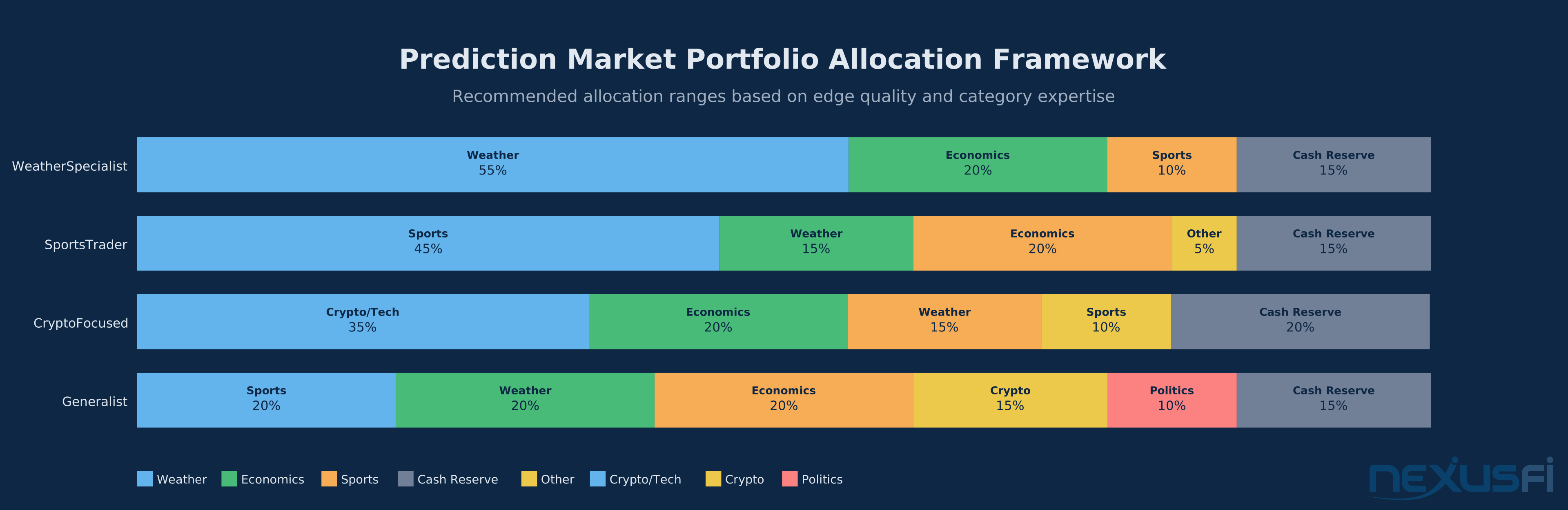
Based on your market knowledge and edge sources, you'll naturally tilt toward certain categories. Rough guidance:
For weather specialists:
- 50-60%: Weather contracts
- 20-30%: Economic data contracts (similar data-driven approach)
- 10-20%: Other categories for diversification
For sports bettors transitioning to prediction markets:
- 40-50%: Sports contracts
- 30-40%: Other data-driven categories (economics, weather)
- 10-20%: Exploratory positions in categories you're learning
For crypto/tech traders:
- 30-40%: Crypto and technology contracts
- 30-40%: Other categories (reduce correlation to overall crypto holdings)
- 20-30%: Cash reserve (higher due to crypto volatility)
The diversification principle: Even if you have strong edge in one category, never exceed 60-70% allocation to that category. Systematic edge evaporates, models go stale, and market efficiency improves
Portfolio Monitoring and Rebalancing #
Daily: Check positions approaching resolution. Assess whether you'd still enter the position at the current price. If the current price implies lower probability than your estimate, consider adding to the position. If it implies higher probability, consider reducing.
Weekly: Review all open positions for staleness. A position opened based on information 2 weeks old may no longer reflect current information.
Monthly: Assess category-level performance. Are you calibrated in each category? What's your ROI by category?
Quarterly: Assess overall model performance. Are your probability estimates well-calibrated? Review CLV data. Adjust strategy based on evidence.
Common Portfolio Mistakes #
The concentration trap: Putting 30-50% of capital on a single "high confidence" position. No matter how confident you are, binary outcomes mean even 95% probability contracts lose 5% of the time. Large concentrations can devastate your bankroll on a single adverse resolution.
Ignoring correlation: Trading multiple crypto price contracts, multiple political contracts on the same candidate, or multiple weather contracts in the same region creates hidden concentration. Map correlations before deploying.
Chasing losses: After a losing streak, increasing position sizes to recover. This amplifies variance exactly when you're most vulnerable. Maintain disciplined sizing regardless of recent results.
Fee blindness: Prediction market fees of 1-3% on winnings, plus bid-ask spread, much reduce realized edge. A 5% edge on paper may generate only 2-3% after costs. Factor fees into every position analysis.
Overtrading: Taking every position where you perceive a small edge, without regard for position quality. Focus on highest-edge opportunities; smaller, more numerous positions in thin markets generate more fees than profits.