



Position Sizing for Binary Event Contracts: Kelly Criterion and Fixed Risk Approaches
How to determine how much capital to deploy in each prediction market trade — the math, the practical adjustments, and the risk management principles that prevent single trades from causing catastrophic losses.
Overview #
Position sizing is where most prediction market traders lose money — not because their probability estimates are wrong, but because they size positions without mathematical discipline. Trading with correct probability estimates but poor position sizing produces poor outcomes: too small when your edge is large, too large when your edge is small, and catastrophic losses when a high-probability event doesn't resolve as expected.
The Kelly Criterion gives you the mathematically optimal sizing formula for known probabilities. Fractional Kelly applies it to the real world, where your probabilities are estimates, not certainties. Fixed risk gives you a workable starting framework when you're not yet tracking calibration. Each approach has its place. All three beat guessing.
The Core Problem: Binary Outcomes and Capital Preservation #
Binary event contracts have a unique risk profile:
- Each trade resolves to 100% win or 100% loss relative to your cost basis
- Multiple correlated positions can all lose simultaneously
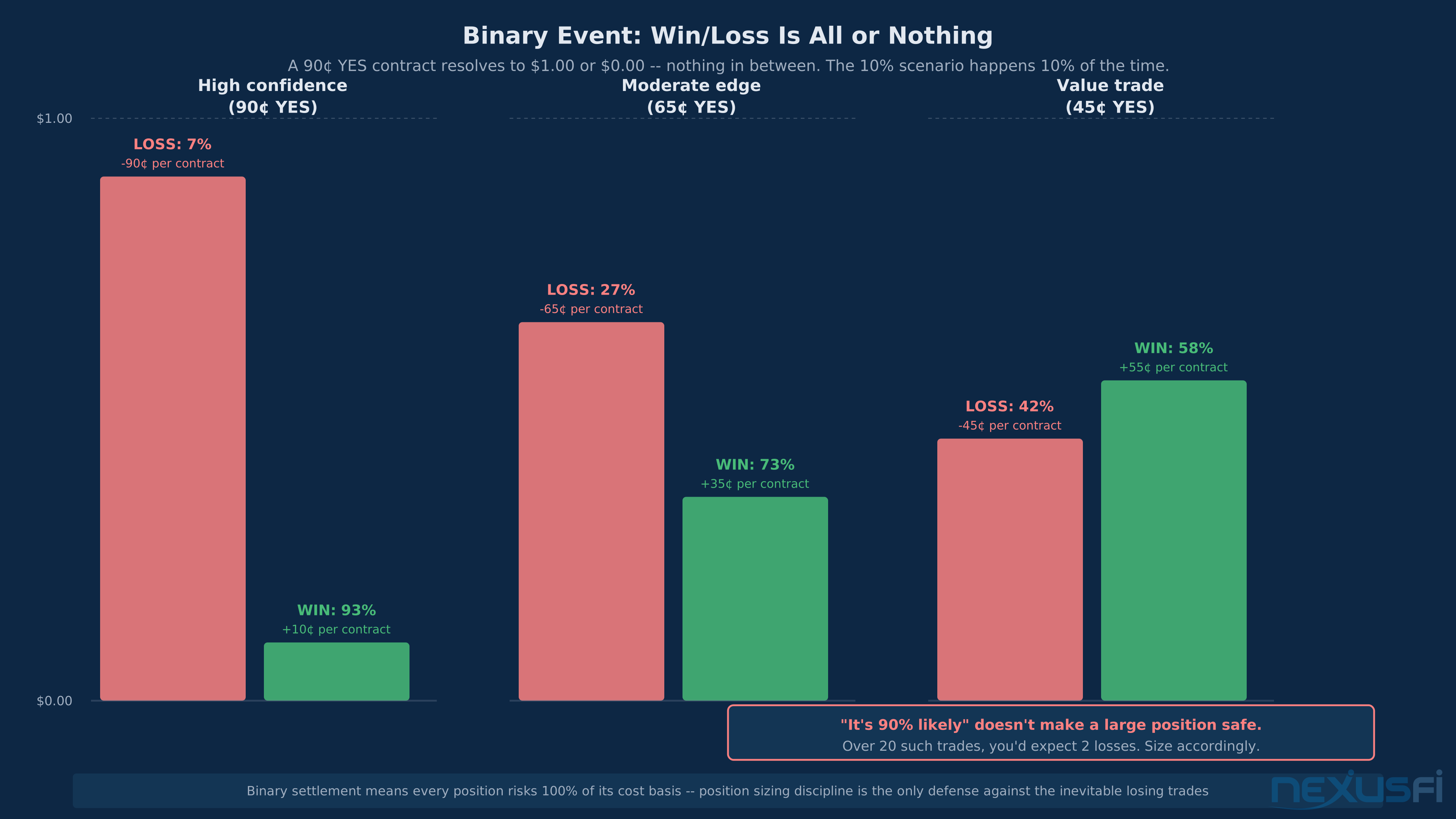
- High-probability contracts (90¢ YES) risk 90¢ per contract on the losing scenario
This binary structure makes intuitive position sizing dangerous. "It's 90% likely" does not make a large position safe — 10% outcomes occur 10% of the time.
The Kelly Criterion: Mathematical Foundation #
The Kelly Criterion answers: "What fraction of my bankroll should I bet to maximize long-run growth?"
For binary outcomes:
f* = (p × b - q) / bWhere:
f*= fraction of bankroll to betp= probability of winning (your estimate)q= 1 - p = probability of losingb= net odds received (gain per dollar risked)
Translating to Prediction Market Terms #
For a YES contract at price P_market with your implied probability estimate P_you:
p= P_youq= 1 - P_youb= (1 - P_market) / P_market (gain per dollar risked)
Example: You estimate 75% probability (p=0.75, q=0.25). Contract priced at 60¢ (P_market=0.60). Net odds = (1-0.60)/0.60 = 0.667.
f* = (0.75 × 0.667 - 0.25) / 0.667
f* = (0.500 - 0.25) / 0.667
f* = 0.250 / 0.667
f* = 37.5% of bankroll
Full Kelly says deploy 37.5% of your total bankroll in this single trade.
Thirty-seven percent. In a single trade. That's the math, and it's why most traders who run full Kelly don't survive long enough to see it work.
Why Kelly Works: Log Utility and Geometric Growth #
The Kelly Criterion isn't just an arbitrary formula — it has deep mathematical foundations that explain why it works and, critically, when it breaks.
Kelly maximizes the expected logarithm of wealth. That sounds abstract, so here's the intuition: your bankroll compounds multiplicatively, not additively. A 50% loss followed by a 50% gain doesn't get you back to even — you're at 75% of where you started. Log utility naturally accounts for this asymmetry. By maximizing expected log wealth, Kelly finds the allocation that produces the fastest geometric growth rate over many repeated bets.
Breiman's theorem formalizes this: a log-optimal strategy (Kelly) asymptotically dominates all other strategies. Given enough bets, a Kelly bettor's wealth will exceed any non-Kelly bettor's wealth with probability approaching 1. The Kelly strategy also minimizes the expected time to reach any target wealth level.
The key intuition behind the formula: f* = edge / odds. Kelly sizes your bet proportional to your edge (how much your probability estimate exceeds the implied probability) and inversely proportional to the odds (how much you stand to gain or lose). Small edge with big odds = small bet. Big edge with small odds = bigger bet. Zero edge = no bet at all. Negative edge = Kelly literally tells you not to play.
This matters for prediction market traders because it explains why full Kelly is a theoretical ceiling, not a practical target. Breiman's theorem requires that you know the true probability — and you don't. Your estimate contains error, and Kelly's growth optimality guarantee evaporates when the inputs are wrong.
Why Full Kelly Is Too Aggressive for Prediction Markets #
Full Kelly is mathematically optimal under two conditions:
- You know the exact probability (no estimation error)
- You have unlimited time (many, many bets)
In prediction markets, both conditions fail:
- Your probability estimate is uncertain. If you think 75%, the true probability might be 65% or 80%.
- You have a finite number of contracts before the event resolves.
With estimation error, the Kelly fraction above was calculated at 37.5% using an estimated probability. If the true probability is 65% (not 75%), full Kelly was overcalculated by 15 probability points. Overcalculating Kelly leads to overbetting, which produces higher variance and eventually ruins.

Fractional Kelly: The Practical Solution #
Most professional gamblers and quantitative traders use 25-50% of the full Kelly fraction. This is called "fractional Kelly."
Half-Kelly: f = f* / 2 In the example above: 37.5% / 2 = 18.75% of bankroll
Quarter-Kelly: f = f* / 4 In the example above: 37.5% / 4 = 9.375% of bankroll
Choosing Your Kelly Fraction #
| Your Calibration Track Record | Kelly Fraction to Use |
|---|---|
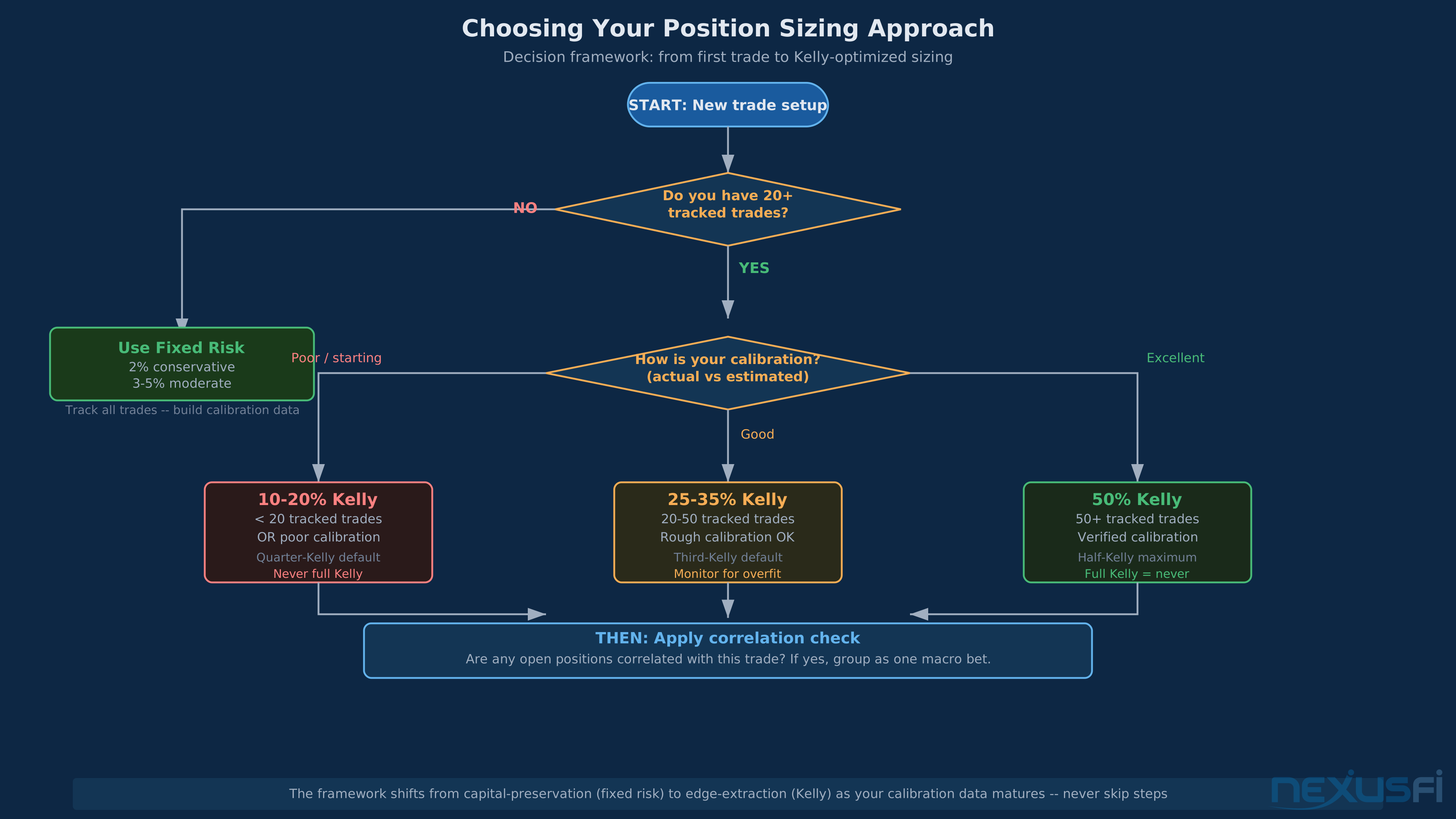
| Excellent (50+ tracked trades, calibration verified) | 50% of Kelly |
| Good (20-50 trades, rough calibration check) | 25-35% of Kelly |
| Starting out (< 20 trades) | 10-20% of Kelly |
| No tracking | 5-10% of Kelly |
When in doubt, use less. The Kelly Criterion's value is lost if overbetting causes ruin. Underbetting reduces expected growth but never causes ruin.
Rule of thumb: Start at quarter-Kelly (25% of f*) with fewer than 20 tracked trades. Step up to half-Kelly after 20-50 trades with a rough calibration check. Only use 50%+ of Kelly once you have 50+ resolved trades with verified accuracy. When uncertain, go smaller — underbetting costs growth, overbetting causes ruin.

Fixed Risk Approach: The Alternative Framework #
For traders who don't want to calculate Kelly on every trade, fixed risk percentage provides a simpler alternative:
Rule: Risk no more than X% of your prediction market bankroll on any single trade.
Typical fixed risk percentages:
- Conservative: 1-2% per trade
- Moderate: 2-5% per trade
- Aggressive: 5-10% per trade
"Risking X%" means: If the trade resolves against you (you lose your cost basis), your bankroll decreases by X%.
Example with 2% fixed risk:
- Bankroll: $10,000
- Maximum risk per trade: $200 (2% of $10,000)
- YES contract priced at 65¢
- Maximum contracts: $200 / $0.65 = 307 contracts
Note: For NO contracts at 35¢, the same 2% risk allows $200 / $0.35 = 571 contracts. Higher contracts but same dollar risk.
The principle maps directly: smaller-priced contracts let the same 2% risk buy more contracts, but the dollar risk is identical.
Why Fixed Risk Falls Short (And Why You Should Start There Anyway) #
Fixed risk has real advantages: simple to implement, no probability estimation required for sizing, and hard protection against catastrophic single-trade losses. You size first, evaluate second. That discipline alone makes it valuable when you haven't built calibration data yet.
The limitations are real. Fixed risk ignores edge magnitude completely — a 5-point edge and a 20-point edge get identical allocations. Suboptimal for growth. A large edge deserves more capital. And it doesn't account for portfolio correlation at all.
Fixed risk is a starting point, not the destination. As you develop calibration data and confidence in your probability estimates, moving toward fractional Kelly generates better long-run results.

Common Mistakes in Kelly-Based Position Sizing #
The Kelly formula is deceptively simple. These are the errors that destroy accounts:
Mistake 1: Overestimating Your Edge #
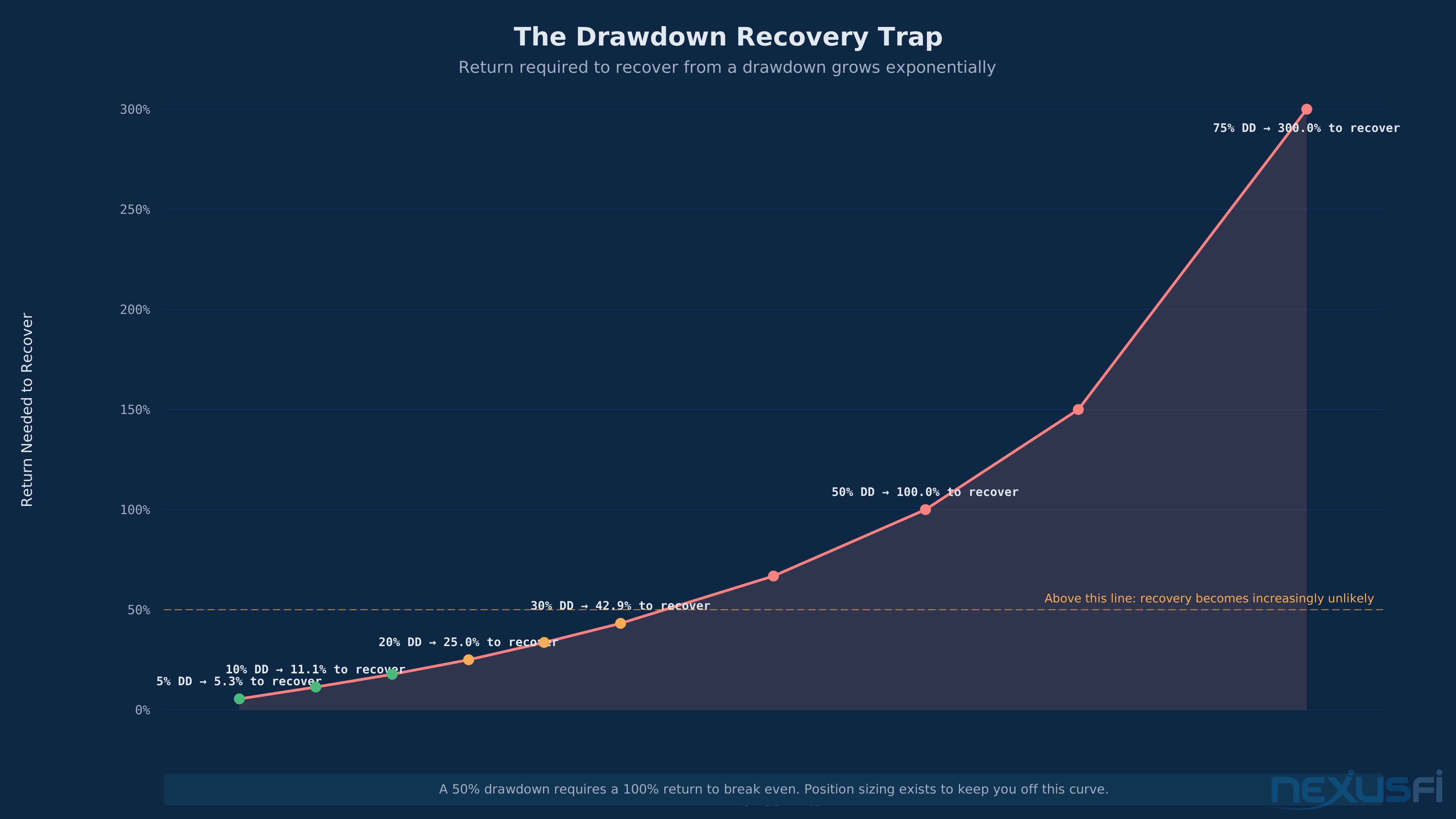
This is the single most dangerous Kelly mistake. The formula is brutally sensitive to probability inputs. If you estimate 70% and the true probability is 60%, your Kelly fraction is roughly double what it should be.
Here's a concrete example. A contract is priced at 50¢ (implied 50%). Three different probability estimates produce dramatically different Kelly fractions:
| Your Estimate | True Edge | Kelly Fraction | Effect |
|---|---|---|---|
| 55% | 5 points | 10% of bankroll | Reasonable |
| 60% | 10 points | 20% of bankroll | Aggressive |
| 70% | 20 points | 40% of bankroll | Dangerous |
Moving from a 5-point edge to a 20-point edge quadruples the Kelly bet. If that 70% estimate is really 55%, you're betting 4x what you should. The research consistently shows that traders overestimate their probability accuracy — a form of overconfidence bias that causes systematic overbetting when using Kelly — the same behavioral biases unique to prediction market trading (anchoring on recent resolution history, illusion of knowledge from following the news) that distort probability estimates across every other trade decision.
The fix: Track your calibration rigorously. Until you have 50+ resolved trades with verified calibration, use quarter-Kelly at most.
In prediction markets, your edge on any contract type can evaporate when market participants become more sophisticated or when conditions change. Kelly calculated on an edge that no longer exists doesn't just produce suboptimal results — it produces systematic losses on the same bet sizing that was previously correct.
Mistake 2: Computing Kelly on Gross Returns #
Kelly must be calculated on net returns — after exchange fees, slippage, and any other friction. A 5-point edge with 2 points of friction is a 3-point edge. Calculating Kelly on the gross 5-point edge produces a position 67% too large.
In prediction markets specifically, watch for:
- Platform fees (Kalshi charges fees on wins, Polymarket has gas costs)
- Spread costs when entering or exiting positions
- Liquidity-dependent slippage on larger orders
Mistake 3: Betting Beyond the Kelly Fraction #
This is called "super-Kelly" and it's mathematically guaranteed to produce worse long-run results than Kelly itself. Betting more than Kelly doesn't just increase risk — it actually reduces expected geometric growth. The growth curve peaks at the Kelly fraction and declines beyond it.
Think of it this way: at 2x Kelly, your expected growth is the same as at zero Kelly (flat). Beyond 2x Kelly, you're actively destroying wealth on average.
Mistake 4: Ignoring Correlation Between Positions #
Covered in the Correlation section below, but worth flagging here: if you apply Kelly independently to five correlated positions, your total exposure could be 5x what a portfolio-level Kelly calculation would recommend. Correlation doesn't just add risk — it multiplies it.

Special Cases in Prediction Market Sizing #
Near-Certainty Contracts (>90% or <10%) #
High-probability contracts create a sizing paradox: small probability of large loss.
For a 95¢ YES contract:
- You're paying 95¢ to potentially gain 5¢ (5.3% return)
- To risk only 2% of a $10,000 bankroll ($200), you buy $200/$0.95 = 210 contracts
- If it resolves NO (5% chance), you lose $200 — exactly your 2% risk target
This is sized correctly if you truly believe 95%+ probability. The 5% scenario losing $200 is just the expected outcome of a 95%-probability bet.
The mistake is using fixed risk AND thinking "this is basically certain" to justify oversizing. 95% isn't 99%. Over 20 such bets, you'd expect one to resolve against you statistically.
Contracts Near Expiration #
Contracts 1-2 days from resolution have very limited time for mean reversion. If a contract is at 90¢ and resolves in 36 hours, you're basically betting 10¢ against 90¢ on a near-resolved outcome.
Treat these as higher-uncertainty regardless of price: the resolution is nearly determined but market makers may have reduced liquidity, and any remaining uncertainty is acute.
Illiquid Markets and Thin Order Books #
Position sizing in illiquid prediction markets requires additional constraints beyond Kelly and fixed risk:
Slippage amplification: In a market with a thin order book, your order itself moves the price. If you want to buy 1,000 YES contracts at 45¢ but only 200 are available at that price, the remaining 800 might fill at 47¢, 50¢, or worse. Your effective entry price is higher than your target, reducing your edge and invalidating the Kelly calculation you made at 45¢.
Practical rule: Never size a position larger than 10-20% of the visible order book depth at your target price. If Kelly says deploy $2,000 but only $500 of liquidity sits near your target price, cap at $500 and accept the reduced position.
Exit risk: Illiquidity cuts both ways. Even if the trade moves in your favor, you may not be able to exit at favorable prices. In prediction markets, holding to expiration eliminates this concern (binary settlement at $1 or $0), but if you need to cut a position early, illiquidity can turn a small loss into a large one.
Calibration uncertainty amplification: Illiquid markets often have wider bid-ask spreads because fewer participants are competing on price. Wider spreads mean less price discovery, which means the market-implied probability is less reliable as an anchor for your own estimates. When market prices are less informative, your estimation error is likely larger — use smaller Kelly fractions.
Multi-Leg Positions and Structured Trades #
Some traders construct positions across multiple related contracts — this is common in prediction markets with correlated event outcomes:
Example: You believe the Fed will cut rates in September but the market is underpricing this. You might:
- Buy "Fed cuts by September" YES at 40¢
- Buy "Fed cuts by December" YES at 65¢ (hedging the timing risk)
Sizing rule for multi-leg trades: Calculate your total capital at risk if ALL legs lose simultaneously, and ensure that total doesn't exceed your per-trade risk limit. Don't make the mistake of sizing each leg independently — if the Fed doesn't cut at all, both positions lose.
For opposing legs (one long, one short on related contracts), calculate your net exposure: the maximum loss across all scenarios. Size to that net exposure, not to each leg's gross risk.
Portfolio-level Kelly: When running multiple positions simultaneously, the mathematically correct approach is to solve the multi-asset Kelly optimization — maximizing expected log wealth across all positions jointly, including their correlations. In practice, most traders approximate this by:
- Treating correlated groups as single positions for sizing
- Applying an overall portfolio heat limit (total risk across all open positions capped at 15-25% of bankroll)
- Reducing individual Kelly fractions as the number of open positions grows
Tracking and Improving Your Sizing Decisions #
Position sizing improves when you track systematically. The data doesn't need to be complex, but it needs to be consistent. The trading journal framework applies directly — prediction market tracking just adds probability estimate and calibration columns to the standard setup. Here's the concrete framework for prediction markets.
The Position Sizing Trade Log #
Maintain a log for every prediction market trade. The minimum fields:
| Date | Contract | Entry Price | Your P(est) | Kelly f* | Actual f | $ Risked | Outcome | P&L |
|---|---|---|---|---|---|---|---|---|
| 6/1 | Fed Sept YES | 0.45 | 0.60 | 27.2% | 6.8% | $340 | Win | +$399 |
| 6/3 | CPI >3% Jun YES | 0.70 | 0.80 | 14.3% | 3.6% | $178 | Loss | -$178 |
| 6/5 | BTC >75k Jul YES | 0.55 | 0.62 | 12.7% | 3.2% | $158 | Win | +$129 |
The columns that matter most for improvement: Your P(est) and Outcome. After enough trades, you can check calibration: of all the trades where you estimated 60%, did roughly 60% resolve in your favor?
Worked Retrospective Analysis Example #
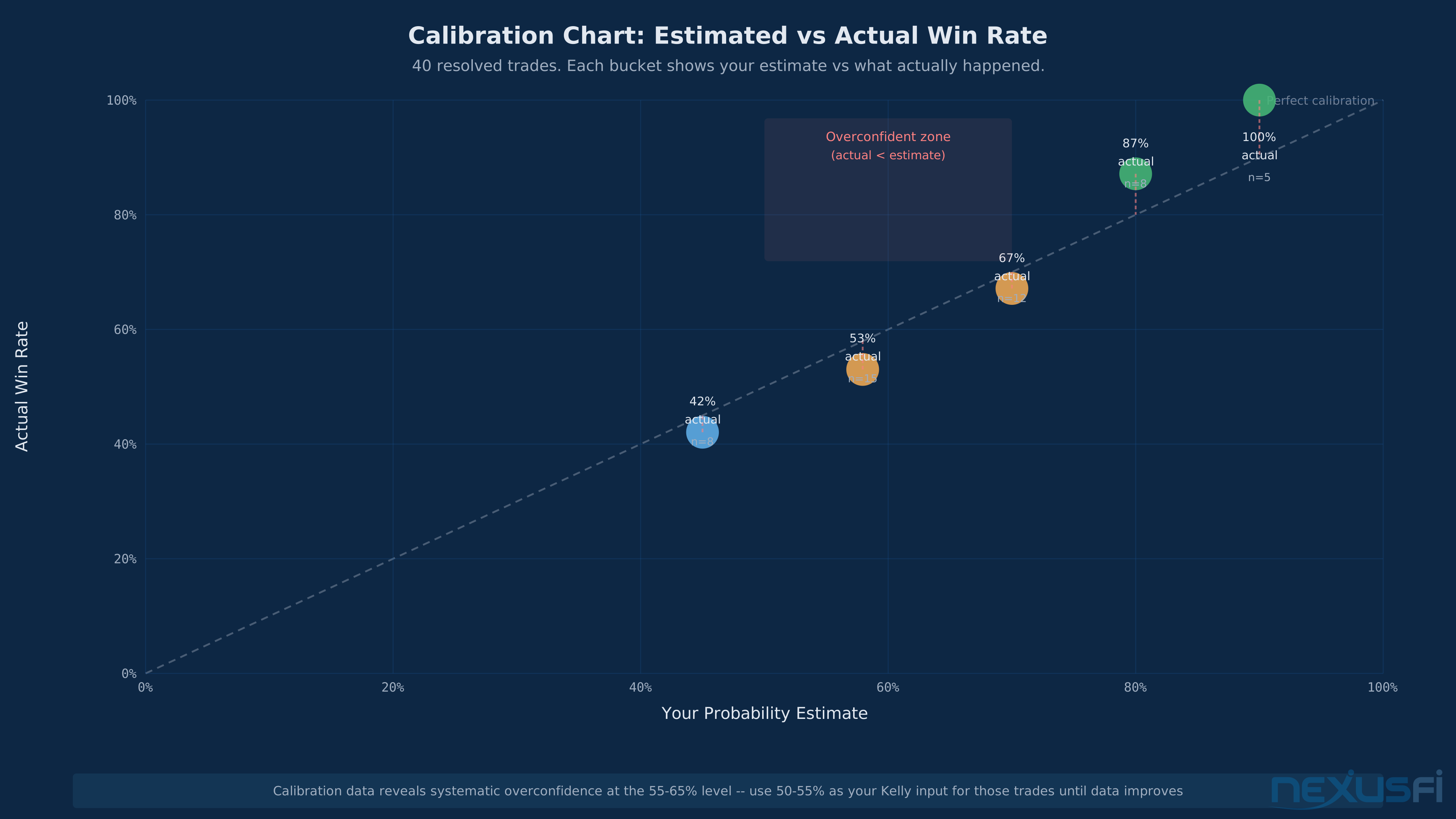
Suppose after 40 resolved trades, you review your log and find:
| Your Estimate Bucket | Trades | Wins | Actual Win Rate | Calibration Gap |
|---|---|---|---|---|
| 55-65% | 15 | 8 | 53.3% | Overestimating by ~5 pts |
| 65-75% | 12 | 8 | 66.7% | Roughly calibrated |
| 75-85% | 8 | 7 | 87.5% | Underestimating by ~5 pts |
| 85-95% | 5 | 5 | 100% | Sample too small to judge |
This tells you something actionable: you're slightly overconfident in the 55-65% range and slightly underconfident in the 75-85% range. For trades where you estimate 55-65%, your Kelly fraction should use 50-60% (the actual rate) instead of your estimate. This single adjustment could prevent systematic overbetting in your most common trade setup.
Key Metrics to Track Over Time #
ROI by edge bucket: Break trades into edge categories (small edge 5-10%, medium 10-20%, large 20%+). Are high-edge trades actually producing higher ROI? If not, your edge estimates are unreliable and you should reduce your Kelly fraction.
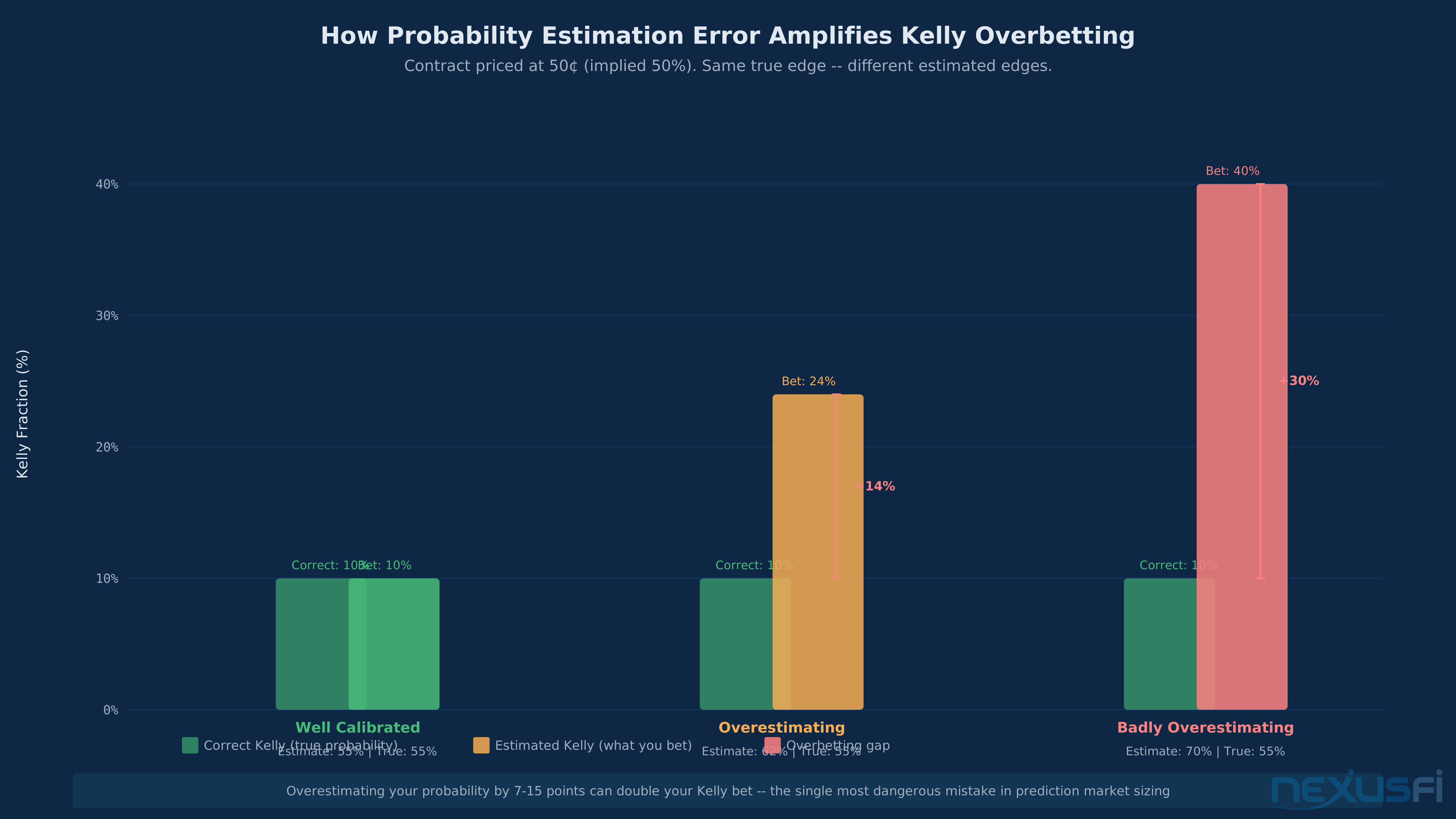
Maximum drawdown sequence: What's the longest consecutive string of losers in your log? Simulate that sequence against your current sizing. Does your bankroll survive? If five consecutive losses at your average position size would draw down more than 30%, you're sizing too aggressively.
Overbetting frequency: After each trade resolves, calculate what the "correct" Kelly fraction would have been using the actual outcome probability (revealed post-resolution). Compare it to what you actually bet. If you're consistently betting more than the correct fraction, your edge estimates are too optimistic. This is the earliest warning signal of sizing problems.
Emotional sizing drift: Flag trades where you deviated from your calculated size.
Working backwards from your defined ruin point to position sizing is the right direction. Define what's unacceptable first — then size to make reaching that outcome a statistical rarity rather than a real possibility.
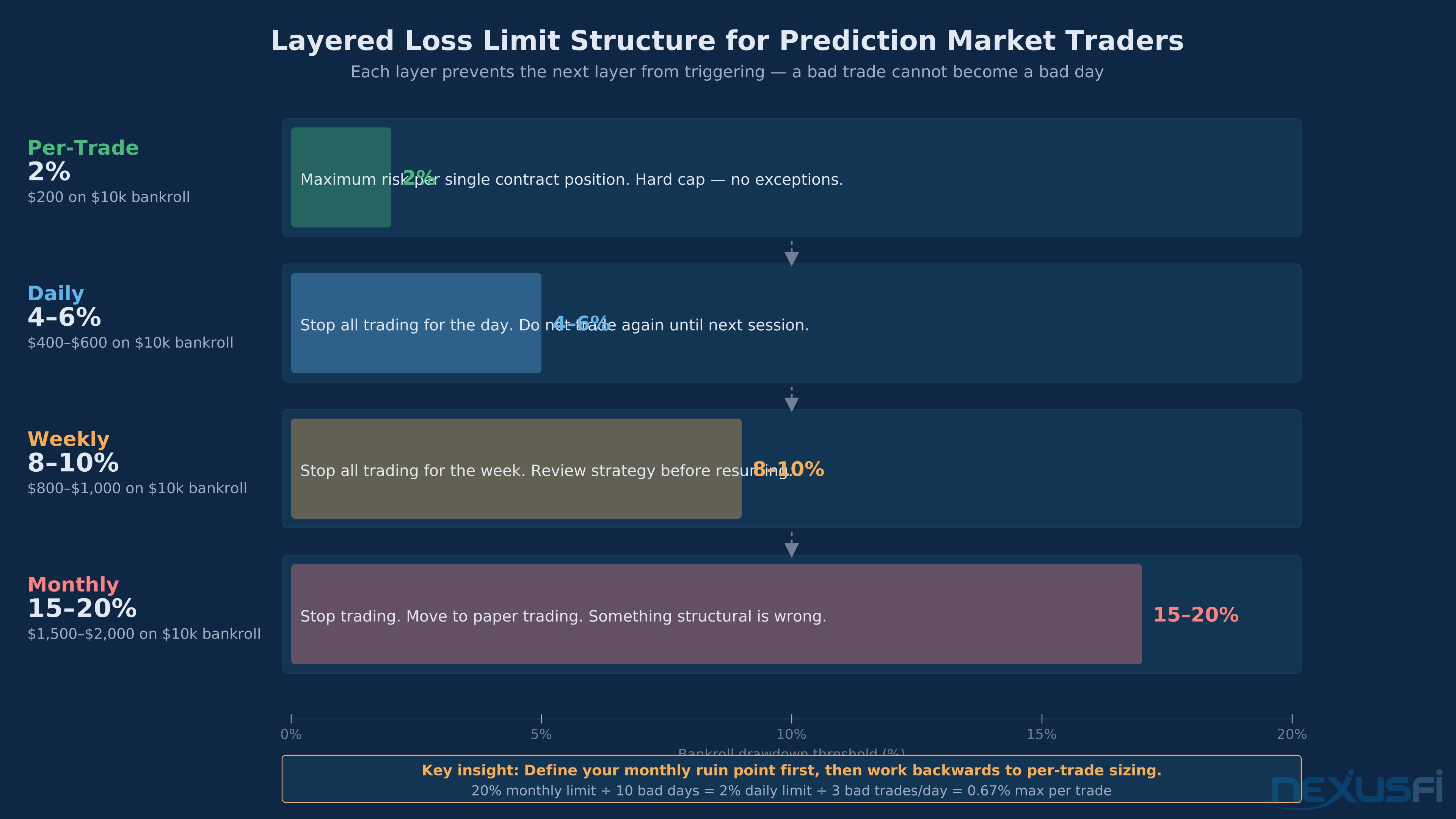
Did you bet more because "it felt like a sure thing"? Did you bet less because you were nervous after a losing streak? Emotional overrides to disciplined sizing are the most common cause of long-run underperformance.
A Complete Position Sizing Example #
Your bankroll: $5,000 dedicated to prediction market trading
Trade opportunity: "Fed cuts rates in September" YES contract at 45¢ Your estimate: 60% probability Calibration: 30 trades tracked, roughly calibrated, use 25% Kelly
Kelly calculation:
- p = 0.60, q = 0.40
- b = (1 - 0.45) / 0.45 = 0.55 / 0.45 = 1.222
- f* = (0.60 × 1.222 - 0.40) / 1.222 = (0.733 - 0.40) / 1.222 = 0.272
- 25% of Kelly = 0.25 × 0.272 = 6.8% of bankroll
Dollar size: 6.8% × $5,000 = $340 Contract count: $340 / $0.45 = 755 contracts
Maximum loss: $340 (if resolves NO) Maximum gain: 755 × ($1.00 - $0.45) - fees = $415 - $16 = $399
Correlated check: No other open Fed rate positions. Treat as independent. Execute: Buy 755 YES contracts at 45¢.
Final parameters: 6.8% of bankroll ($340 risked) — 755 contracts at 45¢. Max loss $340, max gain ~$399 after fees. No correlated positions open. Workflow: probability estimate (60%) → full Kelly (27.2%) → fraction applied (25%) → dollar size ($340) → contract count (755) → correlation check (clear) → execute. Every sizing decision follows this same sequence.
Citations #
- @Fat Tails: Risk of Ruin — NexusFi community discussion on Kelly formula and optimal bet sizing with practical implementations
- @Fi: CME Group Event Contracts Blast Past 100 Million Traded — Institutional participation context for position sizing discipline
- @Fi: Kalshi Hits $1 Billion in Super Bowl Trading Volume — Market scale and liquidity context
- @Fi: CFTC Withdraws Prediction Market Ban, Signals New Rulemaking — Regulatory context for US prediction market participation
- Kelly Criterion — Wikipedia — Mathematical foundation and Breiman theorem reference
- The Kelly Criterion in Blackjack, Sports Betting, and the Stock Market — Edward O. Thorp (2006) — Seminal paper on practical Kelly application
- @tigertrader: Killer Instinct and the Home Run Mentality — Fixed fractional position sizing and risk-per-trade calculation; scaling into positions while keeping risk lowest early in the trade
- @jamiej83: Concerning Risk Per Trade Sizing — Defining ruin point first, working backwards to daily/weekly/monthly loss limits; position sizing as the variable that determines whether any system reaches its objectives
- @tpredictor: Maximum Risk Percentage — Edge persistence and serial correlation risk; why working edges warrant risk limits below 2% and the case for splitting risk across uncorrelated instruments
- Kalshi Position Limits and Accountability Rules — CFTC Filing — KalshiEX Rulebook v1.14 Rules 5.16-5.17: position accountability levels and position limits for prediction market participants
Knowledge Map
Go Deeper
Build on this knowledgeReferences This Article
Articles that build on this topicCitations
- — Risk of Ruin (2012) 👍 30“Kelly formula sizing discussion with practical application to futures trading”
- — CME Group Event Contracts Blast Past 100 Million Traded (2025)“Institutional participation context for position sizing discipline”
- — Kalshi Hits $1 Billion in Super Bowl Trading Volume (2025)“Market scale and liquidity context”
- — CFTC Withdraws Prediction Market Ban, Signals New Rulemaking (2025)“Regulatory context for US prediction market participation”
- — Kelly Criterion -- Wikipedia
- — Kalshi Help Center: Position Limits
- — Prediction Market Position Sizing -- Market Math
- — Polymarket Position Sizing With Fee-Adjusted Kelly
- — Advanced Kelly Criterion: Fractional Kelly & Multi-Market Applications -- Prevayo